Struggling to find quality marine panels in Asia? Navigating supplier certificates can feel overwhelming. I will show you how to use class approvals to find reliable, cost-effective partners quickly.
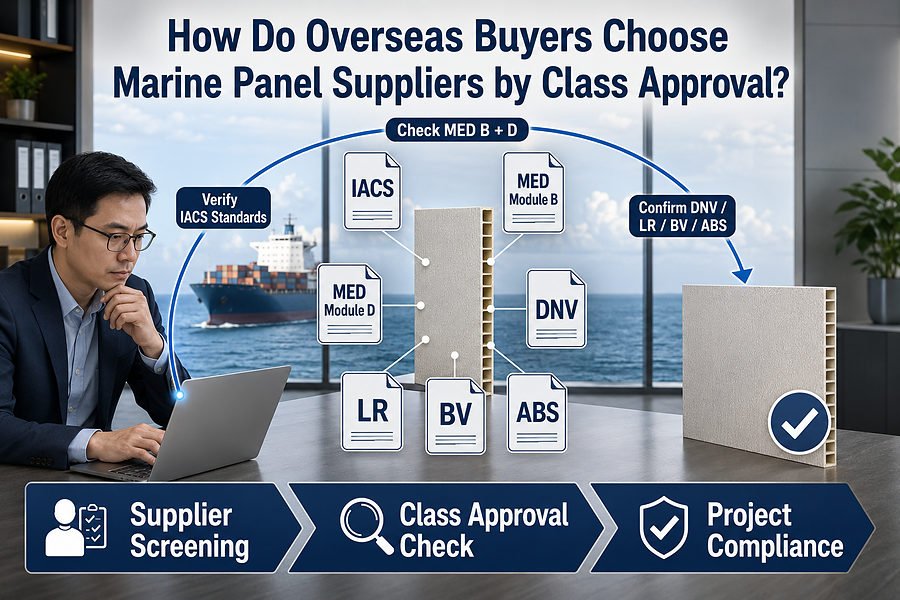
Overseas buyers choose marine panel suppliers by verifying their compliance with International Association of Classification Societies (IACS) standards. They prioritize suppliers holding Marine Equipment Directive (MED) Modules B and D, and specific class certificates like DNV, LR, BV, or ABS, ensuring panels meet exact project safety and legal requirements.
Let us dive into the details. My years at Magellan Marine have taught me that certificates are more than just paper; they are your best tool for managing quality and risk across borders without needing to visit the factory every week.
Which Class Approvals Should Procurement Prioritize When Shortlisting Marine Panel Suppliers?
Wasting time on suppliers who cannot deliver compliant panels? Without the right paperwork, your project stops. You must prioritize three specific types of class approvals to protect your timeline.
Procurement must prioritize three main approvals: International Association of Classification Societies (IACS) member certificates for vessel specific rules, Marine Equipment Directive (MED) wheelmark certificates for European flagged ships, and United States Coast Guard (USCG) type approvals for vessels operating in United States waters.
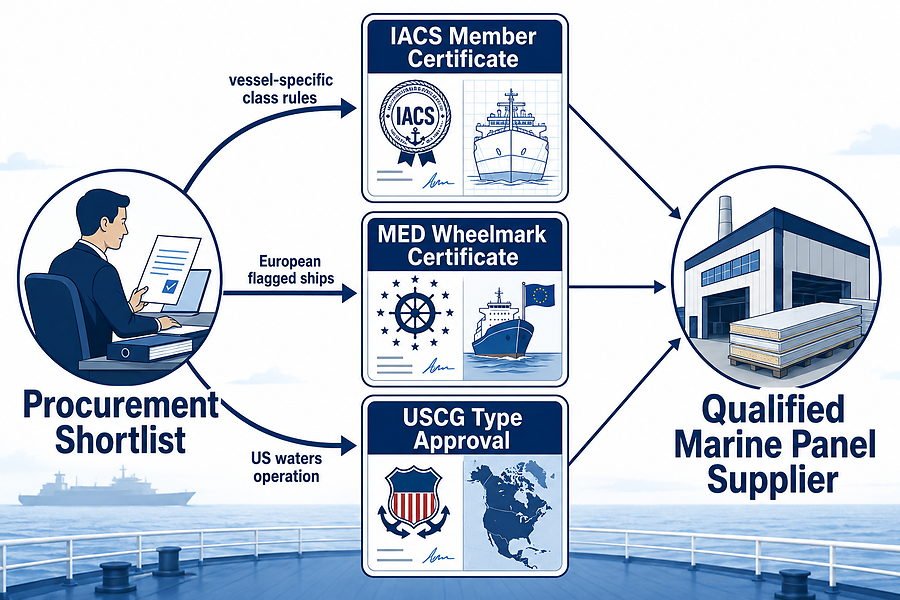
Prioritizing IACS Member Certificates for Marine Panels
When I first started sourcing marine outfitting products in Asia, I learned very fast that not all certificates carry the same weight. You must first look for IACS member certificates. IACS includes major societies like DNV, American Bureau of Shipping (ABS), and Lloyd's Register (LR).1 If a factory holds a DNV type approval for their marine wall panels, it means their product design complies with the specific structural and safety rules of that classification society. Shipyards require these documents before they even look at your price quotation. A standard 50mm rock wool wall panel with an ABS certificate typically costs between $20 to $28 per square meter. Without this certificate, the panel is useless for an ABS-classed commercial vessel, no matter how cheap it is.
Essential MED and USCG Approvals for Regional Compliance
Next, you must prioritize the Marine Equipment Directive (MED) and United States Coast Guard (USCG) approvals. The MED certificate, often called the "Wheelmark," is mandatory for any equipment installed on ships flagged in European Union countries2. It is divided into Module B (Type Examination) and Module D (Production Quality Assurance). A supplier must have both. If your project sails to Europe, an MED-approved panel is non-negotiable. Furthermore, thanks to the Mutual Recognition Agreement (MRA) between the EU and the USA3, an MED certificate can often help secure USCG approval, which is strictly required for ships entering US waters. If a port state control inspector boards your ship and finds panels without MED or USCG marks, they can detain the vessel4. Vessel delays cost shipowners roughly $10,000 to $20,000 per day in port fees. Therefore, buying a certified panel for $25 per square meter is a cheap insurance policy compared to a massive port detention fine.
| Approval Type | Primary Region/Application | Key Documentation Required | Estimated Cost Impact on Panel |
|---|---|---|---|
| IACS (DNV, ABS, LR) | Global commercial vessels | Product Type Approval | Base Price ($20 - $28 / sqm) |
| MED (Wheelmark) | European flagged vessels | Module B and Module D | +$2 to +$5 / sqm |
| USCG | United States waters | USCG Type Approval Certificate | Included if MRA applies |
How Do Engineers Match Class Approvals to Marine Panel Projects?
Worried your marine panels will fail port state control inspections? Guessing on specifications risks severe penalties. Engineers use strict fire ratings and acoustic standards to match approvals exactly.
Engineers match approvals to projects by aligning the ship's fire control plan with the panel's certified SOLAS fire ratings (A-60, A-30, A-15, A-0, B-15, B-0) and verifying the acoustic reduction values (typically 35dB to 45dB) against the vessel's specific noise level requirements.
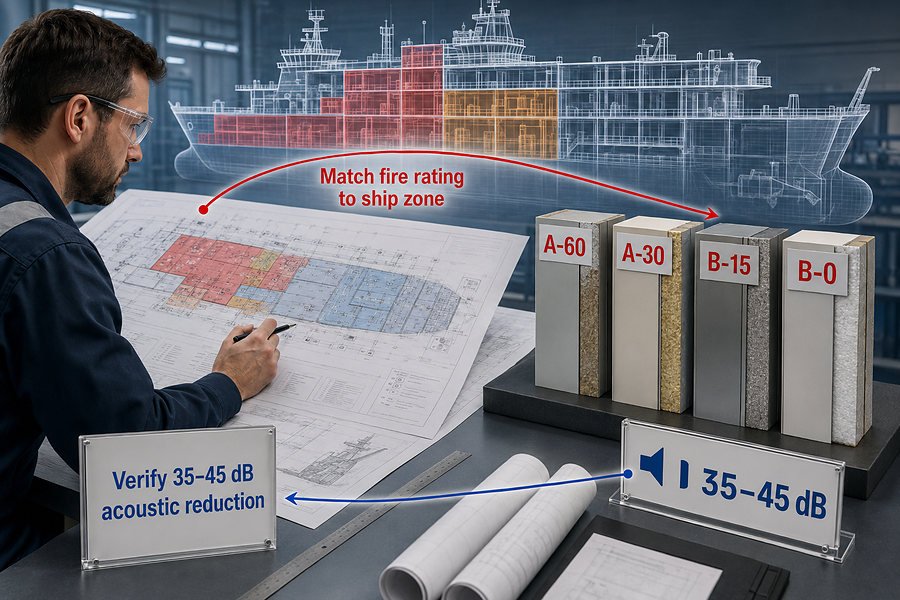
Matching SOLAS Fire Ratings to Ship Layouts
I always tell buyers that engineering is about matching numbers to reality. Engineers first look at the vessel's fire control plan. This plan shows exactly where different fire boundaries are located. According to the Safety of Life at Sea (SOLAS) convention and the IMO Fire Test Procedures (FTP) Code, engineers must choose panels from six specific fire ratings: A-60, A-30, A-15, A-0, B-15, and B-05. For example, the engine room is a high-risk area. The bulkhead separating the engine room from the living quarters must be an A-60 class panel.6 This means the panel must block smoke and flame for 60 minutes, and the unexposed side cannot exceed an average temperature rise of 140°C7. If an engineer is working on cabin partitions, they will select B-15 panels, which must maintain integrity for 30 minutes and limit temperature rise for 15 minutes. An A-60 panel might cost $45 per square meter, while a B-15 panel might cost $22 per square meter. The class approval certificate will clearly state which rating the panel passed.
Verifying Acoustic Reduction Values for Crew Comfort
Fire safety is just the first step. Engineers must also verify the acoustic reduction values listed in the class approvals. The International Maritime Organization (IMO) introduced strict noise limits under resolution MSC.337(91). For sleeping cabins, the background noise must not exceed 60 decibels (dB).8 Because ship engines are incredibly loud, the marine wall panels must absorb a lot of sound. Engineers will check the supplier's laboratory test reports to find the panel's Sound Transmission Class (STC) rating. Standard marine panels usually offer a sound reduction between 35dB and 45dB. If the engine room generates 100dB of noise, a 45dB reduction panel drops the noise to 55dB in the adjacent cabin, successfully meeting the IMO requirement. If the engineer selects a cheaper panel with only a 30dB reduction, the ship fails the noise inspection, and the contractor must tear down the walls and rebuild them.
| Fire Rating | Required Integrity Time | Required Insulation Time | Typical Application Area |
|---|---|---|---|
| A-60 | 60 Minutes | 60 Minutes | Engine rooms, galleys |
| A-30 | 60 Minutes | 30 Minutes | High-risk storage areas |
| A-15 | 60 Minutes | 15 Minutes | Auxiliary machinery spaces |
| A-0 | 60 Minutes | 0 Minutes | Corridors with low fire load |
| B-15 | 30 Minutes | 15 Minutes | Standard cabin partitions |
| B-0 | 30 Minutes | 0 Minutes | Small internal closets |
Why Do Compliance Reviewers Favor Multi-Class-Approved Marine Panel Suppliers?
Tired of sourcing different panels for different ships? Managing single-class suppliers creates endless paperwork. Compliance reviewers favor multi-class-approved suppliers because they eliminate this headache completely.
Compliance reviewers favor multi-class-approved suppliers because they offer universal regulatory acceptance, reduce administrative auditing time by up to forty percent, and guarantee consistent manufacturing quality control across diverse fleets, ultimately preventing costly delays during final vessel commissioning and port state inspections.
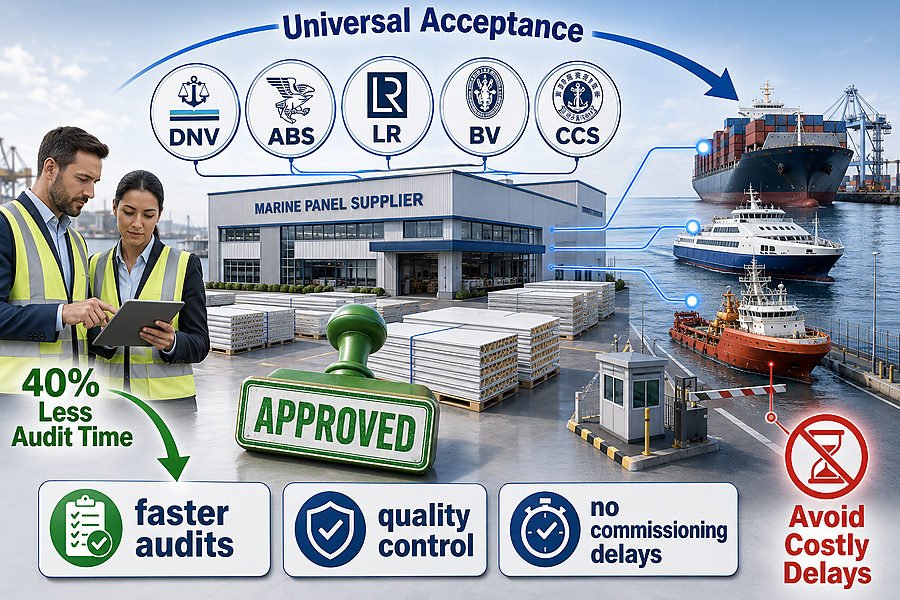
Universal Regulatory Acceptance for Global Fleets
In my work coordinating ship interior decorations, dealing with compliance reviewers can be difficult. They are strict because their jobs depend on it. Reviewers strongly prefer multi-class-approved suppliers due to universal regulatory acceptance. A large shipyard might be building three ships at once: one classed by DNV, one by ABS, and one by BV. If you use a single-class supplier, you can only use their panels on one ship. You then have to find and vet two more suppliers for the other ships. A multi-class-approved factory holds DNV, ABS, and BV certificates simultaneously. This means the reviewer can approve the same panel model for all three ships. This universal acceptance cuts the procurement timeline drastically and allows the buyer to order in bulk, often reducing the unit price by 5% to 8%9 due to larger production runs.
Reducing Administrative Auditing Time and Guaranteeing Quality Control
Additionally, using a multi-class supplier reduces administrative auditing time by up to forty percent and guarantees consistent manufacturing quality control. Every time a reviewer accepts a new supplier, they must read through hundreds of pages of test reports, factory audits, and ISO 9001 quality manuals. By using one supplier with multiple approvals, the reviewer only performs this heavy administrative check once. Furthermore, a supplier that holds multiple top-tier approvals operates under the most rigorous quality control systems. To maintain MED Module D10, for example, the factory undergoes severe annual audits by independent surveyors. They inspect everything from the density of the rock wool (usually between 120kg/m³ and 150kg/m³) to the thickness of the PVC steel plate (typically 0.6mm). Reviewers know that these factories do not cut corners, which prevents the nightmare scenario: failing a port state inspection right before the ship is delivered.
| Supplier Profile | Administrative Audit Time | Global Fleet Interoperability | Bulk Purchasing Discount Potential |
|---|---|---|---|
| Single-Class Supplier | High (Requires new audits per class) | Limited to one specific class | Low (Smaller order volumes) |
| Multi-Class Supplier | Low (Reduced by ~40%) | Universal across major IACS | High (5% to 8% cost reduction) |
What Signals a Strong Class Approval Portfolio in a Marine Panel Supplier?
Afraid a supplier's certificates might be fake or outdated? Choosing the wrong factory costs you money and reputation. A strong portfolio has four clear signals you must check.
A strong class approval portfolio features four key signals: continuous validity with no expired certificates, inclusion of both structural and surface material fire test reports, possession of MED Module D factory quality assurance, and recent type approvals from at least three top-tier IACS members.
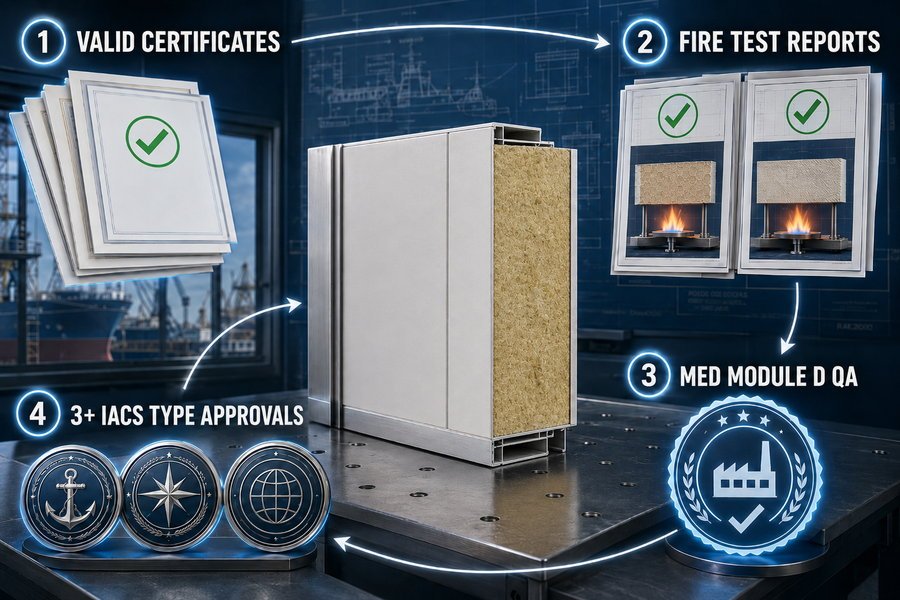
Verifying Continuous Certificate Validity and Material Test Reports
I have seen many buyers fall into a common trap in Asia: trusting a certificate without reading the fine print. The first signal of a strong portfolio is continuous validity. Marine type approval certificates usually operate on a 5-year cycle. A strong supplier has active certificates that do not expire in the next few months. If a certificate expires during your ship's construction, you cannot use those panels. The second signal is the inclusion of both structural and surface material fire test reports. According to the IMO FTP Code, a panel must pass Part 3 for structural fire resistance (proving it stops fire) and Part 5 for surface flammability11 (proving the PVC decorative layer will not spread flames or release toxic smoke). Some cheap factories only test the surface and try to pass it off as a complete panel approval. Always check the portfolio to ensure both Part 3 and Part 5 test reports are present and valid.
Checking MED Module D and Top-Tier IACS Type Approvals
The third signal is possession of an MED Module D factory quality assurance certificate. Module B only proves that the prototype panel passed the lab test. Module D proves that the factory has the quality control system to produce ten thousand panels that are identical to the prototype. Without Module D, the factory cannot legally stamp the Wheelmark on their products. The fourth and final signal is having type approvals from at least three top-tier IACS members, such as DNV, ABS, and LR. Earning just one certificate is hard, but earning three requires a massive financial and technical investment from the factory. Testing a single A-60 panel at an authorized lab can cost over $15,000.12 A supplier with a broad portfolio has invested heavily in their business, proving they are a stable, long-term partner capable of handling strict marine interior decoration projects.
| Key Signal | What to Check on the Certificate | Why It Matters |
|---|---|---|
| Continuous Validity | Expiry date must be valid past delivery | Prevents compliance failure during construction |
| Complete Test Reports | IMO FTP Code Part 3 and Part 5 | Ensures both core and surface are safe |
| MED Module D | Valid Quality Assurance document | Proves factory mass-produces safely |
| Top-Tier IACS | DNV, ABS, LR logos present | Demonstrates heavy technical investment |
How Does a Single-Class Marine Panel Supplier Compare to a Multi-Class One?
Debating between a cheaper local factory and a larger supplier? A single-class factory might look cheap now but cost you later. Let us compare them across three core areas.
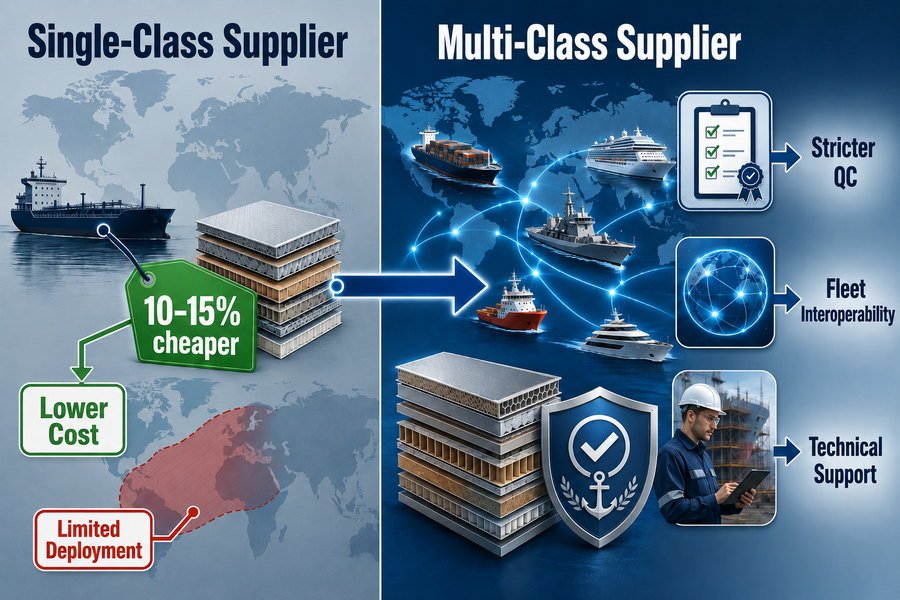
A single-class supplier is compared to a multi-class one across three core areas: single-class suppliers offer panels ten to fifteen percent cheaper but limit vessel deployment, whereas multi-class suppliers ensure global fleet interoperability, maintain stricter factory quality control, and provide comprehensive technical support for complex shipyard installations.
Comparing Initial Costs and Vessel Deployment Limits
When procurement officers hunt for bargains in developing countries like China or Vietnam, they often find factories that hold only one local class certificate, like CCS (China Classification Society) or VR (Vietnam Register). Let us look at the first core area: price and deployment. Single-class suppliers typically offer panels ten to fifteen percent cheaper13 than major brands. If a standard multi-class B-15 wall panel costs $25 per square meter, the single-class factory might sell it for $21.50. This looks great on a spreadsheet. However, the limit on vessel deployment is severe. You cannot install a panel with only a VR certificate on a ship registered in Norway.14 On the other hand, multi-class suppliers ensure global fleet interoperability. You pay a slight premium, but you gain the freedom to use those materials on almost any commercial vessel in the world, which is crucial when your interior decoration company is taking contracts from large shipyards in Europe.
Assessing Quality Control and Technical Support Capabilities
The second area is factory quality control. A single-class factory usually relies on basic local standards. Multi-class suppliers are audited by multiple international bodies every year, forcing them to maintain stricter quality control. They measure their steel tolerances precisely and use automated glue pressing lines to prevent the panel surfaces from peeling in humid sea air. The third area is technical support. Installing marine wall panels, ceiling panels, and fire doors is complicated. Multi-class suppliers provide comprehensive technical support. When I work with top-tier suppliers, they do not just send a box of panels. They provide detailed AutoCAD installation drawings, joint profiles, and specific instructions on how to seal the panel edges to maintain the A-60 fire rating15. A cheaper, single-class supplier rarely has English-speaking engineers on staff, leaving you to figure out the installation problems on your own, which wastes expensive shipyard labor hours.
| Feature Area | Single-Class Supplier | Multi-Class Supplier |
|---|---|---|
| Pricing | 10% to 15% cheaper | Standard market price |
| Vessel Deployment | Limited to specific local class/flag | Global interoperability |
| Quality Control | Basic local standards | Strict international audits (MED Module D) |
| Technical Support | Minimal, often lacks English support | Comprehensive AutoCAD drawings and guidance |
Why Do Shipowners Shortlist Marine Panel Suppliers With DNV, BV, or LR Approval?
Losing bids because your suppliers lack the right name-brand certificates? Shipowners are strict about who they trust. They demand DNV, BV, or LR approvals for three undeniable reasons.
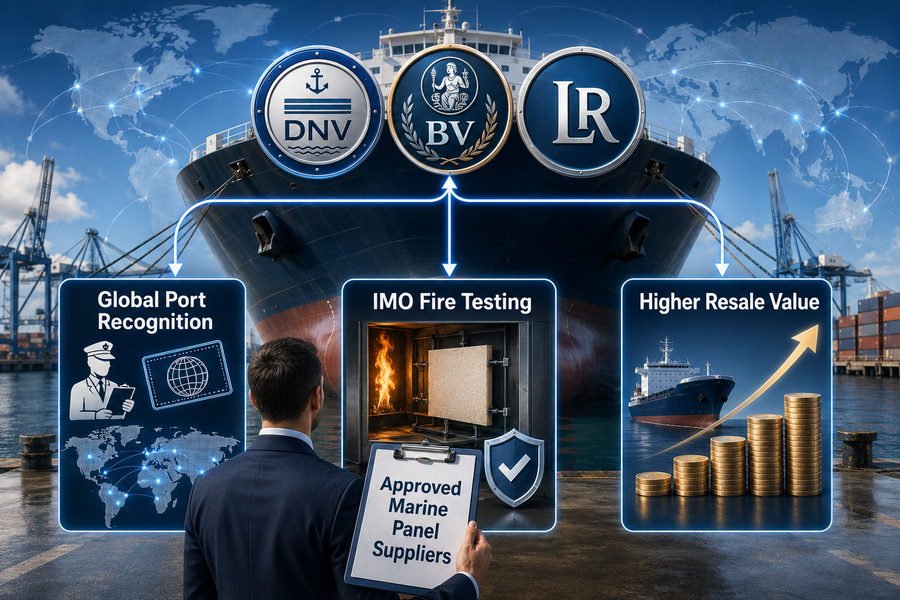
Shipowners shortlist suppliers with DNV, BV, or LR approval for three undeniable reasons: these societies possess the highest global port state recognition, enforce the most rigorous laboratory fire testing protocols under IMO guidelines, and ensure maximum vessel resale value due to their universally trusted maritime engineering standards.
Leveraging High Global Port State Recognition
Shipowners dictate the rules in the maritime industry, and they explicitly tell shipyards to use top-tier materials. The first reason they demand DNV, Bureau Veritas (BV), or Lloyd's Register (LR) approvals is the high global port state recognition. Port State Control (PSC) inspectors check ships in ports all over the world under agreements like the Paris MOU or the Tokyo MOU. When an inspector walks onto a ship and sees DNV-certified marine fire doors and wall panels, they immediately trust the safety of the vessel. These societies have incredible reputations. Ships classed by top-tier IACS members are statistically categorized as "low risk" ships. This means fewer inspections, less time wasted in port, and uninterrupted cargo schedules. For a shipowner, keeping the ship moving is how they make money, and brand-name certificates facilitate smooth port entries.
Rigorous Fire Testing Protocols and Vessel Resale Value
The second reason is the rigorous laboratory fire testing protocols these societies enforce. Under the IMO FTP code, an A-60 panel must survive a furnace test where temperatures reach 945°C within 60 minutes16. DNV, BV, and LR surveyors personally attend these tests at independent laboratories to verify every data point.17 They ensure the core material does not shrink and the steel surface does not warp enough to let flames pass. The third reason is maximizing vessel resale value. Commercial ships are assets that owners buy and sell. A 10-year-old cargo ship built with DNV or LR certified interior outfitting will command a significantly higher price on the secondhand market than a ship built with unverified materials. Brokers estimate that a vessel maintained under a top-tier class society can sell for 5% to 8% more18. Shipowners see these premium panels not as an expense, but as an investment in the long-term value of their multi-million dollar asset.
| Top-Tier Approval Benefit | Direct Impact on Shipowner | Financial Implication |
|---|---|---|
| Global Port State Recognition | Fewer inspections under Paris/Tokyo MOU | Saves $10,000+ per day in port delays |
| Rigorous Fire Testing | Guaranteed safety at 945°C | Protects crew lives and cargo assets |
| Maximum Resale Value | Trusted brand presence in the ship | Increases ship resale price by 5% to 8% |
Conclusion
Choosing marine panel suppliers by class approval drastically reduces project risk. Focus on multi-class portfolios with DNV, MED, and USCG to ensure safety, pass global inspections, and build profitable shipyard partnerships.
-
"International Association of Classification Societies - Wikipedia", https://en.wikipedia.org/wiki/International_Association_of_Classification_Societies. The IACS membership list identifies DNV, American Bureau of Shipping, and Lloyd’s Register as IACS member classification societies, supporting their status within the association; it does not by itself establish the commercial preference for their certificates. Evidence role: definition; source type: institution. Supports: IACS includes major classification societies such as DNV, ABS, and Lloyd’s Register.. Scope note: Supports membership and identity of the societies, not the market claim that their certificates carry greater weight. ↩
-
"Directive 96/98/EC - Wikipedia", https://en.wikipedia.org/wiki/Directive_96/98/EC. EU Marine Equipment Directive materials state that marine equipment falling within the Directive’s scope and placed on board EU-flagged ships must meet MED conformity requirements and bear the wheel mark; this support is limited to covered equipment categories rather than every item installed on a vessel. Evidence role: general_support; source type: government. Supports: The Marine Equipment Directive/Wheelmark is mandatory for covered marine equipment installed on EU-flagged ships.. Scope note: The MED applies to equipment within the Directive’s scope, so the source may not support an absolute claim covering all onboard equipment. ↩
-
"2004 U.S.-EU Marine Equipment Agreement - USTR", https://ustr.gov/archive/World_Regions/Europe_Middle_East/Europe/2004_US-EU_Marine_Equipment_Agreement/Section_Index.html. Official EU-US marine equipment mutual recognition documentation explains that certain marine equipment approvals may be mutually recognized between the European Union and the United States under specified conditions; the support is limited to equipment types and conformity procedures covered by the agreement. Evidence role: historical_context; source type: government. Supports: The EU and the United States have a marine equipment Mutual Recognition Agreement that can facilitate recognition of certain approvals.. Scope note: Mutual recognition is not automatic for every product and depends on the covered equipment category and applicable conditions. ↩
-
"[PDF] PROCEDURES FOR PORT STATE CONTROL, 2023", https://wwwcdn.imo.org/localresources/en/OurWork/IIIS/Documents/A%2033-Res.1185%20-%20PROCEDURES%20FOR%20PORT%20STATE%20CONTROL,%202023%20(Secretariat)%20(1).pdf. Port State Control guidance describes detention as an enforcement measure when deficiencies create grounds that a ship is not compliant with applicable safety or statutory requirements; this is contextual support and does not prove that every missing MED or USCG mark on panels would lead to detention. Evidence role: mechanism; source type: institution. Supports: Port State Control inspectors can detain vessels for serious statutory or safety deficiencies, including non-compliant equipment where applicable.. Scope note: Supports the general enforcement mechanism of detention for serious deficiencies, not a guaranteed detention outcome for a specific panel-certification defect. ↩
-
"What Is the Purpose and Scope of the IMO FTP Code? - Magellan ...", https://magellanmarinetech.com/what-purpose-scope-of-imo-ftp-code/. SOLAS chapter II-2 and the IMO FTP Code define A- and B-class divisions and their insulation-time designations, including common ratings such as A-60, A-30, A-15, A-0, B-15, and B-0; this supports the classification framework but not the claim that every ship layout is limited only to these six ratings. Evidence role: definition; source type: institution. Supports: SOLAS and the IMO FTP Code use fire-rating classes such as A-60, A-30, A-15, A-0, B-15, and B-0 for marine divisions.. Scope note: The source would support the regulatory rating categories, while the article’s wording may oversimplify the full range of possible divisions and vessel-specific requirements. ↩
-
"[PDF] MSC.99(73) - International Maritime Organization", https://wwwcdn.imo.org/localresources/en/KnowledgeCentre/IndexofIMOResolutions/MSCResolutions/MSC.99(73).pdf. SOLAS chapter II-2 regulation 9 fire-integrity tables specify high fire-resistance requirements for boundaries between machinery spaces of category A and accommodation spaces, often A-60, depending on vessel type and arrangement. Evidence role: expert_consensus; source type: institution. Supports: A boundary between an engine room or machinery space and accommodation/living quarters commonly requires A-60 fire integrity under SOLAS fire-containment rules.. Scope note: The requirement can vary by ship category, space classification, and regulatory table, so the source would support the general rule rather than every possible engine-room boundary. ↩
-
"What Is the Purpose and Scope of the IMO FTP Code? - Magellan ...", https://magellanmarinetech.com/what-purpose-scope-of-imo-ftp-code/. The IMO FTP Code and SOLAS definitions for A-class divisions require prevention of smoke and flame passage for a one-hour standard fire test and limit the average temperature rise on the unexposed face to 140°C during the relevant insulation period. Evidence role: definition; source type: institution. Supports: An A-60 fire division must maintain integrity for 60 minutes and meet the 140°C average unexposed-face temperature-rise insulation criterion.. Scope note: This supports the laboratory test criterion for approved A-class divisions, not necessarily the performance of an installed panel after penetrations, joints, or damage. ↩
-
"[PDF] MSC.337(91) (adopted on 30 November 2012) CODE ON NOISE ...", https://wwwcdn.imo.org/localresources/en/KnowledgeCentre/IndexofIMOResolutions/MSCResolutions/MSC.337(91).pdf. IMO resolution MSC.337(91), the Code on Noise Levels on Board Ships, lists maximum noise levels for accommodation spaces, including a 60 dB(A) limit for cabins under the Code’s measurement conditions. Evidence role: statistic; source type: institution. Supports: IMO noise rules set a 60 dB(A) maximum noise level for sleeping cabins or cabins on covered ships.. Scope note: The limit applies to ships and spaces covered by the Code and is expressed as dB(A), so it should not be generalized to all vessels or all measurement methods without qualification. ↩
-
"The effects of quantity discounts on supply chain performance - PMC", https://pmc.ncbi.nlm.nih.gov/articles/PMC7578567/. Procurement and operations-management literature on economies of scale and order consolidation can support the general mechanism by which larger production runs reduce unit cost; any 5%–8% figure should be treated as an industry estimate unless directly documented for marine interior panels. Evidence role: statistic; source type: paper. Supports: Bulk ordering from one approved supplier can reduce unit prices, with the article estimating a 5% to 8% reduction.. Scope note: The source may support volume-discount mechanisms generally rather than the specific percentage range for this product category. ↩
-
"Conformity Assessment of Medical Devices: An Overview from a ...", https://pmc.ncbi.nlm.nih.gov/articles/PMC12821529/. European Marine Equipment Directive documentation describes Module D as production-quality assurance subject to notified-body assessment and ongoing surveillance, supporting the claim that certified manufacturers undergo recurring independent oversight. Evidence role: definition; source type: government. Supports: Maintaining MED Module D involves independent assessment and surveillance of the manufacturer’s production quality-assurance system.. Scope note: The legal framework supports the existence of quality-system surveillance, but it may not verify the article’s wording about audit severity or the inspection of each listed material parameter. ↩
-
"[PDF] RESOLUTION MSC.307(88) (adopted on 3 December 2010 ...", https://wwwcdn.imo.org/localresources/en/KnowledgeCentre/IndexofIMOResolutions/MSCResolutions/MSC.307(88).pdf. The IMO Fire Test Procedures Code identifies Part 3 with fire-resistance tests for A, B, and F class divisions and Part 5 with surface-flammability testing, supporting the distinction between structural fire resistance and surface flame-spread assessment. Evidence role: definition; source type: institution. Supports: The IMO FTP Code uses Part 3 for structural fire resistance and Part 5 for surface flammability.. Scope note: Part 5 supports surface-flammability requirements; smoke and toxicity are addressed separately in the FTP Code, so it should not be cited as direct proof of toxic-smoke performance unless the source also covers that test. ↩
-
"How Are Fire Ratings Verified for Marine Wall and Ceiling Panels ...", https://magellanmarinetech.com/how-fire-ratings-verified-for-marine-wall-ceiling-panels/. A published fee schedule, public procurement record, or accredited laboratory quotation for A-class or FTP Code fire-resistance testing can document the approximate price range for such tests, supporting the statement that a single A-60 panel test may involve five-figure costs. Evidence role: statistic; source type: other. Supports: Testing a single A-60 panel at an authorized lab can cost over $15,000.. Scope note: Testing prices vary by laboratory, country, specimen size, setup complexity, retesting needs, and whether engineering or certification services are included. ↩
-
"How to choose the right fire class for marine wall panels?", https://magellanmarinetech.com/how-choose-right-marine-wall-panels-for-marine-interior-projects/. A procurement cost source or market survey should document whether single-approval marine interior panels are commonly priced about 10–15% below multi-class-certified alternatives. Evidence role: statistic; source type: other. Supports: Single-class suppliers typically offer panels ten to fifteen percent cheaper than major brands.. Scope note: Pricing varies by material specification, order volume, certification scope, and region, so any source would support the range only as market context rather than a universal rule. ↩
-
"History of SOLAS fire protection requirements", https://www.imo.org/en/OurWork/Safety/Pages/History-of-fire-protection-requirements.aspx. Norwegian maritime or recognized-organization rules can support the general requirement that fire-safety materials installed on Norwegian-flagged ships must be accepted under the applicable flag-state, class, or EU/IMO approval regime. Evidence role: general_support; source type: government. Supports: A panel certified only by Vietnam Register may not be acceptable for installation on a Norwegian-flagged vessel without recognition by the relevant flag-state or classification regime.. Scope note: Such sources may establish the approval framework without specifically naming Vietnam Register certificates or every possible equivalence arrangement. ↩
-
"[PDF] RESOLUTION MSC.307(88) (adopted on 3 December 2010 ...", https://wwwcdn.imo.org/localresources/en/KnowledgeCentre/IndexofIMOResolutions/MSCResolutions/MSC.307(88).pdf. IMO fire-test and SOLAS fire-integrity requirements indicate that A-class divisions and associated joints or penetrations must be installed as approved so that fire integrity and insulation performance are preserved. Evidence role: mechanism; source type: institution. Supports: Marine panel edges and joints must be sealed or installed according to approved details to preserve an A-60 fire rating.. Scope note: The source would support the need for approved installation details in general; the exact edge-sealing method depends on the tested panel system and certificate conditions. ↩
-
"Are Marine Fire Divisions the Same as Marine Panel Ratings?", https://magellanmarinetech.com/are-marine-fire-divisions-same-as-marine-panel-ratings/. The IMO Fire Test Procedures Code specifies standard fire-test methods for ship divisions, and the standard time-temperature curve reaches approximately 945°C at 60 minutes for A-class fire-resistance testing. Evidence role: definition; source type: institution. Supports: A-60 marine fire divisions are tested under a standard furnace curve reaching about 945°C at 60 minutes.. Scope note: The source establishes the test condition and classification basis; it does not by itself verify that any specific manufacturer’s panel passed the test. ↩
-
"What Are Marine Fire Doors?", https://magellanmarinetech.com/what-are-marine-fire-doors/. Classification-society type-approval rules and laboratory-witnessing procedures can support that approval testing may be witnessed or reviewed by surveyors as part of certification. Evidence role: mechanism; source type: institution. Supports: Major classification societies use surveyor witnessing or technical review during type approval of marine fire-safety products.. Scope note: Such sources may show required witnessing, review, or approval procedures, but may not substantiate the absolute wording that surveyors personally verify every data point in all DNV, BV, and LR tests. ↩
-
"Method for Estimating Price of Second hand Ship with Multi Method", https://ui.adsabs.harvard.edu/abs/2021MS%26E.1052a2011A/abstract. A shipping-market study, valuation guide, or broker research note would be needed to support the asserted resale premium for vessels maintained under higher-recognition class societies. Evidence role: statistic; source type: research. Supports: A vessel with top-tier classification or verified certified outfitting can command a measurable secondhand-market price premium.. Scope note: Evidence may show that class status affects vessel valuation generally, but a precise 5%–8% premium may vary by vessel type, age, market cycle, and maintenance history. ↩