Confused by marine panel certifications? Choosing the wrong approval can delay your shipyard project for months and cost thousands in fines. Let me clear up this common compliance headache today.
The MED Wheel Mark is a mandatory European Union statutory certification ensuring SOLAS compliance for EU-flagged ships, while Class Society Approval is a commercial verification by organizations like DNV or ABS confirming the panel meets specific structural and safety standards for the vessel's classification rules.
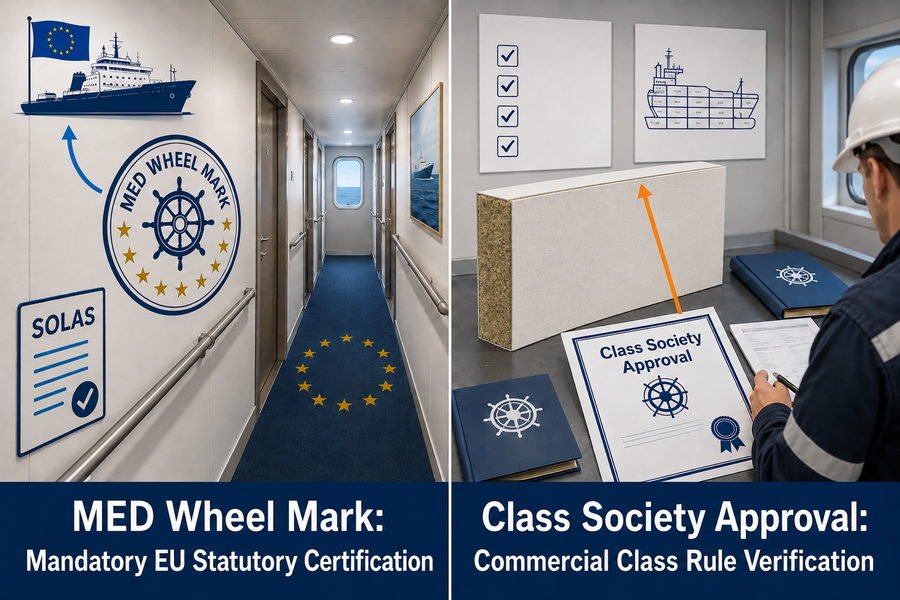
Many procurement officers ask me which certificate they actually need when buying marine wall panels or fire doors from Asia. You do not want to ship containers of materials only to have the surveyor reject them on site. Let's break down the exact differences so you buy the right certified products every time.
Does DNV Type Approval of a Marine Accommodation Panel Equal MED Wheel Mark Compliance?
Think your DNV-approved panel is ready for Europe? Assuming Class approval covers MED requirements is a costly mistake that leads to rejected ship interiors. They are not the same.
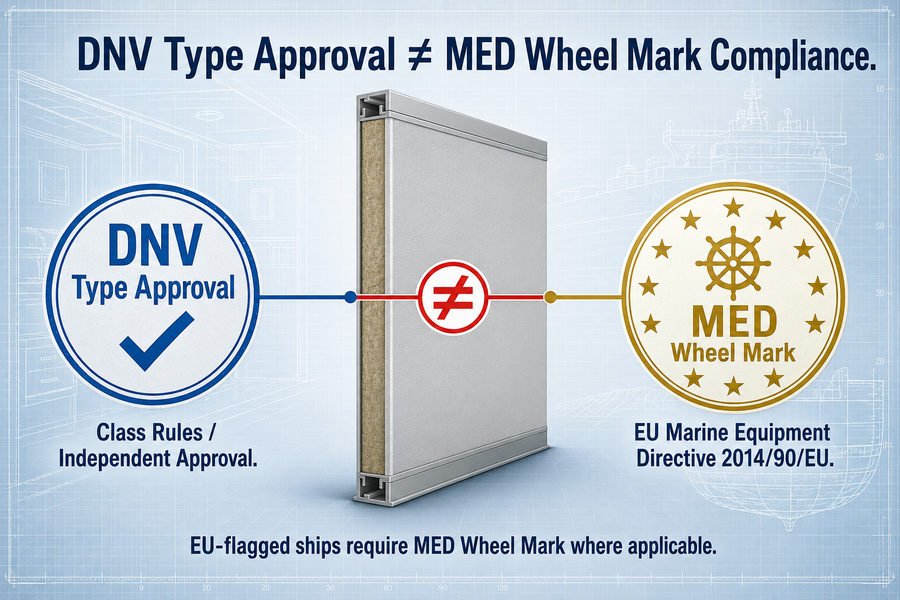
No, DNV Type Approval alone does not equal MED Wheel Mark compliance. DNV approval verifies the panel meets DNV's independent class rules, while the MED Wheel Mark is a separate statutory requirement explicitly mandated under the EU Marine Equipment Directive 2014/90/EU for ships flying an EU flag.
Understanding DNV Type Approval Rules for Marine Panels
When I worked at the marine outfitting factory, we often applied for DNV Type Approval first. DNV is a classification society.1 They have their own set of rules for building and operating ships. For marine accommodation panels, DNV focuses on structural strength, vibration resistance, and basic fire safety according to their internal standards. If a panel has DNV Type Approval, it means DNV engineers have tested it and confirmed it is safe for ships that DNV classes. The cost for a factory to get DNV Type Approval for a basic B-15 wall panel is usually around $5,000 to $8,000. This certificate makes the panel acceptable for commercial insurance purposes on DNV-classed ships. However, this approval alone only satisfies DNV, not the European government.
The Separate Requirements for MED Wheel Mark Compliance
The MED Wheel Mark is completely different. It is a legal requirement created by the European Union. The official rule is the Marine Equipment Directive 2014/90/EU.2 If a ship flies the flag of an EU country, the law says all fire protection materials must have the Wheel Mark. To get this mark, the panel must pass strict fire tests, like the IMO 2010 FTP Code Part 33. The factory must also pass a Module D factory audit. This process is more expensive, often costing a factory $10,000 to $15,000. Because the Wheel Mark is a government law and DNV approval is a commercial society rule, they do not equal each other. A panel can have DNV approval but fail to meet MED legal requirements.
| Certification Feature | DNV Type Approval | MED Wheel Mark |
|---|---|---|
| Nature of Standard | Commercial class society rule | Statutory European Union law |
| Primary Focus | Vessel insurance and classification | European flag legal compliance |
| Average Factory Cost | $5,000 - $8,000 per product type | $10,000 - $15,000 per product type |
| Mandatory for EU Flags? | No, unless DNV is the chosen class | Yes, always mandatory |
Why Do EU-Flagged Vessels Require Both MED Module B and Class Certificates for Marine Accommodation Panels?
Facing dual certification demands? Buying panels without understanding why EU ships need both MED and Class certificates risks project failure. Let me explain this double requirement.
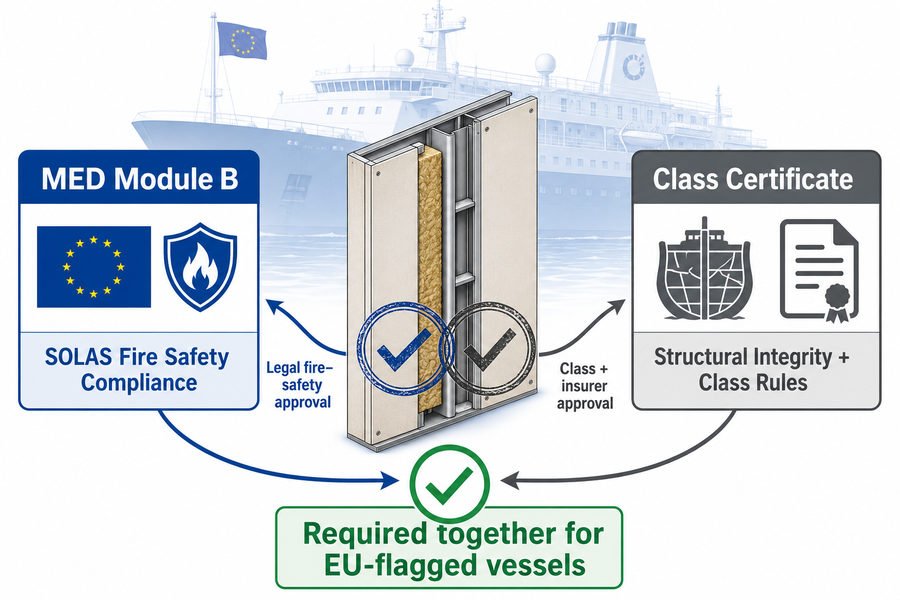
EU-flagged vessels require MED Module B to legally prove compliance with international SOLAS fire safety regulations as demanded by European law, and Class certificates to satisfy the ship's insurer and classification society regarding structural integrity and specific vessel class rules.
Fulfilling Statutory Law with MED Module B Fire Safety Regulations
If you are buying materials for a shipyard in Europe, you will notice they always ask for both papers. First, we must look at the MED Module B certificate. Module B is an "EC Type Examination" certificate. This document proves that a sample of the marine wall panel passed the required fire tests. For example, to get a B-15 rating4, the panel must block flames and keep the unexposed side below 140°C above the starting temperature for 15 minutes, according to the IMO 2010 FTP Code Part 3. European law forces any EU-flagged ship to use products with this Module B certificate5 to guarantee the safety of the crew. Without Module B, the ship cannot legally register in Europe.
Satisfying Commercial Insurance with Class Society Certificates
Second, we must look at the Class Society certificate. Even if the panel has the MED Module B paper, the ship still belongs to a specific classification society, like Lloyd's Register (LR) or Bureau Veritas (BV). The class society acts on behalf of the ship's insurance company.6 They want to make sure the panel fits their specific building rules. For example, a class rule might say the steel skin of the panel must be exactly 0.6 mm thick. The class certificate proves the panel meets these physical and structural rules. So, the MED Module B satisfies the government law for fire safety, and the Class certificate satisfies the private insurance company for building quality. You must provide both to your shipyard client to close the deal.
| Requirement Area | MED Module B Purpose | Class Certificate Purpose |
|---|---|---|
| Testing Standard | IMO 2010 FTP Code | Class society internal rules |
| Main Beneficiary | Port State Control (Government) | Ship Owner and Insurance Company |
| Focus of Approval | Fire safety and life saving | Structural strength and material quality |
| Result of Missing It | Cannot register ship in EU | Cannot insure the vessel |
Is an ABS-Only Certified Marine Accommodation Panel Acceptable on a SOLAS Passenger Ship?
Relying only on ABS approval? Using a panel with only an ABS certificate on a SOLAS passenger ship can trigger severe port state control detentions. Here is the reality.
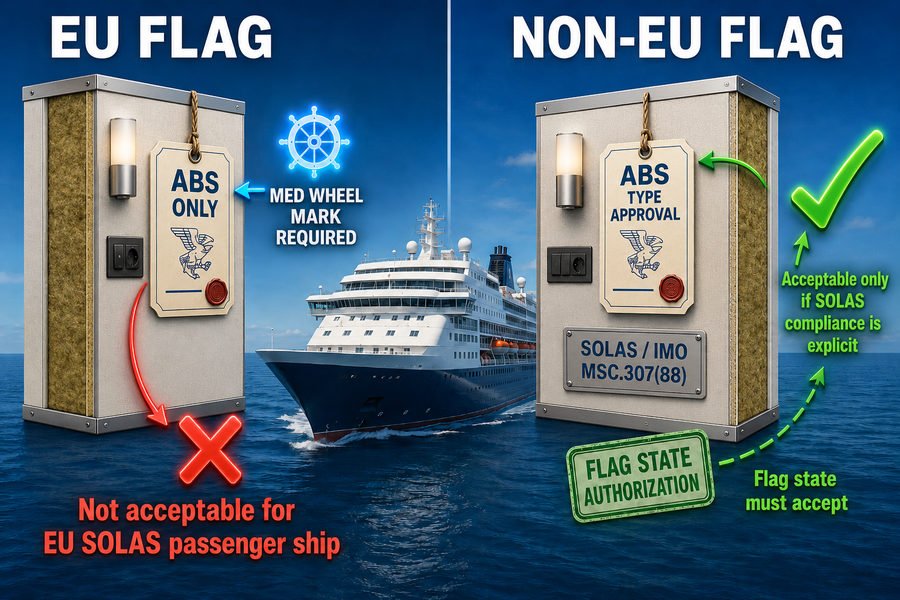
An ABS-only certified panel is not acceptable on a SOLAS passenger ship flying an EU flag; it requires an MED Wheel Mark. However, for non-EU flags, an ABS Type Approval explicitly stating SOLAS compliance (meeting IMO Res. MSC.307(88)) is acceptable, depending on the flag state's authorization.
Flag State Authorizations for Non-EU SOLAS Passenger Ships
I get this question a lot when shipping panels to Southeast Asia or the Americas. If you buy a marine accommodation panel that only has an ABS (American Bureau of Shipping) Type Approval, its acceptance depends entirely on the ship's flag. If the SOLAS passenger ship flies a non-EU flag, like Panama, Liberia, or the Bahamas, an ABS-only certificate is usually acceptable. However, the ABS certificate must clearly state that the panel meets SOLAS regulations and the IMO 2010 FTP Code (IMO Res. MSC.307(88))7. Panama and Liberia authorize ABS to act on their behalf8. They trust ABS to verify the fire safety of the panels. In these cases, you do not need to spend extra money finding a supplier with European MED approvals.
The Legal Limit of ABS-Only Approvals in European Waters
The situation completely changes if that same SOLAS passenger ship flies an EU flag, like France, Italy, or Malta. In this case, an ABS-only certificate is illegal to use for fire protection panels. EU law does not care if ABS is a highly respected class society. EU law demands the MED Wheel Mark9 for all SOLAS passenger ships registered in its member states. If you install an ABS-only panel on an Italian passenger ship, the port state control inspector will find it. They will force you to rip out the panels and replace them. A standard ABS-approved panel might cost you $45 per square meter, while an MED-approved panel might cost $55 per square meter. Trying to save that $10 difference by ignoring the flag rules will cause a massive financial loss during the ship inspection.
| Ship Flag Location | Acceptability of ABS-Only Panel | Required Action for Buyer |
|---|---|---|
| Non-EU Flag (e.g., Panama) | Yes, if it states SOLAS compliance | Check ABS certificate for IMO FTP Code |
| EU Flag (e.g., Italy, France) | No, strictly forbidden | Must buy MED Wheel Mark approved panels |
| US Flag (USCG rules apply) | Sometimes, via USCG-MED MRA10 | Verify USCG approval number on ABS paper |
Who Issues MED Wheel Mark vs Class Society Approval for Marine Accommodation Panels?
Unsure who signs your certificates? Sending paperwork to the wrong authority wastes precious project time and delays your panel shipments. Let us identify the right issuers.
The MED Wheel Mark is strictly issued by European Union Notified Bodies (such as DNV AS Notified Body 0575), whereas Class Society Approvals are issued directly by the 11 member organizations of IACS (like ABS, LR, BV, or CCS) acting as independent technical evaluation agencies.
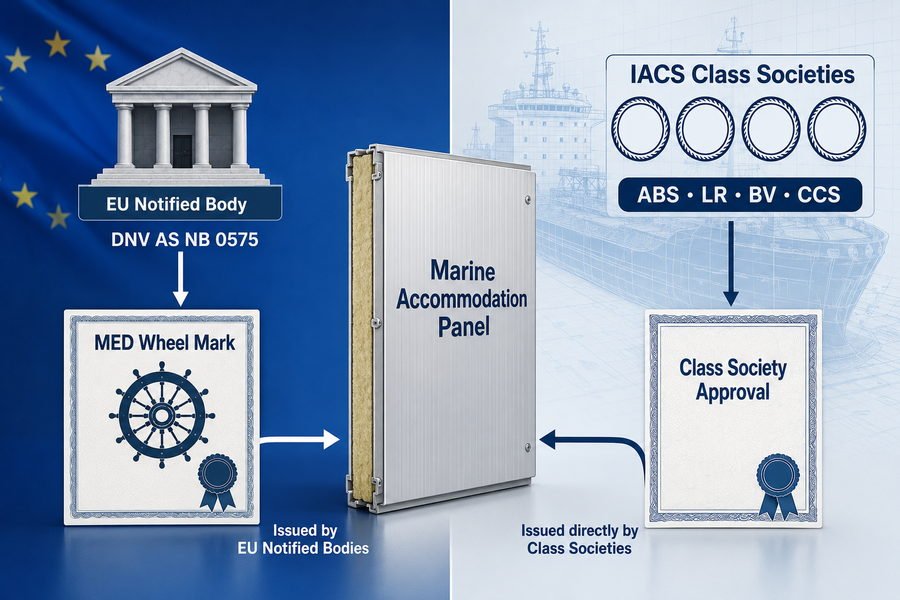
The Role of EU Notified Bodies in MED Wheel Mark Issuance
When I help factories apply for the MED Wheel Mark, we cannot just send an email to any inspector. The European Commission appoints very specific agencies to issue the Wheel Mark. These agencies are called "Notified Bodies." Each Notified Body has a unique 4-digit identification number. For example, DNV AS acts as Notified Body number 0575, and RINA acts as Notified Body number 047411. Only these authorized bodies can review the fire test reports, audit the factory quality system (Module D)12, and finally issue the Wheel Mark certificate. The factory must pay this Notified Body a fee, usually around $3,000 to $5,000 annually, just to maintain the factory audit. You can always check if an MED certificate is real by searching the 4-digit number on the official European database.
IACS Member Organizations and Class Society Approval Issuance
Class Society Approvals come from a different group entirely. These are issued by the member organizations of the International Association of Classification Societies (IACS). There are currently 11 major IACS members13, including the American Bureau of Shipping (ABS), Lloyd's Register (LR), Bureau Veritas (BV), and the China Classification Society (CCS). These organizations are independent technical groups, not government bodies. A factory applies directly to the local office of ABS or BV to get their class approval. The local class surveyor comes to the factory, checks the production line, and issues the paper. Sometimes, a single organization like DNV can wear two hats. DNV can issue a Class Approval as an IACS member, and DNV can also issue an MED Wheel Mark as an EU Notified Body. But the two certificates are issued by different departments under different rules.
| Certificate Type | Issuing Authority | Examples of Issuers | Identification Method |
|---|---|---|---|
| MED Wheel Mark | EU Notified Bodies | DNV AS (0575), RINA (0474) | 4-digit Notified Body Number |
| Class Approval | IACS Members | ABS, LR, BV, CCS, NK | Society Logo and Certificate Number |
Which Marine Accommodation Panel Projects Demand MED Certification Beyond Class Approval?
Bidding on new interior projects? Quoting standard class-approved panels when the contract strictly demands MED certification will destroy your profit margin. Know the exact project types.
Three specific marine projects demand MED certification beyond basic class approval: 1. All newbuilds flying a European Economic Area (EEA) flag, 2. Existing ships transferring to an EEA flag, and 3. Vessels undergoing major retrofits in European shipyards that mandate EU-compliant marine accommodation panels.
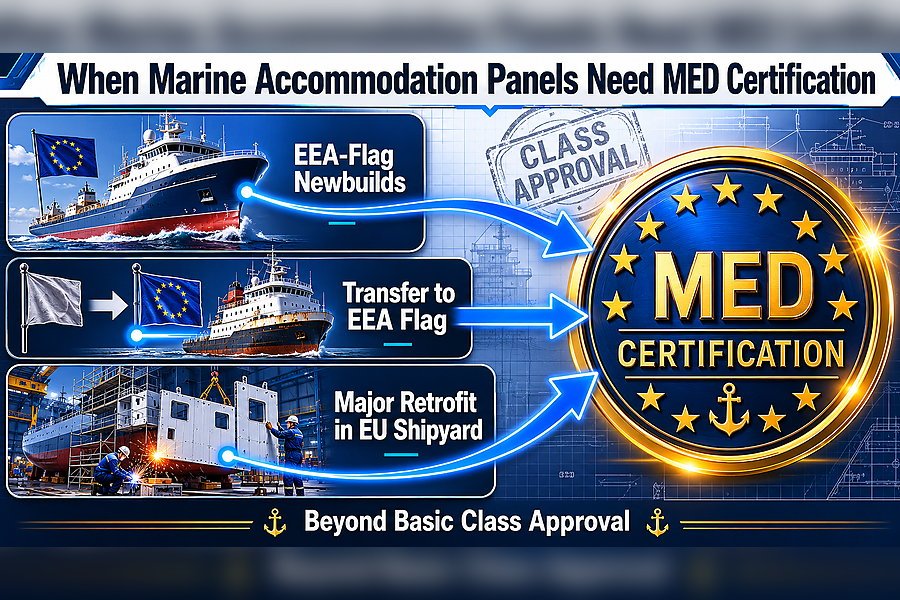
Newbuilds and Flag Transfers to the European Economic Area
If you are a procurement officer buying materials in Asia for overseas projects, you must watch out for these specific projects. The first project type is any new ship construction (newbuild) that will fly the flag of a country in the European Economic Area (EEA)14. If a shipyard in Vietnam is building a ferry that will operate under the flag of Norway or Greece, every single fire door and wall panel must have the MED Wheel Mark15. Standard class approval is not enough. The second project type is a flag transfer. Sometimes a ship owner buys an old ship registered in Panama and wants to change the flag to Germany. To do this, the marine panels onboard must comply with European rules16. If the old panels only have class approval, the owner must rip them out and buy MED-certified panels from you.
Major Vessel Retrofits Conducted in European Shipyards
The third project type involves major retrofits. When a cruise ship goes into a dry dock in Italy or Spain for a huge interior upgrade, the local maritime authorities govern the repair rules. Even if the cruise ship flies a non-EU flag like the Bahamas, European shipyards often enforce strict local safety rules during major structural changes17. They will demand that all new accommodation panels entering the yard have the MED Wheel Mark. I have seen buyers quote $50 per square meter for standard class-approved panels on a retrofit bid, only to find out later the yard demanded MED panels, which cost $65 per square meter. This mistake wiped out their entire project profit. You must always ask the shipyard about these three project conditions before you place your final order with an Asian supplier.
| Project Type | Condition for MED Requirement | Financial Impact Example |
|---|---|---|
| 1. EEA Flag Newbuilds | Vessel will register in EU/EEA nation | Must source $65/sqm MED panels over $50/sqm standard panels |
| 2. Flag Transfers | Ship changes from non-EU to EU flag | Complete replacement of non-MED interior outfitting |
| 3. Major Retrofits | Work done in EU shipyard jurisdiction | Local port authority demands EU-compliant materials |
Does MED Wheel Mark on a Marine Accommodation Panel Replace Class Society Project Inspection?
Think the Wheel Mark lets you skip inspections? Assuming an MED sticker replaces the local surveyor will halt your installation process immediately. Never skip the final check.
No, the MED Wheel Mark does not replace Class Society project inspections. The MED mark only proves the panel's manufacturing compliance, while the Class surveyor must physically inspect the onboard installation to ensure it matches approved drawings and maintains the ship's structural fire protection integrity.
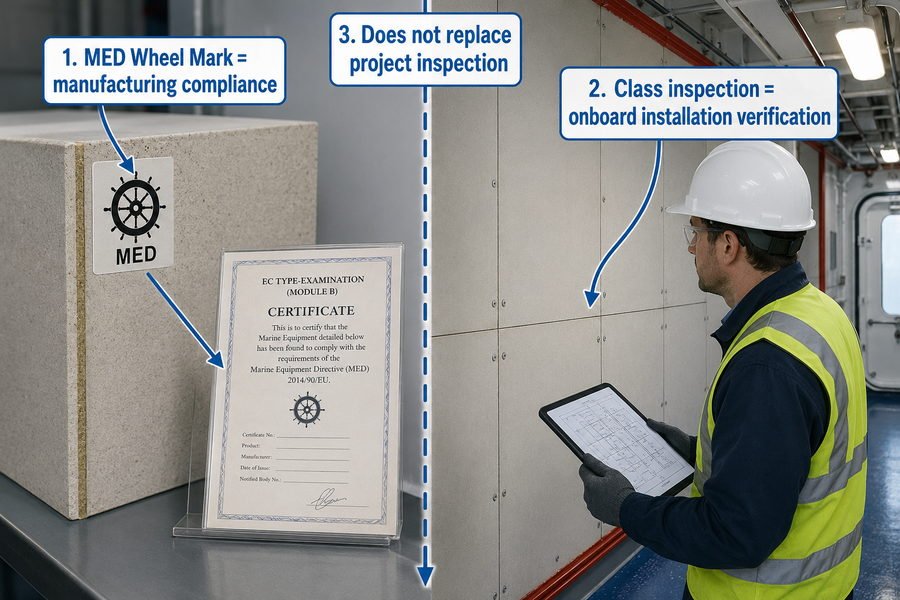
Why the MED Wheel Mark Only Covers Manufacturing Compliance
This is a very common trap. You buy a container of beautiful, high-quality marine panels from China. The panels have a valid MED Wheel Mark. You show the paper to the shipyard, and you think your job is done. But you are wrong. The MED Wheel Mark only proves that the factory made the panel correctly.18 It proves the materials inside the panel will stop a fire according to the lab tests. The mark belongs to the product, not to the ship. A perfect panel can fail to protect a ship if the workers install it poorly. Therefore, having the MED certificate is only step one. It allows the panel to legally enter the ship, but it does not approve the final room structure.
The Mandatory Nature of Class Society Onboard Installation Inspections
Step two is the onboard inspection, and this is always done by the Class Society surveyor19. The shipyard must submit installation drawings to the class society. Getting these drawings approved usually costs $500 to $1,000 per drawing20. After the workers install your MED-approved panels, the local class surveyor (from ABS, DNV, LR, etc.) walks onto the ship. The surveyor checks the physical gaps. For an A-60 or B-15 bulkhead, the installation gap tolerances are very strict, often less than 3 mm21. The surveyor checks if the workers used the correct fireproof sealant on the joints. If the installation is bad, the surveyor will fail the room, even if the panels have the MED Wheel Mark. The MED paper proves the product is good; the Class inspection proves the ship is safe.
| Inspection Stage | Responsible Party | Focus of the Approval | Outcome of Passing |
|---|---|---|---|
| Factory Production | MED Notified Body | Product material and fire resistance | Panel gets Wheel Mark sticker |
| Drawing Approval | Class Society Engineers | Room layout and safety plans | Permission to start installation |
| Onboard Installation | Local Class Surveyor | Physical joints, gaps, and sealant | Ship gets final class certificate |
Conclusion
To succeed in marine procurement, always verify the ship's flag and classification first. Combining the right MED and Class approvals ensures smooth installations and keeps your shipyard projects profitable.
-
"DNV - Wikipedia", https://en.wikipedia.org/wiki/DNV. A neutral reference should establish that DNV is a ship classification society that publishes rules and standards used in maritime classification. Evidence role: definition; source type: encyclopedia. Supports: DNV is a classification society with rules relevant to ship construction and operation.. Scope note: This supports DNV’s institutional role, not the specific requirements for marine accommodation panels. ↩
-
"How to Avoid EU Rejection of Marine Accommodation Panels for ...", https://magellanmarinetech.com/how-avoid-eu-rejection-marine-accommodation-panels-for-med-non-compliance/. The text of Directive 2014/90/EU should be cited to show that the Marine Equipment Directive is an EU legal framework governing conformity assessment and marking of marine equipment placed on board EU-flagged ships. Evidence role: historical_context; source type: government. Supports: The MED Wheel Mark is based on the European Union’s Marine Equipment Directive 2014/90/EU.. Scope note: The directive establishes the legal framework; the precise equipment categories and standards are identified through implementing acts and referenced international instruments. ↩
-
"How Does the IMO FTP Code Connect with Other Marine Fire Safety ...", https://magellanmarinetech.com/how-imo-ftp-code-connect-with-other-marine-fire-safety-frameworks/. The IMO 2010 FTP Code should be cited to show that Part 3 sets fire-test procedures for A, B, and F class divisions, which are commonly relevant to marine fire protection panels. Evidence role: expert_consensus; source type: institution. Supports: Marine fire protection panels seeking MED conformity may need to pass fire tests such as those specified in the IMO 2010 FTP Code Part 3.. Scope note: This supports the relevance of the cited fire-test standard, but the exact test obligations for a given panel depend on the product category and applicable MED implementing regulation. ↩
-
"How Are Integrity and Insulation Judged in Marine Panel Fire Tests?", https://magellanmarinetech.com/how-integrity-insulation-judged-in-marine-panel-fire-tests/. The IMO 2010 FTP Code sets fire-test criteria for fire-resisting divisions, including temperature-rise limits and duration requirements used to classify B-class divisions such as B-15. Evidence role: definition; source type: institution. Supports: A B-15-rated marine panel must satisfy IMO FTP Code fire-resistance criteria for a 15-minute classification, including limits on temperature rise on the unexposed face.. Scope note: The source supports the regulatory test basis for the rating; the exact applicability depends on the tested assembly and its approved installation conditions. ↩
-
"Marine Equipment Directive enters into force in the EEA - Efta.Int", https://www.efta.int/media-resources/news/marine-equipment-directive-enters-force-eea. Directive 2014/90/EU requires marine equipment placed on board EU ships, when covered by the Directive, to comply with applicable international testing standards and EU conformity-assessment procedures, including EC type-examination where prescribed. Evidence role: general_support; source type: government. Supports: EU-flagged ships must use compliant marine equipment under the Marine Equipment Directive, with Module B forming part of the conformity-assessment process for covered products.. Scope note: This is contextual support: the Directive applies to specified marine equipment listed in implementing measures, and lawful use generally requires the full conformity-assessment route and wheel mark, not Module B alone. ↩
-
"Ship classification society - Wikipedia", https://en.wikipedia.org/wiki/Ship_classification_society. IACS and IMO descriptions of classification societies explain that they develop and apply technical rules for ship design, construction, and survey, and that class status is commonly used by flag administrations, owners, and insurers as evidence of technical compliance. Evidence role: expert_consensus; source type: institution. Supports: Classification societies provide technical assurance used by insurers and other maritime stakeholders, although they are not simply agents of insurance companies.. Scope note: This supports the link between classification and insurance practice, but classification societies do not universally act as legal agents of insurers; their role is primarily technical classification and statutory survey when authorized. ↩
-
"[PDF] RESOLUTION MSC.307(88) (adopted on 3 December 2010 ...", https://wwwcdn.imo.org/localresources/en/KnowledgeCentre/IndexofIMOResolutions/MSCResolutions/MSC.307(88).pdf. An IMO source on Resolution MSC.307(88) identifies the International Code for Application of Fire Test Procedures, 2010 as the fire-test code used for SOLAS-related marine fire-safety requirements, supporting the article’s reference to this standard for accommodation panels. Evidence role: definition; source type: institution. Supports: Marine accommodation panels intended to demonstrate SOLAS fire-safety compliance should reference the IMO 2010 FTP Code, adopted by IMO Resolution MSC.307(88).. Scope note: This establishes the regulatory test-code context, but it does not prove that any specific ABS certificate or product complies with the code. ↩
-
"RECOGNIZED ORGANIZATIONS", https://www.imo.org/en/OurWork/IIIS/Pages/Recognized-Organizations.aspx. Flag-administration recognized-organization lists for Panama and Liberia identify the American Bureau of Shipping as authorized to perform specified statutory survey and certification functions on behalf of those flag States, supporting the statement that ABS can act under delegated authority for those flags. Evidence role: case_reference; source type: government. Supports: Panama and Liberia authorize ABS to carry out certain statutory functions on behalf of their flag administrations.. Scope note: Recognized-organization authorizations are scope-specific and can change; the current authorization and certificate type must be checked for the vessel and product involved. ↩
-
"How to Avoid EU Rejection of Marine Accommodation Panels for ...", https://magellanmarinetech.com/how-avoid-eu-rejection-marine-accommodation-panels-for-med-non-compliance/. Directive 2014/90/EU on marine equipment requires covered equipment placed on board EU Member State-flagged ships to meet Marine Equipment Directive conformity requirements and bear the wheel mark, supporting the article’s statement that EU-flagged vessels require MED-compliant equipment rather than an ABS-only approval. Evidence role: general_support; source type: government. Supports: EU-flagged SOLAS ships require covered marine equipment, including relevant fire-protection products, to comply with the Marine Equipment Directive and bear the wheel mark.. Scope note: The directive supports the general legal requirement; applicability still depends on whether the specific panel type is covered by the current MED implementing regulation and conformity-assessment module. ↩
-
"Products covered by Mutual Recognition Agreements (MRAs). - eCFR", https://www.ecfr.gov/current/title-46/chapter-I/subchapter-Q/part-159/subpart-159.003/section-159.003-9. U.S. Coast Guard materials on the U.S.–EU Marine Equipment Mutual Recognition Agreement describe how certain marine equipment approvals may be mutually recognized between the Coast Guard and the EU MED system, supporting the article’s statement that U.S.-flag acceptance can depend on USCG approval under the MRA framework. Evidence role: mechanism; source type: government. Supports: For U.S.-flag vessels, some marine equipment may be accepted through the USCG–MED mutual recognition framework if the product has the relevant USCG approval.. Scope note: The MRA is category-specific and does not automatically validate every panel; the individual product should be checked against current USCG approval listings and the applicable approval series. ↩
-
"What Is the Wheel Mark Certification Process for Marine ...", https://magellanmarinetech.com/what-wheel-mark-certification-process-for-marine-accommodation-panels/. The European Commission’s NANDO listings record notified-body identification numbers for organizations designated under EU legislation, which can verify whether DNV AS and RINA are listed with the stated MED notified-body numbers. Evidence role: case_reference; source type: government. Supports: DNV AS and RINA are MED Notified Bodies with the stated four-digit notified-body numbers.. Scope note: The database supports the identification numbers and notification status, but it does not by itself prove that any particular certificate issued by those bodies is valid. ↩
-
"Conformity Assessment of Medical Devices: An Overview from a ...", https://pmc.ncbi.nlm.nih.gov/articles/PMC12821529/. Directive 2014/90/EU and its conformity-assessment modules describe Module D as quality assurance of the production process, supporting the statement that MED certification can involve assessment of a manufacturer’s factory quality system. Evidence role: mechanism; source type: government. Supports: Under MED Module D, the notified body assesses the manufacturer’s production quality system as part of the conformity-assessment process.. Scope note: The source explains the regulatory module; the exact audit scope and frequency may vary by product category, notified body, and certificate conditions. ↩
-
"International Association of Classification Societies - Wikipedia", https://en.wikipedia.org/wiki/International_Association_of_Classification_Societies. The International Association of Classification Societies publishes its current member list, which supports the article’s statement about the number and identity of IACS member organizations at the time of consultation. Evidence role: general_support; source type: institution. Supports: IACS has 11 member organizations, including major classification societies such as ABS, LR, BV, and CCS.. Scope note: Membership can change over time, so the citation supports the count only as of the source’s publication or access date. ↩
-
"Marine Equipment Directive enters into force in the EEA - Efta.Int", https://www.efta.int/media-resources/news/marine-equipment-directive-enters-force-eea. The Marine Equipment Directive applies to equipment placed on board ships flying the flag of an EU Member State, and EEA incorporation extends relevant internal-market rules to EEA states; this supports the flag-based framing for EU/EEA vessels. Evidence role: definition; source type: government. Supports: Newbuild vessels flying an EEA flag are within the regulatory scope relevant to MED-compliant marine equipment.. Scope note: The directive text itself refers to EU Member State flags; EEA application should be confirmed through EEA incorporation or national implementation for non-EU EEA states such as Norway. ↩
-
"How Long Is MED Certification Valid for Marine Accommodation ...", https://magellanmarinetech.com/how-long-med-certification-valid-for-marine-accommodation-panels/. EU marine-equipment rules require covered equipment placed on board EU-flagged ships to comply with the Marine Equipment Directive and bear the wheel mark, including fire-protection equipment listed in implementing regulations. Evidence role: mechanism; source type: government. Supports: Fire doors and certain fire-rated accommodation panels used on EU/EEA-flagged ships may require MED wheel-mark conformity rather than only classification-society approval.. Scope note: The support is strongest for equipment categories explicitly listed in the MED implementing acts; the phrase “every single” may overstate coverage if a panel or component is outside the listed scope or covered by an exemption. ↩
-
"Directive 96/98/EC - Wikipedia", https://en.wikipedia.org/wiki/Directive_96/98/EC. The Marine Equipment Directive establishes conformity requirements for marine equipment placed on board EU-flagged ships, supporting the need to assess onboard materials when a vessel comes under an EU flag. Evidence role: general_support; source type: government. Supports: During a transfer to an EU flag such as Germany, onboard marine panels may need to meet applicable European marine-equipment requirements.. Scope note: This source would support the general compliance obligation, but not by itself prove that all existing non-MED panels must be removed during every flag transfer; that depends on flag-state inspection practice, equipment status, and applicable transitional provisions. ↩
-
"Port State Control - International Maritime Organization", https://www.imo.org/en/ourwork/iiis/pages/port%20state%20control.aspx. Port-state and national maritime-safety regimes give coastal and flag administrations authority to inspect ships and enforce safety requirements, providing context for why major repairs in European yards can trigger additional compliance checks. Evidence role: historical_context; source type: institution. Supports: Major vessel retrofits in European shipyards can be subject to local or port-state safety oversight that affects material acceptance.. Scope note: Such sources would provide contextual support for regulatory oversight during repairs, but they may not directly prove that every European yard requires MED-marked panels for non-EU-flag cruise ships. ↩
-
"How to Avoid EU Rejection of Marine Accommodation Panels for ...", https://magellanmarinetech.com/how-avoid-eu-rejection-marine-accommodation-panels-for-med-non-compliance/. Directive 2014/90/EU establishes that the wheel mark is affixed to marine equipment only after conformity-assessment procedures show compliance with applicable design, construction, and performance requirements; this supports the product-compliance point but does not by itself address installation approval on a particular vessel. Evidence role: definition; source type: government. Supports: The MED Wheel Mark indicates product conformity for marine equipment rather than approval of the installed ship structure.. Scope note: The source supports the legal meaning of the mark, but the wording about the factory making the panel correctly is a simplified paraphrase of conformity assessment. ↩
-
"RECOGNIZED ORGANIZATIONS", https://www.imo.org/en/OurWork/IIIS/Pages/Recognized-Organizations.aspx. IMO and IACS materials describe classification societies or recognized organizations as performing surveys to verify compliance with ship construction and safety requirements, which supports the role of class surveyors in onboard verification; however, the word “always” is context-dependent because authority may rest with the flag administration or a delegated recognized organization. Evidence role: expert_consensus; source type: institution. Supports: Onboard installation inspections for fire-safety-related ship structures are commonly carried out by class society surveyors or recognized organizations.. Scope note: The evidence would support the common role of class societies, not an absolute rule for every flag state, vessel type, or project. ↩
-
"[PDF] RESOLUTION MSC.349(92) (Adopted on 21 June 2013) CODE ...", https://wwwcdn.imo.org/localresources/en/KnowledgeCentre/IndexofIMOResolutions/MSCResolutions/MSC.349(92).pdf. Published classification-society fee schedules or plan-appraisal tariffs can show how drawing-review charges are calculated and may corroborate a per-drawing cost range; such fees vary by society, flag, vessel type, region, and contract, so the evidence would support only a typical or contextual range. Evidence role: statistic; source type: institution. Supports: Class-society drawing approval can involve per-drawing or plan-appraisal fees in the approximate range stated.. Scope note: A fee schedule may not prove the article’s exact range universally, because actual costs depend on the classification society and project terms. ↩
-
"How Are Integrity and Insulation Judged in Marine Panel Fire Tests?", https://magellanmarinetech.com/how-integrity-insulation-judged-in-marine-panel-fire-tests/. Class-approved installation instructions or type-approval documentation for A- and B-class fire divisions can specify maximum joint or panel-gap limits and sealant requirements, supporting the statement that tolerances may be very small; because these limits are system-specific, the source would not establish a universal 3 mm requirement for all A-60 or B-15 bulkheads. Evidence role: statistic; source type: institution. Supports: Installation gap tolerances for approved A-60 or B-15 bulkhead systems can be below 3 mm in some approved installation specifications.. Scope note: The cited tolerance would likely apply only to the tested or approved panel system described in the source. ↩