Replacing heavy marine panels constantly eats your profit margin. Warping and rot damage ship interiors quickly. Aluminum honeycomb panels offer a lightweight, permanent solution to stop these expensive refits.
Aluminum honeycomb core marine accommodation panels deliver exceptional long-term performance by providing a 20 to 25-year service life, resisting structural fatigue, maintaining flatness under extreme temperature shifts, limiting thermal expansion to 23.8 µm/(m·K), resisting 100% of mold growth, and passing rigorous salt spray and humidity aging tests.
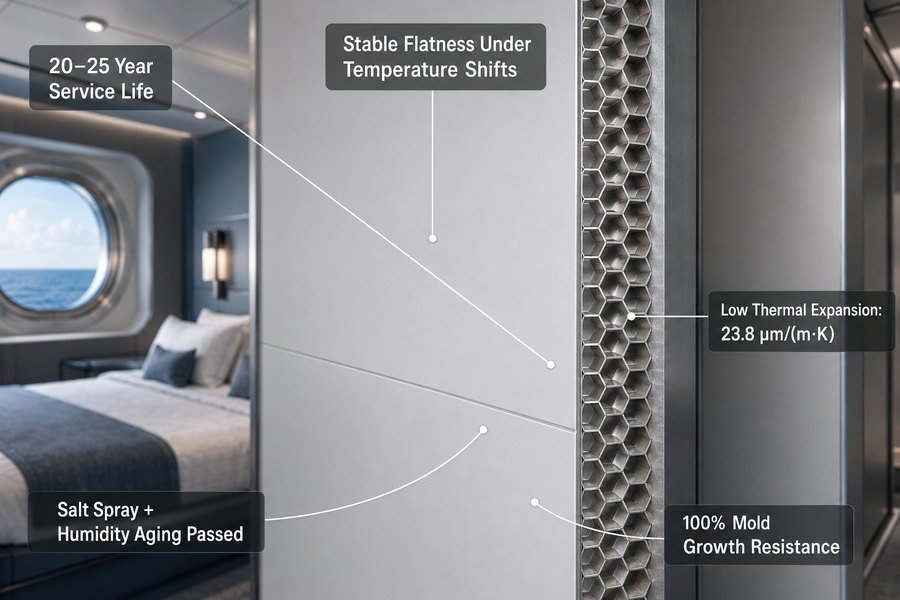
Let us look at exactly what these panels do over time, so you can stop worrying about costly shipyard repairs and keep your projects profitable.
What Service Life Do Aluminum Honeycomb Core Marine Accommodation Panels Achieve in Service?
Short panel lifespans mean you lose money re-doing cabin interiors. If materials fail early, shipyards get angry. Aluminum honeycomb cores last for decades, protecting your reputation and budget.
Aluminum honeycomb core marine accommodation panels achieve a reliable service life of 20 to 25 years. This longevity comes from their non-combustible nature, absolute resistance to moisture-induced rot, and high strength-to-weight ratio, allowing them to outlast traditional plywood or mineral wool panels in marine environments.
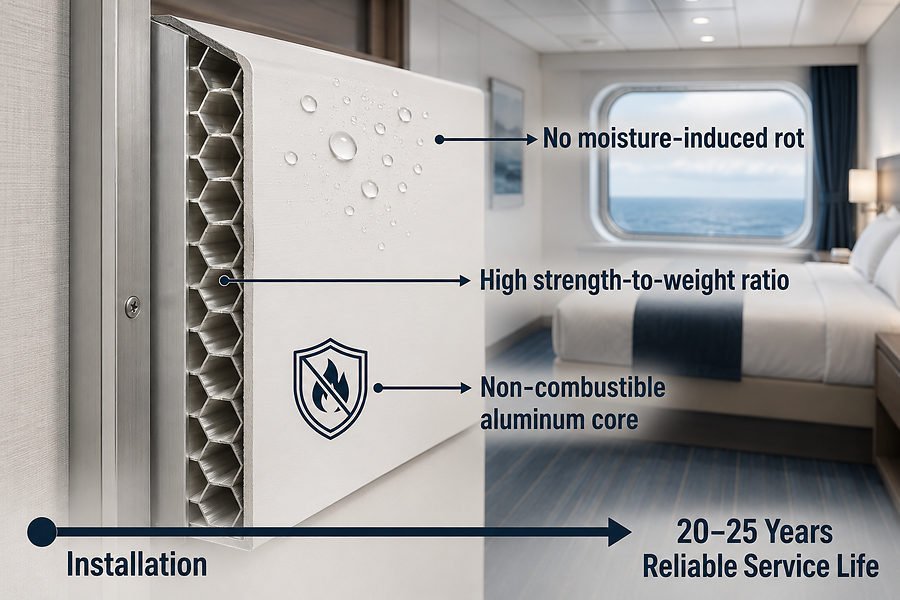
I remember when I first started at the marine outfitting factory, we got a lot of complaints about rotting cabin walls. Shipyards in Europe had to tear out and replace wooden panels every five to ten years. That is a lot of wasted money. When we look at the data from marine classification societies like DNV and ABS, we see a huge difference with metal panels. I always tell my buyers that using aluminum honeycomb cores is the best way to stop doing the same job twice.
Service Life Comparison Between Panel Core Materials
Traditional materials simply do not last on a ship. Plywood absorbs water from the damp sea air.1 Within 5 to 10 years, the wood swells and rots. Mineral wool is good for fire ratings, but it absorbs moisture over time. After 10 to 15 years, the wet wool gets heavy and sags to the bottom of the steel frame.2 The panel loses its shape and fire protection. But an aluminum honeycomb core does not soak up water. It does not rot.3 Because it is an inorganic metal, it can easily reach a 20 to 25-year service life4. This matches the normal working life of the entire commercial vessel.
Factors Maximizing the 25-Year Lifespan of Honeycomb Cores
To reach that 25-year mark, the panel relies on its absolute resistance to moisture and its non-combustible nature. Water from cabin showers or ocean humidity cannot break down the aluminum. Also, the high strength-to-weight ratio means the panels do not sag under their own weight. They stay rigid inside their mounting tracks. I always check the manufacturer data to make sure they use marine-grade aluminum foil for the honeycomb. This ensures the material will not break down over time.
| Core Material | Expected Service Life | Main Cause of Failure Over Time | Replacement Frequency in 25 Years |
|---|---|---|---|
| Plywood Core | 5 - 10 Years | Moisture absorption and wood rot | 2 to 3 times |
| Mineral Wool Core | 10 - 15 Years | Moisture weight causing internal sag | 1 to 2 times |
| Aluminum Honeycomb | 20 - 25 Years | Extreme physical impact only | 0 times (lasts the ship's lifetime) |
How Do Aluminum Honeycomb Core Marine Accommodation Panels Resist Fatigue From Hull Flexing?
A ship bends constantly in rough seas. Brittle panels crack and pop out of their frames, ruining your hard work. Honeycomb cores absorb this stress without breaking.
Aluminum honeycomb core marine panels resist hull flexing fatigue through three mechanisms: high shear strength of the hexagonal cell structure, elastic adhesive bonding that absorbs vibrations, and a high structural yield strength of 1.5 to 2.5 MPa, preventing micro-cracks during continuous vessel movement.
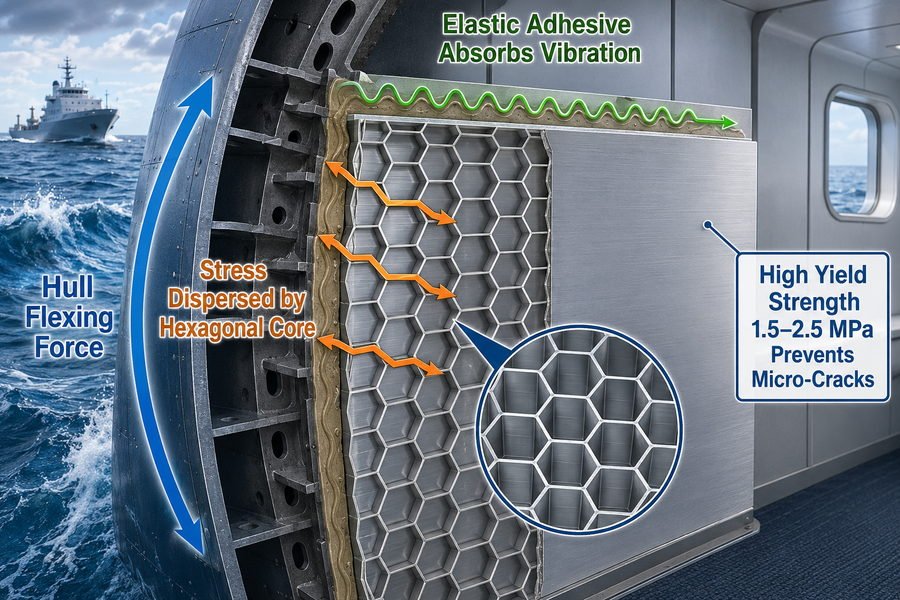
When a large cargo ship hits big ocean waves, the steel hull bends5. We call this hull deflection. Sometimes, the hull bends a lot. If you bolt rigid, hard panels to a moving ship, the panels will crack. The joints will snap open.6 I have seen cheap panels pop right out of their ceiling profiles because they could not handle the vibration. We fix this by using aluminum honeycomb panels. They are designed like an airplane wing. They take the stress and keep the cabin walls intact.
The Hexagonal Cell Structure and High Shear Strength
The first mechanism that stops fatigue is the high shear strength of the hexagonal cell structure7. Think about a bee's honeycomb. It is mostly air, but the shape makes it incredibly strong. When the ship's deck moves left and the ceiling moves right, this creates shear stress on the wall panel. According to marine structural engineering tests, aluminum honeycomb cores offer a high structural yield strength of 1.5 to 2.5 Megapascals (MPa)8. This means the tiny aluminum walls inside the panel can stretch and bend slightly without breaking. They handle the twisting forces of the hull perfectly.
Elastic Adhesive Bonding and Structural Yield Strength Under Vibration
The second and third mechanisms work together. The aluminum skin is glued to the honeycomb core using elastic adhesive bonding. Many bad factories use cheap, hard glue. Hard glue dries like glass. When the ship vibrates from the engine running, hard glue shatters, and the panel falls apart. Good marine panels use a two-part polyurethane elastic glue. This glue acts like a rubber shock absorber. It eats the vibrations. Combined with the 1.5 to 2.5 MPa yield strength, this stops micro-cracks from forming in the metal. The panel moves with the ship but never loses its shape.
| Fatigue Resistance Feature | Mechanism of Action | Benefit for Ship Corridors and Cabins |
|---|---|---|
| Hexagonal Cell Structure | Disperses shear force across many cell walls | Stops the panel from twisting and breaking |
| Elastic Adhesive Bonding | Acts as a rubber cushion against engine shaking | Prevents the metal skin from peeling off the core |
| 1.5 - 2.5 MPa Yield Strength | Absorbs bending forces without micro-cracking | Stops visible surface cracks near door frames |
Do Aluminum Honeycomb Core Marine Accommodation Panels Stay Flat Under Long-Term Thermal Cycling?
Cabin temperatures change from freezing cold outside to warm inside. Poor panels warp and ruin the wall alignment. Honeycomb panels stay perfectly straight, keeping cabins looking new.
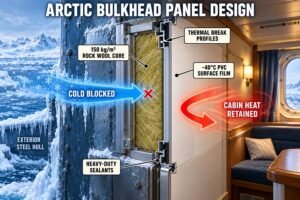
Yes, aluminum honeycomb core panels stay perfectly flat under long-term thermal cycling from -40°C to +80°C. They maintain flatness because the open honeycomb structure allows internal air to balance pressure, and the symmetrical facing skins prevent the bowing or cupping seen in solid core panels.
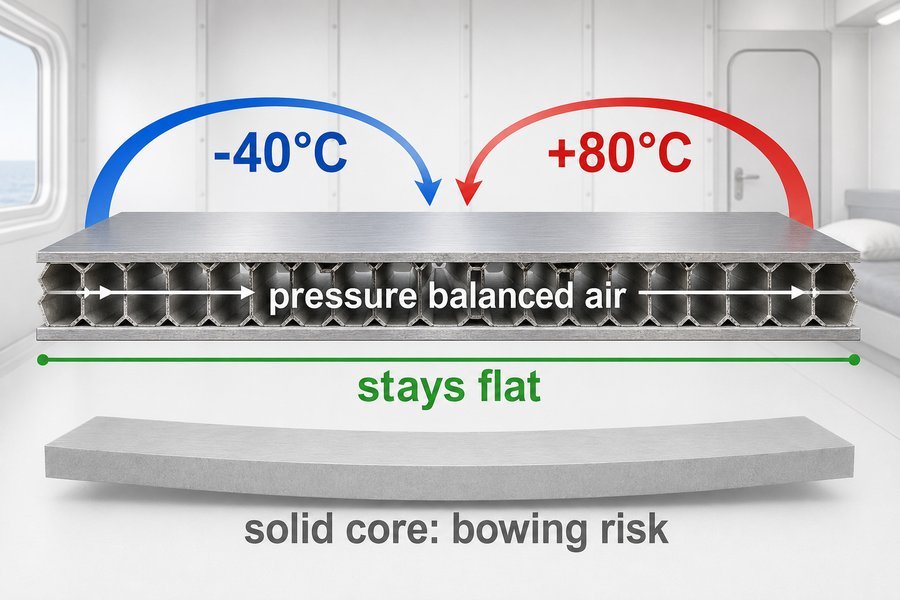
If you work on ships sailing near Russia or Canada, the outside steel gets very cold. But the inside of the cabin is warm. This temperature difference causes cheap panels to bend like a banana.9 We call this bowing or warping. Warped walls make the whole interior look terrible. Shipowners will refuse to pay you if the walls are not straight. I always recommend aluminum honeycomb panels for this exact reason. They stay perfectly flat, no matter how hot or cold the ship gets over its 25-year life.
How Internal Air Pressure Balance Prevents Panel Deformation
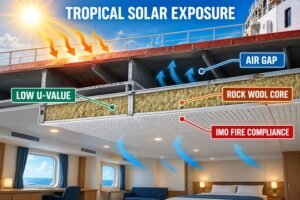
The biggest secret to keeping a panel flat is air pressure. Solid foam panels trap air bubbles inside. When the temperature reaches +80°C near an engine room or exhaust stack, the trapped gas expands10. The expanding gas pushes out and creates ugly bumps on the wall surface. Aluminum honeycomb panels work differently. The open honeycomb structure allows internal air to balance pressure.11 The air moves freely between the metal cells. When the temperature swings from -40°C in the Arctic to +80°C in the tropics, the pressure inside the panel stays exactly the same as the pressure outside. There is no force pushing the skin outward.
The Role of Symmetrical Facing Skins in Maintaining Flatness
The next reason these panels stay flat is the symmetrical facing skins. If you glue a thick steel sheet on the front and a thin plastic sheet on the back, the panel will warp. The two materials react differently to heat. A good marine honeycomb panel uses the exact same thickness of aluminum skin on both the front and the back. This is called a symmetrical build. When the panel gets hot, the front skin and back skin pull with the exact same force. They cancel each other out.12 This stops the bowing or cupping effect completely.
| Temperature Condition | Flatness Deviation per Meter (Honeycomb) | Visual Result on Cabin Wall | Flatness Deviation (Foam Core) |
|---|---|---|---|
| -40°C (Arctic Conditions) | Less than 0.5 mm | Wall looks perfectly straight | Up to 3.0 mm (Bowing inwards) |
| +25°C (Standard Room Temp) | 0.0 mm | Wall looks perfectly straight | 0.0 mm |
| +80°C (Near Engine/Exhaust) | Less than 0.5 mm | Wall looks perfectly straight | Up to 4.0 mm (Bubbling/Cupping) |
What Thermal Expansion Do Aluminum Honeycomb Core Marine Accommodation Panels Show?
When materials expand too much in the heat, walls buckle and joints break. This causes huge rework costs. Aluminum honeycomb panels expand predictably, keeping your joints tight.
Aluminum honeycomb core panels show a linear thermal expansion coefficient of approximately 23.8 µm/(m·K). For a standard 2.4-meter panel experiencing a 30°C temperature swing, this results in an expansion of just 1.7 millimeters, making it easy to manage with standard marine joint profiles and sealants.
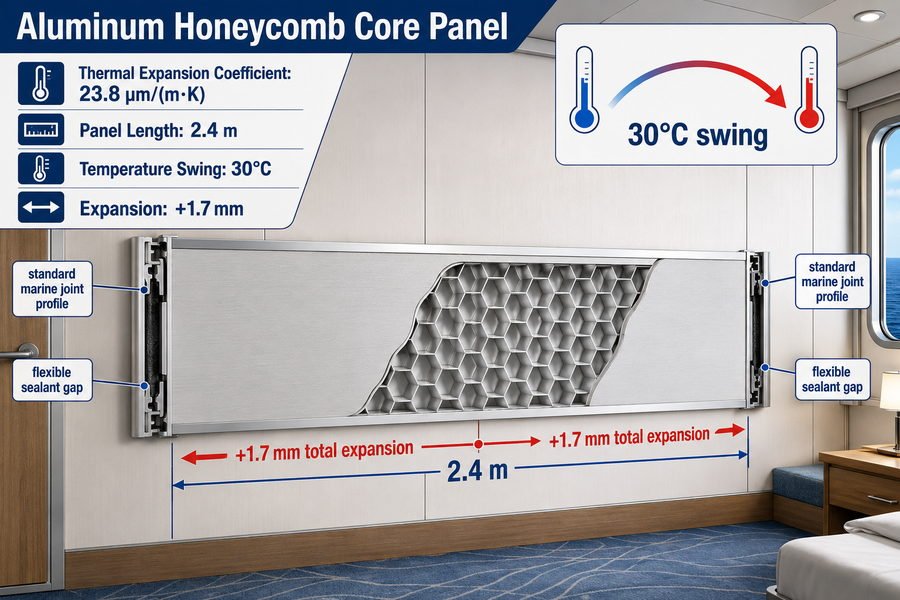
Thermal expansion is a tricky problem. When things get hot, they get bigger. I have seen bad installers push wall panels tight against each other. When the ship sailed to a hot climate, the panels grew, pushed against each other, and popped right off the tracks. You need to know exactly how much the material will grow so you can leave the right size gap. The numbers for aluminum are well-tested and very reliable. Because we know the exact numbers, we can plan the installation perfectly.
Calculating the 23.8 µm/(m·K) Linear Thermal Expansion in Real Cabins
Engineering manuals from the Aluminum Association tell us that standard marine alloys like 3003 or 5052 have a linear thermal expansion coefficient of approximately 23.8 µm/(m·K)13. This means for every meter of length, and every one degree Celsius the temperature goes up, the panel grows by 23.8 micrometers.14 Let us look at a real cabin wall. A standard marine panel is 2.4 meters tall. If the cabin goes from a cold 10°C in port to a warm 40°C in direct sun, that is a 30°C temperature swing. You multiply 23.8 by 2.4 meters, then multiply by 30 degrees. The result is 1.71 millimeters.15
Managing 1.7 Millimeter Expansion Using Marine Joint Profiles
Now that we know the 2.4-meter panel will expand by just 1.7 millimeters, the job becomes easy. 1.7 millimeters is a very small amount of growth. You handle this easily by using standard marine joint profiles. When we install these panels on ships, we leave a 3-millimeter to 5-millimeter gap between every panel. We use an Omega profile or an H-profile joint, and we fill the gap with flexible silicone sealant16. As the panel grows by 1.7 millimeters, it just squeezes the soft silicone a little bit. The wall stays completely safe, and the joints never crack.
| Temperature Swing (°C) | Panel Height | Calculated Total Expansion | Recommended Joint Gap Needed |
|---|---|---|---|
| 10°C change | 2.4 meters | ~0.57 millimeters | 3.0 millimeters |
| 20°C change | 2.4 meters | ~1.14 millimeters | 3.0 millimeters |
| 30°C change | 2.4 meters | ~1.71 millimeters | 3.0 to 5.0 millimeters |
| 50°C change | 2.4 meters | ~2.85 millimeters | 5.0 millimeters minimum |
How Do Aluminum Honeycomb Core Marine Accommodation Panels Resist Mold and Microbial Growth?
Humid sea air causes black mold inside cabin walls. Mold ruins air quality and fails health inspections. Aluminum panels offer no food for mold, keeping cabins clean.
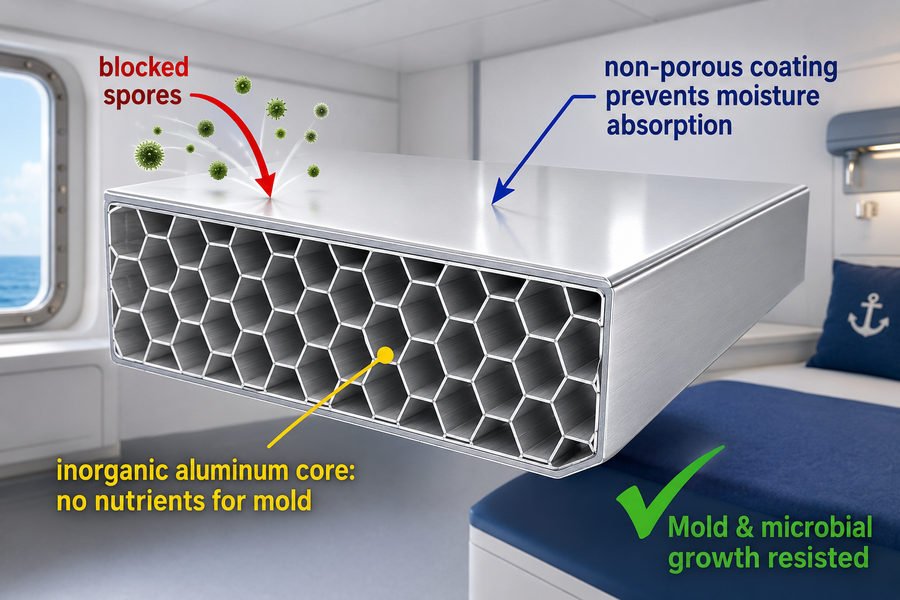
Aluminum honeycomb core panels resist 100% of mold and microbial growth because they lack organic nutrients. They rely on two factors: the inorganic aluminum alloy 3003 core and non-porous surface coatings, which completely prevent spores from taking root, absorbing moisture, or surviving inside the bulkhead.
Nobody wants to sleep in a cabin that smells like dirty water. I know a lot of buyers who had big problems with health inspectors. If an inspector from the US Public Health Service finds black mold on a cruise ship wall, they can stop the ship from sailing17. You lose a lot of money when a ship cannot leave the port. Traditional wood or paper walls give mold exactly what it wants to eat. But you will never have this problem with aluminum panels. They keep the air safe and clean.
The Inorganic Aluminum Alloy 3003 Core Defeats Fungi
Mold is a living thing. To grow, it needs water, air, and food. The food must be an organic nutrient.18 Wood, paper, and natural glue are organic. They are food for mold. The first reason these panels resist 100% of mold is the inorganic aluminum alloy 3003 core. Aluminum is metal. Metal has no carbon nutrients for fungi to eat. According to the ASTM G21 standard test for determining resistance to fungi, aluminum gets a rating of zero. A zero rating means no fungal growth at all. Spores might blow into the wall cavity from the air conditioning, but they will starve and die.
How Non-Porous Surface Coatings Block Moisture and Spores
The core is only half of the story. The outside of the panel is just as important. The second factor is the non-porous surface coatings used on marine panels. We usually finish the metal skin with a baked PVC film or a tough epoxy paint. These finishes are completely smooth and non-porous. This means water cannot soak into the surface.19 Spores cannot find tiny holes to take root. Even if a crew member spills coffee or water on the wall, the liquid just runs down to the floor. Without trapped moisture and without food, mold simply cannot exist on these panels.
| Panel Material Type | Organic Nutrient Source? | ASTM G21 Fungal Growth Rating | Risk of Failing Health Inspections |
|---|---|---|---|
| Paper Honeycomb | Yes (Cellulose) | 4 (Heavy Growth) | High Risk |
| Plywood Panel | Yes (Wood Fibers) | 3 to 4 (Moderate to Heavy) | High Risk |
| Aluminum Honeycomb | No (Inorganic Metal) | 0 (No Growth) | Zero Risk |
Which Aging Tests Predict Aluminum Honeycomb Core Marine Accommodation Panel Durability?
You cannot afford to guess if a panel will last 20 years. Unproven panels fail at sea. Standardized aging tests prove these honeycomb panels will survive harsh oceans.
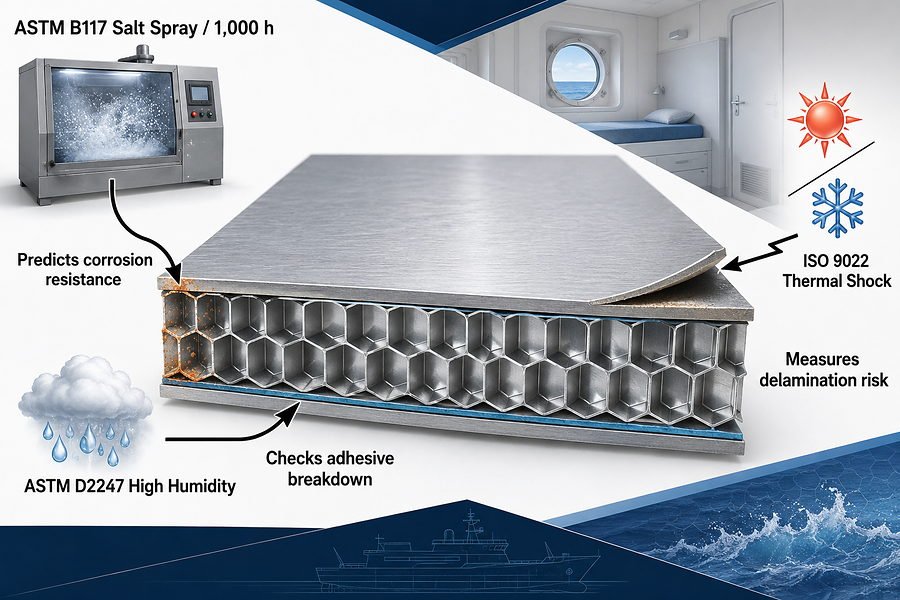
Three critical aging tests predict aluminum honeycomb panel durability: the ASTM B117 salt spray test (evaluating corrosion resistance over 1,000 hours), the ASTM D2247 high-humidity test (checking adhesive breakdown), and the ISO 9022 thermal shock test (measuring delamination risk during rapid hot-to-cold shifts).
When a factory tells you their product will last for 25 years, do not just believe them. You must ask for the test reports. As a marine outfitting specialist, I look at testing certificates every day. The ocean is an ugly environment for building materials. Salt eats metal, humidity destroys glue, and fast temperature changes rip materials apart. We rely on independent laboratory tests to show us how a panel will react over decades of use. I tell all my buyers to look for three specific tests on the product data sheet.
Predicting Corrosion with the ASTM B117 1,000-Hour Salt Spray Test
The first major test is the ASTM B117 salt spray test. This checks the corrosion resistance. The laboratory puts the aluminum panel inside a hot, sealed box. They spray a fog of 5% sodium chloride (saltwater) onto the panel at 35°C. They do this continuously for 1,000 hours. This simulates years of harsh sea breezes hitting the panel.20 A good marine aluminum honeycomb panel will pass 1,000 hours without rusting, blistering, or losing its paint. If the test report shows red rust or white powdery corrosion early, do not buy that panel.
Testing Adhesives with ASTM D2247 Humidity and ISO 9022 Thermal Shock
The next tests check the glue holding the panel together. The ASTM D2247 high-humidity test puts the panel in 100% relative humidity at 38°C for weeks. This is to check for adhesive breakdown. If the glue is cheap, the water vapor will melt it, and the panel skins will fall off. Finally, there is the ISO 9022 thermal shock test. They freeze the panel, then immediately blast it with heat. This measures the delamination risk during rapid hot-to-cold shifts.21 Because the aluminum honeycomb uses elastic polyurethane glue, it stretches. Good panels pass all these tests, proving they will survive the ocean.
| Testing Standard Code | Purpose of the Aging Test | Duration / Parameters | What a Passing Result Means for the Ship |
|---|---|---|---|
| ASTM B117 | Evaluates corrosion resistance | 1,000 hours in 5% salt fog at 35°C | Metal will not rust or rot from ocean salt air |
| ASTM D2247 | Checks adhesive breakdown | 100% relative humidity at 38°C | Wall will not fall apart in wet, steamy bathrooms |
| ISO 9022 | Measures delamination risk | Rapid shifts from freezing to +80°C | Panel layers will stay glued together in any climate |
Conclusion
Aluminum honeycomb panels solve your worst shipyard headaches. They provide decades of durable, flat, and clean cabin walls, saving you massive replacement costs and protecting your project profits.
-
"[PDF] glossary - I Absorption The gain of free water by the cell cavities ...", https://ucanr.edu/sites/default/files/2013-08/172258.pdf. Wood-based panels are hygroscopic materials that exchange moisture with humid air, and elevated moisture content can contribute to swelling, biological decay, and loss of dimensional stability in service. Evidence role: mechanism; source type: education. Supports: Plywood used in damp marine interiors can absorb moisture from humid sea air.. Scope note: This supports the moisture-uptake mechanism for plywood generally; it does not by itself establish a specific marine service-life interval. ↩
-
"[PDF] Beneficial Use Potential of Mineral Wool Waste - NYC.gov", https://www.nyc.gov/assets/ddc/downloads/town-and-gown/Mineral%20Wool.pdf. Mineral wool insulation can retain water when exposed to moisture, and water retention may increase weight and reduce installed performance; this provides contextual support for moisture-related sagging concerns in panel assemblies. Evidence role: mechanism; source type: paper. Supports: Moisture exposure can make mineral wool heavier and contribute to sagging or performance loss over time.. Scope note: The source should support moisture retention and performance effects in mineral wool, but may not directly verify the article’s 10–15 year timeframe or the exact failure mode inside marine wall panels. ↩
-
"Aluminum honeycomb - Wikipedia", https://en.wikipedia.org/?title=Aluminum_honeycomb&redirect=no. Aluminum is an inorganic metallic material and aluminum honeycomb cores consist of open or bonded metal cell structures rather than organic fibers, supporting the claim that they are not subject to biological rot and do not absorb water in the manner of wood-based cores. Evidence role: definition; source type: encyclopedia. Supports: Aluminum honeycomb cores are non-organic metal structures that do not absorb water or rot like wood-based materials.. Scope note: This supports the material-property distinction; it does not prove that a finished panel cannot trap moisture at joints, skins, adhesives, or damaged edges. ↩
-
"What Are Aluminum Honeycomb Panels?", https://magellanmarinetech.com/what-are-aluminum-honeycomb-panels/. Marine classification and materials references indicate that aluminum alloys and aluminum honeycomb sandwich structures are widely used where corrosion resistance and high stiffness-to-weight performance are required; this supports the plausibility of long service life under appropriate marine design and maintenance conditions. Evidence role: general_support; source type: institution. Supports: Aluminum honeycomb core panels can plausibly achieve a 20–25 year service life in marine interiors when properly specified and maintained.. Scope note: This is contextual support for durability and marine suitability, not direct proof that every aluminum honeycomb interior panel will last 20–25 years in service. ↩
-
"Estimation of hull girder vertical bending moments including non ...", http://ui.adsabs.harvard.edu/abs/2009PIMEM.223..377P/abstract. A naval-architecture reference should be cited to document that wave loading produces longitudinal hull-girder bending, commonly described as hogging and sagging, in ships at sea. Evidence role: mechanism; source type: education. Supports: Large ocean waves can cause a steel ship hull to bend, producing hull deflection.. Scope note: This supports the general mechanism of hull bending under waves, but it does not quantify deflection for a specific cargo ship or sea state. ↩
-
"[PDF] Vibration Fatigue of Leaded Solder Joint Interconnects for PCB ...", https://open.clemson.edu/cgi/viewcontent.cgi?article=5149&context=all_theses. A structural-fatigue or marine-vibration study should be cited to show that cyclic vibration and imposed displacement can initiate cracking or joint failure in stiff, constrained assemblies. Evidence role: mechanism; source type: paper. Supports: Rigid panels fixed to a moving ship structure can crack or suffer joint opening under vibration and hull movement.. Scope note: Such evidence would support the general fatigue mechanism; it may not directly test the exact interior panel system described in the article. ↩
-
"Sandwich Structures Failure Modes and Their Prevention", https://nescacademy.nasa.gov/video/0284e3f6685746b5879f5fd99773640a1d. A peer-reviewed sandwich-structure source should be cited to explain that hexagonal honeycomb cores resist shear loads through their cell-wall geometry and are widely used to provide high stiffness-to-weight performance. Evidence role: mechanism; source type: paper. Supports: The hexagonal cell structure of aluminum honeycomb panels contributes to high shear strength and fatigue resistance.. Scope note: This supports the structural principle of honeycomb cores, not the performance of every aluminum honeycomb panel in marine installation conditions. ↩
-
"[PDF] Experimental investigation on flexural behavior and energy ...", https://digitalcommons.usu.edu/cgi/viewcontent.cgi?article=1228&context=mae_facpub. A materials-testing paper or neutral technical database should be cited to document that comparable aluminum honeycomb cores can have shear yield or shear strength values in the low-megapascal range, including values near 1.5–2.5 MPa. Evidence role: statistic; source type: paper. Supports: Aluminum honeycomb cores used in panels can have structural yield or shear strength values around 1.5 to 2.5 MPa.. Scope note: Reported strength varies with alloy, foil thickness, cell size, density, bonding method, and loading direction, so the range should not be treated as universal for all marine panels. ↩
-
"[PDF] thermal bowing testing of precast concrete sandwich wall", https://digitalcommons.usu.edu/cgi/viewcontent.cgi?article=4624&context=cee_facpub. Mechanics literature on layered and sandwich panels explains that temperature gradients and mismatched coefficients of thermal expansion can generate thermal stresses and curvature in panels. Evidence role: mechanism; source type: paper. Supports: A temperature difference across or within panel materials can cause bowing or warping.. Scope note: This supports the general deformation mechanism, but not the article’s qualitative claim that panels bend severely or that only low-cost panels are affected. ↩
-
"Stellar Structure", https://pages.uoregon.edu/jschombe/ast122/lectures/lec12.html. Thermodynamics references describing the ideal gas law show that, at approximately constant volume, increasing gas temperature increases internal pressure. Evidence role: mechanism; source type: education. Supports: Gas trapped in closed cells or voids expands or increases pressure when heated.. Scope note: This supports the pressure mechanism in trapped gas, but does not by itself prove that a specific foam-core marine panel will blister at +80°C. ↩
-
"[PDF] Examining Rapid Depressurization of Honeycomb Panels", https://tfaws.nasa.gov/wp-content/uploads/TFAWS23-AE-3-Paper.pdf. Technical literature on vented honeycomb sandwich structures notes that connected or vented honeycomb cells can permit pressure equalization and reduce pressure differentials across face sheets. Evidence role: mechanism; source type: research. Supports: Open or vented honeycomb cores can help equalize internal and external air pressure.. Scope note: This support applies only to honeycomb cores with open or vented pathways; sealed honeycomb cells may not equalize pressure in the same way. ↩
-
"[PDF] effect of structural variations on thermal deformation of single ...", https://mavmatrix.uta.edu/cgi/viewcontent.cgi?article=1986&context=mechaerospace_theses. Composite and sandwich-panel theory describes how symmetric laminates reduce thermally induced bending because balanced face sheets create opposing expansion effects about the mid-plane. Evidence role: mechanism; source type: paper. Supports: Symmetrical facing skins can reduce or prevent thermal bowing in sandwich panels.. Scope note: This supports the engineering principle of symmetric construction, but the phrase “exact same force” depends on identical materials, thicknesses, bonding, temperatures, and constraints. ↩
-
"[PDF] Thermal expansion of aluminum and some aluminum alloys", https://nvlpubs.nist.gov/nistpubs/jres/048/jresv48n3p209_a1b.pdf. Materials handbooks list room-temperature linear thermal expansion coefficients for common aluminum alloys in the range of about 23–24 µm/(m·K), supporting the use of 23.8 µm/(m·K) as an approximate design value. Evidence role: statistic; source type: institution. Supports: Standard marine aluminum alloys such as 3003 or 5052 have a linear thermal expansion coefficient of approximately 23.8 µm/(m·K).. Scope note: The value is alloy- and temperature-dependent, so it should be treated as an approximate coefficient rather than an exact constant. ↩
-
"Thermal expansion - Wikipedia", https://en.wikipedia.org/wiki/Thermal_expansion. Standard engineering references define the linear thermal expansion coefficient as the fractional change in length per unit temperature change, which supports the stated interpretation of µm/(m·K). Evidence role: definition; source type: education. Supports: A coefficient of 23.8 µm/(m·K) means one meter of material changes length by 23.8 micrometers for each 1°C temperature increase.. Scope note: This definition assumes unconstrained, approximately uniform heating and a coefficient valid over the temperature interval considered. ↩
-
"Thermal expansion - Wikipedia", https://en.wikipedia.org/wiki/Thermal_expansion. The linear thermal expansion relation ΔL = αLΔT supports calculating the expected length change of a 2.4 m aluminum panel under a 30°C temperature increase as approximately 1.7 mm when α = 23.8 µm/(m·K). Evidence role: mechanism; source type: education. Supports: A 2.4-meter panel with α = 23.8 µm/(m·K) expands by about 1.71 millimeters over a 30°C temperature increase.. Scope note: The calculation is theoretical and does not account for constraints, fasteners, composite panel layers, or nonuniform solar heating. ↩
-
"[DOC] SECTION 07 9200 - JOINT SEALANTS - LANL Engineering Standards", https://engstandards.lanl.gov/specs/07_9200R5.doc. Building and marine sealant standards classify elastomeric silicone sealants by movement capability, supporting the general claim that suitable silicone sealants can accommodate limited joint movement. Evidence role: general_support; source type: institution. Supports: Flexible silicone sealant can accommodate the small movement caused by panel thermal expansion in a properly designed joint.. Scope note: Such standards support movement capacity for compliant sealants under specified test conditions; they do not by themselves prove that a particular shipboard joint design will remain crack-free in service. ↩
-
"About Vessel Sanitation Program - CDC", https://www.cdc.gov/vessel-sanitation/about/index.html. CDC Vessel Sanitation Program guidance describes federal public-health oversight of cruise ships and identifies circumstances in which an imminent public-health risk may affect a vessel’s ability to sail. Evidence role: historical_context; source type: government. Supports: A US Public Health Service or CDC Vessel Sanitation Program inspection finding can prevent or delay a cruise ship from sailing when it indicates a serious public-health risk.. Scope note: This would support the regulatory context, but it may not prove that visible black mold alone automatically triggers a sailing prohibition in every case. ↩
-
"A Brief Guide to Mold, Moisture and Your Home | US EPA", https://www.epa.gov/mold/brief-guide-mold-moisture-and-your-home. Public-health and building-science sources explain that mold growth generally requires moisture, oxygen, suitable temperature, and an organic food source such as cellulose or other carbon-containing material. Evidence role: mechanism; source type: government. Supports: Mold growth depends on moisture, air, and an organic nutrient source.. Scope note: This is a general biological mechanism and does not establish mold resistance for a specific wall-panel product without product testing. ↩
-
"Improving the Barrier Properties of Paper to Moisture, Air, and ... - PMC", https://pmc.ncbi.nlm.nih.gov/articles/PMC9609131/. Materials-science and coatings references describe cured epoxy coatings and PVC films as low-porosity barrier layers that can reduce liquid-water penetration into protected substrates. Evidence role: mechanism; source type: paper. Supports: Baked PVC film or epoxy paint can function as a low-porosity moisture barrier on panel surfaces.. Scope note: The support is contextual; actual water resistance depends on coating formulation, thickness, seams, scratches, and installation quality. ↩
-
"[PDF] Modification of ASTM Standard B117 Salt Spray Corrosion Test for ...", https://www.waru.edu/sites/default/files/Migrated/CopDocuments/Modification%20of%20ASTM%20Standard%20B117%20Salt%20Spray%20Corrosion%20Test%20for%20Improved%20Correlation%20to%20Field%20Measurements.pdf. Technical discussions of salt-spray testing describe ASTM B117 as an accelerated comparative corrosion exposure, while noting that salt-spray duration does not reliably translate into a precise number of years in natural marine service. Evidence role: general_support; source type: paper. Supports: ASTM B117 is commonly used as an accelerated corrosion exposure related to saline environments, but its results have limited direct correlation with real-world service duration.. Scope note: The evidence can support the idea of accelerated comparative exposure, but it should not be used as direct proof that 1,000 hours equals a defined number of years at sea. ↩
-
"[PDF] DAMAGE AND DAMAGE TOLERANCE OF HIGH TEMPERATURE ...", https://ecommons.cornell.edu/server/api/core/bitstreams/127088cd-2086-462a-8f73-acad127f7a32/content. ISO 9022 covers environmental test methods involving temperature stress for optical and related instruments, supporting the contextual use of rapid temperature-change testing to reveal bond or material weaknesses such as separation between layers. Evidence role: mechanism; source type: institution. Supports: Thermal shock or rapid temperature-change testing can be used to evaluate whether layered assemblies are vulnerable to separation under abrupt temperature changes.. Scope note: ISO 9022 is not specific to aluminum honeycomb panels, so its relevance to delamination risk is contextual and depends on the exact test method and acceptance criteria used by the laboratory. ↩