Are your marine accommodation panels failing shipyard inspections? Navigating complex maritime testing standards is tough. Let me show you exactly how to prove your aluminum honeycomb panels meet the strict rules.
Aluminum honeycomb core marine accommodation panels are validated by mechanical tests like ASTM C365 (flatwise compression), ASTM C273 (shear), ASTM C297 (flatwise tension), and out-of-plane load testing. They also require fire and safety certifications verified by Class Society Type Approvals (DNV, ABS, Lloyd's) alongside thorough Mill Test Certificate material checks.
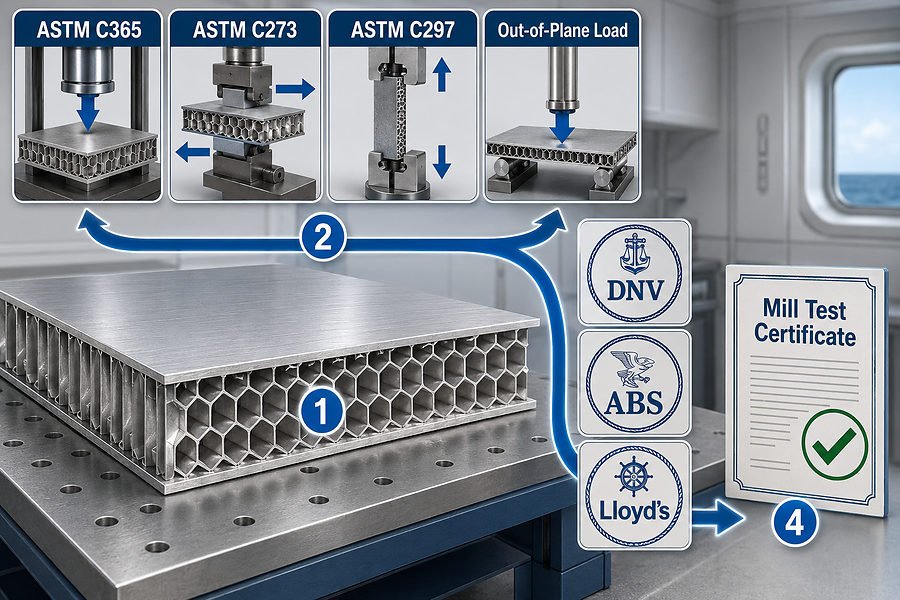
Testing your panels is the only way to avoid project delays. If you do not have the right certificates, shipyards will reject your products. Let us break down the exact mechanical and certification rules you must follow to succeed.
What ASTM C365 Results Qualify Aluminum Honeycomb Core Marine Accommodation Panels?
A weak panel core will ruin your cabin walls. Without passing ASTM C365, your honeycomb will crush easily. Here is the exact test data you need from your supplier.
ASTM C365 measures flatwise compressive strength and modulus for aluminum honeycomb panels. To qualify for standard marine use, core compression strength must exceed 2.0 MPa (290 psi) for 5052 alloy cores. High-load bulkheads require at least 4.1 MPa (600 psi) depending on foil thickness and cell size.
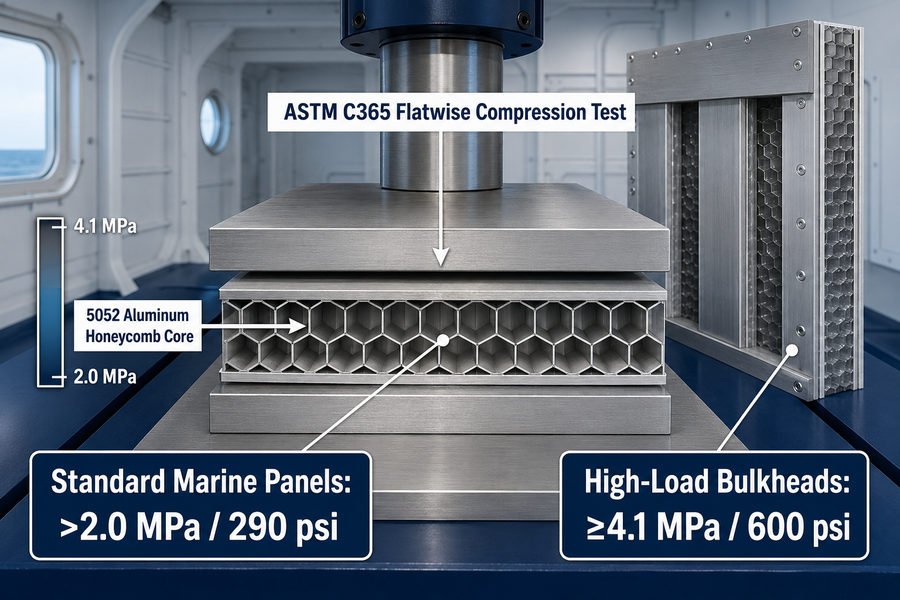
Standard Marine Grade ASTM C365 Requirements for 5052 Alloy Cores
In my time working at a marine outfitting factory, I saw many panels fail the ASTM C365 test. This test pushes straight down on the flat face of the panel. It measures how much weight the core can take before it crushes. For standard cabin partitions, the test result must show a flatwise compressive strength of at least 2.0 MPa (290 psi). We strictly use 5052 aluminum alloy for the core to reach this number. Some cheap factories try to use 3003 alloy to save money. But 3003 alloy often fails to reach 2.0 MPa. When you buy panels for basic room dividers, you must check the test report to ensure the 2.0 MPa minimum is met. If the number is lower, the panels will dent when workers lean on them during installation.
High-Load Bulkhead ASTM C365 Specifications and Variables
Standard panels are not strong enough for every room on a ship. Sometimes you need to build high-load bulkheads. These are walls that support heavy equipment or face high traffic. For these high-load areas, the ASTM C365 test result must reach at least 4.1 MPa (600 psi). To get this higher strength, the factory must change the core structure. They must use a thicker aluminum foil, usually 0.06 mm thick. They also need to make the honeycomb cell size smaller. A smaller cell size means more aluminum walls inside the panel to hold the weight.1 If your project needs high-load walls, you must tell your supplier. Ask them to prove their 4.1 MPa test results before you place the order.
| Application Type | Required Compressive Strength | Recommended Alloy | Typical Foil Thickness | Typical Cell Size |
|---|---|---|---|---|
| Standard Cabin Partitions | 2.0 MPa (290 psi) | 5052 | 0.04 mm | 6.4 mm |
| High-Load Bulkheads | 4.1 MPa (600 psi) | 5052 | 0.06 mm | 4.8 mm |
How Is ASTM C273 Shear Strength Tested on Aluminum Honeycomb Core Marine Accommodation Panels?
If the ship rolls in bad weather, the walls must hold strong. Shear failure makes panels snap in half. This test shows if your panels can handle the ship's movement.
ASTM C273 tests shear properties by bonding the aluminum honeycomb panel to thick steel plates and applying opposing parallel forces. Marine panels must typically achieve a core shear strength of 1.5 MPa (217 psi) to 2.5 MPa (362 psi), proving they can withstand transverse ship vibrations and motions.
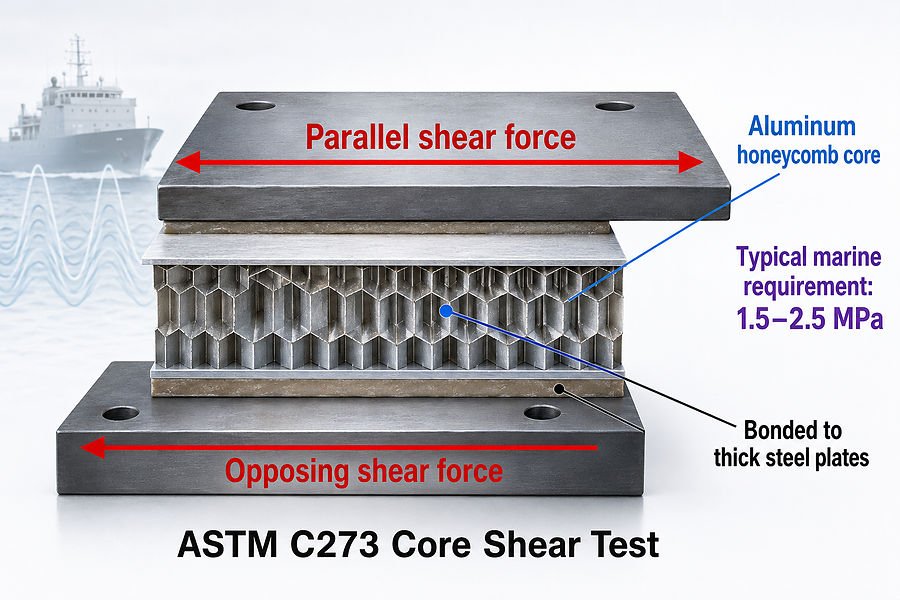
The ASTM C273 Testing Process with Bonded Steel Plates
I want to explain how the lab performs the ASTM C273 test. This test is very different from pushing straight down. The lab takes a sample of the aluminum honeycomb panel and glues it between two thick steel plates. Then, a machine pulls one steel plate up and pulls the other steel plate down. This creates opposing parallel forces. It mimics what happens when a ship twists in heavy waves. The test measures the exact moment the inner honeycomb core tears apart. I always check this test method closely. If the lab uses cheap glue to attach the steel plates, the glue will break before the panel breaks. This gives a false result. The glue must be stronger than the panel itself for the test to be valid.
Required Shear Strength Values for Marine Vibrations and Motions
You need to know the exact numbers to look for on the test report. For marine accommodation panels, the core shear strength must be between 1.5 MPa (217 psi) and 2.5 MPa (362 psi)2. The exact number depends on where the panel is placed on the ship. If the panel is near the engine room, it faces strong transverse vibrations. It needs to reach the 2.5 MPa limit. If the panel is on a higher deck with less vibration, 1.5 MPa is enough. Ships move constantly. If your panels have low shear strength, the internal core will break. Then the wall will bend and the paint will crack. Your shipyard clients will be very angry. Always ask your supplier to show the ASTM C273 shear strength data.
| Ship Location | Vibration Level | Minimum ASTM C273 Shear Strength | Recommended Core Cell Size |
|---|---|---|---|
| Upper Decks / Quiet Zones | Low | 1.5 MPa (217 psi) | 6.4 mm |
| Main Decks / Corridors | Medium | 2.0 MPa (290 psi) | 6.4 mm |
| Near Engine Rooms | High | 2.5 MPa (362 psi) | 4.8 mm |
What Flatwise Tensile Strength Is Required for Aluminum Honeycomb Core Marine Accommodation Panels?
Panels tearing apart under pressure changes is a real nightmare. ASTM C297 tests the glue holding the skin to the core. A bad bond means a ruined panel.
ASTM C297 tests flatwise tensile strength, verifying the bond between the aluminum skin and the honeycomb core. Marine accommodation panels require a minimum flatwise tensile strength of 1.0 MPa (145 psi) up to 2.0 MPa (290 psi) to ensure the face sheets do not peel away.
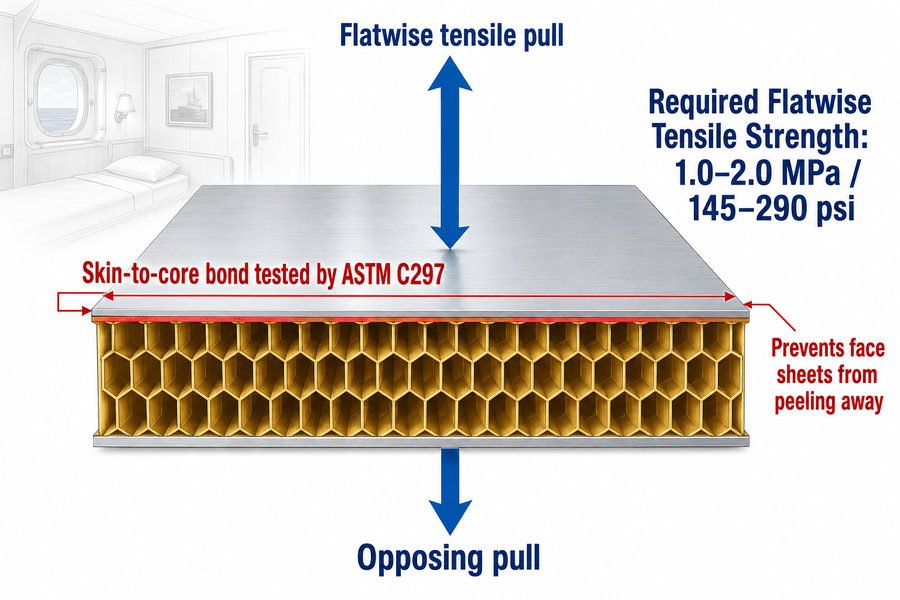
Testing the Skin-to-Core Bond Using ASTM C297
I have seen cheap panels fall apart just from the wind blowing through an open cabin door. This happens because the face sheet peels off the honeycomb core. The ASTM C297 test prevents this. This test pulls the panel apart by pulling the top skin away from the bottom skin. It directly measures the strength of the glue line. For standard marine applications, the flatwise tensile strength must be at least 1.0 MPa (145 psi). For heavy-duty panels, it must reach up to 2.0 MPa (290 psi). If the number is below 1.0 MPa, the factory used poor glue or did not press the panel correctly. You must verify these numbers so the face sheets stay firmly attached for the life of the ship.
Preventing Delamination by Using the Correct Adhesive
When the skin peels away, we call it delamination. To reach the 1.0 MPa to 2.0 MPa tensile strength, the factory must use the right adhesive. During my factory days, we learned that cheap single-component glue is very bad. It dries out and loses strength over time. To pass the ASTM C297 test easily, factories must use a high-quality two-component polyurethane glue or a strong epoxy film. These glues are more expensive. But they form a permanent bond. As a buyer, you must be careful. If a supplier offers you a very low price, they are probably saving money on the glue. This will result in a low flatwise tensile strength. Your panels will delaminate in a few years, and you will lose your customers.
| Adhesive Type | Typical Flatwise Tensile Strength | Delamination Risk | Cost Level |
|---|---|---|---|
| Single-Component Glue | 0.5 MPa - 0.8 MPa | High | Low |
| Two-Component Polyurethane | 1.2 MPa - 1.5 MPa | Low | Medium |
| Epoxy Film | 1.8 MPa - 2.2 MPa | Very Low | High |
What Out-of-Plane Compressive Strength Do Aluminum Honeycomb Core Marine Accommodation Panels Deliver?
Heavy furniture pushing against cabin walls causes ugly dents. Out-of-plane forces attack panels from the side. Here is how much direct impact they can take.
Out-of-plane compressive strength for aluminum honeycomb marine panels ranges from 2.5 MPa (360 psi) for standard 15mm panels to over 5.0 MPa (725 psi) for 25mm heavy-duty partitions. This ensures the panel withstands direct impacts from heavy marine furniture, equipment mounts, and sudden personnel impacts.
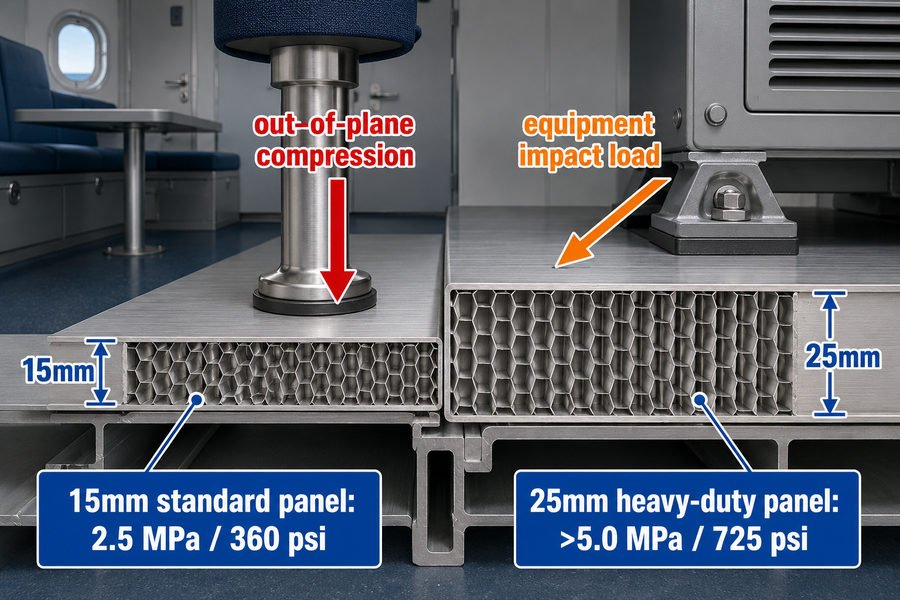
Out-of-Plane Strength for Standard 15mm Marine Partitions
Out-of-plane loads are very common on ships. This means force pushing directly onto the face of the wall. Think about a sailor falling against the wall, or heavy beds bolted to the panel. Standard marine partitions are usually 15mm thick. These 15mm panels must deliver an out-of-plane compressive strength of at least 2.5 MPa (360 psi)3. This strength is enough to handle basic sudden personnel impacts and light furniture. If the panel cannot hold 2.5 MPa, it will bend inward permanently. The surface will show a large dent. Once an aluminum panel dents, you cannot fix it. You have to throw it away and buy a new one. This wastes a lot of money and time.
Heavy-Duty Out-of-Plane Strength for 25mm Marine Partitions
Some areas on the ship need much thicker walls. Corridors, public spaces, and heavy equipment rooms use 25mm thick partitions. Because they hold more weight and face more impacts, these 25mm panels must reach over 5.0 MPa (725 psi) of out-of-plane compressive strength4. They need to support heavy marine furniture, TV mounts, and heavy pipes. To achieve this 5.0 MPa strength, the panel relies on both the thicker core and thicker aluminum face skins. Usually, the face skin is upgraded from 0.7mm to 1.0mm thick. I always tell my clients to double-check these exact strength numbers before ordering. If you use a weak 15mm panel where a 25mm panel is needed, the wall will fail very fast.
| Panel Thickness | Minimum Out-of-Plane Strength | Common Ship Application | Face Skin Thickness |
|---|---|---|---|
| 15mm Standard | 2.5 MPa (360 psi) | Crew Cabins, Bathrooms | 0.7 mm |
| 20mm Medium | 3.5 MPa (500 psi) | Offices, Meeting Rooms | 0.7 mm to 0.8 mm |
| 25mm Heavy-Duty | 5.0 MPa (725 psi) | Corridors, Equipment Rooms | 1.0 mm |
Which Class Society Type Approvals Cover Aluminum Honeycomb Core Marine Accommodation Panels?
Selling marine panels without certificates is completely impossible. Major shipyards demand strict proof of safety. Let us see which approvals matter most for your business.
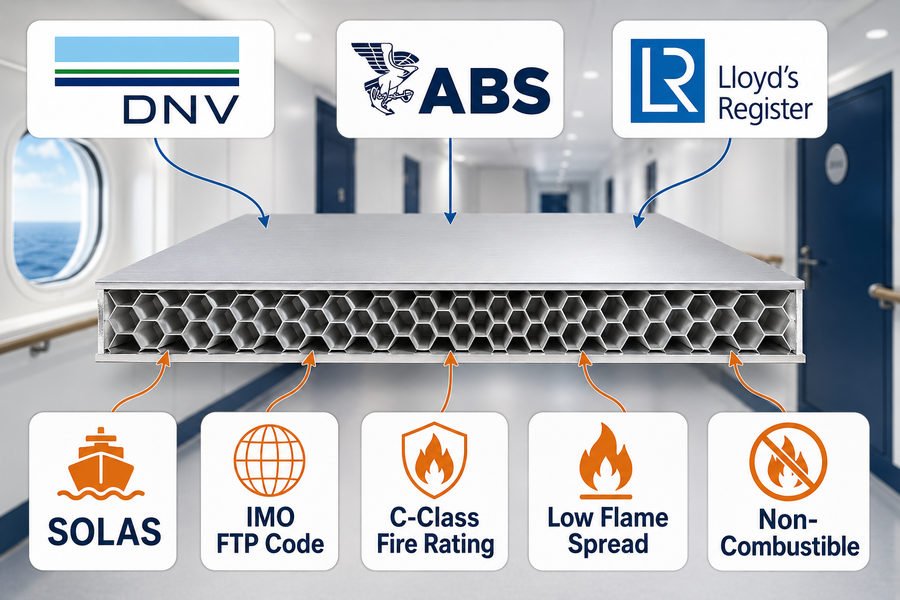
Marine aluminum honeycomb panels require Class Society Type Approvals from major bodies like DNV, ABS, and Lloyd's Register (LR). These approvals certify compliance with SOLAS fire regulations (such as C-Class ratings), low flame spread standards, and non-combustibility rules mandated by the IMO FTP Code.
Key Classification Societies for Marine Aluminum Honeycomb Panels
In the marine business, a product is only as good as its certificate. You cannot just tell a shipyard your panel is safe. You must show them a Type Approval certificate. The three most important classification societies in the world are DNV (Norway/Germany), ABS (United States), and Lloyd's Register or LR (United Kingdom).5 If your factory has Type Approvals from DNV, ABS, or LR, shipyards in Europe and America will trust your product. I have helped many buyers who bought cheap panels with no certificates. Their panels got stuck at the port, and the shipyard refused to pay them. When you look for a supplier in Asia, you must ask to see their valid DNV, ABS, or LR certificates before you talk about price.
Fire Safety Ratings and IMO FTP Code Compliance
Class society approvals do not just check panel strength. They focus heavily on fire safety. Marine aluminum honeycomb panels must comply with SOLAS fire regulations.6 Most pure aluminum honeycomb panels get a C-Class fire rating. A C-Class rating means the panel will not produce too much smoke, but it does not stop heat. Sometimes, if the panel is combined with ceramic wool, it can pass as a B-15 rating. The approvals also test for low flame spread and non-combustibility rules. These rules are written in the IMO FTP Code. Specifically, the aluminum and the glue must pass IMO FTP Code Part 1 and Part 5. These tests prove the panel will not catch fire easily and will not release toxic smoke if it burns.
| Classification Society | Region of Origin | Common Fire Rating for Bare Panels | Applicable IMO FTP Code Parts |
|---|---|---|---|
| DNV | Norway / Germany | C-Class | Part 1, Part 5 |
| ABS | United States | C-Class | Part 1, Part 5 |
| Lloyd's Register (LR) | United Kingdom | C-Class | Part 1, Part 5 |
How to Verify Mill Test Certificates for Aluminum Honeycomb Core Marine Accommodation Panels?
Fake material grades can ruin your reputation fast. A Mill Test Certificate proves your raw aluminum is real and strong. Here is how to check it properly.
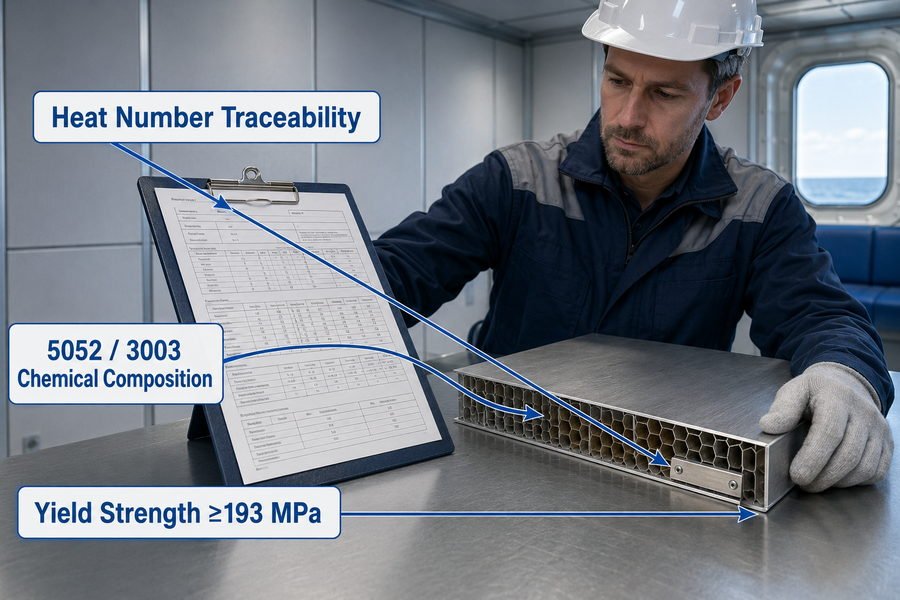
Verify a Mill Test Certificate (MTC) for marine panels by checking three main areas: the heat number for traceability, the chemical composition to ensure it matches 5052 or 3003 aluminum alloy standards, and the mechanical properties confirming the yield strength meets the minimum 193 MPa.
Checking Traceability and Heat Numbers on the MTC
A Mill Test Certificate, or MTC, is the birth certificate of the raw aluminum. It comes from the metal factory, not the panel factory. The first thing I look at is the heat number. The heat number is a code printed on the paper. This same code must be printed directly on the aluminum rolls used to make your panels. This gives you traceability.7 If the paper has a heat number, but the aluminum in the factory has no numbers, the MTC is likely fake. Fake certificates are a big problem. You must match the heat number on the document to the physical material. This proves the factory is using the exact metal they claim to be using.
Validating Chemical Composition and Alloy Standards
The next step is to check the chemical composition section on the MTC. The numbers on the paper must match the standards for 5052 or 3003 aluminum alloy. For marine use, 5052 alloy is the best choice.8 On the MTC, a true 5052 alloy will show a Magnesium (Mg) content between 2.2% and 2.8%9. It will also show a Chromium (Cr) content between 0.15% and 0.35%. If the Magnesium is lower than 2.2%, the material is not 5052. It will rust faster in the salty ocean air. I always review these exact percentages. You do not need to be a scientist. Just take the standard 5052 chemical limits and compare them directly to the numbers on the MTC document.
Confirming Mechanical Properties for Marine Application
Finally, you must check the mechanical properties on the MTC. The chemical mix is only half the story. The metal must also be cooked and stretched correctly to become strong. Look for the "Yield Strength" row on the test report. For marine-grade 5052-H32 aluminum, the minimum yield strength must be 193 MPa (28,000 psi)10. This number proves the metal can bend without breaking. If the yield strength is lower than 193 MPa, the aluminum is too soft. It will tear during the manufacturing process. By checking the heat number, the chemical percentages, and the 193 MPa yield strength, you can be 100% sure your panels are made from safe, high-quality materials.
| MTC Verification Area | Key Parameter to Check | Required Value for 5052-H32 | Purpose |
|---|---|---|---|
| Traceability | Heat Number / Lot Number | Must match physical label | Proves document authenticity |
| Chemical Composition | Magnesium (Mg) Content | 2.2% to 2.8% | Ensures corrosion resistance |
| Mechanical Properties | Minimum Yield Strength | 193 MPa (28,000 psi) | Ensures structural durability |
Conclusion
Aluminum honeycomb marine panels rely on strict ASTM mechanical tests, MTC verification, and Class Society approvals to ensure safety. Meet these exact standards to keep your shipyard clients completely satisfied.
-
"Impact of core cell size on selected properties of honeycomb ...", https://bioresources.cnr.ncsu.edu/resources/impact-of-core-cell-size-on-selected-properties-of-honeycomb-paperboard/. Research on honeycomb sandwich cores shows that out-of-plane compressive strength is strongly related to core geometry and relative density, including cell-wall thickness and cell size; thicker walls and smaller cells generally increase load-bearing area. Evidence role: mechanism; source type: paper. Supports: Increasing aluminum honeycomb foil thickness and reducing cell size can improve flatwise compressive strength.. Scope note: Such sources support the mechanical relationship between geometry and compressive strength, but may not directly validate the specific 0.06 mm foil or 4.8 mm cell-size values for a given marine product. ↩
-
"How to choose the right marine wall panels for marine interior ...", https://magellanmarinetech.com/how-choose-right-marine-wall-panels-for-marine-interior-projects/. A classification-society rule, marine material standard, or peer-reviewed source should be cited if these values are intended as acceptance thresholds for marine accommodation panels; otherwise, available sources may only show that sandwich-core shear strength is a design-dependent property rather than a universal requirement. Evidence role: statistic; source type: institution. Supports: Marine accommodation panels require ASTM C273 core shear strength values in the 1.5–2.5 MPa range depending on ship location.. Scope note: The cited source must be checked carefully because shear-strength requirements can vary by vessel type, panel construction, approval regime, and location; contextual material-property data would not directly prove these exact minimums. ↩
-
"How to choose the right marine wall panels for marine interior ...", https://magellanmarinetech.com/how-choose-right-marine-wall-panels-for-marine-interior-projects/. Marine panel type-approval data or a classification-society test report reporting out-of-plane compression performance for 15 mm accommodation panels would support the stated 2.5 MPa threshold as a technical specification for that panel class. Evidence role: statistic; source type: institution. Supports: Standard 15 mm marine partition panels require at least 2.5 MPa out-of-plane compressive strength.. Scope note: This would substantiate the value for the tested or specified panel type, but not prove that 2.5 MPa is a universal regulatory minimum for all 15 mm marine partitions unless the source states that explicitly. ↩
-
"[PDF] Mechanical Properties of Wood-Based Composite Materials", https://www.fpl.fs.usda.gov/documnts/fplgtr/fplgtr190/chapter_12.pdf. Engineering literature or classification/type-approval documentation on sandwich marine partition panels can show how increased panel thickness and face-sheet thickness are associated with higher out-of-plane or flexural load capacity, giving contextual support for a higher strength specification for 25 mm panels. Evidence role: general_support; source type: paper. Supports: Heavy-duty 25 mm marine partitions should exceed 5.0 MPa out-of-plane compressive strength.. Scope note: Such evidence may support the mechanical rationale and comparable performance ranges, but it would only directly verify the 5.0 MPa figure if the source reports that exact threshold for 25 mm marine partitions. ↩
-
"International Association of Classification Societies - Wikipedia", https://en.wikipedia.org/wiki/International_Association_of_Classification_Societies. The International Association of Classification Societies identifies DNV, ABS, and Lloyd’s Register as member classification societies, supporting their status as internationally recognized bodies in ship classification. Evidence role: general_support; source type: institution. Supports: DNV, ABS, and Lloyd's Register are among the key internationally recognized classification societies relevant to marine product approval.. Scope note: This supports their recognized international role but does not independently prove that they are the three ‘most important’ classification societies by every possible metric. ↩
-
"What Is the Purpose and Scope of the IMO FTP Code? - Magellan ...", https://magellanmarinetech.com/what-purpose-scope-of-imo-ftp-code/. The IMO’s SOLAS fire-safety framework and the International Code for Application of Fire Test Procedures establish fire-test requirements for materials and divisions used on ships, including tests for non-combustibility and surface flammability. Evidence role: general_support; source type: institution. Supports: Marine aluminum honeycomb panels used in regulated ship applications may need to meet SOLAS and IMO FTP Code fire-safety requirements.. Scope note: The source supports the regulatory framework for shipboard fire testing; exact applicability depends on the vessel, flag administration, class rules, and where the panel is installed. ↩
-
"Heat number - Wikipedia", https://en.wikipedia.org/wiki/Heat_number. A standards or quality-assurance source on metallic-material inspection documents supports that heat or lot identifiers link test certificates to a specific production batch, enabling material traceability through purchasing and manufacturing records. Evidence role: general_support; source type: institution. Supports: Matching the heat number on the MTC to the physical aluminum material provides traceability.. Scope note: Such a source would support the traceability function of heat or lot numbers, but it would not by itself prove whether any individual certificate is genuine or fake. ↩
-
"[PDF] Corrosion of Bare and Coated Al 5052-H3 and Al 6061-T6 in Seawater", https://www.hnei.hawaii.edu/wp-content/uploads/Corrosion-of-Aluminum-Alloys-in-Seawater.pdf. A corrosion or materials-engineering source supports that 5052 aluminum is widely used in marine environments because its magnesium-containing composition provides relatively good resistance to seawater and salt-atmosphere corrosion. Evidence role: expert_consensus; source type: education. Supports: 5052 aluminum is suitable or preferred for many marine uses because of its corrosion resistance.. Scope note: This contextual evidence supports 5052 as a common corrosion-resistant marine alloy, but it does not prove that it is the single best choice for every marine application. ↩
-
"5052 aluminium alloy - Wikipedia", https://en.wikipedia.org/wiki/5052_aluminium_alloy. An alloy specification source supports that Aluminum Association alloy 5052 has a magnesium composition range of about 2.2–2.8% and a chromium range of about 0.15–0.35%, which can be compared against an MTC chemical analysis. Evidence role: definition; source type: institution. Supports: A true 5052 aluminum alloy should show Mg content of 2.2%–2.8% and Cr content of 0.15%–0.35% on the MTC.. Scope note: The cited composition limits verify alloy designation requirements, not the accuracy of a particular mill’s chemical test results. ↩
-
"5052 aluminium alloy - Wikipedia", https://en.wikipedia.org/wiki/5052_aluminium_alloy. A material specification or engineering data source supports that 5052-H32 aluminum sheet has a specified minimum yield strength of approximately 193 MPa, or 28 ksi, under relevant product standards. Evidence role: statistic; source type: institution. Supports: Marine-grade 5052-H32 aluminum should meet a minimum yield strength of 193 MPa, or 28,000 psi.. Scope note: Mechanical-property minima can vary by product form, thickness, temper definition, and governing standard, so the citation should match the material form used for the panels. ↩