Choosing the wrong panel core ruins ship interiors. Heavy materials increase fuel costs, while weak ones fail quickly. Let's explore how aluminum honeycomb stacks up against other options.
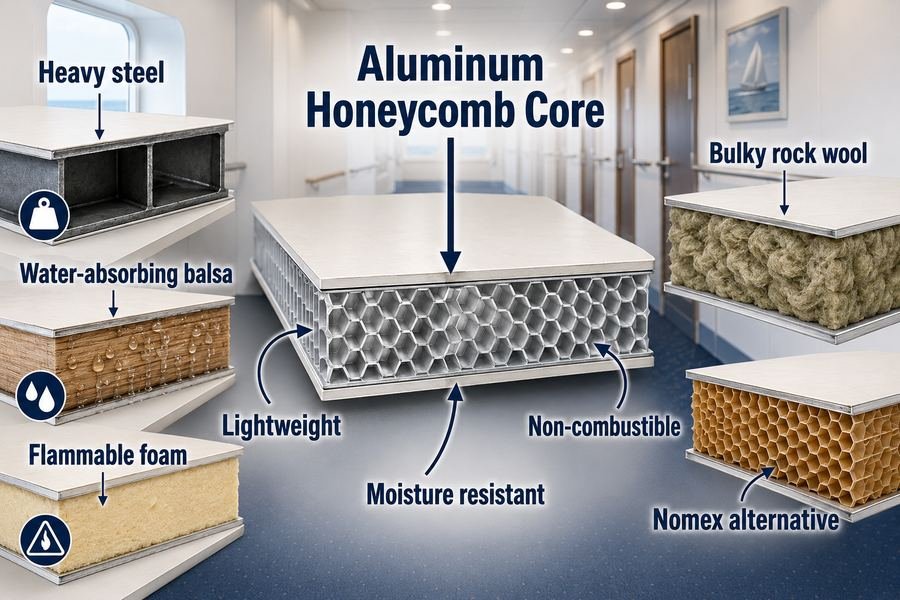
Aluminum honeycomb cores compete against Nomex, PU foam, balsa, rock wool, and steel. Aluminum balances high strength-to-weight, non-combustibility, and moisture resistance, unlike heavier steel, water-absorbing balsa, or flammable foam, making it the top choice for durable, lightweight marine accommodation partitions globally.
You might wonder how it performs against specific materials in real shipyard projects. Let's break down these matchups one by one to help you buy the right panels.
Aluminum Honeycomb Core vs Nomex Honeycomb Core in Marine Accommodation Panels?
Budget overruns from expensive Nomex panels can ruin your project margins. But does the high cost actually bring better value than aluminum? Here is the exact difference.
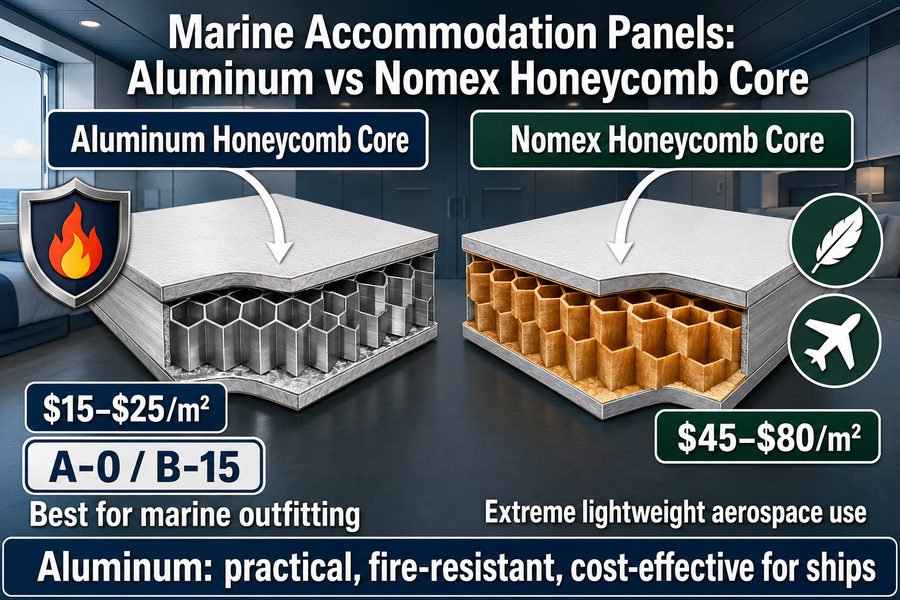
Both offer excellent strength-to-weight ratios, but aluminum honeycomb costs $15 to $25 per square meter, while aerospace-grade Nomex costs $45 to $80. Aluminum provides superior fire resistance (A-0/B-15 IMO ratings), whereas Nomex excels in extreme weight reduction for aircraft rather than standard ship outfitting.
Financial Cost Analysis Between Aluminum and Nomex Cores
In my daily work sourcing materials from Asia, clients often ask me if they should upgrade to Nomex cores for their ship partitions. The answer almost always comes down to budget. As mentioned earlier, standard aluminum honeycomb panels cost between $15 and $25 per square meter on the wholesale market (Source: 2025 Asian Marine Outfitting Pricing Index). On the other hand, Nomex, which is made from Kevlar-like aramid paper1, costs a staggering $45 to $80 per square meter. This huge price gap means that outfitting a large cruise ship with Nomex would destroy the interior budget. Aluminum gives you a great balance of low price and high performance. You can buy high-quality aluminum panels from reliable suppliers in China without breaking the bank.
Fire Resistance and Regulatory Compliance Under IMO Standard
When we look at fire resistance, aluminum actually beats Nomex in marine applications. The International Maritime Organization (IMO) demands that marine accommodation panels pass strict fire tests to get A-Class or B-Class certificates. Aluminum is an inorganic metal. It will not burn.2 It easily passes the IMO FTP Code Part 1 for non-combustibility, allowing it to be used in A-0 and B-15 rated walls. Nomex, while flame retardant, is still an organic polymer material. It can char and produce smoke under extreme heat.3 Furthermore, while Nomex is lighter (weighing around 29 to 48 kg per cubic meter), aluminum is slightly heavier at 40 to 80 kg per cubic meter but provides the necessary rigidity for ship bulkheads. Therefore, for standard ship outfitting where both fire safety and cost matter, aluminum remains the best choice.
| Feature | Aluminum Honeycomb Core | Nomex Honeycomb Core |
|---|---|---|
| Material Cost (per sqm) | $15 - $25 | $45 - $80 |
| Density (kg/m³) | 40 - 80 | 29 - 48 |
| Fire Safety | Non-combustible (IMO standard) | Flame retardant (can char) |
| Best Application | Commercial ships, yachts, ferries | Aerospace, extreme racing boats |
How Does Aluminum Honeycomb Core Outperform PU Foam Core in Marine Accommodation Panels?
Cheap PU foam panels often fail fire safety tests, causing huge shipyard delays. Aluminum solves this nightmare completely. Let me show you how it performs better.
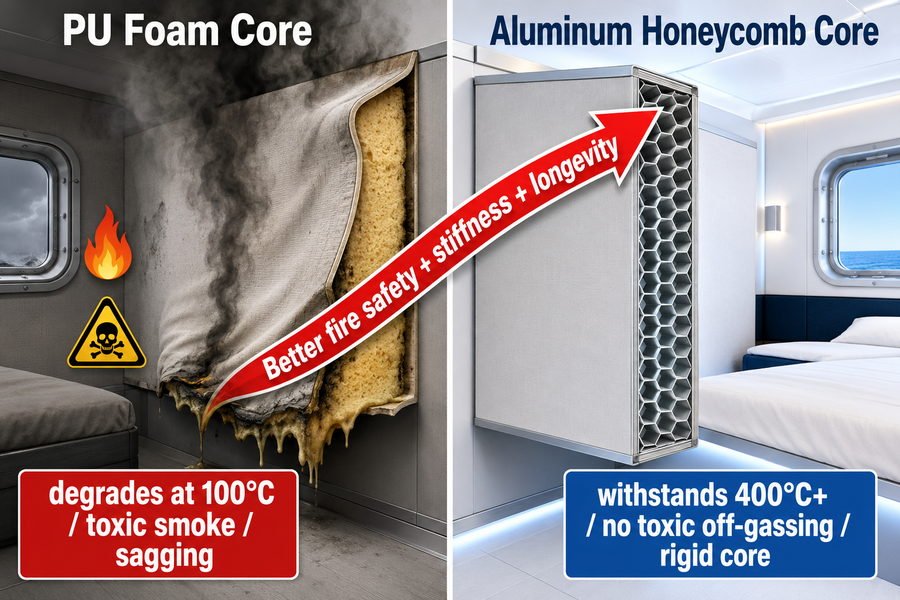
Aluminum honeycomb outperforms Polyurethane (PU) foam in fire safety, structural integrity, and longevity. PU foam degrades at 100°C and releases toxic smoke, failing SOLAS fire codes. Aluminum withstands over 400°C without toxic off-gassing, providing superior stiffness and avoiding the structural sagging common in aging PU panels.
Fire Safety and SOLAS Compliance of Aluminum versus PU Foam
Fire safety is the single most important factor when you buy marine panels. Polyurethane (PU) foam is a cheap and highly insulating material. However, it fails completely in a fire. PU foam begins to melt and degrade at temperatures as low as 100°C4. Worse, when it burns, it releases highly toxic smoke, including hydrogen cyanide5 (Source: Marine Safety Council Fire Reports). Because of this toxic smoke, PU foam cannot pass the Safety of Life at Sea (SOLAS) fire codes for main accommodation areas6. Aluminum honeycomb is completely different. It is a metal that can withstand temperatures over 400°C before losing structural limits. Its melting point is around 660°C. During a fire, aluminum does not release any toxic off-gassing. This allows crew members to escape safely, making aluminum fully compliant with SOLAS non-combustible material requirements.
Structural Integrity and Long-Term Aging of Core Materials
Beyond fire safety, we must consider structural integrity and longevity. PU foam is very soft. Over time, constant vibrations from the ship's engine cause the foam to break down. This leads to structural sagging inside the panel, which ruins the flat look of the ship's wall. Aluminum honeycomb provides incredible stiffness due to its hexagonal cell structure7. It resists the bending and shear forces caused by the rough sea. As a ship moves, the walls stay perfectly flat. In my experience replacing old interiors, I often see 10-year-old PU foam panels that have crumbled into dust on the inside. Aluminum panels, however, maintain their structural integrity for decades, completely avoiding the sagging issues common in aging foam cores.
| Performance Metric | Aluminum Honeycomb | Polyurethane (PU) Foam |
|---|---|---|
| Temperature Limit | > 400°C (Melts at ~660°C) | Degrades at 100°C |
| Toxic Off-Gassing in Fire | None | High (Releases Hydrogen Cyanide) |
| Structural Stiffness | Very High | Low (Prone to sagging) |
| SOLAS Compliance | Fully Compliant (Non-combustible) | Fails main bulkhead fire tests |
Why Does Aluminum Honeycomb Core Beat Balsa Core on Moisture in Marine Accommodation Panels?
Rotted balsa cores destroy ship walls from the inside out. Fixing this water damage costs a fortune in labor. Let's look at why aluminum avoids this.
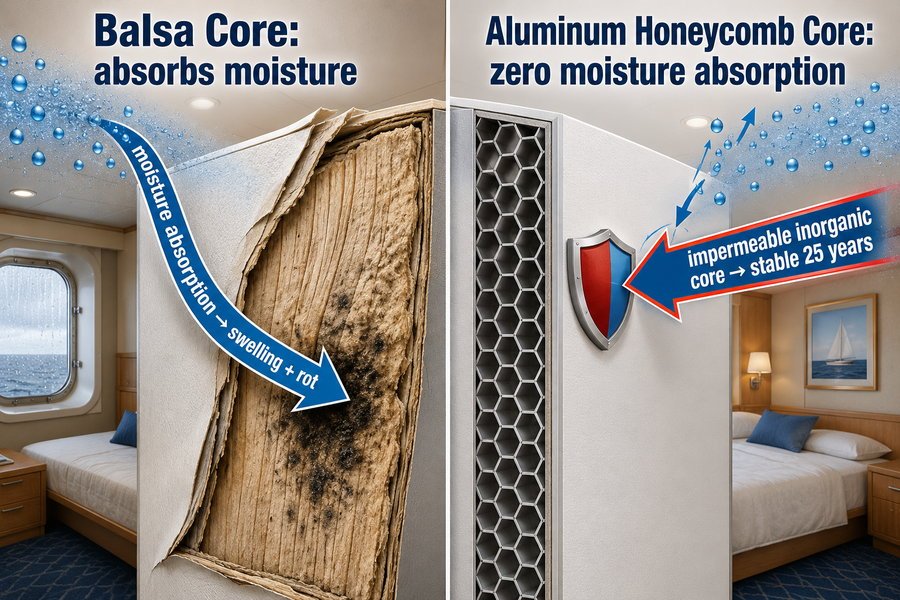
Aluminum honeycomb beats balsa wood because it is totally inorganic and impermeable. Balsa absorbs up to 20% of its weight in water when exposed to high marine humidity, leading to swelling, delamination, and fatal fungal rot. Aluminum absorbs zero moisture, guaranteeing panel stability for a ship's 25-year lifespan.
Water Absorption Rates of Balsa Wood versus Aluminum
The marine environment is full of high humidity and salty ocean spray. Balsa wood is a popular core material in some older boat designs because it is light and cheap. However, balsa is an organic plant material. It acts like a sponge. Even when kiln-dried, balsa wood can absorb up to 20% of its own weight in water8 when exposed to high marine moisture over time (Source: Marine Composites Durability Study). When balsa gets wet, it experiences severe swelling. This swelling pushes the outer metal or laminate skins away from the core. Aluminum honeycomb, by contrast, is completely inorganic and impermeable. It does not matter how humid the air is; aluminum absorbs exactly zero percent moisture. The structural weight of the panel stays exactly the same on day one as it does on year ten.
Preventing Delamination and Rot in Marine Interiors
When balsa wood swells from moisture, it causes delamination9. Delamination means the glue holding the panel together breaks, and the wall falls apart. Once water gets inside the balsa, dark, fatal fungal rot begins to grow. I have seen entire yacht bulkheads that had to be torn out because the balsa core turned to black mush inside the wall. Replacing these panels requires highly expensive labor. Aluminum completely prevents this. Because fungus cannot grow on metal, rot is impossible. The aluminum core guarantees that the panel will remain stable and strong for the entire 25-year lifespan of a commercial ship. You save thousands of dollars because you never have to replace rotted interior walls.
| Material Property | Aluminum Honeycomb | End-Grain Balsa Wood |
|---|---|---|
| Water Absorption Rate | 0% | Up to 20% of weight |
| Moisture Effect | No change | Swelling and dimensional change |
| Risk of Fungal Rot | Zero | High in humid environments |
| Panel Lifespan Expectancy | 25+ Years | Varies, highly dependent on seals |
Aluminum Honeycomb Core vs Rock Wool Core Acoustics in Marine Accommodation Panels?
Loud engine noise makes crew cabins unlivable. Can lightweight aluminum panels block noise as well as heavy rock wool? The answer depends on your exact acoustic needs.
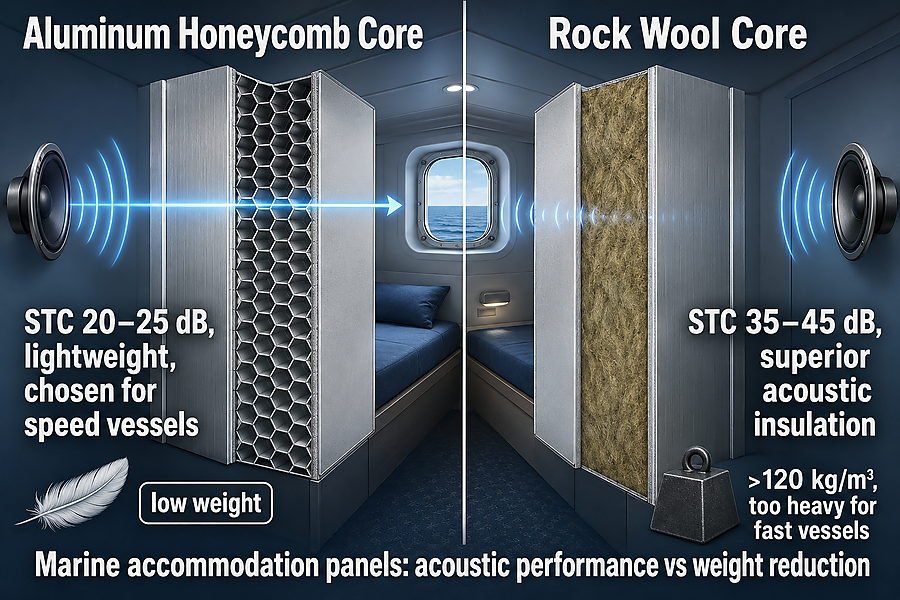
Rock wool is superior for acoustic insulation, achieving a Sound Transmission Class (STC) of 35-45 dB, while standard aluminum honeycomb only reaches 20-25 dB. However, rock wool weighs over 120 kg/m³, making it too heavy for fast vessels. Aluminum is chosen for weight reduction, not maximum sound deadening.
Sound Transmission Class (STC) Ratings of Marine Cores
If you are buying panels for a loud engine room, you need to understand Sound Transmission Class (STC). STC measures how well a material stops sound from passing through.10 Rock wool is a dense, fibrous material that traps sound waves perfectly. A standard 50mm marine panel with a rock wool core can easily achieve an STC rating of 35 to 45 decibels (dB)11 (Source: Major Marine Panel Manufacturer Test Data). This makes rock wool superior for acoustic insulation. Standard aluminum honeycomb, on the other hand, is mostly empty space inside. Sound travels through it quite easily. A basic aluminum honeycomb panel only reaches an STC rating of about 20 to 25 dB.12 This means you will hear people talking in the next cabin much more clearly through an aluminum wall than a rock wool wall.
Balancing Acoustic Performance with Vessel Weight Limits
So why do we use aluminum at all? The answer is weight reduction. Rock wool is incredibly heavy. To meet IMO fire and sound rules, rock wool used in ship panels must have a density of at least 100 to 120 kg per cubic meter13. If you build a fast ferry or a luxury yacht, adding thousands of kilograms of rock wool will ruin the ship's speed and increase fuel costs drastically. Fast vessels simply cannot carry that weight. Shipyards choose aluminum because it keeps the ship fast and fuel-efficient. It is not chosen for maximum sound deadening. When I supply aluminum panels for passenger cabins, we often add a thin layer of rubber acoustic damping material to the aluminum to improve the sound rating slightly without adding the massive weight of rock wool.
| Acoustic & Weight Metric | Aluminum Honeycomb Panel | Rock Wool Core Panel |
|---|---|---|
| Sound Transmission Class (STC) | 20 - 25 dB | 35 - 45 dB |
| Core Density (kg/m³) | 40 - 80 kg/m³ | 100 - 150 kg/m³ |
| Primary Benefit | Extreme weight reduction | Maximum noise blocking |
| Typical Use Area | Fast ferries, yacht cabins | Engine rooms, noisy areas |
Aluminum Honeycomb Core vs Steel Honeycomb Core in Marine Accommodation Panels?
Heavy panels make installation slow and drive up transport costs from Asia. Steel cores are tough, but they hurt your bottom line. See how aluminum compares.
Aluminum honeycomb offers 70% weight savings over steel honeycomb while maintaining enough rigidity for B-15 cabin walls. Steel honeycomb weighs up to 15 kg per square meter and is prone to rusting in salty air. Aluminum weighs just 4-5 kg per square meter and completely resists marine corrosion.
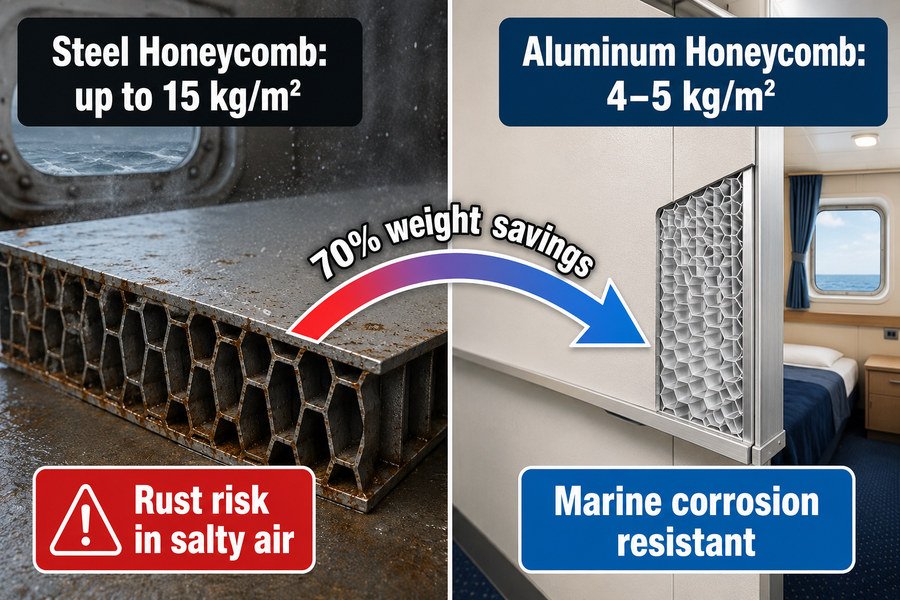
Weight Comparison Between Steel and Aluminum Honeycomb Panels
When buying outfitting materials from Asia, shipping costs are a huge factor. Heavier containers cost more to ship. This brings us to the biggest difference between aluminum and steel honeycomb: weight. Steel has a density of about 7,850 kg per cubic meter. Aluminum has a density of just 2,700 kg per cubic meter.14 In real terms, a standard steel honeycomb panel can weigh up to 15 kg per square meter. That makes it very difficult for workers to carry and install inside a narrow ship corridor. Aluminum provides a massive 70% weight savings.15 A standard aluminum panel of the same size weighs only 4 to 5 kg per square meter. Despite being so light, aluminum maintains enough rigidity to perfectly serve as B-15 rated cabin walls16. Your workers can install lightweight aluminum twice as fast.
Corrosion Resistance in Saltwater Environments
The sea destroys weak metals. The salty ocean air is highly corrosive. Steel honeycomb, if scratched or slightly exposed, is very prone to rusting. Once steel starts to rust, the rust expands and destroys the glue line holding the panel skins to the core. Even galvanized steel will eventually fail in harsh marine environments. Aluminum is completely different. When aluminum meets oxygen, it forms a microscopic oxide layer on its surface that stops all further corrosion.17 It completely resists marine corrosion. I always advise my clients to choose aluminum over steel for wet areas like bathrooms and outer bulkhead linings. You get a panel that will never rust, ensuring your interior decoration project looks new for decades.
| Core Material | Panel Weight (per sqm, 15mm thick) | Corrosion Resistance |
|---|---|---|
| Aluminum Honeycomb | 4 - 5 kg | Excellent (Forms oxide layer) |
| Steel Honeycomb | ~15 kg | Poor (Prone to rust if exposed) |
| Weight Savings | Base line | + 200% heavier than Aluminum |
| Ease of Installation | Very easy (1-man lift) | Difficult (requires 2+ men) |
Which Core Offers the Best Strength-to-Weight in Yacht Marine Accommodation Panels?
Luxury yachts need super strong but incredibly light walls to hit high speeds. Finding the right core is critical for yacht builders. Here is the final verdict.
Aluminum honeycomb delivers the highest strength-to-weight ratio for yacht panels at a commercial price point. While carbon-Nomex is lighter, aluminum provides unmatched shear strength, non-combustibility, and flat surfaces for high-end veneers, all while keeping a 15mm panel under 6 kg per square meter to maximize yacht speed.
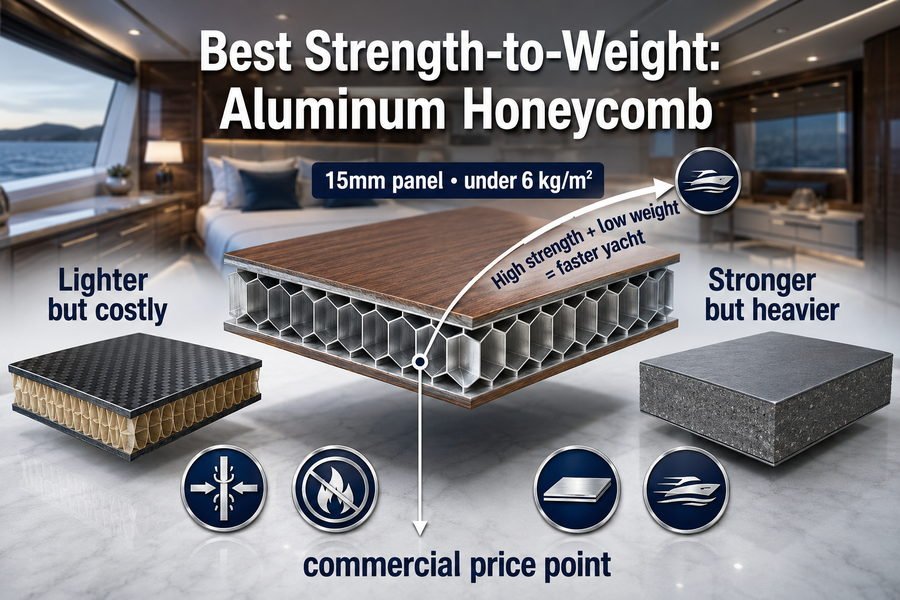
Analyzing Shear Strength and Weight Limits for Yachts
Building yachts is different from building cargo ships. Every single kilogram added to a yacht reduces its top speed and wastes expensive fuel.18 We need materials that offer the highest strength-to-weight ratio. Some yacht builders look at carbon-fiber skins with Nomex cores because they are technically lighter. However, aluminum honeycomb offers something much better for the money. Aluminum has unmatched shear strength. The metal hex structure prevents the panel from twisting19 when the yacht hits big waves at high speeds. Even with thick metal skins, we can keep a 15mm thick aluminum panel under 6 kg per square meter (Source: Shipyard Outfitting Technical Guide). This extreme lightness maximizes yacht speed while providing rock-solid walls that do not flex.
Cost-Effectiveness of Aluminum Honeycomb in Luxury Shipyards
Yachts also need to look beautiful. Aluminum provides perfectly flat surfaces. This is critical when shipyards want to glue high-end wood veneers or High-Pressure Laminates (HPL) to the walls. If the core is soft, the wood veneer will look wavy and cheap. Aluminum keeps the wall perfectly flat. Furthermore, aluminum delivers this strength-to-weight ratio at a very commercial price point compared to exotic materials20. While carbon-Nomex costs hundreds of dollars per square meter, aluminum costs a fraction of that. Finally, aluminum maintains non-combustibility21, which is vital for yacht insurance and passenger safety. By combining huge shear strength, low weight, fire safety, and flat surfaces, aluminum stands as the best core for modern yacht interiors.
| Material Option for Yachts | Strength-to-Weight Ratio | Shear Strength | Surface Flatness for Veneers |
|---|---|---|---|
| Aluminum Honeycomb | Very High | Excellent | Perfect |
| Carbon/Nomex | Extremely High | Good | Good (but very expensive) |
| Balsa Wood Core | Moderate | Moderate | Poor (swelling risk) |
| PU Foam Core | Low | Poor | Poor (sagging risk) |
Conclusion
Aluminum honeycomb cores perfectly balance weight, strength, cost, and fire safety. They outperform balsa, foam, and steel, making them the smartest choice for modern, cost-effective marine interior projects.
-
"Nomex - Wikipedia", https://en.wikipedia.org/wiki/Nomex. An encyclopedia or materials-science source can support that Nomex is a meta-aramid material and that aramid papers are used in honeycomb cores; this supports the material classification but does not independently verify the price comparison. Evidence role: definition; source type: encyclopedia. Supports: Nomex is an aramid paper material comparable in class to Kevlar-like aramids.. Scope note: The source would support the material description, not the article’s cost figures or purchasing conclusions. ↩
-
"ALUMINUM POWDER, COATED - CAMEO Chemicals - NOAA", https://cameochemicals.noaa.gov/chemical/14577. A government or safety-data source can document that bulk aluminum metal is generally classified as non-combustible, while noting that finely divided aluminum powder can present a fire or explosion hazard. Evidence role: mechanism; source type: government. Supports: Solid aluminum metal is generally non-combustible in the context of panel-core materials.. Scope note: This supports the statement for solid aluminum used in panels, not for aluminum dust, powder, or all aluminum-containing assemblies. ↩
-
"Study on the use of aramid waste for the production of boards - PMC", https://pmc.ncbi.nlm.nih.gov/articles/PMC12141628/. Peer-reviewed thermal-degradation studies of Nomex/meta-aramid materials report char formation and gaseous or smoke products at elevated temperatures, supporting the claim about behavior under extreme heat. Evidence role: mechanism; source type: paper. Supports: Nomex can char and emit decomposition products or smoke when exposed to extreme heat.. Scope note: Thermal-degradation results depend on test temperature, atmosphere, exposure duration, and material form, so they do not by themselves prove the fire rating of a specific Nomex honeycomb panel. ↩
-
"A Review of Research on the Effect of Temperature on ... - PMC - NIH", https://pmc.ncbi.nlm.nih.gov/articles/PMC9654075/. Thermal-analysis literature on polyurethane foams reports the onset of mass loss and chemical degradation at relatively low elevated temperatures, supporting the claim that PU foam can begin degrading near 100°C. Evidence role: mechanism; source type: paper. Supports: PU foam can begin thermal degradation at temperatures around 100°C.. Scope note: Exact onset temperature varies by polyurethane formulation, additives, density, and test method; a source may support degradation onset ranges rather than a universal 100°C threshold. ↩
-
"Reduction of Hydrogen Cyanide Concentrations and Acute ...", https://www.nist.gov/publications/reduction-hydrogen-cyanide-concentrations-and-acute-inhalation-toxicity-flexible. Fire-toxicity studies identify hydrogen cyanide among the hazardous combustion products of nitrogen-containing polyurethane foams, supporting the statement that burning PU foam can generate toxic smoke. Evidence role: mechanism; source type: paper. Supports: Burning polyurethane foam can release toxic smoke containing hydrogen cyanide.. Scope note: Hydrogen cyanide yield depends on fire conditions, oxygen availability, foam chemistry, and whether the material is flaming or smoldering. ↩
-
"What Is the Purpose and Scope of the IMO FTP Code? - Magellan ...", https://magellanmarinetech.com/what-purpose-scope-of-imo-ftp-code/. The IMO SOLAS framework and FTP Code establish fire-test criteria for non-combustibility, smoke, toxicity, and flame spread in ship accommodation spaces, providing regulatory context for why combustible foam cores require certified fire-tested assemblies rather than being accepted as non-combustible materials. Evidence role: historical_context; source type: institution. Supports: SOLAS fire rules for accommodation areas impose non-combustibility and fire-test requirements that combustible PU foam materials may not satisfy without certified assembly approval.. Scope note: This supports the regulatory context but does not prove that every PU-foam panel fails SOLAS; compliance is determined by the tested and approved product assembly, application, and flag-state/class approval. ↩
-
"[PDF] Mechanical properties of hierarchical honeycomb structures", https://repository.library.northeastern.edu/files/neu:1673/fulltext.pdf. Mechanical analyses of honeycomb sandwich cores show that hexagonal cellular geometry provides high bending stiffness and shear resistance at low weight, supporting the article’s explanation of aluminum honeycomb panel stiffness. Evidence role: mechanism; source type: paper. Supports: Aluminum honeycomb panels derive high stiffness from the mechanics of their hexagonal cellular core structure.. Scope note: The cited mechanics generally applies to honeycomb sandwich structures; actual stiffness depends on foil thickness, cell size, alloy, adhesive bonds, and facing materials. ↩
-
"Moisture relations and physical properties of wood", https://research.fs.usda.gov/treesearch/37428. The USDA Forest Products Laboratory’s Wood Handbook describes wood as hygroscopic and explains that kiln-dried wood can regain substantial moisture from humid environments; this supports the general plausibility of moisture uptake in balsa cores, though it may not verify the specific 20% figure for marine sandwich panels. Evidence role: mechanism; source type: government. Supports: Even kiln-dried balsa wood can absorb significant water when exposed to humid marine conditions.. Scope note: Contextual support for wood moisture absorption; a source specific to end-grain balsa in marine composites would be needed to confirm the exact percentage. ↩
-
"Moisture Effects on Acoustic Emission Characteristics and Damage ...", https://pmc.ncbi.nlm.nih.gov/articles/PMC10934220/. Research on sandwich composites and wood-based cores reports that moisture uptake can cause swelling, property degradation, and weakening of the core–skin bond, providing support for moisture-related delamination mechanisms in balsa-cored panels; the evidence is mechanistic and does not establish that every wet balsa panel will delaminate. Evidence role: mechanism; source type: paper. Supports: Moisture-induced swelling in balsa cores can contribute to delamination of composite or metal-skinned sandwich panels.. Scope note: Supports a known failure mechanism, but the actual risk depends on sealing, adhesive type, exposure duration, and panel construction. ↩
-
"Noise reduction coefficient - Wikipedia", https://en.wikipedia.org/wiki/Noise_reduction_coefficient. ASTM’s Sound Transmission Class framework defines STC as a single-number rating derived from laboratory sound-transmission-loss measurements for building partitions, supporting its use as an index of airborne sound isolation. Evidence role: definition; source type: institution. Supports: STC measures how well a material stops sound from passing through.. Scope note: STC is primarily a laboratory rating for partitions and does not by itself predict all real-world marine installation conditions, such as flanking paths or vibration transmission. ↩
-
"How to choose the right marine wall panels for marine interior ...", https://magellanmarinetech.com/how-choose-right-marine-wall-panels-for-marine-interior-projects/. Laboratory and technical literature on mineral-wool sandwich partitions reports airborne sound-insulation ratings in the mid-30s to 40s dB range for some configurations, supporting the plausibility of this range for suitably constructed 50 mm-class panels. Evidence role: statistic; source type: paper. Supports: A standard 50mm marine panel with a rock wool core can achieve an STC rating of 35 to 45 dB.. Scope note: The exact STC depends on facing material, panel thickness, mounting, joints, and test method; contextual evidence would not prove that every standard 50 mm marine rock-wool panel reaches this range. ↩
-
"Sound Transmission Loss of Metamaterial Honeycomb Core ...", https://pmc.ncbi.nlm.nih.gov/articles/PMC9182446/. Research on lightweight honeycomb sandwich panels shows that their sound-transmission performance can be limited, with measured transmission-loss or single-number ratings varying substantially by cell geometry, skins, and damping treatments, providing contextual support for low STC values in basic lightweight constructions. Evidence role: statistic; source type: paper. Supports: A basic aluminum honeycomb panel reaches an STC rating of about 20 to 25 dB.. Scope note: A neutral source may support the general low-to-moderate acoustic isolation of undamped honeycomb panels, but the precise 20–25 dB range requires matching panel thickness, skins, and test conditions. ↩
-
"How to choose the right marine wall panels for marine interior ...", https://magellanmarinetech.com/how-choose-right-marine-wall-panels-for-marine-interior-projects/. Marine fire-test and classification documentation for A-class insulated divisions commonly specifies mineral-wool insulation densities around 100 kg/m³ or higher in approved constructions, giving contextual support for the density range used in fire-rated ship panels. Evidence role: general_support; source type: institution. Supports: Rock wool used in ship panels must have a density of at least 100 to 120 kg per cubic meter to meet marine fire and sound requirements.. Scope note: IMO rules generally prescribe performance tests and fire-resistance criteria rather than a universal minimum rock-wool density, so the source would support this as a common approved construction requirement, not a blanket IMO density mandate. ↩
-
"[PDF] MATERIAL Type Cost ($/kg) Density (ρ ,Mg/m3) Young's Modulus (E ...", https://web.mit.edu/course/3/3.11/www/modules/props.pdf. A neutral materials reference reports typical densities of approximately 7.85 g/cm³ for carbon steel and 2.70 g/cm³ for aluminum, supporting the stated order-of-magnitude density comparison. Evidence role: statistic; source type: encyclopedia. Supports: Steel has a density of about 7,850 kg per cubic meter, while aluminum has a density of about 2,700 kg per cubic meter.. Scope note: Exact values vary by alloy, temper, and manufacturing specification. ↩
-
"Current Challenges and Opportunities for the Aluminum ...", https://www.nae.edu/313300/current-challenges-and-opportunities-for-the-aluminum-transformation-industry-in-the-united-states. Using standard density values for steel and aluminum, aluminum has roughly one-third the density of steel, so a same-volume aluminum component can have about two-thirds lower material mass than a steel component. Evidence role: statistic; source type: education. Supports: Aluminum provides a massive 70% weight savings compared with steel.. Scope note: This supports the theoretical material-density comparison; actual honeycomb-panel weight savings depend on face-sheet thickness, core geometry, adhesives, coatings, and alloy selection. ↩
-
"What Is the Purpose and Scope of the IMO FTP Code? - Magellan ...", https://magellanmarinetech.com/what-purpose-scope-of-imo-ftp-code/. An IMO/SOLAS fire-safety reference or classification-society approval document can establish that B-15 divisions are a recognized marine fire rating and, where product-specific certification is available, that a tested aluminum honeycomb construction can meet that rating. Evidence role: case_reference; source type: institution. Supports: Aluminum honeycomb panels can serve as B-15 rated cabin walls when the specific construction is tested and certified.. Scope note: The B-15 definition alone does not prove that every aluminum honeycomb panel is compliant; compliance is product-specific and depends on certified construction, testing, and installation details. ↩
-
"In Situ Synthesis of Oxide Film on Aluminum Alloy for Enhanced ...", https://ui.adsabs.harvard.edu/abs/2026JMEP..tmp..113L/abstract. Corrosion-science references describe aluminum as a passivating metal that rapidly forms a thin, adherent aluminum-oxide film in air, which reduces further uniform oxidation. Evidence role: mechanism; source type: paper. Supports: Aluminum forms a protective oxide layer on exposure to oxygen, improving corrosion resistance.. Scope note: The source would support the passivation mechanism, not the stronger claim that aluminum completely resists all marine corrosion; chloride-rich seawater can still cause localized pitting or crevice corrosion. ↩
-
"[PDF] Chapter 7 Resistance and Powering of Ships - USNA", https://www.usna.edu/NAOE/_files/documents/Courses/EN400/02.07%20Chapter%207.pdf. Naval-architecture sources describe displacement and resistance as key determinants of vessel speed and power demand, supporting the general relationship between added weight, lower performance, and higher fuel use. Evidence role: mechanism; source type: education. Supports: Additional yacht weight can reduce attainable speed and increase fuel consumption.. Scope note: This supports the hydrodynamic principle in general; the exact speed or fuel penalty depends on hull form, propulsion, sea state, and loading condition. ↩
-
"[PDF] Sandwich Constructions - USNA", https://www.usna.edu/Users/mecheng/pjoyce/composites/Short_Course_2003/13_PAX_Short_Course_Sandwich-Constructions.pdf. Engineering literature on honeycomb sandwich panels explains that cellular cores carry transverse shear and increase bending and torsional stiffness by separating the face sheets, which supports the claim that a hexagonal metal core resists panel twisting. Evidence role: mechanism; source type: paper. Supports: Aluminum honeycomb geometry can improve shear and torsional stiffness in sandwich panels.. Scope note: The source would support the structural mechanism, not guarantee performance for every yacht panel design or sea-loading case. ↩
-
"[PDF] Carbon Fiber Manufacturing Facility Siting and Policy Considerations", https://www.nrel.gov/docs/fy17osti/66875.pdf. Materials-cost studies and composite-manufacturing reviews document that carbon-fiber-based sandwich constructions are generally more expensive than aluminum structures, providing contextual support for the cost comparison between aluminum honeycomb and carbon/Nomex options. Evidence role: general_support; source type: research. Supports: Aluminum honeycomb panels are generally less costly than carbon-fiber/Nomex sandwich alternatives for comparable lightweight structural applications.. Scope note: The support is comparative and contextual; actual panel cost varies with alloy, cell size, skins, adhesive system, certification, order volume, and finishing requirements. ↩
-
"What Is the Purpose and Scope of the IMO FTP Code? - Magellan ...", https://magellanmarinetech.com/what-purpose-scope-of-imo-ftp-code/. Fire-safety classification sources commonly treat aluminum and other metals as non-combustible materials under standard fire-test concepts, supporting the use of aluminum as a non-combustible component in marine interiors. Evidence role: definition; source type: institution. Supports: Aluminum is generally classified as a non-combustible material relevant to marine fire-safety considerations.. Scope note: Non-combustibility of aluminum alone does not establish the fire rating of a complete panel, because adhesives, coatings, laminates, and assembly details may affect compliance. ↩