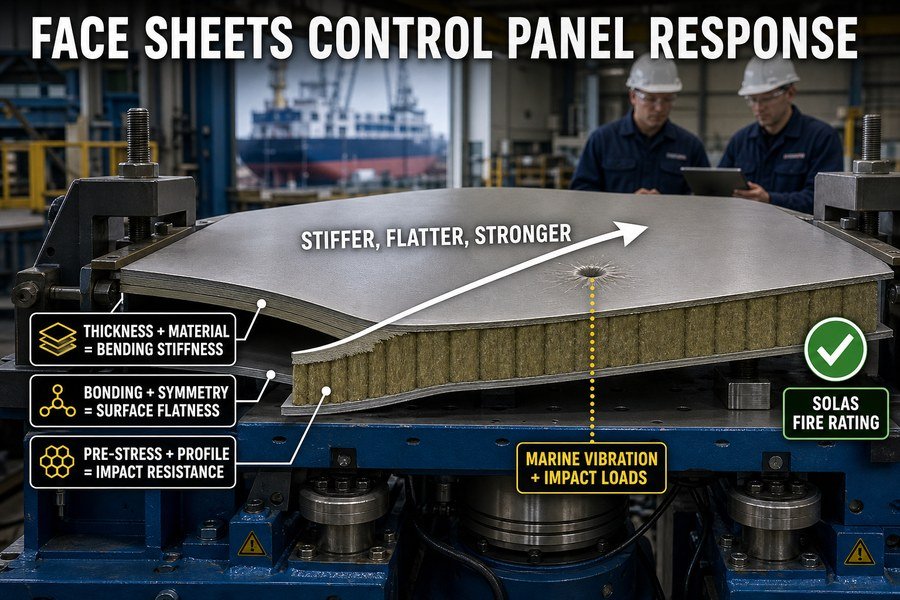
Tired of marine panels bending or failing under stress? Understanding how face sheets drive panel strength is the key to preventing costly rework and passing rigorous shipyard inspections.
Face sheet properties—specifically thickness, material type, pre-stress state, surface profiling, adhesive bonding, and symmetry—dictate the bending stiffness, impact resistance, and surface flatness of marine sandwich panels. By controlling these six factors, panels achieve required SOLAS fire ratings while maintaining structural integrity under marine vibration and impact loads.
How Does Face Sheet Gauge Prevent Telegraphing Effects in Marine Accommodation Panels?
Seeing the core material pattern show through your panel surface ruins the high-end finish. A thicker face sheet stops this ugly "telegraphing" effect completely.
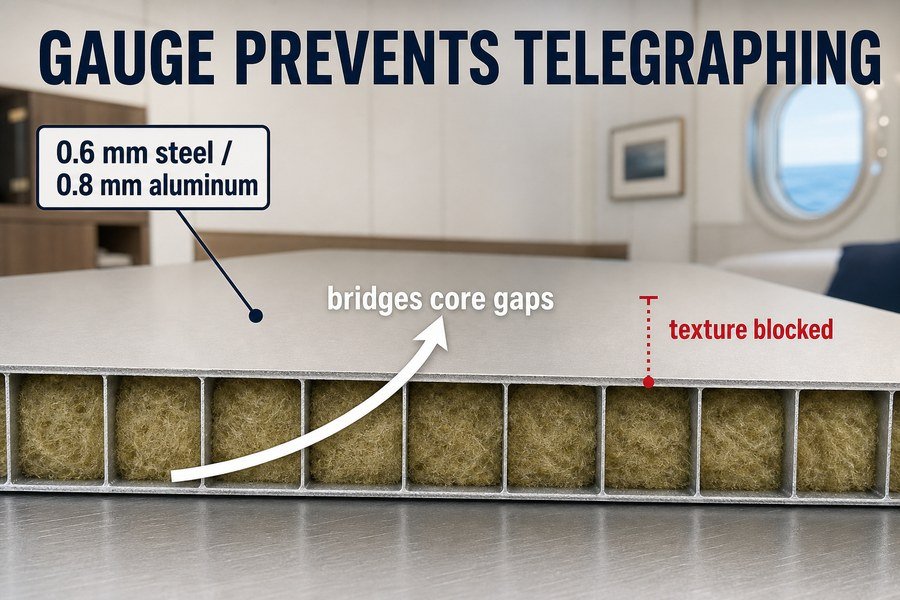
Face sheet gauge prevents telegraphing by providing enough bending stiffness to span the core's cell structure without sagging. Using a minimum steel thickness of 0.6mm or aluminum thickness of 0.8mm bridges the core gaps, absorbing compression forces during lamination and stopping the core texture from showing on the surface.
Minimum Thickness Standards for Telegraphing Prevention
I see many buyers try to save money by choosing thin metal skins. They order 0.4mm steel for rockwool core panels. When the panels arrive, they look terrible. You can see every line of the rockwool through the painted surface. We call this telegraphing. The face sheet gauge is the direct cause of this problem. A thicker metal skin has higher bending stiffness.1 Bending stiffness means the metal will not bend into the small gaps of the core material. According to general marine outfitting practices and DNV guidelines for interior panels, you need a minimum steel thickness of 0.6mm. If you buy aluminum panels, you need a minimum thickness of 0.8mm. Aluminum is softer. It must be thicker to provide the same stiffness.2 When you use these exact gauges, the metal bridges the gaps in the core. The metal spans the core's cell structure without sagging. It stays flat. The surface looks perfect after installation. This saves you from shipyard rejections.
The Impact of Lamination Pressure on Thin Face Sheets
The factory manufacturing process also causes telegraphing if the skin is too thin. Factories use heavy press machines to bond the skin to the core. This process applies high compression forces. If the metal is thinner than 0.6mm, the lamination pressure pushes the soft metal down into the texture of the core3. The metal deforms permanently. I learned this the hard way during my early days at the factory. We tested different pressures and skin thicknesses. We found that 0.6mm steel absorbs these compression forces during lamination. It takes the pressure without bending into the core texture. A 0.4mm skin fails this test every time. The result of using 0.6mm steel is a smooth panel. This smooth panel passes strict shipyard inspections easily. You must specify this minimum thickness in your purchasing contracts.
| Face Sheet Material | Minimum Thickness to Prevent Telegraphing | Typical Cost Per Square Meter (USD) | Visual Result After Lamination |
|---|---|---|---|
| Galvanized Steel | 0.4 mm | $12 - $15 | Severe telegraphing |
| Galvanized Steel | 0.6 mm | $18 - $22 | Smooth, flat surface |
| Aluminum | 0.6 mm | $20 - $25 | Minor telegraphing |
| Aluminum | 0.8 mm | $28 - $32 | Smooth, flat surface |
How Does Galvanized Versus Stainless Steel Skin Affect Marine Accommodation Panel Impact Resistance?
Cabin walls take a beating from moving carts and luggage. Choosing between galvanized and stainless steel skins changes how much impact your panels can handle.
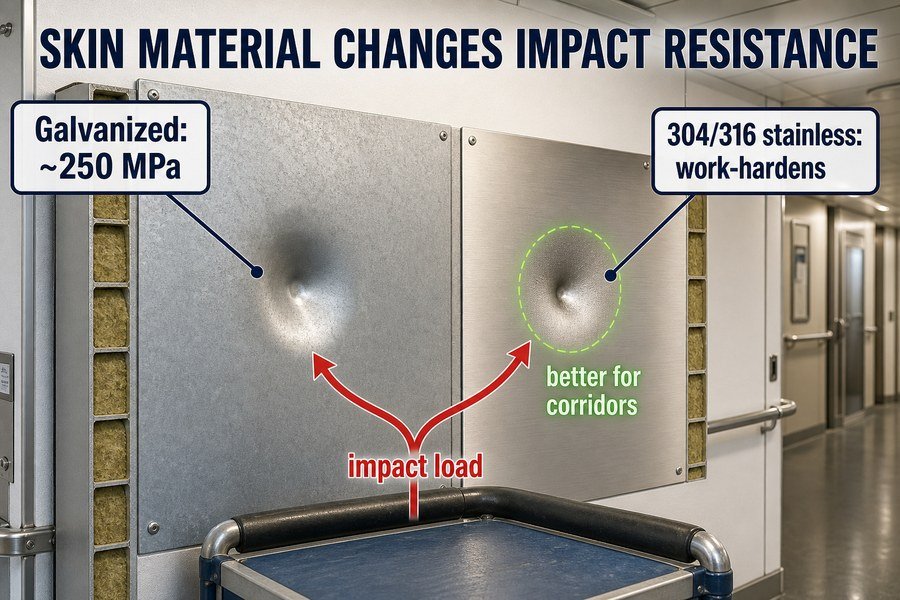
Galvanized steel offers moderate impact resistance with a yield strength of 250 MPa, making it suitable for standard cabins. Stainless steel, specifically 304 or 316 grades, provides superior impact resistance with a yield strength of 210 to 290 MPa and high work-hardening properties, making it essential for heavy-traffic corridors.
Yield Strength and Energy Absorption of Galvanized Steel Panels
When we plan a ship interior, we look at where the panel goes. A standard cabin wall does not face many heavy impacts. For these quiet areas, galvanized steel is the standard choice. Galvanized steel has a yield strength of about 250 MPa, according to ASTM A653 standards. Yield strength is the point where the metal bends and does not bend back. At 250 MPa, galvanized steel offers moderate impact resistance. It can handle a passenger bumping a suitcase into the wall. It absorbs the energy well enough for low-traffic zones. The cost is also very friendly for your budget. A standard galvanized panel costs about $20 to $30 per square meter. This low price keeps your project costs down. It also meets the basic quality needs for standard cabins.
Work-Hardening Advantages of Stainless Steel in Heavy Traffic Areas
Corridors and public spaces are completely different. Carts, heavy luggage, and cleaning equipment hit these walls every day. Galvanized steel will dent here quickly. You need stainless steel for these heavy-traffic corridors. We use 304 or 316 grade stainless steel. These grades provide superior impact resistance. They have a yield strength between 210 and 290 MPa, based on ASTM A240 standards. But their real power comes from high work-hardening properties4. Work-hardening means the metal gets harder when something hits it. When a heavy cart hits a stainless steel panel, the impact area actually becomes stronger. This amazing property prevents deep dents. Stainless steel is more expensive. It usually costs $45 to $60 per square meter. However, you will not need to replace damaged panels later. You save money on maintenance. You also keep the shipyard happy over the long term.
| Steel Type | Typical Yield Strength (MPa) | Key Property | Best Application | Price Estimate (per sqm) |
|---|---|---|---|---|
| Galvanized Steel | ~250 MPa | Moderate impact resistance | Standard passenger cabins | $20 - $30 |
| 304 Stainless Steel | ~215 MPa | High work-hardening | Corridors, dining areas | $45 - $55 |
| 316 Stainless Steel | ~290 MPa | High work-hardening & anti-rust | Wet units, high-traffic zones | $55 - $70 |
What Role Does Face Sheet Pre-Stress Play in Marine Sandwich Panel Warping?
Panels that warp after installation cause rejected cabins and delayed schedules. Residual pre-stress in the face sheet is often the hidden culprit.
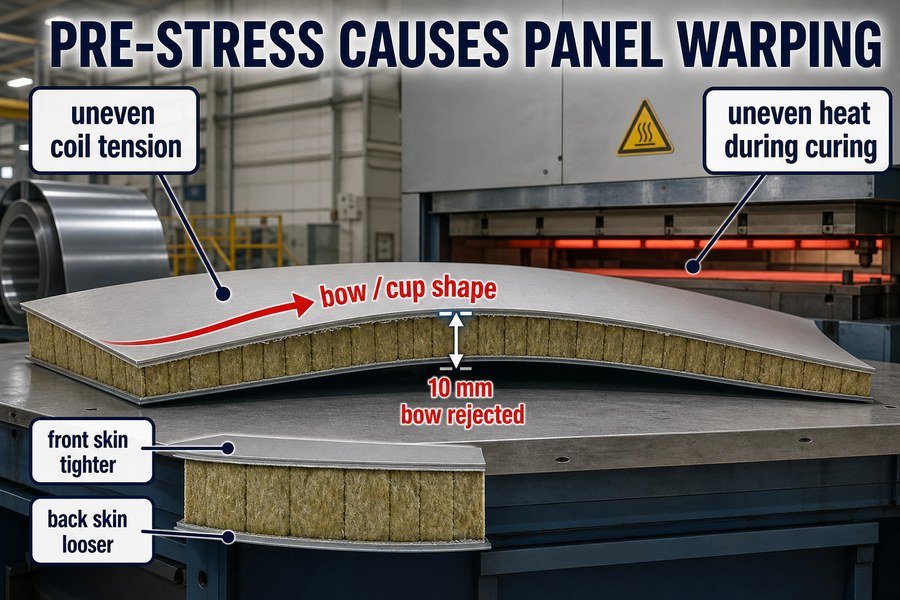
Face sheet pre-stress causes panel warping when uneven tension exists between the front and back skins during lamination. If one skin is coiled tighter or heated unevenly during bonding, it creates a thermal or mechanical imbalance, leading to a permanent bow or cup shape in the finished marine panel.
Mechanical Imbalance from Coiled Steel Processing
Factories buy steel in large rolls or coils. When unrolled, the metal still wants to curve. We call this residual stress5. Good factories use leveling machines to remove this stress6. Bad factories skip this leveling step to save time. If a factory uses one tightly coiled skin on the front and a flat skin on the back, they create a huge problem. They create uneven tension between the front and back skins7. When the glue dries, the tight skin pulls harder. This mechanical imbalance ruins the panel. The panel develops a permanent bow or cup shape. A bowed panel has a curve that sticks out in the middle. A cupped panel has a curve that dips in. If you buy a 2.5-meter tall panel with a 10mm bow, the shipyard will reject it immediately. You cannot force a warped panel flat during installation.
Thermal Expansion Differences During Adhesive Curing
Heat also causes pre-stress problems during manufacturing. Factories use heat to cure the adhesive quickly. Sometimes, the hot press machine is hotter on the top plate than on the bottom plate. The top metal skin gets hotter. It expands more than the bottom skin. The glue cures while the skins are in this uneven state. When the panel cools down to room temperature, the top skin shrinks more than the bottom skin. This creates a thermal imbalance8. The result is exactly the same as the mechanical problem. The panel warps into a permanent bow or cup shape. To avoid this, you must buy from factories that strictly control their press temperatures. A temperature difference of just 5 degrees Celsius between the top and bottom plates can ruin a whole batch of panels. I always check the temperature logs when I visit a new supplier.
| Cause of Pre-Stress | Immediate Effect During Production | Final Panel Shape | Prevention Method |
|---|---|---|---|
| Tightly coiled steel | Uneven mechanical tension | Bow or cup shape | Proper coil leveling machine |
| Uneven press heating | Thermal expansion differences | Bow or cup shape | Calibrated heated press |
| Mixed metal types | Uneven tension and expansion | Bow or cup shape | Symmetrical skin materials |
How Does Skin Profiling or Embossing Change Marine Accommodation Panel Bending Strength?
Flat panels often lack the rigidity needed for long ceiling spans. Adding profiles or embossing to the skin changes everything.
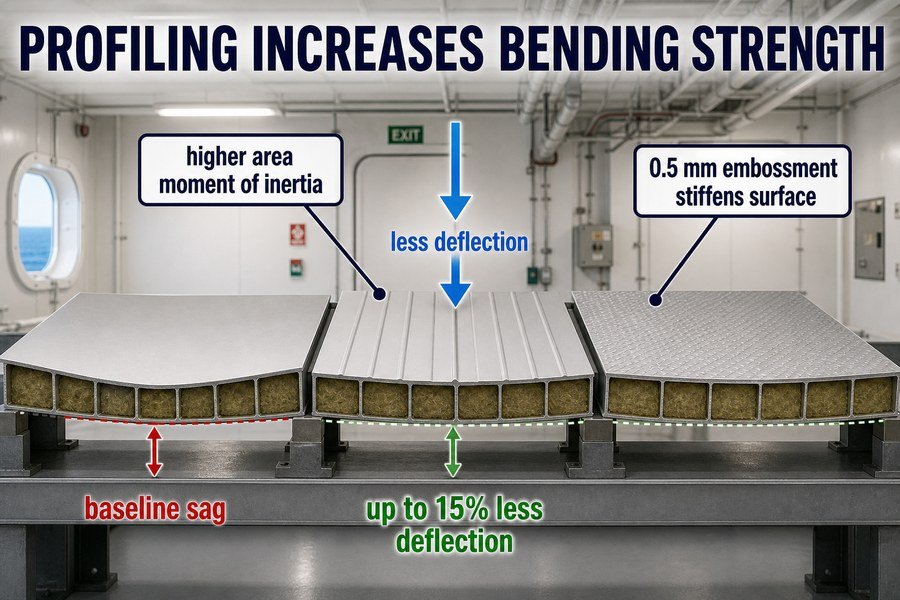
Skin profiling and embossing increase bending strength by increasing the area moment of inertia of the face sheet. Adding a 1.5mm deep V-groove profile or a 0.5mm textured embossment stiffens the metal, reducing deflection by up to 15% and allowing panels to span longer distances without adding weight.
Area Moment of Inertia Increases from V-Groove Profiles
When you need a panel to cover a long ceiling without sagging, you need high bending strength. Making the metal thicker adds too much weight. It also adds too much cost. Instead, factories use skin profiling. By bending the flat metal into shapes, we increase the area moment of inertia of the face sheet9. This is a common engineering term. It just means the shape resists bending better. For example, adding a 1.5mm deep V-groove profile to a flat steel sheet makes it much stiffer10. The groove acts like a tiny support beam built right into the metal. I often recommend this solution for ceiling panels. Because the metal is stiffer, the panel resists gravity better. We see a big drop in bending under load. We can reduce deflection by up to 15%11. This means the ceiling stays perfectly flat, even over wide cabin spaces.
Stiffness Gains from Surface Embossing Techniques
If you do not want V-grooves, surface embossing is another great option. Embossing presses a pattern into the metal. It looks like small bumps or a wood grain texture. Even a small 0.5mm textured embossment makes a huge difference. The tiny bends in the pattern lock the metal structure together. It stiffens the metal across the whole surface. This gives you two big benefits. First, it hides fingerprints and scratches. This makes the final owner very happy. Second, it allows panels to span longer distances without adding weight. A standard flat panel might need support every 1200mm. An embossed panel might reach 1500mm without sagging12. You save money because you buy less support steel. You also save a lot of installation time in the shipyard.
| Surface Treatment | Depth/Size | Effect on Deflection | Visual Style | Best Use Case |
|---|---|---|---|---|
| Flat Skin | 0 mm | Baseline (0%) | Smooth, plain | Standard short-span walls |
| V-Groove Profile | 1.5 mm deep | Reduces up to 15% | Linear lines | Long-span ceilings |
| Textured Embossment | 0.5 mm deep | Reduces up to 10% | Pebbled, wood grain | High-traffic walls, ceilings |
How Do Localized Adhesive Voids Trigger Face Sheet Buckling in Marine Sandwich Panels?
A tiny spot of missing glue might seem harmless. But under load, these localized adhesive voids quickly lead to catastrophic face sheet buckling.
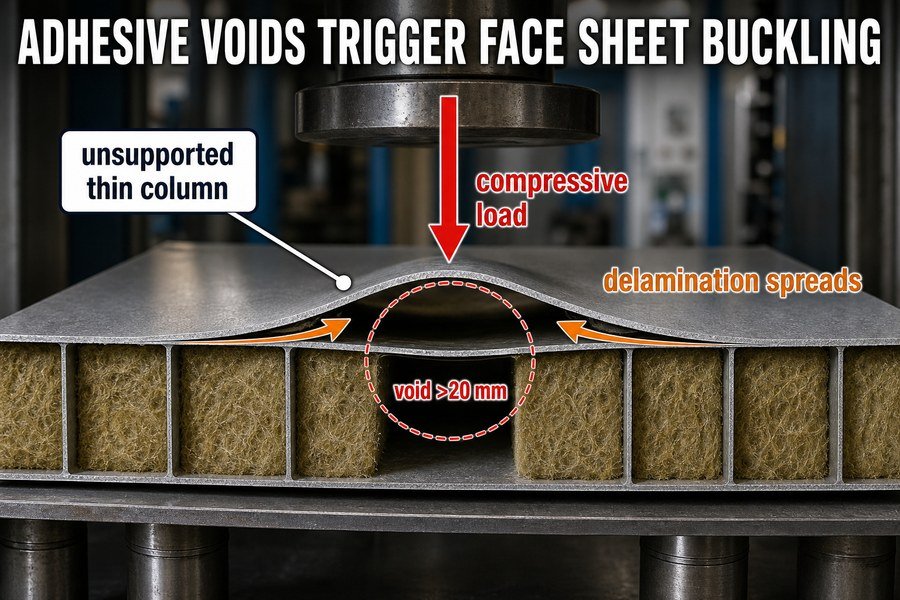
Localized adhesive voids trigger face sheet buckling by removing the continuous support provided by the core. When compressive loads hit a void area measuring more than 20mm in diameter, the unbonded face sheet acts as an unsupported thin column, causing it to buckle outward and delaminate the surrounding panel.
Loss of Continuous Core Support in Void Areas
The strength of a sandwich panel comes from the glue. The glue holds the skin and core together. The core keeps the thin metal skin perfectly flat. We call this continuous support13. Sometimes, the glue machine leaves an empty spot. We call this a localized adhesive void. When you have a void, you are removing the continuous support provided by the core in that exact spot. The metal skin is now floating over an empty space. In normal conditions, you might not see this hidden defect. But when the ship moves, the walls face heavy compressive loads. The ship's structure pushes down on the panel. The area with good glue passes the load safely to the core. The area with the void cannot pass the load anywhere.
Thin Column Behavior and Outward Buckling Under Compression
When compressive loads hit a void area, the metal fails quickly. Through factory testing, we know that a void measuring more than 20mm in diameter is highly dangerous14. In this empty 20mm space, the unbonded face sheet acts as an unsupported thin column. Think about pushing down on a dry piece of spaghetti. It bends and breaks outward. The thin metal does the same thing. It cannot hold the weight. This causes it to buckle outward. Once a small buckle starts, it pulls the nearby metal away from the core too. This will delaminate the surrounding panel completely. A tiny 20mm mistake ruins a $100 panel in seconds. You must ensure your supplier uses automated glue spreaders. Automated spreaders prevent these voids and protect your investment.
| Defect Type | Critical Size for Failure | Physical Reaction Under Load | Result on Panel |
|---|---|---|---|
| Minor air bubble | Under 10mm diameter | Skin stays flat | No visible damage |
| Localized adhesive void | More than 20mm diameter | Acts as unsupported thin column | Outward buckling |
| Large dry spot | Over 50mm diameter | Instant separation | Massive delamination |
How Do Asymmetric Dual-Skin Constructions Behave in Marine Accommodation Applications?
Sometimes you need a thick steel back and a thin decorative front. But mixing skin thicknesses creates a highly unbalanced panel structure.
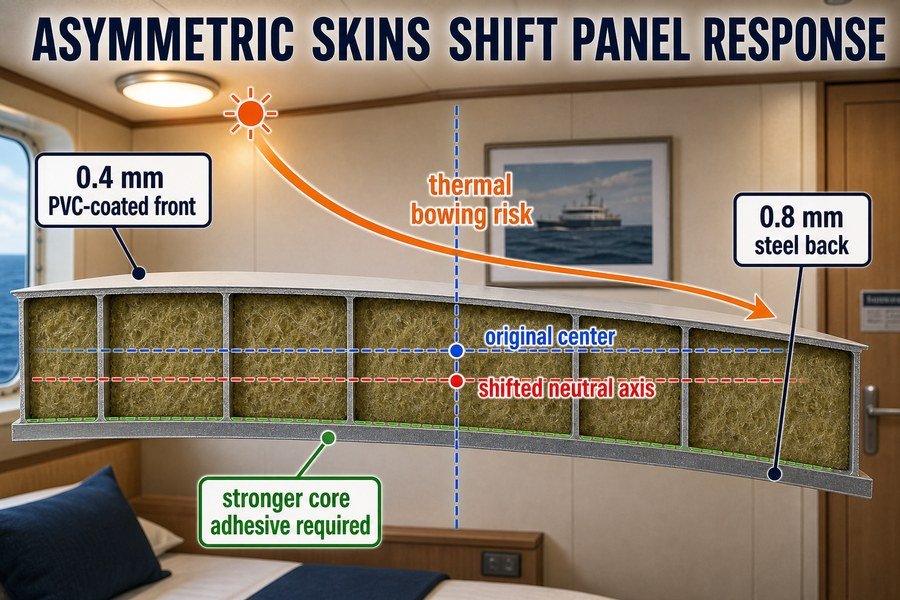
Asymmetric dual-skin constructions shift the neutral axis away from the panel center, causing unequal stress distribution under bending loads. Combining a 0.8mm steel back with a 0.4mm PVC-coated front leads to different thermal expansion rates, requiring stronger core adhesives to prevent thermal bowing when exposed to temperature changes.
Shifting of the Neutral Axis and Unequal Stress Distribution
A balanced panel has the same skin on both sides. It behaves predictably. An asymmetric dual-skin construction uses different skins. Many buyers want this to save money. They put a nice finish on the front and a cheap finish on the back. But this changes the physics of the panel completely. It will shift the neutral axis away from the panel center15. The neutral axis is the invisible line inside the panel that does not stretch or compress when bent.16 When the axis moves, it causes unequal stress distribution under bending loads. The thinner side will stretch much more than the thicker side. This makes the panel structurally weaker. If a shipyard engineer calculates load limits based on a standard panel, an asymmetric panel might fail those safety tests.
Managing Thermal Expansion in Mixed-Material Skins
Temperature changes are the biggest enemy of asymmetric panels. Let us look at a common example from my past projects. You might combine a 0.8mm steel back with a 0.4mm PVC-coated front. The thick steel and the thin PVC-coated steel react to heat differently. They have very different thermal expansion rates.17 Sunlight or heating makes the cabin hot. The thin front skin gets hot. It grows faster than the thick back skin. The panel wants to bend like a banana. We call this thermal bowing18. To stop this, you cannot use cheap glue. You must use stronger core adhesives. High-grade two-part polyurethane adhesives hold the skins tightly. They resist the pulling force of thermal expansion. This strong glue prevents thermal bowing when exposed to temperature changes. It keeps the wall straight.
| Construction Type | Front Skin | Back Skin | Neutral Axis Position | Risk of Thermal Bowing |
|---|---|---|---|---|
| Symmetric (Standard) | 0.6mm Steel | 0.6mm Steel | Exact Center | Very Low |
| Asymmetric (Mild) | 0.6mm Steel | 0.5mm Steel | Slightly shifted | Low |
| Asymmetric (Severe) | 0.4mm PVC-Steel | 0.8mm Steel | Highly shifted | High (Requires strong adhesive) |
Conclusion
Understanding face sheet properties helps you buy better marine panels. You can avoid warping, buckling, and telegraphing, ensuring your interior outfitting projects meet shipyard standards on time and within budget.
-
"[PDF] 3 Elasticity and Flexure", https://sseh.uchicago.edu/doc/Geodynamics_Turcotte_Schubert_ch_3.pdf. Classical plate and beam theory states that flexural rigidity increases with the elastic modulus and with thickness cubed, supporting the claim that increasing sheet thickness substantially increases resistance to bending. Evidence role: mechanism; source type: education. Supports: A thicker metal face sheet has greater bending stiffness and is less likely to bend into small core gaps.. ↩
-
"[PDF] Aluminium versus steel in low-volume production of structural ...", https://www.ntnu.edu/documents/139799/1279149990/30+TPD4505+-+Aluminium+versus+steel+in+low-volume+production+of+structural+applications+.pdf. Reference data on elastic modulus show that common aluminum alloys have a substantially lower Young’s modulus than steel, and flexural-rigidity equations show that a lower-modulus material requires greater thickness to achieve comparable bending stiffness. Evidence role: mechanism; source type: education. Supports: Aluminum face sheets need greater thickness than steel face sheets to approach similar bending stiffness.. Scope note: The word “softer” is colloquial; exact stiffness depends on alloy, temper, coating, and panel geometry. ↩
-
"[PDF] Facesheet Wrinkling in Sandwich Structures", https://ntrs.nasa.gov/api/citations/19990017863/downloads/19990017863.pdf. Research on sandwich panels and composite manufacturing describes local face-sheet deformation, print-through, or core imprinting under pressure, supporting the mechanism by which thin skins can conform to core surface irregularities during bonding. Evidence role: mechanism; source type: paper. Supports: High lamination pressure can deform thin metal face sheets into the texture of the core during panel bonding.. Scope note: Such sources may support the general deformation mechanism rather than proving the article’s exact 0.6 mm threshold or the specific rockwool-core manufacturing setup. ↩
-
"[PDF] PREDICTED STRAINS IN AUSTENITIC STAINLESS STEELS ... - OSTI", https://www.osti.gov/servlets/purl/5282151. Metallurgical references describe austenitic stainless steels such as 304 and 316 as having relatively high strain-hardening capacity, meaning plastic deformation increases dislocation density and raises local hardness and strength. Evidence role: mechanism; source type: paper. Supports: The impact-performance argument for 304 and 316 stainless steel relies on their comparatively high work-hardening behavior.. Scope note: This supports the material mechanism, but it does not by itself quantify dent resistance for a specific ship-panel geometry or impact condition. ↩
-
"[PDF] STRESS AND DEFORMATION ANALYSIS OF THE METAL ...", https://deepblue.lib.umich.edu/bitstreams/cc94140a-c2a2-48d2-9d10-2cfdad9dca06/download. A materials-engineering source defines residual stress as stress retained in a material after manufacturing or forming and notes that releasing constraints can produce dimensional distortion such as curvature. Evidence role: definition; source type: education. Supports: Coiled or rolled steel can retain residual stress that contributes to curvature after unrolling.. Scope note: This supports the general mechanism in sheet metals, not the quality of any specific panel factory. ↩
-
"The Selection of Leveler Parameters Using FEM Simulation - PMC", https://pmc.ncbi.nlm.nih.gov/articles/PMC10779611/. Research on roller leveling describes the process as repeated bending of sheet or strip metal to reduce coil set and redistribute residual stresses, thereby improving flatness. Evidence role: mechanism; source type: paper. Supports: Leveling machines are used to reduce residual stress or coil set in sheet steel before further processing.. Scope note: The source would support the leveling mechanism generally; it may not quantify performance for a specific steel grade or panel design. ↩
-
"Material-Dependent Effect of Common Printing Parameters ... - PMC", https://pmc.ncbi.nlm.nih.gov/articles/PMC10347020/. Studies of laminated and sandwich panels show that unsymmetrical face-sheet properties or residual stresses can create bending moments after bonding or curing, leading to warpage or curvature. Evidence role: mechanism; source type: paper. Supports: A panel with different stress states in its front and back skins can develop bowing or cupping after bonding.. Scope note: This is contextual support from laminate or sandwich-panel mechanics and may not directly test the exact metal-skin/adhesive panel described. ↩
-
"[PDF] Viscoelastic Model to Capture Residual Stresses in Heat Cured ...", https://open.clemson.edu/cgi/viewcontent.cgi?article=1099&context=auto_eng_pub. Thermo-mechanical analyses of bonded laminates and sandwich structures report that temperature gradients and differences in thermal expansion during curing can leave residual stresses that cause curvature after cooling. Evidence role: mechanism; source type: paper. Supports: Uneven heating during adhesive curing can create residual thermal stress and warpage in bonded panels.. Scope note: This supports the general thermo-mechanical mechanism; it does not establish that any particular press-temperature difference will always ruin a production batch. ↩
-
"[PDF] 3. beams: strain, stress, deflections", https://courses.washington.edu/me354a/chap3.pdf. A mechanics-of-materials reference defines the area moment of inertia as a geometric property governing bending stress and deflection, supporting the explanation that changing cross-sectional geometry can improve bending resistance. Evidence role: definition; source type: education. Supports: Bending a flat metal sheet into a profile can increase its area moment of inertia and improve bending resistance.. Scope note: This source would support the engineering concept, not the performance of any specific ceiling-panel profile. ↩
-
"[PDF] Curved creases redistribute global bending stiffness in corrugations", https://drsl.engin.umich.edu/wp-content/uploads/sites/414/2020/06/WoodruffAndFilipov_2020_CurvedCreasesRedistributeGlobalBendingStiffness.pdf. Research on profiled or corrugated metal plates shows that introducing folds or grooves can increase flexural rigidity relative to flat sheets of the same material, providing contextual support for the stiffness effect of a V-groove profile. Evidence role: mechanism; source type: paper. Supports: A shallow V-groove profile can make a flat steel sheet stiffer by altering its geometry.. Scope note: Unless the source tests a 1.5 mm V-groove in the same sheet thickness and support conditions, it supports the mechanism rather than the exact magnitude claimed. ↩
-
"Deflection Test of Wire-Integrated Steel Deck Plates with Various ...", https://pmc.ncbi.nlm.nih.gov/articles/PMC10056878/. A test report or finite-element study comparing flat and V-grooved metal panels under identical loading would substantiate the reported percentage reduction in deflection. Evidence role: statistic; source type: paper. Supports: V-groove profiling can reduce panel deflection by up to 15% under load.. Scope note: The percentage is likely design-specific and may vary with sheet thickness, groove spacing, boundary conditions, span, and load level. ↩
-
"[PDF] FUNDAMENTAL FEM ANALYSIS ON TENSILE DEFORMATION OF ...", https://upcommons.upc.edu/bitstreams/3777eb42-3e5e-40bb-a596-873ce660d5d4/download. A structural test standard, laboratory report, or peer-reviewed study on embossed sheet-metal panels under span loading would support the comparison between allowable spans for flat and embossed panels. Evidence role: case_reference; source type: research. Supports: Embossed metal panels may span farther than flat panels without unacceptable sagging.. Scope note: Span capacity depends on load, allowable deflection criterion, support detail, alloy or steel grade, thickness, and embossing pattern, so evidence from one panel system may not generalize to all ceiling panels. ↩
-
"[PDF] Sandwich Constructions - USNA", https://www.usna.edu/Users/mecheng/pjoyce/composites/Short_Course_2003/13_PAX_Short_Course_Sandwich-Constructions.pdf. A structural-mechanics source on sandwich panels explains that the core supports and stabilizes the face sheets while transferring shear between them, which is the basis for describing bonded face/core contact as continuous support. Evidence role: mechanism; source type: education. Supports: The bonded core provides continuous support to the thin metal skin and helps keep it flat under load.. Scope note: This supports the general sandwich-panel mechanism, not the performance of the specific panel design discussed in the article. ↩
-
"[PDF] Facesheet Wrinkling in Sandwich Structures", https://ntrs.nasa.gov/api/citations/19990017863/downloads/19990017863.pdf. Studies of sandwich panels with face-sheet/core debonds report that localized disbonds can reduce compressive load capacity and initiate local face-sheet buckling or delamination growth; any 20 mm danger threshold should be interpreted as dependent on specimen geometry, materials, loading, and test method. Evidence role: mechanism; source type: paper. Supports: A localized adhesive void larger than 20 mm can be dangerous because it may allow the unbonded face sheet to buckle under compression and promote delamination.. Scope note: Neutral literature can support the mechanism and size sensitivity of debonds, but may not verify a universal 20 mm critical diameter for all panels. ↩
-
"[PDF] 4.1 4. beams: curved, composite, unsymmetrical", https://courses.washington.edu/mengr354/jenkins/notes/chap4.pdf. Composite-beam and transformed-section theory shows that the neutral axis depends on the geometry and elastic moduli of the bonded layers, so unsymmetrical skin configurations can place it away from the geometric mid-plane. Evidence role: mechanism; source type: education. Supports: An asymmetric dual-skin panel can shift the neutral axis away from the panel center.. Scope note: The source would support the general mechanics; the exact shift for a given panel requires layer thicknesses, moduli, and core properties. ↩
-
"[PDF] Chapter 12", https://web1.eng.famu.fsu.edu/~woates/template/Kaushik%20Bhattacharya%27s%20Group_files/teaching/MoMI/Chapter12.pdf. A mechanics-of-materials source defines the neutral axis in bending as the locus in a beam or section where longitudinal strain and stress are zero, supporting the article’s definition. Evidence role: definition; source type: education. Supports: The neutral axis is the line within a bent panel or beam that experiences no stretching or compression.. ↩
-
"[PDF] Thermal Properties Of Selected Plastic Piping Used in Housing", https://www.huduser.gov/portal/Publications/pdf/HUD-050047.pdf. Engineering reference data for coefficients of thermal expansion show that steel and PVC have substantially different expansion coefficients, supporting the claim that mixed steel/PVC layers respond differently to temperature changes. Evidence role: statistic; source type: institution. Supports: Steel and PVC-coated layers can have very different thermal expansion rates.. Scope note: Published coefficients describe bulk materials; a PVC-coated steel skin may behave differently depending on coating thickness, bonding, temperature range, and restraint. ↩
-
"[PDF] NUMERICAL SIMULATION OF CTE MISMATCH AND THERMAL ...", https://digitalcollections.ohsu.edu/record/129/files/129_etd.pdf. Studies of laminated or sandwich panels under temperature gradients report that differential thermal expansion between bonded layers can produce curvature or bowing, providing a mechanics basis for the described thermal bowing effect. Evidence role: mechanism; source type: paper. Supports: Differential thermal expansion in asymmetric bonded panels can cause the panel to bend or bow when heated.. Scope note: This supports the general mechanism, not the magnitude of bowing in the specific 0.8 mm steel and 0.4 mm PVC-coated example. ↩