Upgrading a working ship is hard. Delays cost money, and mistakes upset the crew. I will show you exactly what limits your panel replacement projects and how to fix them.
Replacing marine panels on in-service vessels is constrained by four main factors: physical occupancy limits, continuous live system operations, strict environmental controls for dust and noise, and rigorous SOLAS safety regulations. You must manage all four limits to keep the ship running and avoid heavy financial penalties.
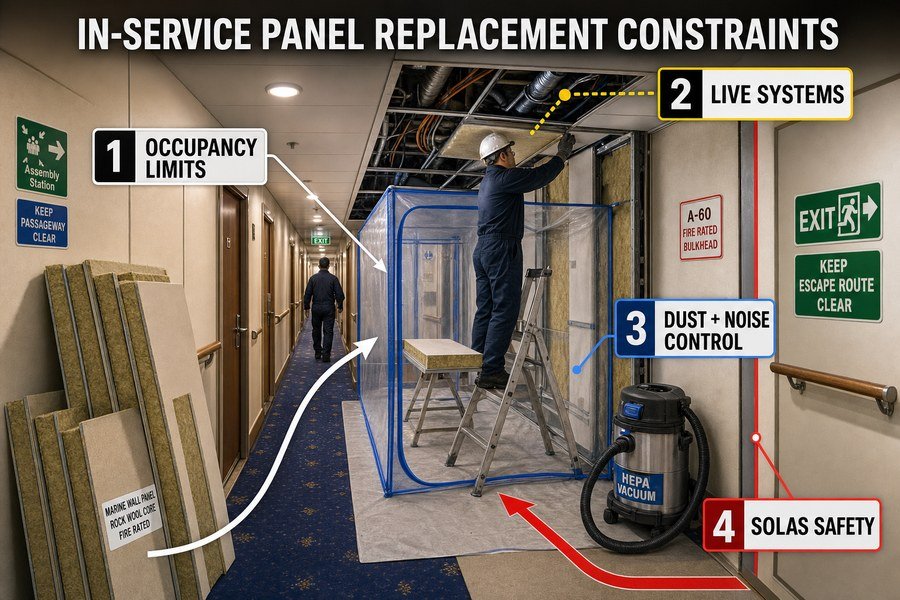
You might think you can just pull down the old panels and put up the new ones. But if you do that on a working ship, you will fail quickly. Let us look at the real limits you will face and how you can beat them to save time and money.
How Does Vessel Occupancy Limit Marine Wall Panel Replacement Scope?
Space on a working ship is very tight. If you bring in too many panels at once, nobody can move. This slows down your project.
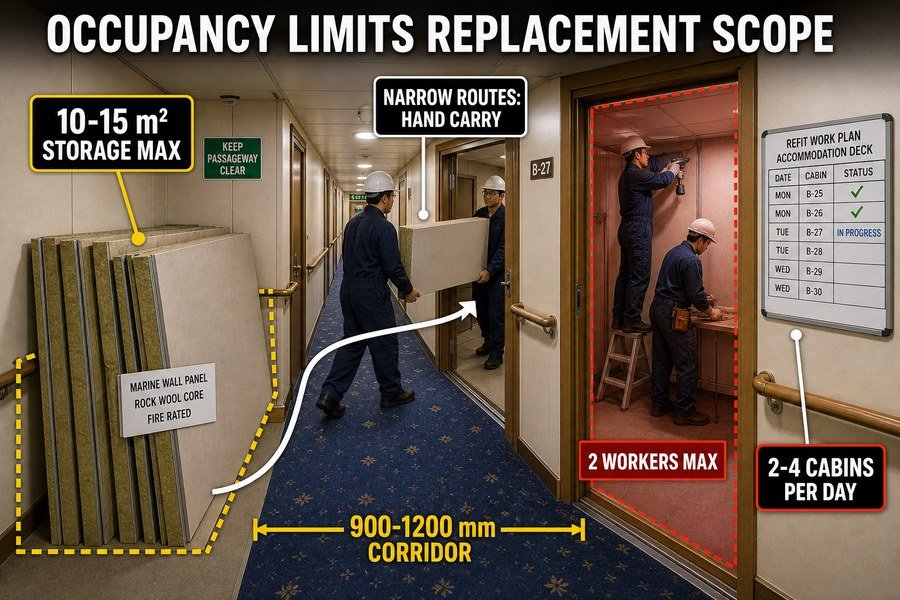
Vessel occupancy limits replacement scope through three restrictions: limited storage space for new materials, narrow access routes for transport, and restricted work zones. You can usually only replace 2 to 4 cabins per day because most ships only allow a maximum of 15 square meters of temporary storage.
Storage Space Constraints for New Marine Wall Panels
I remember a project in 2019. The project manager ordered 500 square meters of wall panels at once. The ship only had a small storage room. They had to put panels in the hallway. The captain was very angry. The International Maritime Organization (IMO) says corridors must be clear1. On most cargo ships, you only get about 10 to 15 square meters of safe storage space. This means you can only keep enough panels for 2 to 4 cabins at a time. You must plan your supply chain carefully. I always tell my clients to order panels from Asia with strict delivery batches so they do not run out of space.
Narrow Access Routes and Restricted Work Zones for Panel Transport
The second restriction is the narrow access routes. Standard marine doors are only 600mm to 800mm wide. Corridors are often just 900mm to 1200mm wide. You cannot use large forklifts inside. Workers must carry the panels by hand. A standard 50mm thick composite rock wool wall panel weighs about 18 to 20 kg per square meter. A full 2400mm x 600mm panel weighs about 26 to 29 kg. Two workers can carry this, but it is hard work in a tight space.
The third restriction is restricted work zones. You cannot block the crew from doing their jobs. If you work in a 10-square-meter cabin, only two workers can fit inside comfortably. If you put three workers in a small room, they will bump into each other. This lowers efficiency by 30%2. By buying high-quality, pre-cut panels from a reliable factory, you save cutting time in these tight zones. This helps you control the lead time perfectly.
| Occupancy Constraint | Measurement / Limit | Impact on Project |
|---|---|---|
| Temporary Storage | Maximum 10 to 15 square meters | Limits work to 2-4 cabins daily |
| Door/Corridor Width | 600mm to 1200mm wide | Requires manual lifting by 2 workers |
| Cabin Work Zone | 8 to 10 square meters per room | Maximum 2 workers per room |
How Do Live Ship Systems Dictate Marine Ceiling Panel Replacement Timing?
Cables and pipes run above the ceiling. If you cut the power, the ship stops working. This makes ceiling replacement very dangerous and stressful.
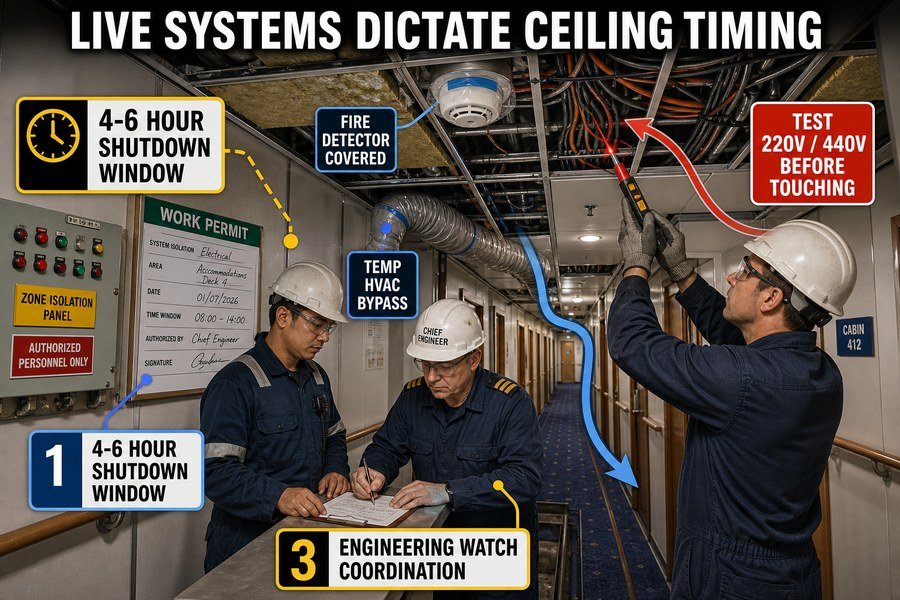
Live ship systems dictate ceiling replacement timing by requiring three things: scheduled power shutdowns, temporary bypasses for active HVAC pipes, and strict coordination with the engineering watch. You must limit ceiling work to 4-hour to 6-hour windows when critical systems can be safely taken offline.
Scheduled Power Shutdowns for Safe Marine Ceiling Work
Behind the ceiling panels, you will find electrical cables, fire alarms, and water pipes. You cannot just remove a panel without checking what is above it. The first requirement is scheduled power shutdowns3. The ship's generators must keep running. You cannot turn off the main power. Instead, you must ask the chief engineer to turn off power to specific zones. According to standard marine safety practices, you usually only get a 4-hour to 6-hour window to work on a specific section. If a worker touches a live 220V or 440V cable4 hidden above the ceiling, the result is fatal. You must test every wire before you touch the ceiling frame.
Temporary Bypasses for Active HVAC Pipes and Watch Coordination
The second requirement is managing temporary bypasses for active HVAC (Heating, Ventilation, and Air Conditioning) pipes. When you remove a ceiling panel, you expose the HVAC ducts. The crew still needs fresh air. Sometimes, you must install a temporary soft duct to keep the air flowing while you change the heavy steel ceiling frame.
The third requirement is strict coordination with the engineering watch. You must sign a "Permit to Work5" document before you start. The watch officer needs to know exactly which fire detectors are disabled6. I saw a contractor cause a false fire alarm once because dust got into an active smoke detector above the ceiling. The whole ship stopped. It cost the contractor a $5,000 penalty. Always cover the sensors and work fast within your approved time limit. Good ceiling panels with simple click-in systems help you finish the job in 3 hours instead of 6 hours.
| System Requirement | Action Needed | Time Limit | Penalty for Failure |
|---|---|---|---|
| Power Shutdown | Test 220V/440V lines | 4 to 6 hours max | Fatal injury or ship blackout |
| HVAC Bypasses | Install soft ducts | Continuous | Loss of cabin air flow |
| Watch Coordination | Sign Permit to Work | Per shift | False alarms and $5,000+ fines |
What Dust and Noise Controls Are Required When Retrofitting Marine Wall and Ceiling Panels on Active Ships?
Cutting panels makes toxic dust and loud noise. The crew cannot sleep or work. If you ignore this, the captain will stop your project immediately.
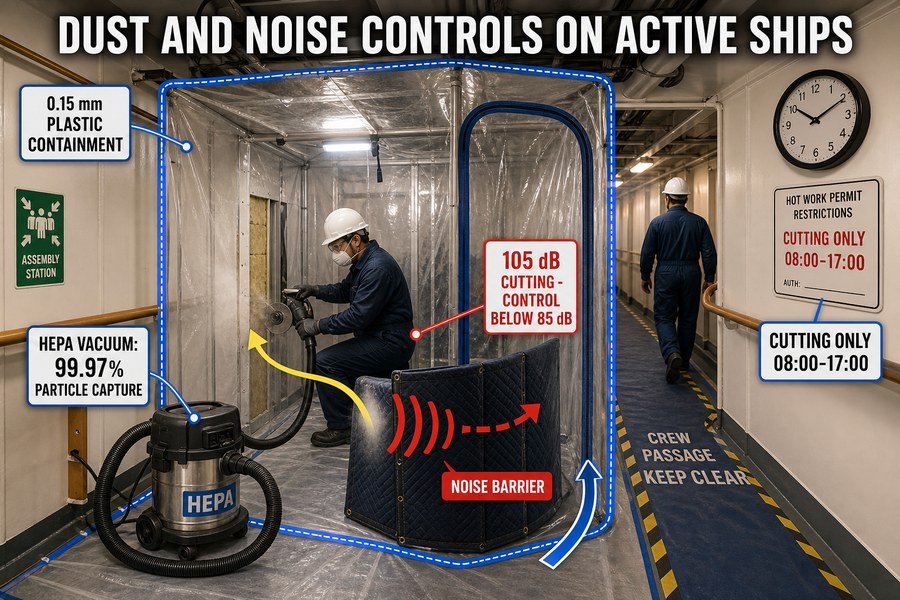
Retrofitting panels requires three strict controls: using HEPA vacuums to capture harmful rockwool dust, installing temporary plastic containment walls, and limiting noisy cutting to specific daytime hours. Noise must stay below 85 decibels, and dust must be contained to protect the health of the crew.
HEPA Vacuums and Plastic Containment for Rockwool Dust
When you cut a marine wall panel, you expose the rockwool core. Rockwool dust makes the skin itch and hurts the lungs. The first strict control is using HEPA (High-Efficiency Particulate Air) vacuums. Standard brooms just push the dust around the ship. You must use a vacuum that captures 99.97% of fine particles7.
The second control is installing temporary plastic containment walls. Before you cut any ceiling or wall panel, you must build a tent out of thick plastic sheets (at least 0.15mm thick). This keeps the dust inside your work area. The World Health Organization (WHO) has strict rules about air quality. You cannot let fiberglass or rockwool dust enter the ship's main air conditioning system. If you do, it will spread to the bridge and engine room, causing health problems for everyone.
Daytime Hour Restrictions for Noisy Panel Cutting Operations
The third strict control is limiting noisy cutting to specific daytime hours. Ship crews work in shifts. Some people sleep during the day. However, most captains will only allow you to use loud electric saws between 08:00 and 17:00. The International Labour Organization (ILO) states that constant noise above 85 decibels (dB) can damage hearing8. Cutting a steel marine panel with a grinder makes about 105 dB of noise. This is much too high for an active ship. You must use acoustic blankets to block the sound. I always suggest ordering customized panels from factories in China or Vietnam. If the panel size is exactly right, you do not need to cut it on the ship. This eliminates the noise and dust completely.
| Environmental Risk | Required Control Method | Standard / Limit |
|---|---|---|
| Rockwool Dust | HEPA Vacuum System | Captures 99.97% of particles |
| Air Pollution | Plastic Containment Walls | 0.15mm minimum thickness |
| Cutting Noise | Time Limits & Acoustic Blankets | Keep below 85 dB, work 08:00-17:00 |
How Does Cabin-by-Cabin Handover Dictate Marine Wall Panel Retrofit Schedules?
You cannot tear down all cabins at once. The crew needs places to sleep. This slow handover process ruins your schedule if you are not prepared.
Cabin-by-cabin handover dictates schedules through three rules: you must finish one room fully before starting the next, material deliveries must match the daily completion rate, and buffer days are required for inspection. This phased approach extends a 20-cabin project timeline from 5 days to 14 days.
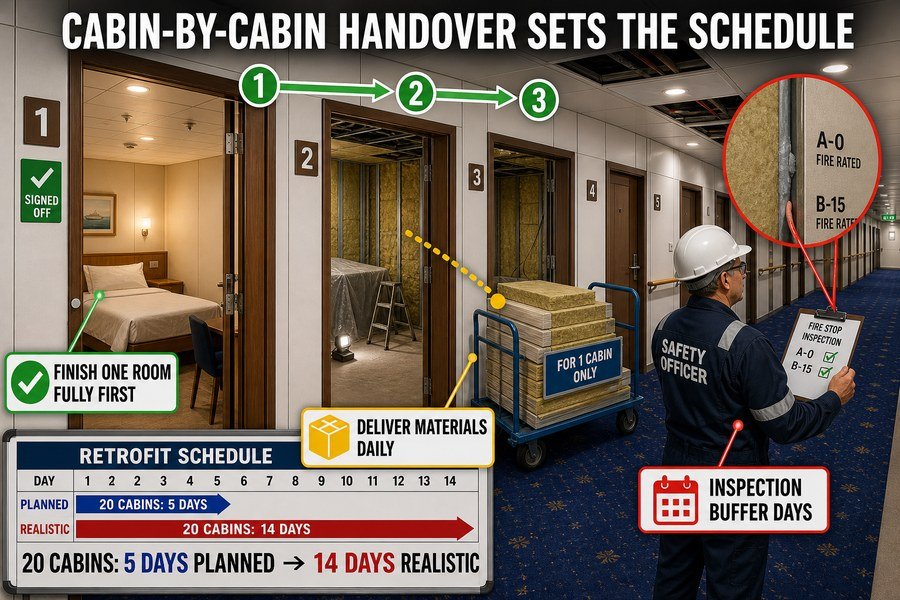
Finishing One Marine Cabin Fully Before Starting the Next
On an active ship, you do not have empty rooms. When you take a cabin from a crew member, they must sleep in a temporary bed. The first rule is that you must finish one room fully before starting the next. You cannot leave a room half-finished. A standard single crew cabin is about 6 to 8 square meters. It takes two trained workers about 12 to 14 hours to replace all the wall and ceiling panels, including the marine fire door. You must work quickly so the crew member can return to their own bed the next night. You cannot start taking apart cabin number 2 until cabin number 1 is completely clean and ready.
Matching Material Deliveries and Buffer Days for Inspection
The second rule is that material deliveries must match the daily completion rate. If you only finish one cabin a day, you only bring panels for one cabin from the storage room. This takes careful planning. If your supplier in Asia sends the wrong size for one room, the whole chain stops.
The third rule is that buffer days are required for inspection. The captain or the ship's safety officer must inspect the A-0 or B-15 fire-rated panels9 before the room is handed back. If they find a gap in the fire seal, you must fix it immediately. You cannot rush this. Because of this slow, step-by-step process, a job that looks like it takes 5 days will actually take 14 to 15 days. You must explain this timeline to your shipyard client so they understand the lead time.
| Handover Rule | Impact on Schedule | Example Timeline |
|---|---|---|
| Complete one room fully | Adds 12 to 14 hours per room | 1 room per day maximum |
| Daily material delivery | Slows down material movement | Delays next room if parts are missing |
| Mandatory inspection | Requires extra buffer days | Adds 1-2 days per 5 cabins |
How Do SOLAS Evacuation Regulations Constrain In-Service Marine Wall Panel Replacement?
Blocking a hallway during a fire will kill people. SOLAS rules are very strict about escape routes. If you block them, you will face huge fines.
SOLAS evacuation regulations constrain panel replacement by enforcing three mandatory rules: escape corridors must remain minimum 800mm wide at all times, emergency exits cannot be blocked by materials, and fire boundaries must be maintained overnight. Violating these rules can result in the immediate detention of the vessel.
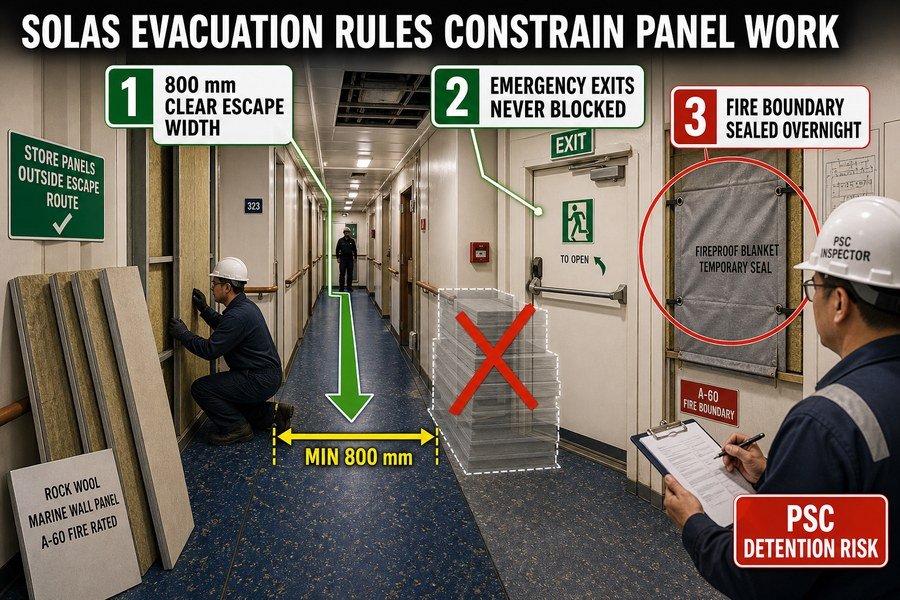
Maintaining Minimum Corridor Widths and Clearing Emergency Exits
Safety of Life at Sea (SOLAS) is the most important rulebook in our industry. The first mandatory rule is that escape corridors must remain at least 800mm wide at all times10. When you are replacing panels in a hallway, your ladders, tools, and old panels take up space. If an alarm rings, the crew must run past you. If your ladder leaves only 500mm of space, you are breaking the law.
The second rule is that emergency exits cannot be blocked by materials. You cannot put your boxes of new ceiling panels near the stairs. I once saw a Port State Control (PSC) inspector give a $10,000 fine to a ship because workers put old B-15 wall panels in front of a fire door. You must keep all escape doors clear 24 hours a day.
Maintaining Fire Boundaries Overnight During Panel Replacement
The third mandatory rule is that fire boundaries must be maintained overnight. This is the hardest constraint to manage. A marine wall panel is not just for decoration. An A-60 or B-15 panel stops fire from spreading11. If you remove an old A-60 panel at 16:00, you cannot go home and leave an empty hole in the steel bulkhead. If a fire starts at night, it will go straight through the hole. SOLAS Chapter II-2 requires the fire boundary to be complete. You must install the new panel and seal it before your shift ends. If you run out of time, you must install a temporary fireproof blanket. This means you must calculate your work hours very carefully every single day.
| SOLAS Regulation | Physical Constraint | Penalty for Violation |
|---|---|---|
| Escape Route Width | Must maintain 800mm clear space | Ship detention by PSC |
| Emergency Exits | Zero blocking materials allowed | Heavy fines (e.g., $10,000) |
| Fire Boundaries | Must seal all A-60/B-15 gaps overnight | Extreme fire risk and legal action |
How Does Crew Occupancy Affect Marine Wall Panel Replacement Operations?
A ship is a home for the crew. Working in their home creates friction. If you do not manage their needs, your project will fail.
Crew occupancy affects replacement operations by creating three major challenges: security of personal belongings, restricted use of shared bathrooms, and the need for daily clean-up routines. Workers must cover personal items, avoid blocking toilets, and spend 1 to 2 hours every evening cleaning the work site.
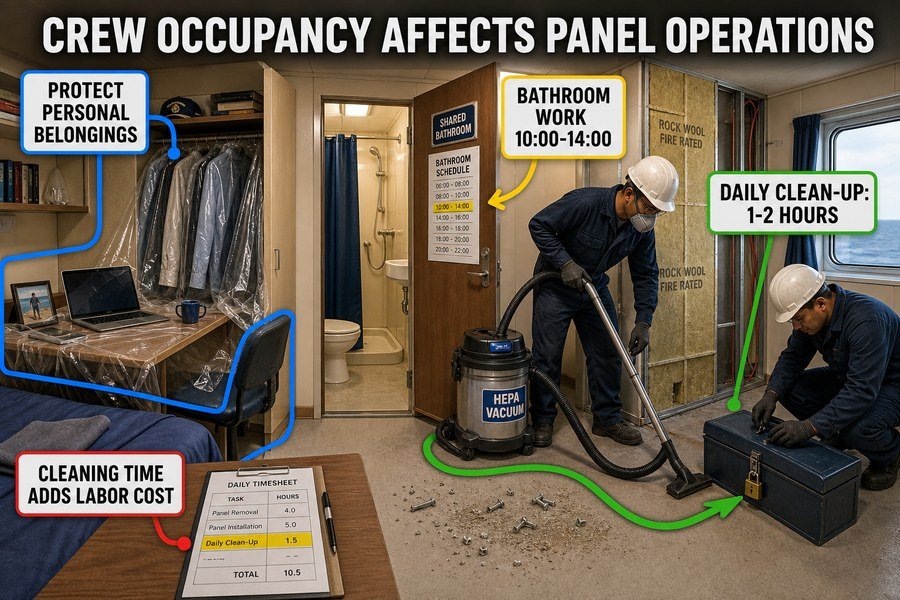
Security of Personal Belongings and Restricted Bathroom Use
When you replace a wall panel in a lived-in cabin, all the crew member's clothes, laptops, and photos are still there. The first challenge is the security of personal belongings. You must cover everything with heavy plastic. If a worker drops a hammer on a sailor's $1,000 laptop, your company must pay for it. Trust is very important on a ship.
The second challenge is the restricted use of shared bathrooms. On many older ships, two cabins share one wet unit (bathroom). If you are replacing the panels on the bathroom wall, two different crew members cannot take a shower. You must schedule bathroom work for the middle of the day, usually between 10:00 and 14:00, when most people are working. You cannot block the toilet when the crew wakes up or goes to sleep.
The Importance of Daily Clean-up Routines for Crew Comfort
The third major challenge is the need for daily clean-up routines12. On a normal construction site on land, you can leave your tools on the floor and go home. On an occupied ship, you cannot do this. The crew member needs to walk in their room at night. You must spend 1 to 2 hours every evening cleaning the site. You must pick up all screws, wipe the dust, and put your tools away in a locked box. I know that price is important for procurement. But you must add this cleaning time to your labor costs. If you pay workers $30 an hour, 2 hours of cleaning costs $60 per day per team. You cannot skip this step if you want the captain to sign your completion paper.
| Occupancy Challenge | Worker Action Required | Cost / Time Impact |
|---|---|---|
| Personal Belongings | Cover with heavy plastic, lock valuables | Adds 30 mins prep time per room |
| Shared Bathrooms | Work only between 10:00 and 14:00 | Limits daily work window |
| Daily Cleaning | Vacuum dust, lock tools in boxes | Costs $60+ daily in labor per team |
Conclusion
Replacing marine panels on an active ship requires strict planning for space, systems, noise, rules, and crew. Good preparation and pre-cut materials save time and protect your profits.
-
"[PDF] resolution msc.27(61) - International Maritime Organization", https://wwwcdn.imo.org/localresources/en/KnowledgeCentre/IndexofIMOResolutions/MSCResolutions/MSC.27(61).pdf. Maritime fire-safety and means-of-escape rules require escape routes to remain available for safe movement, supporting the statement that ship corridors should not be used as obstructed storage areas. Evidence role: general_support; source type: institution. Supports: The IMO requires ship corridors and escape routes to remain clear rather than being blocked by stored panels.. Scope note: The source supports the regulatory principle of unobstructed escape routes, but it does not verify the specific 2019 incident or the article's storage-space estimates. ↩
-
"Key Factors Affecting Labor Productivity in Offsite Construction ...", https://scholarsmine.mst.edu/cgi/viewcontent.cgi?article=3251&context=civarc_enveng_facwork. Research on construction labor productivity identifies overcrowding, congestion, and restricted work areas as causes of measurable productivity loss, providing contextual support for efficiency reduction in cramped cabin work zones. Evidence role: general_support; source type: paper. Supports: Adding too many workers in a small cabin work zone can reduce installation efficiency by around 30%.. Scope note: The literature supports productivity loss from congestion generally; the exact 30% figure may vary by trade, task, and site conditions and may not be specific to marine wall-panel installation. ↩
-
"[PDF] Matrix - OSHA", https://www.osha.gov/sites/default/files/shipboardelectrical_all-in-one.pdf. Maritime electrical-safety guidance describes isolating and securing electrical circuits before maintenance as a core control measure for preventing electric shock during shipboard work. Evidence role: expert_consensus; source type: government. Supports: Marine ceiling work should begin with planned isolation of the relevant electrical zones rather than ad hoc panel removal.. Scope note: The source may support isolation/lockout principles generally rather than the article's specific ceiling-panel workflow. ↩
-
"[PDF] Basic Electricity Safety - OSHA", https://www.osha.gov/sites/default/files/2019-04/Basic_Electricity_Materials.pdf. Occupational electrical-safety references identify contact with energized conductors at common shipboard voltages as capable of causing severe or fatal electric shock, depending on current path, exposure duration, and environmental conditions. Evidence role: mechanism; source type: government. Supports: Touching hidden energized 220V or 440V wiring above a ceiling can create a potentially fatal electric-shock hazard.. Scope note: Such sources generally explain shock risk by voltage, current, and exposure conditions; they do not prove that every contact with a 220V or 440V cable is fatal. ↩
-
"[PDF] Resolution MSC.539(107) - International Maritime Organization", https://wwwcdn.imo.org/localresources/en/MediaCentre/Documents/Resolution%20MSC.539(107).pdf. Permit-to-work systems are widely described in marine and industrial safety guidance as formal controls for hazardous work, documenting authorization, isolation measures, and communication among responsible personnel. Evidence role: definition; source type: institution. Supports: Shipboard ceiling work involving electrical systems, fire detection, or HVAC interfaces should be controlled through a documented permit-to-work process.. Scope note: A general permit-to-work source may not specify ceiling-panel removal, but it supports the procedural role of permits in coordinating hazardous maintenance. ↩
-
"[PDF] RESOLUTION MSC.311 (88) (adopted on 3 December 2010 ...", https://wwwcdn.imo.org/localresources/en/KnowledgeCentre/IndexofIMOResolutions/MSCResolutions/MSC.311(88).pdf. Fire-safety guidance for ships treats fire detection and alarm systems as critical safety equipment and requires controlled management when parts of a system are isolated or impaired during maintenance. Evidence role: general_support; source type: institution. Supports: Engineering watch personnel should know when fire detectors are disabled during ceiling work so that fire-safety coverage and alarm response remain controlled.. Scope note: The source is likely to support impairment control and notification requirements generally, not the article's exact statement about the watch officer's role. ↩
-
"What is a HEPA filter? | US EPA", https://www.epa.gov/indoor-air-quality-iaq/what-hepa-filter. The U.S. Environmental Protection Agency defines HEPA filtration as removing at least 99.97% of airborne particles at 0.3 microns, supporting the filtration-efficiency figure stated here. Evidence role: definition; source type: government. Supports: A HEPA vacuum captures 99.97% of fine particles.. Scope note: This supports the HEPA efficiency standard, not the actual performance of every vacuum in shipboard use. ↩
-
"Occupational Noise Exposure - Overview - OSHA", http://www.osha.gov/noise. ILO occupational safety guidance identifies 85 dB(A) as a key workplace noise threshold for hearing-conservation controls, supporting the use of 85 dB as a benchmark for hearing-risk management. Evidence role: expert_consensus; source type: institution. Supports: Constant occupational noise above 85 dB can damage hearing.. Scope note: The degree of hearing risk depends on exposure duration, frequency weighting, impulse characteristics, and hearing protection use. ↩
-
"What Is the Purpose and Scope of the IMO FTP Code?", https://magellanmarinetech.com/what-purpose-scope-of-imo-ftp-code/. IMO/SOLAS fire-test and structural fire-protection rules define A-class and B-class divisions and their time-based insulation criteria, including ratings such as A-0 and B-15, supporting the use of these terms for marine fire-rated cabin panels. Evidence role: definition; source type: institution. Supports: A-0 and B-15 are recognized marine fire-rating classifications for panels used in ship accommodation spaces.. Scope note: Such rules define the ratings and test context; they may not directly verify the article's project-specific inspection workflow. ↩
-
"[PDF] resolution msc.27(61) - International Maritime Organization", https://wwwcdn.imo.org/localresources/en/KnowledgeCentre/IndexofIMOResolutions/MSCResolutions/MSC.27(61).pdf. IMO/SOLAS fire-safety provisions on means of escape specify minimum clear-width requirements for shipboard escape routes, supporting the 800 mm clearance threshold discussed here. Evidence role: general_support; source type: institution. Supports: Escape corridors on ships must maintain at least 800 mm of clear width.. Scope note: The exact minimum can depend on ship type, construction date, route category, and flag-state implementation; the source may support the dimensional requirement more directly than the operational phrase "at all times." ↩
-
"Are Marine Fire Divisions the Same as Marine Panel Ratings?", https://magellanmarinetech.com/are-marine-fire-divisions-same-as-marine-panel-ratings/. SOLAS/IMO fire-test standards define A-class and B-class divisions by their ability to resist flame passage and limit temperature rise for specified periods, providing technical context for why A-60 and B-15 panels are treated as fire-boundary components. Evidence role: definition; source type: institution. Supports: A-60 and B-15 marine panels function as rated fire divisions intended to restrict fire spread for specified durations.. Scope note: The standards define rated performance under test conditions; they do not prove that any particular installed panel will perform correctly if damaged, poorly fitted, or improperly sealed. ↩
-
"29 CFR 1926.25 -- Housekeeping. - eCFR", https://www.ecfr.gov/current/title-29/subtitle-B/chapter-XVII/part-1926/subpart-C/section-1926.25. Occupational safety guidance on construction housekeeping requires debris, waste, and materials to be cleared from work areas and passageways to reduce hazards such as trips, slips, and blocked access, supporting the need for routine clean-up during occupied repair work. Evidence role: general_support; source type: government. Supports: Daily clean-up is necessary in occupied work areas to keep living spaces and access routes safe after construction activity.. Scope note: The cited housekeeping rules are general construction safety requirements and may not address ship-cabin refurbishment specifically. ↩