Crew complaints about ship noise can ruin your reputation. If you ignore what rooms sit next to each other, you risk failing sea trials. Let me help you fix this.
Cabin adjacency determines your allowable noise limit based on IMO regulations. A cabin next to a quiet space allows 60 dB(A), but adjacency to machinery, entertainment, or open decks dictates stricter acoustic barriers (Rw ≥ 45 dB) to maintain the mandatory 55-60 dB(A) internal cabin limit.
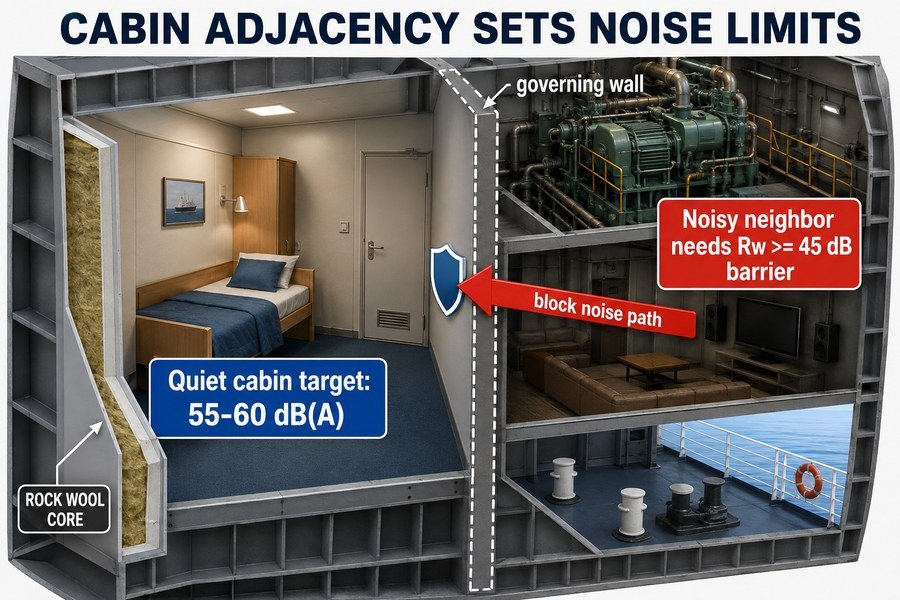
When I first started sourcing marine outfitting materials, I only looked at the target room. I quickly learned that the room next door changes everything about your panel choices. If you want to buy smart in Asia, you must understand how adjacent spaces push your noise limits up or down.
How Does a Marine Cabin Next to a Noisy Space Change Its Allowable Noise Limit?
Are you installing standard panels near the ship's galley? The noise bleed will trigger immediate inspection failures. Understanding adjacency rules saves you from costly tear-downs and replacements.
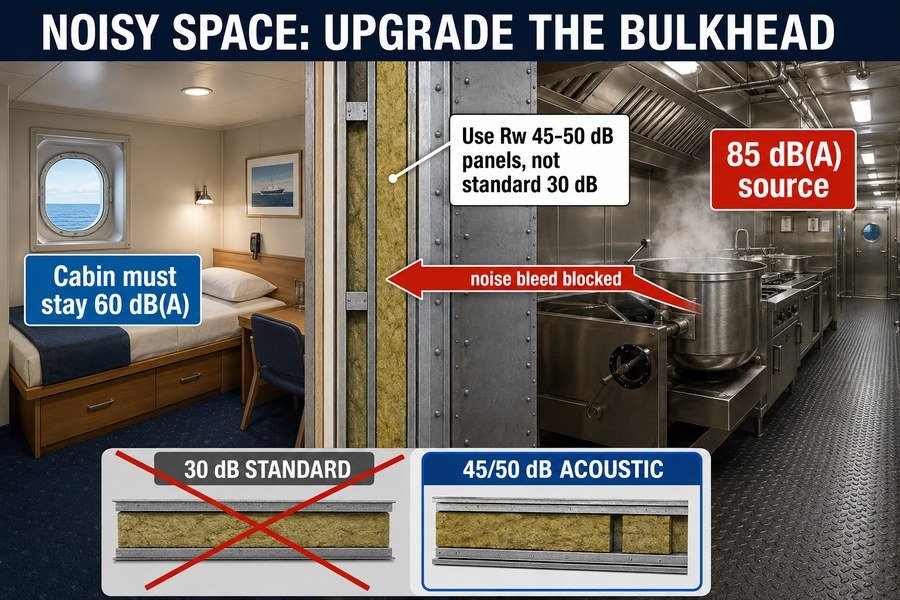
A marine cabin next to a noisy space does not change its internal 60 dB(A) limit, but it drastically changes the bulkhead requirement. You must upgrade from standard 30 dB panels to high-acoustic 45 dB or 50 dB panels to block the adjacent 85 dB(A) noise source.
Understanding IMO Code on Noise Levels on Board Ships Requirements
The IMO (International Maritime Organization) Resolution MSC.337(91) sets the rules for noise levels on ships. This document clearly states that the noise limit inside a standard crew cabin is 60 dB(A). It is 55 dB(A) for passenger cabins1. This internal limit never changes. What changes is how hard your marine wall panels must work. If you place a cabin next to a quiet storage room, the background noise is low. But if you place that same cabin next to a service area or a galley, the adjacent room produces up to 85 dB(A) of noise2.
You cannot let that 85 dB(A) noise enter the cabin. If it does, the cabin will easily exceed the 60 dB(A) limit. The wall dividing these two spaces must absorb or block the difference. As a marine outfitting specialist, I see many buyers make the mistake of using the same panel for every room. They buy a standard panel and fail the sea trial. You must look at the blueprint and find the noisy spaces first.
Upgrading from Standard to High-Acoustic Marine Panels
To block an 85 dB(A) noise source, you need to change your procurement strategy. A standard marine wall panel offers a sound reduction index (Rw) of about 30 dB. This is not enough. You must upgrade to high-acoustic panels with an Rw of 45 dB or 50 dB. These upgraded panels use thicker steel skins, heavier rockwool cores (up to 150 kg/m³), and special sound-damping membranes3.
I know budget is important. You want a competitive price. Standard 30 dB panels from China cost about $22 to $25 per square meter. A 45 dB panel costs around $45 per square meter. A 50 dB panel will cost $60 to $70 per square meter. You do not need to buy the expensive panel for the whole ship. You only buy the 45 dB or 50 dB panels for the walls that directly touch the 85 dB(A) noisy space.
| Panel Acoustic Rating (Rw) | Adjacent Space Noise Level | Typical Core Material | Average Price in Asia (per m²) |
|---|---|---|---|
| 30 dB | Low (60-65 dB) | 100 kg/m³ Rockwool | $22 - $25 |
| 45 dB | Medium (75-80 dB) | 120 kg/m³ Rockwool + Membrane | $45 - $50 |
| 50 dB | High (85 dB+) | 150 kg/m³ Rockwool + Double Skin | $60 - $70 |
Why Do Marine Cabins Bordering Machinery Spaces Require Stricter Acoustic Panels?
Engine room noise easily penetrates weak walls. If your panels fail to block this heavy vibration, the crew cannot sleep. Stricter panels are your only defense against this problem.
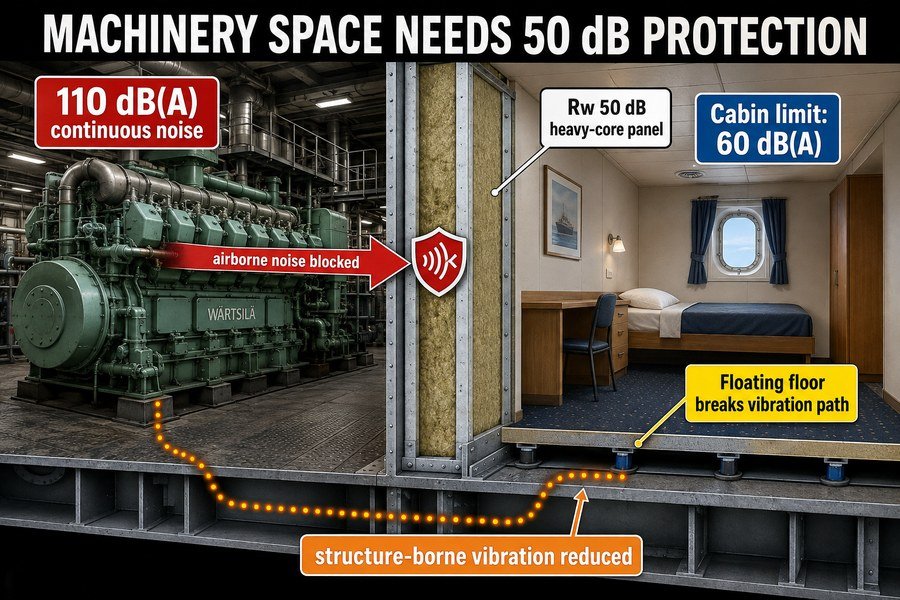
Cabins bordering machinery spaces require stricter acoustic panels because engine rooms generate 110 dB(A) of continuous noise. To maintain the IMO-mandated 60 dB(A) cabin limit, outfitting requires heavy-core acoustic panels with sound reduction indexes (Rw) of 50 dB, plus floating floors, to block airborne and structure-borne transmission.
Blocking 110 dB(A) Airborne Noise from Engine Rooms
Machinery spaces and engine rooms are the loudest parts of any ship. According to standard measurements, main engine rooms easily generate 110 dB(A) of continuous noise4. If a crew cabin sits right next to this machinery space, the wall between them faces extreme acoustic pressure. The IMO-mandated limit for the crew cabin remains 60 dB(A)5. This means the dividing wall must block a massive amount of noise.
You cannot fix this with a normal marine fire door or a standard wall panel. The sound pressure will pass right through the metal. You must specify heavy-core acoustic panels with an Rw rating of at least 50 dB. In my factory experience, a true 50 dB panel uses a double-layer steel plate design with a very dense rockwool core inside. We usually pack 150 kg/m³ density rockwool into these panels. Sometimes we add an extra layer of damping material, like a 2mm visco-elastic sheet. You must ask your Asian suppliers for their ISO 10140 acoustic lab test reports6 to prove their panels actually hit 50 dB.
Mitigating Structure-Borne Transmission with Floating Floors
Airborne noise is only half the problem. Machinery spaces also create heavy vibrations that travel through the steel deck. This is called structure-borne transmission. Even if you use a 50 dB wall panel, the noise will travel under the wall through the floor.
To stop this, you must install floating floors. A floating floor separates the cabin deck from the main steel deck of the ship. We typically use a 50mm thick high-density rockwool slab on the bottom, covered with a 3mm steel plate on top. This creates a break in the vibration path. A good A-60 floating floor will reduce impact noise by 15 to 20 dB. By combining 50 dB wall panels with a floating floor system, you block the 110 dB(A) machinery noise entirely and keep the cabin inside the 60 dB(A) limit.
| Noise Control Method | Target Transmission Type | Material Specification | Estimated Cost (per m²) |
|---|---|---|---|
| Heavy-Core Acoustic Panels | Airborne Noise | Rw 50 dB, 150 kg/m³ rockwool | $60 - $70 |
| Marine Floating Floor | Structure-Borne Vibration | 50mm Rockwool + 3mm Steel top | $40 - $55 |
| Acoustic Marine Fire Door | Airborne Noise (Access) | A-60 rated, Rw 45 dB | $350 - $450 per set |
How Does a Marine Cabin Above an Entertainment Space Affect Its Noise Target?
Bass frequencies travel right through standard ship decks. A VIP cabin above a loud lounge will get complaints every night. You need specific acoustic strategies for vertical noise bleed.
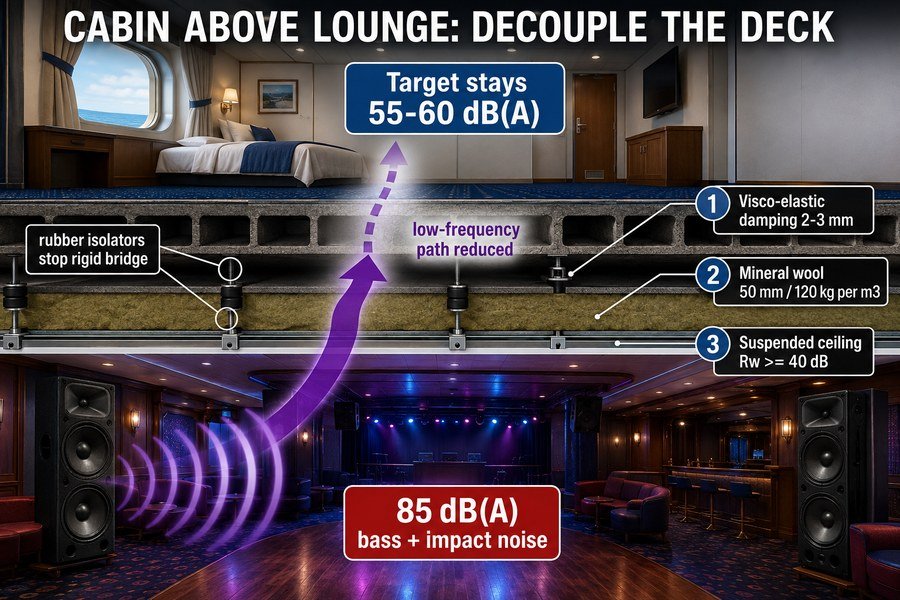
A marine cabin above an entertainment space retains its 60 dB(A) target, but requires specialized deck and ceiling treatments. You must install visco-elastic damping layers, isolated suspended marine ceiling panels (Rw ≥ 40 dB), and thick mineral wool insulation to block low-frequency bass and 85 dB(A) impact noise.
Managing 85 dB(A) Low-Frequency Entertainment Noise
Shipyards in Europe and the United States build many cruise ships and luxury ferries. These ships have large entertainment lounges, bars, and theaters. These spaces generate up to 85 dB(A) of noise. But unlike engine noise, entertainment noise is full of low-frequency bass. Low-frequency bass from music and movies travels upward very easily. If a cabin is directly above this space, the bass will shake the floor.
The target limit for the cabin above is still 60 dB(A) for crew, or 55 dB(A) for passengers. Standard deck insulation does not block low-frequency bass. The sound waves are too long and powerful. As a buyer, you must look beyond standard rockwool. You need heavy mass and disconnection.7 The 85 dB(A) impact noise from people dancing and heavy bass speakers will pass straight through a rigid steel deck. You have to decouple the ceiling below from the deck above.
Installing Visco-Elastic Damping and Suspended Marine Ceilings
To solve this vertical noise problem, you need three specific products. First, you need visco-elastic damping layers. This is a special compound painted or laid onto the steel deck. It is usually 2mm to 3mm thick. It stops the steel plate from vibrating like a drum. Second, you must fill the deck cavity with thick mineral wool insulation. We recommend at least 50mm of 120 kg/m³ density mineral wool. This absorbs the airborne sound trapped between the decks.
Third, and most importantly, you must install isolated suspended marine ceiling panels. You cannot screw the ceiling panels directly to the steel beams. You must use anti-vibration rubber hangers. The ceiling panels themselves need an acoustic rating of Rw ≥ 40 dB. Buying these specialized ceiling panels from China or Vietnam is highly cost-effective, but you must verify the hanger system. If the shipyard uses rigid metal hangers, the acoustic ceiling will fail to stop the 85 dB(A) noise.
| Deck Treatment Product | Primary Function | Specification Needed | Installation Location |
|---|---|---|---|
| Visco-Elastic Damping | Stops steel vibration | 2-3mm thick layer | Applied to raw steel deck |
| Mineral Wool Insulation | Absorbs trapped sound | 50mm thick, 120 kg/m³ | Inside deck cavity |
| Suspended Marine Ceilings | Blocks upward bass | Rw ≥ 40 dB rating | Hung on rubber isolators |
How Does Bulkhead Adjacency Between Marine Cabins Set Required Acoustic Ratings?
Crew members need privacy from their neighbors. If your bulkheads are too thin, they hear every conversation. Proper cabin-to-cabin acoustic ratings solve this privacy issue immediately.
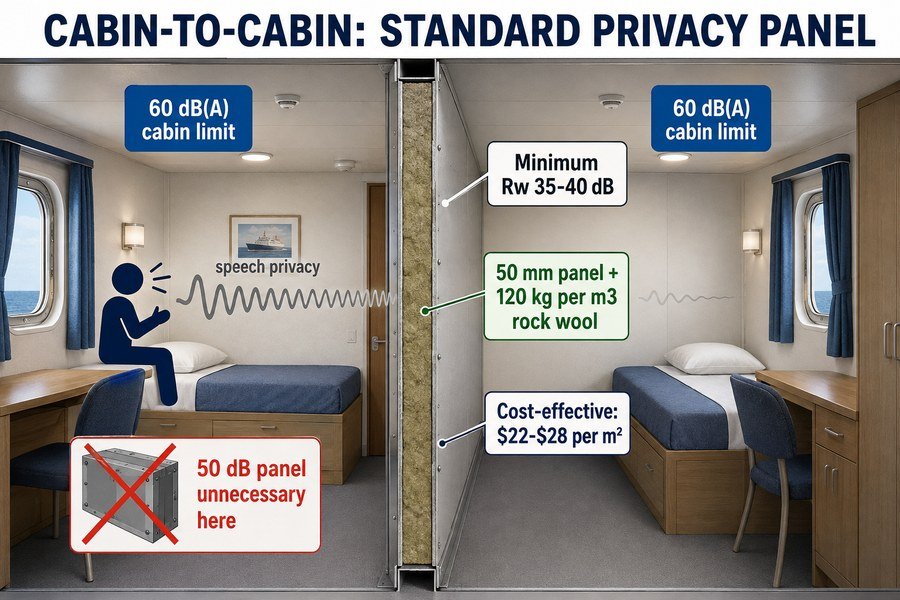
Bulkhead adjacency between two marine cabins sets a minimum acoustic rating requirement of Rw = 35 dB to 40 dB under IMO rules. Because both spaces share the same 60 dB(A) limit, standard 50mm sandwich panels with 120 kg/m³ rockwool cores are fully sufficient and cost-effective.
Meeting the Minimum Rw 35 dB Requirement for Marine Cabins
When you look at a ship layout, most rooms are just cabins next to other cabins. The IMO MSC.337(91) standard states that the bulkhead between two standard crew cabins must have an acoustic rating of at least Rw = 35 dB8. Some shipowners request a stricter Rw = 40 dB for extra privacy. Because both cabins have the exact same internal noise limit of 60 dB(A)9, there is no massive noise difference to fight against.
The noise source in one cabin is usually just a person talking, watching a TV, or closing a cabinet. This generates about 60 to 65 dB of noise. You do not need expensive, heavy acoustic panels here. If you use a 50 dB panel between two normal cabins, you are throwing your decoration budget into the ocean. You just need to meet the Rw 35 dB to 40 dB range. This provides total speech privacy10. The person in cabin A will not hear the person in cabin B.
Cost-Effective Procurement of 50mm Rockwool Sandwich Panels
This is where you can save a lot of money when buying from Asia. To hit the Rw 35 dB requirement, a standard 50mm sandwich panel is perfectly sufficient. These panels are made with a 0.6mm galvanized steel skin on both sides. Inside, they use a rockwool core with a density of 120 kg/m³.
During my time working at marine outfitting factories, this was our most popular export product. It is highly cost-effective. A standard 50mm thick panel with a 120 kg/m³ rockwool core costs only $22 to $28 per square meter. It is lightweight, easy for the shipyard to install, and fully complies with IMO rules for cabin-to-cabin adjacency. You do not need special acoustic membranes or double skins. Just ensure the factory has a valid MED (Marine Equipment Directive) certificate for fire safety, and you are ready to buy.
| Bulkhead Type | Acoustic Requirement | Recommended Panel Spec | Average Asian Price (per m²) |
|---|---|---|---|
| Cabin to Cabin (Standard) | Rw ≥ 35 dB | 50mm panel, 120 kg/m³ core | $22 - $25 |
| Cabin to Cabin (Privacy) | Rw ≥ 40 dB | 50mm panel, 150 kg/m³ core | $28 - $32 |
| Cabin to Corridor | Rw ≥ 35 dB | 50mm panel, 120 kg/m³ core | $22 - $25 |
How to Identify the Governing Noise Limit When a Marine Cabin Borders Multiple Spaces?
A cabin bordering an engine casing, a corridor, and another cabin creates severe confusion. Guessing the wrong panel ruins your budget or fails the inspection. Here is the exact calculation method.
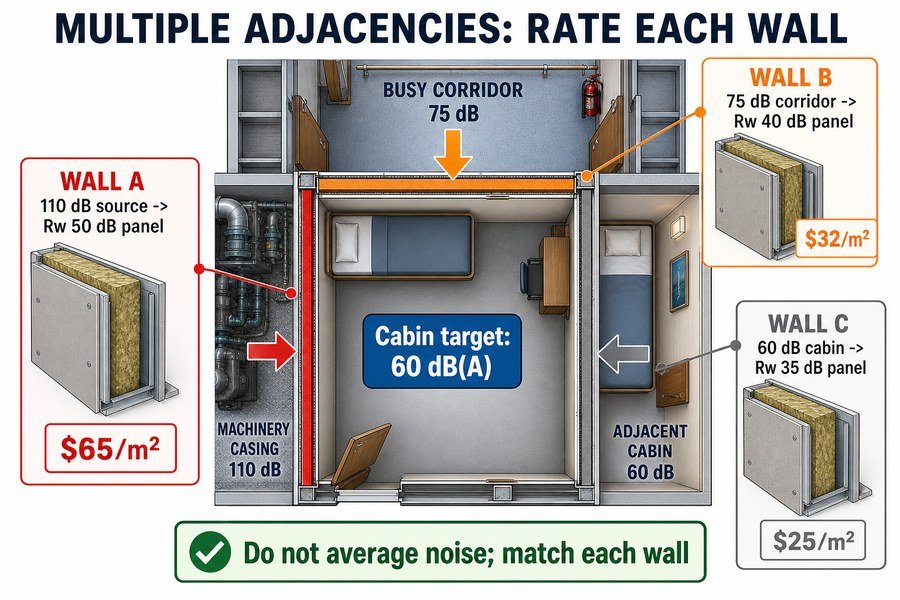
When a marine cabin borders multiple spaces, identify the governing noise limit by selecting the loudest adjacent source. You must apply 50 dB panels against the 110 dB machinery casing, 40 dB panels against the 75 dB corridor, and 35 dB panels against the adjacent cabin to optimize costs.
Calculating Acoustic Needs Against 110 dB Machinery and 75 dB Corridors
Real ship layouts are messy. A single crew cabin rarely borders just one type of room. Often, a cabin has three different walls bordering three different spaces. For example, Wall A touches the main machinery casing, which generates 110 dB. Wall B touches a busy crew corridor, which generates 75 dB. Wall C touches another crew cabin. How do you find the governing noise limit?
You must treat every wall as a separate problem11. You do not calculate an average. You select the loudest adjacent source for each specific wall direction. The cabin inside must stay at 60 dB(A). For Wall A, the machinery casing pushes 110 dB. You need heavy protection here. For Wall B, the corridor pushes 75 dB. You need moderate protection. For Wall C, the adjacent cabin is quiet. You only need standard privacy. If you use one panel type for all three walls, you will either fail the noise test or waste thousands of dollars.
Optimizing Outfitting Budgets with Mixed Panel Specifications
As a procurement officer, your goal is to buy high-quality products at low prices. You can optimize your outfitting budget by mixing panel specifications inside the same cabin.
For Wall A (against the 110 dB machinery), buy the heavy 50 dB acoustic panels. These cost around $65 per square meter. For Wall B (against the 75 dB corridor), buy 40 dB acoustic panels. These cost about $32 per square meter. For Wall C (against the adjacent cabin), buy the standard 35 dB panels. These cost just $25 per square meter. By matching the panel directly to the governing noise limit of that specific wall, you protect the crew perfectly while keeping your total invoice very low. Shipyards in Europe love this approach because it proves you understand both engineering and cost control.
| Wall Location | Adjacent Space Noise | Required Panel Rating (Rw) | Procurement Cost (per m²)12 |
|---|---|---|---|
| Wall A (Machinery) | 110 dB | 50 dB Panel | $65.00 |
| Wall B (Corridor) | 75 dB | 40 dB Panel | $32.00 |
| Wall C (Cabin) | 60 dB | 35 dB Panel | $25.00 |
Conclusion
Cabin adjacency dictates your marine panel purchases. Always match your acoustic ratings to the loudest adjacent room to meet IMO limits while keeping your decoration budget firmly under control.
-
"What Are Cabin Noise Level Standards on Ships?", https://magellanmarinetech.com/what-are-cabin-noise-level-standards-on-ships/. IMO Resolution MSC.337(91), the Code on Noise Levels on Board Ships, specifies maximum A-weighted sound pressure levels for accommodation spaces, including 60 dB(A) for crew cabins and 55 dB(A) for passenger cabins; the application depends on the vessel type, size, and regulatory scope of the Code. Evidence role: general_support; source type: institution. Supports: IMO Resolution MSC.337(91) sets cabin noise limits of 60 dB(A) for crew cabins and 55 dB(A) for passenger cabins.. Scope note: The source supports the regulatory thresholds, but the Code's applicability can vary by ship category and date of construction. ↩
-
"Physical influences on seafarers are different during their voyage ... - PMC", https://pmc.ncbi.nlm.nih.gov/articles/PMC7141673/. The IMO Code on Noise Levels on Board Ships assigns higher permissible noise levels to work and service spaces than to cabins, with some shipboard work areas listed around the 75-85 dB(A) range; this provides contextual support for treating adjacent service areas as higher-noise spaces, though it does not prove that every galley reaches 85 dB(A). Evidence role: general_support; source type: institution. Supports: Shipboard service or work spaces adjacent to cabins can have substantially higher noise levels, potentially approaching 85 dB(A).. Scope note: Support is contextual because actual galley or service-space noise depends on equipment, layout, operating condition, and measurement method. ↩
-
"Damping contribution of viscoelastic core on airborne sound ...", https://pmc.ncbi.nlm.nih.gov/articles/PMC10511544/. Building- and marine-acoustics literature explains that higher surface mass, absorptive porous cores, and damping layers can improve airborne sound insulation in panel systems by reducing transmission and resonance effects; this supports the stated design mechanism, although it does not verify the exact 150 kg/m³ density or any specific product configuration. Evidence role: mechanism; source type: research. Supports: High-acoustic panels use increased mass, denser mineral wool cores, and damping membranes to improve sound insulation.. Scope note: The source would support the acoustic mechanism generally, not the precise specification or performance of a particular marine panel. ↩
-
"Physical influences on seafarers are different during their ...", https://pmc.ncbi.nlm.nih.gov/articles/PMC7141673/. Peer-reviewed shipboard-noise studies report that machinery and engine-room locations can reach approximately 100-110 dB(A), supporting the use of 110 dB(A) as a plausible high-noise design condition. Evidence role: statistic; source type: paper. Supports: Main engine rooms can generate about 110 dB(A) of continuous airborne noise.. Scope note: Reported levels vary by vessel type, engine load, measurement position, and operating condition; the source would support plausibility rather than prove every main engine room reaches 110 dB(A). ↩
-
"What Are Cabin Noise Level Standards on Ships?", https://magellanmarinetech.com/what-are-cabin-noise-level-standards-on-ships/. The IMO Code on Noise Levels on Board Ships specifies maximum noise levels for accommodation spaces, including a 60 dB(A) limit for cabins, establishing the regulatory basis for the stated cabin target. Evidence role: expert_consensus; source type: institution. Supports: The IMO limit for crew cabins is 60 dB(A).. Scope note: Applicability depends on vessel type, tonnage, build date, and the version or implementation of the IMO code by flag administrations. ↩
-
"Sound insulation dataset of 30 wooden and 8 concrete floors ...", https://pmc.ncbi.nlm.nih.gov/articles/PMC10365936/. ISO 10140 defines laboratory methods for measuring sound insulation of building elements, providing a standardized basis for acoustic test reports used to document panel sound-reduction performance. Evidence role: definition; source type: institution. Supports: ISO 10140 lab reports are an appropriate form of evidence for verifying acoustic panel performance.. Scope note: ISO 10140 supports the relevance of the laboratory test method; it does not itself certify that a specific marine panel achieves Rw 50 dB or satisfies ship-class requirements. ↩
-
"Airborne sound insulation performance of lightweight double ...", https://pmc.ncbi.nlm.nih.gov/articles/PMC11666719/. Acoustics literature on transmission loss and mass-spring-mass systems supports that increasing surface mass and resiliently decoupling layers are established methods for improving sound insulation, particularly when low-frequency resonance is controlled. Evidence role: mechanism; source type: education. Supports: Controlling low-frequency noise through a deck requires mass and mechanical decoupling rather than relying only on standard insulation.. Scope note: This supports the design principle, not the adequacy of any particular deck assembly or product specification. ↩
-
"What Are Cabin Noise Level Standards on Ships?", https://magellanmarinetech.com/what-are-cabin-noise-level-standards-on-ships/. IMO Resolution MSC.337(91), the Code on Noise Levels on Board Ships, specifies minimum airborne sound insulation values for accommodation spaces, including an Rw criterion for cabin-to-cabin partitions. Evidence role: definition; source type: institution. Supports: The IMO MSC.337(91) standard requires at least Rw 35 dB airborne sound insulation between standard crew cabins.. ↩
-
"What Are Cabin Noise Level Standards on Ships?", https://magellanmarinetech.com/what-are-cabin-noise-level-standards-on-ships/. The IMO Code on Noise Levels on Board Ships lists maximum noise limits for accommodation spaces and gives 60 dB(A) as the limit for cabins under the relevant operating conditions. Evidence role: definition; source type: institution. Supports: Crew cabins covered by the IMO shipboard noise code have the same internal noise limit of 60 dB(A).. Scope note: This supports the regulatory cabin noise limit, not the actual measured noise level in any specific vessel or cabin layout. ↩
-
"Acoustic assessment of speech privacy curtains in two nursing ...", https://pmc.ncbi.nlm.nih.gov/articles/PMC4918673/. Acoustics guidance on sound transmission class or weighted sound reduction index indicates that partitions in the mid-30 to 40 dB range reduce speech transmission substantially, but speech privacy also depends on background noise, flanking paths, doors, seals, and installation quality. Evidence role: expert_consensus; source type: research. Supports: An Rw 35-40 dB partition can provide meaningful speech privacy between cabins.. Scope note: Such sources provide contextual support for improved speech privacy, not direct proof of total inaudibility in every installed marine cabin. ↩
-
"Validation of EN 12354-1 prediction models by means ...", https://www.academia.edu/81991324/Validation_of_EN_12354_1_prediction_models_by_means_of_Intensity_and_Vibration_measurement_techniques_in_Spanish_buildings_involving_flanking_airborne_sound_transmission. ISO 12354-1 models airborne sound transmission between rooms as contributions from separating and flanking elements, supporting path-by-path evaluation of boundaries rather than a simple average of adjacent noise sources. Evidence role: mechanism; source type: institution. Supports: Each wall or transmission path should be assessed separately when estimating cabin noise intrusion.. Scope note: ISO 12354-1 is primarily a building-acoustics calculation framework; its support is contextual unless the ship design standard or project specification adopts an equivalent path-based method. ↩
-
"How to choose the right marine wall panels for marine interior projects?", https://magellanmarinetech.com/how-choose-right-marine-wall-panels-for-marine-interior-projects/. A public tender record or independent construction-cost database for comparable marine acoustic wall panels would provide a contemporaneous benchmark for per-square-meter pricing of specified panel types. Evidence role: statistic; source type: government. Supports: The listed per-square-meter prices for 35 dB, 40 dB, and 50 dB acoustic panels are realistic procurement benchmarks.. Scope note: Panel prices vary materially with fire rating, certification, finish, order volume, region, currency date, and installation scope, so one source would only contextualize the listed figures rather than prove universal costs. ↩