Tired of shipyard clients rejecting your interior outfitting due to noise complaints? Understanding marine noise standards is hard, but it is the key to getting your panels approved fast.
Cabin noise level standards on ships are mandatory acoustic limits set by IMO Resolution MSC.337(91), capping noise at 55 dB(A) for standard passenger cabins, 60 dB(A) for crew cabins, and 85 dB(A) for machinery spaces, ensuring safe, comfortable environments using certified acoustic bulkheads and ceilings.
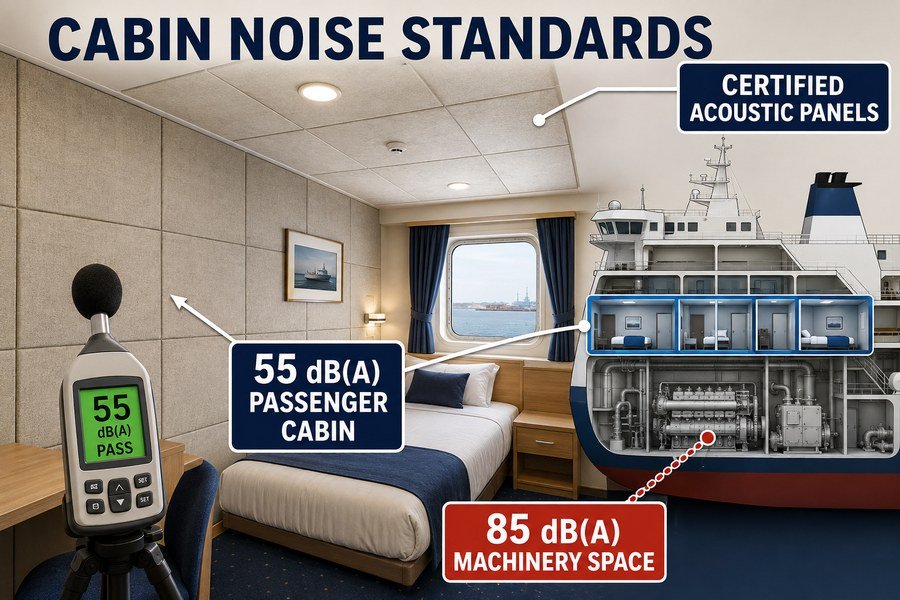
Let me break down exactly how these rules work and how they impact the wall and ceiling panels you buy.
What Does "Cabin Noise Limit" Mean for Marine Bulkhead and Ceiling Panels?
Are your suppliers confusing you with raw acoustic data? If you buy the wrong panels, your whole cabin will fail the final noise test. Here is the truth.
For marine bulkhead and ceiling panels, "cabin noise limit" means the maximum allowable sound pressure in a room. Panels must provide a specific Sound Reduction Index (Rw), typically ranging from 30 dB to 45 dB, to block external engine or neighbor noise from exceeding the 55-60 dB(A) cabin limit.
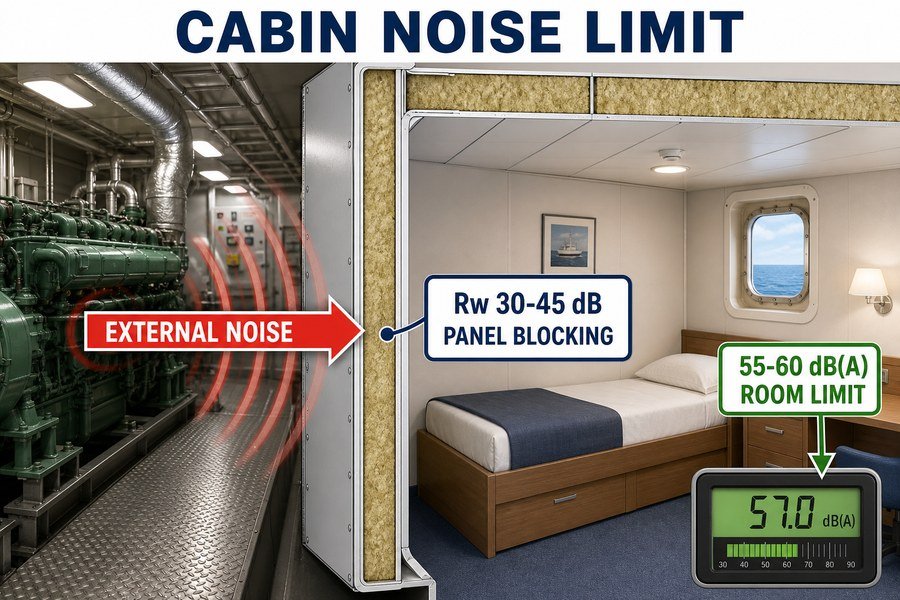
Understanding Sound Reduction Index (Rw) for Marine Panels
When a shipyard gives you a cabin noise limit of 60 dB(A), you cannot just go to a factory in Asia and ask for a "60 dB panel." That is not how it works. The cabin limit is the final goal. To reach that goal, your bulkhead and ceiling panels need a Sound Reduction Index (Rw). The Rw tells you how much noise the panel can block. According to laboratory tests, standard marine wall panels offer an Rw of 30 dB. High-acoustic panels offer up to 45 dB. I have seen procurement officers buy cheap 30 dB panels for a noisy area. The noise easily passed through the wall, the cabin exceeded the 60 dB(A) limit, and the shipyard rejected the whole deck. You must always match the Rw of the panel to the surrounding noise environment.
How External Engine and Neighbor Noise Dictate Panel Choice
Ship cabins face two main types of noise. The first is external engine noise. Ship engines are very loud. The second is neighbor noise. This is the sound of people talking or televisions playing in the next room. To stop both types of noise and keep the room under the 55-60 dB(A) limit, your panels must use the right core material. A 50mm thick panel with a 120 kg/m3 rockwool core will block about 32 dB of noise.1 If you upgrade to a sandwich panel with a steel sheet inside the rockwool, the Rw jumps to 44 dB. This extra mass stops both engine vibrations and human voices.
| Noise Source | Average Source Level | Required Panel Rw | Final Cabin Noise Level |
|---|---|---|---|
| Neighbor Talking (Next Cabin) | 70 dB(A) | 30 dB | < 40 dB(A) (Passes) |
| Engine Room (Above Deck) | 90 dB(A) | 45 dB | 45 dB(A) (Passes) |
| Standard Corridor | 75 dB(A) | 35 dB | 40 dB(A) (Passes) |
Which Criteria Define Acceptable Noise Levels in Marine Accommodation Cabins?
Do you know exactly what the surveyor checks during sea trials? Guessing the criteria leads to expensive rework. We must look at the official rules.
Acceptable marine cabin noise levels are defined by three main criteria: vessel size (over 1,600 GT), cabin function (crew vs. passenger), and location. IMO MSC.337(91) mandates 60 dB(A) for crew standard cabins, 55 dB(A) for hospitals, and 55 dB(A) for passenger cabins on vessels over 10,000 GT.
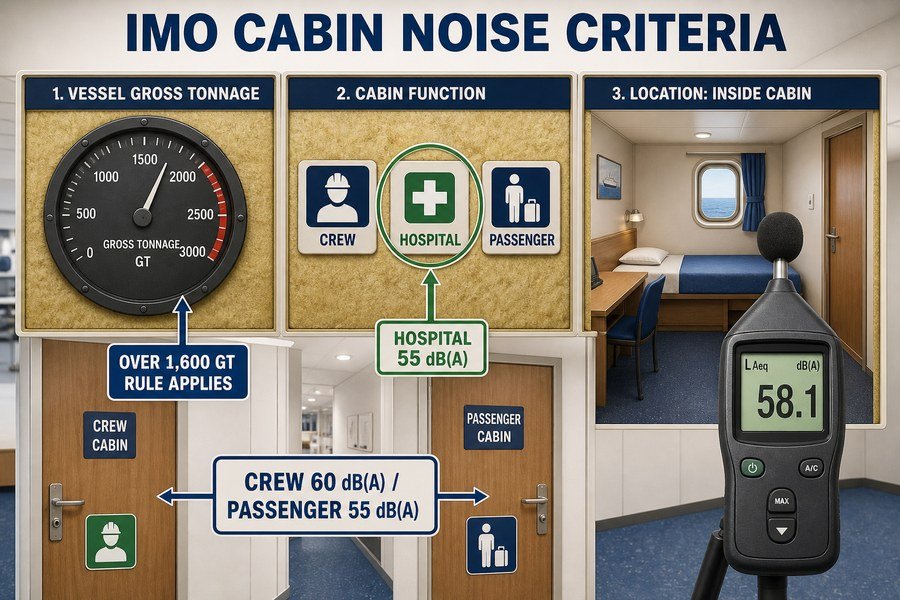
IMO MSC.337(91) Gross Tonnage (GT) Classifications
The first thing you must check is the size of the ship. The International Maritime Organization (IMO) uses Gross Tonnage (GT) to set the rules. According to IMO Resolution MSC.337(91), the strict noise rules apply to all new ships of 1,600 GT and above2. If your shipyard client is building a small tugboat under 1,600 GT, the rules are much softer. But if you are supplying interior decoration for large ships, the rules change again at 10,000 GT. For ships between 1,600 GT and 10,000 GT, the limit for a crew cabin is 60 dB(A). For massive ships over 10,000 GT, the limit drops down to 55 dB(A)3 for certain areas. I always ask the shipyard for the exact GT of the vessel before I ask Chinese or Vietnamese factories for panel prices.
Different Noise Criteria for Crew versus Passenger Spaces
The second and third criteria are cabin function and location. A ship is not just one big room. Different rooms have different noise limits. The IMO values the rest of the crew, but it values sick people and paying passengers even more. For a standard crew cabin on a standard ship, the limit is 60 dB(A). But if you are outfitting the ship's hospital, the limit is a very quiet 55 dB(A). Passenger cabins also require a 55 dB(A) limit. This means you cannot buy the same cheap wall panel for the whole ship. You must buy high-density, sound-blocking panels for hospitals and passenger spaces, and you can save money by using standard panels in regular crew cabins.
| Vessel Size (GT) | Cabin Function | Measurement Location | Maximum Allowed Noise Level |
|---|---|---|---|
| 1,600 to 9,999 GT | Crew Cabin | Inside Cabin | 60 dB(A) |
| 10,000 GT and up | Crew Cabin | Inside Cabin | 55 dB(A) |
| Any Size > 1,600 GT | Ship Hospital | Inside Hospital Room | 55 dB(A) |
| Any Size > 1,600 GT | Passenger Cabin | Inside Cabin | 55 dB(A) |
How Is a Cabin Noise Target Expressed in dB(A) for Marine Interiors?
Does "dB(A)" look like random letters on your specification sheets? Misreading this unit will make you buy materials that do not meet shipyard demands.
A marine cabin noise target is expressed in dB(A), which means A-weighted decibels. This scale mimics human hearing by filtering out very low and very high frequencies. A typical target is a single number, like 55 dB(A), representing the maximum continuous background noise allowed during normal sea transit.
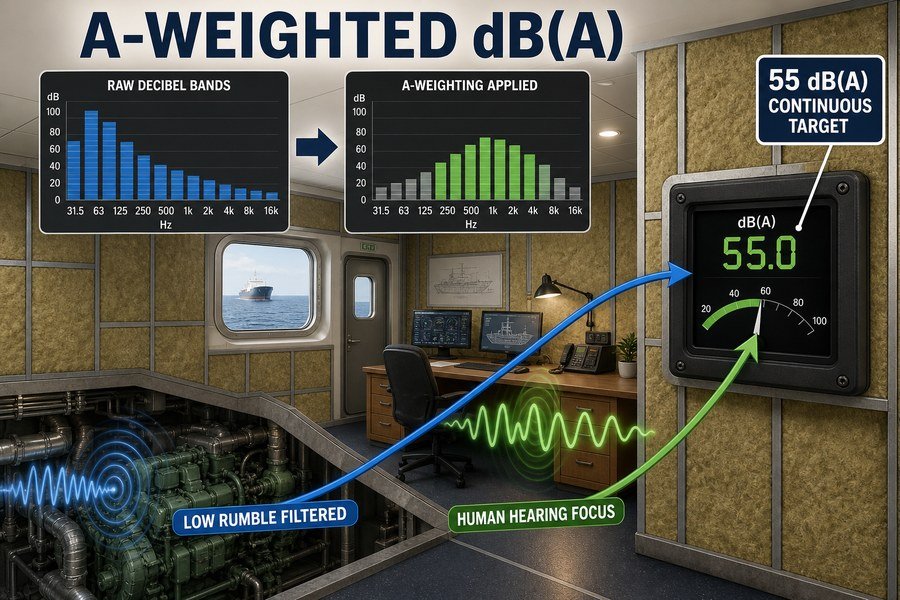
The Science Behind A-Weighted Decibels in Marine Testing
When you read a ship's interior specification, you will always see the target written as dB(A). The "A" stands for A-weighting. Ship engines make a lot of low-frequency rumbling sounds. But human ears do not hear low-frequency sounds very well. Human ears are very sensitive to mid-frequency sounds, like a baby crying or a smoke alarm ringing. The A-weighted scale changes the raw noise data to match human hearing.4 It filters out the very low and very high frequencies. If a raw noise meter reads 70 dB of low engine rumble, the A-weighted reading might only show 55 dB(A) because a human would not feel it as loudly. Shipyards only care about what the human ear hears, so they only use the dB(A) scale to accept or reject your interior panels.
Measuring Continuous Background Noise During Sea Transit
The dB(A) target is always a single number. For example, a contract will ask for a maximum of 55 dB(A) in a cabin. This number represents the continuous background noise during normal sea transit. It does not include short, sudden noises like a door slamming or a person dropping a tool. The surveyor turns on the microphone while the ship's main engine runs at 85% maximum continuous rating (MCR)5. They let the microphone record the steady, constant hum of the ship. Your marine ceiling panels and wall panels must work together to absorb and block this constant vibration. If your panels have cheap, thin steel skins, they will vibrate with the engine and create more noise, causing the dB(A) reading to fail.
| Frequency Band | Raw Decibel (dB) Level | A-Weighting Adjustment | Final dB(A) Value |
|---|---|---|---|
| 63 Hz (Low Engine Rumble) | 70 dB | -26.2 dB | 43.8 dB(A) |
| 500 Hz (Mid-Level Hum) | 60 dB | -3.2 dB | 56.8 dB(A) |
| 1000 Hz (Human Voice Range) | 55 dB | 0 dB | 55.0 dB(A) |
Why Does a Single Cabin Noise Limit Fail Across All Marine Projects?
Are you trying to use one standard panel for every project? This mistake ruins profit margins because every ship has different noise risks and rules.
A single cabin noise limit fails because marine projects differ drastically in structural design, engine type, and operational purpose. A luxury cruise ship requires passenger cabins below 45 dB(A) (DNV SILENT class), while a standard cargo vessel only legally needs 60 dB(A) for crew cabins under IMO baseline rules.
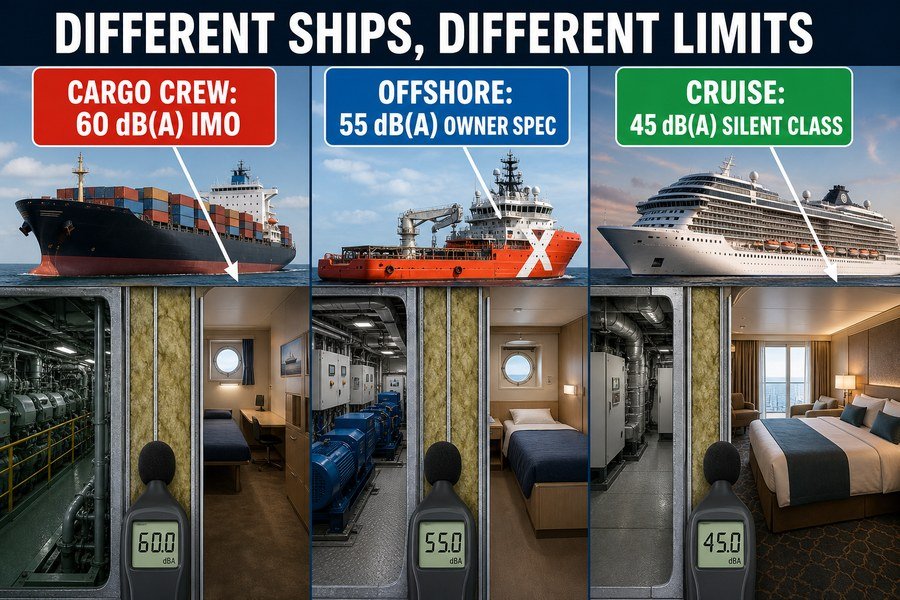
How Vessel Purpose and Engine Type Change Acoustic Requirements
Every ship is built for a different purpose. This changes the structural design and the engine type. A heavy bulk carrier has a massive, slow-speed diesel engine6. This engine shakes the whole steel structure of the ship. The operational purpose of this ship is just to move cargo. Therefore, the shipyard only follows the basic IMO legal limit of 60 dB(A) for the crew. On the other hand, an offshore wind farm support vessel has a different purpose. The crew works 12-hour shifts in harsh weather. They need perfect sleep. These ships often use diesel-electric engines that create high-pitched whining noises7. You cannot use the same interior wall panel for both ships. The bulk carrier needs heavy panels to stop low vibrations. The offshore vessel needs thick rockwool to absorb high-pitched whine.
The Impact of Voluntary Class Notations Like DNV SILENT
The biggest mistake you can make is assuming the IMO limit is the only rule. Many European and American shipyards add voluntary class notations to their ships. A famous example is the DNV SILENT notation. Luxury cruise ships and high-end research vessels use these strict rules to prove their quality. Under the basic IMO rule, a passenger cabin allows 55 dB(A). But under a strict DNV SILENT notation, the shipyard might demand a limit of 45 dB(A) or even 40 dB(A). This is a huge difference. Sound energy doubles every 3 dB8. A room at 45 dB(A) is incredibly quiet. If your sales contract from the shipyard mentions a voluntary class notation, you must immediately contact your Asian suppliers to upgrade your marine fire doors and bulkhead panels to the highest acoustic grades.
| Ship Type | Engine Type | Regulatory Standard | Required Cabin Limit |
|---|---|---|---|
| Standard Cargo Vessel | Slow-speed Diesel | IMO MSC.337(91) Baseline | 60 dB(A) |
| Offshore Support Vessel | Diesel-Electric | IMO + Owner Specs | 55 dB(A) |
| Luxury Cruise Ship | Gas Turbine / Pods | DNV SILENT Class Notation | 45 dB(A) |
How Do Cabin Noise Requirements Translate Into Marine Panel Acoustic Values?
Shipyards give you a room limit, but panel factories give you a material rating. If you do not know how to link them, you will buy the wrong product.
Cabin noise requirements translate to marine panel acoustic values using the Sound Reduction Index (Rw). If a hallway has 85 dB(A) noise and the cabin limit is 55 dB(A), the dividing bulkhead panel must have an Rw rating of at least 30 dB to block the difference.
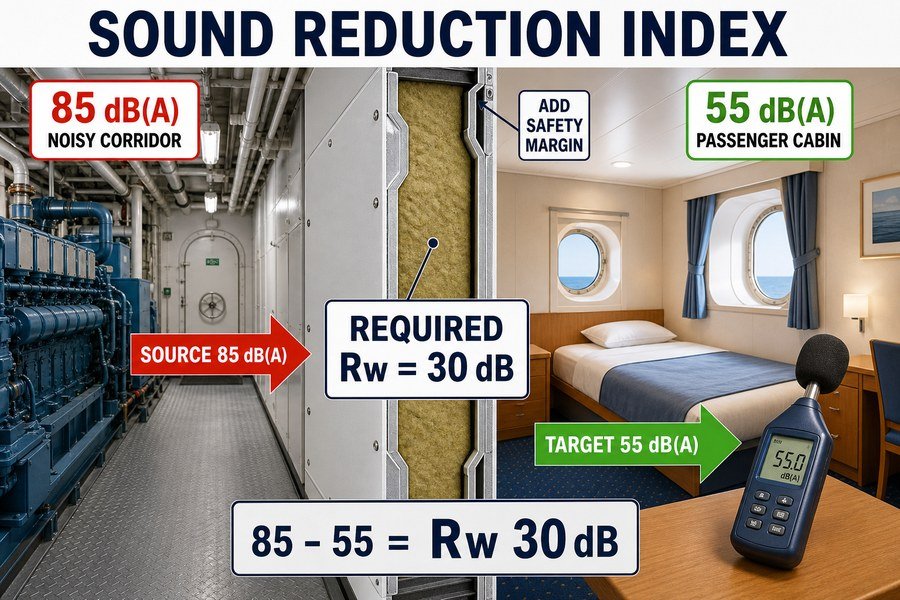
Calculating the Required Sound Reduction Index (Rw)
Translating a room requirement into a panel specification is just basic math. You need to know two numbers. First, you need the noise level of the source room. Second, you need the noise limit of the target room. Let us look at a real example I solved last year. A shipyard client in Europe was building a ship with a noisy machinery corridor. The noise in the corridor was 85 dB(A). Right next to this corridor was a passenger cabin. The cabin had a strict limit of 55 dB(A). To find the right panel, you subtract the cabin limit from the corridor noise. 85 minus 55 equals 30. Therefore, the bulkhead panel between the corridor and the cabin must have an Rw of at least 30 dB9. To be safe from installation leaks, I always add 3 dB to the result. I told the buyer to purchase a panel with an Rw of 33 dB.
Choosing the Right Rockwool Core for Acoustic Bulkheads
Once you calculate the required Rw value, you must select the right panel from your supplier. The secret to a panel's Rw value is the rockwool core. Rockwool absorbs sound waves. If you need a standard Rw of 30 dB, a basic marine wall panel with a 50mm thickness and a 100 kg/m3 rockwool density will work perfectly10. It is cheap and easy to buy in China. But if your math shows you need an Rw of 44 dB, standard rockwool is not enough. You must ask the factory for a composite panel. These panels have a 150 kg/m3 high-density rockwool core with a 1mm galvanized steel sheet glued right in the middle. The steel blocks the sound, and the rockwool absorbs the echo.
| Source Area Noise | Target Cabin Limit | Required Rw (Difference) | Recommended Panel Choice |
|---|---|---|---|
| Corridor: 75 dB(A) | Crew Cabin: 60 dB(A) | 15 dB | Standard 50mm Panel (Rw 30) |
| Next Cabin: 70 dB(A) | Pass. Cabin: 55 dB(A) | 15 dB | Standard 50mm Panel (Rw 30) |
| Machinery: 85 dB(A) | Pass. Cabin: 55 dB(A) | 30 dB | Acoustic 50mm Panel (Rw 35) |
| Engine Casing: 95 dB(A) | Ship Hospital: 55 dB(A) | 40 dB | Double Sandwich Panel (Rw 44) |
What Measurement Location Defines a Marine Cabin's Noise Rating?
Do you know where the inspector actually places the microphone? Failing to understand the test location means your panels might fail the final inspection.
A marine cabin's noise rating is defined by measurements taken in the center of the room and at the head of the bed. According to IMO rules, the microphone must be 1.2 to 1.6 meters above the deck and at least 0.5 meters away from any bulkhead panel.
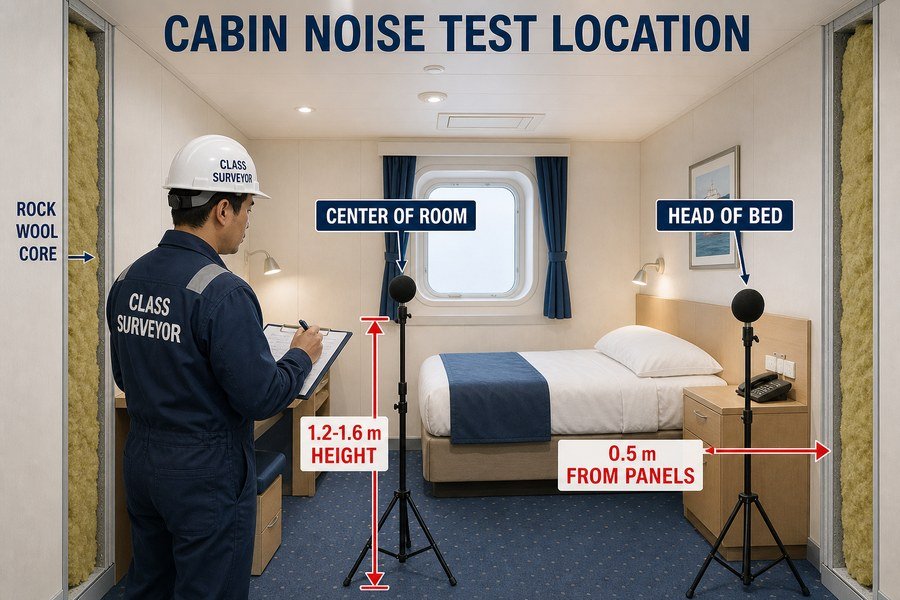
Exact Microphone Placement Rules for IMO Noise Testing
When the shipyard finishes building the ship, a class surveyor comes on board with a sound level meter. They do not just stand anywhere. The IMO rules are very strict about the measurement location. For a standard accommodation cabin, the surveyor must take readings in two exact places. First, they place the microphone in the center of the free space in the room. Second, they place the microphone right at the head of the bed. Why the bed? Because that is where the crew sleeps, and sleep quality is the most important factor for marine safety. The microphone height is also strictly controlled. It must sit between 1.2 meters and 1.6 meters above the cabin floor. This height matches the ear level of a sitting or standing person.
Common Testing Mistakes Near Marine Wall Panels
As an outfitting specialist, I often see people fail the noise test because they misunderstand the 0.5-meter rule. The IMO rule states that the microphone must stay at least 0.5 meters away from any marine bulkhead panel, ceiling panel, or window11. Why? Because sound waves bounce off hard surfaces. If you put the microphone right against a steel-faced wall panel, the reading will be artificially high due to the bouncing sound. I once had a client panic because their cabin measured 62 dB(A), failing the 60 dB(A) limit. I asked for a photo of the test. The surveyor had placed the microphone right next to the air conditioning vent on the ceiling panel. We moved the microphone to the center of the room, 0.5 meters away from the ceiling. The reading dropped to 58 dB(A), and the room passed the test immediately.
| Measurement Parameter | IMO Required Value | Reason for the Rule |
|---|---|---|
| Primary Location | Center of the room | Captures general ambient room noise |
| Secondary Location | Head of the bed | Ensures sleep areas are quiet |
| Height from Floor | 1.2 to 1.6 meters | Simulates human ear height |
| Distance from Panels | Minimum 0.5 meters | Prevents false readings from sound reflection |
Conclusion
Understanding these marine noise standards helps you buy the right panels. This keeps your shipyard clients happy, stops costly rework, and secures your next interior decoration contract.
-
"Why Does Marine Accommodation Panel Acoustic Performance Vary ...", https://magellanmarinetech.com/why-marine-accommodation-panel-acoustic-performance-vary-by-frequency/. Laboratory studies of steel-faced mineral-wool sandwich partitions report weighted sound reduction indices in the low-to-mid 30 dB range for comparable lightweight panel constructions and show that added mass or internal steel layers can increase sound insulation. Evidence role: case_reference; source type: paper. Supports: A 50 mm, 120 kg/m3 rockwool-core marine-type panel can have an approximate Rw near 32 dB, with higher values possible when mass is added.. Scope note: Panel Rw varies with facing thickness, core density, mounting conditions, joints, and test standard, so such evidence would contextualize rather than directly certify this exact panel specification. ↩
-
"Figure 2 - from The New Imo Noise Code: A Lost Technical", https://www.academia.edu/figures/7705063/figure-2-the-new-imo-noise-code-lost-technical-opportunity. IMO Resolution MSC.337(91), adopting the Code on Noise Levels on Board Ships, identifies its application to ships of 1,600 gross tonnage and above, providing the regulatory basis for this threshold. Evidence role: definition; source type: institution. Supports: IMO Resolution MSC.337(91) applies strict shipboard noise requirements to new ships of 1,600 gross tonnage and above.. Scope note: The source should be checked for effective-date and vessel-category qualifications, since the Code’s application depends on SOLAS implementation and may include exceptions. ↩
-
"(PDF) Crew noise exposure on board ships and comparative study of ...", https://www.academia.edu/24691711/Crew_noise_exposure_on_board_ships_and_comparative_study_of_applicable_standards. The IMO Code on Noise Levels on Board Ships sets maximum A-weighted noise limits for accommodation spaces, including crew cabin thresholds that vary by ship size, supporting the stated 60 dB(A) and 55 dB(A) figures. Evidence role: statistic; source type: institution. Supports: Crew cabin noise limits under the IMO Code differ by vessel gross tonnage, with 60 dB(A) for ships from 1,600 to under 10,000 GT and 55 dB(A) for ships of 10,000 GT and above.. Scope note: This supports the regulatory noise-limit values, not the article’s broader purchasing conclusions about which panels should be used. ↩
-
"[PDF] Evaluation of Noise Exposures and Hearing Loss at a Forging ...", https://stacks.cdc.gov/view/cdc/172312/cdc_172312_DS1.pdf. Standards and acoustics references describe A-weighting as a frequency-weighting curve intended to approximate the relative sensitivity of human hearing, with substantial attenuation at low frequencies and smaller adjustments near the mid-frequency range. Evidence role: definition; source type: institution. Supports: The A-weighted scale changes raw sound level data to better reflect human hearing sensitivity across frequencies.. Scope note: This supports the rationale for A-weighting generally; perceived loudness also depends on sound level, duration, and spectral content, so dB(A) is an approximation rather than a complete model of hearing. ↩
-
"A ship noise rating system for underwater vessel noise reduction ...", https://pubmed.ncbi.nlm.nih.gov/41844077/. Shipboard noise-measurement standards and the IMO Code on Noise Levels on Board Ships specify that measurements are taken under defined operating conditions during trials or normal seagoing operation, commonly tied to a substantial fraction of maximum continuous rating or normal service speed. Evidence role: general_support; source type: institution. Supports: Marine interior noise measurements are taken while the ship is operating under specified propulsion conditions, such as a defined percentage of maximum continuous rating.. Scope note: The exact percentage can vary by contract, vessel type, class rule, or standard; a source should be checked before presenting 85% MCR as universal. ↩
-
"How to Match a Marine Accommodation Panel System to the ...", https://magellanmarinetech.com/how-match-marine-accommodation-panel-system-to-the-correct-noise-path/. Marine-engine acoustics literature describes large low-speed diesel engines as major sources of low-frequency vibration and structure-borne noise in ships, supporting the link between this propulsion type and vibration-sensitive accommodation design. Evidence role: mechanism; source type: paper. Supports: A heavy bulk carrier’s slow-speed diesel engine can transmit low-frequency vibration through the ship structure.. Scope note: The source would support the general mechanism; vibration levels on a specific bulk carrier still depend on engine mounting, hull structure, propeller design, and operating condition. ↩
-
"Analysis and Control of Acoustic Emissions from Marine ...", https://arxiv.org/html/2509.08656v1. Studies of electric and diesel-electric marine propulsion identify tonal noise components associated with electric motors, converters, and switching frequencies, which can contribute to higher-frequency tonal noise; the exact audibility and frequency content depend on the propulsion architecture and acoustic treatment. Evidence role: mechanism; source type: paper. Supports: Diesel-electric propulsion systems can produce higher-frequency tonal noise components relevant to vessel interior acoustic design.. Scope note: This supports the general acoustic mechanism, not the claim that all offshore support vessels using diesel-electric propulsion will have objectionable high-pitched whine. ↩
-
"How is Sound Measured? - NIDCD - NIH", https://www.nidcd.nih.gov/health/how-sound-measured. Standard acoustics references define the decibel as a logarithmic unit and show that a 3 dB increase corresponds approximately to a doubling of acoustic intensity or power, distinguishing physical sound energy from perceived loudness. Evidence role: mechanism; source type: education. Supports: A 3 dB increase represents roughly a doubling of sound energy or acoustic power.. Scope note: This does not mean humans perceive a 3 dB increase as twice as loud; perceived loudness typically requires a larger change and depends on frequency and context. ↩
-
"Sound reduction index - Wikipedia", https://en.wikipedia.org/wiki/Sound_reduction_index. Building-acoustics standards describe airborne sound insulation as the level difference between source and receiving spaces, with laboratory indices such as Rw used to characterize partition performance; this supports using the source-room and receiver-room limits as the starting point for a required insulation value, but not as a complete design calculation. Evidence role: definition; source type: institution. Supports: A 30 dB difference between an 85 dB(A) source area and a 55 dB(A) cabin limit implies a minimum airborne sound insulation target of about 30 dB before design allowances.. Scope note: Rw is a laboratory rating and the in-situ level difference also depends on partition area, receiving-room absorption, flanking paths, and installation quality. ↩
-
"How to choose the right marine wall panels for marine interior ...", https://magellanmarinetech.com/how-choose-right-marine-wall-panels-for-marine-interior-projects/. Experimental studies of mineral-wool sandwich panels report that panel thickness, core density, and metal facings influence sound transmission loss and weighted sound reduction ratings; this can contextualize why a 50 mm, approximately 100 kg/m3 mineral-wool panel may achieve moderate airborne sound insulation, but it is not proof of the exact rating without a test report for the specific product assembly. Evidence role: general_support; source type: paper. Supports: A 50 mm marine wall panel with a roughly 100 kg/m3 rockwool core can be suitable for moderate Rw requirements around 30 dB.. Scope note: Exact Rw values are assembly-specific and should be verified with laboratory test data for the panel, joints, facings, and mounting conditions used. ↩
-
"The Measurement of Unsteady Surface Pressure Using ... - PMC", https://pmc.ncbi.nlm.nih.gov/articles/PMC5226344/. The IMO noise measurement procedure requires microphone positions to be kept at least 0.5 m from boundaries or large reflecting surfaces such as bulkheads, ceilings, and windows, supporting the stated clearance rule. Evidence role: definition; source type: institution. Supports: IMO noise testing requires the microphone to remain at least 0.5 m away from bulkheads, ceilings, windows, or similar reflective surfaces.. Scope note: The source verifies the clearance requirement; it does not by itself quantify the measurement error caused by every nearby surface. ↩