You receive complaints about noisy ship cabins, but applying top-tier soundproofing everywhere ruins your project budget. We can solve this by matching exact noise limits to specific room functions.
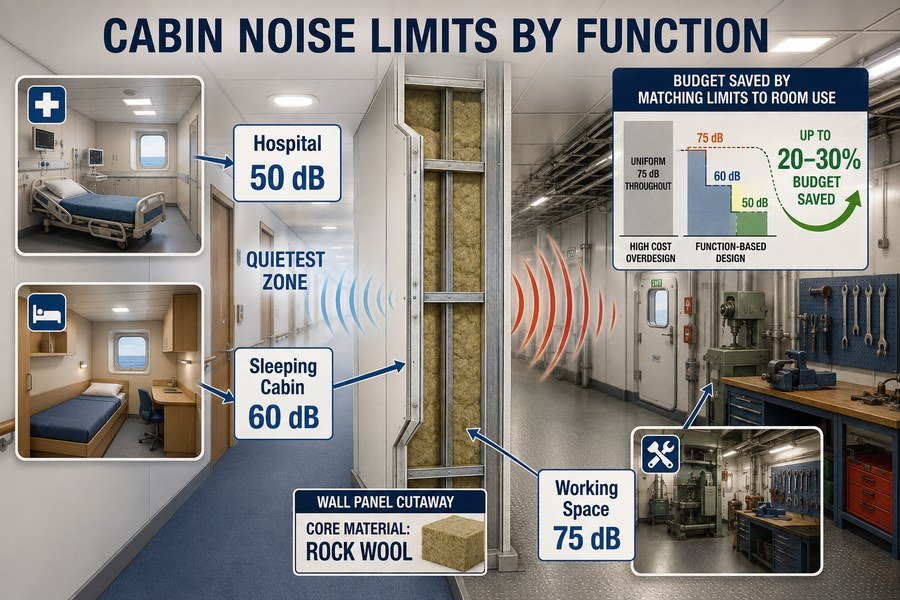
Cabin noise limits vary because IMO regulations mandate different maximum decibel (dB) levels based on how a space is used. Limits range from 50 dB for hospitals, 60 dB for sleeping cabins, to 75 dB for working spaces, ensuring safety and comfort without unnecessary outfitting costs.
Let me walk you through exactly how to select the right acoustic materials for different ship areas. I will help you satisfy strict European shipyards while keeping your Asian supply chain costs under control.
How Does Vessel Category Influence Marine Panel Acoustic Requirements?
Are you losing interior outfitting bids because your panel costs are too high? Different ships need different sound panels. Knowing the rules prevents you from overpaying for unneeded acoustic performance.
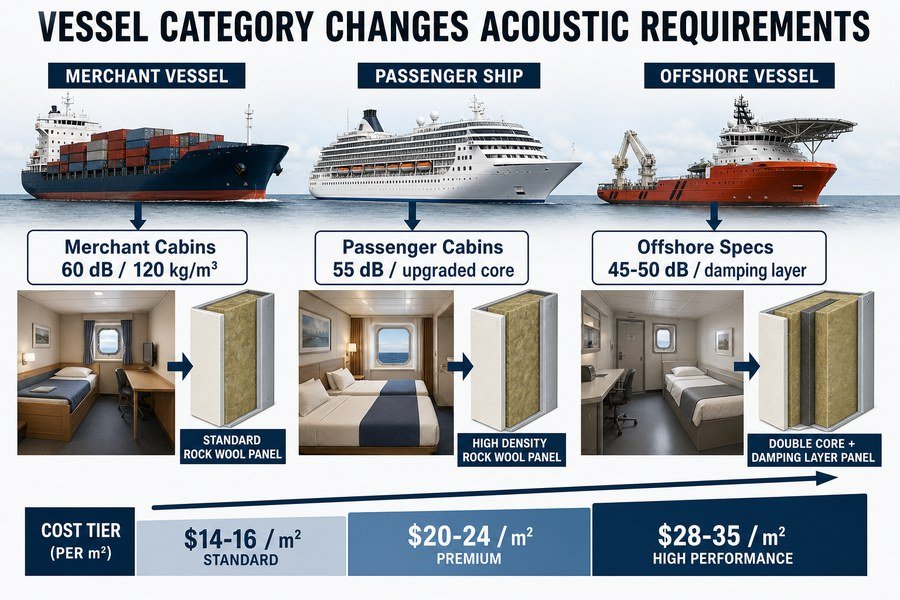
Vessel category dictates acoustic requirements through IMO Code MSC.337(91), classifying ships into three main groups: standard merchant vessels (requiring 60 dB in cabins), passenger ships (requiring stricter 55 dB limits), and specialized offshore vessels (often requiring custom 45-50 dB limits), which directly changes your panel core density needs.
I started my career on the factory floor making these panels. I saw many buyers purchase the most expensive acoustic panels for every single project. They lost money. You must adjust your purchasing based on the three vessel categories defined by the IMO. If you buy smart, you keep your prices competitive.
Acoustic Panel Requirements for Standard Merchant Vessels
Standard merchant vessels, like bulk carriers and container ships, follow the basic IMO MSC.337(91) rules. The maximum noise limit for sleeping cabins on these ships is 60 dB. To meet this rule, you only need standard rockwool core wall panels. For example, a 50mm thick panel with a rockwool density of 120 kg/m³ is enough1. You can buy these from reliable suppliers in China for about $14 to $16 per square meter. The shipyard will pass the noise test, and you will save your budget. You do not need expensive double-skin panels here.
Stricter Acoustic Demands for Passenger Ships and Offshore Vessels
Passenger ships and offshore oil vessels are very different. Passengers pay for comfort, so passenger ships require a stricter 55 dB limit in cabins2. Offshore vessels have massive drill engines, so their project specs often push limits down to 45 or 50 dB3. To meet these lower numbers, you must buy high-acoustic panels. These panels use thicker steel skins, double rockwool layers, or added sound-damping rubber sheets inside. These special panels will cost you between $28 and $35 per square meter. If you quote a passenger ship project using standard merchant vessel prices, you will fail the acoustic test and pay huge penalties.
| Vessel Category | Max Cabin Noise Limit (IMO / Project) | Required Panel Core Density | Estimated Material Cost (Per Square Meter) |
|---|---|---|---|
| Standard Merchant | 60 dB | 120 kg/m³ Rockwool (Standard) | $14 - $16 |
| Passenger Ships | 55 dB | 150 kg/m³ Rockwool (Upgraded) | $20 - $25 |
| Offshore Vessels | 45 - 50 dB | Double Core + Damping Layer | $28 - $35 |
Why Do Marine Sleeping Cabins Carry Stricter Noise Limits Than Working Spaces?
Crew fatigue causes terrible accidents at sea. If sleeping cabins are too noisy, shipowners will reject your interior outfitting work. You must fix this before the final shipyard inspection happens.
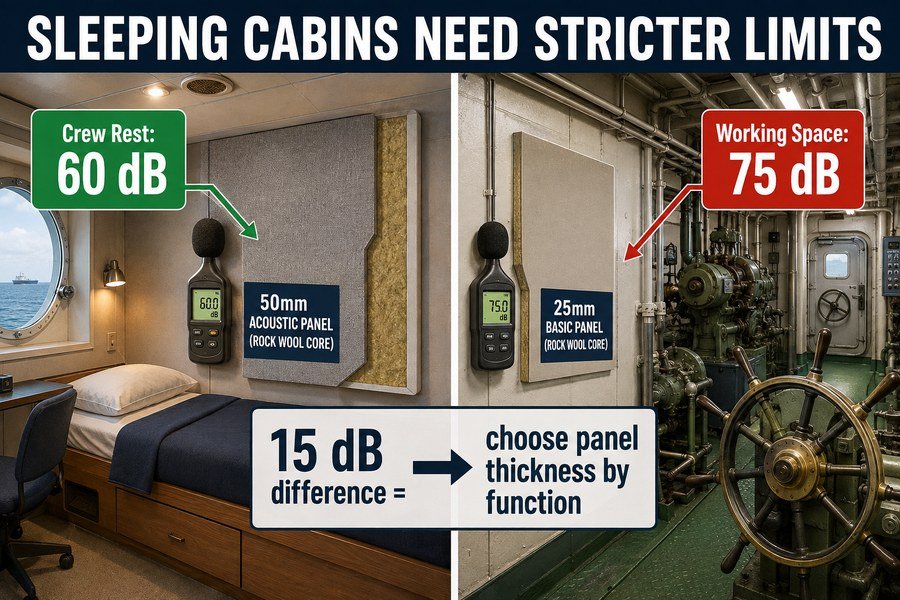
Sleeping cabins require stricter limits (60 dB) than working spaces (75 dB) to ensure crew recovery, prevent hearing damage, and comply with the Maritime Labour Convention (MLC 2006). This 15 dB difference means sleeping cabins need heavier 50mm acoustic panels, while working spaces can use standard 25mm panels.
When I help clients fix failed sound tests, the problem usually starts with a misunderstanding of room functions. The rules do not treat all rooms the same. The Maritime Labour Convention (MLC 2006) protects the crew. You must understand why the rules require a 15 dB difference between sleeping and working spaces. This difference is your chance to balance your budget.
Crew Recovery and the Maritime Labour Convention (MLC 2006)
Sailors work long, hard shifts in loud areas. The MLC 2006 mandates that crew members must have a quiet place to sleep and recover. Because of this, IMO rules cap sleeping cabin noise at 60 dB. To achieve this, you must buy robust 50mm thick marine wall panels. These panels block the noise from the hallway and the ship engines. If you use cheap panels here, the sailors cannot sleep. The shipyard inspector will use a sound meter in the room. If it reads 62 dB, they will make you tear down the walls and rebuild them.
Preventing Hearing Damage in 75 dB Working Spaces
Working spaces, like the steering gear room or workshops, are different. People do not sleep there. The main goal here is to prevent permanent hearing damage, not to provide perfect silence. Therefore, the IMO allows a higher limit of 75 dB in these rooms. This is great news for your budget. You do not need 50mm thick acoustic panels in a loud workshop. You can buy standard 25mm thick panels or basic lining panels for these walls. These thinner panels cost about $10 to $12 per square meter. By using thinner panels in working spaces, you offset the high cost of the heavy panels you used in the sleeping cabins.
| Space Function | Primary Goal | IMO Noise Limit | Required Panel Thickness | Action Required by Procurement |
|---|---|---|---|---|
| Sleeping Cabins | Crew rest and recovery (MLC 2006) | 60 dB | 50mm | Purchase high-grade acoustic panels. |
| Working Spaces | Prevent hearing damage | 75 dB | 25mm | Purchase basic lining panels to save money. |
How Does Cabin Function Dictate Acoustic Ratings for Marine Bulkhead Panels?
Choosing one panel type for the whole ship eats up your profit margin quickly. You must match the bulkhead panel's sound reduction index (Rw) to the specific room's daily function.
Cabin function dictates bulkhead acoustic ratings (Rw) across four functional levels: high-privacy medical rooms (Rw=45 dB), standard sleeping cabins (Rw=35 dB), noisy mess rooms (Rw=30 dB), and utility corridors (Rw=25 dB). This functional grading tells you exactly which mineral wool density to buy for each wall.
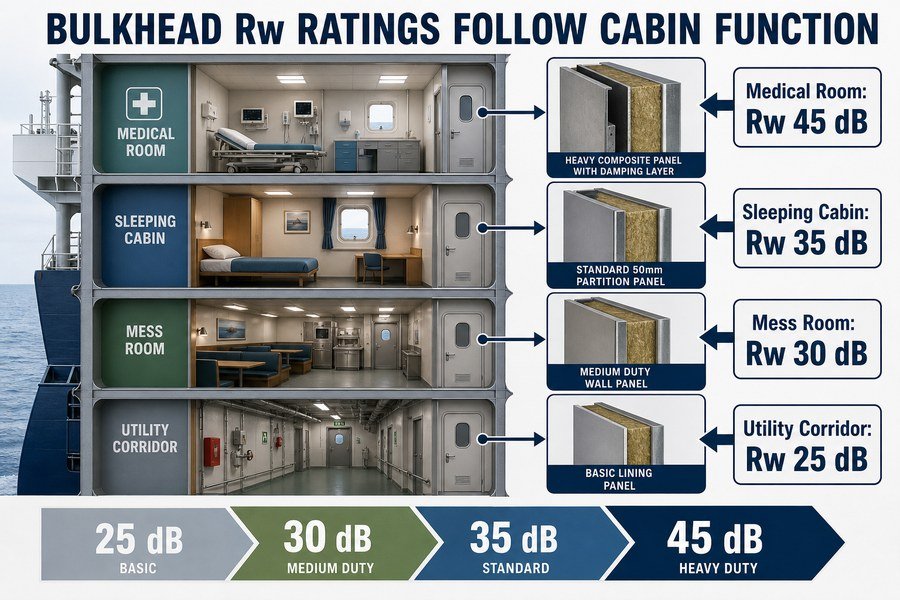
You cannot just look at the overall room limit; you must look at the wall itself. In marine engineering, we measure a wall panel's ability to block sound using the Sound Reduction Index, called Rw4. The shipyard will give you a drawing. This drawing shows four main functional levels. You must buy the correct Rw-rated panel for each level. If you buy Rw=45 dB panels for the whole ship, your prices will be too high to win the European contract.
Bulkhead Ratings for High-Privacy Medical Rooms and Sleeping Cabins
Medical rooms and hospitals on ships need the highest privacy. The doctor must talk to patients without the crew outside hearing them. Shipyards demand an Rw rating of 45 dB for medical room bulkheads5. To meet this, you need a heavy composite panel. Sleeping cabins need good rest, but not medical-level privacy. For sleeping cabin partitions (the wall between two bedrooms), the standard requirement is Rw=35 dB6. You can achieve this with a standard 50mm marine wall panel filled with 120 kg/m³ rockwool. This is the most common panel you will buy in Asia.
Bulkhead Ratings for Mess Rooms and Utility Corridors
Mess rooms (dining rooms) and recreation rooms are noisy places. People talk, eat, and watch TV. The wall separating a mess room from a corridor usually only needs an Rw rating of 30 dB. Corridors and utility spaces are even less strict. The walls lining a basic walkway often only require an Rw rating of 25 dB. For these areas, you can buy lighter panels with lower density mineral wool, perhaps 100 kg/m³. By stepping down the Rw rating for mess rooms and corridors, you cut down your total material weight7. This saves you money on both the product and the ocean shipping freight.
| Room Function Level | Required Bulkhead Rating (Rw) | Panel Type Required | Typical Rockwool Density |
|---|---|---|---|
| Medical Room | 45 dB | Heavy Composite Acoustic Panel | 150 kg/m³ + Damping |
| Sleeping Cabin | 35 dB | Standard 50mm Partition Panel | 120 kg/m³ |
| Mess Room | 30 dB | Medium Duty Wall Panel | 100 - 120 kg/m³ |
| Utility Corridor | 25 dB | Basic Lining Panel | 100 kg/m³ |
Why Might One Marine Project Specify Multiple Cabin Noise Limits Across Decks?
You open a new project drawing and see five different noise limits on different floors. This confusion slows down your purchasing process. Let us simplify exactly how decks affect these numbers.
A single project specifies multiple noise limits across decks because of three layout factors: proximity to the engine room (highest noise), distance to open weather decks (wind/wave noise), and vertical vibration transfer from propellers. You must zone your purchases into high, medium, and low acoustic protection tiers.
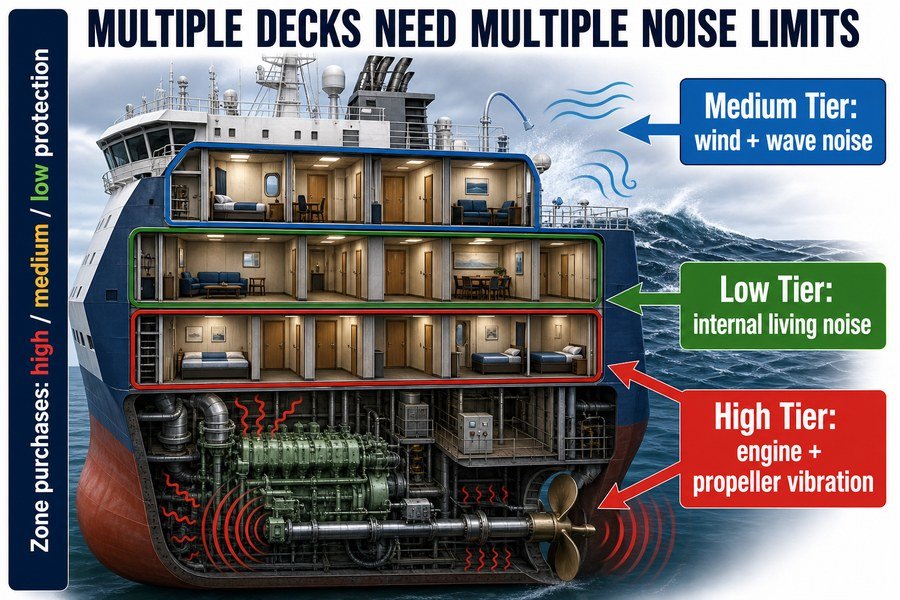
When I review outfitting drawings for clients, they often ask why a cabin on Deck A has different rules than a cabin on Deck C. The ship is a complex machine. Noise comes from different places. The shipyard engineers calculate these three layout factors before they write your material list. You must zone your purchases into tiers based on where the cabin sits on the ship.
Managing Noise Near the Engine Room and Propeller Vibration Zones
The engine room is the loudest place on the ship. It produces over 110 dB of raw noise.8 Cabins located on the lower decks, right above or next to the engine casing, face extreme noise. The propeller also creates strong vertical vibrations that shake the steel floors.9 For these lower deck cabins, you are in the high protection tier. You must buy specialized floating floors and heavy acoustic wall panels (Rw=40 to 45 dB) to stop the engine noise from coming up. These materials are expensive, but you only need them for this specific zone.
Handling Wind and Wave Noise Near Open Weather Decks
When you move to the top decks, the engine noise disappears. But a new problem takes its place: wind and wave noise from the open weather decks.10 Cabins near the bridge or top exterior doors face harsh weather sounds. This is the medium protection tier. You do not need anti-vibration materials here. Instead, you need good thermal-acoustic insulation to block the wind noise and the cold air. For cabins in the middle of the ship, far from the engine and far from the wind, you are in the low protection tier. Here, you buy the cheapest standard 50mm panels. Zoning your orders this way makes you look like a true professional to your shipyard buyers.
| Deck Location | Primary Noise Source | Acoustic Protection Tier | Outfitting Strategy |
|---|---|---|---|
| Lower Decks | Engine room & Propeller | High Tier | Buy floating floors and heavy Rw=45 dB panels. |
| Upper/Exterior Decks | Wind & Waves | Medium Tier | Buy thermal-acoustic combination panels. |
| Middle Internal Decks | General living noise | Low Tier | Buy standard 50mm marine wall panels to save costs. |
How Does Space Usage Change the Acoustic Requirements for Marine Ceiling Panels?
You bought great wall panels, but the room still fails the sound test. Noise leaks through the ceiling from the floor above. You must match your ceiling panels to the space usage too.
Space usage changes ceiling acoustic requirements by splitting them into two systems: heavy acoustic ceilings (Rw=35 dB) for quiet zones like cabins beneath public spaces, and standard decorative ceilings (Rw=25 dB) for technical rooms or top-deck offices. This choice prevents impact noise from traveling between deck levels.
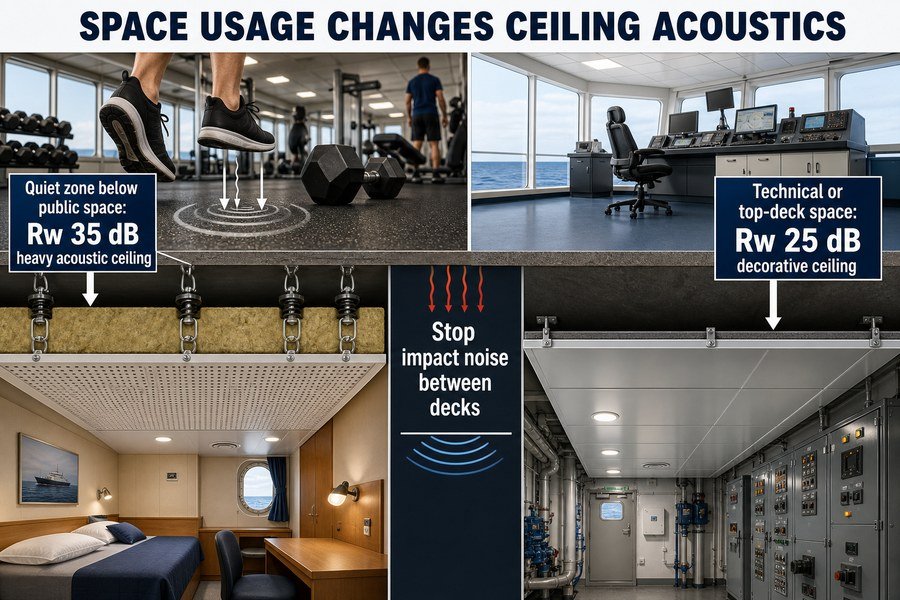
I once saw a contractor lose $20,000 because they ignored the ceiling. They put basic metal ceilings inside a cabin located directly under a busy ship gym. The sound of dropping weights ruined the cabin. Space usage above and below the room determines your ceiling choice. You must pick between two distinct ceiling systems to stop impact noise.
Installing Heavy Acoustic Ceilings in Quiet Zones Beneath Public Spaces
Impact noise happens when someone walks or drops something on the steel deck above.11 If a sleeping cabin is located under a public space, like a gym, a mess room, or a disco on a passenger ship, the noise travels straight down12. For these quiet zones, you must buy heavy acoustic ceilings. These ceilings have an Rw rating of at least 35 dB.13 They are made of thick perforated steel with a thick layer of high-density mineral wool bonded to the back. Sometimes, you even need to buy spring-loaded suspension hooks to hang the ceiling. This breaks the vibration path. These heavy acoustic ceilings cost more, but they are mandatory for cabins under public spaces.
Using Standard Decorative Ceilings in Technical Rooms and Top-Deck Offices
If you are buying ceilings for a top-deck office, there is nobody walking on the roof above. If you are outfitting a technical room or a storage closet, nobody cares about impact noise. For these spaces, you use standard decorative ceilings. These ceilings only provide about an Rw=25 dB rating. They are very thin, usually just 0.6mm galvanized steel, with no heavy rockwool backing. They are easy to install, lightweight, and very cheap. By using these standard ceilings in non-critical spaces, you keep your average material cost low across the whole project.
| Space Usage (Above the Ceiling) | Ceiling Type Required | Minimum Rw Rating | Impact Noise Threat |
|---|---|---|---|
| Public Space / Gym / Mess Room | Heavy Acoustic Ceiling with Rockwool | 35 dB | High (Footsteps, dropped items) |
| Top Deck / No room above | Standard Decorative Ceiling | 25 dB | None |
| Technical / Storage Room | Standard Decorative Ceiling | 25 dB | Low |
Conclusion
To win European shipyard interior contracts, you must stop guessing on noise limits. Match panel purchases to the IMO regulations for each room function to maximize your project profits.
-
"How Does Rock Wool Density Affect Marine Accommodation Panel ...", https://magellanmarinetech.com/how-rock-wool-density-affect-marine-accommodation-panel-performance/. Acoustic research on mineral-wool-filled panels shows that panel thickness, density, and cavity construction affect sound absorption and transmission loss, providing contextual support for the use of dense rockwool cores in noise-control panels. Evidence role: mechanism; source type: paper. Supports: A 50 mm panel using 120 kg/m³ rockwool can be adequate for standard merchant-vessel acoustic requirements.. Scope note: This would support the acoustic mechanism only; compliance with a 60 dB(A) shipboard cabin limit depends on the full wall assembly, doors, penetrations, installation quality, and onboard noise sources. ↩
-
"(PDF) Crew noise exposure on board ships and comparative study of ...", https://www.academia.edu/24691711/Crew_noise_exposure_on_board_ships_and_comparative_study_of_applicable_standards. Classification-society comfort notations for passenger vessels and accommodation spaces commonly use cabin noise criteria stricter than the baseline IMO Code, with some comfort levels around 55 dB(A). Evidence role: expert_consensus; source type: institution. Supports: Passenger-ship projects may require a stricter cabin noise limit of about 55 dB.. Scope note: This supports the existence of stricter passenger-ship project or class requirements, not a universal statutory IMO limit for every passenger ship. ↩
-
"When Should Marine Accommodation Panels Integrate Acoustic ...", https://magellanmarinetech.com/when-marine-accommodation-panels-integrate-acoustic-performance-with-decorative-surfaces/. Offshore accommodation and vessel comfort standards can specify cabin noise criteria below general merchant-ship limits, including ranges near 45–50 dB(A) for higher comfort or accommodation-quality classes. Evidence role: general_support; source type: institution. Supports: Offshore vessel project specifications often set cabin noise limits around 45–50 dB.. Scope note: This supports the plausibility of lower offshore project targets, but actual limits vary by contract, class notation, flag requirements, and vessel operating profile. ↩
-
"Sound insulation dataset of 30 wooden and 8 concrete floors ...", https://pmc.ncbi.nlm.nih.gov/articles/PMC10365936/. An acoustics reference defining the weighted sound reduction index explains that Rw is a single-number rating, derived from frequency-dependent transmission-loss measurements, used to characterize airborne sound insulation of a wall, door, or similar building element. Evidence role: definition; source type: institution. Supports: Rw is the relevant index for expressing a wall panel’s ability to reduce transmitted airborne sound.. Scope note: The definition is general to architectural acoustics and is not specific to ship accommodation bulkheads. ↩
-
"How to Match a Marine Accommodation Panel System to the ...", https://magellanmarinetech.com/how-match-marine-accommodation-panel-system-to-the-correct-noise-path/. A maritime accommodation-noise standard or classification-society guidance that tabulates airborne sound-insulation requirements by space type can support the use of approximately Rw 45 dB for hospital or medical-room bulkheads on ships. Evidence role: expert_consensus; source type: institution. Supports: Medical-room bulkheads on ships are commonly specified with a higher airborne sound-insulation rating, around Rw 45 dB.. Scope note: Such a source would establish an industry benchmark; exact values may vary by flag administration, ship type, class notation, and shipyard specification. ↩
-
"How to Match a Marine Accommodation Panel System to the ...", https://magellanmarinetech.com/how-match-marine-accommodation-panel-system-to-the-correct-noise-path/. Published ship-accommodation noise guidance can support Rw 35 dB as a typical minimum airborne sound-insulation value for partitions between sleeping cabins or comparable accommodation spaces. Evidence role: expert_consensus; source type: institution. Supports: Sleeping-cabin partitions on ships are commonly specified around Rw 35 dB.. Scope note: The source may describe a minimum or typical design value, not proof that every shipyard or European contract uses the same requirement. ↩
-
"Airborne sound insulation performance of lightweight double ...", https://pmc.ncbi.nlm.nih.gov/articles/PMC11666719/. Acoustics literature on the mass law of sound insulation supports the general relationship that, for single-leaf barriers, higher sound reduction usually requires greater surface mass or more complex construction, so specifying lower Rw assemblies can reduce panel weight. Evidence role: mechanism; source type: education. Supports: Reducing the required Rw rating can reduce the weight of selected wall-panel assemblies.. Scope note: The relationship is design-dependent; multilayer, damped, or decoupled panels can improve Rw without a simple proportional increase in weight. ↩
-
"Noise-Induced Hearing Loss - CDC", https://www.cdc.gov/niosh/noise/about/noise.html. Measurements and ship-noise guidance commonly identify machinery spaces, including engine rooms, as among the highest onboard noise areas, with reported levels that can exceed 110 dB depending on vessel type and operating condition. Evidence role: statistic; source type: institution. Supports: The engine room is often one of the loudest shipboard areas and can produce noise levels above 110 dB.. Scope note: The exact level varies by ship design, engine load, measurement position, and whether the value is A-weighted or unweighted. ↩
-
"Development of deep learning-based detection technology for ...", http://ui.adsabs.harvard.edu/abs/2022JSV...52016629L/abstract. Marine vibration literature describes propeller-induced pressure fluctuations and shaft-line excitation as important sources of hull and deck vibration, which may be transmitted through ship structures to accommodation spaces. Evidence role: mechanism; source type: paper. Supports: Propeller operation can generate vibrations that transmit through the ship structure and affect decks or floors.. Scope note: The source may establish the vibration mechanism generally rather than proving that every vessel experiences perceptible floor shaking. ↩
-
"How to Match a Marine Accommodation Panel System to ...", https://magellanmarinetech.com/how-match-marine-accommodation-panel-system-to-the-correct-noise-path/. Studies of shipboard and marine environmental noise identify wind, wave impact, and sea-state-related excitation as contributors to noise and vibration, especially at exposed exterior structures and upper-deck locations. Evidence role: general_support; source type: paper. Supports: Upper or exterior deck cabins may be more affected by wind and wave noise than by machinery noise, depending on vessel layout and operating conditions.. Scope note: This supports wind and wave noise as relevant sources, but it does not show that engine noise fully disappears on all top decks. ↩
-
"[PDF] This is normal text - K-REx", https://krex.k-state.edu/dspace/bitstream/handle/2097/502/ClareSeip2007.pdf?isAllowed=y&sequence=1. A source on impact sound should verify that footfalls and dropped objects excite a floor or deck structure and generate structure-borne noise that can radiate into adjacent rooms. Evidence role: mechanism; source type: education. Supports: Impact noise is generated by walking or dropped objects on the deck above.. ↩
-
"How to Match a Marine Accommodation Panel System to ...", https://magellanmarinetech.com/how-match-marine-accommodation-panel-system-to-the-correct-noise-path/. Research on shipboard noise transmission can support that steel decks and connected structures transmit structure-borne sound from machinery or activity spaces into accommodation areas below. Evidence role: mechanism; source type: paper. Supports: Noise from activity on a steel deck above can be transmitted into rooms below.. Scope note: Such sources usually describe multiple transmission paths through ship structures, so they support downward transmission contextually rather than proving noise travels only straight down. ↩
-
"How Does Rock Wool Density Affect Marine Accommodation Panel ...", https://magellanmarinetech.com/how-rock-wool-density-affect-marine-accommodation-panel-performance/. An acoustics standard or institutional source should establish that Rw is the weighted sound reduction index used to rate airborne sound insulation of building or ship partitions; any 35 dB threshold should be treated as a design specification rather than a universal rule unless the source directly states it. Evidence role: definition; source type: institution. Supports: Rw is an acoustic rating relevant to ceiling sound insulation, and the article’s 35 dB value is a specified performance threshold.. Scope note: General acoustics sources define Rw but may not confirm that all heavy marine acoustic ceilings require a minimum Rw of 35 dB. ↩