
Ship noise causes crew fatigue and fails passenger expectations. Solving this requires targeting the exact noise path. Learn how to match your accommodation panels to these specific acoustic challenges today.
To match marine accommodation panels to noise paths, you must address three distinct transmission types: airborne noise using mass-loaded sandwich panels (45-50 dB reduction), structure-borne noise using elastic mounting profiles, and impact noise using floating floor systems. Treating all three ensures compliance with IMO noise regulations.
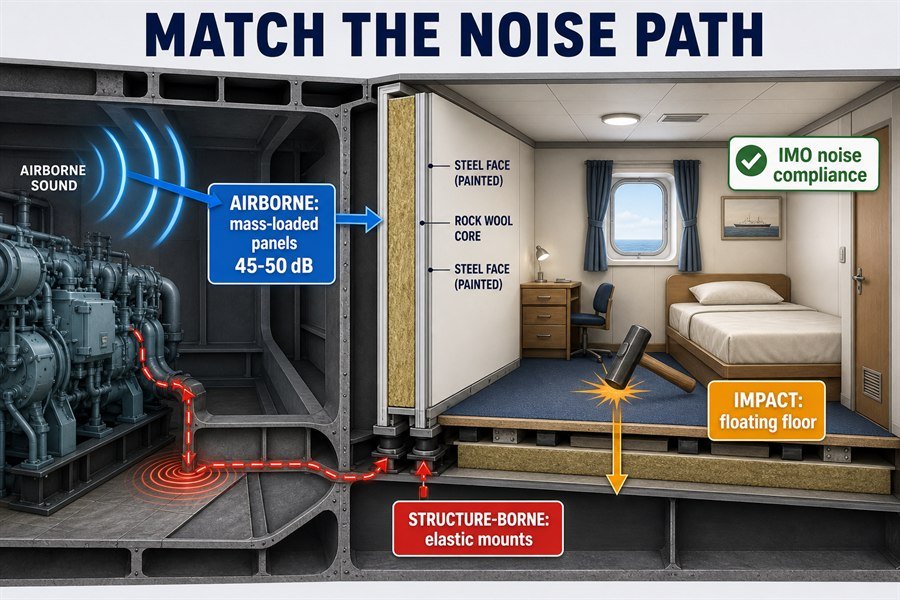
Understanding the source of the noise is just the start. If you do not install the right system for the specific noise type, your investment will be wasted. Let's look at the exact scenarios and methods for each challenge.
When Is a Fully Decoupled System Required Instead of a Standard Acoustic Marine Bulkhead?
Standard bulkheads fail when engine vibrations travel directly through the steel hull into cabins. You need a fully decoupled system to stop this vibration transfer completely.
A fully decoupled system is required instead of a standard acoustic bulkhead in three specific scenarios: adjacent to engine rooms (noise >110 dB), below helicopter decks, and in luxury passenger suites demanding <45 dB ambient noise. Standard bulkheads only stop airborne sound, not severe structural vibrations.
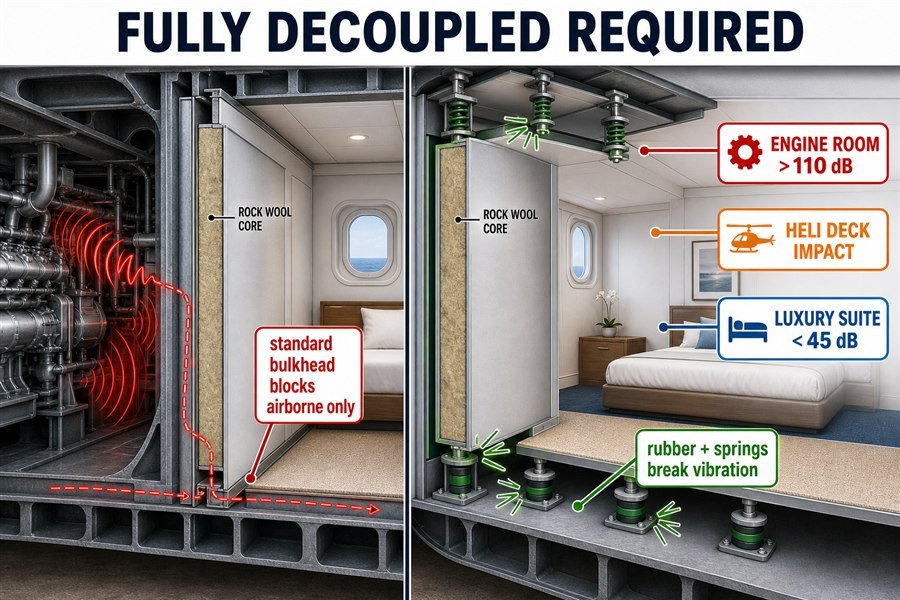
To truly stop noise, we must look at where standard panels fail. A standard acoustic bulkhead works well for airborne noise between two normal cabins. But it fails when severe vibration shakes the steel deck itself. I learned this the hard way during my early days at the factory. A client bought our standard B-15 acoustic panels for a cabin next to the engine casing. They failed the sea trial. The airborne noise was blocked, but the steel vibration bypassed the panel entirely.
Scenario 1: Adjacent to High-Vibration Engine Rooms
Engine rooms are loud. The noise level often exceeds 110 dB according to IMO measurements.1 The main engine creates massive vibrations. These vibrations travel through the steel decks.2 A standard marine wall panel sits directly in a steel bottom track. This track is welded or screwed to the steel deck. The vibration travels from the deck, into the track, and straight into the panel. The panel then acts like a speaker, radiating noise into the room. In this scenario, you must use a fully decoupled system. This means the panel never touches the bare steel. We use thick rubber isolators under the floor track. This physical break stops the vibration. For an engine room boundary, standard panels will only give you about 35 dB of real-world reduction. A fully decoupled system can push that over 50 dB.
Scenario 2: Helicopter Decks and Luxury Passenger Suites
Helicopter decks create massive impact noise. When a helicopter lands, the kinetic energy hits the deck hard. If the ceiling panels below are rigidly attached to the deck, the noise goes straight through.3 You must use a decoupled ceiling system. We use spring hangers to hang the ceiling panels. These springs absorb the impact energy. Luxury passenger suites also require fully decoupled systems. IMO Resolution MSC.337(91) requires passenger cabins to have noise levels below 55 dB. But luxury cruise lines demand levels below 45 dB. Standard panels cannot achieve this. You must isolate the walls, floor, and ceiling from the ship's structure.
| Feature Comparison | Standard Acoustic Bulkhead | Fully Decoupled System |
|---|---|---|
| Primary Noise Target | Airborne noise between cabins | Structure-borne & high-impact noise |
| Physical Connection | Direct metal-to-metal track | Isolated via rubber/springs |
| Typical Noise Reduction (Rw) | 35 dB to 44 dB | 48 dB to 55+ dB |
| Material Cost (per sqm) | $45 to $65 USD | $120 to $180 USD |
| Best Application Area | Crew cabins, corridors | Engine boundaries, luxury suites |
Which Mounting Methods Break Structure-Borne Noise Paths Between Steel Hulls and Marine Lining Panels?
Screwing panels directly to steel frames guarantees noise problems. You must break the physical connection between the hull and the cabin interior to stop structure-borne noise.
Three mounting methods break structure-borne noise paths: U-channel rubber isolators at the floor track, resilient Z-clips with neoprene pads connecting wall panels to steel frames, and spring-loaded ceiling hangers. These three methods physically separate the marine lining panel from the vibrating steel hull.
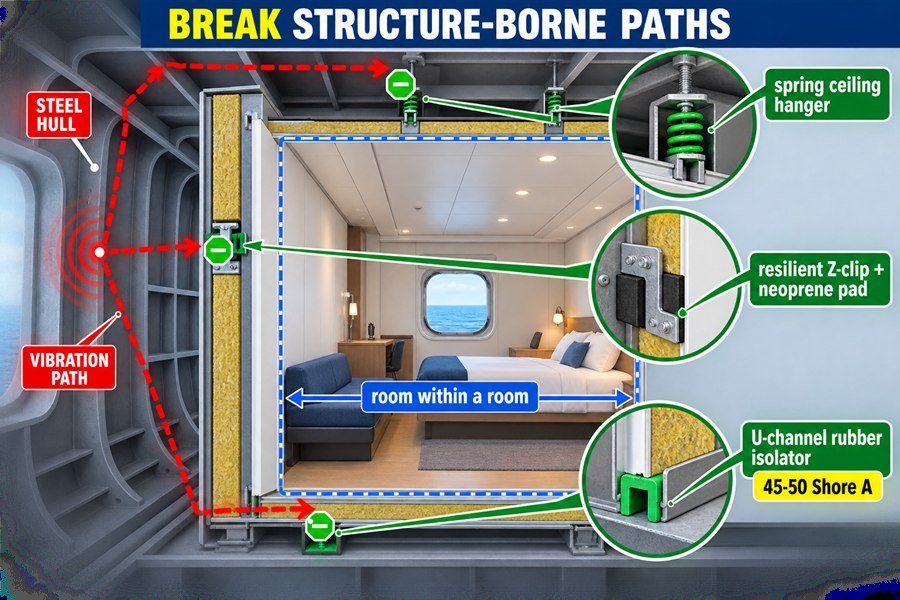
Structure-borne noise travels incredibly fast. Sound travels through steel at about 5,000 meters per second4. This is 15 times faster than it travels through the air. If your marine lining panel touches the steel hull, the noise will find it. You must insert a flexible material between the hard steel and the hard panel. This is called "breaking the path." In my factory experience, fixing a rigid mounting mistake after installation costs five times more than doing it right the first time. We must address all three mounting areas: the floor, the walls, and the ceiling.
Floor Isolation Using U-Channel Rubber Profiles
The floor track is the most common path for structure-borne noise. Installers often weld or bolt the steel U-channel directly to the deck. To break this path, you must use a rubber U-channel isolator. This isolator sits inside the steel track, or between the track and the deck. The marine wall panel then sits inside the rubber. The rubber must have a specific stiffness. We measure this in Shore A hardness. According to marine acoustic engineering standards, the ideal rubber hardness for this application is 45 to 50 Shore A5. If it is too soft, the panel will wobble. If it is too hard, it transfers the vibration. These rubber profiles usually cost between $5 and $8 USD per linear meter. They can reduce structure-borne noise transfer by 10 to 15 dB6 at the floor level.
Wall and Ceiling Separation via Z-Clips and Spring Hangers
Wall lining panels often attach to steel frames on the ship's side. You cannot screw the panel directly to the frame. You must use a resilient Z-clip. This metal clip has a neoprene pad in the middle. The pad absorbs the hull vibration before it reaches the panel. These clips cost about $2 to $4 USD each. You usually need 4 to 6 clips per square meter. For the ceiling, you must break the path from the deck above. We use spring-loaded ceiling hangers. A steel rod drops from the deck, connects to a coiled spring, and the ceiling profile hangs from the spring. The spring absorbs low-frequency vibrations from engines or foot traffic above. These hangers cost about $12 to $18 USD each. Using these three methods together creates a "room within a room," which is the ultimate defense against ship noise.
| Mounting Method | Connection Point | Isolation Material | Estimated Cost |
|---|---|---|---|
| Floor U-Channel Isolator | Deck to Bottom Track | 45-50 Shore A Rubber | $5 - $8 / meter |
| Resilient Z-Clips | Hull Frame to Wall Panel | Neoprene / Silicone Pad | $2 - $4 / clip |
| Ceiling Hangers | Deck above to Ceiling | Coiled Steel Spring | $12 - $18 / hanger |
How to Specify Marine Accommodation Systems That Address Both Airborne and Structure-Borne Noise?
Specifying just a high sound reduction index (Rw) panel is a common mistake. You must specify a complete system that tackles both air and steel noise paths.
To specify marine accommodation systems for both noise types, you must require three components: heavy mineral wool sandwich panels (airborne block), viscoelastic damping layers applied to bare steel (hull vibration absorption), and elastic mounting profiles (structure-borne break). All three must be tested together as an assembly.
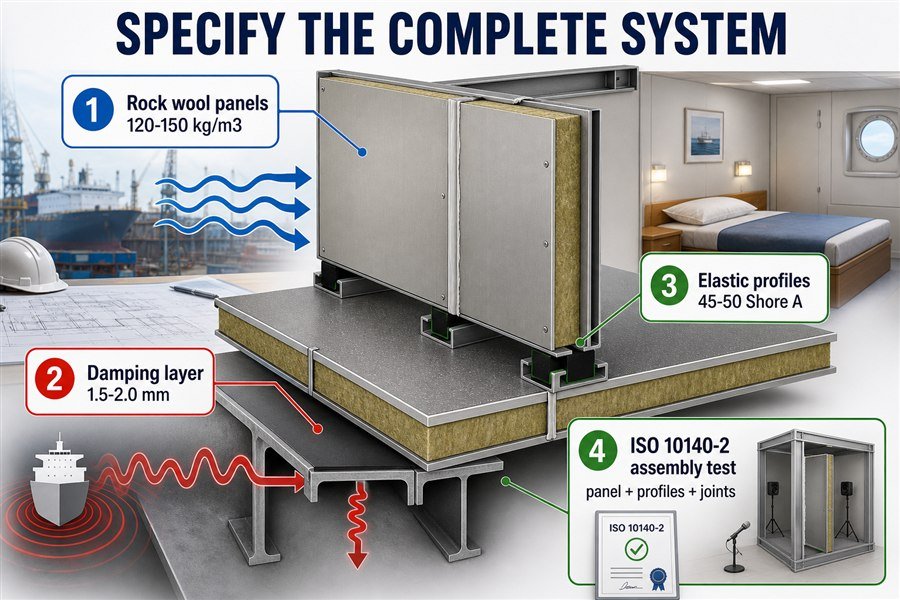
When I review shipyard purchase orders, I often see missing specifications. Buyers just write "Marine Wall Panel, 45 dB Rw." This only solves half the problem. The Rw rating only measures airborne sound reduction in a perfect laboratory.7 It tells you nothing about how the panel handles steel vibrations on a real ship. To get real quiet, you must specify a complete acoustic system. You have to write down exactly what materials are used for the panels, the deck, and the connections. Let me break down exactly what you need to put in your procurement specifications.
Component 1: Sandwich Panels and Viscoelastic Damping Layers
To stop airborne noise, you must specify the core material of your marine sandwich panels. Do not just ask for "rock wool." You must specify the density. For good airborne noise reduction, specify a rock wool core with a density of 120 to 150 kg/m3.8 Heavy mass blocks airborne sound waves. To stop structure-borne noise at the source, you must specify a viscoelastic damping layer. This is a special compound applied directly to the bare steel deck before any panels or floors go down. When the steel vibrates, this layer stretches and turns the vibration energy into a tiny amount of heat9. You should specify a damping layer thickness of 1.5 to 2.0 mm. This material costs about $15 to $25 USD per square meter. It is highly effective at killing low-frequency hull vibrations before they reach your cabin walls.
Component 2: Elastic Mounting Profiles and Assembly Testing
You must specify the elastic mounting profiles clearly. As discussed earlier, specify rubber profiles with 45-50 Shore A hardness. Finally, you must specify how the system is tested. Do not accept a certificate for just the panel. You must demand an acoustic test report based on the ISO 10140-2 standard10. This report must test the panel, the profiles, and the joints as one complete assembly. I have seen panels that test at 44 dB alone drop to 38 dB when assembled with poor joints. Specify that the supplier must provide installation drawings showing exactly how the acoustic breaks are maintained. If the installation crew puts one hard screw through the rubber profile into the steel, the entire acoustic system fails.
| Specification Component | Target Noise Path | Required Specification Value | Standard Cost Range |
|---|---|---|---|
| Sandwich Panel Core | Airborne Noise | Rock wool, 120-150 kg/m3 density | $45 - $75 / sqm |
| Viscoelastic Damping | Structure-borne | 1.5 - 2.0 mm thickness on steel | $15 - $25 / sqm |
| Elastic Profiles | Structure-borne | Rubber, 45-50 Shore A hardness | $5 - $8 / linear m |
| Testing Standard | Both Paths | ISO 10140-2 (Full Assembly Test) | Included in system |
Why Does Marine Interior Panel Selection Depend on Noise Frequency Rather Than Fire Ratings?
Many buyers assume a B-15 fire-rated panel automatically blocks noise. But fire ratings ignore how different panels react to high and low-frequency sound waves.
Marine panel selection depends on noise frequency because fire ratings only measure heat resistance, not acoustic performance. Low-frequency engine rumble (50-250 Hz) requires heavy mass panels (over 18 kg/m2), while high-frequency ventilation hiss (1000-4000 Hz) requires porous acoustic core materials to absorb the sound energy.
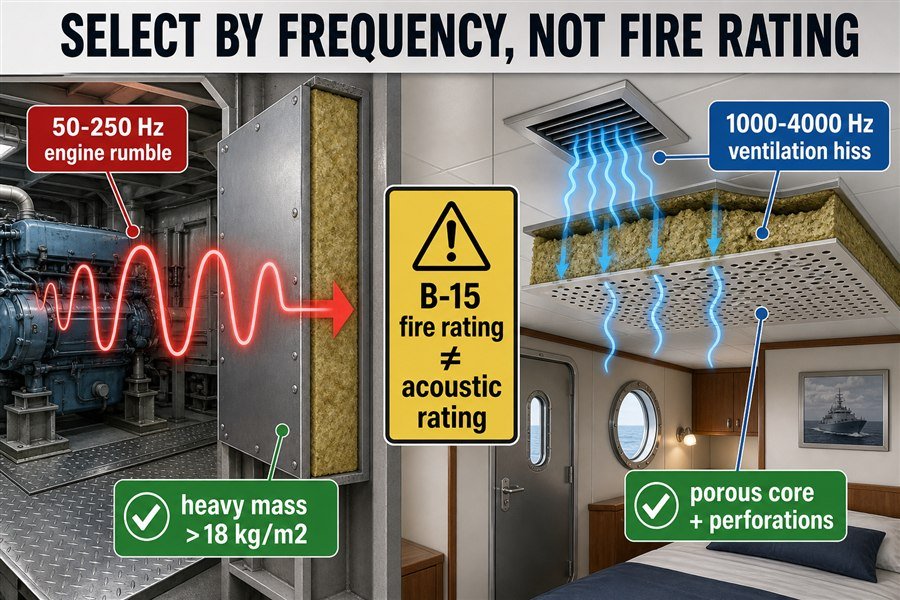
Fire safety and acoustic performance are completely different sciences. A standard B-15 marine fire panel might pass the fire test easily because it uses a rigid ceramic core. But that same rigid core might be terrible at stopping noise. Sound travels in waves, and these waves have different lengths. We measure these in Hertz (Hz). Low numbers mean deep, rumbling sounds. High numbers mean sharp, hissing sounds. You cannot treat both with the same material property. You must look at the acoustic frequency chart provided by the panel manufacturer, not just the single Rw number11 or the fire certificate.
Addressing Low-Frequency Engine Rumble
Low-frequency noise on a ship comes from the main engines and large generators. These frequencies usually sit between 50 Hz and 250 Hz12. Low-frequency sound waves are very long and carry a lot of energy. They push right through light materials. To stop them, we rely on the "Mass Law" of acoustics. The Mass Law states that heavy things are harder to move13. To stop low-frequency engine rumble, your marine wall panel must be heavy. You need to select panels that weigh more than 18 kg per square meter. A panel with 0.8 mm steel skins will perform much better at low frequencies than a panel with 0.5 mm skins, simply because it is heavier. If your ship has a huge diesel engine, ignore the fire rating when looking at noise; look directly at the panel weight.
Managing High-Frequency Ventilation Hiss
High-frequency noise comes from HVAC ventilation systems, whistling wind, or water splashing. These frequencies range from 1000 Hz to 4000 Hz. High-frequency sound waves are short and bounce around a room. Heavy mass does not stop them from bouncing. To manage high frequencies, you need absorption. You must select panels with porous core materials. A perforated ceiling panel with a soft glass wool core is excellent for this. The sound waves enter the small holes and get trapped in the soft wool fibers. A standard flat steel panel will just reflect the high-frequency noise back into the cabin, making it echo. A good perforated acoustic ceiling panel costs about $35 to $55 USD per square meter, but it is the only way to kill that annoying ventilation hiss.
| Noise Type | Frequency Range | Source on Ship | Required Panel Property |
|---|---|---|---|
| Low Frequency | 50 - 250 Hz | Main engines, large generators | Heavy Mass (>18 kg/m2) |
| Mid Frequency | 250 - 1000 Hz | Human speech, small pumps | Combination (Mass + Core) |
| High Frequency | 1000 - 4000 Hz | HVAC airflow, whistling wind | Porous Core / Perforations |
How to Prioritize Treating Airborne vs. Structure-Borne Noise During Marine Accommodation Panel Refits?
Refit budgets are always tight. If you try to fix every noise path at once, costs explode. You must prioritize treatments based on the actual noise source.
To prioritize treatments during refits, follow a two-step hierarchy: first, treat structure-borne noise at the source using $40-$60/sqm damping tiles on the steel deck, as this travels furthest. Second, treat airborne noise in specific cabins using $50-$80/sqm acoustic panels to block localized air-transmitted sound.
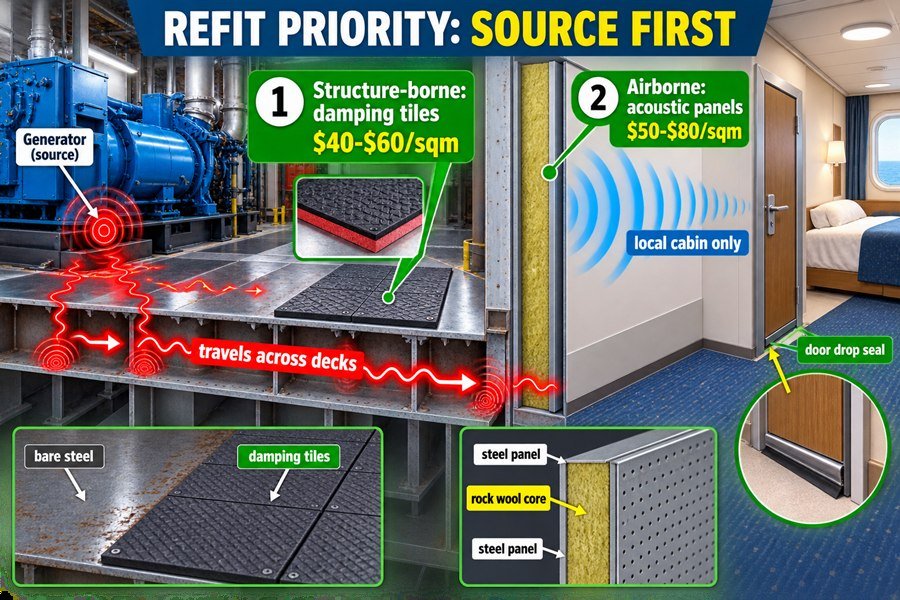
When a ship comes in for a refit, the owner always wants it quieter. But ripping out every cabin is too expensive. You have to be smart. You need a strategy. In my experience at Magellan Marine, we always do a noise survey first. We find out if the noise is traveling through the air or through the steel. If you replace the wall panels but the noise is in the steel deck, you waste all the client's money. You must follow a strict order of operations to get the best return on investment.
Step 1: Prioritizing Structure-Borne Noise at the Source
Always prioritize structure-borne noise first. Why? Because it travels everywhere. A vibrating generator base can cause noise in a cabin three decks away.14 If you stop the vibration at the source, you solve the problem for multiple cabins at once. During a refit, we target the bare steel around the noisy machinery. We apply heavy constrained layer damping tiles directly to the steel deck and bulkheads15 in the engine room. These tiles cost about $40 to $60 USD per square meter to buy and install. They are incredibly cost-effective. By spending $5,000 in the engine room, you might lower the noise level by 5 dB in twenty different passenger cabins. This must be your first step. Fix the steel before you fix the rooms.
Step 2: Treating Localized Airborne Noise in Cabins
Once the steel is quiet, you look at airborne noise. Airborne noise is local. It only affects the room next door. For example, if you can hear people talking in the next cabin, that is an airborne problem. Now you prioritize replacing the specific marine wall panels between those two rooms. During a refit, we install high-acoustic sandwich panels with internal sound barriers. These specialized acoustic panels cost between $50 and $80 USD per square meter. We also check the doors. A standard marine door has a gap at the bottom. We replace it with a high-acoustic door that has an automatic drop seal. This local treatment fixes the specific complaint without needing to rebuild the entire deck. Treat the source first, treat the symptom second.
| Priority Level | Noise Path Target | Treatment Method | Estimated Cost | Impact Area |
|---|---|---|---|---|
| Priority 1 | Structure-borne | Damping tiles on bare steel near source | $40 - $60 / sqm | Multiple decks and cabins |
| Priority 2 | Airborne | High-acoustic sandwich wall panels | $50 - $80 / sqm | Specific adjacent cabins |
| Priority 3 | Airborne / Leaks | Acoustic doors with drop seals | $400 - $700 / door | Single cabin entry |
Conclusion
Stopping ship noise requires matching the exact panel system to the specific noise path. By identifying airborne, structure-borne, and frequency issues, you will build quieter, compliant, and cost-effective cabins.
-
"Physical influences on seafarers are different during their ...", https://pmc.ncbi.nlm.nih.gov/articles/PMC7141673/. IMO noise-control guidance and field studies of ship machinery spaces document very high A-weighted sound-pressure levels in engine-room environments, with 110 dB(A) used as an upper regulatory reference for machinery spaces. Evidence role: statistic; source type: institution. Supports: Ship engine rooms can reach or exceed approximately 110 dB noise levels.. Scope note: This supports the plausibility of 110 dB(A)-class engine-room noise but does not prove that every engine room often exceeds that level. ↩
-
"How Do Structural Connections Impact Marine Ceiling Panel ...", https://magellanmarinetech.com/how-structural-connections-impact-marine-ceiling-panel-acoustics/. Research on shipboard noise and vibration describes steel hulls and decks as structural transmission paths through which machinery-induced vibration can propagate and radiate as structure-borne noise in adjacent spaces. Evidence role: mechanism; source type: paper. Supports: Machinery vibration can propagate through steel ship structures and contribute to noise in nearby rooms.. Scope note: The source would support the general physical mechanism; actual transmission depends on ship design, machinery mounts, deck stiffness, and installation details. ↩
-
"How Do Structural Connections Impact Marine Ceiling Panel ...", https://magellanmarinetech.com/how-structural-connections-impact-marine-ceiling-panel-acoustics/. Studies of building and ship acoustics show that rigid mechanical connections can transmit impact-induced vibration through a structure, while resilient or spring isolation reduces structure-borne sound transmission. Evidence role: mechanism; source type: paper. Supports: Rigidly attached ceiling systems can transmit impact vibration from a deck into rooms below.. Scope note: This is contextual support for the acoustic mechanism rather than direct proof for every helicopter-deck ceiling assembly. ↩
-
"17.2: Speed of Sound - Maricopa Open Digital Press", https://open.maricopa.edu/mccphy121jg5/chapter/speed-of-sound/. A materials acoustics reference listing longitudinal sound speeds in solids supports that sound propagates in steel at roughly 5,000–6,000 m/s, substantially faster than in air. Evidence role: definition; source type: encyclopedia. Supports: Sound travels through steel at about 5,000 meters per second and much faster than through air.. Scope note: Exact speed varies by steel alloy, temperature, and wave type; the figure is an approximate engineering value. ↩
-
"Study on Dynamic Characteristics of Resilient Mount Under ...", https://pmc.ncbi.nlm.nih.gov/articles/PMC11509879/. A marine noise-control guideline or resilient-mount design reference discussing elastomer hardness or dynamic stiffness would support the claim that rubber isolators must be selected within a controlled stiffness range for effective vibration isolation. Evidence role: expert_consensus; source type: institution. Supports: Marine wall-panel U-channel rubber isolators should use rubber with an ideal hardness of 45 to 50 Shore A.. Scope note: Unless the source explicitly names 45–50 Shore A for marine lining U-channel isolators, it provides contextual support for stiffness selection rather than direct proof of this exact range. ↩
-
"Study on Dynamic Characteristics of Resilient Mount Under Preload - PMC", https://pmc.ncbi.nlm.nih.gov/articles/PMC11509879/. A laboratory or field test report on resilient floor-track or elastomeric mounting systems would support the stated decibel reduction by documenting insertion loss or vibration reduction for comparable marine panel assemblies. Evidence role: statistic; source type: paper. Supports: Rubber U-channel isolators can reduce structure-borne noise transfer by 10 to 15 dB at the floor level.. Scope note: Reported dB reductions are frequency-dependent and installation-specific, so evidence from one assembly may not generalize to all marine floor tracks. ↩
-
"Sound insulation dataset of 30 wooden and 8 concrete floors ...", https://pmc.ncbi.nlm.nih.gov/articles/PMC10365936/. References defining the weighted sound reduction index, Rw, describe it as a single-number rating for airborne sound insulation derived from standardized laboratory measurements, which supports distinguishing it from structure-borne vibration performance. Evidence role: definition; source type: institution. Supports: Rw is a laboratory-based airborne sound insulation rating and does not directly describe structure-borne vibration behavior on ships.. Scope note: The source would define the Rw metric generally; it would not by itself prove performance limits for every marine installation. ↩
-
"[PDF] optimizing sandwich panels with graded tubular cell core for ... - arXiv", https://arxiv.org/pdf/2401.11412. Studies of mineral-wool or sandwich-panel acoustic insulation can support the relationship between porous core properties, density, and sound transmission loss; however, the cited evidence may justify the density range only as an engineering example rather than as a universal marine requirement. Evidence role: general_support; source type: paper. Supports: Rock wool core density is a relevant specification for airborne noise reduction, and a 120–150 kg/m3 range is presented as an appropriate target for marine sandwich panels.. Scope note: The exact 120–150 kg/m3 range may depend on panel geometry, facings, cavity depth, and target frequency band. ↩
-
""Finite Element Analysis of Structures with Constrained ...", https://digitalcommons.odu.edu/mae_etds/450/. Technical literature on viscoelastic damping explains that cyclic deformation of the viscoelastic layer dissipates mechanical vibration energy as heat, supporting the stated damping mechanism. Evidence role: mechanism; source type: education. Supports: A viscoelastic damping layer reduces vibration by deforming under cyclic motion and dissipating mechanical energy as heat.. Scope note: This supports the physical mechanism, not the article’s specific thickness or cost values. ↩
-
"Sound insulation dataset of 30 wooden and 8 concrete floors ...", https://pmc.ncbi.nlm.nih.gov/articles/PMC10365936/. ISO 10140-2 specifies laboratory methods for measuring airborne sound insulation of building elements, which supports requiring a standardized acoustic test report for panels or assemblies; its applicability to a complete marine wall system depends on how the test specimen is configured. Evidence role: definition; source type: institution. Supports: ISO 10140-2 is the relevant standardized laboratory test method for airborne sound insulation reports, but the tested specimen must represent the intended assembly for the result to be meaningful.. Scope note: The standard is a laboratory airborne-sound test method and does not alone guarantee installed shipboard performance or structure-borne vibration control. ↩
-
"Sound reduction index - Wikipedia", https://en.wikipedia.org/wiki/Sound_reduction_index. ISO 717-1 defines the weighted sound reduction index (Rw) as a single-number value derived from frequency-band sound-reduction measurements, which supports the point that frequency-specific performance can be obscured by the summary rating. Evidence role: definition; source type: institution. Supports: A single Rw rating is insufficient for judging how a panel performs against noise at different frequencies.. Scope note: This supports the limitation of single-number acoustic ratings generally, but it does not evaluate any specific marine fire panel. ↩
-
"[PDF] Survey of Noise Suppression Systems for Engine Generator Sets", https://www.osti.gov/servlets/purl/752962. Studies of shipboard noise commonly identify main diesel engines and generator machinery as important low-frequency noise sources, with substantial components in low-frequency bands; this provides contextual support for the stated 50–250 Hz range. Evidence role: general_support; source type: paper. Supports: Main engines and large generators on ships commonly produce low-frequency noise in the approximate 50–250 Hz range.. Scope note: Exact frequency content depends on engine speed, mounting, hull structure, and measurement location, so the range should be treated as typical rather than universal. ↩
-
"Analytic Modeling of Sound Transmission through Membrane ...", https://composites.usc.edu/analytic-modeling-of-sound-transmission-through-membrane-type-acoustic-metamaterials/. Acoustic mass law states that, for an ideal barrier, transmission loss increases with surface density and frequency, often approximated as about 6 dB for each doubling of mass per unit area; this supports the claim that heavier panels generally improve airborne sound isolation. Evidence role: mechanism; source type: education. Supports: Heavier marine wall panels generally provide better low-frequency airborne sound isolation under the acoustic mass-law principle.. Scope note: Mass law is an idealized model and may not predict real sandwich-panel performance where stiffness, resonances, coincidence effects, seals, and flanking paths are significant. ↩
-
"Analysis of the Underwater Radiated Noise Generated by Hull Vibrations ...", https://pmc.ncbi.nlm.nih.gov/articles/PMC9861438/. Marine acoustics literature explains that machinery vibration can be transmitted through a ship’s structure and re-radiated as sound in remote spaces, providing a mechanism for machinery mounts or bases to affect cabins away from the source. Evidence role: mechanism; source type: research. Supports: Structure-borne vibration from machinery can propagate through a vessel and create audible noise in cabins distant from the original source.. Scope note: This supports the physical mechanism; the exact distance of “three decks away” depends on vessel structure, mounting, frequency, and damping. ↩
-
"Sound Radiation Analysis of Constrained Layer Damping ... - PMC", https://pmc.ncbi.nlm.nih.gov/articles/PMC6803831/. Studies of constrained-layer damping show that viscoelastic damping layers bonded to metal plates dissipate vibrational energy and can reduce structural vibration and radiated noise from plate-like structures. Evidence role: mechanism; source type: paper. Supports: Constrained-layer damping applied to steel decks and bulkheads can reduce vibration and associated structure-borne noise.. Scope note: Evidence from plate or laboratory studies supports the damping mechanism, but it does not by itself verify the article’s specific cost or decibel-reduction estimates for a given vessel. ↩