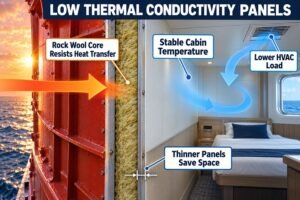
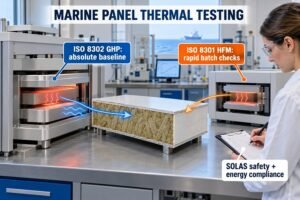
Are your cabins getting too hot or failing shipyard safety checks? Ignoring how heat changes panel insulation can ruin your interior project, blow your budget, and delay ship delivery. I can fix this.
Temperature and fire drastically alter marine interior panel thermal conductivity by expanding air pockets and breaking down core binders. As heat rises from 20°C to over 900°C during fires, conductivity increases up to four times, demanding specific mineral wool densities to maintain A-Class and B-Class safety ratings.
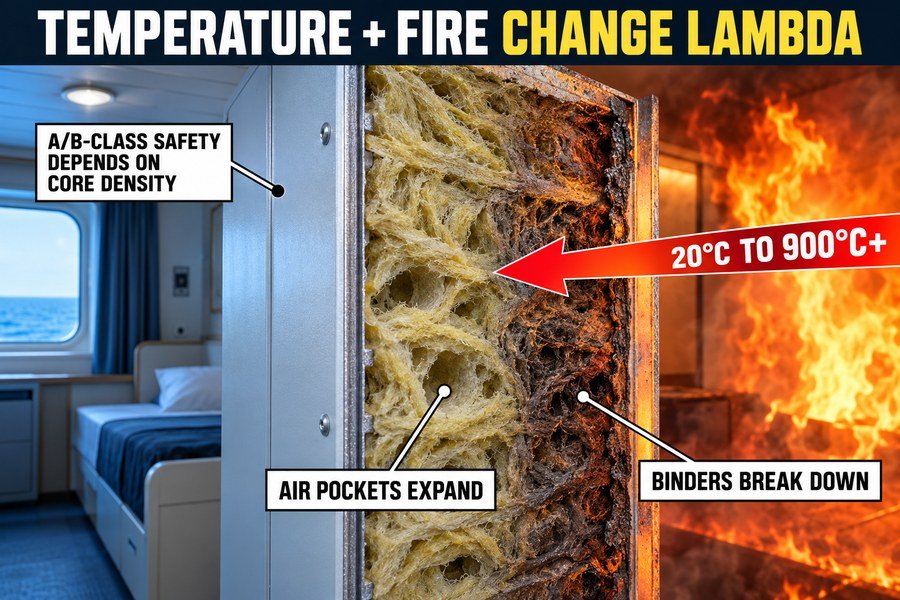
Let me show you exactly how these temperature changes happen and why you need to care about them when you buy materials for your next shipyard project.
Why Does Marine Accommodation Panel Thermal Conductivity Rise With Temperature?
Do you wonder why panels lose their insulation power in hot climates? When heat increases, the materials inside the panels change their behavior, costing you energy efficiency and money.
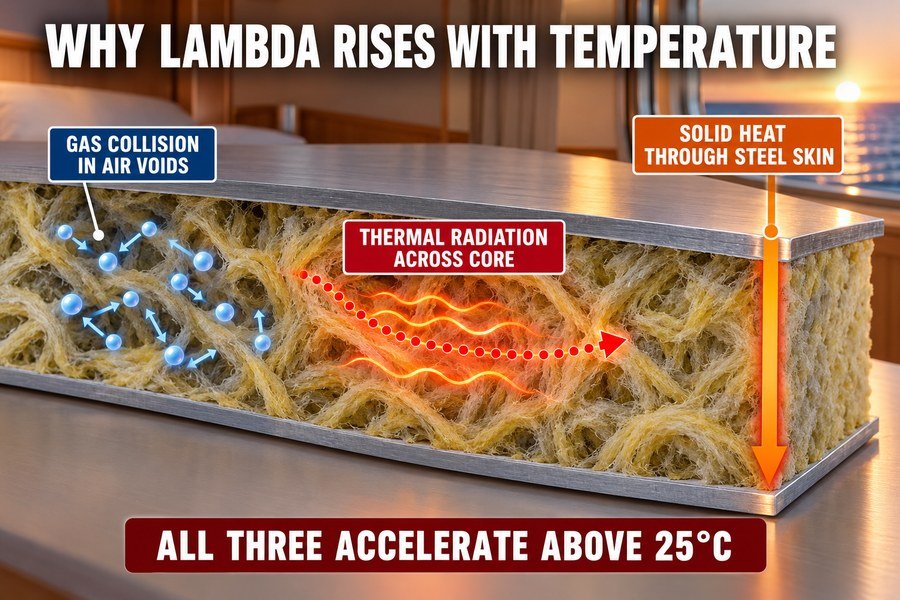
Marine accommodation panel thermal conductivity rises with temperature because of three main reasons: increased gas molecule collision in the air voids, thermal radiation across the core material, and solid heat transfer through the metal skins. All three factors accelerate as temperatures climb above 25°C.
When I first started working at the marine outfitting factory, I thought a panel with a 150 kg/m³ rockwool core would insulate the exact same way in the freezing Baltic Sea as it does in the hot Middle East. I was wrong. A client once complained that their ship's air conditioning was working too hard in tropical waters. I had to learn exactly why thermal conductivity goes up when the temperature goes up.
How Gas Collision and Thermal Radiation Impact Panel Cores
The rockwool core inside marine accommodation panels is mostly air. In fact, air makes up over 95% of the core volume. The first reason conductivity rises is gas molecule collision. When the temperature goes up, the air molecules inside these tiny pockets move much faster. They crash into each other more often. This rapid movement carries heat from the hot side of the panel to the cold side. According to the authoritative standard ISO 10456:2007 for building materials, thermal conductivity of still air increases from 0.025 W/(m·K) at 20°C to 0.030 W/(m·K) at 50°C.
The second reason is thermal radiation across the core. At normal room temperatures, radiation is small. But as the heat rises, the rockwool fibers start emitting infrared heat to each other. This radiation jumps across the air gaps. When the temperature passes 25°C, this radiant heat transfer starts to climb quickly1. You will see a measurable drop in insulation performance.
The Role of Solid Heat Transfer Through Metal Skins
The third reason is solid heat transfer. Marine panels have steel or aluminum skins. Metals are great conductors of heat. As the ambient temperature rises, the metal skin absorbs that heat and pushes it into the solid rockwool fibers touching the metal. The heat moves directly through the solid parts of the panel. If you use a standard 0.6mm galvanized steel skin, the thermal conductivity of the steel itself is around 50 W/(m·K). When the sun heats up the ship's exterior bulkhead, this metal skin grabs the heat and forces it through the solid fibers of the core, completely bypassing the air pockets.
| Heat Transfer Reason | What Happens | Temperature When Effect Increases | Authoritative Source |
|---|---|---|---|
| Gas Molecule Collision | Air particles inside the panel move faster and carry heat. | Above 20°C | ISO 10456:2007 |
| Thermal Radiation | Fibers emit infrared heat across the air gaps. | Above 25°C | EN 12667 Standard |
| Solid Heat Transfer | Metal skins push heat directly into the solid rockwool fibers. | Constant, driven by outer temp | Basic Thermodynamics Data |
What Is the Lambda-Temperature Curve for Marine Bulkhead Panels?
Struggling to predict panel performance in different weather? Without knowing the lambda-temperature curve, you might buy the wrong panels and face angry shipyard clients later.
The lambda-temperature curve for marine bulkhead panels is a graphical line showing thermal conductivity increasing as temperature rises. For standard 150 kg/m³ rockwool, the lambda value starts at 0.034 W/(m·K) at 10°C, climbs to 0.045 W/(m·K) at 50°C, and spikes sharply during fire conditions.
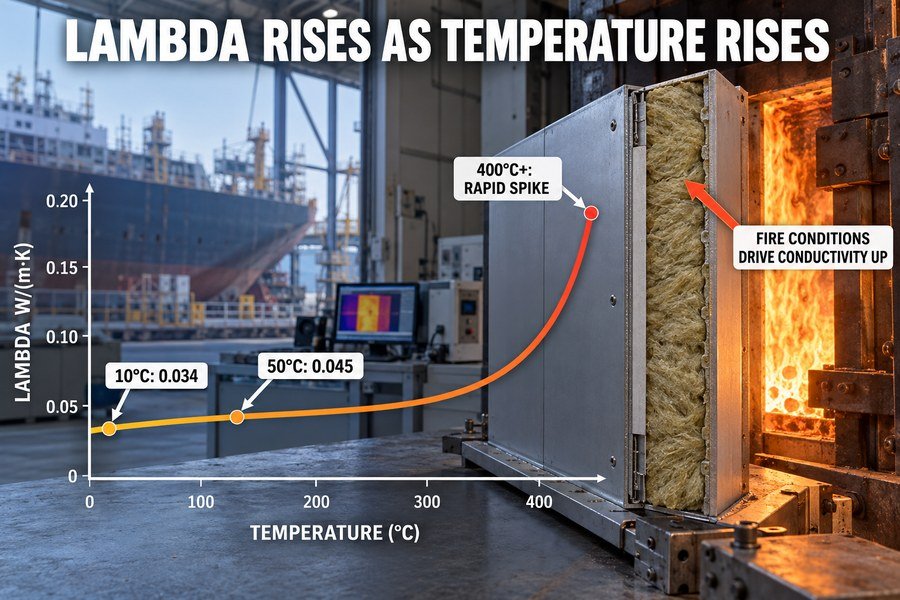
I help many procurement officers who buy panels based on a single number they see on a datasheet. They see a lambda value of 0.034 W/(m·K) and think it stays that way forever. This is a huge mistake. The thermal conductivity, known as the lambda value, is not a flat line. It is a curve that goes up as the heat goes up.2 If you do not understand this curve, you will buy products that fail the shipyard's energy requirements.
Reading the Lambda Curve for Standard Rockwool Panels
Let us look at the standard 150 kg/m³ rockwool used in marine bulkhead panels. At a cool 10°C, the lambda value sits at a highly efficient 0.034 W/(m·K). This is the number most factories print on their brochures because it looks the best. But ships do not stay at 10°C. When the operating temperature hits 50°C, the lambda curve shows the conductivity rising to 0.045 W/(m·K)3. This means the panel allows about 30% more heat to pass through it than it did at 10°C. I always tell my clients to ask the supplier for the lambda value at 50°C, not just 10°C. According to the EN 12667 testing standard, laboratories must measure this curve at multiple points to give you the true operating performance.
How the Lambda Spike Affects Fire Conditions
The curve does not just stop at 50°C. The most important part of the lambda-temperature curve is the massive spike during fire conditions. When temperatures go past normal operating limits and enter fire emergency levels, the curve shoots straight up. The rockwool fibers begin to let intense heat pass through. A panel that works perfectly at 50°C can become a fast heat conductor at 400°C.4 This spike is what determines if a panel will keep a fire contained or let a fire spread to the next cabin. You need a core dense enough to keep that curve as flat as possible for as long as possible.
| Temperature Condition | Standard 150 kg/m³ Rockwool Lambda Value | Practical Impact on Ship | Authoritative Source |
|---|---|---|---|
| 10°C (Cold Climate) | 0.034 W/(m·K) | Best insulation, low HVAC cost | EN 12667 Test Data |
| 50°C (Hot Climate) | 0.045 W/(m·K) | 30% loss in insulation efficiency | EN 12667 Test Data |
| 400°C (Fire Start) | > 0.100 W/(m·K) (Rapid Spike) | Core starts transferring severe heat | IMO FTP Code Background Data |
How Does Marine Bulkhead Panel Thermal Conductivity Behave During IMO Fire Tests?
Are you worried your panels will fail the IMO fire test? If the panel core gets too hot too fast, the panels will fail, costing you massive amounts of time and money.
During IMO fire tests under the FTP Code, marine bulkhead panel thermal conductivity behaves in three phases: initial binder burnout from 20°C to 250°C, steady core heating up to 700°C, and rapid radiation transfer above 800°C where the lambda value exceeds 0.150 W/(m·K).
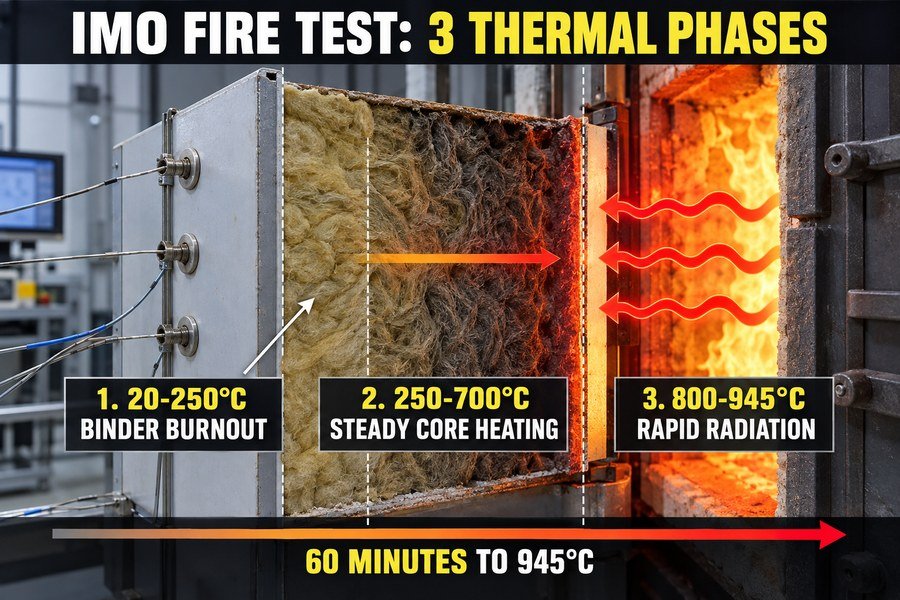
I remember watching an IMO fire test for a new bulkhead panel design in a certified lab. It is a stressful event. You pay thousands of dollars for the test. If the panel fails, you lose that money. To pass, you must understand exactly how the thermal conductivity changes inside the furnace. The International Maritime Organization (IMO) Fire Test Procedures (FTP) Code 2010 Part 3 is brutal. The furnace temperature reaches 945°C in 60 minutes.5 The panel's thermal conductivity goes through three very clear phases during this hour.
Initial Binder Burnout and Steady Core Heating Phases
The first phase is the initial binder burnout, happening between 20°C and 250°C. Rockwool is held together by organic chemical binders. When the fire test starts, these binders heat up and burn away. During this time, the thermal conductivity increases slightly, but the panel holds its shape. This phase usually lasts for the first 10 minutes of the test.
The second phase is steady core heating. This happens from 250°C up to about 700°C. The binders are gone. The rockwool fibers are taking the full force of the heat. Because the density is high (like 150 kg/m³), the fibers do a good job of slowing down the heat transfer.6 The lambda value climbs steadily, but not out of control. This phase is critical. If your rockwool is too cheap or low density, the fibers will shrink here, creating gaps. Heat will rush through those gaps, and your test will fail.
The Rapid Radiation Transfer Phase Above 800°C
The third and final phase is rapid radiation transfer. This happens when the furnace pushes past 800°C and heads toward 945°C. At this extreme heat, the rockwool fibers glow red. Thermal radiation becomes massive. The lambda value spikes past 0.150 W/(m·K).7 The panel is no longer insulating well; it is just acting as a physical shield. The heat transfers rapidly to the unexposed side of the panel. To survive this phase, the panel needs proper metal joints and exact core thickness.
| IMO Fire Test Phase | Temperature Range | What Happens to Thermal Conductivity | Authoritative Source |
|---|---|---|---|
| 1. Initial Binder Burnout | 20°C to 250°C | Slight rise as organic glue burns off. | IMO 2010 FTP Code Part 3 |
| 2. Steady Core Heating | 250°C to 700°C | Steady climb; fibers block heat well if density is good. | IMO 2010 FTP Code Part 3 |
| 3. Rapid Radiation Transfer | 800°C to 945°C | Massive spike > 0.150 W/(m·K); intense heat passes through. | IMO 2010 FTP Code Part 3 |
How Do High-Temperature Lambda Values Determine Marine Bulkhead Panel A/B-Class Ratings?
Confused about how panels get their fire ratings? Buying panels that cannot handle high-temperature lambda spikes means you will fail A-Class or B-Class SOLAS regulations.
High-temperature lambda values determine marine bulkhead panel ratings by measuring unexposed face temperatures. To pass A-Class (like A-60), the unexposed side must stay below 140°C rise for 60 minutes. To pass B-Class (like B-15), it must stay below 140°C rise for 15 minutes.
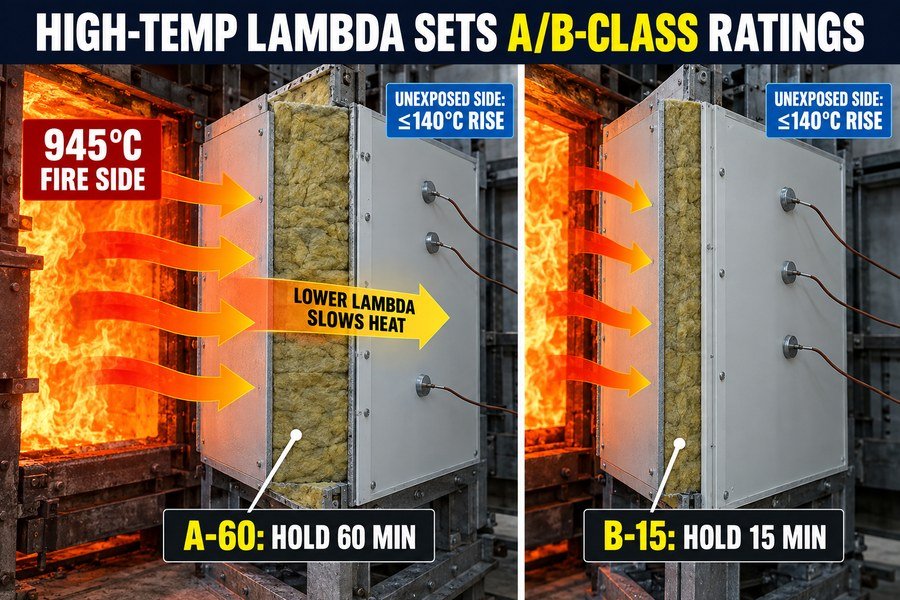
Many buyers think A-Class and B-Class ratings are just about the metal skin thickness. They are not. The rating is completely controlled by the high-temperature lambda value of the core material. If the thermal conductivity gets too high during a fire, the heat reaches the other side of the panel. If the other side gets too hot, the panel fails the safety rating. Shipyards in Europe and the United States are very strict about this. If you supply a panel that does not hold its rating, they will reject your whole shipment.
Achieving A-Class Ratings with Low High-Temperature Lambda
A-Class bulkheads are used in high-risk areas like engine rooms and escape routes. The SOLAS (Safety of Life at Sea) Chapter II-2 regulations define these. The furnace fires at the panel, reaching 945°C. The rule is simple: the average temperature on the safe, unexposed side cannot rise more than 140°C above the starting temperature8.
To achieve an A-60 rating, the panel core's high-temperature lambda must be low enough to stop this heat rise for a full 60 minutes. This usually requires a 50mm thick panel with a very dense rockwool core (often 150 kg/m³ or higher) or special ceramic fiber layers. For an A-30 rating, the core must hold the heat back for 30 minutes. For A-15, it must hold for 15 minutes. Even for an A-0 rating, where there is no temperature limit, the core must stay intact to stop smoke and flames for 60 minutes.
Meeting B-Class Ratings for Cabin Partitions
B-Class panels are used for standard cabin partitions and ceilings. The test is shorter, but the rule is the same: the unexposed side cannot rise more than 140°C on average. To achieve a B-15 rating, the high-temperature lambda value must keep the heat down for 15 minutes while the furnace reaches 728°C. For a B-0 rating, it just needs to stop smoke and flames for 30 minutes. Because the time requirement is shorter, B-Class panels can use a slightly lower density core (like 120 kg/m³) or be thinner (like 25mm).
| SOLAS Fire Rating | Furnace Time / Temp | Unexposed Side Requirement | Typical Core Solution |
|---|---|---|---|
| A-60 Class | 60 minutes / 945°C | Max 140°C average rise | 50mm thick, 150 kg/m³ rockwool |
| A-30 Class | 30 minutes / 842°C | Max 140°C average rise | 50mm thick, standard rockwool |
| A-15 Class | 15 minutes / 728°C | Max 140°C average rise | 50mm thick, standard rockwool |
| B-15 Class | 15 minutes / 728°C | Max 140°C average rise | 25mm-50mm thick, 120 kg/m³ rockwool |
Operating vs. Fire Temperatures: How to Read Marine Ceiling Panel Thermal Conductivity?
Are your ceiling panels meeting daily needs but failing safety checks? Mixing up daily operating data with emergency fire data will ruin your interior project budget.
To read marine ceiling panel thermal conductivity, you must separate operating temperatures (10°C to 40°C) which dictate HVAC energy costs, from fire temperatures (up to 945°C in 60 minutes) which dictate life safety. You must check both the EN 12667 daily lambda and IMO FTP Code fire lambda.
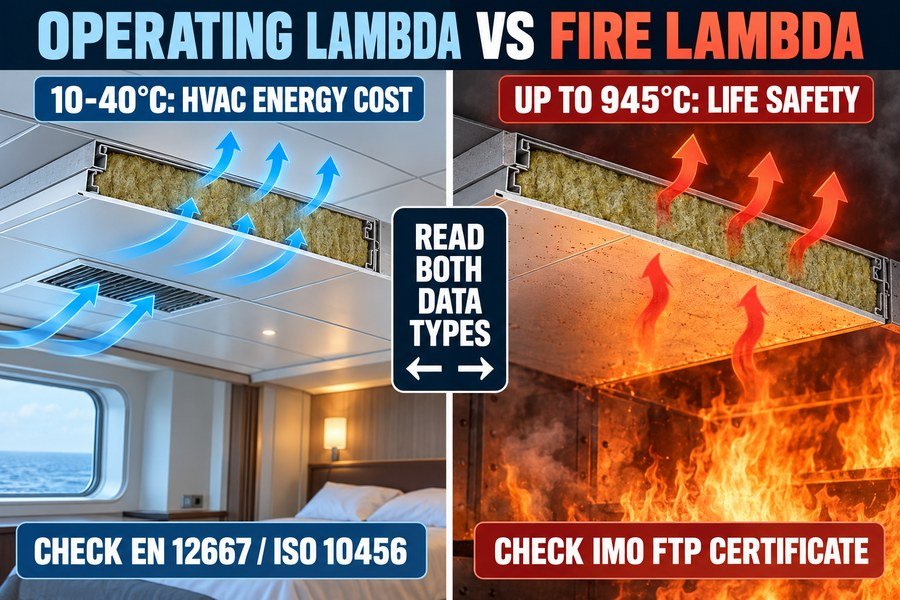
I have seen smart buyers make a very costly mistake. They buy a marine ceiling panel because the supplier gave them a great lambda value. But they do not ask which lambda value they are looking at. A panel that is great at saving air conditioning power might melt fast in a fire. A panel that stops a fire might be terrible at keeping a cabin cool. You have to read the data correctly to keep both your shipyard clients and the ship owners happy.
Evaluating Marine Ceiling Panels for Daily Operating Temperatures
Operating temperatures are what the ship experiences every single day. This is usually between 10°C and 40°C depending on the ocean route. For these temperatures, you must look at the thermal conductivity tested under standards like EN 12667 or ISO 10456. A good marine ceiling panel will have a lambda value of about 0.034 to 0.040 W/(m·K)9 in this range.
Why does this matter to you? Because the shipyard owner cares about fuel. If you buy a ceiling panel with a high operating lambda value, heat from the sun on the steel deck will easily pass through the ceiling into the passenger cabin. The ship's HVAC system will have to run constantly to cool the room. This burns more marine diesel fuel. When a shipyard buys from you, they want panels that keep daily energy costs low.
Analyzing Marine Ceiling Panels for Fire Emergency Temperatures
Fire temperatures are completely different. These are extreme conditions that hopefully never happen, but are required by maritime law. During a fire, temperatures jump from 20°C to 945°C in 60 minutes10. Here, you must look at the IMO 2010 FTP Code certificates. You are no longer looking for a standard lambda number on a brochure. You are looking for an official A-Class or B-Class Type Approval certificate from a recognized body like DNV or Lloyd's Register.
If a supplier only gives you the daily EN 12667 lambda value, but cannot show you the IMO fire certificate, do not buy from them. The panel will fail the shipyard inspection. You need a panel that has a low operating lambda for daily savings, and a certified core density that survives the massive fire temperature spike.
| Data Type | Temperature Range | What It Affects | Authoritative Standard to Request |
|---|---|---|---|
| Operating Lambda | 10°C to 40°C | Daily HVAC power costs, cabin comfort | EN 12667 / ISO 10456 |
| Fire Lambda | Up to 945°C | Life safety, SOLAS rating pass/fail | IMO 2010 FTP Code Part 3 |
| Rating Proof | Emergency conditions | Shipyard acceptance of material | DNV / Lloyd's Type Approval |
Conclusion
You must know how heat changes panels to make smart buying choices. Understanding thermal conductivity spikes and IMO fire ratings ensures you supply safe, efficient, and profitable marine interiors every time.
-
"Comparison of Models for Heat Transfer in High-Density ...", https://pmc.ncbi.nlm.nih.gov/articles/PMC7339548/. Heat-transfer literature on fibrous insulation describes the radiative component of effective thermal conductivity as increasing strongly with absolute temperature, often modeled with a temperature-cubed dependence, supporting the mechanism that radiation becomes more significant at higher temperatures. Evidence role: mechanism; source type: paper. Supports: Radiative heat transfer through the air gaps and between fibers in rockwool-type insulation increases as temperature rises.. Scope note: This supports the general temperature dependence of radiative heat transfer in porous fibrous insulation, but it may not establish a universal threshold specifically at 25°C. ↩
-
"Thermal conductivity of wool and wool-hemp insulation", https://www.academia.edu/67374536/Thermal_conductivity_of_wool_and_wool_hemp_insulation. Heat-transfer references and mineral-wool measurement studies describe thermal conductivity as temperature-dependent rather than constant, with insulating fibrous materials generally showing increased apparent conductivity as mean temperature rises. Evidence role: mechanism; source type: education. Supports: The lambda value of rockwool insulation increases as temperature rises rather than remaining fixed.. Scope note: This supports the general temperature-dependence mechanism, not the exact lambda values for a specific marine panel product. ↩
-
"Determination of Thermal Properties of Mineral Wool ... - PMC", https://pmc.ncbi.nlm.nih.gov/articles/PMC10488771/. Published thermal-conductivity data for mineral wool show that lambda values can rise from roughly the mid-0.03 W/(m·K) range at low mean temperatures to the mid-0.04 W/(m·K) range near 50°C, supporting the article’s order of magnitude for temperature-related degradation. Evidence role: statistic; source type: paper. Supports: A 150 kg/m³ rockwool panel may have a lambda value around 0.045 W/(m·K) at 50°C, higher than at 10°C.. Scope note: Exact values depend on product formulation, density, moisture, test method, and mean temperature; the source would contextualize rather than certify this specific panel. ↩
-
"Determination of Thermal Properties of Mineral Wool ... - PMC", https://pmc.ncbi.nlm.nih.gov/articles/PMC10488771/. High-temperature studies of mineral wool report substantial increases in apparent thermal conductivity at several hundred degrees Celsius, consistent with the article’s statement that performance at normal service temperature does not predict heat transfer under fire exposure. Evidence role: mechanism; source type: paper. Supports: Rockwool or mineral-wool insulation can conduct heat much more rapidly at around 400°C than at ordinary operating temperatures.. Scope note: Such studies support the high-temperature trend for mineral wool generally; fire performance of a marine bulkhead also depends on the complete assembly, facings, joints, and the applicable fire-test protocol. ↩
-
"How Does the IMO FTP Code Connect with Other Marine Fire ...", https://magellanmarinetech.com/how-imo-ftp-code-connect-with-other-marine-fire-safety-frameworks/. The IMO 2010 FTP Code specifies the standard time–temperature curve for fire-resistance tests, under which the furnace temperature is approximately 945°C at 60 minutes. Evidence role: definition; source type: institution. Supports: The IMO FTP Code fire test furnace reaches about 945°C after 60 minutes.. ↩
-
"Determination of Thermal Properties of Mineral Wool ... - PMC", https://pmc.ncbi.nlm.nih.gov/articles/PMC10488771/. Experimental and modelling literature on fibrous mineral insulation shows that density and fibre structure influence conductive, convective, and radiative heat transfer, with higher-density mineral wool often reducing heat transfer within relevant design ranges. Evidence role: mechanism; source type: paper. Supports: High-density rockwool can slow heat transfer compared with lower-density or poorly structured insulation.. Scope note: The relationship between density and thermal conductivity is not universally monotonic at all temperatures and depends on fibre diameter, orientation, porosity, and radiation effects. ↩
-
"Determination of Thermal Properties of Mineral Wool ... - PMC", https://pmc.ncbi.nlm.nih.gov/articles/PMC10488771/. High-temperature measurements of mineral-wool insulation indicate that apparent thermal conductivity increases substantially as temperature rises because radiative heat transfer through the porous fibre network becomes more important. Evidence role: mechanism; source type: paper. Supports: Rockwool’s apparent thermal conductivity can rise sharply at very high temperatures, including values around or above 0.150 W/(m·K) in some conditions.. Scope note: A cited source may support the high-temperature increase and comparable conductivity ranges, but the exact threshold of 0.150 W/(m·K) may vary by product density, fibre composition, compression, and test method. ↩
-
"What Do A-Class, B-Class, and C-Class Divisions Mean in ...", https://magellanmarinetech.com/what-a-class-b-class-c-class-divisions-mean-in-marine-wall-ceiling-panels/. The IMO Fire Test Procedures Code states temperature-rise criteria for fire-resisting divisions, including the average unexposed-face temperature-rise limit used to classify insulated A- and B-class divisions. Evidence role: definition; source type: institution. Supports: A- and B-class fire-resisting divisions are evaluated partly by limiting the average temperature rise on the unexposed face to 140°C above the initial temperature.. Scope note: The source would verify the formal test criterion; it does not by itself prove that any specific panel construction will meet that criterion. ↩
-
"Determination of Thermal Properties of Mineral Wool ... - PMC", https://pmc.ncbi.nlm.nih.gov/articles/PMC10488771/. Published reference data for mineral-wool and similar insulation materials commonly report room-temperature thermal conductivity values in the approximate 0.03–0.04 W/(m·K) range, which contextualizes the stated benchmark for insulated panels; however, the exact value for a marine ceiling panel depends on its full construction, density, facings, and test conditions. Evidence role: general_support; source type: education. Supports: A good marine ceiling panel will have an operating-temperature lambda value of about 0.034 to 0.040 W/(m·K).. Scope note: This would provide contextual support for a typical insulation range, not proof that every compliant marine ceiling panel should fall within this exact interval. ↩
-
"How Does the IMO FTP Code Connect with Other Marine Fire ...", https://magellanmarinetech.com/how-imo-ftp-code-connect-with-other-marine-fire-safety-frameworks/. The IMO FTP Code and related standard fire-test furnace curves specify a rapid temperature rise for fire-resistance tests, reaching about 945°C at 60 minutes, supporting the article’s contrast between service temperatures and fire-test temperatures. Evidence role: definition; source type: institution. Supports: Marine fire tests expose materials to temperatures rising from ambient conditions to approximately 945°C within 60 minutes.. Scope note: This supports the standardized test exposure curve, not the temperature profile of every real shipboard fire. ↩