Hot ship cabins cause angry passengers and high air conditioning costs. You lose profit if your insulation fails. I will show you exactly what low thermal conductivity means for your ship panels.
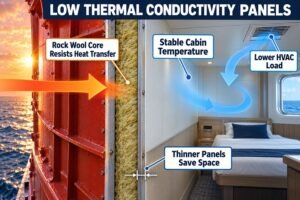
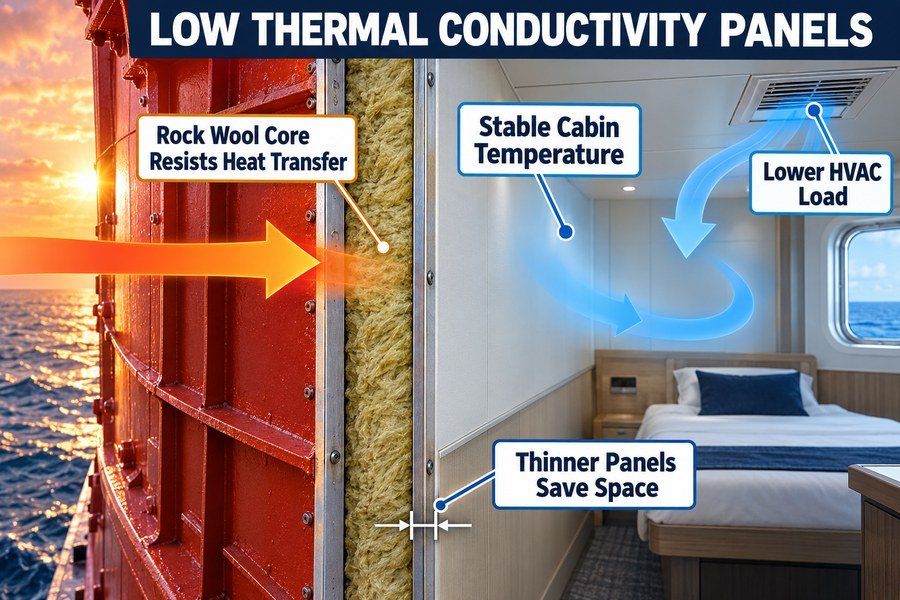
Low thermal conductivity in marine accommodation panels means the core material strongly resists heat transfer. It ensures stable cabin temperatures, reduces HVAC energy consumption, and allows for thinner panels, directly impacting passenger comfort, fuel costs, and space optimization for shipbuilders and vessel owners.
Understanding this simple thermal metric changes how you buy marine interior materials. It separates high-quality suppliers from cheap ones. Let us break down how this works in real shipbuilding projects.
How Do Low Thermal Conductivity Cores Block Heat In Marine Lining Panels?
The sun beats down on a steel hull and makes cabins hot. If heat transfers easily, your air conditioner works too hard. Low conductivity cores stop this heat dead.
Low thermal conductivity cores block heat in marine lining panels through three main mechanisms: trapping still air inside microscopic pockets, utilizing dense mineral fibers to slow solid conductive heat flow, and employing reflective foil backings to bounce radiant heat away from the inner cabin space.
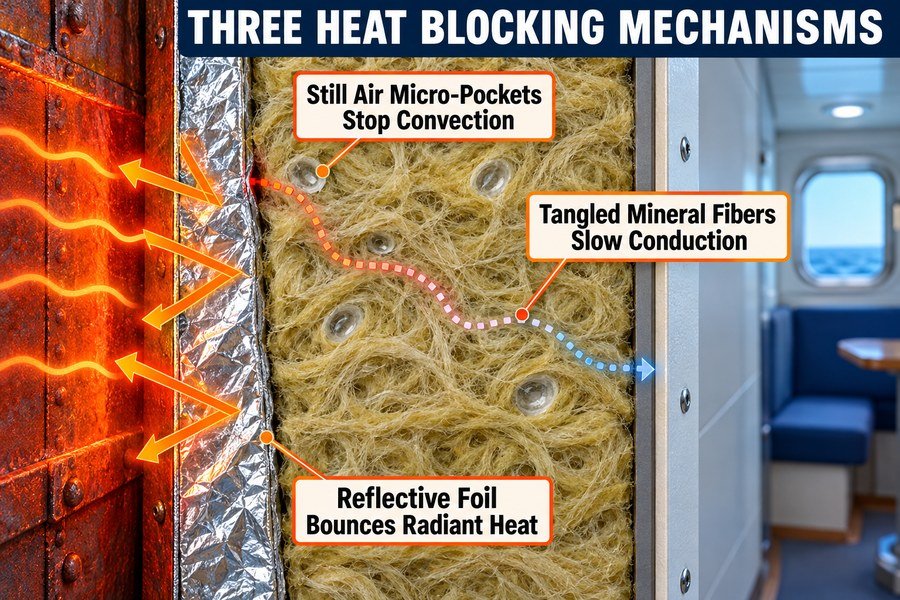
I inspect many marine lining panels in my work as an outfitting specialist. The core material is the absolute secret to blocking heat transfer. We must look at the three main mechanisms mentioned above. I will explain exactly how each one works in a real ship environment.
Trapping Still Air in Panel Micro-Pockets
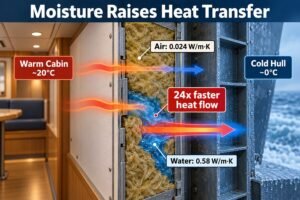
The first mechanism is trapping still air. Air is a very poor conductor of heat. Its thermal conductivity is about 0.024 W/mK at 20°C1, according to the testing standard ISO 10456. Marine panel cores use this physical fact to their advantage. A good rock wool core is mostly just air. The manufacturing process creates millions of tiny pockets inside the material. These microscopic pockets hold the air completely still. The heat from the hot steel hull hits the back of the panel. The heat tries to cross to the inside cabin. The trapped air stops the heat from moving. The air cannot flow, so thermal convection does not happen inside the panel. This is a very cheap and effective way to block heat transfer in ships.
Utilizing Dense Mineral Fibers to Slow Heat Flow
The second mechanism uses the solid core material itself. We use dense mineral fibers like rock wool to slow down the heat. Heat travels slowly through these solid fibers. We call this conductive heat flow. The rock wool fibers are very long and tangled together. The heat cannot travel in a straight line. The heat must follow a very long, twisted path along the fiber to get across the panel. This long path slows the heat down significantly. High-quality marine rock wool has a density of 100 to 120 kg/m³. I always recommend this specific density to my clients. It provides the best balance. It gives enough structural strength to hold the air pockets together. It also minimizes the solid paths for conductive heat.
Bouncing Radiant Heat with Reflective Foil Backings
The third mechanism is about stopping radiant heat. Sometimes heat travels as invisible radiation through empty spaces behind the bulkhead. Many high-end marine lining panels use a shiny, reflective aluminum foil backing. The factory glues this foil to the hidden side of the rock wool. This foil faces the hot side of the steel bulkhead. When radiant heat hits the aluminum foil, the foil bounces it right back. It reflects up to 95% of radiant heat. This stops the heat before it even enters the rock wool core material. It acts just like a mirror for heat waves.
| Heat Blocking Mechanism | Material Used in Core | Function in Marine Panel | Typical Effectiveness |
|---|---|---|---|
| Trapping Still Air | Rock wool pores | Stops internal convection currents | Very High |
| Slowing Conductive Flow | Tangled mineral fibers | Lengthens the physical heat path | High |
| Bouncing Radiant Heat | Aluminum foil backing | Reflects thermal radiation from steel | High (reflects up to 95%) |
Why Do Low Lambda Values Enable Thinner Marine Ceiling Panels For Higher Headroom?
Low ceilings make ship cabins feel very cramped and uncomfortable. Thick ceiling insulation steals your valuable cabin space. A lower lambda value solves this height problem fast.
Low lambda values enable thinner marine ceiling panels because highly efficient insulators require less physical thickness to achieve the target thermal resistance (R-value). Shipbuilders can use a 25mm high-performance panel instead of a standard 50mm panel, instantly gaining 25mm of vital headroom for passengers.
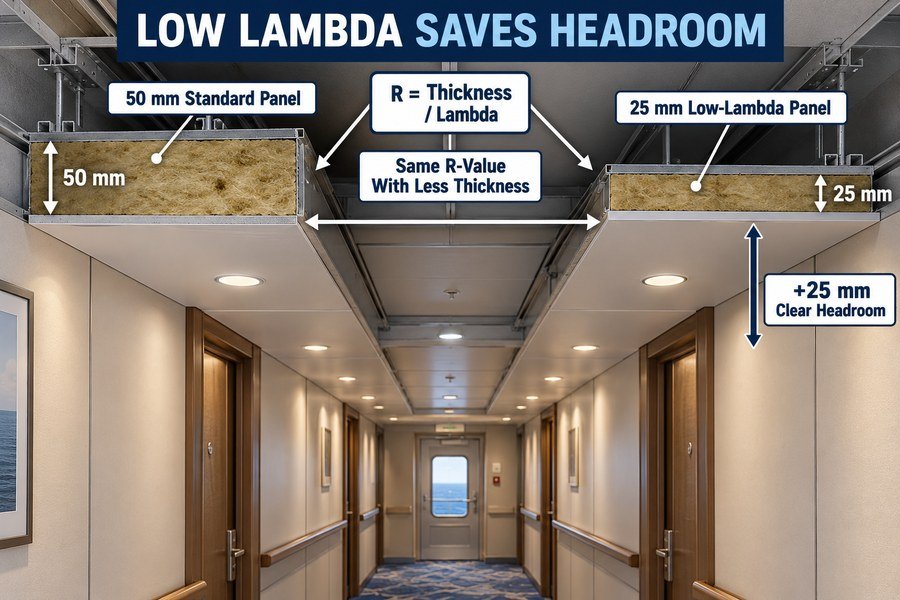
Headroom is very important in marine interior design. Every single millimeter matters to the passengers. We measure insulation power using the R-value. A higher R-value means better insulation2. We calculate this R-value by dividing the panel thickness by the lambda value. Let us explore the math and the real-world headroom gains.
The Math Behind Thermal Resistance and Panel Thickness
I use a simple formula every day at Magellan Marine. The formula is: R-value = Thickness / Lambda3. To keep the cabin cool, a shipyard engineer specifies a target R-value. If you use a cheap material with a high lambda value, the bottom number in the formula is big. You must increase the physical thickness to get the target R-value. If you use a low lambda material, you need much less thickness. For example, a shipyard wants an R-value of 0.83 m²K/W. A standard material with a lambda of 0.060 W/mK needs a thickness of 50mm. A high-performance material with a lambda of 0.030 W/mK only needs a thickness of 25mm to get the exact same 0.83 R-value.
Real-World Headroom Gains in Marine Cabins
We can easily save space using this math. I recently helped a customer with a small river cruise ship project. The ceiling height was too low4. The original plan used 50mm standard ceiling panels. I suggested a low lambda composite panel. It was only 25mm thick. We achieved the exact same insulation performance. The shipyard gained 25mm of clear headroom instantly. This small change made the cabins feel much bigger. Passengers do not like hitting their heads on ceilings. A thinner panel also weighs less. A 25mm panel weighs about 30% less than a 50mm panel of the same density. This makes the overhead installation work much easier for the shipyard workers.
| Panel Type | Lambda Value (W/mK) | Target R-value (m²K/W) | Required Panel Thickness | Headroom Gained |
|---|---|---|---|---|
| Standard Glass Wool | 0.060 | 0.83 | 50 mm | 0 mm (Baseline) |
| Standard Rock Wool | 0.045 | 0.83 | 37.5 mm | + 12.5 mm |
| Advanced Composite | 0.030 | 0.83 | 25 mm | + 25.0 mm |
What Thermal Conductivity Range Defines High-Performance Marine Interior Panels?
You cannot evaluate marine panel quality without hard numbers. Vague promises of good insulation waste your money. You need specific lambda value ranges to compare suppliers.
High-performance marine interior panels are defined by a thermal conductivity (lambda) range of 0.030 to 0.045 W/mK. Standard mineral wool panels average 0.040 W/mK, while advanced composite cores push closer to 0.030 W/mK, offering superior insulation for high-specification passenger vessels.
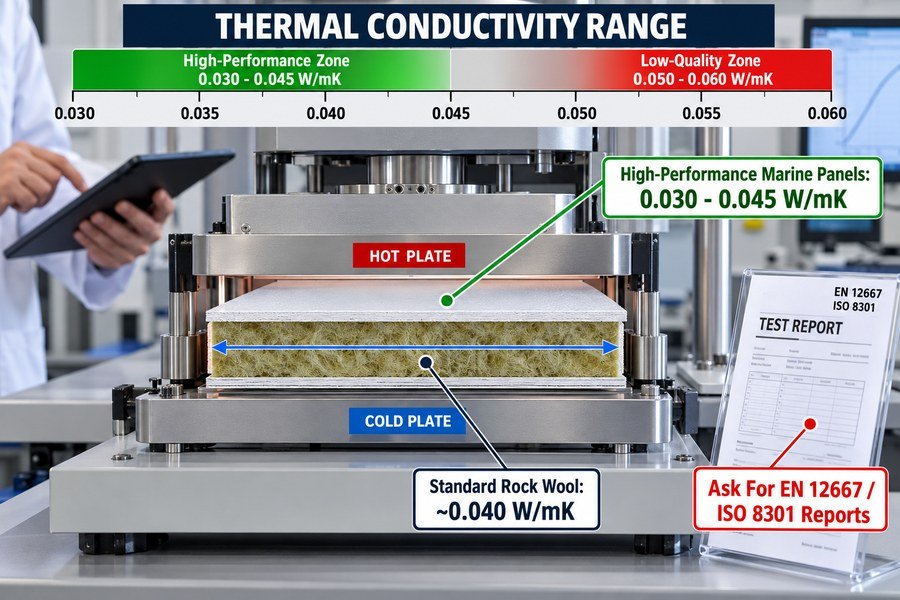
I see many salesmen quote vague insulation terms. You must ask for the exact lambda value. A laboratory tests this value. The scientific unit is Watts per meter-Kelvin (W/mK). A lower number is always better. Let us look closely at standard mineral wool and advanced composites to see the difference.
Standard Mineral Wool Core Thermal Conductivity Values
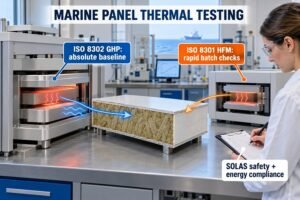
Most marine accommodation panels use mineral wool cores. This category includes rock wool and glass wool. A standard, good-quality rock wool panel has a lambda value around 0.040 W/mK to 0.045 W/mK at room temperature (20°C)5. This is the baseline performance for the marine industry. You will find this value printed on the manufacturer's Technical Data Sheet (TDS). This range is perfectly acceptable for normal cargo ships or standard ferry cabins. If a supplier offers a rock wool panel with a lambda of 0.055 W/mK, the quality is poor. You should not buy it. The fibers might be too loose or the density might be wrong. I always ask factories for the EN 12667 or ISO 8301 test reports to prove their numbers.
Advanced Composite Cores and Their Lambda Ratings
High-specification vessels need much better performance. Luxury cruise ships and offshore oil rig living quarters use advanced panels. These panels might use high-density micro-glass wool or special composite materials. The lambda values for these high-performance panels range from 0.030 W/mK to 0.035 W/mK. This is a big improvement. The thermal conductivity is up to 25% lower than standard rock wool. These panels cost more money up front. A standard panel might cost $25 per square meter, while an advanced panel costs $35. But they offer superior insulation in thinner profiles. I always check the laboratory test reports to verify these advanced numbers. You must ensure the core stays dry. If water gets inside any panel, the lambda value increases dramatically and ruins the insulation.6
| Marine Core Material | Typical Lambda Range (W/mK) | Application Suitability | Cost Category |
|---|---|---|---|
| Low-Quality Rock Wool | 0.050 - 0.060 | Not recommended | Very Low |
| Standard Rock Wool | 0.040 - 0.045 | Cargo ships, basic ferries | Medium |
| Advanced Composites | 0.030 - 0.035 | Cruise ships, offshore rigs | High |
How Do Low Lambda Marine Lining Panels Cut Cabin HVAC Energy Loss?
Ship HVAC systems burn massive amounts of expensive diesel fuel. Poor wall insulation leaks chilled air continuously. Low lambda panels stop this expensive energy drain.
Low lambda marine lining panels cut cabin HVAC energy loss by maintaining a strict thermal barrier. This prevents chilled air from escaping, blocks external ambient heat, and reduces the AC compressor's workload by up to 20%, saving hundreds of liters of marine diesel monthly.
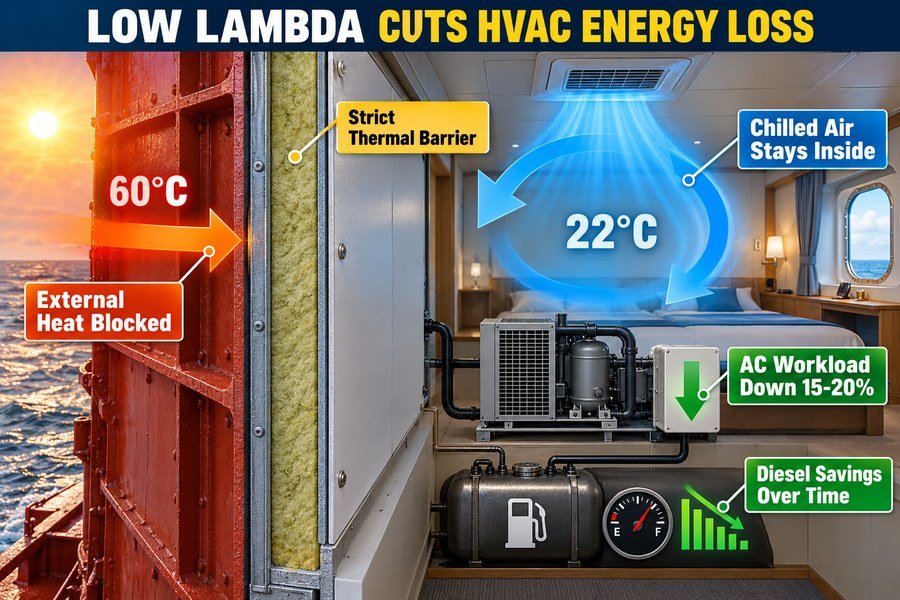
Electricity on a ship comes from burning fuel in generators. The HVAC system uses a massive amount of this electricity. If the cabin loses its cooling, the HVAC must work much harder. I will explain the thermal barrier concept and the compressor workload reduction.
Maintaining the Cabin Thermal Barrier During Summer Trips
A marine lining panel creates a thermal barrier. The outside steel deck gets very hot in the summer sun. It can easily reach 60°C. The inside cabin needs to be a comfortable 22°C. A low lambda panel stops the outside heat from pushing inside. It also stops the inside chilled air from leaking out to the hot steel. We call this a strong thermal envelope. If you use a panel with a high lambda value, the heat crosses the wall easily. The cabin temperature rises quickly. The thermal barrier is weak. Low lambda panels keep the boundary strong. The cold air stays exactly where you want it. This improves the Energy Efficiency Design Index (EEDI) of the entire ship.
Reducing HVAC Compressor Workload and Diesel Consumption
The HVAC compressor is the biggest energy user in the cooling system. It turns on when the cabin gets too warm. With poor panels, the heat enters quickly. The compressor turns on very often and runs for a long time. With low lambda marine lining panels, the cabin stays cool much longer. The compressor works less. According to energy audits on passenger ferries, upgrading to low lambda panels can reduce the HVAC cooling load by 15% to 20%.7 A large marine generator burns about 200 to 250 grams of diesel fuel to make 1 kWh of electricity. By saving 20% on cooling energy, you directly save diesel fuel. A medium-sized ferry can save 500 to 800 liters of diesel per month just by using better wall panels. This saves a lot of money for the ship owner over the 25-year lifetime of the vessel.
| Panel Insulation Quality | Cabin Heat Gain | HVAC Compressor Run Time | Estimated Fuel Savings |
|---|---|---|---|
| Poor (High Lambda) | Fast | Continuous | None |
| Standard (Medium Lambda) | Moderate | Frequent | Baseline |
| Excellent (Low Lambda) | Very Slow | Intermittent | Up to 20% |
Why Doesn't Low Thermal Conductivity Guarantee SOLAS Compliance For Marine Bulkhead Panels?
Good insulation does not mean fire safety. Buying a low-lambda panel could still fail a marine inspection. SOLAS cares about fire containment, not just heat.
Low thermal conductivity doesn't guarantee SOLAS compliance because SOLAS A-Class and B-Class ratings mandate three strict criteria: structural integrity during a fire, non-combustibility of materials, and preventing temperature rise on the unexposed side, which ordinary low-lambda thermal insulators like polyurethane foam completely fail.
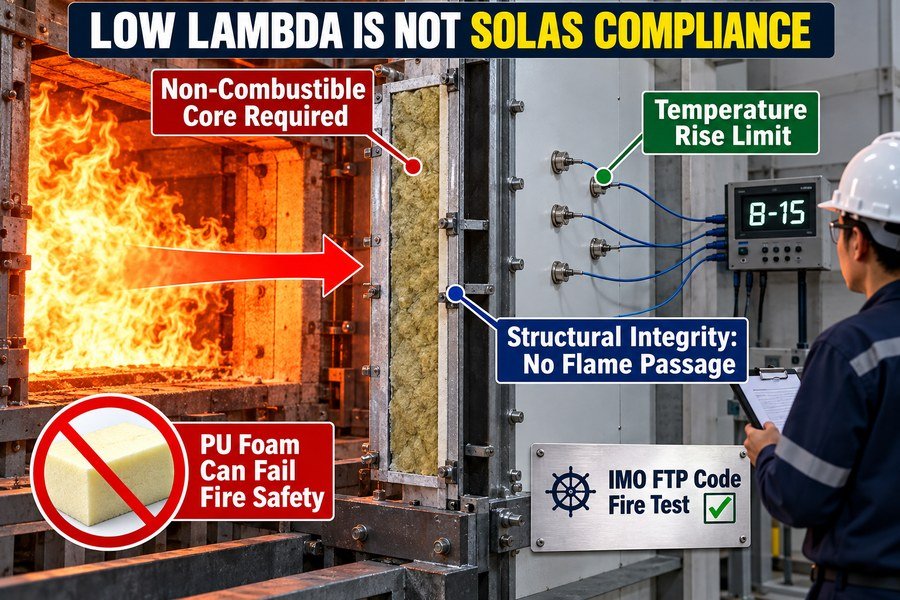
I often see buyers make a big mistake. They buy panels with great thermal insulation. But the panels fail the safety fire test. The International Convention for the Safety of Life at Sea (SOLAS) sets the strict rules. A low lambda value is not enough. The panel must meet three specific criteria during a real fire. Let us look at non-combustibility, structural integrity, and temperature rise.
SOLAS Requirements for Non-Combustibility in Marine Panels
The first criteria is non-combustibility. Polyurethane (PU) foam has an amazing low lambda value of 0.022 W/mK8. It is great for regular buildings on land. But you cannot use standard PU foam9 for SOLAS A-Class or B-Class marine bulkheads. When fire hits PU foam, it burns very quickly. It also releases deadly toxic smoke. SOLAS requires the core material to be non-combustible. It must pass the fire test defined in the IMO 2010 FTP Code, Part 1. Marine rock wool is completely non-combustible. It does not burn at all. This is why we use rock wool in ships, even if its lambda value is slightly higher than land-based foam. Fire safety always comes first.
Structural Integrity and Temperature Rise Under Fire Testing
The second and third criteria happen during the actual fire test in a laboratory furnace. We test B-15 marine panels and fire doors using the IMO FTP Code Part 3 heating curve. The panel must keep its structural integrity. It cannot collapse or let flames pass through the joints for 30 minutes during a B-Class test. It must block the actual fire. The final criteria is temperature rise. The side of the panel away from the fire is the unexposed side. The temperature on this safe side cannot rise more than 140°C on average above the original room temperature for 15 minutes10 (for a B-15 rating). A low lambda value helps with this specific temperature rise requirement. But if the panel burns up or collapses mechanically, the lambda value does not matter at all. The inspector will fail the panel immediately.
| SOLAS Fire Test Criteria | Goal of the Test | IMO 2010 FTP Code Reference | Does Low Lambda Help? |
|---|---|---|---|
| Non-Combustibility | Prevent material from burning and smoking | Part 1 | No |
| Structural Integrity | Stop flames from breaking through the wall | Part 3 | No |
| Temperature Rise | Keep the safe side cool enough to touch | Part 3 | Yes (Slows heat transfer) |
Conclusion
Low thermal conductivity directly optimizes cabin temperature, increases passenger headroom, and significantly cuts HVAC diesel costs. You must always balance these powerful thermal benefits with strict SOLAS fire safety certifications for legal compliance.
-
"Interpolation Correlations for Fluid Properties of Humid Air ...", https://srd.nist.gov/jpcrdreprint/1.555998.pdf. A standards or reference-data source gives dry air a thermal conductivity close to 0.024 W/m·K near room temperature, supporting the numerical basis for treating still air as a low-conductivity insulating medium. Evidence role: statistic; source type: institution. Supports: Air has a thermal conductivity of about 0.024 W/mK at 20°C. ↩
-
"Guide to Home Insulation", https://www.energy.gov/sites/prod/files/guide_to_home_insulation.pdf. An energy-efficiency or building-science source should define R-value as a measure of resistance to heat flow and explain that higher values indicate greater resistance to conductive heat transfer. Evidence role: definition; source type: government. Supports: A higher R-value indicates better resistance to heat transfer and therefore better insulation performance. Scope note: This supports the general insulation principle; actual marine-cabin performance also depends on installation quality, air gaps, moisture, and thermal bridging. ↩
-
"April 28, 2014 Via Regulations.gov Ms. Brenda Edwards ...", https://www.energy.gov/sites/prod/files/2014/04/f15/Bally%20Comments%20on%20Supplemental%20Notice%20of%20Proposed%20Rulemaking.pdf. A heat-transfer reference or standards source should state that thermal resistance for a homogeneous plane layer is calculated as thickness divided by thermal conductivity, usually expressed in m²K/W. Evidence role: definition; source type: education. Supports: The R-value of a panel layer is calculated by dividing its thickness by its lambda value, or thermal conductivity. ↩
-
"How Does Accommodation Panel Thickness Fit Ship Interior ...", https://magellanmarinetech.com/how-accommodation-panel-thickness-fit-ship-interior-constraints/. A maritime accommodation standard or guidance document can provide context by specifying minimum or recommended headroom in ship accommodation spaces, showing why small reductions in ceiling buildup can matter in cabin design. Evidence role: historical_context; source type: institution. Supports: Marine cabin headroom is a practical design constraint, and insufficient ceiling height can be a real compliance or comfort issue. Scope note: Such standards establish regulatory or ergonomic context for headroom but do not verify the specific river-cruise project described in the article. ↩
-
"Determination of Thermal Properties of Mineral Wool ... - PMC", https://pmc.ncbi.nlm.nih.gov/articles/PMC10488771/. Published material-property data for mineral wool or rock wool insulation can document that typical room-temperature thermal conductivity values are commonly in the approximate 0.04 W/m·K range. Evidence role: statistic; source type: research. Supports: Standard good-quality rock wool panels commonly have lambda values around 0.040–0.045 W/mK at 20°C. Scope note: The exact value varies with product density, fibre structure, temperature, binder content, and test method, so the source supports the range as typical rather than universal. ↩
-
"Research on Thermal Insulation Performance and Impact on ...", https://pmc.ncbi.nlm.nih.gov/articles/PMC10419949/. Experimental studies on building or mineral-fibre insulation show that moisture content increases effective thermal conductivity because water conducts heat more readily than air within insulation pores. Evidence role: mechanism; source type: paper. Supports: Moisture ingress increases lambda and degrades insulation performance. Scope note: The magnitude of the increase depends on moisture level, material type, drainage, temperature, and whether the panel can dry; the evidence supports the mechanism rather than every marine panel configuration. ↩
-
"Thermo-economic Design and Optimization of Cooling ...", https://docs.lib.purdue.edu/cgi/viewcontent.cgi?article=3407&context=iracc. A passenger-vessel energy audit or peer-reviewed simulation reporting HVAC-load reductions after improved accommodation insulation would support the stated 15–20% range, while remaining vessel- and climate-specific rather than a universal result. Evidence role: statistic; source type: paper. Supports: Upgrading to low-lambda marine lining panels can reduce HVAC cooling load by 15% to 20% on passenger ferries. Scope note: Savings depend on baseline insulation, climate zone, occupancy, ventilation rate, glazing, HVAC controls, and operating schedule. ↩
-
"Polyurethane Foams for Thermal Insulation Uses Produced ...", https://pmc.ncbi.nlm.nih.gov/articles/PMC6152006/. Published insulation references commonly report rigid polyurethane foam thermal conductivity in the approximate range of 0.02–0.03 W/m·K, supporting the stated order of magnitude for PU foam insulation performance. Evidence role: statistic; source type: education. Supports: Polyurethane foam can have a low thermal conductivity around 0.022 W/mK. Scope note: The exact lambda value varies by formulation, density, blowing agent, aging condition, and test standard, so 0.022 W/m·K should be treated as a representative value rather than a universal constant. ↩
-
"What Is the IMO FTP Code for Marine Interior Materials?", https://magellanmarinetech.com/what-imo-ftp-code-for-marine-interior-materials/. The IMO fire-test framework and SOLAS fire-protection rules distinguish required non-combustible materials and approved fire-rated divisions from ordinary combustible insulation materials, providing regulatory context for why standard PU foam is generally unsuitable for SOLAS A- or B-class divisions unless specifically approved as part of a tested assembly. Evidence role: definition; source type: institution. Supports: Standard PU foam cannot be used as the core material for SOLAS A-Class or B-Class marine bulkheads unless the relevant assembly satisfies the applicable fire-test requirements. Scope note: The source would support the regulatory requirement and classification context, but it may not address every proprietary PU formulation or certified composite panel system. ↩
-
"Are Marine Fire Divisions the Same as Marine Panel Ratings?", https://magellanmarinetech.com/are-marine-fire-divisions-same-as-marine-panel-ratings/. The IMO FTP Code/SOLAS criteria for B-class divisions specify insulation-performance limits based on temperature rise on the unexposed face, including an average rise limit of 140°C for the rated period, which supports the B-15 temperature-rise statement. Evidence role: definition; source type: institution. Supports: For a B-15 rating, the unexposed side average temperature rise must remain within the specified 140°C limit for 15 minutes. Scope note: The complete criterion also includes additional details such as maximum temperature rise at individual points and test-assembly conditions; citing only the average-rise limit gives partial support. ↩