
Shipyard complaints about noisy cabins hurt your profits. When crew cannot sleep, the shipyard blames your materials. Do you know how noise actually gets through your ceiling panels?
Noise reaches marine cabins through three complete transmission paths: structure-borne vibration from the steel deck above, structure-borne vibration traveling down rigid suspension hangers, and airborne noise leaking through panel edge gaps and HVAC penetrations. Blocking all three paths requires resilient hangers, heavy-mass panels, and airtight acoustic sealing.
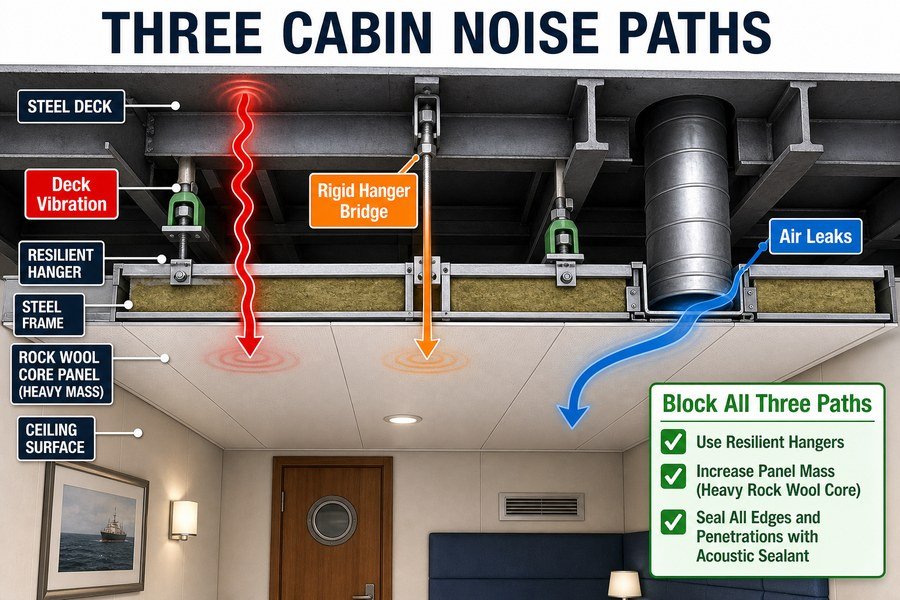
Understanding these three specific paths is the only way to stop noise and pass the inspection. If you ignore even one path, the shipyard will fail their acoustic tests, and they will delay your final payment. Let us look at each path in detail.
How Does Machinery Vibration Reach Cabins Through the Deck Above Marine Ceiling Panels?
Engine vibration shakes the whole ship. If you use cheap ceiling materials, that vibration drops straight into the cabin. How does the steel deck transmit this noise?
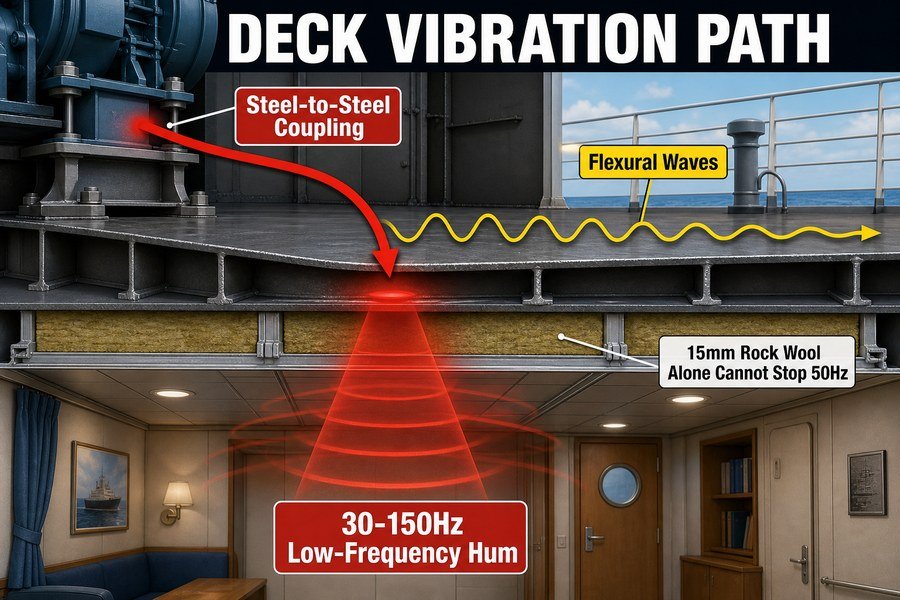
Machinery vibration reaches cabins through the steel deck via three physical mechanisms: direct steel-to-steel acoustic coupling from engine mounts, flexural wave propagation along the deck plating, and low-frequency resonance where the deck acts like a speaker, radiating noise down into the cabin space below at 30Hz to 150Hz.
When I worked in the marine outfitting factory, I saw many buyers purchase very thick ceiling panels but still fail the noise test. They failed because they did not understand how vibration moves through the ship structure before it even touches the ceiling.
Understanding Direct Steel-to-Steel Acoustic Coupling
The first mechanism is direct steel-to-steel coupling. The main diesel engines and generators sit on steel mounts. When these machines run, they push physical energy directly into the steel hull. Sound travels through air at 343 meters per second. But vibration travels through solid ship steel at 5,000 meters per second1. This means the engine noise hits the cabin deck almost instantly. The deck steel does not absorb this energy. It passes it along perfectly. According to standard acoustic physics, solid steel has almost zero internal damping2. The vibration just keeps moving.
How Flexural Waves and Low-Frequency Resonance Radiate Sound
The second mechanism is flexural wave propagation. As the vibration moves along the deck plating, it creates bending waves. Think of a wave moving across a swimming pool. The steel deck physically bends up and down by tiny fractions of a millimeter.
The third mechanism is low-frequency resonance. As the deck bends, it acts exactly like a large stereo speaker3. It pushes the air below it, creating airborne noise inside the cabin. Based on the ISO 6954 standards for ship vibration, this resonance usually happens at low frequencies between 30Hz and 150Hz. This low hum is very hard to block. Standard 15mm thick rockwool ceiling panels cannot stop 50Hz noise4. You need special panel structures to fight these three mechanisms.
| Vibration Transmission Mechanism | Frequency Range | Physical Action on Deck | Acoustic Result in Cabin |
|---|---|---|---|
| Direct Steel Coupling | 10Hz to 5000Hz | Vibration travels at 5,000 m/s in steel | Energy reaches cabin deck instantly |
| Flexural Waves | 20Hz to 1000Hz | Steel plating bends and flexes | Moves energy across long distances |
| Low-Frequency Resonance | 30Hz to 150Hz | Deck acts like a large speaker diaphragm | Creates a deep hum that penetrates panels |
Why Do Rigid Suspension Hangers Transmit Structure-Borne Vibration Through Marine Ceiling Panels?
Your workers use standard metal hangers to save time. But the shipyard acoustic tests fail. Why do these simple metal parts ruin your cabin noise reduction?
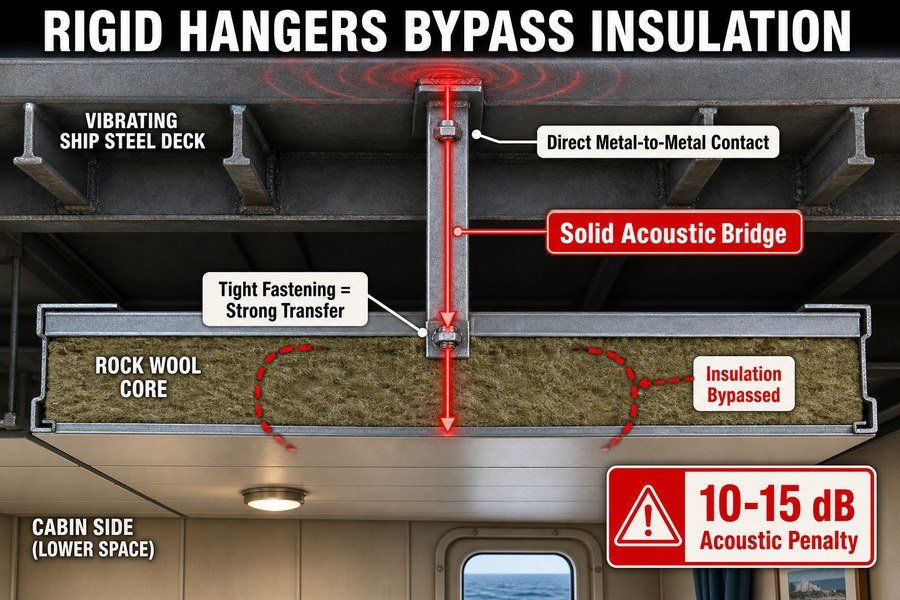
Rigid suspension hangers transmit structure-borne vibration because they act as direct solid acoustic bridges. They bypass the ceiling panel's insulation, completely transferring deck vibrations via direct metal-to-metal contact, mechanical fastening points, and lack of damping material, resulting in a 10 dB to 15 dB acoustic penalty.
A ceiling panel is only as good as its mounting system. You can buy the most expensive acoustic panel in the world. But if you hang it with a simple piece of galvanized steel, you waste your money.
The Danger of Direct Metal-to-Metal Acoustic Bridges
The first reason rigid hangers fail is direct metal-to-metal contact5. A rigid hanger creates a solid bridge from the vibrating steel deck directly to the ceiling panel frame. Because there is no break in the metal, 100% of the vibration energy travels straight down the hanger. The acoustic insulation inside the panel never gets a chance to block the noise because the vibration enters the panel's metal skin directly.
Impact of Mechanical Fastenings and Lack of Damping
The second reason is the mechanical fastening points. Installers use steel screws or welding to fix the hangers to the deck and the panel. A tight screw creates high pressure between the two metal parts. This high pressure makes the sound transfer even stronger.
The third reason is the complete lack of damping material. Without rubber or silicone to absorb the energy, nothing slows down the vibration. Based on laboratory tests following ISO 717-1 standards, using rigid steel hangers instead of resilient hangers creates a massive 10 decibel (dB) to 15 decibel (dB) acoustic penalty6. For a procurement officer, a 15 dB drop means the difference between a passed project and a rejected project.
| Hanger Feature | Effect on Vibration | Acoustic Penalty (ISO 717-1) | Project Impact |
|---|---|---|---|
| Direct Metal Contact | Creates solid path bypassing insulation | Severe loss | Fails standard cabin noise limits |
| Tight Screws/Welds | Increases pressure, improving sound transfer | High loss | Makes vibration transfer more efficient |
| No Damping Material | Zero energy absorption | 10 dB to 15 dB loss | Causes shipyard to reject the installation |
How Does Airborne Noise Leak Around Marine Ceiling Panel Edges and HVAC Penetrations?
You bought expensive heavy panels, but you still hear people talking outside. Air gaps kill acoustic privacy. How exactly does airborne noise leak through your ceiling?
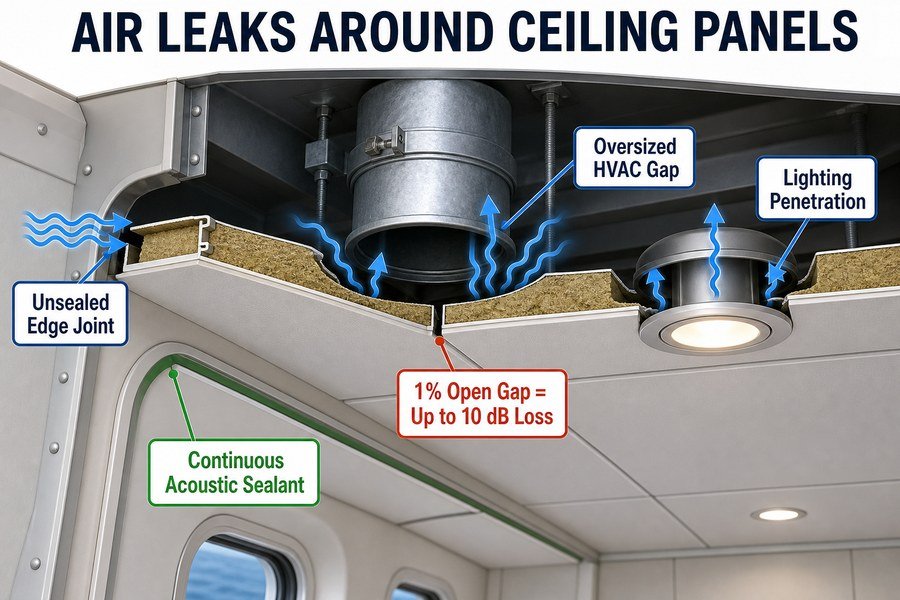
Airborne noise leaks through marine ceilings via three main gaps: unsealed perimeter edge joints where panels meet bulkheads, oversized cutouts for HVAC ducts, and unsealed lighting fixture penetrations. Even a 1% open gap in the ceiling surface can reduce the total acoustic insulation performance by up to 10 dB.
I always tell my clients that acoustic panels behave like water buckets. If a bucket has a tiny hole, it cannot hold water. If a ceiling has a tiny gap, it cannot block noise.
Acoustic Leaks from Perimeter Edge Joints
The first major leak point is unsealed perimeter edge joints. When workers install ceiling panels, they leave small gaps where the ceiling meets the wall bulkhead. Sometimes this gap is only 5mm wide. But sound is like water; it finds the easiest path. According to the standard acoustic Mass Law, if just 1% of the total ceiling area is open air, a 40 dB rated ceiling panel will drop down to 30 dB performance7. A 5mm gap around a 2.4-meter panel is enough to ruin your acoustic rating.
Noise Flanking Through HVAC and Lighting Penetrations
The second leak point comes from oversized HVAC cutouts. Air conditioning ducts must pass through the ceiling. Installers often cut the hole 10mm or 15mm larger than the duct to make installation easy. If they do not fill this gap with fire-rated acoustic sealant, engine noise and voices will travel right through it8.
The third leak point is lighting fixture penetrations. Recessed downlights look great in a ship cabin. But cutting a hole for a light removes the heavy metal skin and the rockwool core of the panel. You are basically putting a thin plastic light cover in place of a 25mm thick acoustic panel. This lets the noise drop right into the room.
| Leakage Path | Common Gap Size | Acoustic Performance Loss | Solution Required |
|---|---|---|---|
| Perimeter Edge Joints | 3mm to 8mm | Up to 10 dB loss (1% area rule) | Continuous acoustic sealant line |
| HVAC Duct Cutouts | 10mm to 20mm | 5 dB to 8 dB loss | Tight fit and heavy acoustic packing |
| Lighting Penetrations | 50mm to 150mm hole | 8 dB to 12 dB loss | Acoustic fire-rated box behind the light |
Which Resilient Suspension Details Interrupt Structure-Borne Noise in Marine Ceiling Panels?
You need a fast, cheap way to stop deck vibration. Standard hangers fail. Which specific suspension parts actually stop the noise before it reaches the panel?
Three resilient suspension details interrupt structure-borne noise: rubber-isolated hanger brackets, spring-loaded suspension clips, and neoprene vibration dampening pads at panel joints. These components isolate the ceiling mass from the steel deck, improving the sound reduction index (Rw) by 5 to 8 dB based on ISO 717-1.
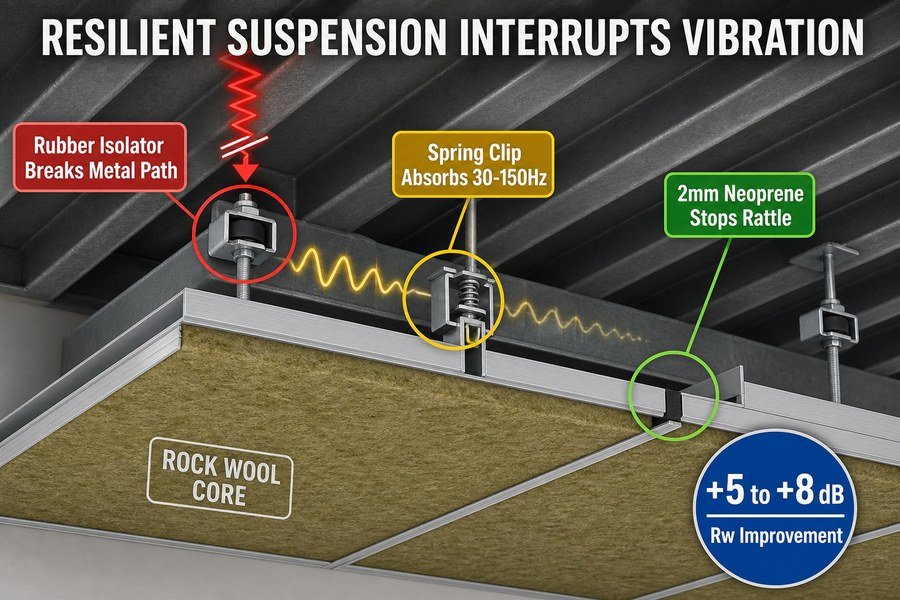
Buying the right suspension parts is the cheapest way to improve your cabin noise ratings. You do not need thicker panels; you just need smarter connections.
Using Rubber-Isolated Hanger Brackets and Spring Clips
The first detail is the rubber-isolated hanger bracket. This hanger has a steel top and a steel bottom, but they do not touch. A thick piece of rubber connects them in the middle. The rubber breaks the direct metal path. For marine use, you should check that the rubber has a hardness of 40 to 50 Shore A9. A standard rigid hanger costs about $0.50, while a rubber hanger costs $2.50 to $3.50. This $3.00 difference saves you from a $5,000 penalty from the shipyard.
The second detail is spring-loaded suspension clips. These are for areas with very strong low-frequency engine vibrations. A metal spring supports the weight of the panel. When installed, a good spring clip should deflect, or bend, by 2mm to 5mm under a 15kg panel load. This deflection eats the low-frequency energy that rubber cannot stop.10
Installing Neoprene Vibration Dampening Pads at Panel Joints
The third detail is the use of neoprene vibration dampening pads at the panel joints. When two metal ceiling panels lock together, they can rattle against each other when the ship engine runs. Placing a 2mm thick neoprene pad inside the joining profile stops this metal-to-metal rattle. By using these three specific parts, you completely isolate the ceiling mass. Tested under ISO 717-1, this isolation system improves your overall sound reduction index (Rw) by 5 to 8 dB11.
| Suspension Detail | Material Specification | Estimated Cost per Piece | Best Used For |
|---|---|---|---|
| Rubber-Isolated Bracket | 40-50 Shore A hardness rubber | $2.50 to $3.50 | Blocking mid-to-high frequency vibration |
| Spring-Loaded Clip | 2mm to 5mm load deflection | $4.00 to $6.00 | Blocking low-frequency engine thrum (30-150Hz) |
| Neoprene Joint Pads | 2mm thick neoprene strip | $0.20 per meter | Stopping panel-to-panel rattle at joints |
Why Does Sealing Air Gaps Fail Against Structure-Borne Noise in Marine Ceilings?
You taped every gap and used fire sealant on every edge. But the engine noise is still too loud. Why does sealing air gaps fail here?
Sealing air gaps fails against structure-borne noise because sealants only block airborne sound waves. Structure-borne vibration physically shakes the ceiling panels themselves, causing the solid panel surface to radiate secondary airborne noise into the cabin, completely bypassing the caulked joints, sealants, and edge tapes.
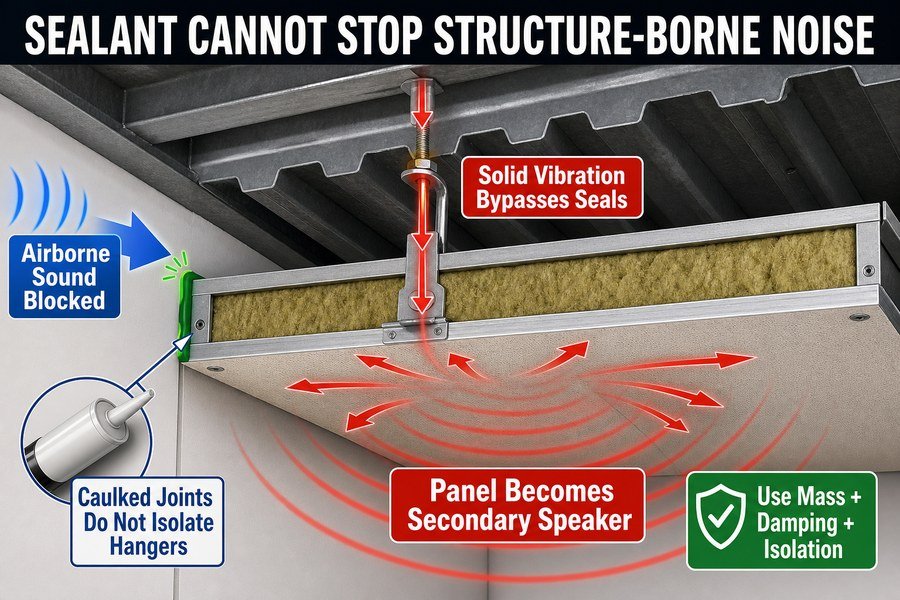
Many buyers think that a tube of silicone sealant will fix all acoustic problems. I see shipyards waste days caulking every tiny gap, only to fail the noise test again. You must understand the physics of the problem.
The Physics of Airborne Sound vs. Structure-Borne Vibration
The first reason sealants fail is the difference in physics. Sealants are designed to block airborne sound waves. Airborne sound travels through the air at 343 meters per second.12 When this air hits a heavy line of silicone caulk, it stops. But structure-borne vibration is different. It travels through the solid steel of the hanger and the metal frame at 5,000 meters per second.13 The vibration does not need an air gap to enter the room. It simply flows through the solid parts.14 You can put 100 tubes of sealant on a rigid steel hanger, and it will do absolutely nothing.
How Solid Ceiling Panels Radiate Secondary Airborne Noise
The second reason is panel radiation. When the structure-borne vibration comes down the rigid hanger, it shakes the steel skin of the ceiling panel. The entire 2.4-meter panel begins to vibrate. The ceiling panel itself turns into a speaker. This is called secondary airborne noise.15 The noise is now being created inside the room by the ceiling surface.
Because the noise comes from the flat face of the panel, it completely bypasses the sealed edges. To stop this, sealant is useless. You must add mass or damping to the panel itself. You need a core made of rockwool with a density of 100 kg/m3 to 120 kg/m3. You also need Constrained Layer Damping (CLD) steel sheets on the panel face to stop the metal from vibrating.
| Treatment Method | Works Against Airborne Noise? | Works Against Structure-Borne Noise? | Core Mechanism |
|---|---|---|---|
| Silicone Joint Sealant | Yes (Highly Effective) | No (Fails completely) | Plugs air paths to stop sound waves |
| Heavy Rockwool (120 kg/m3) | Yes | Yes (Partial benefit) | Adds mass to reduce panel vibration |
| Rubber Isolation Hangers | No | Yes (Highly Effective) | Breaks the solid vibration path |
Conclusion
Blocking cabin noise requires a complete approach. You must use resilient hangers for structure-borne vibration and seal every gap against airborne noise. Do both to protect your project profits.
-
"Speed of Sound", http://hyperphysics.phy-astr.gsu.edu/hbase/Sound/souspe2.html. Reference data for acoustic wave speeds in solids supports that longitudinal waves in steel travel on the order of 5,000–6,000 m/s, much faster than airborne sound at room temperature. Evidence role: statistic; source type: education. Supports: Vibration or acoustic waves in steel can propagate at roughly 5,000 m/s, far faster than sound in air.. Scope note: The exact velocity depends on steel grade, temperature, and whether the wave is longitudinal, shear, or flexural; 5,000 m/s should be treated as an approximate value. ↩
-
"Viscoelastic Materials - Rod Lakes", https://lakeslab.ep.wisc.edu/VE.html. Materials-acoustics references report that metals such as steel have low internal damping or low loss factors compared with viscoelastic materials, supporting the claim that steel efficiently transmits vibrational energy. Evidence role: mechanism; source type: paper. Supports: Solid steel has very low internal damping relative to common damping materials, so vibration can propagate efficiently through it.. Scope note: The source would support low damping, not literally zero damping; real steel structures lose energy through joints, coatings, boundaries, and attached materials. ↩
-
"Low Noise Structure Design and Experimental Verification of ...", https://pmc.ncbi.nlm.nih.gov/articles/PMC12526233/. Structural-acoustics literature explains that vibrating plates radiate airborne sound by moving adjacent air, which supports the speaker-diaphragm analogy for a vibrating ship deck. Evidence role: mechanism; source type: paper. Supports: A vibrating deck plate can radiate airborne noise into a cabin by acting like a vibrating diaphragm.. Scope note: The analogy is contextual rather than exact; sound radiation from ship plating depends on modal behavior, boundary conditions, radiation efficiency, and frequency. ↩
-
"Providing an optimal porous absorbent pattern to reduce mid ...", https://pmc.ncbi.nlm.nih.gov/articles/PMC6277340/. Acoustics research on porous absorbers and partition transmission loss shows that thin mineral-wool layers are generally ineffective at very low frequencies such as 50 Hz unless incorporated into a heavier or resonant isolation assembly. Evidence role: expert_consensus; source type: research. Supports: A thin 15 mm rockwool ceiling layer by itself is unlikely to provide strong attenuation of 50 Hz noise.. Scope note: Performance depends on panel density, air cavity depth, mounting, facing layers, and the complete ceiling construction; evidence should not be read as a universal result for every 15 mm rockwool product. ↩
-
"Review of Modelling and Prediction Methods for Flanking ...", https://upcommons.upc.edu/bitstreams/61ecb1e5-2d31-4e5a-9331-36438f565f22/download. Acoustics literature on structure-borne sound describes rigid mechanical connections as transmission paths that can bypass insulating layers, supporting the claim that metal-to-metal hangers create an acoustic bridge. Evidence role: mechanism; source type: paper. Supports: Rigid metal-to-metal hangers can create a structure-borne sound bridge that bypasses the acoustic insulation in a ceiling panel.. Scope note: This would support the mechanism generally; it would not prove that all vibration energy is transmitted or quantify transfer for this specific ceiling assembly. ↩
-
"How Do Structural Connections Impact Marine Ceiling Panel ...", https://magellanmarinetech.com/how-structural-connections-impact-marine-ceiling-panel-acoustics/. Laboratory studies comparing rigid and resilient ceiling or mount systems under standardized sound insulation ratings report that resilient isolation can change measured performance by roughly 10–15 dB, supporting the magnitude of the stated penalty. Evidence role: statistic; source type: paper. Supports: Using rigid steel hangers instead of resilient hangers can cause an acoustic performance loss of about 10 dB to 15 dB in laboratory-rated ceiling assemblies.. Scope note: The exact decibel difference depends on the tested assembly, frequency range, installation details, and whether ISO 717-1 is used to derive the single-number rating. ↩
-
"Acoustics in Music: Outdoor, Indoor, and Isolated Spaces", https://online.berklee.edu/takenote/acoustics-in-music/. Composite sound-transmission calculations show that a small unsealed opening can dominate the effective transmission loss of an otherwise high-rated partition; for example, applying the standard area-weighted transmission coefficient method to a 40 dB element with 1% open area gives an overall loss of about 20 dB, so the article’s 30 dB figure should be checked against the intended assumptions. Evidence role: mechanism; source type: education. Supports: A small open-air gap can substantially reduce the effective acoustic performance of a high-rated ceiling panel.. Scope note: The calculation depends on the acoustic model and assumptions about the opening; it supports the importance of small leaks but may not directly confirm the exact 40 dB-to-30 dB value. ↩
-
"Noise Attenuation Guidelines", https://www.rileycountyks.gov/DocumentCenter/View/18114/Noise-Attenuation-Guidelines-pdf. Building-acoustics guidance identifies unsealed cracks and service penetrations as common weak paths for airborne sound transmission and recommends sealing them to preserve partition sound insulation. Evidence role: general_support; source type: government. Supports: Unsealed gaps around HVAC penetrations allow airborne sound such as machinery noise and speech to bypass the acoustic ceiling barrier.. Scope note: This supports the general mechanism for HVAC and service penetrations but does not quantify the noise loss for a specific ship-cabin ceiling assembly. ↩
-
"Development of elastomeric isolators to reduce roof bolting ...", https://pmc.ncbi.nlm.nih.gov/articles/PMC4642732/. Research on elastomer vibration isolators shows that Shore A hardness is commonly used to characterize rubber stiffness and that hardness affects dynamic stiffness and vibration transmissibility; this supports the relevance of specifying hardness for isolation design. Evidence role: mechanism; source type: paper. Supports: For marine use, rubber-isolated hanger brackets should use rubber with a hardness of 40 to 50 Shore A.. Scope note: This would contextualize the 40–50 Shore A range but would not prove it is a universal requirement for all marine ceiling hangers. ↩
-
"[PDF] Barry-isolators-selection-guide.pdf", https://wp.optics.arizona.edu/optomech/wp-content/uploads/sites/53/2016/08/Barry-isolators-selection-guide.pdf. Vibration-isolation theory relates an isolator’s static deflection to its natural frequency and explains why spring isolators are often used for lower-frequency excitation than stiffer elastomer mounts; this supports the mechanism described for spring-loaded clips. Evidence role: mechanism; source type: education. Supports: Spring-loaded clips with measurable deflection can reduce low-frequency vibration energy that rubber isolation may not sufficiently attenuate.. Scope note: The source would support the general mechanism, not necessarily the exact 2–5 mm deflection under a 15 kg panel load. ↩
-
"Sound insulation dataset of 30 wooden and 8 concrete floors ...", https://pmc.ncbi.nlm.nih.gov/articles/PMC10365936/. Laboratory acoustic measurements of resiliently suspended ceiling or lining systems, with ratings calculated under ISO 717-1, can substantiate reported changes in weighted sound reduction index for isolated assemblies. Evidence role: statistic; source type: paper. Supports: The described isolation system improves the weighted sound reduction index, Rw, by 5 to 8 dB when tested under ISO 717-1.. Scope note: A general study would show that resilient suspension can improve Rw, but the exact 5–8 dB range requires test data for a comparable hanger, clip, pad, and panel assembly. ↩
-
"Physics of the Sound Barrier", http://ffden-2.phys.uaf.edu/webproj/211_fall_2016/Andrew_Bray/Andrew_Bray/physics.html. A standard acoustics reference should support that the speed of sound in dry air is approximately 343 m/s near 20°C, providing the baseline used to contrast airborne and structure-borne transmission. Evidence role: definition; source type: education. Supports: Airborne sound travels through air at about 343 meters per second.. Scope note: The value varies with temperature, humidity, and air composition, so the citation supports an approximate standard-condition figure rather than a universal constant. ↩
-
"Speed of Sound", http://hyperphysics.phy-astr.gsu.edu/hbase/Sound/souspe2.html. A materials or acoustics source should support that longitudinal elastic waves in steel propagate on the order of 5,000–6,000 m/s, explaining why vibration can travel rapidly through rigid metal members. Evidence role: mechanism; source type: education. Supports: Structure-borne vibration can propagate through steel at roughly 5,000 meters per second.. Scope note: The exact speed depends on steel grade, geometry, boundary conditions, and wave mode; the source would contextualize the order of magnitude rather than verify every hanger/frame condition. ↩
-
"Structure-borne noise generation and transmission - NASA Technical ...", https://ntrs.nasa.gov/citations/19880032660. An architectural acoustics or building-noise source should support the distinction between airborne transmission through openings and structure-borne transmission through connected solid elements, clarifying why sealing gaps alone may not stop mechanically transmitted vibration. Evidence role: mechanism; source type: institution. Supports: Structure-borne noise can enter a room through solid structural connections without requiring an air gap.. Scope note: Such a source would support the general transmission mechanism, not prove the outcome for a specific shipyard assembly without measurements. ↩
-
"[PDF] A New Measurement Method for Separating Airborne and ...", https://ntrs.nasa.gov/api/citations/19830003568/downloads/19830003568.pdf. A vibroacoustics source should support that vibrating plates or panels can radiate sound into adjacent air, converting structure-borne excitation into airborne noise within a room. Evidence role: mechanism; source type: paper. Supports: A vibrating ceiling panel can radiate secondary airborne noise into the room.. Scope note: The source would substantiate the general panel-radiation mechanism; radiation efficiency and audibility depend on panel size, stiffness, damping, frequency, and mounting conditions. ↩