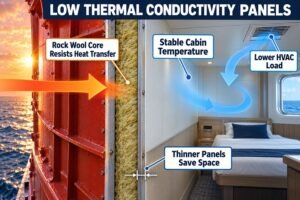
Ship noise keeps your crew awake. You buy expensive panels, but engine rumble still gets through. Let me explain why sound control behaves differently across different frequencies.
Marine accommodation panel acoustic performance varies by frequency because sound interacts differently with panel mass, stiffness, and thickness. Low frequencies bypass light walls, mid-frequencies follow the mass law, and high frequencies fail at the coincidence dip, requiring specific steel skins and rockwool densities to block the full noise spectrum.
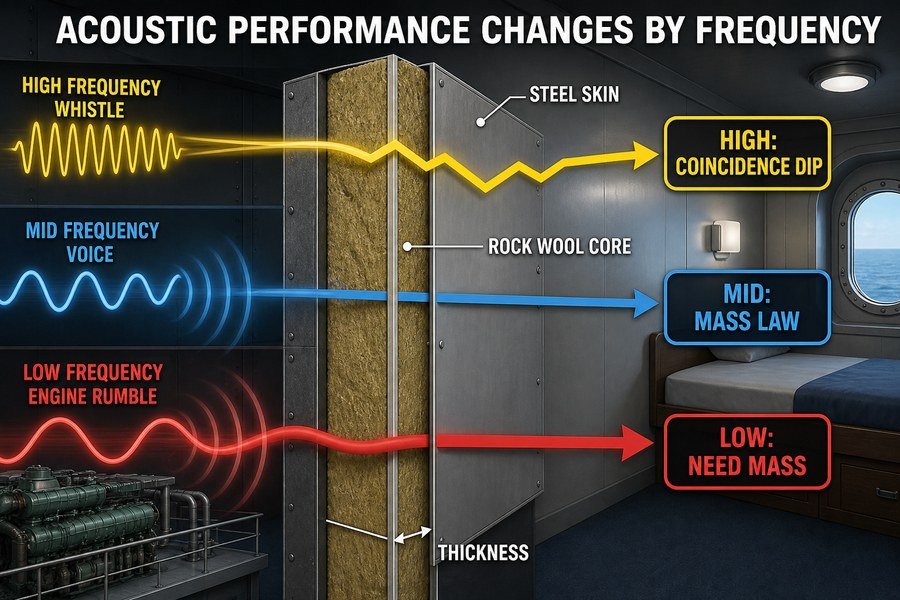
Acoustic control on ships is not a single number. You must match the panel's physical traits to the exact noise you want to block. I will break down exactly how this works below.
Why Does Marine Accommodation Panel STL Vary by Frequency?
You install a standard panel, but it only blocks voices, not machinery. This mismatch ruins cabin comfort. We must understand Sound Transmission Loss (STL) to fix this.
Marine accommodation panel STL varies by frequency across three distinct zones: the stiffness-controlled low-frequency region, the mass-controlled mid-frequency region, and the coincidence-controlled high-frequency region. Complete soundproofing requires heavy rockwool for lows, dense steel skins for mids, and constrained layer damping to manage high-frequency coincidence dips.
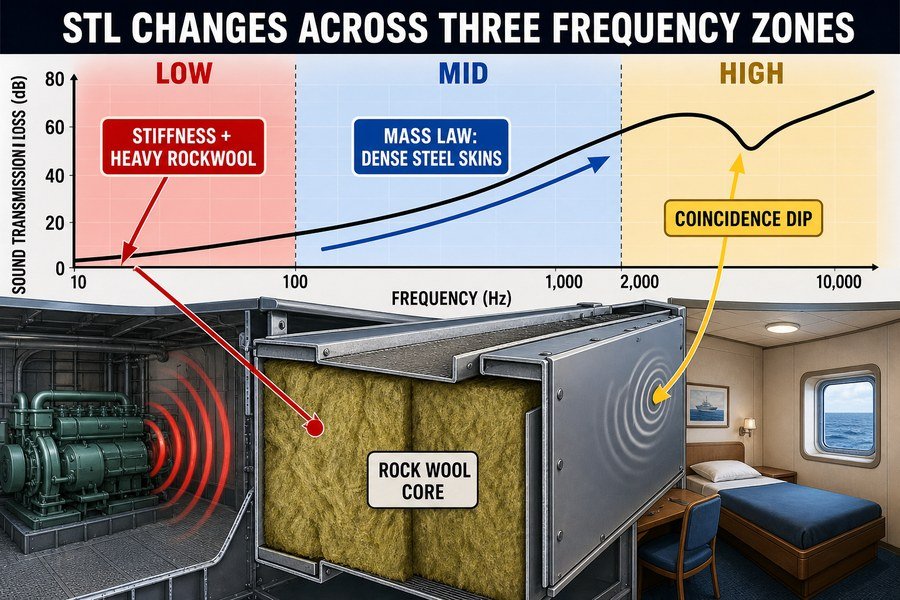
When clients ask me why their new cabins are still loud, I always look at the frequency zones. Sound Transmission Loss (STL) is not flat.1 It changes based on how the sound wave hits the wall. We must address three very specific zones to get true silence. Let me break down the items I mentioned above.
Managing the Stiffness-Controlled Low-Frequency Region
The first zone is the stiffness-controlled low-frequency region. This happens below 100 Hz. At these low pitches, the sound waves are very long. They push against the whole wall. To stop this, the panel needs structural stiffness, but it also desperately needs mass. When I worked in the marine outfitting factory, we solved low-frequency complaints by adding heavy rockwool. Standard panels use 100 kg/m³ rockwool. To beat low frequencies, you must upgrade to heavy rockwool with a density of at least 150 kg/m³2. This extra weight makes it much harder for the long sound waves to push the wall back and forth.
Controlling the Mass-Controlled Mid-Frequency Region
The second zone is the mass-controlled mid-frequency region. This covers 100 Hz to 2000 Hz. This range includes most human voices and normal ship operations. Here, STL follows a strict rule. You must use mass.3 We achieve this by using dense steel skins. A standard 0.4mm skin will let mid-frequency noise pass. You need 0.6mm or even 0.8mm dense galvanized steel skins to block this range. Every time we increase the steel thickness, the mid-frequency noise drops noticeably.
Fixing the Coincidence-Controlled High-Frequency Region
The third zone is the coincidence-controlled high-frequency region. This happens above 2000 Hz. Here, high-pitched whistling noises find a weak spot in the panel. The sound matches the natural vibration of the steel skin. We call this a coincidence dip4. Heavy rockwool and dense skins cannot fix this alone. You need constrained layer damping. This means adding a thin layer of special PVC or damping glue between the steel and the rockwool core. This damping layer absorbs the high-frequency vibration and turns it into heat.
Summary of Marine Panel STL Frequency Zones
| Frequency Zone | Pitch Range | Primary Acoustic Weakness | Required Panel Solution |
|---|---|---|---|
| Stiffness-Controlled | Under 100 Hz | Wall bending and flexing | Heavy rockwool (150 kg/m³) |
| Mass-Controlled | 100 Hz to 2000 Hz | Lack of surface weight | Dense steel skins (0.6mm+) |
| Coincidence-Controlled | Over 2000 Hz | Resonance and bending waves | Constrained layer damping |
What Causes the Acoustic Coincidence Dip in Marine Accommodation Panels?
High-pitched whistling noises penetrate your walls. Your panels have high sound ratings, but this specific noise ignores the mass. The acoustic coincidence dip is the hidden culprit.
The acoustic coincidence dip in marine accommodation panels occurs when the wavelength of airborne sound perfectly matches the natural bending wave speed of the panel skin. This resonance drastically reduces sound transmission loss, typically occurring between 2000 Hz and 4000 Hz depending on the skin material, thickness, and panel stiffness.
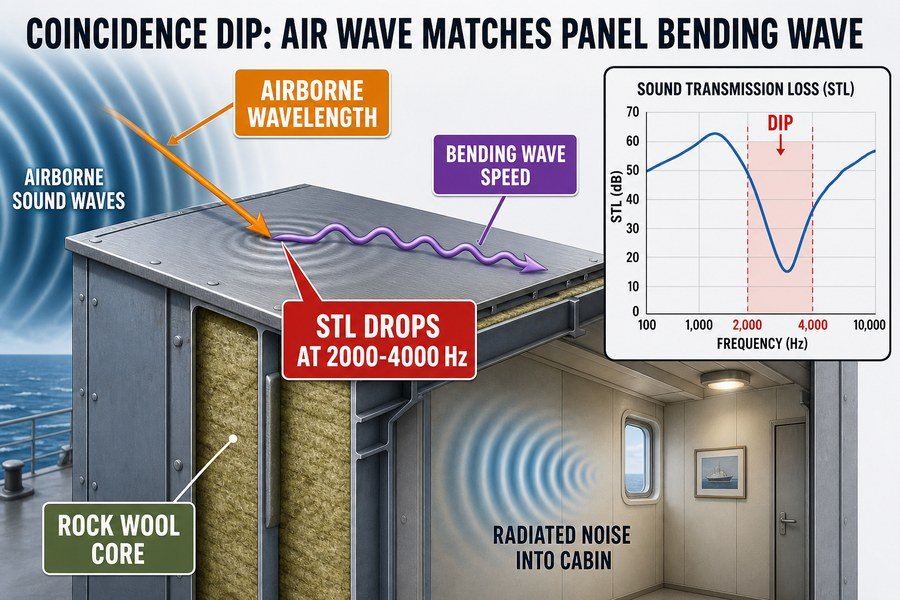
I have seen ship owners reject entire cabin setups because of high-pitched fan noise. The panels passed the weight test. They had good fire ratings. But they failed the acoustic test at one specific pitch. This failure is the acoustic coincidence dip. I will explain exactly how the physical traits of the panel cause this problem.
Matching Airborne Sound and Bending Wave Speeds
The acoustic coincidence dip is a physics problem. It occurs when the wavelength of airborne sound perfectly matches the natural bending wave speed of the panel skin.5 Imagine sound hitting the wall at an angle. The sound wave travels across the surface. At the same time, the steel skin has its own natural ripple, like a wave in a pool. This is the bending wave. When the speed of the airborne sound matches the speed of that bending wave, the wall stops fighting the noise. Instead, the wall vibrates with the noise and transfers it directly into the cabin. This resonance causes a huge drop in Sound Transmission Loss (STL).6
How Skin Material and Thickness Shift the Dip
We cannot stop the coincidence dip, but we can move it. The frequency where this drop occurs depends entirely on the skin material and thickness. The dip typically occurs between 2000 Hz and 4000 Hz for standard marine panels.7 If you change the skin material from steel to aluminum, the speed of the bending wave changes. Aluminum is lighter but very stiff, so the dip moves to a lower, more annoying frequency. Thickness also matters. A 0.6mm steel skin has a dip around 3500 Hz. If you increase the thickness to 1.2mm, the dip drops down to around 1800 Hz.
Managing Panel Stiffness to Stop Resonance
Finally, panel stiffness plays a big role. The glue you use between the skin and the rockwool core changes the total panel stiffness. A rigid glue makes the panel act like a thick block. This pushes the coincidence dip into the hearing range. A flexible glue allows the skin to move slightly independent of the core. This breaks the resonance and makes the dip less severe.8
Variables Controlling the Coincidence Dip
| Panel Variable | Condition A | Condition B | Effect on Coincidence Dip Frequency |
|---|---|---|---|
| Skin Material | Galvanized Steel | Marine Aluminum | Aluminum shifts dip to lower frequencies |
| Skin Thickness | 0.6mm thickness | 1.2mm thickness | Thicker skins shift dip to lower frequencies |
| Panel Stiffness | Rigid epoxy glue | Flexible PU glue | Flexible glue reduces the severity of the dip |
How Does Mass Affect Low-Frequency STL in Heavy Marine Wall Panels?
Main engine rumble shakes the crew beds. Standard 25mm walls fail completely here. You must add mass to stop low-frequency energy from destroying sleep quality on board.
Mass increases low-frequency STL in heavy marine wall panels according to the theoretical Mass Law, which dictates a 6 dB acoustic improvement for every doubling of panel weight. To block 50 Hz to 100 Hz engine noise, panels must combine thick 0.8mm steel plates with high-density 150 kg/m³ rockwool.
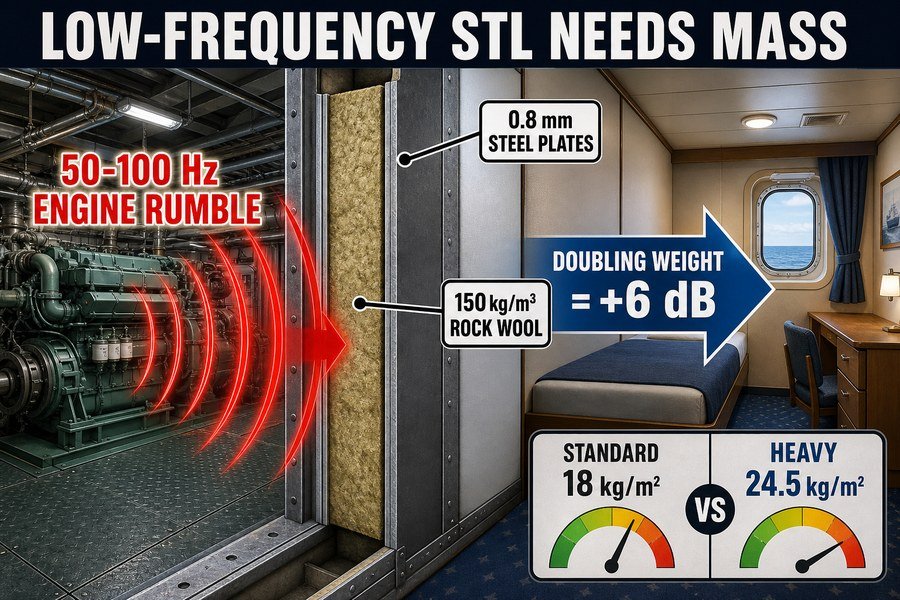
When a client tells me their ship has engine rumble problems, I know standard panels will not work. Low-frequency sound waves have massive energy. They ignore light materials. You cannot trick low frequencies with fancy shapes or thin damping layers. You must use heavy, dense materials. Let us look at the exact rules and materials needed to stop this noise.
Applying the Theoretical Mass Law to Marine Walls
In acoustic engineering, we follow a strict rule called the theoretical Mass Law9. This law states that mass increases low-frequency STL in heavy marine wall panels in a very predictable way. The rule dictates a 6 dB acoustic improvement for every doubling of panel weight10. For example, if a 15 kg/m² panel gives you 20 dB of noise reduction at a low pitch, upgrading to a 30 kg/m² panel will give you roughly 26 dB. You get another 6 dB if you jump to 60 kg/m². This is why heavy walls are mandatory near engine casings.
Targeting 50 Hz to 100 Hz Engine Noise
We add this mass specifically to block 50 Hz to 100 Hz engine noise11. Main diesel engines and large generators produce huge sound waves in this band. These sound waves travel through the steel decks and into the cabin air12. A standard 50mm cabin wall only weighs about 18 kg/m². That is simply not enough mass to stop a 50 Hz wave. The wave pushes right through the thin wall.
Combining Thick Steel Plates and High-Density Rockwool
To get the weight we need, we must upgrade the raw materials. We must combine thick 0.8mm steel plates with high-density 150 kg/m³ rockwool. A normal cabin wall uses 0.6mm steel and 100 kg/m³ rockwool. By pushing the steel to 0.8mm on both sides and packing the core with 150 kg/m³ rockwool, we increase the total panel weight by over 30%. This jump in mass activates the 6 dB improvement rule. The heavy steel plates reflect the low pitches, and the dense rockwool traps the remaining energy.
Mass Law Effects on Marine Panels at 100 Hz
| Panel Configuration | Skin Thickness | Rockwool Density | Total Weight (approx.) | Expected STL at 100 Hz |
|---|---|---|---|---|
| Standard Panel | 0.6mm / 0.6mm | 100 kg/m³ | 18.0 kg/m² | ~ 15 dB |
| Heavy Panel | 0.8mm / 0.8mm | 150 kg/m³ | 24.5 kg/m² | ~ 21 dB |
| Extreme Heavy Panel | 1.0mm / 1.0mm | 150 kg/m³ + 2mm steel core | 45.0 kg/m² | ~ 27 dB |
Why Might High-Rw Marine Accommodation Panels Leak Low-Frequency Noise?
You buy a panel rated Rw 45 dB, but the cabin still sounds like a machine room. The Rw rating system actively ignores the most annoying engine noises.
High-Rw marine accommodation panels leak low-frequency noise because the ISO 717-1 Weighted Sound Reduction Index calculates average performance only between 100 Hz and 3150 Hz. This formula heavily prioritizes human speech frequencies, completely ignoring structural engine rumble and propeller vibrations occurring at 31 Hz to 63 Hz.
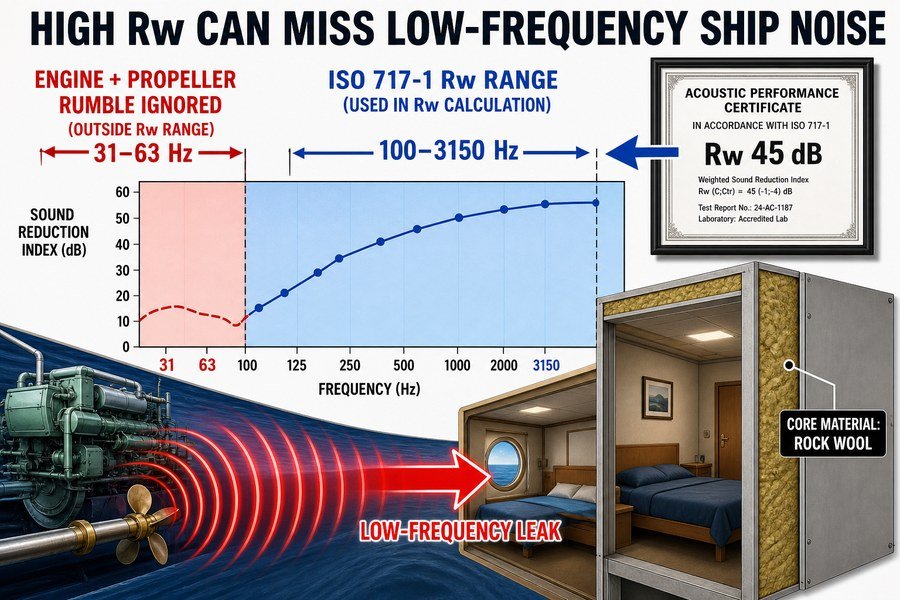
I see this mistake all the time. A shipyard buys a very expensive wall panel because the certificate says "Rw 45 dB". They install it. Then, the crew complains about engine noise. The shipyard gets angry at the supplier. But the panel is not broken. The rating system itself is the problem. I will explain why this happens.
The Blind Spots of the ISO 717-1 Standard
High-Rw marine accommodation panels leak low-frequency noise because of how we test them. The Rw value comes from the ISO 717-1 Weighted Sound Reduction Index. This standard is widely used in construction and shipbuilding. However, it only calculates average performance between 100 Hz and 3150 Hz. The testing lab literally stops measuring anything below 100 Hz. If a panel blocks zero noise at 80 Hz, it can still get a very high Rw score. The test simply does not care about deep bass noises.
The Bias Toward Human Speech Frequencies
Why does the test ignore low pitches? Because the ISO 717-1 formula heavily prioritizes human speech frequencies. The standard was originally made for apartment buildings and offices. In an office, you want to stop people from hearing each other talk. Human speech sits mostly between 500 Hz and 2000 Hz. The Rw curve looks at these mid-frequencies very closely. A marine panel with good mid-frequency blocking will score a fantastic Rw number, even if its low-frequency performance is terrible.
The Danger of Ignoring Propeller Vibrations
This creates a huge blind spot for ships. The Rw system completely ignores structural engine rumble and propeller vibrations. These massive ship noises occur at 31 Hz to 63 Hz13. A large propeller beating against the water sends huge 50 Hz shockwaves through the hull. If you only look at the Rw rating on a panel certificate, you are buying a product tested for office voices, not for 63 Hz propeller vibrations. You must ask the factory for the full frequency test report, not just the single Rw number.
ISO 717-1 Rw Rating Limitations
| Frequency Band | Noise Source | Does ISO 717-1 Rw Include This? | Real-World Impact on Ship |
|---|---|---|---|
| 31 Hz to 63 Hz | Propeller wash, heavy generators | No. Completely Ignored. | Major cabin vibration and rumble |
| 100 Hz to 250 Hz | Fast diesel engines, exhaust | Yes. Included but weighted low. | Noticeable hum in background |
| 500 Hz to 2000 Hz | Crew voices, radios, alarms | Yes. Heavily Prioritized. | Privacy between adjacent cabins |
| Above 3150 Hz | High speed fans, air leaks | No. Usually ignored. | Annoying hissing sounds |
Which Frequency Bands Matter Most for Marine Accommodation Panel Acoustics?
Noise comes from everywhere on a ship. If you try to block everything equally, you spend too much money. You must target the specific frequency bands that cause trouble.
Three primary frequency bands matter most for marine accommodation panel acoustics: the low-frequency band (31.5 Hz to 125 Hz) for machinery noise, the mid-frequency band (250 Hz to 1000 Hz) for human speech, and the high-frequency band (2000 Hz to 8000 Hz) for HVAC airflow and whistles.
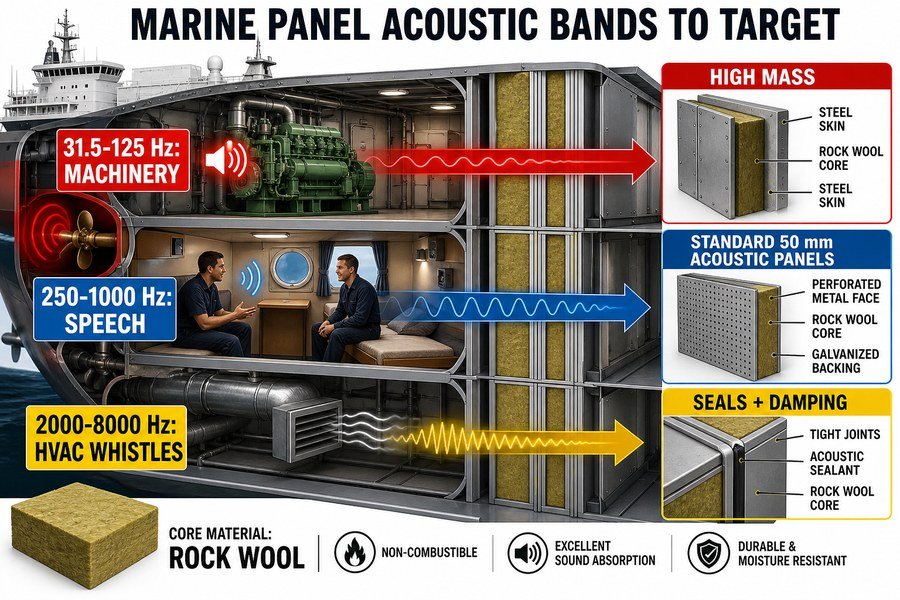
When I help clients plan their interior budgets, I tell them to map the ship first. You do not need expensive heavy panels everywhere. You only need them where the specific noise lives. To do this correctly, we break the ship noises down into three primary frequency bands. Every band requires a different panel design.
Managing the Low-Frequency Band for Machinery Noise
The most difficult zone is the low-frequency band. This ranges from 31.5 Hz to 125 Hz. This band matters most for machinery noise. Huge slow-speed diesel engines, bow thrusters, and heavy generators live in this range.14 The sound waves are massive and physical. You can feel them in your chest. To stop noise in this 31.5 Hz to 125 Hz band, you cannot use thin panels. You must put heavy 50mm double-skin panels with high-density cores near the engine casing.15
Isolating the Mid-Frequency Band for Human Speech
The second zone is the mid-frequency band. This ranges from 250 Hz to 1000 Hz. This band matters most for human speech.16 Crew members talking, televisions playing, and standard daily activities happen here. This is the most common noise in the living quarters. For this 250 Hz to 1000 Hz band, standard 50mm or 25mm marine panels work very well. The standard 0.6mm steel and 100 kg/m³ rockwool are perfectly designed to trap these human voice wavelengths.
Controlling the High-Frequency Band for HVAC Airflow
The third zone is the high-frequency band. This ranges from 2000 Hz to 8000 Hz. This band matters most for HVAC airflow and whistles. Air conditioning vents pushing air at high speeds create a sharp hissing sound. High-speed pumps also whine in this range. This 2000 Hz to 8000 Hz noise is very annoying and ruins concentration. To block this, you do not need mass. You need good panel joints. Small gaps let high frequencies leak easily.17 You also need panels with constrained layer damping to stop the thin metal from ringing.
Targeted Frequency Bands for Marine Outfitting
| Target Frequency Band | Pitch Range | Primary Noise Source on Ship | Best Panel Solution |
|---|---|---|---|
| Low-Frequency | 31.5 Hz to 125 Hz | Engines, Thrusters, Propellers | Heavy double-skin panels, high mass |
| Mid-Frequency | 250 Hz to 1000 Hz | Human voices, TV, Music | Standard 50mm acoustic panels |
| High-Frequency | 2000 Hz to 8000 Hz | HVAC air ducts, pumps, whistles | PVC-coated skins, tight joint seals |
How Does Skin Stiffness Affect Marine Accommodation Panel High-Frequency STL?
You swap steel for lighter aluminum skins to save weight. Suddenly, high-pitched whistling fills the cabin. Changing the skin stiffness moves the acoustic weak point of your panel.
Skin stiffness affects marine accommodation panel high-frequency STL by determining the critical frequency where the coincidence dip occurs. Highly stiff materials like aluminum push this failure point into highly sensitive mid-to-high hearing ranges (1500 Hz), while flexible PVC-laminated steel delays this dip to less noticeable higher frequencies (3500 Hz).
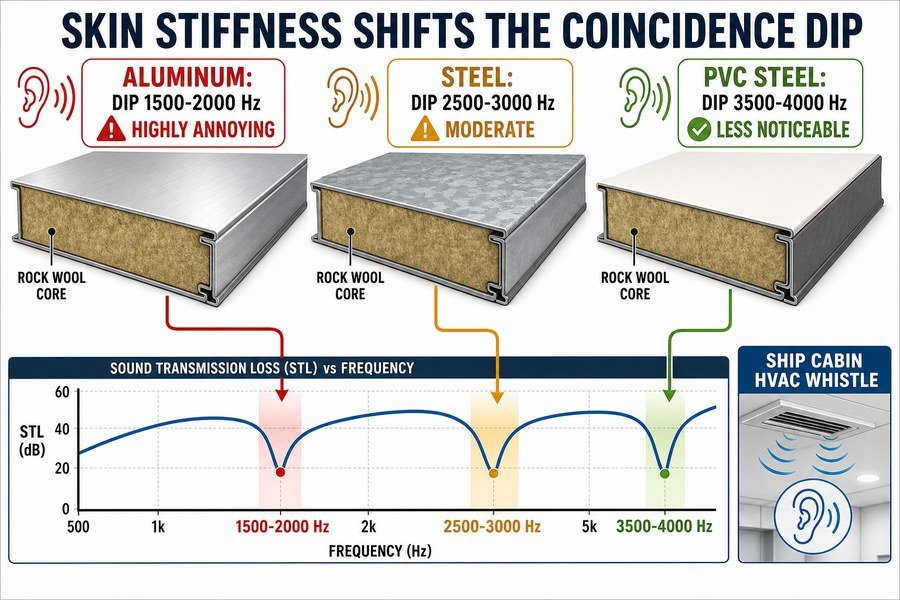
I once worked on a fast ferry project. The owner wanted to save weight, so they ordered panels with thick aluminum skins instead of steel. The weight was great, but the noise was terrible. The cabins suffered from a sharp, ringing noise from the air conditioning. The problem was skin stiffness. Let me explain how the stiffness of the metal skin changes the high-frequency sound blocking.
Determining the Critical Frequency Coincidence Dip
As we discussed earlier, every panel has a weak spot called the coincidence dip18. Skin stiffness affects marine accommodation panel high-frequency STL by determining exactly where this critical frequency happens. The stiffer the panel skin, the faster bending waves travel across it.19 When the skin stiffness changes, the speed of the bending wave changes. This means it matches the speed of the airborne sound at a totally different pitch.
The Risks of Highly Stiff Aluminum Skins at 1500 Hz
This is why changing materials is dangerous. Highly stiff materials like marine aluminum have very fast bending waves. Because aluminum is stiff and light, it causes the coincidence dip to happen at lower pitches. Specifically, aluminum pushes this failure point into highly sensitive mid-to-high hearing ranges20. An aluminum skin can drop your sound protection severely right around 1500 Hz to 2000 Hz. Human ears are very sensitive to 1500 Hz. If your HVAC system makes noise at this pitch, the stiff aluminum will let it pass straight into the cabin.
The Benefits of Flexible PVC-Laminated Steel at 3500 Hz
To fix this, we want to push that weak spot out of the annoying hearing range. We do this by using less stiff, heavier skins. Standard steel is better than aluminum. But flexible PVC-laminated steel is the best. Adding a soft PVC layer on top of the steel reduces the raw stiffness.21 This flexible layer delays this dip to less noticeable higher frequencies. A good PVC-laminated steel skin pushes the coincidence dip up to 3500 Hz or even 4000 Hz. At 3500 Hz, the noise is much less annoying to the human ear.
Material Stiffness and Critical Frequency Failure Points
| Panel Skin Material | Relative Stiffness | Coincidence Dip Frequency (Approximate) | Human Ear Sensitivity at this Pitch |
|---|---|---|---|
| Marine Aluminum (1.0mm) | Very High | 1500 Hz - 2000 Hz | Highly Sensitive (Very Annoying) |
| Bare Galvanized Steel (0.6mm) | Moderate | 2500 Hz - 3000 Hz | Moderately Sensitive |
| PVC-Laminated Steel (0.6mm) | Flexible | 3500 Hz - 4000 Hz | Less Sensitive (Easier to Ignore) |
Conclusion
Acoustic performance across frequencies depends entirely on mass, stiffness, and thickness. By understanding these variables, you can choose the right marine panels to block real-world ship noise effectively and affordably.
-
"[PDF] Extraction of plate bending stiffness from coincidence angles of ...", https://physics.byu.edu/docs/publication/2624. An architectural-acoustics or engineering-acoustics source should support that sound transmission loss varies with frequency and panel behavior, including stiffness-, mass-, and coincidence-related regions; this provides the theoretical basis but does not validate the specific frequency cutoffs used in this article. Evidence role: definition; source type: education. Supports: Sound Transmission Loss is frequency-dependent rather than flat across all frequencies.. Scope note: Supports the general frequency-dependent nature of STL, not the article’s exact marine-panel design thresholds. ↩
-
"Aluminum Honeycomb vs Rock Wool Core: Mechanical Performance in ...", https://magellanmarinetech.com/aluminum-honeycomb-rock-wool-core-mechanical-performance-marine-accommodation-panels/. A peer-reviewed study or technical acoustics reference should show how mineral-wool density and porous core properties affect sound transmission or absorption in panel assemblies; such evidence would be contextual because it may not establish 150 kg/m³ as a universal minimum for marine cabins. Evidence role: general_support; source type: paper. Supports: Using denser rockwool can improve the low-frequency acoustic performance of panel assemblies.. Scope note: The exact 150 kg/m³ threshold is likely application- and assembly-specific, so evidence may only support the broader relationship between mineral-wool density and acoustic performance. ↩
-
"[PDF] Chapter 6 Transmission Loss Tests 6.1 Test Setup - VTechWorks", https://vtechworks.lib.vt.edu/bitstream/handle/10919/31833/Chapter6.pdf. An engineering-acoustics reference should support the mass law of sound insulation, under which transmission loss for limp or single-leaf barriers generally increases with surface mass and frequency; this is a simplified model and may not predict complex sandwich-panel behavior exactly. Evidence role: mechanism; source type: education. Supports: In the mass-controlled frequency region, increasing surface mass generally increases sound transmission loss.. Scope note: Mass law is an idealized principle and does not fully account for panel stiffness, resonances, seams, or flanking transmission. ↩
-
"[PDF] Extraction of plate bending stiffness from coincidence angles of ...", https://physics.byu.edu/docs/publication/2624. A building- or engineering-acoustics source should document the coincidence effect, in which bending waves in a panel couple efficiently with airborne sound and reduce transmission loss near the critical frequency; this supports the mechanism but not the exact claim that it occurs above 2000 Hz for every steel panel. Evidence role: mechanism; source type: education. Supports: High-frequency transmission loss can be weakened by the coincidence effect, producing a dip in panel insulation performance.. Scope note: The coincidence frequency depends on material properties, thickness, boundary conditions, and panel construction, so the 2000 Hz cutoff may vary. ↩
-
"[PDF] Sound Transmission Loss of Composite Sandwich Panels", https://etd.auburn.edu/bitstream/10415/1702/3/Ran%20Zhou_Dissertation.pdf. A standard architectural-acoustics or vibration reference defines coincidence, or critical frequency, as the condition in which the trace wavelength of an obliquely incident airborne sound wave matches the bending wavelength of a plate, causing efficient coupling between air and panel vibration. Evidence role: definition; source type: education. Supports: The acoustic coincidence dip occurs when airborne sound couples efficiently with a panel’s bending waves.. Scope note: This supports the general physical mechanism; it does not verify the performance of any specific marine cabin panel. ↩
-
"[PDF] Extraction of plate bending stiffness from coincidence angles of sound ...", https://physics.byu.edu/docs/publication/2624. Peer-reviewed and textbook treatments of plate sound insulation report a reduction in sound transmission loss near the critical, or coincidence, frequency because bending-wave radiation becomes more efficient at that frequency. Evidence role: mechanism; source type: paper. Supports: Coincidence resonance reduces sound transmission loss near the panel’s critical frequency.. Scope note: The magnitude of the STL reduction depends on panel construction, damping, mounting, and incidence conditions, so the source supports the direction of the effect rather than the word “huge” for every panel. ↩
-
"This Acoustic Panel Absorbs Down To 30Hz", https://www.youtube.com/watchv=T7Ve6E-lBbI. Marine-acoustics guidance or measured panel-transmission data can document typical coincidence-region frequencies for thin metal-faced accommodation panels, providing context for the stated 2–4 kHz range. Evidence role: statistic; source type: institution. Supports: Standard marine panels often have coincidence dips in the 2000–4000 Hz range.. Scope note: This range is likely construction-dependent; a source may support representative examples rather than a universal frequency band for all standard marine panels. ↩
-
"[PDF] Noise transmission by viscoelastic sandwich panels", https://ntrs.nasa.gov/api/citations/19770023963/downloads/19770023963.pdf. Research on laminated panels and viscoelastic interlayers shows that compliant bonding layers can alter coupling and add damping between skins and cores, reducing resonance amplitudes in some sandwich-panel configurations. Evidence role: mechanism; source type: paper. Supports: Flexible adhesive layers can reduce the severity of resonance or coincidence effects in composite or sandwich panels.. Scope note: The evidence is contextual: the amount of dip reduction depends on adhesive modulus, layer thickness, core properties, and the tested frequency range. ↩
-
"[PDF] Ultrasonic, Normal-Incidence Insertion Loss through Common ...", https://physics.byu.edu/docs/thesis/269. An acoustics textbook or university acoustics note defining the sound-transmission mass law would support the use of surface density as a first-order predictor of transmission loss in limp or homogeneous panels. Evidence role: definition; source type: education. Supports: In acoustic engineering, mass law is a standard rule used to estimate how increasing panel mass affects sound transmission loss.. Scope note: Mass law is an idealized model and does not account for panel resonances, coincidence effects, flanking transmission, or multilayer marine-panel construction details. ↩
-
"(PDF) Experimental investigation on sound transmission through ...", https://www.academia.edu/88980668/Experimental_investigation_on_sound_transmission_through_cavity_backed_panels. A standard acoustics reference explaining that mass law predicts approximately 6 dB higher transmission loss for each doubling of surface mass, or for each doubling of frequency, would support this numerical rule. Evidence role: mechanism; source type: education. Supports: The mass law predicts about a 6 dB increase in sound transmission loss when panel surface weight is doubled.. Scope note: The 6 dB rule applies under ideal mass-law conditions and may not be realized at low frequencies near panel resonance or in ship structures with flanking paths. ↩
-
"[PDF] Sound Source List - Bureau of Ocean Energy Management (BOEM)", https://www.boem.gov/environment/center-marine-acoustics/sound-source-list. A peer-reviewed ship-noise study or maritime noise guideline documenting low-frequency components from marine diesel engines and generator sets would support identifying the 50–100 Hz band as relevant to engine-room noise control. Evidence role: general_support; source type: paper. Supports: Marine diesel engines and large generators can produce important low-frequency noise components in the 50 Hz to 100 Hz range.. Scope note: Exact dominant frequencies depend on engine speed, cylinder firing order, mounting, hull structure, and measurement location, so the source would contextualize rather than prove this range for every vessel. ↩
-
"[PDF] Discussion Paper Noise", http://maritime.lamar.edu/joomla2025/index.php/ergonomicsdownload=66:ergonomic-discussion-paper-noise. A naval-architecture or acoustics source on structure-borne ship noise would support the claim that machinery vibration can propagate through steel hull or deck structures and reradiate as airborne noise in accommodation spaces. Evidence role: mechanism; source type: research. Supports: Engine and generator vibration can transmit through steel ship structures and reradiate as airborne noise in cabins.. Scope note: The source would describe the general transmission mechanism; actual cabin levels depend on isolation mounts, structural connections, damping treatments, and flanking paths. ↩
-
"Underwater Sound Characteristics of a Ship with ...", https://dspace.mit.edu/bitstream/handle/1721.1/141117/jmse-10-00328-v2.pdf. Marine-noise and ship-vibration studies commonly report important propulsion, machinery, and hull-radiated components in low-frequency one-third-octave bands, including the 31.5 Hz and 63 Hz bands, which provides contextual support for treating these bands as relevant to shipboard rumble and vibration. Evidence role: mechanism; source type: paper. Supports: Ship propulsion and machinery noise can occur in low-frequency bands around 31 Hz to 63 Hz.. Scope note: The exact dominant frequencies vary with vessel size, engine speed, propeller blade rate, operating condition, and measurement location, so the cited source would support the range as typical or relevant rather than universal. ↩
-
"Vessel-Generated Underwater Radiated Noise ...", https://www.maritime.dot.gov/sites/marad.dot.gov/files/2024-11/NCE%20REPORT%202024-079%20MARAD%20Vessel-Generated%20Underwater%20Radiated%20Noise%20Comparison%20Study%20%28Tugs%29%20Rev%200.pdf. A naval-acoustics standard or peer-reviewed ship-noise study can document that propulsion machinery, generators, and thrusters commonly produce substantial low-frequency noise components in octave bands around 31.5–125 Hz. Evidence role: general_support; source type: paper. Supports: Ship machinery such as slow-speed diesel engines, bow thrusters, and heavy generators commonly produces noise in the 31.5 Hz to 125 Hz low-frequency band.. Scope note: The source would support the general frequency tendency, not the exact spectrum of every vessel or machinery installation. ↩
-
"Sound Transmission Loss of a Panel Backed by a Small Enclosure LOW ...", https://www.academia.edu/30078653/Sound_Transmission_Loss_of_a_Panel_Backed_by_a_Small_Enclosure_LOW_FREQUENCY_NOISE_VIBRATION_AND_ACTIVE_CONTROL_Sound_Transmission_Loss_of_a_Panel_Backed_by_a_Small_Enclosure. An acoustics text, classification-society guide, or peer-reviewed paper on marine partitions can support the mechanism that low-frequency airborne sound generally requires high surface mass, decoupled double-leaf construction, or absorptive cavities for effective transmission loss. Evidence role: mechanism; source type: research. Supports: Low-frequency machinery noise control near an engine casing requires heavier or double-skin panel constructions with dense or absorptive cores rather than thin panels.. Scope note: Such evidence would justify the design principle, but it may not validate the specific 50 mm thickness or core density without a tested panel assembly report. ↩
-
"[PDF] Evaluating the role of spectral and envelope characteristics in the ...", https://www.utdallas.edu/~assmann/hcs6367/krause_braida09.pdf. A speech-acoustics source can show that much of the intelligibility-relevant energy of spoken language lies in the mid-frequency range, including bands between roughly 250 Hz and 1000 Hz. Evidence role: definition; source type: education. Supports: The 250 Hz to 1000 Hz mid-frequency band is especially relevant to human speech in interior spaces.. Scope note: Human speech also contains important components outside 250–1000 Hz, especially higher-frequency consonant cues, so the citation would support the band as important rather than exhaustive. ↩
-
"Study on sound insulation performance of walls in traditional ...", https://pmc.ncbi.nlm.nih.gov/articles/PMC12979663/. A building- or architectural-acoustics reference can support that acoustic leakage through small gaps and joints reduces the sound-insulation performance of partitions, with short-wavelength sound particularly sensitive to discontinuities and flanking paths. Evidence role: mechanism; source type: education. Supports: Small gaps in panel joints can allow high-frequency sound to leak through and reduce acoustic isolation.. Scope note: The evidence would support the leakage mechanism generally; the magnitude of leakage depends on gap size, joint geometry, sealing material, and the tested panel system. ↩
-
"[PDF] Sound transmission loss characteristics of sandwich panel ...", https://bulldog2.redlands.edu/fac/julie_rathbun/physclasses/sound.pdf. A technical acoustics reference defines the coincidence effect as the frequency region where airborne sound couples efficiently with bending waves in a panel, causing a reduction in sound transmission loss. Evidence role: definition; source type: education. Supports: Panels can exhibit a coincidence dip, a frequency region where their sound insulation performance decreases.. ↩
-
"[PDF] Theoretical predictions and experimental measurements of ...", https://auetd.auburn.edu/bitstream/handle/10415/5922/th.pdfsequence=2&isAllowed=y. Plate-vibration theory relates bending-wave speed to a plate’s bending stiffness, supporting the statement that changes in skin stiffness alter bending-wave propagation and therefore the coincidence condition. Evidence role: mechanism; source type: paper. Supports: Greater panel-skin stiffness increases bending-wave propagation speed and changes the coincidence frequency.. Scope note: The source may describe ideal homogeneous plates; sandwich or laminated marine panels can deviate depending on core, bonding, damping, and boundary conditions. ↩
-
"Equal Loudness Curves", http://hyperphysics.phy-astr.gsu.edu/hbase/Sound/eqloud.html. Acoustics literature on single-leaf partitions shows that critical frequency depends on stiffness-to-mass properties, while equal-loudness/hearing-sensitivity data show that the human ear is relatively sensitive in the kilohertz range; together these sources provide contextual support for the concern about aluminum-panel coincidence in audible mid-to-high frequencies. Evidence role: general_support; source type: institution. Supports: Aluminum skins can place the coincidence dip in a frequency range to which human hearing is relatively sensitive.. Scope note: This supports the physical and psychoacoustic rationale but does not by itself verify the article’s specific 1500–2000 Hz value for a 1.0 mm marine aluminum skin. ↩
-
"[PDF] Characterization of Sound Transmission Loss of Laminated ...", http://www.osti.gov/servlets/purl/883220-UHYeNn/. Research on constrained-layer and viscoelastic laminates shows that adding a compliant polymer layer to metal sheet constructions can change composite bending stiffness and increase damping, which can alter sound-transmission behavior near resonance or coincidence regions. Evidence role: mechanism; source type: research. Supports: A PVC layer on steel can modify the panel’s effective stiffness and damping, affecting the coincidence-dip behavior.. Scope note: This is contextual support for the mechanism; the exact shift to 3500–4000 Hz would require test data for the specific PVC-laminated steel panel construction. ↩