You see a high Rw number and think your cabins are quiet. But crew still complain about engine noise. You need to know what that single number really means.
A headline Rw (Weighted Sound Reduction Index) represents a laboratory average of airborne sound insulation across frequencies from 100 Hz to 3150 Hz. You must interpret it alongside spectrum adaptation terms (C and Ctr) and full Sound Transmission Loss (STL) curves to guarantee actual shipboard acoustic performance.
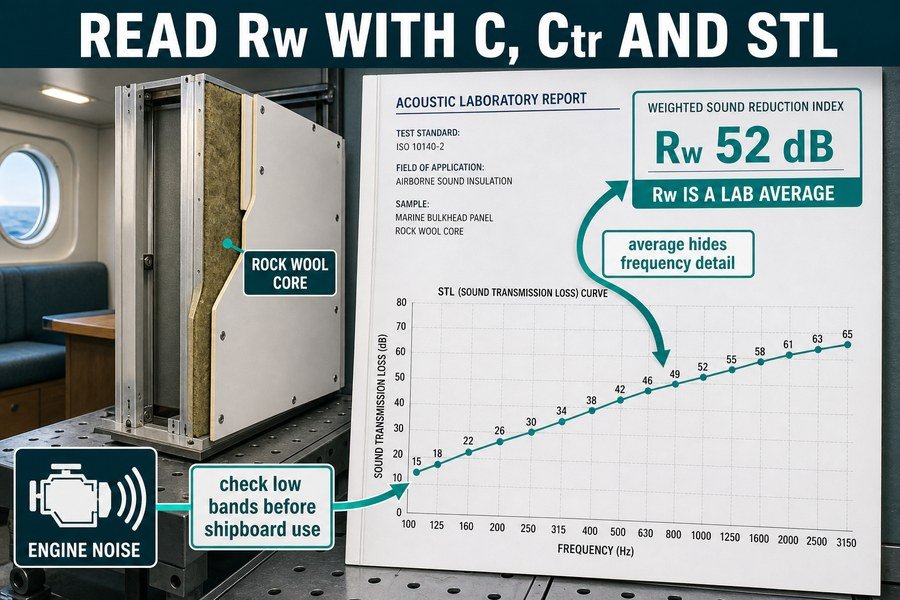
I have seen many buyers choose a 45 dB panel based on the headline number alone, only to fail sea trials. The shipyard gets angry. Your payment gets delayed. Let me explain why this happens and how you can buy the right marine wall panel every time.
Why Is Relying Solely On A Single Rw Risky For Marine Interior Panels?
Buying panels based on one Rw number causes failed acoustic tests. Your shipyard client will reject the work. We must look at the full frequency range to avoid this.
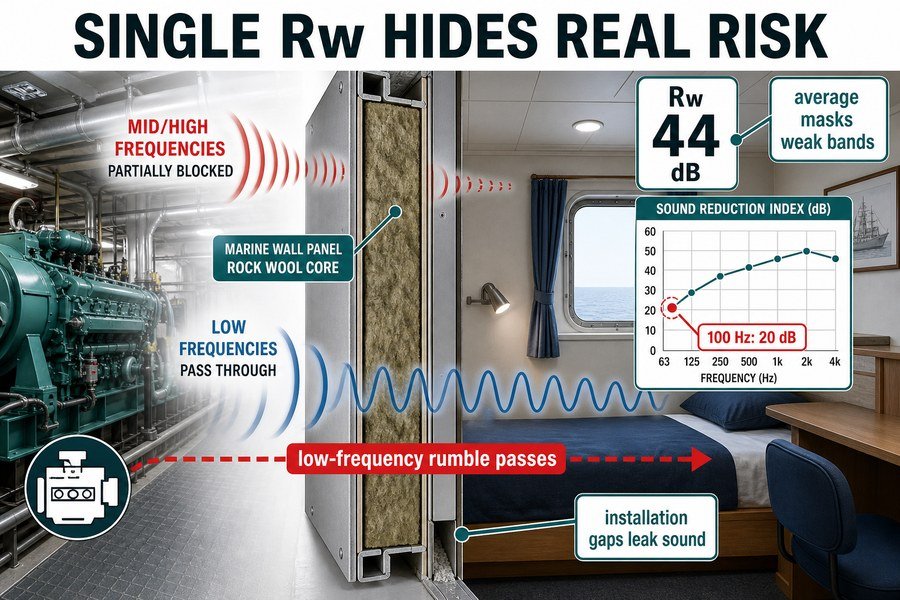
Relying solely on a single Rw is risky because it averages out critical weaknesses, masks low-frequency engine rumble, ignores real-world installation flaws, and fails to account for structure-borne noise. A panel with an impressive 44 dB Rw might only block 20 dB at 100 Hz.
I have helped many procurement officers fix problems caused by trusting a single Rw number. When you buy marine wall panels from a factory in Asia, the sales person will always highlight the highest Rw number. They do this because it makes the product look good. But this number is dangerous for your project.
The Danger of Averaging Out Acoustic Weaknesses in Marine Panels
The Rw rating is just an average value.1 It averages out critical acoustic weaknesses across different frequencies. For example, a 50mm marine composite panel might block 55 dB of noise at 2000 Hz. This high number pulls the average up. However, the same panel might only block 15 dB at 125 Hz. If you only look at the 44 dB Rw average, you will not see this weakness. The International Maritime Organization (IMO) Resolution MSC.337(91) requires specific noise limits in cabins, usually around 60 dB(A). If your panel has a massive weakness at a specific frequency, it will fail this IMO standard on the ship.
How Single Rw Values Mask Low-Frequency Ship Engine Rumble
A single Rw completely masks low-frequency engine rumble. Ship engines produce very strong low-frequency noise. This noise travels through the air and hits the bulkheads. Because the Rw calculation stops at 100 Hz, and gives less weight to the 100 Hz to 250 Hz range2, it hides how badly the panel performs against heavy diesel engines. You think you are buying a strong barrier, but you are actually buying a panel that lets engine rumble pass right through to the sleeping crew.
Ignoring Real-World Installation Flaws and Structure-Borne Noise
The Rw rating also ignores real-world installation flaws. Laboratory tests install the panel perfectly. They seal all edges with heavy putty. On a real ship, workers leave small gaps. The Rw number does not tell you how the panel performs when installed with normal shipboard tolerances. Finally, the Rw fails to account for structure-borne noise. Sound travels through the steel deck and shakes the panel. The Rw only measures airborne sound.3 It cannot tell you if the panel will act like a speaker when the deck vibrates.
| Feature | Laboratory Rw Test Condition | Real Shipboard Condition | Result of Relying on Rw |
|---|---|---|---|
| Frequency Weaknesses | Averaged into one final score | Noise finds the weakest frequency | Cabin fails noise inspection |
| Low-Frequency Noise | Given low mathematical weight | Dominates the ship environment | Engine rumble wakes the crew |
| Installation Quality | Perfect sealing with lab putty | Normal shipyard construction gaps | Sound leaks through joints |
| Noise Transmission Type | Purely airborne sound only | Heavy structure-borne vibration | Panel radiates deck noise |
What Acoustic Flaws Can A Headline Rw Hide In Marine Interior Panels?
You pay for high-quality insulation, but noise still gets through. A single Rw hides specific frequency dips. Finding these hidden flaws saves your interior decoration project from failure.
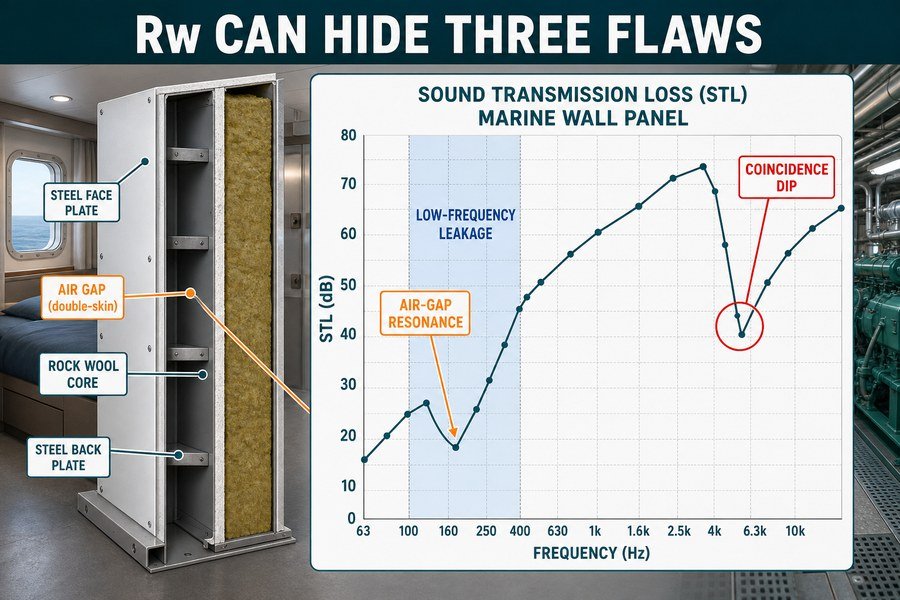
A headline Rw can hide three major acoustic flaws: coincidence dips where panel stiffness transmits specific frequencies, resonance issues in the air gap of double-skin bulkheads, and severe sound leakage at low frequencies below 250 Hz. These hidden flaws cause panels to fail shipyard inspections.
You must act like a detective when you read a marine panel test report. The headline number looks perfect. But underneath that number, physical laws cause specific acoustic flaws. I always check the data for these three hidden problems before I approve a supplier.
Uncovering Coincidence Dips in Marine Wall Panels
The first major flaw is the coincidence dip. Every stiff material has a critical frequency. When sound hits the steel skin of a marine panel, the sound wave bends the steel. If the bending wave in the steel matches the sound wave in the air, the sound passes straight through. This is called the coincidence effect.4 It creates a sharp drop in sound insulation at a specific frequency. For standard 0.6mm galvanized steel skins used in marine outfitting, this dip often happens between 2000 Hz and 3150 Hz. A panel might drop from blocking 45 dB down to only 30 dB at this exact spot. The headline Rw hides this sudden drop.
Resonance Issues in Double-Skin Marine Bulkheads
The second flaw involves resonance issues in the air gap of double-skin bulkheads. Many high-acoustic B-15 marine wall panels use two steel skins with rockwool and an air gap inside. The air gap acts like a spring. The two steel skins act like weights. At a specific frequency, this system hits its mass-air-mass resonance.5 When this happens, the two skins vibrate together. They actually amplify the sound instead of blocking it. This usually occurs around 160 Hz to 200 Hz. The overall Rw number smooths over this resonance failure, hiding it from the buyer.
The Threat of Low-Frequency Leakage Below 250 Hz
The third major flaw is severe sound leakage at low frequencies below 250 Hz. Standard 50mm marine rockwool panels with a density of 120 kg/m3 are very good at stopping high-frequency sounds like human voices. They are terrible at stopping long, low-frequency sound waves. A wave at 100 Hz is about 3.4 meters long.6 It pushes right through a thin 50mm panel. The panel might only provide 15 dB to 20 dB of reduction below 250 Hz. The high performance at 2000 Hz pulls the Rw average up, hiding this severe low-frequency leakage.
| Hidden Acoustic Flaw | Physical Cause | Typical Frequency Range | Impact on Shipboard Comfort |
|---|---|---|---|
| Coincidence Dip | Bending waves in steel skin match air waves | 2000 Hz to 3150 Hz | Whistling air or high-pitch fan noise enters |
| Resonance Issues | Air gap acts as a spring between two steel skins | 160 Hz to 200 Hz | Amplifies specific machinery hums |
| Low-Frequency Leakage | Long sound waves easily push through thin mass | 100 Hz to 250 Hz | Heavy diesel engine rumble vibrates cabin |
How Does ISO 717-1 Calculate Marine Interior Panel Rw?
You need to understand how testing labs get that Rw number. Without this knowledge, you cannot verify if a supplier's certificate is good. Let me break down the math.
ISO 717-1 calculates Rw by measuring the Sound Transmission Loss across 16 one-third octave bands from 100 Hz to 3150 Hz. It overlays a standard reference curve onto these results, shifting it until the sum of unfavorable deviations is as large as possible but below 32 dB.
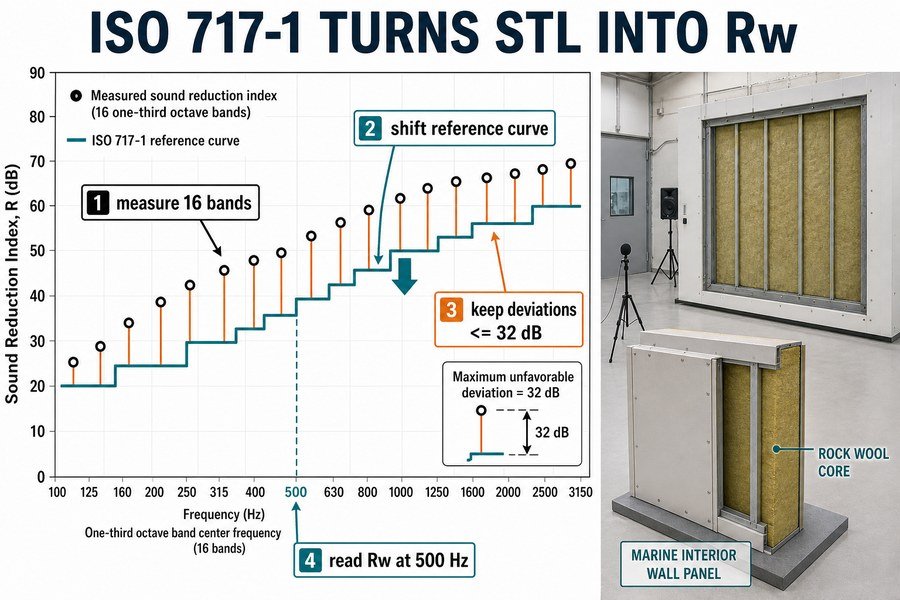
Many procurement officers just accept the certificate. I do not. I want to know exactly how the laboratory generated the number. When I worked in the factory, we tested panels constantly. The ISO 717-1 standard is the global rule for this calculation. Here is how it actually works.
Measuring Sound Transmission Loss Across 16 One-Third Octave Bands
The process starts with a physical test following the ISO 10140-2 standard7. The lab builds a massive concrete facility with two separate rooms. They install your marine wall panel in the opening between the rooms. In the source room, they play very loud noise. In the receiving room, they measure how much noise comes through. They do not just take one measurement. They measure the Sound Transmission Loss (STL) across 16 specific frequency bands. These are called one-third octave bands. They start at 100 Hz and go up to 3150 Hz8. This gives the lab 16 separate data points showing exactly how many decibels the panel blocks at each step.
Applying the ISO 717-1 Standard Reference Curve Shifting Method
Once the lab has these 16 data points, they apply the ISO 717-1 calculation. They take a standard reference curve from the ISO rulebook. This reference curve represents an ideal sound insulation shape. The lab overlays this reference curve on top of the 16 actual test results. Then, they start shifting the reference curve downward. They look for "unfavorable deviations." An unfavorable deviation is any point where the actual panel performance is worse than the reference curve. They add up the decibels of all these bad points. The strict rule says the total sum of these unfavorable deviations cannot be more than 32.0 dB9. The lab shifts the curve until the sum gets as close to 32.0 dB as possible without going over. When they stop shifting, they look at the value of the reference curve exactly at 500 Hz. That specific number at 500 Hz becomes the official Rw rating.
| Step in ISO 717-1 Process | Action Performed by Acoustic Laboratory | Purpose in Rw Calculation |
|---|---|---|
| Step 1: Test 16 Bands | Measure transmission loss from 100 Hz to 3150 Hz | Gather raw data for the panel |
| Step 2: Overlay Curve | Place ISO reference curve over test data | Establish a baseline for comparison |
| Step 3: Shift and Sum | Shift curve down, sum deviations below curve | Find the limit of 32.0 dB total deviation |
| Step 4: Read at 500 Hz | Record the value of the shifted curve at 500 Hz | Determine the final single-number Rw |
When Do High-Rw Marine Interior Panels Fail Against Shipboard Noise?
You buy a 44 dB Rw panel for a luxury cabin. It still sounds loud. High-Rw panels fail when the test environment does not match the actual ship conditions.
High-Rw marine panels fail against shipboard noise when confronted with three conditions: dominant low-frequency engine exhaust noise, flanking transmission through poor deck connections, and structural vibrations bypassing the panel entirely. The laboratory Rw only measures direct airborne sound, not these real-world ship environments.
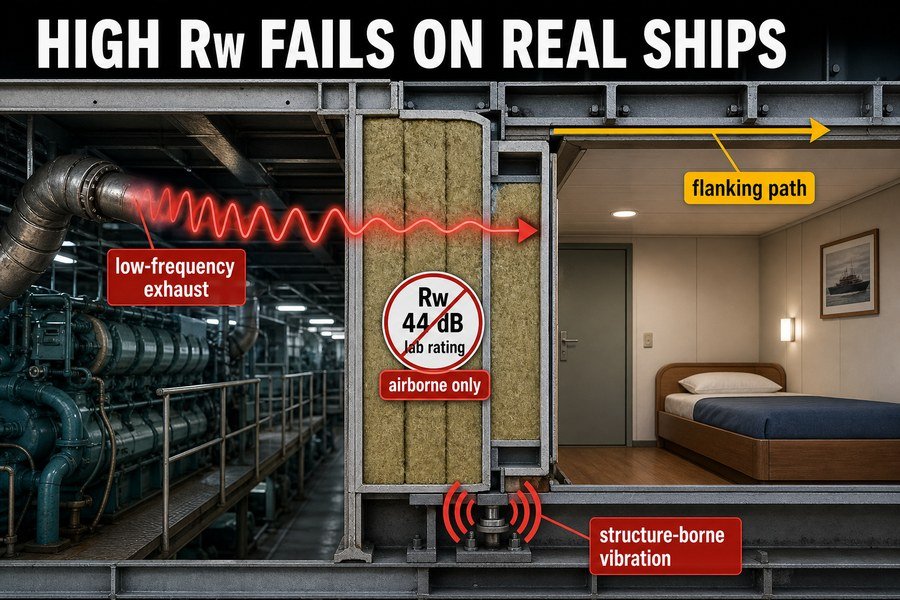
I get calls from buyers who are confused. They bought the best panels. They paid high prices. But the ship failed the final noise survey. This happens because a ship is not a concrete laboratory. Real shipboard noise attacks the panels differently than laboratory speakers do.
Failure Caused by Dominant Low-Frequency Engine Exhaust Noise
High-Rw marine panels fail when confronted with dominant low-frequency engine exhaust noise. A laboratory tests a panel with pink noise, which has equal energy across all frequencies. A ship does not sound like pink noise. A marine diesel engine and its massive exhaust system push huge amounts of energy at 63 Hz and 125 Hz.10 As we discussed, a 44 dB Rw panel might only block 15 dB at these low frequencies. When the engine exhaust fires, the low-frequency sound wave easily penetrates the panel. The cabin fills with a deep rumble. The high Rw rating is useless because it does not cover the exact noise the engine produces.
How Flanking Transmission Defeats High-Rw Marine Panels
The second failure condition is flanking transmission through poor deck connections. In a lab, the panel sits inside a thick concrete frame. Sound can only travel directly through the panel. On a ship, the panel sits on a continuous steel deck. It connects to a continuous steel ceiling. Sound hits the deck outside the cabin. The sound travels straight through the continuous steel deck under the panel. It enters the cabin through the floor. This is flanking transmission.11 The marine interior panel could have an Rw of 50 dB, but if 40 dB of noise flanks under the bottom track, the cabin will be loud. The panel did its job, but the installation environment caused a failure.
The Impact of Structural Vibrations Bypassing the Wall Panel
The third failure condition is structural vibrations bypassing the panel entirely. Ships vibrate. The main engine shakes the hull. The propellers hit the water and send shockwaves into the steel structure. These vibrations travel up the steel pillars and into the cabin decks. The deck shakes the bottom profile of the marine wall panel. The panel itself starts to vibrate. It becomes a giant speaker inside the room. It creates noise. The Rw rating only measures airborne sound trying to get through.12 It does not measure how the panel reacts to structure-borne vibration shaking it from the bottom.
| Real-World Ship Condition | How It Attacks the Cabin | Why the Lab Rw Rating Fails to Predict It |
|---|---|---|
| Low-Frequency Exhaust | Pushes massive energy below 125 Hz | Rw calculation gives low weight to low frequencies13 |
| Flanking Transmission | Sound travels under the deck or over the ceiling | Lab blocks all flanking paths with heavy concrete |
| Structural Vibrations | Engine shakes the deck, panel becomes a speaker | Lab only tests airborne sound, not mechanical shaking |
Why Request Full STL Curves Over Single Rw Values For Marine Interior Panels?
Do not just ask suppliers for an Rw rating. Ask for the full test report. The curve shows you the truth about how the panel blocks different sounds.
You must request full Sound Transmission Loss (STL) curves because they reveal the exact decibel reduction at every frequency, identify critical coincidence dips, allow precise matching against specific ship engine noise profiles, and prove the supplier actually performed authentic laboratory testing under ISO 10140-2 standards.
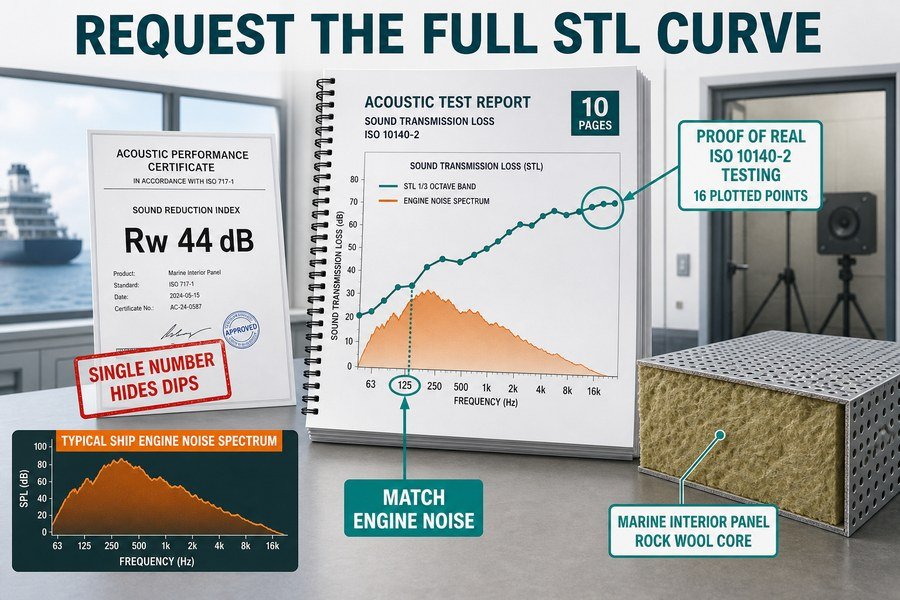
I tell my clients to demand the 10-page test report, not just the one-page certificate. When you buy from developing countries, some factories try to hide bad products. They only give you the single number. The full STL curve is your best weapon to ensure you get what you pay for.
Revealing Exact Decibel Reduction and Identifying Coincidence Dips
You must request the full STL curve because it reveals the exact decibel reduction at every single frequency. The curve is a line graph showing performance at all 16 one-third octave bands. Instead of a vague average, you can see exactly how the panel performs at 100 Hz, 500 Hz, and 3150 Hz. Furthermore, the curve clearly identifies critical coincidence dips14. You can look at the graph and see if the line suddenly drops at 2000 Hz. If the dip is too deep, you know the panel will let high-pitched whistling noises into the cabin. You cannot see this dip by looking at a single Rw number.
Matching STL Curves Against Specific Ship Engine Noise Profiles
The STL curve allows precise matching against specific ship engine noise profiles. Your shipyard client will usually provide a predicted noise spectrum for the vessel. They will tell you that the engine room will produce 90 dB at 125 Hz. You can take the shipyard's noise profile and compare it directly to the supplier's STL curve. If the ship makes 90 dB of noise at 125 Hz, and the STL curve shows the panel only blocks 15 dB at 125 Hz, you will have 75 dB of noise in the cabin. That fails the IMO limit. You can only do this math if you have the full curve.
Proving Authentic Laboratory Testing Under ISO 10140-2
Finally, requesting the full STL curve proves the supplier actually performed authentic laboratory testing under ISO 10140-2 standards. It is easy for a factory to fake a one-page certificate with an "Rw = 44 dB" stamp. It is very hard to fake a complex STL curve with 16 precise data points, reverberation time measurements, and source room sound pressure levels15. Asking for the full curve forces the supplier to prove they spent the $5,000 to test the panel in a real acoustic laboratory.
| Information Type | What a Single Rw Number Shows | What a Full STL Curve Shows |
|---|---|---|
| Performance Detail | One average number (e.g., 44 dB) | 16 specific data points from 100 Hz to 3150 Hz |
| Coincidence Dips | Completely hidden in the average | Clearly visible as a sharp drop on the graph |
| Ship Matching | Impossible to match to engine profiles | Easy to subtract panel reduction from engine noise |
| Supplier Honesty | Easy to fake on a basic certificate | Requires a real, expensive ISO laboratory test report |
How Do C And Ctr Adjust Marine Interior Panel Rw For Real Noise?
The Rw number alone is too optimistic. We use C and Ctr terms to bring it down to reality. This helps you buy panels that actually meet shipyard specs.
C (pink noise) and Ctr (traffic noise) are spectrum adaptation terms that adjust the Rw for specific real-world sound sources. C corrects for high-frequency noise like speech and high-speed machinery, while Ctr corrects for low-frequency noise like slow-speed diesel engines and HVAC rumble on ships.
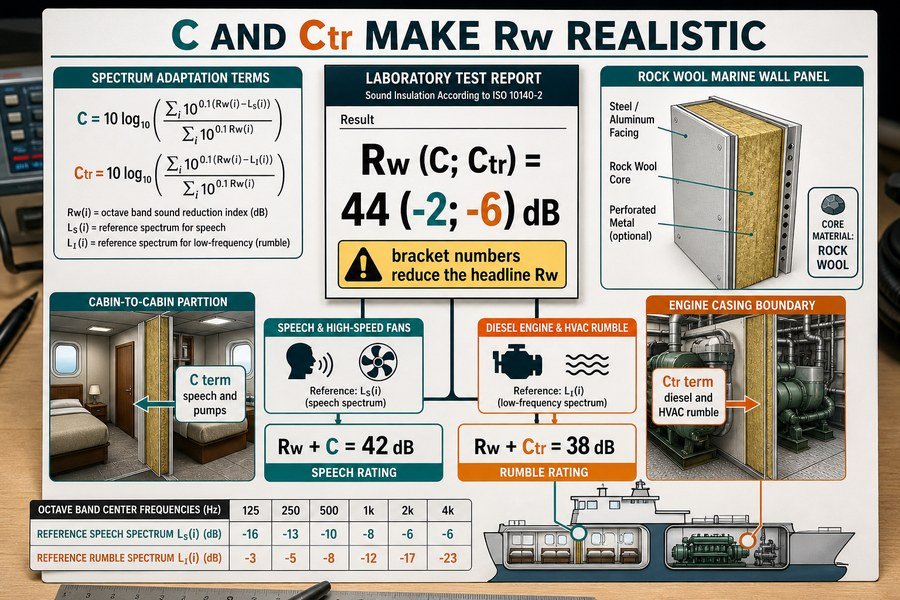
When you look at a real test report, you will see a rating like this: Rw (C; Ctr) = 44 (-2; -6) dB. Most buyers ignore the numbers in the brackets. You cannot ignore them. These negative numbers are the key to buying safe marine panels.
Using the C Term to Correct for High-Frequency Ship Machinery Noise
C is the spectrum adaptation term for pink noise. It corrects the Rw for high-frequency noise sources. On a ship, this includes loud human speech, high-speed machinery, pumps, and high-speed fans. The C value is almost always a negative number. If your panel has an Rw of 44 dB, and a C value of -2 dB, the real performance against high-speed machinery is 42 dB (44 minus 2). You use the Rw + C rating when you are building bulkheads between two passenger cabins where speech privacy is the main concern. It tells you how well the panel blocks normal, higher-pitched sounds.
Using the Ctr Term to Correct for Low-Frequency Diesel Engine Rumble
Ctr is the spectrum adaptation term for traffic noise. The "tr" stands for traffic. Urban street traffic is very heavy in low frequencies.16 On a ship, this low-frequency profile perfectly matches slow-speed diesel engines, large exhaust pipes, and heavy HVAC rumble17. The Ctr value is a larger negative number. It pulls the Rw rating down severely to reflect poor low-frequency performance. If a panel has an Rw of 44 dB and a Ctr of -6 dB, its real performance against main engine noise is only 38 dB. You must use the Rw + Ctr rating when buying panels that sit near the engine casing or heavy equipment rooms.
| Panel Rating Component | Noise Source It Represents | Shipboard Application | Example Calculation |
|---|---|---|---|
| Rw (Weighted Index) | General laboratory average | Good for comparing basic material quality | Rw = 44 dB |
| C (Pink Noise Term) | Speech, high-speed pumps, small fans | Cabin-to-cabin partitions, crew living areas | Rw + C = 44 + (-2) = 42 dB |
| Ctr (Traffic Term) | Main engines, exhaust, heavy HVAC | Engine casing boundaries, lower deck bulkheads | Rw + Ctr = 44 + (-6) = 38 dB |
Conclusion
Relying on a single Rw rating causes project failures. Always request full STL curves and check C/Ctr values to ensure your marine panels truly block shipboard noise effectively.
-
"Sound reduction index - Wikipedia", https://en.wikipedia.org/wiki/Sound_reduction_index. ISO 717-1 defines the weighted sound reduction index as a single-number quantity derived from frequency-band sound reduction measurements, supporting the statement that Rw condenses frequency-dependent performance into one rating. Evidence role: definition; source type: institution. Supports: Rw is a single-number rating that summarizes frequency-dependent acoustic insulation performance and can therefore obscure weaknesses at individual frequencies.. Scope note: This supports the nature of the rating method, but not the specific numerical panel example given later in the article. ↩
-
"Sound reduction index - Wikipedia", https://en.wikipedia.org/wiki/Sound_reduction_index. ISO 717-1 specifies the standard Rw evaluation over one-third-octave frequency bands beginning at 100 Hz, which supports the point that standard Rw does not directly rate sub-100 Hz transmission loss. Evidence role: definition; source type: institution. Supports: Standard Rw evaluation begins at 100 Hz and therefore excludes lower-frequency noise from the basic Rw rating.. Scope note: This directly supports the lower frequency boundary of standard Rw; claims about the practical weighting of 100–250 Hz should be checked against the reference-curve procedure or spectrum adaptation terms. ↩
-
"Sound insulation dataset of 30 wooden and 8 concrete floors ...", https://pmc.ncbi.nlm.nih.gov/articles/PMC10365936/. Laboratory sound reduction index standards define Rw from airborne sound transmission measurements through a test element, whereas structure-borne and flanking transmission are treated as separate transmission paths in building and ship acoustics. Evidence role: definition; source type: institution. Supports: Rw is an airborne sound insulation rating and does not directly characterize structure-borne vibration or flanking transmission.. Scope note: This supports the measurement scope of Rw; it does not by itself quantify how much structure-borne noise a specific marine panel will radiate in service. ↩
-
"[PDF] Sound Transmission Loss of Composite Sandwich Panels", https://etd.auburn.edu/bitstream/10415/1702/3/Ran%20Zhou_Dissertation.pdf. A building-acoustics or vibroacoustics source explains that coincidence occurs when the projected airborne sound wavelength matches the bending wavelength in a panel, reducing transmission loss near the critical frequency. Evidence role: definition; source type: paper. Supports: The described matching of bending waves in the steel skin and sound waves in air is known as the coincidence effect.. ↩
-
"[PDF] Investigation of transmission loss through double wall structures with ...", https://ir.library.louisville.edu/cgi/viewcontent.cgi?referer=&httpsredir=1&article=2758&context=etd. Acoustics literature on double-leaf partitions describes mass-air-mass resonance, in which two panel masses coupled by an air cavity can show reduced sound insulation near the resonance frequency; the precise resonance frequency depends on cavity depth, panel mass, and cavity absorption. Evidence role: mechanism; source type: paper. Supports: Double-skin marine bulkheads with two steel skins and an air gap can suffer a mass-air-mass resonance that reduces sound insulation.. Scope note: The source would establish the physical mechanism, while the article’s stated 160–200 Hz range would still require panel-specific dimensions or test data. ↩
-
"Phyx 103-0, Waves", https://faculty.wcas.northwestern.edu/infocom/Ideas/waves.html. An educational or physics reference for the relation wavelength = speed of sound / frequency supports that a 100 Hz airborne sound wave has a wavelength of approximately 3.4 m when the speed of sound is about 343 m/s at room temperature. Evidence role: definition; source type: education. Supports: A 100 Hz sound wave in air is approximately 3.4 meters long.. Scope note: The exact wavelength varies slightly with air temperature and humidity. ↩
-
"Sound insulation dataset of 30 wooden and 8 concrete floors ...", https://pmc.ncbi.nlm.nih.gov/articles/PMC10365936/. ISO 10140-2 specifies laboratory measurement procedures for airborne sound insulation of building elements, providing the measured frequency-dependent data used for later single-number evaluation. Evidence role: definition; source type: institution. Supports: The underlying laboratory sound transmission test is performed according to ISO 10140-2.. Scope note: The standard describes laboratory procedures generally; it does not by itself verify that a particular marine wall panel test was performed correctly. ↩
-
"Analysis between weighted sound reduction index according to ISO ...", https://www.academia.edu/21437199/Analysis_between_weighted_sound_reduction_index_according_to_ISO_717_1_and_indices_according_to_ISO_16717_1. Descriptions of ISO 717-1 report that the Rw evaluation uses one-third-octave-band sound reduction data over the standard range from 100 Hz to 3150 Hz. Evidence role: mechanism; source type: institution. Supports: The standard Rw calculation uses one-third-octave bands from 100 Hz through 3150 Hz.. Scope note: This supports the normal ISO 717-1 evaluation range; laboratories may also report extended low- or high-frequency data for other descriptors or project requirements. ↩
-
"Evaluating standard airborne sound insulation measures in terms of ...", https://pubmed.ncbi.nlm.nih.gov/19603878/. Technical summaries of ISO 717-1 state that the reference contour is shifted until the sum of unfavorable deviations is as large as possible without exceeding 32 dB, after which the 500 Hz contour value is taken as Rw. Evidence role: mechanism; source type: education. Supports: ISO 717-1 limits the sum of unfavorable deviations to 32 dB when determining Rw by the reference-curve shifting method.. Scope note: This is a procedural summary of the ISO calculation and should be checked against the current official standard text for exact wording and any edition-specific details. ↩
-
"[PDF] Proposed criteria in residential communities for low‡frequency ...", https://www.pwcva.gov/assets/2025-03/DCOAG%20Hessler%20Residential%20Criteria%20for%20Industrial%20Noise%20%282004%29.pdf. Measurements and reviews of ship diesel-engine and exhaust noise commonly report strong low-frequency components, including octave-band energy around 63 Hz and 125 Hz, which supports treating these bands as important in cabin-noise assessments. Evidence role: general_support; source type: paper. Supports: Marine diesel engines and exhaust systems can produce substantial low-frequency acoustic energy around the 63 Hz and 125 Hz bands.. Scope note: The exact spectral peaks depend on engine type, load, firing frequency, exhaust layout, and installation details. ↩
-
"Flanking transmission", https://en.wikipedia.org/wiki/Flanking_transmission. Acoustics references define flanking transmission as sound reaching a receiving room by indirect paths through adjoining structural elements, such as floors, ceilings, or side walls, rather than only through the separating partition. Evidence role: definition; source type: education. Supports: Sound can bypass a wall panel through connected deck or ceiling structures; this indirect path is known as flanking transmission.. Scope note: Most definitions are developed in building-acoustics contexts, so their use for ship decks and ceilings is an application of the same physical mechanism to marine structures. ↩
-
"Sound insulation dataset of 30 wooden and 8 concrete floors ...", https://pmc.ncbi.nlm.nih.gov/articles/PMC10365936/. Laboratory sound-insulation standards define the sound reduction index and the derived Rw value from airborne sound transmission through a test element under controlled acoustic excitation, whereas structure-borne vibration and re-radiated noise are assessed by different vibroacoustic methods. Evidence role: definition; source type: institution. Supports: Rw is an airborne sound-insulation metric and does not directly measure how a panel responds to mechanical vibration transmitted through a ship structure.. Scope note: This supports the scope of the Rw metric; it does not prove that a particular ship installation will fail because of structure-borne vibration. ↩
-
"Analysis between weighted sound reduction index according to ISO ...", https://www.academia.edu/21437199/Analysis_between_weighted_sound_reduction_index_according_to_ISO_717_1_and_indices_according_to_ISO_16717_1. The weighted sound reduction index Rw is derived from standardized one-third-octave sound reduction data using a reference contour, and standards such as ISO 717-1 also define spectrum adaptation terms to address source spectra not represented well by Rw alone, including traffic-like low-frequency spectra. Evidence role: definition; source type: institution. Supports: The Rw single-number rating can underrepresent low-frequency-dominated noise problems because it is based on a standardized weighting procedure rather than the exact source spectrum on a ship.. Scope note: This supports the limitation of a single-number Rw rating in general acoustics; it does not by itself quantify the performance of any specific marine panel. ↩
-
"Sound transmission class - Wikipedia", https://en.wikipedia.org/wiki/Sound_transmission_class. Acoustics references describe the coincidence effect as a frequency-dependent reduction in panel sound insulation, producing dips in transmission-loss curves; this supports the need to inspect frequency-band data rather than relying only on a single-number rating. Evidence role: mechanism; source type: education. Supports: Coincidence dips can appear in STL curves and may be obscured by a single Rw value.. Scope note: The source would explain the physical mechanism generally; it would not prove that any particular marine panel has a severe dip at 2000 Hz. ↩
-
"Sound insulation dataset of 30 wooden and 8 concrete floors ...", https://pmc.ncbi.nlm.nih.gov/articles/PMC10365936/. ISO 10140-2 specifies laboratory procedures for measuring airborne sound insulation, including source and receiving room sound pressure levels and corrections involving reverberation/absorption, supporting the claim that a complete laboratory report contains more underlying measurement data than a certificate summary. Evidence role: definition; source type: institution. Supports: An ISO 10140-2 laboratory report should include detailed measurement data beyond a single Rw value.. Scope note: This supports what standardized testing requires; it does not by itself prove authenticity, prevent forged documents, or substantiate the stated testing cost. ↩
-
"[PDF] road traffic noise in downtown area of tehran", https://applications.emro.who.int/imemrf/Iran_J_Environ_Health_Sci_Eng/Iran_J_Environ_Health_Sci_Eng_2006_3_4_267_272.pdf. Environmental-noise literature characterizes road-traffic noise as containing substantial low-frequency components, especially from heavy vehicles and engine-related sources. Evidence role: general_support; source type: paper. Supports: Urban street traffic is very heavy in low frequencies.. Scope note: The source would support the general spectral tendency of traffic noise, not the exact frequency distribution of every urban street environment. ↩
-
"Vessel-Generated Underwater Radiated Noise ...", https://www.maritime.dot.gov/sites/marad.dot.gov/files/2024-11/NCE%20REPORT%202024-079%20MARAD%20Vessel-Generated%20Underwater%20Radiated%20Noise%20Comparison%20Study%20%28Tugs%29%20Rev%200.pdf. Marine and mechanical-noise studies identify diesel engines, exhaust systems, and HVAC equipment as important sources of low-frequency noise and vibration in ships and buildings. Evidence role: mechanism; source type: paper. Supports: Slow-speed diesel engines, large exhaust pipes, and heavy HVAC systems produce low-frequency rumble relevant to sound-insulation selection.. Scope note: This evidence would support the low-frequency character of these sources in general; it would not prove that their spectrum perfectly matches the ISO traffic-noise spectrum for every vessel. ↩