Ship noise causes serious crew fatigue, and confusing datasheet terms make picking the right panels hard. I will explain STL and Rw so you can buy with total confidence.
STL (Sound Transmission Loss) is the decibel drop across specific frequency bands as noise passes through a panel, while Rw (Weighted Sound Reduction Index) is the single-number average of those STL values used on datasheets to classify a panel's overall ability to block airborne noise.
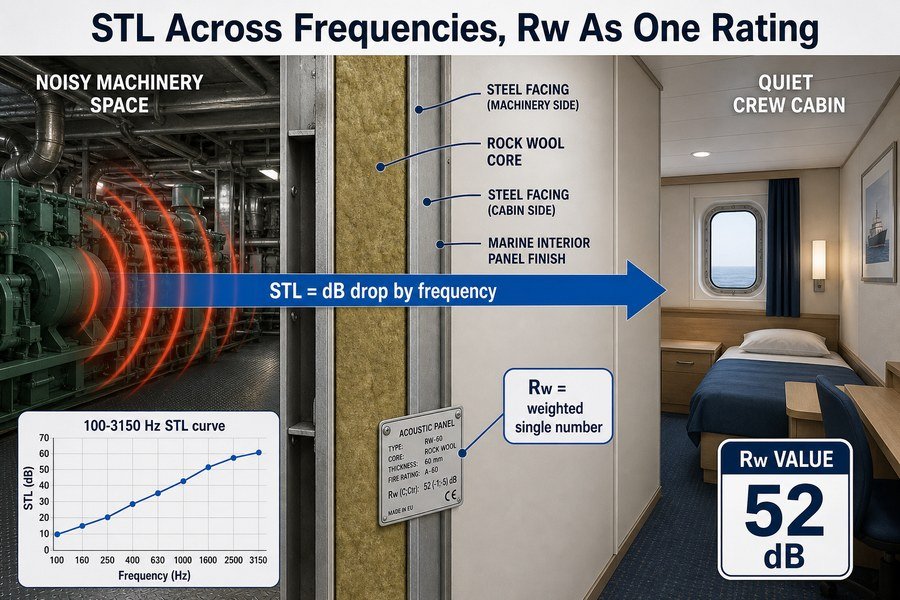
Let us look closer at these exact terms and numbers to help you find the best sound-blocking panels for your next shipyard project.
How Is STL Defined for Marine Interior Panels?
High engine noise ruins cabin comfort. You need a reliable way to measure how well a panel blocks sound. STL gives you that exact measurement across different pitches.
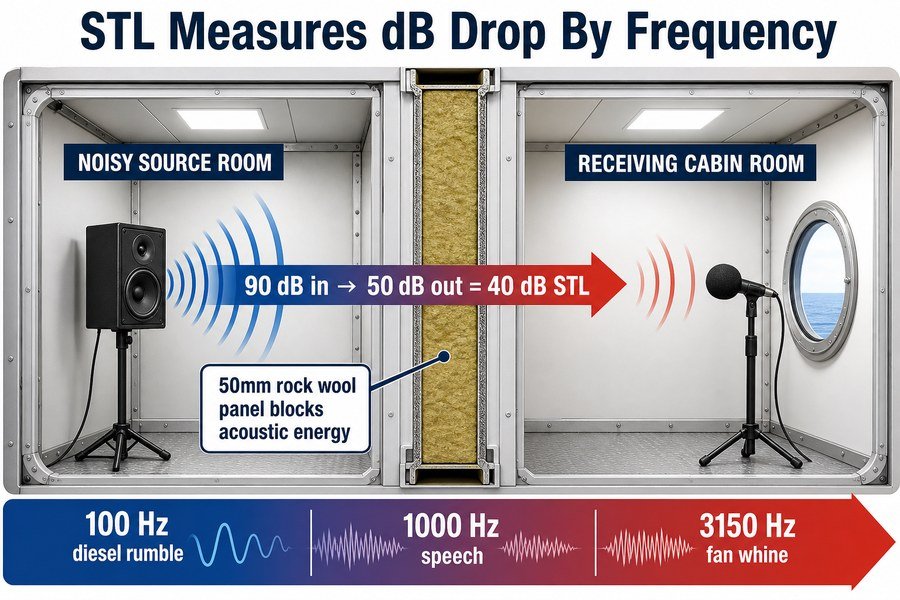
Sound Transmission Loss (STL) for marine panels is defined as the reduction in noise, measured in decibels (dB), at specific frequency bands from 100 Hz to 3150 Hz, indicating exactly how much acoustic energy the panel blocks as sound travels from a noisy space into a quiet cabin.
The Core Definition of Sound Transmission Loss (STL) in Marine Outfitting
I worked in a factory testing marine panels. I saw how STL works firsthand. STL is a physical measurement of blocked acoustic energy. According to the ISO 10140-2 laboratory testing standard1, engineers place a standard 50mm thick marine wall panel between two sealed rooms. One room has a speaker making loud noise. The other room has a microphone to measure what passes through. The difference in sound pressure level between the noisy space and the quiet cabin is the STL. This reduction in noise is always measured in decibels (dB). For example, if the speaker plays a 90 dB noise, and the microphone in the next room only hears 50 dB, the panel has an STL of 40 dB. This means the panel blocked 40 dB of acoustic energy.
Key Frequency Bands for STL Testing in Ship Environments
Sound on a ship does not have just one pitch. Ship noise covers many specific frequency bands. Therefore, acoustic engineers measure STL across a range from 100 Hz to 3150 Hz2. They do not just give one number. They test the panel at 16 different frequency points. A low 100 Hz sound is a deep rumble from a large diesel engine. A high 3150 Hz sound is a sharp whine from an air conditioning fan.
| Sound Source on a Ship | Typical Frequency Band | Required STL for Good Cabin Comfort |
|---|---|---|
| Large Diesel Engine Hum | 100 Hz to 250 Hz | 25 dB to 30 dB |
| Crew Conversation | 500 Hz to 1000 Hz | 35 dB to 40 dB |
| HVAC System Whine | 2000 Hz to 3150 Hz | 45 dB to 50 dB |
I always tell buyers they must check the STL at the exact frequency of their ship's problem noise. You cannot just guess. I have seen buyers purchase cheap panels without checking the low-frequency STL. The shipyard rejected the project because engine vibration noise passed right through the cabin walls. Good panels use high-density rockwool, usually 120 kg/m3 to 150 kg/m3, to achieve high STL values across all 16 testing bands.
How Do STL Curves and Rw Ratings Differ for Marine Interior Panels?
Comparing raw STL data for every panel takes too much time. You risk missing your project deadlines. Rw solves this by simplifying complex STL curves into one easy number.
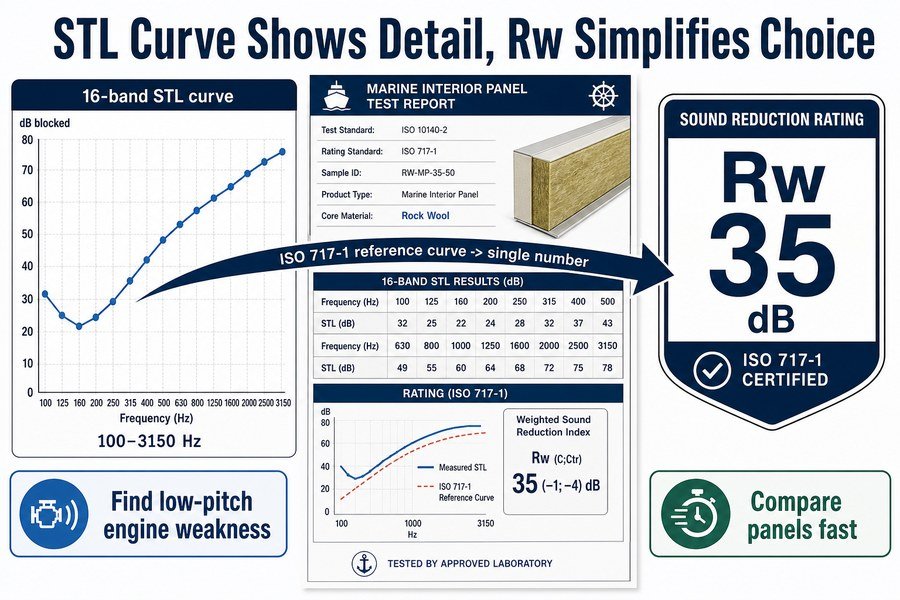
STL curves plot multiple decibel reduction values across 16 specific frequency bands on a graph, showing exact high and low pitch performance. In contrast, Rw is a single-number rating derived by comparing that STL curve to a standardized reference curve per ISO 717-1 for easy product comparison.
Plotting the 16-Band Sound Transmission Loss (STL) Curve
An STL curve is a detailed map of acoustic performance. When a laboratory tests a marine panel, the testing equipment generates a line on a graph. This graph plots the multiple decibel reduction values across the 16 specific frequency bands I mentioned earlier, from 100 Hz to 3150 Hz. This curve shows the exact high and low pitch performance of the panel. For example, the curve might show the panel blocks only 22 dB at 100 Hz, but blocks a massive 52 dB at 3150 Hz. This visual curve tells a shipyard engineer exactly how the panel behaves against different types of engine and wind noises. However, looking at 16 data points for every single panel you want to buy is very slow and confusing.
Calculating the Single-Number Rw Rating Using ISO 717-1
To make purchasing easier, the industry created Rw. Rw stands for Weighted Sound Reduction Index. Rw is a single-number rating.3 How do we get this single number? An acoustic engineer takes the complex STL curve and lays a standardized reference curve on top of it. This process follows the strict rules of the ISO 717-1 standard. They shift the reference curve until the average negative deviation between the two lines is less than 2.0 dB. Once the curves align, they look at the value of the reference curve at exactly 500 Hz. That specific number becomes the final Rw rating.
| Metric Type | Data Format | Best Use Case in Marine Outfitting |
|---|---|---|
| STL Curve | Graph with 16 data points (100 Hz to 3150 Hz) | Analyzing specific low-pitch engine noise problems. |
| Rw Rating | Single number (e.g., Rw 35 dB) | Fast product comparison and basic cabin purchasing. |
This makes your job much faster. If you buy a 50mm B-15 marine wall panel, the datasheet will just say "Rw = 33 dB". You do not need to analyze the full graph. However, two panels can have the same Rw of 35 dB but totally different STL curves4. Panel A might block low-frequency generator noise better. Panel B might block high-frequency air conditioning noise better. For general cabins, comparing the single Rw number is enough.
Why Is Rw the Standard Metric on Marine Interior Panel Datasheets?
Technical datasheets are often packed with confusing data. Buying the wrong panel wastes money. Rw became the standard because it allows fast comparisons across different outfitting suppliers.
Rw is the standard metric because it condenses complex acoustic data into one single value, aligns with international maritime regulations like IMO MSC.337(91), allows fast price-to-performance comparisons across different suppliers, and makes procurement verification for shipyards simple and foolproof.
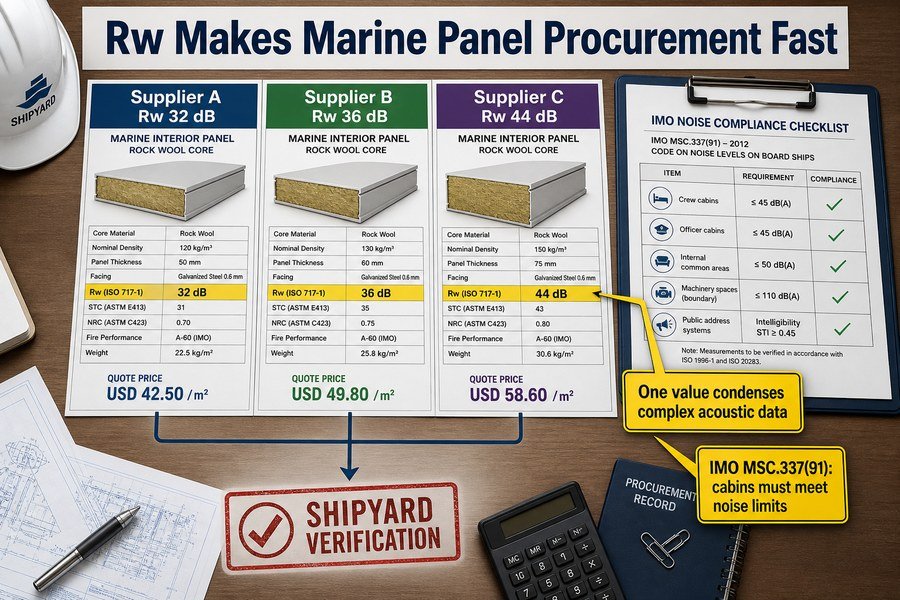
Simplifying Procurement and Supplier Comparisons with Rw
When you are a procurement officer buying from factories in Asia, you look at dozens of quotes every week. If every supplier sent a 16-point graph for every panel, you would waste hours analyzing them. Rw is the standard metric5 because it condenses this complex acoustic data into one single value. This single value allows extremely fast price-to-performance comparisons across different suppliers. For example, if a factory in China offers a standard 50mm rockwool panel with Rw 32 dB for $15 per square meter, and another offers an upgraded panel with Rw 36 dB for $18 per square meter, you can instantly see the value difference. You can make a fast, confident purchasing decision.
Aligning with IMO MSC.337(91) Maritime Noise Regulations
Rw is also the standard because it perfectly aligns with international maritime regulations. The International Maritime Organization (IMO) released the MSC.337(91) code to protect crew health from hearing damage. This code dictates strict noise limits. For example, standard sleeping cabins must not exceed 60 dB(A) of noise. Shipyard engineers use the Rw value of your wall panels to calculate if the final cabin will meet this IMO standard.
| Panel Type | Typical Core Material | Standard Rw Value Range |
|---|---|---|
| Standard B-15 Wall Panel | 120 kg/m3 Rockwool | Rw 30 dB to Rw 33 dB |
| High-Acoustic Wall Panel | Rockwool + 1mm Steel Core | Rw 35 dB to Rw 44 dB |
| High-Acoustic Ceiling | Rockwool + Viscoelastic Foil | Rw 40 dB to Rw 48 dB |
Finally, using a single number makes procurement verification for shipyards simple and foolproof. When your interior decoration project is finished, the shipyard inspector just checks your DNV or Lloyd's Register certificate. They look straight at the Rw number to approve the installation. I have helped many clients win EU shipyard contracts simply by ensuring their datasheets clearly displayed a certified Rw value.
How Do High-Rw Marine Interior Panels Reduce Cabin Airborne Noise?
Airborne noise from conversations travels easily through thin walls. This annoys the crew. High-Rw panels block this noise using specialized mass and internal damping materials.
High-Rw marine panels reduce cabin airborne noise through a combination of heavy outer steel skins that reflect sound waves, dense mineral wool cores that convert acoustic energy into heat, and internal viscoelastic damping layers that break the vibration transmission path between adjacent cabins.
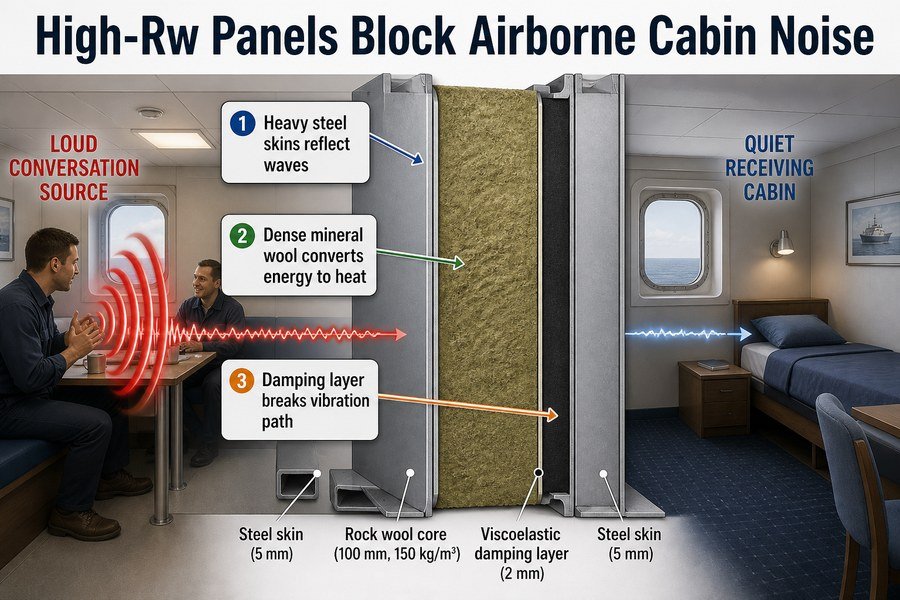
Reflecting Sound Waves with Heavy Steel Skins
How does a wall actually stop people in the next cabin from hearing your conversation? Airborne noise travels through the air as invisible pressure waves. When these waves hit a standard wall, they shake the wall, and the wall creates new noise on the other side. High-Rw marine panels stop this using three specific physical methods. First, they use heavy outer steel skins. In acoustics, heavier objects are harder to move. This is called the mass law6. A standard cheap panel uses 0.5mm steel. A high-Rw panel uses 0.6mm to 0.8mm PVC-coated galvanized steel. This heavy mass acts like a mirror.7 It forces the heavy outer steel skins to reflect the airborne sound waves right back into the noisy room.
Converting Acoustic Energy and Breaking Vibration Paths
Second, high-Rw panels use dense mineral wool cores. When sound does penetrate the outer steel, it hits a thick layer of rockwool. High-quality marine panels use rockwool weighing 120 kg/m3 to 150 kg/m3. The sound waves force the air inside the tiny rockwool fibers to vibrate rapidly. This physical friction converts the acoustic energy into tiny amounts of heat8. The sound literally burns away inside the panel.
| Noise Reduction Component | Physical Mechanism | Impact on Airborne Noise |
|---|---|---|
| 0.6mm - 0.8mm Steel Skin | Mass Reflection | Bounces sound waves back into the source room. |
| 150 kg/m3 Rockwool Core | Energy Conversion | Changes sound wave vibrations into heat energy. |
| 1mm Viscoelastic Foil Layer | Decoupling | Stops physical vibrations from crossing the panel center. |
Third, the very best high-Rw panels use internal viscoelastic damping layers. Sometimes, loud noise travels straight through the metal frame of the panel itself. To stop this, factories add a thin 1mm to 2mm rubber or viscoelastic foil directly between two layers of inner steel. This breaks the vibration transmission path between adjacent cabins.9 The vibration hits the rubber and stops dead. I always remind buyers: if your shipyard client demands strict privacy between passenger cabins, you must buy panels that feature all three of these noise-reducing layers.
How Does STL Differ from Sound Absorption in Marine Interior Panels?
Many buyers confuse blocking sound with absorbing sound, leading to rejected vessel inspections. You must know the exact difference to solve the correct noise problem on the ship.
STL measures how much sound a panel blocks from passing through a wall into another room using decibels (dB), whereas sound absorption measures how much sound a panel's surface stops from echoing back into the same room using a coefficient scale from 0.0 to 1.0.
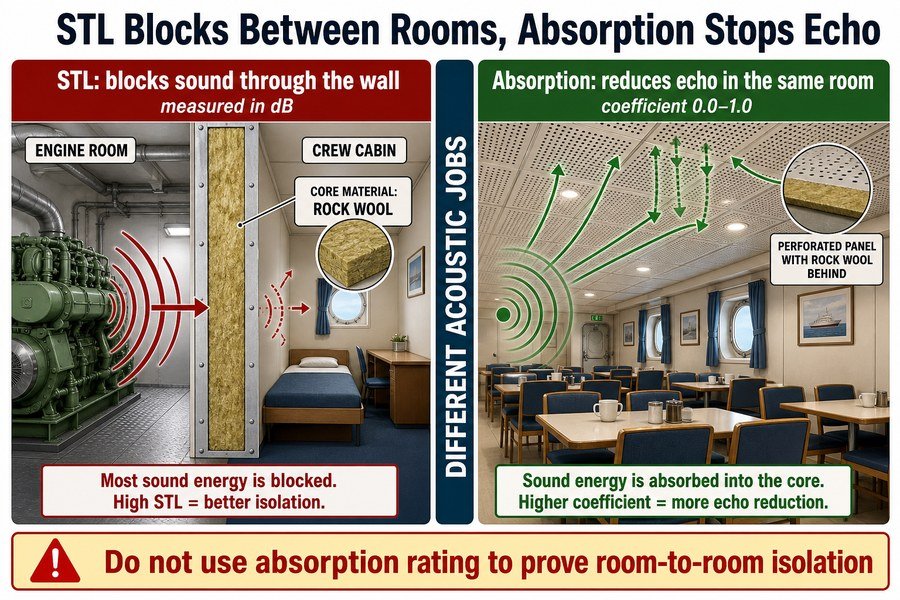
Blocking Noise Between Rooms with STL
I have seen this expensive mistake many times. A buyer wants to quiet a noisy engine control room. They buy panels with high "sound absorption" ratings. They are shocked when the sleeping cabin next door is still loud. STL and sound absorption are two completely different things. STL measures how much sound a panel blocks from passing through a wall into another room.10 As I explained before, STL is measured using decibels (dB). A high STL means the noise stays in the noisy room. It cannot cross the physical boundary of the wall. You use high-STL panels when you want to isolate one room from another.
Reducing Echo Inside a Room with Sound Absorption
On the other hand, sound absorption measures how much sound a panel's surface stops from echoing back into the same room.11 Hard, flat steel surfaces reflect sound. This creates a terrible, ringing echo inside a dining hall or hallway. To fix this, we use perforated marine panels. These panels have thousands of tiny 2mm or 3mm holes punched into the steel. The sound goes into the holes and gets trapped in the rockwool behind it.12
| Acoustic Feature | Primary Function | Measurement Unit | Real-World Application |
|---|---|---|---|
| Sound Transmission Loss (STL) | Blocks sound passing through walls. | Decibels (dB) | Separating a loud engine room from a quiet cabin. |
| Sound Absorption | Stops sound echoing in the same room. | Coefficient (0.0 to 1.0) | Stopping echoes in a large ship dining hall. |
Sound absorption is not measured in dB. It is measured using a coefficient scale from 0.0 to 1.0.13 A value of 0.0 means total reflection, exactly like a solid steel plate. A value of 1.0 means total absorption, exactly like an open window. A good perforated acoustic ceiling panel might have an absorption coefficient of 0.85 at 1000 Hz. If you want to stop noise from bothering the next cabin, you need high STL. If you want to make a ship's dining room less echoey and more comfortable, you need high sound absorption.
What Units Express Marine Interior Panel STL Across Frequencies?
If you read a test report wrong, you might buy the wrong material. Understanding the exact units of measurement keeps your purchasing process safe and highly accurate.
Marine interior panel STL is expressed in decibels (dB) to measure the reduction in sound pressure, while the frequencies at which these decibel drops occur are expressed in Hertz (Hz), typically tested across standard one-third octave bands ranging from 100 Hz to 3150 Hz.
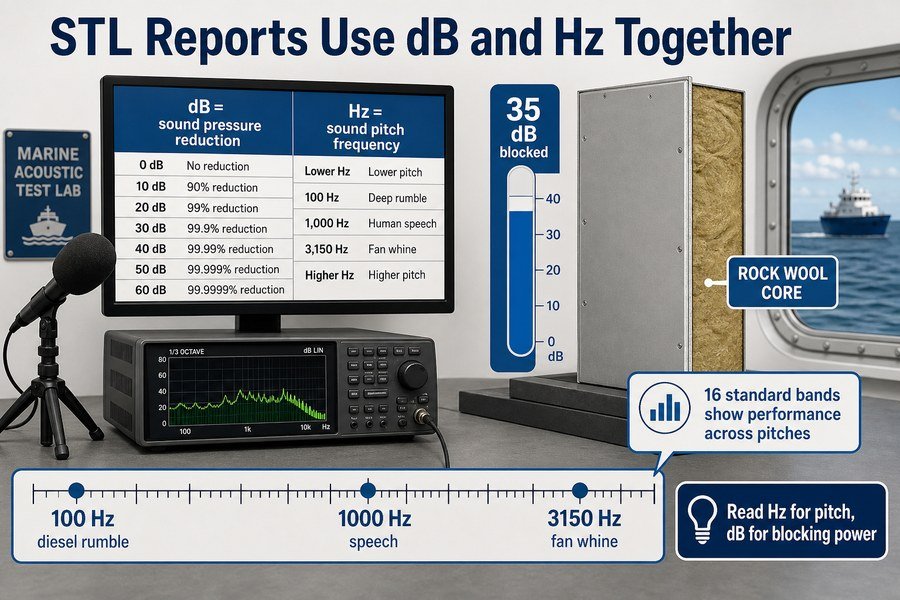
Measuring Sound Pressure Reduction in Decibels (dB)
When you open a laboratory acoustic report from a Chinese or Vietnamese testing facility, you will see a large table of numbers. Do not let it confuse you. You only need to care about two specific units: decibels (dB) and Hertz (Hz). First, marine interior panel STL is expressed in decibels (dB). A decibel is a unit used to measure the reduction in sound pressure. The human ear hears sound on a logarithmic scale. Therefore, decibels are also logarithmic. This means an STL drop of just 3 dB actually represents a 50% reduction in physical acoustic energy14. If a supplier tells you their panel has an Rw of 40 dB, that is a massive amount of sound blocking power.
Identifying Sound Pitch in Hertz (Hz) Across Standard Bands
Second, the exact frequencies at which these decibel drops occur are expressed in Hertz (Hz). Hertz measures the pitch of the sound by counting the sound wave vibrations per second. A low pitch, like a ship's main diesel engine, vibrates slowly. We measure this around 100 Hz. A high pitch, like a warning alarm, vibrates quickly. We measure this around 3000 Hz.
| Measurement Unit | What It Measures | Standard Testing Range | Example |
|---|---|---|---|
| Decibel (dB) | Sound Pressure Reduction (Volume) | 0 dB to 60+ dB | The panel blocked 35 dB of noise. |
| Hertz (Hz) | Sound Frequency (Pitch) | 100 Hz to 3150 Hz | The test was done at a low 125 Hz pitch. |
During laboratory testing, acoustic engineers do not test every single number between 100 and 3150. They use standard one-third octave bands. This means they test the STL in specific, standardized chunks. These standard one-third octave bands range from 100 Hz to 3150 Hz. There are exactly 16 of these standard bands tested in a normal ISO report.15 By reading both the Hz to know the pitch, and the dB to know the amount of blocked sound, you know exactly how the panel will perform on the real ship.
Conclusion
Understanding STL decibel drops and single-number Rw ratings ensures you buy the right marine panels, meet IMO regulations, and easily provide cost-effective noise solutions to your shipyard clients.
-
"Sound insulation dataset of 30 wooden and 8 concrete floors ...", https://pmc.ncbi.nlm.nih.gov/articles/PMC10365936/. ISO 10140-2 specifies a laboratory method for measuring airborne sound insulation of building elements using source and receiving rooms, with the sound reduction index calculated from level differences and receiving-room absorption conditions. Evidence role: definition; source type: institution. Supports: STL is measured in a laboratory by placing a test element between two rooms and comparing sound levels between the source and receiving sides.. Scope note: The standard supports the laboratory measurement concept but does not establish a universal 50 mm marine panel specimen; specimen thickness and mounting depend on the product being tested. ↩
-
"[PDF] Airborne Sound Transmission Loss Characteristics of Wood-Frame ...", https://research.fs.usda.gov/download/treesearch/20271.pdf. ISO 717-1 and related building-acoustics practice use one-third-octave-band sound reduction data over the 100 Hz to 3150 Hz range when deriving single-number airborne sound insulation ratings, which contextualizes this frequency span as a standard reporting range. Evidence role: general_support; source type: institution. Supports: Acoustic transmission loss is commonly evaluated over frequency bands from 100 Hz to 3150 Hz rather than as only one broadband number.. Scope note: This supports the common acoustics rating range, but it does not by itself prove that every marine outfitting specification requires exactly the same range or exactly 16 test points. ↩
-
"Sound reduction index - Wikipedia", https://en.wikipedia.org/wiki/Sound_reduction_index. ISO 717-1 defines the weighted sound reduction index, Rw, as a single-number quantity derived from frequency-dependent airborne sound insulation measurements. Evidence role: definition; source type: institution. Supports: Rw is the Weighted Sound Reduction Index and is expressed as a single-number rating.. ↩
-
"Analysis between weighted sound reduction index according to ISO ...", https://www.academia.edu/21437199/Analysis_between_weighted_sound_reduction_index_according_to_ISO_717_1_and_indices_according_to_ISO_16717_1. Research and standards discussions of single-number sound insulation ratings note that Rw condenses frequency-dependent transmission loss data into one value, so constructions with the same Rw can have different spectral performance across low and high frequencies. Evidence role: general_support; source type: paper. Supports: Panels with the same Rw can have different sound transmission loss curves and therefore different low- and high-frequency performance.. Scope note: This support establishes the limitation of single-number ratings generally; it does not prove the specific hypothetical value of Rw 35 dB for the two example panels. ↩
-
"Sound reduction index - Wikipedia", https://en.wikipedia.org/wiki/Sound_reduction_index. ISO 717-1 defines the weighted sound reduction index, Rw, as a single-number rating derived from frequency-dependent airborne sound insulation measurements, which supports its use as a concise descriptor of panel acoustic performance. Evidence role: definition; source type: institution. Supports: Rw is a standardized single-number metric used to summarize complex acoustic insulation data.. Scope note: This supports Rw as a standardized acoustic rating, but it does not directly prove that it makes procurement decisions faster. ↩
-
"[PDF] Ultrasonic, Normal-Incidence Insertion Loss through Common ...", https://physics.byu.edu/docs/thesis/269. A building-acoustics source should define the mass law as the approximate increase in sound transmission loss with greater surface mass and frequency for a limp, homogeneous barrier. Evidence role: definition; source type: education. Supports: In acoustics, heavier wall or panel elements are harder for airborne sound to move, a principle called the mass law.. Scope note: The mass law is an idealized model; real panels deviate because of stiffness, resonances, leaks, and coincidence effects. ↩
-
"[PDF] Chapter 6 – Reflection and Transmission", https://jontallen.ece.illinois.edu/uploads/473.F18/Lectures/Chapter_6a.pdf. A source on acoustic impedance and sound reflection should support that dense, stiff boundaries can reflect a substantial portion of incident airborne sound because of impedance mismatch. Evidence role: mechanism; source type: education. Supports: Heavy steel skins can reflect part of the incident airborne sound rather than allowing all of it to pass through the panel.. Scope note: This supports the reflection analogy only in a simplified sense; a steel-skinned panel also transmits, vibrates, and absorbs some acoustic energy depending on frequency and construction. ↩
-
"[PDF] Rigid-Frame Porous Material Acoustic Attenuation on Compressor ...", https://docs.lib.purdue.edu/cgi/viewcontent.cgi?article=3094&context=icec. A porous-absorber acoustics source should explain that mineral wool attenuates sound through viscous and thermal losses as air oscillates in its interconnected pores, converting part of the acoustic energy into heat. Evidence role: mechanism; source type: paper. Supports: Rockwool or mineral-wool cores reduce airborne sound partly by converting acoustic energy into heat through viscous and thermal losses in the porous fibre structure.. Scope note: This supports the heat-conversion mechanism, but not the colloquial statement that sound “burns away” or any specific mineral-wool density range. ↩
-
"(PDF) Vibro-acoustic characteristics of viscoelastic sandwich panel: effect ...", https://www.academia.edu/83436899/Vibro_acoustic_characteristics_of_viscoelastic_sandwich_panel_effect_of_inherent_damping. A vibration-control or sandwich-panel source should support that viscoelastic interlayers add damping and can reduce structure-borne vibration transmission by dissipating vibrational energy as heat. Evidence role: mechanism; source type: paper. Supports: A rubber or viscoelastic layer within a panel can reduce vibration transmission by damping structural motion and interrupting direct mechanical coupling.. Scope note: Such sources generally support the damping principle, not the absolute claim that vibration stops completely or that every cabin partition requires this exact layer arrangement. ↩
-
"[PDF] Determination of Sound Transmission Class (STC)", https://www.montana.edu/rmaher/eele417_fl14/Determination_of_STC.pdf. A standards or acoustics reference defines sound transmission loss as a decibel measure of the reduction in airborne sound energy transmitted through a partition, supporting the distinction between blocking transmission and treating sound within the source room. Evidence role: definition; source type: institution. Supports: STL measures how much sound a panel blocks from passing through a wall into another room.. Scope note: This supports the general acoustic definition; actual shipboard performance depends on installation details, flanking paths, and test conditions. ↩
-
"(PDF) An alternative coefficient for sound absorption - Academia.edu", https://www.academia.edu/108125551/An_alternative_coefficient_for_sound_absorption. An acoustics reference explains that sound absorption describes the fraction of incident sound energy not reflected by a surface, supporting the use of absorptive materials to reduce reflections and reverberation within a room. Evidence role: definition; source type: education. Supports: Sound absorption measures how much sound a panel's surface stops from echoing back into the same room.. Scope note: The source may describe room acoustics generally rather than marine interiors specifically. ↩
-
"Acoustic Absorption in Porous Materials", https://ntrs.nasa.gov/api/citations/20110011143/downloads/20110011143.pdf. Research on perforated-panel absorbers describes how perforations coupled with a porous backing dissipate acoustic energy through viscous and thermal losses, supporting the stated mechanism for perforated panels backed by mineral wool. Evidence role: mechanism; source type: paper. Supports: Perforated panels reduce reflected sound by allowing sound into perforations where backing material such as rockwool dissipates acoustic energy.. Scope note: The mechanism is generally established for perforated absorbers, but absorption varies with hole diameter, perforation ratio, air gap, backing density, and frequency. ↩
-
"[PDF] Understanding the Impact of Room Acoustic Conditions on the ...", https://digitalcommons.unl.edu/cgi/viewcontent.cgi?article=1063&context=archengdiss. Acoustics standards and teaching references define the sound absorption coefficient as a dimensionless ratio commonly ranging from 0 for complete reflection to 1 for complete absorption, supporting the article’s measurement distinction from decibels. Evidence role: definition; source type: institution. Supports: Sound absorption is measured as a coefficient from 0.0 to 1.0 rather than in decibels.. Scope note: Some derived room-acoustic quantities, such as absorption area or noise reduction coefficient, may be reported differently, so the note applies specifically to absorption coefficient values. ↩
-
"Sound Intensity and Sound Level – ISP209", https://openbooks.lib.msu.edu/collegephysics/chapter/sound-intensity-and-sound-level/. A source on the decibel scale should support that a 3 dB change corresponds approximately to a factor-of-two change in acoustic power or intensity, because decibels express logarithmic ratios. Evidence role: mechanism; source type: education. Supports: A 3 dB change in sound transmission loss corresponds approximately to a 50% reduction in physical acoustic energy.. Scope note: This supports the energy or intensity relationship, not a direct 50% change in perceived loudness or sound-pressure amplitude. ↩
-
"[PDF] The finite layer method for modelling the sound transmission ...", https://upcommons.upc.edu/bitstreams/6ce7ff3e-10c0-4bbc-baa9-c0aea47a9c5a/download. A standards or acoustics reference should document that airborne sound insulation measurements are commonly reported in one-third-octave bands from 100 Hz to 3150 Hz, yielding 16 nominal center-frequency bands in that range. Evidence role: definition; source type: institution. Supports: Normal ISO-style acoustic reports test 16 standard one-third-octave bands from 100 Hz to 3150 Hz.. Scope note: This supports the conventional ISO-style reporting range; specific marine or laboratory reports may include optional extended low- or high-frequency bands. ↩