Buying uncertified marine panels can ruin your shipyard project and cost you millions in rework. Avoid these rejections by knowing exactly how to check fire and smoke certificates.
To verify marine interior panel certifications, you must cross-check the Type Approval Certificate against the IMO 2010 FTP Code, ensure the specific material thickness matches the lab test reports, confirm the Notified Body's valid stamp (like DNV or ABS), and validate the Wheelmark (MED) for European projects.
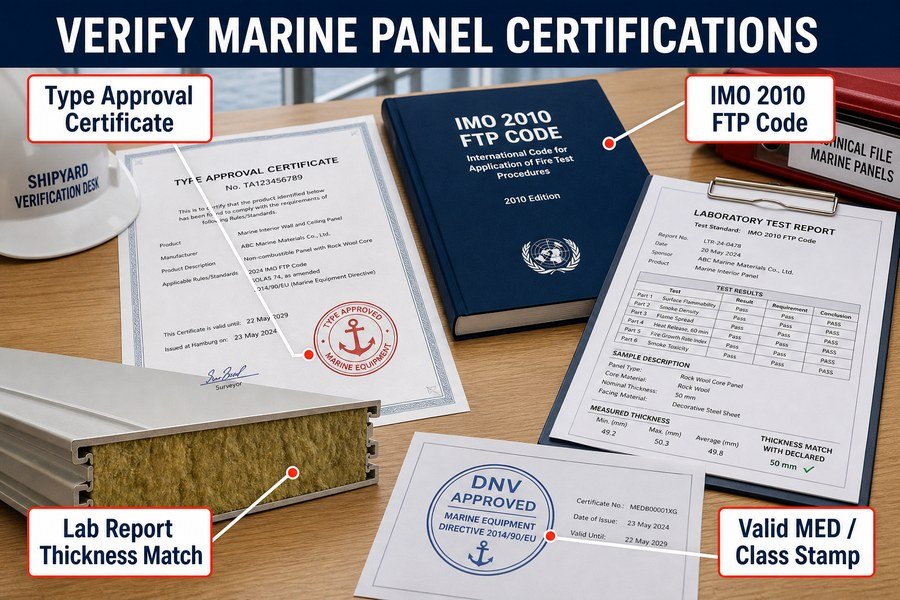
Certifications often look authentic at first glance, but missing just one detail can lead to a failed vessel inspection. Let me show you exactly what to look for based on my years of dealing with factory documentation.
How to Verify an A-60 Marine Bulkhead's Type Approval Certificate?
Are you worried that your A-60 bulkhead might fail inspection? Substandard factory documents delay projects. Here is how to verify that Type Approval Certificate fast.
Verify an A-60 certificate by checking four items: the certificate's expiry date, the specific classification society (e.g., DNV, Lloyd's), the exact approved insulation thickness (typically 50mm to 75mm of 110kg/m³ rockwool), and the specific joint profiles tested according to IMO Resolution MSC.307(88).
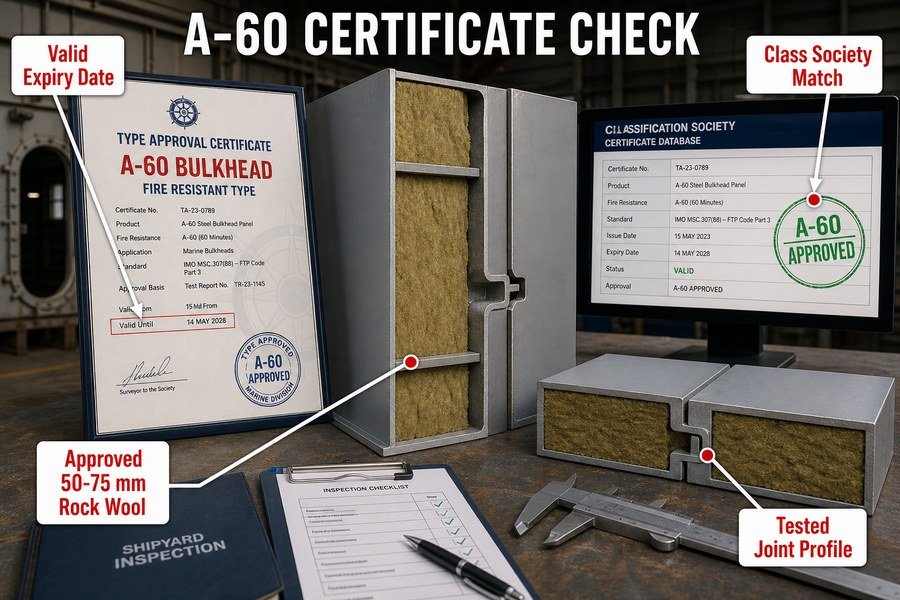
Validating the Certificate Expiry Date and Classification Society
When I get an A-60 bulkhead certificate from a new supplier, I look at the expiry date first. Classification societies like DNV, ABS, or Lloyd's Register issue Type Approval Certificates (TAC) that are valid for exactly five years. A factory might send you an expired document. You must reject this. The date is clearly printed at the bottom of the first page. Next, I check the classification society. The society issuing the certificate must match the requirements of the shipyard or the ship's flag state. If the shipyard wants a DNV certificate, an ABS certificate will not work. You need to confirm this detail early. I always go to the official website of the classification society. I type the certificate number into their database. This step proves the document is real and not a fake PDF file created by a dishonest salesperson.
Checking Approved Insulation Thickness and Specific Joint Profiles
After checking the date and society, I look at the technical details. The certificate must state the exact approved insulation thickness. According to standard IMO fire test data, a true A-60 rating requires heavy rockwool. The certificate usually lists 50mm to 75mm of rockwool with a density of 110kg/m³ or 120kg/m³. If a factory shows you a 25mm thick panel and claims it is a standalone A-60 bulkhead, they are lying. Physics does not allow that. Finally, I check the specific joint profiles. The way two panels connect is the weakest point in a fire. The certificate must show the exact joint type tested according to IMO Resolution MSC.307(88). How Is the IMO FTP Code Structured into Annexes and Parts?1. If the factory tested a complex spline joint, but they sell you a simple C-joint, the certificate is invalid for your purchase.
| Verification Item | What to Look For on Certificate | Authoritative Source / Standard |
|---|---|---|
| Expiry Date | Must be valid (5-year lifespan) | Class Society Database |
| Class Society | Must match shipyard requirement | DNV, ABS, LR, BV |
| Insulation Thickness | 50mm - 75mm rockwool (110kg/m³) | IMO A-60 Test Reports |
| Joint Profile | Must match the actual purchased joint | IMO Res. MSC.307(88) |
What Test Data Confirms Smoke and Toxicity Compliance for Marine Ceiling Panels?
Toxic smoke kills faster than fire, making bad ceiling panels a massive liability. Stop guessing and learn exactly which test data proves your panels are safe.
Smoke and toxicity compliance for marine ceiling panels is confirmed by checking three specific test data points: maximum specific optical smoke density (Ds max ≤ 200), gas concentration limits for toxic gases like Carbon Monoxide (CO ≤ 1450 ppm), and Hydrogen Chloride (HCl ≤ 600 ppm) per IMO FTP Code Part 2.
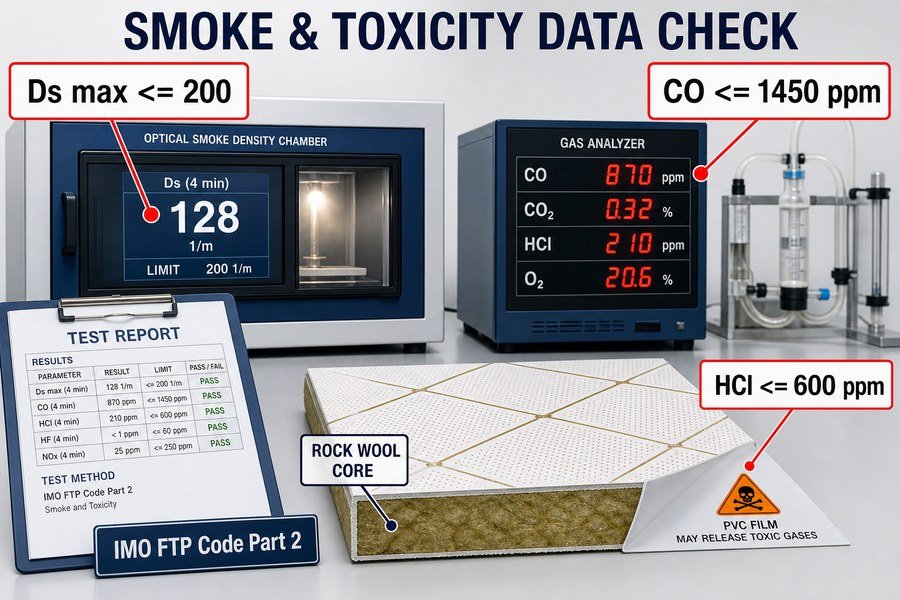
Analyzing Optical Smoke Density (Ds Max) in Marine Ceiling Panels
I always check the laboratory test report to find the specific optical smoke density. The maritime industry uses the term Ds max for this value. The IMO 2010 FTP Code Part 2 states a strict rule. The Ds max value for marine ceiling panels must be less than or equal to 200. This number means the smoke cannot be too thick. If a fire starts, the crew needs to see the exit signs. When a factory sends me a test report, I skip straight to the data tables. I look for the Ds max number. I have seen cheap ceiling panels with a PVC film score over 300 in factory pre-tests. Those panels fail the official test. You must make sure the test report clearly shows a number below 200.
Verifying Toxic Gas Concentration Limits (CO and HCl) for Safety
Thick smoke is bad, but toxic gas is deadly. The test report must also show the gas concentration limits. The IMO FTP Code Part 2 sets clear limits for several gases. The two most important ones are Carbon Monoxide (CO) and Hydrogen Chloride (HCl). The CO limit is 1450 ppm (parts per million). The HCl limit is 600 ppm. Hydrogen Chloride comes from burning PVC films. Toxicity of the Pyrolysis and Combustion Products of Polyvinyl Chlorides2. Many decorative ceiling panels use PVC. If the factory uses a cheap, thick PVC film, the HCl level will go over 600 ppm. I always check these two numbers in the lab data. If the factory report hides the ppm values, they are hiding a failed test.
| Toxic Gas / Metric | IMO FTP Code Part 2 Maximum Limit | Impact on Passenger Safety |
|---|---|---|
| Optical Smoke Density (Ds max) | ≤ 200 | Visibility for evacuation |
| Carbon Monoxide (CO) | ≤ 1450 ppm | Prevents asphyxiation |
| Hydrogen Chloride (HCl) | ≤ 600 ppm | Prevents lung burning |
| Sulfur Dioxide (SO2) | ≤ 120 ppm | Protects respiratory system |
Which IMO FTP Code Parts Apply to Decorative Marine Interior Walls?
Confused by endless IMO regulations for your decorative walls? Applying the wrong test ruins compliance. Here is the exact breakdown you need to avoid costly mistakes.
Decorative marine interior walls must comply with three specific sections of the IMO 2010 FTP Code: Part 5 for surface flammability, Part 2 for smoke and toxicity, and Part 3 for the fire resistance of the core panel (A, B, or F Class rating) supporting the decoration.
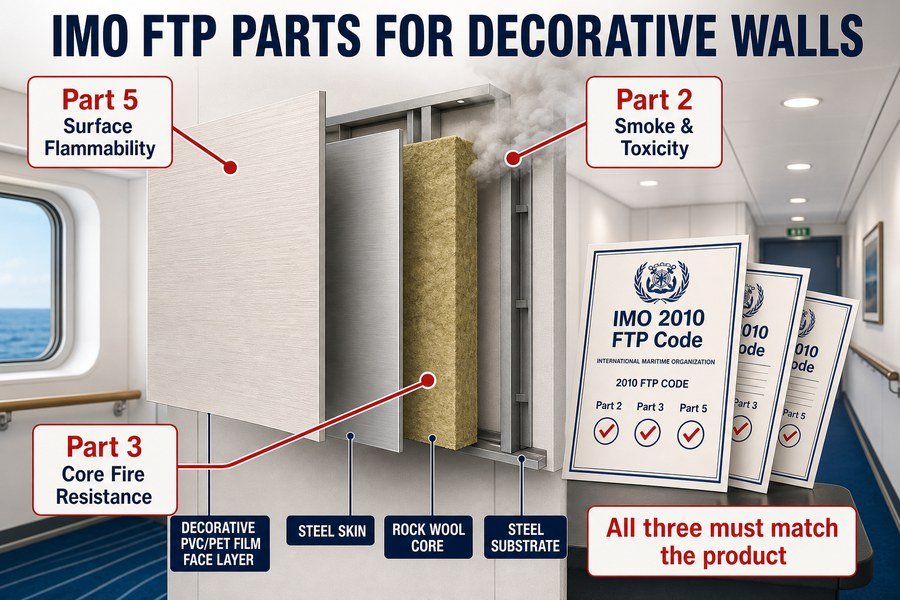
Complying with IMO FTP Code Part 5 for Surface Flammability
When you buy a decorative marine interior wall, the surface is usually covered with a PVC or PET film. This film must not spread fire. To prove this, the product must pass the IMO 2010 FTP Code Part 5. This part tests surface flammability. The laboratory puts the panel near a heat source. They measure how fast the flame travels across the decorative film. The test also measures how much heat the panel releases. I always ask the supplier for their Part 5 certificate. If the film burns too fast, the fire will spread from one cabin to another in minutes. A simple bare steel panel does not need this test, but any panel with a decorative finish must have it.
Integrating Part 2 Smoke Toxicity and Part 3 Core Fire Resistance
The surface flammability is just the beginning. The wall must also pass Part 2 and Part 3. As I mentioned before, Part 2 tests the smoke and toxicity. When that decorative film burns, it cannot release dangerous levels of toxic gas. Finally, you must look at Part 3. Part 3 tests the fire resistance of the core panel itself. The core is the thick part of the wall, usually filled with rockwool. Part 3 gives the wall its official rating, like B-15 or A-0. The wall must stop the fire from breaking through for a specific time. You need all three parts. A wall can have a great Part 3 core, but if the decorative film fails Part 5 or Part 2, the whole product is illegal to use on a ship.
| IMO 2010 FTP Code Section | What It Tests | What Part of the Wall is Tested |
|---|---|---|
| Part 5 | Surface Flammability (Flame spread) | The outer decorative finish (PVC/PET film) |
| Part 2 | Smoke Generation and Toxicity | The outer decorative finish burning gases |
| Part 3 | Fire Resistance (A, B, F Class) | The structural core (Rockwool and steel) |
How to Ensure a Marine Interior Panel Was Fire-Tested With Its Actual Finish?
Factories sometimes test bare metal panels but sell you PVC-coated ones. This bait-and-switch voids your certification. Learn how to verify the tested finish matches the product.
Ensure a marine interior panel was tested with its actual finish by comparing two documents: the "Product Description" on the Type Approval Certificate must explicitly list the exact decorative finish material (e.g., 150-micron PVC film), and the associated laboratory test report must state this same finish was physically burned.
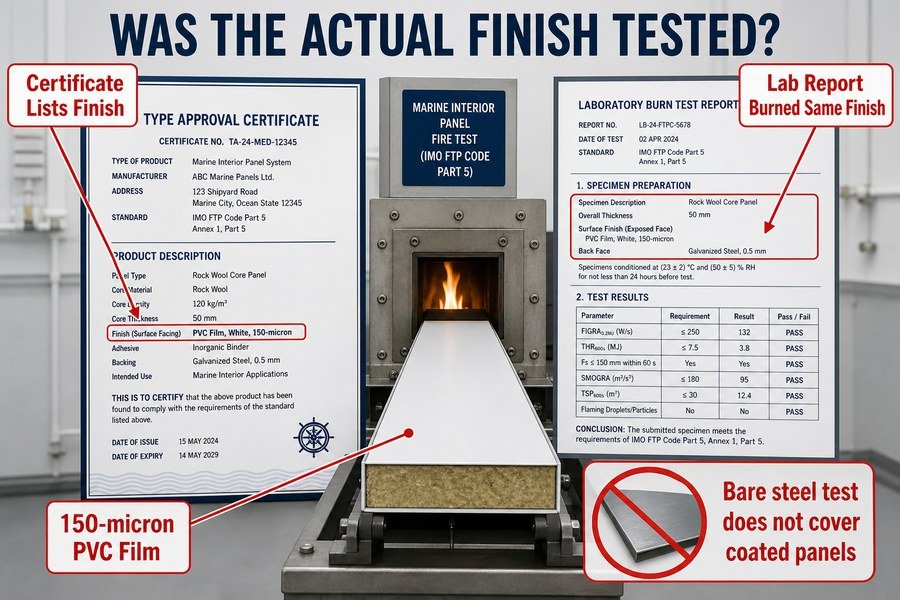
Scrutinizing the Type Approval Certificate for Finish Specifications
Many buyers make a huge mistake here. They look at a B-15 certificate, see a valid stamp, and place an order. But I always read the "Product Description" section very carefully. A factory can get a B-15 certificate for a bare, unpainted galvanized steel panel. Bare steel does not burn. It is easy to pass the test. But then the factory adds a 150-micron PVC wood-grain film to the panel to make it look nice for the buyer. If the Type Approval Certificate only says "Galvanized Steel Panel," the certificate does not cover the PVC film. How Does the IMO FTP Code Govern Fire Testing Procedures for Marine Panels?3. The certificate must explicitly list the exact decorative finish material. It needs to say something like "Covered with PVC film of maximum 150 microns thickness." If this text is missing, the panel you buy has no legal certification.
Cross-Checking the Laboratory Test Report for Physical Burn Proof
I do not stop at the certificate. I ask the factory for the full laboratory test report. The certificate is just a summary. The lab report tells the true story of the test day. The report has a section describing the specimen prepared for the test. I read this part to see what the engineers actually put into the fire furnace. The report must state that the panel had the PVC film attached during the burn test. Evaluations of Fire-Retardant Fiber-Reinforced Polymer Composites for Naval Applications4. It should record the weight and thickness of that film. If the lab report describes a bare metal panel, but the factory is selling you a coated panel, they are tricking you. You must force the factory to provide a report that proves the actual finish was burned.
| Document to Check | Target Section | Verification Requirement |
|---|---|---|
| Type Approval Certificate | Product Description | Must list finish type and max thickness (e.g., 150-micron PVC) |
| Laboratory Test Report | Specimen Preparation | Must state the finish was present during the burn |
| Purchase Order | Material Specifications | Must match the exact finish listed in both documents above |
What Gaps Exist Between Marketing Claims and Certified Fire Tests for Marine Walls?
Sales brochures often promise impossible fire ratings for thin panels. Falling for this means purchasing illegal products. Here is how to spot the lies.
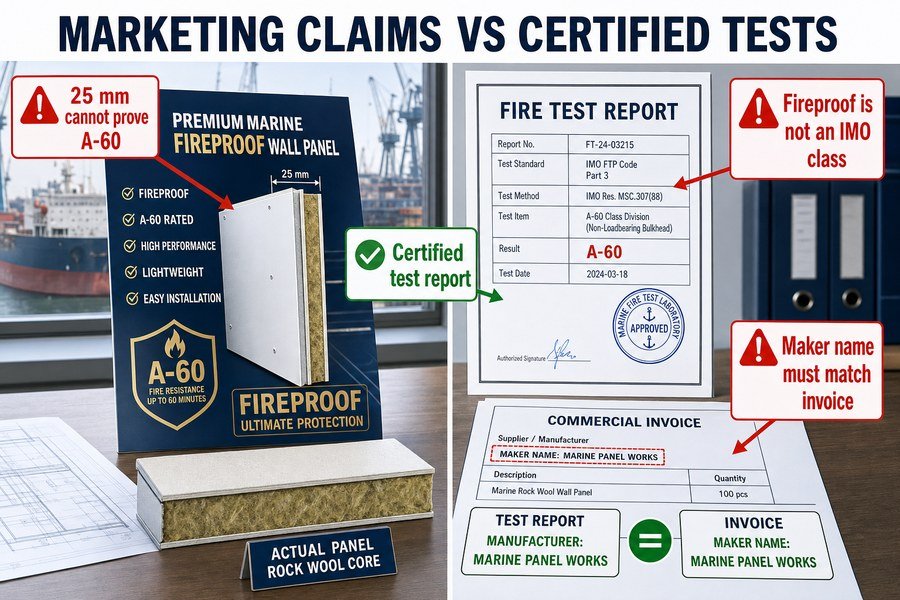
Three major gaps exist between marketing claims and actual certified fire tests for marine walls: claiming A-60 ratings without the required 50mm insulation, advertising "fireproof" status without specifying IMO FTP Part 3 compliance, and using one supplier's certificate to cover a completely different factory's untested product.
Exposing False A-60 Thickness Claims and Vague Fireproof Labels
In my years working with marine suppliers, I have seen many wild marketing claims. The first big gap is the false A-60 thickness claim. A salesperson will show you a beautiful, thin 25mm wall panel. They will tell you it is A-60 rated. This is physically impossible for standard rockwool panels. To pass an IMO A-60 test, the panel must stop heat transfer for 60 minutes. This requires at least 50mm of high-density rockwool (usually 110kg/m³). The 25mm panel might be B-15, but never A-60. The second gap is the word "fireproof." Sales brochures love this word. But "fireproof" has no legal meaning in shipbuilding. A panel is only compliant if it has a specific class rating, like B-15 or A-0, based on IMO FTP Part 3 compliance. When I see the word "fireproof" without an IMO class, I know the supplier is unprofessional.
Identifying Borrowed Certificates and Untested Factory Products
The third gap is the most dangerous one. It is the gap between the paper and the factory. In some parts of Asia, a small factory will borrow a Type Approval Certificate from a larger, certified factory. The small factory prints their own brochure using the big factory's test data. They claim the product is certified. This is a massive risk. The product you receive is totally untested. I solve this by checking the manufacturer's name and address on the Type Approval Certificate. FAA and Industry Guide to Product Certification5. The name on the certificate must exactly match the name of the company on your commercial invoice. If the salesperson says, "That is our sister company," I ask for a formal OEM agreement stamped by the classification society. If they cannot provide it, I walk away.
| Marketing Claim | The Certified Reality | Action Required by Buyer |
|---|---|---|
| "25mm A-60 Panel" | A-60 requires at least 50mm insulation | Ask for the specific A-60 lab test report |
| "100% Fireproof" | Meaningless term; needs IMO Part 3 | Demand exact B-15 or A-60 classification |
| Certificate from "Partner" | Product is untested by actual maker | Check name on certificate matches invoice |
Conclusion
Verifying marine interior panel certifications requires strict cross-checking of IMO FTP codes, lab reports, and Type Approvals. Master these details to secure safe, compliant, and cost-effective outfitting projects.
-
"How Is the IMO FTP Code Structured into Annexes and Parts?", https://magellanmarinetech.com/how-is-imo-ftp-code-structured-into-annexes-parts/. IMO Resolution MSC.307(88), the 2010 FTP Code, specifies fire-test procedures for divisions and requires assessment of the tested construction, which supports tying approval to the tested assembly details, including joints and connections where applicable. Evidence role: mechanism; source type: institution. Supports: The approved joint profile must correspond to the joint configuration tested under IMO Resolution MSC.307(88). Scope note: The resolution establishes the test framework; whether a different commercial joint is outside approval must be confirmed against the specific certificate and test report. ↩
-
"Toxicity of the Pyrolysis and Combustion Products of Polyvinyl Chlorides", https://www.nist.gov/publications/toxicity-pyrolysis-and-combustion-products-polyvinyl-chlorides-literature-assessment. Combustion and thermal decomposition studies of polyvinyl chloride describe hydrogen chloride as a major decomposition product, which supports the statement that PVC films can generate HCl when burned. Evidence role: mechanism; source type: paper. Supports: Hydrogen Chloride comes from burning PVC films. Scope note: The amount of HCl released depends on formulation, additives, thickness, ventilation, and fire conditions, so the source supports the chemical mechanism rather than a specific ppm result for any given panel. ↩
-
"How Does the IMO FTP Code Govern Fire Testing Procedures for Marine Panels?", https://magellanmarinetech.com/how-does-imo-ftp-code-govern-fire-testing-procedures-for-marine-panels/. Type-approval and conformity-assessment rules generally limit certification to the product construction, materials, and configuration described in the certificate and tested specimen, so an added surface finish may fall outside the approved scope if it is not included. Evidence role: general_support; source type: institution. Supports: A certificate for a bare galvanized steel panel may not certify the same panel after addition of a PVC decorative film. Scope note: This is contextual support from approval-scope principles; the exact legal effect depends on the issuing authority, certificate wording, and applicable flag-state or class rules. ↩
-
"Evaluations of Fire-Retardant Fiber-Reinforced Polymer Composites for Naval Applications", https://verso.uidaho.edu/view/pdfCoverPage?instCode=01ALLIANCE_UID&filePid=13308580280001851&download=true. Fire-test standards for marine materials require the tested specimen to represent the actual construction and surface condition being approved, supporting the need to include applied coverings or finishes when those finishes are part of the supplied product. Evidence role: mechanism; source type: institution. Supports: The laboratory burn test should include the PVC film if the finished product sold to the buyer includes that film. Scope note: The source would support representative testing requirements; it would not by itself prove that every PVC film thickness changes the B-15 result. ↩
-
"FAA and Industry Guide to Product Certification", https://www.faa.gov/sites/faa.gov/files/aircraft/air_cert/design_approvals/transport/CPI_guide.pdf. Classification-society and marine-equipment type-approval certificates identify the approved product, certificate holder, manufacturer, and often production location, supporting the need to verify that the supplied goods correspond to the entity and site covered by the certificate. Evidence role: mechanism; source type: institution. Supports: Buyers should verify the manufacturer identity and address on a marine Type Approval Certificate against the actual supplier documentation.. Scope note: Certificate formats vary by authority, and matching names is a due-diligence control rather than a complete guarantee against nonconforming production. ↩