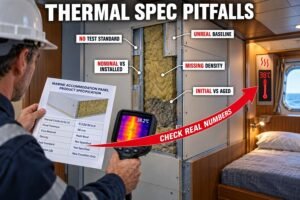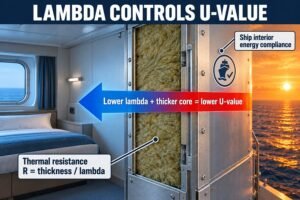
Many buyers lose money on ship interior projects because cheap panels fail fire tests. I help you spot bad deals and protect your shipyard budget.
Procurement traps with fire-rated marine interior panels include buying panels with fake certificates, ignoring core weight limits, and accepting wrong steel thicknesses. You must verify MED or USCG certificates, check core densities like 140 to 180 kilograms per cubic meter for rockwool, and ensure skin steel is 0.6 millimeters thick.
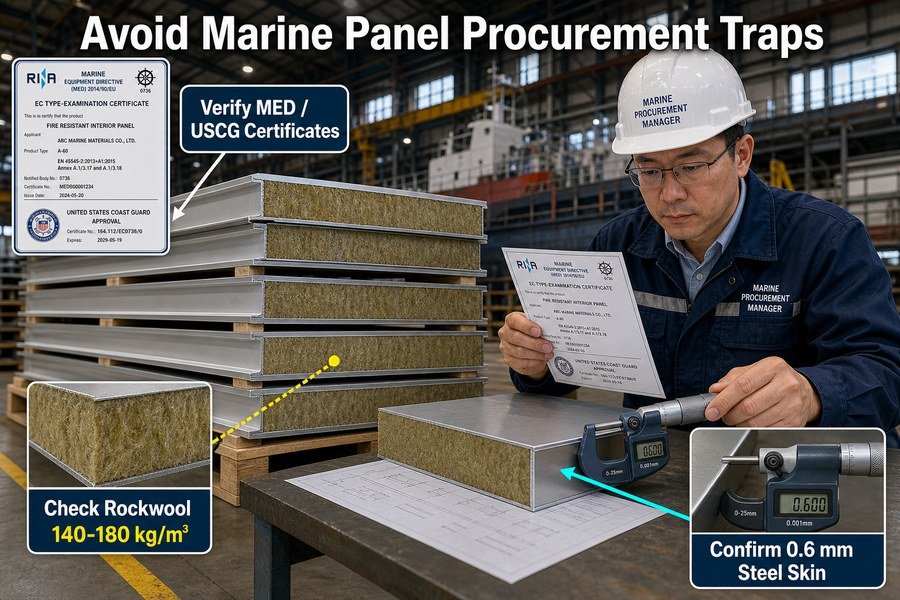
I see many buyers rush to buy cheap panels. They do not check the details. Then the ship fails the safety inspection. This costs much more money later.
What Are Common Errors When Specifying Fire-Rated Marine Interior Walls?
Buyers often make simple mistakes on paperwork that lead to rejected materials at the port.
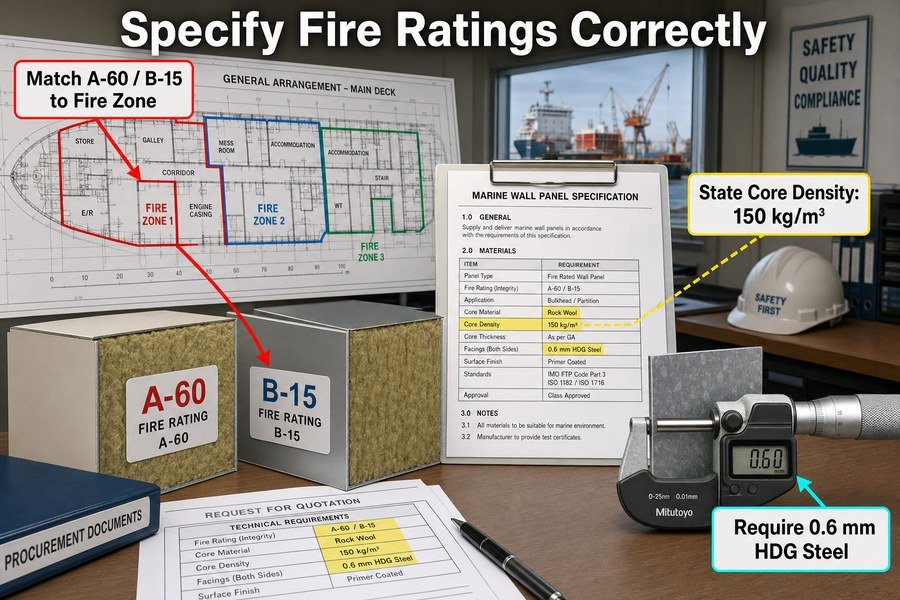
Common specification errors include mixing up bulkhead fire ratings like A-60 and B-15, omitting core density requirements, and failing to specify skin metal types. You must list exact ratings, state a core density of 150 kilograms per cubic meter, and demand 0.6 millimeter hot-dip galvanized steel.
Specifying Incorrect Fire Ratings for Bulkheads and Cabins
When I work with interior projects, I see many purchase orders list generic fire panels. This is a big mistake. The International Maritime Organization SOLAS convention divides fire divisions into A-class and B-class standards. A-class divisions like A-60 must prevent the passage of smoke and flame for 60 minutes. They also must keep the unexposed face temperature from rising more than 140 degrees Celsius above the original temperature during the first 30 minutes, based on SOLAS Chapter II-2 regulations. If you buy a B-15 panel for an A-60 boundary, the Port State Control will detain the vessel. You must check the exact bulkhead location on the General Arrangement plan. I always tell my clients to match the panel type directly to the fire zone rating.
Omitting Core Density and Steel Skin Thickness Requirements
Another common error is leaving out the core density and steel thickness in the purchase contract. Some suppliers send panels with low-density rockwool to save money. The standard density for a good marine rockwool panel is 140 to 180 kilograms per cubic meter1, according to standard marine outfitting guidelines. If the density drops below 120 kilograms per cubic meter, the panel loses its structural strength and fire insulation value. The steel skin must also be thick enough to resist dents. Standard marine interior panels use a hot-dip galvanized steel sheet with a thickness of 0.5 to 0.8 millimeters, with 0.6 millimeters being the most common choice. Thinner skins like 0.4 millimeters will buckle easily during installation.
| Panel Specification Item | Standard Requirement | Risk of Incorrect Specification |
|---|---|---|
| Fire Rating Class | SOLAS A-60, A-30, B-15, B-0 | Port State Control detention, project rejection |
| Core Material Density | 140 to 180 kg per cubic meter | Loss of fire insulation, structural failure |
| Steel Skin Thickness | 0.6 mm hot-dip galvanized steel | Surface buckling, poor durability |
| Surface Finish | PVC film or coil coating | Peeling, easy scratching |
How to Prevent Custom Finishes From Voiding a Marine Interior Panel's Certificate?
Changing the look of a panel can ruin its legal fire rating if you do not follow the rules.
Custom finishes void certificates when you use unauthorized glue, apply heavy wood veneers over 0.5 millimeters thick, or use non-fire-rated paint. You must use IMO-approved decorative laminates, ensure total organic load stays below factory tested limits, and get written approval from the certification body.
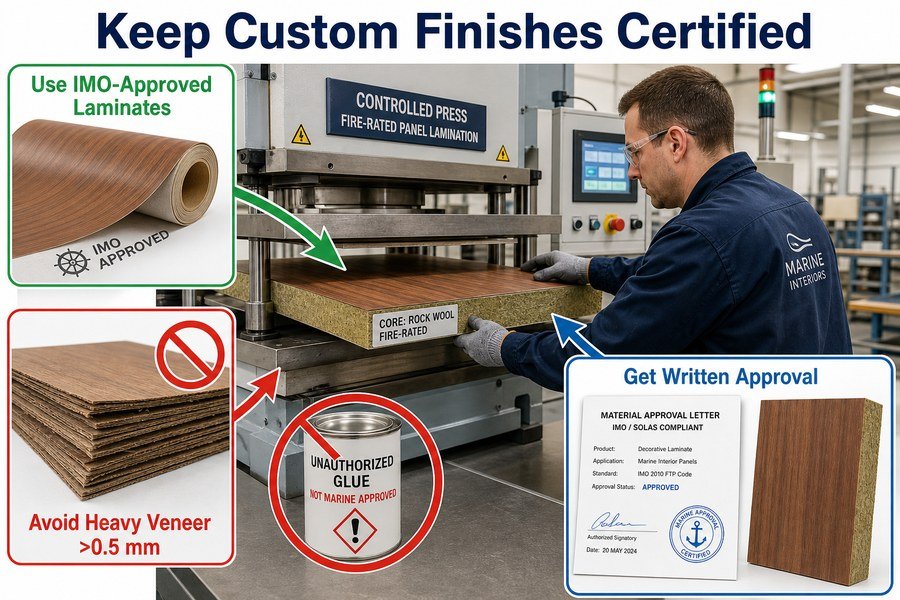
Interior designers often want custom looks for passenger ship cabins. They add thick wood veneers or special plastic sheets to the marine panels. This creates a hidden danger. The original Wheelmark or USCG certificate is only valid for the exact layup tested in the fire laboratory. If you use a glue that is not approved, the glue can create toxic smoke or burn fast during a fire. The International Code for Application of Fire Test Procedures (FTP Code) states that surface materials must have low flame-spread characteristics. Applying a wood veneer thicker than 0.5 millimeters or using solvent-based adhesives can violate the IMO FTP Code Part 5 rules for surface flammability.
Managing Factory-Applied Laminates and Approval Letters
To keep the certificate valid, you must order the custom finish directly from the panel manufacturer. The factory applies the PVC film or decorative laminate using approved machine pressing and fire-retardant adhesives under controlled conditions. When I order panels with special colors, I always ask the supplier for an extension of the type-approval certificate. This document must state that the specific laminate does not change the A-60 or B-15 fire test result. If the supplier cannot provide this letter signed by a recognized organization like DNV or Bureau Veritas, do not accept the panels. You will fail the marine safety audit during delivery.
| Finish Modification Type | Allowed Limit per IMO Rules | Consequence of Violation |
|---|---|---|
| Decorative Laminate | Factory-applied, max thickness 1.0 mm | Invalid MED certificate, survey failure |
| Adhesive Layer | IMO FTP Code Part 5 certified glue | Toxic smoke generation, rapid flame spread |
| Veneer Application | Max 0.5 mm wood veneer with fire treatment | Loss of low flame-spread rating |
| Field Painting | Approved marine interior paint systems | Flammability failure during inspection |
Why Do Modified Lightweight Marine Interior Panels Often Fail PSC Checks?
Lightweight panels save fuel, but cheap modifications cause port inspectors to reject them instantly.
Lightweight panels fail Port State Control checks because of altered internal frames, insufficient core bonding, and missing manufacturer stamps. You must verify structural load test reports, check that core thickness matches the original type approval drawing, and ensure every panel has an indelible certification mark.
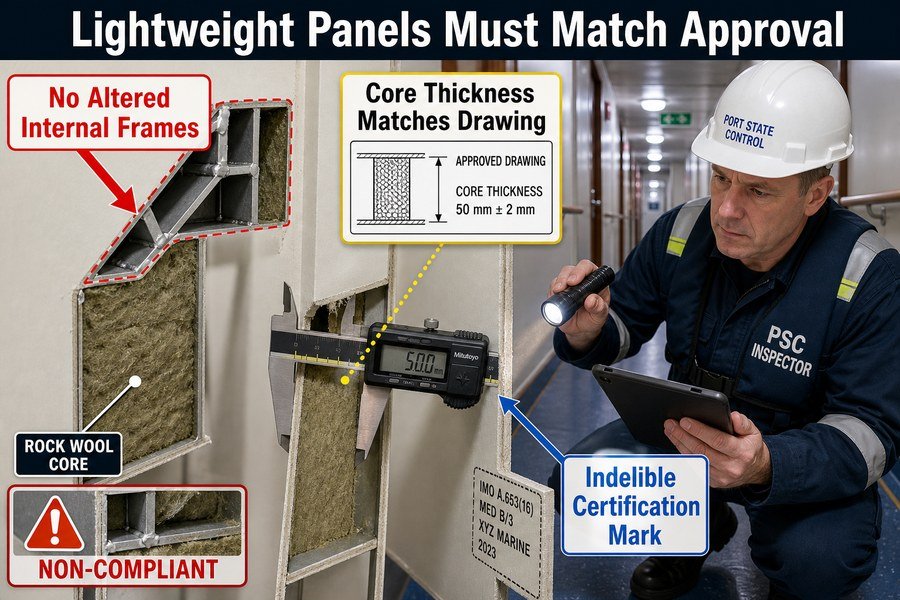
Altering Internal Reinforcements and Core Thickness
Shipowners want lightweight ships to burn less fuel. Panel makers use thinner steel or honeycomb cores to reduce weight. Some buyers try to cut panels on site and add wood pieces inside for door frames. This breaks the fire barrier. The type-approval drawing shows the exact internal structure, including stiffeners and edge channels. If you change the internal steel profile or reduce the core thickness from 50 millimeters to 40 millimeters to save space, the fire test report is no longer valid2. The heat will transfer through the weak spots during a standard fire test.
Verifying Manufacturer Marks and Production Batch Traceability
Port State Control officers check the edges of installed wall panels for official stamps. Every approved marine panel must have a label or laser mark showing the manufacturer name, approval number, and fire class3. When I receive panels at the shipyard, I inspect the packaging and the panel edges. Some low-cost suppliers ship panels without any marks to hide the fact that they come from a different factory than the one on the test certificate. You must cross-check the production batch number on the delivery invoice with the certificate issued by the classification society.
| Inspection Checkpoint | What to Verify | Standard Requirement |
|---|---|---|
| Panel Thickness | Measure total panel depth with caliper | Exactly match type approval drawing (e.g., 50 mm) |
| Edge Stiffeners | Check internal steel channel placement | Match laboratory test configuration |
| Certification Marking | Look for Wheelmark or classification stamp | Visible on every panel edge or label |
| Batch Traceability | Compare invoice batch to test report | 100 percent matching documentation |
How to Ensure a Delivered A-60 Marine Bulkhead Matches Its Lab-Tested Spec?
Getting what you paid for requires physical checks before you sign the delivery receipt.
Ensuring delivered bulkheads match lab specs requires measuring steel thickness, checking core density with a scale, and reviewing test reports. You must use a micrometer to verify the 0.6 millimeter steel skin, weigh a sample piece to confirm rockwool density, and inspect joint connections against drawings.
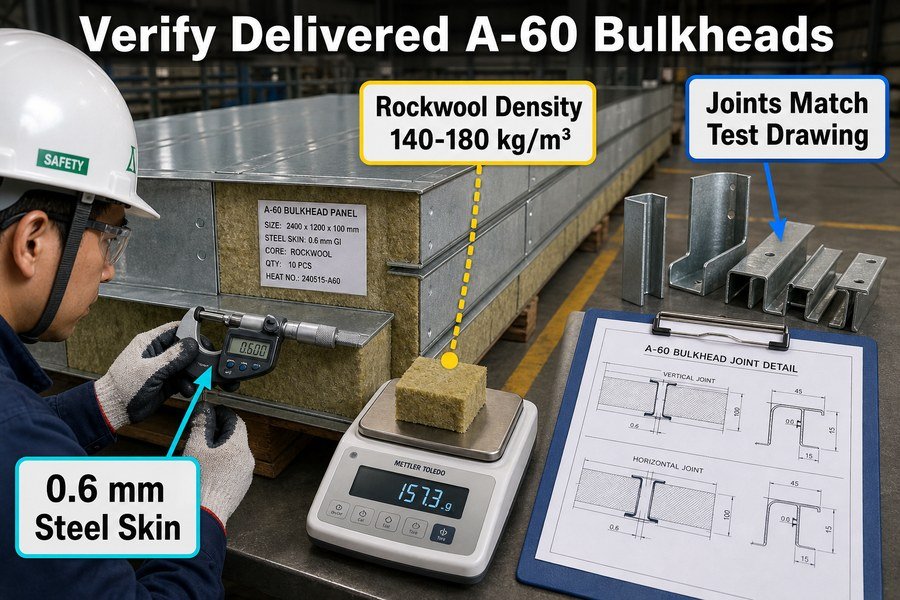
Measuring Steel Thickness and Core Density On Site
Words on a contract do not stop a fire. You must test the physical panels when they arrive at your warehouse. I carry a digital micrometer and a small scale when I inspect incoming shipments. I peel back a small section of the protective film to measure the steel skin. It must read at least 0.6 millimeters. If it reads 0.45 millimeters, the supplier cheated on the raw material cost. Next, I cut a 10 by 10 centimeter sample of the core insulation and weigh it. Using the volume calculation, I verify that the density hits the required 150 kilograms per cubic meter mark.
Inspecting Joint Connections and Profile Accessories
An A-60 bulkhead is only as strong as its joints.4 The connection profiles, joint clips, and ceiling tracks must be made of galvanized steel or aluminum matching the test report. If a supplier swaps the steel joint profiles for cheap aluminum or thinner brackets, the thermal bridge will fail. During the fire test, heat transfers through the metal joints. I always check the joint assembly manual provided by the factory. I ensure the workers install the ceramic wool packing inside the steel profiles exactly as shown in the installation manual.
| Physical Test Item | Tool Used | Acceptable Range |
|---|---|---|
| Steel Skin Gauge | Digital Micrometer | 0.55 mm to 0.65 mm |
| Core Insulation Weight | Precision Scale | 140 to 180 kg per cubic meter |
| Joint Profile Material | Magnet and Visual Check | Hot-dip galvanized steel or tested aluminum |
| Packing Material | Ceramic Fiber Inspection | Density over 100 kg per cubic meter |
What Red Flags Expose False Fire and Weight Claims From Marine Interior Panel Suppliers?
Spotting fake suppliers early saves your company from huge financial losses and legal trouble.
Red flags include missing classification society stamps, prices 40 percent below market average, and vague test certificates. You must check the official database of the issuing body, demand original third-party test reports, and reject suppliers who refuse to provide raw material mill test certificates.
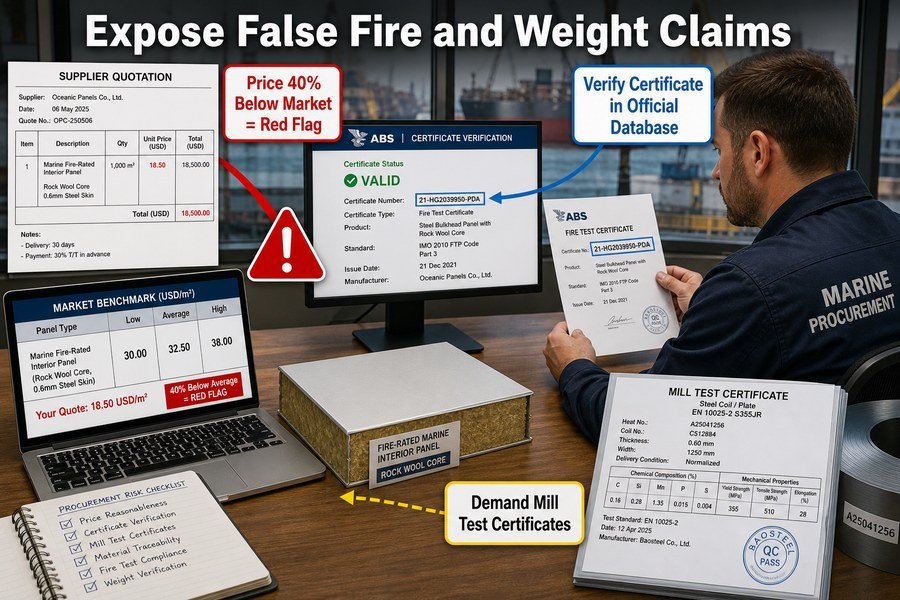
Spotting Suspiciously Low Prices and Fake Certificates
If a supplier offers A-60 marine panels at a price much lower than the market average, be very careful. Good rockwool and certified steel cost money. A price that is 40 percent lower means the supplier is using low-density insulation, thin steel, or a fake certificate. Many dishonest traders use Photoshop to change the company name on an old MED certificate. When I evaluate a new supplier, I go directly to the maritime authority database online. I type in the certificate number to see if it is active and if it matches the factory address.
Demanding Mill Test Certificates and Factory Audits
You should never buy panels based on a simple product catalog. I always request the mill test certificates for the steel coils and the material safety data sheets for the core glue. A real manufacturer will send these documents without hesitation. If a trading company makes excuses and says the documents are a trade secret, walk away. Visiting the factory or hiring a third-party inspection agency like SGS to check the production line before shipping is the best way to stop bad suppliers from stealing your budget.
| Red Flag Indicator | Common Deception Tactic | Correct Verification Action |
|---|---|---|
| Abnormally Low Price | Using sub-standard steel and low-density core | Check raw material market costs |
| Modified Certificate | Altering company name on expired PDF | Verify number on official maritime database |
| Vague Test Reports | Providing internal lab tests instead of IMO reports | Demand DNV, LR, or USCG approved reports5 |
| Missing Mill Sheets | Refusing to share steel coil test documents | Make mill certificates mandatory in contract |
Conclusion
Avoid procurement traps by verifying certificates, checking steel thickness, testing core densities, and demanding official documentation for all marine panels.
-
"Why Is Rock Wool the Standard Core for Marine Wall & Ceiling Panels?", https://magellanmarinetech.com/why-rock-wool-standard-core-for-marine-wall-ceiling-panels/. Technical literature on mineral-wool sandwich panels shows that core density is a key parameter affecting mechanical behavior and thermal/fire-insulation performance, providing context for specifying density in marine panels. Evidence role: mechanism; source type: paper. Supports: Marine rockwool panel specifications should include core density because density affects structural strength and fire-insulation performance.. Scope note: A neutral source may support the importance of density and typical tested ranges, but may not establish 140–180 kg/m³ as a universal marine-outfitting standard unless it is a class-society or shipbuilding specification. ↩
-
"What Does Class Society Type Approval Mean for Marine Wall and ...", https://magellanmarinetech.com/what-class-society-type-approval-mean-for-marine-wall-ceiling-panels/. The IMO 2010 FTP Code bases fire-resistance approval on the construction and performance of the tested specimen, so approval evidence applies to the tested configuration rather than to panels with altered cores, stiffeners, or edge details. Evidence role: expert_consensus; source type: institution. Supports: Changing the internal steel profile or reducing the core thickness can invalidate reliance on the original fire test report.. Scope note: This supports the regulatory principle; it does not specifically test the article’s 50 mm-to-40 mm example. ↩
-
"What Is the Purpose and Scope of the IMO FTP Code?", https://magellanmarinetech.com/what-purpose-scope-of-imo-ftp-code/. Marine-equipment conformity regimes such as the EU Marine Equipment Directive require approved equipment to be identifiable through conformity marking and supporting approval documentation, including the manufacturer and approval basis; this contextualizes the need for traceable markings on certified fire-rated panels. Evidence role: general_support; source type: government. Supports: Approved marine panels should carry identifiable manufacturer and approval information to allow verification against certification records.. Scope note: The EU Wheelmark rules directly apply to equipment placed on EU-flagged ships and may not prove identical marking requirements for all flags or that every panel edge must be marked. ↩
-
"What Is the Purpose and Scope of the IMO FTP Code?", https://magellanmarinetech.com/what-purpose-scope-of-imo-ftp-code/. The IMO FTP Code treats fire-resisting divisions as tested assemblies, with construction details such as joints, edges, and penetrations forming part of the specimen or approval context; this supports the importance of joint construction to A-class fire performance. Evidence role: expert_consensus; source type: institution. Supports: The fire performance of an A-60 bulkhead depends on the tested joint and connection assembly, not only on the panel face materials.. Scope note: This supports the general principle that joints affect certified fire resistance, but it does not verify the specific joint design or supplier described in the article. ↩
-
"What Is the IMO FTP Code for Marine Interior Materials?", https://magellanmarinetech.com/what-imo-ftp-code-for-marine-interior-materials/. IMO fire-safety testing frameworks and maritime approval systems require shipboard fire-protection materials to be tested or approved under recognized procedures, supporting the preference for reports from recognized administrations or classification bodies over unaudited internal laboratory documents. Evidence role: expert_consensus; source type: institution. Supports: For A-60 marine panels, buyers should require recognized IMO, classification-society, or maritime-administration approval reports rather than relying on vague internal test reports.. Scope note: This supports the general need for recognized fire-test approval; the exact accepted authority depends on flag state, vessel class, and procurement contract. ↩