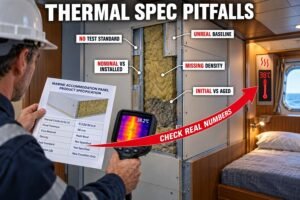
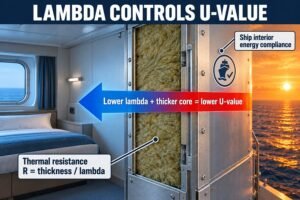
You buy marine panels thinking the insulation specs are great. Later, the cabins get too hot, and shipyard clients complain. Here is how to find the real numbers.
Marine panel thermal conductivity specs hide five major pitfalls: missing testing standards, unrealistic baseline claims, differences between nominal and installed performance, missing density data, and confusing initial versus aged lambda values. Spotting these issues ensures your panels meet strict shipyard temperature requirements and avoid costly project rejections.
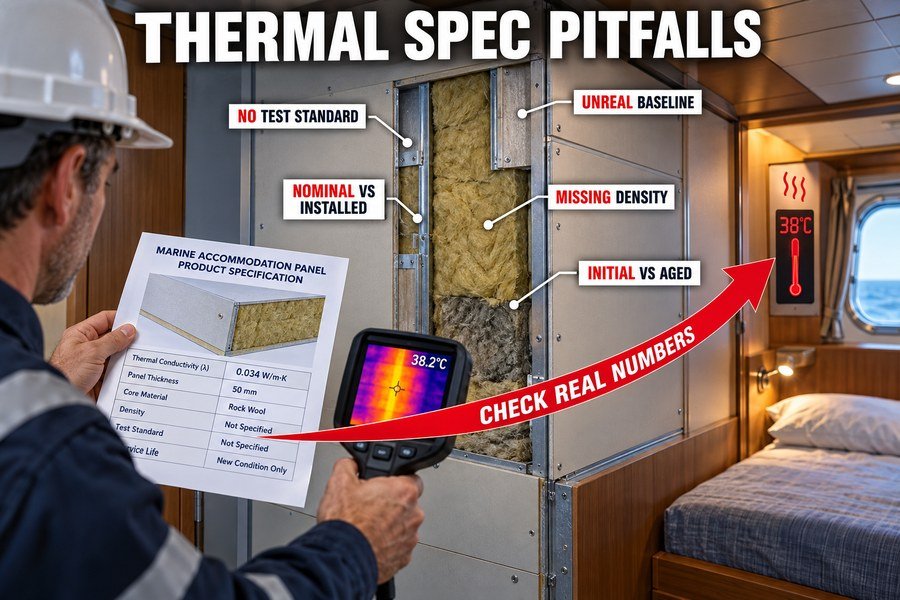
You must look beyond the basic numbers on a factory brochure. Let us break down the exact tricks and missing data that cause marine interior panels to fail thermal inspections.
Why Are Standardless Lambda Values Unreliable for Marine Interior Panels?
You see a low lambda value and feel happy. But without a testing standard, that number means nothing. I will show you why missing standards ruin your panel choice.
Standardless lambda values are unreliable because they ignore three critical testing variables: mean testing temperature, moisture content during testing, and the specific test method used. Without matching these three variables to marine standards like ASTM C518 or EN 12667, manufacturers can manipulate numbers to look artificially good.
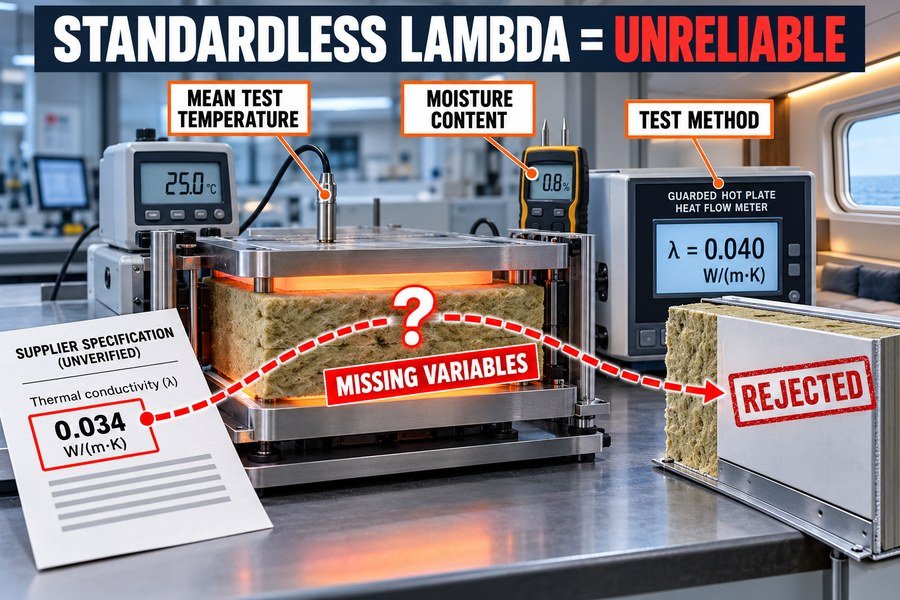
I work at Magellan Marine, and I help buyers evaluate these specs every day. Many suppliers provide a simple lambda value like 0.036 W/m·K. But this number is meaningless without knowing how they got it.
The Impact of Mean Testing Temperature on Marine Panels
According to standard EN 12667, laboratories must state the mean testing temperature. The thermal conductivity of rock wool changes based on the heat in the room. A rock wool core tested at 10°C will show a thermal conductivity of 0.034 W/m·K. The exact same core tested at 24°C will show 0.038 W/m·K.1 If the supplier does not state the temperature, they might use 10°C to make the panel look better on paper. Your ships operate in hot climates. You need to know the performance at higher temperatures. I always reject spec sheets that hide the mean testing temperature.
Moisture Content and Specific Test Methods for Panel Insulation
Moisture content also changes the lambda value. Standard ASTM C518 requires the material to be dry during testing. Water conducts heat very well. The thermal conductivity of water is 0.60 W/m·K.2 If a supplier tests a panel with 5% moisture, the lambda value will be much worse. However, some suppliers bake the sample to 0% moisture before the test. This gives an artificially low number that you will never see on a real ship.
Finally, you must check the specific test method used. EN 12667 uses a guarded hot plate method. ASTM C518 uses a heat flow meter method. You cannot compare a value from EN 12667 directly with a value from an unknown local factory test method. I always tell my clients to ask for the exact test method to ensure a fair comparison.
| Testing Variable | Standard Requirement (e.g., EN 12667) | Trick Used in Standardless Specs | Resulting Risk for the Buyer |
|---|---|---|---|
| Mean Testing Temperature | Must be clearly stated (e.g., 10°C or 24°C) | Tested at very low temperatures | Panels fail in warm climates |
| Moisture Content | Regulated conditioning before testing | Baked completely dry before test | Unrealistic real-world performance |
| Test Method | Guarded hot plate or heat flow meter | Unknown in-house factory method | Numbers cannot be compared fairly |
How to Spot Unrealistic Thermal Conductivity Claims in Marine Accommodation Panel Specs?
Some suppliers promise amazing insulation numbers that sound too good. If you buy them, they fail the shipyard tests. Here is how to spot fake claims fast.
You can spot unrealistic thermal conductivity claims by checking three things: comparing the claim against the absolute physical limits of the core material, verifying the panel thickness-to-lambda ratio, and demanding third-party lab certificates. If a standard mineral wool panel claims below 0.030 W/m·K, it is likely fake.
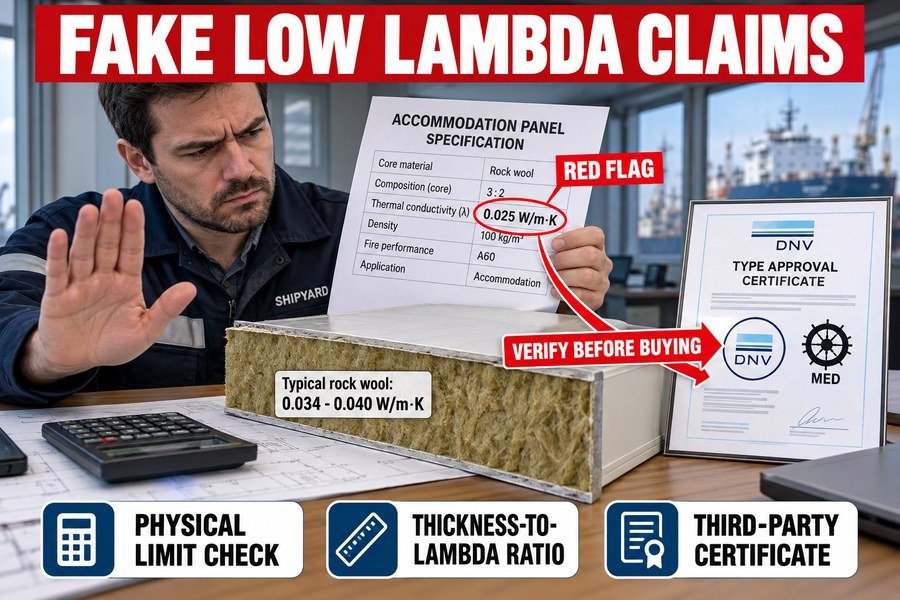
I see fake numbers constantly. A supplier wants to win your order, so they invent a lower number. You must know the rules of physics to catch them.
Comparing Claims Against Physical Limits of Core Materials
I often see suppliers claiming a thermal conductivity of 0.025 W/m·K for a standard rock wool panel. This is a huge red flag. You must compare the claim against the absolute physical limits of the core material. The air trapped inside the rock wool has a thermal conductivity of about 0.025 W/m·K at room temperature3. The solid rock fibers conduct heat faster than the air. Therefore, it is physically impossible for a standard marine rock wool panel to have a lambda value lower than 0.030 W/m·K. Typical high-quality rock wool for marine use ranges from 0.034 to 0.040 W/m·K4. If the number is lower than 0.030, they are lying to you.
Verifying Thickness Ratios and Third-Party Certificates
Next, you must verify the panel thickness-to-lambda ratio. The thermal resistance (R-value) depends on both thickness and lambda. A 50mm panel with a lambda of 0.036 W/m·K has an R-value of 1.38 m²K/W. If a supplier offers a 25mm panel and claims the exact same R-value, their lambda claim is mathematically false. You can calculate this yourself to catch the lie.
Finally, you must demand third-party lab certificates. Do not trust an in-house factory test report. The certificate must come from a recognized classification society like DNV or a laboratory approved by the Marine Equipment Directive (MED)5. A real certificate will show the test date, the sample thickness, and the exact lambda value. If the supplier refuses to provide a DNV or MED certificate for the thermal test, you should look for another supplier immediately.
| Verification Step | What to Look For | Red Flag | Action to Take |
|---|---|---|---|
| Physical Limits | Rock wool lambda > 0.030 W/m·K | Claiming 0.025 W/m·K for rock wool | Reject the supplier immediately |
| Thickness Ratio | R-value matches thickness and lambda | 25mm panel claims R-value of 50mm | Calculate the math to prove the lie |
| Lab Certificates | DNV or MED approved laboratory | Only an in-house factory stamp | Demand the official third-party document |
Why Do Nominal Lambda Values Differ From Installed Marine Interior Panel Performance?
You install panels with good nominal values. But the cabin still feels too hot. Installation changes how the panel actually stops heat. Let us look at why this happens.
Nominal lambda values differ from installed performance because they ignore three real-world factors: thermal bridging from steel profiles, compression of the insulation material during assembly, and moisture absorption at the shipyard. These three installation factors can increase the actual thermal conductivity by 20% to 50% above factory specs.
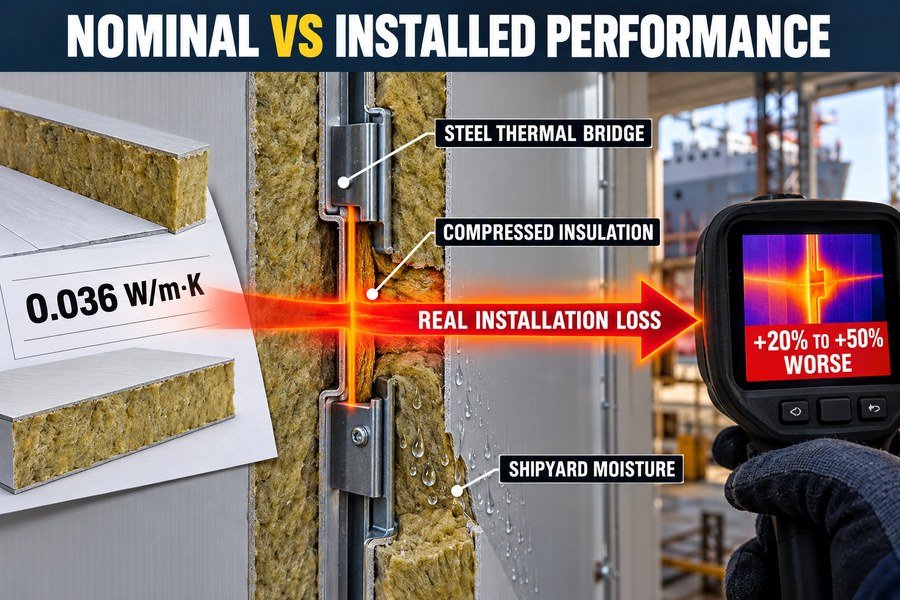
A factory tests a perfect, untouched panel. But a ship is not a perfect laboratory. Installation always hurts insulation.
Thermal Bridging from Steel Profiles in Panel Assembly
You look at the factory test report and see a nominal lambda of 0.036 W/m·K. But installed panels perform differently. First, you must consider thermal bridging from steel profiles. Marine accommodation panels are not continuous. They connect using steel or aluminum joint profiles. Steel has a thermal conductivity of about 50 W/m·K. This is over 1000 times higher than the rock wool core. Heat travels very quickly through these metal joints. This thermal bridging bypasses the insulation completely. It can increase the overall thermal conductivity of the wall system by 20% to 30%6. You must account for this when buying panels for a demanding shipyard.
Material Compression and Moisture Absorption at the Shipyard
Second, you must account for the compression of the insulation material during assembly. A factory might take 52mm thick rock wool and squeeze it into a 50mm steel box. This compression reduces the air pockets inside the wool. Less trapped air means faster heat transfer. This compression can increase the lambda value by another 5% to 10%.7
Third, you must factor in moisture absorption at the shipyard. Shipyards are humid environments. The panels often sit in unsealed cabins during construction. The rock wool core absorbs moisture from the ocean air. Water has a thermal conductivity of 0.60 W/m·K. Even a 2% increase in moisture volume can increase the panel's lambda value by 15%. When you add thermal bridging, compression, and moisture together, the actual installed performance is 20% to 50% worse than the factory specs. I always advise my clients to calculate a safety margin to protect themselves.
| Installation Factor | How it Changes the Panel | Impact on Thermal Conductivity |
|---|---|---|
| Thermal Bridging | Heat travels through steel joining profiles | Increases overall conductivity by 20% to 30% |
| Material Compression | Squeezes air pockets out of the rock wool | Increases conductivity by 5% to 10% |
| Moisture Absorption | Humid shipyard air enters the core | Increases conductivity by up to 15% |
What Missing Data Invalidates Declared Marine Accommodation Panel Thermal Conductivity?
A spec sheet gives you a lambda number but nothing else. This missing data hides the truth. You need the full picture to avoid buying bad panels.
Declared thermal conductivity is invalid if the spec sheet is missing four critical pieces of data: the core material density, the exact testing temperature, the fire classification impact on density, and the facing material properties. Without these four details, the lambda value cannot predict actual thermal performance on a ship.
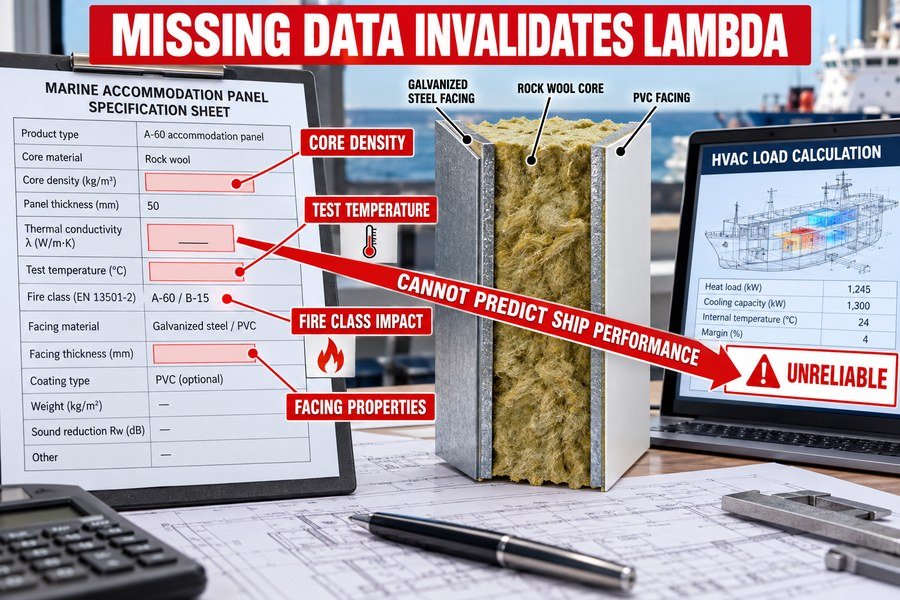
A single number tells you nothing. I have rejected many spec sheets because they lack critical data. You must ask for the complete testing conditions.
Missing Core Material Density and Testing Temperature Data
First, the spec sheet must state the core material density. The thermal conductivity of rock wool changes with its density. A 100 kg/m³ rock wool board will have a different lambda than a 150 kg/m³ board. If the density is missing, you cannot verify the panel's true performance. You might buy a panel expecting high density, but receive a low-density panel instead.
Second, the sheet must list the exact testing temperature. I explained this earlier, but it is worth repeating. A value of 0.035 W/m·K at 10°C is very different from 0.035 W/m·K at 24°C8. Without the testing temperature, the lambda value is completely invalid. You cannot use it to calculate the HVAC requirements for the ship.
Missing Fire Classification Impact and Facing Material Properties
Third, you must understand the fire classification impact on density. Marine panels must pass strict fire tests like IMO A-60 or B-15. To pass an A-60 test, the manufacturer usually increases the rock wool density to 120 kg/m³ or 150 kg/m³9. Higher density means more solid material and less trapped air. This often increases the thermal conductivity slightly. You cannot use a thermal value from a B-15 panel for an A-60 panel. They are built differently.
Fourth, the spec sheet must include the facing material properties. A marine panel has a steel sheet on the outside. This galvanized steel sheet is usually 0.6mm thick. The steel sheet does not insulate. It actually transfers heat across the surface. The PVC decorative film on top of the steel also has its own thermal properties. If the test only measured the bare rock wool core and ignored the facing materials, the data is incomplete. You need the thermal transmittance (U-value) of the complete composite panel, not just the core10.
| Missing Data Element | Why it is Critical | Risk if Missing |
|---|---|---|
| Core Material Density | Lambda changes based on kg/m³ | You receive a cheaper, lower-density core |
| Exact Testing Temp | Performance drops in hot conditions | HVAC system fails in warm climates |
| Fire Class Impact | A-60 panels require denser cores | Using B-15 thermal data for A-60 walls |
| Facing Properties | Steel skins conduct heat across panels | Overall wall insulation is much weaker |
Initial vs. Aged Lambda Values in Marine Interior Panel Specs: How to Tell?
Some panels insulate well on day one. Five years later, they fail. Manufacturers often show initial values, not aged values. Here is how to know the difference.
You can tell the difference by looking for two specific terms: "lambda-initial" and "lambda-aged" (or design value). Initial values show performance on day one. Aged values account for blowing agent diffusion over time and moisture uptake, often showing a 15% to 25% higher thermal conductivity than initial claims.
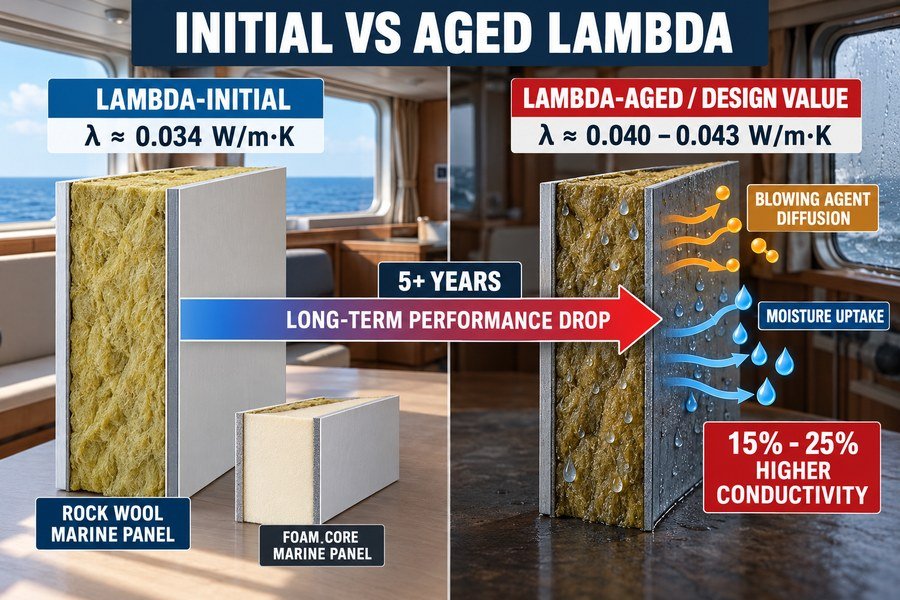
Many buyers focus on the day-one performance. They buy panels based on initial lambda values to save money. This is a mistake that hurts the ship later.
Understanding Initial Lambda Values and Blowing Agent Diffusion
First, look for the term "lambda-initial" on the test certificate. This value comes from testing the panel immediately after production. For some specialized lightweight marine panels using PUR or PIR foam cores, this initial value is very low, around 0.022 W/m·K11. However, these foam cores rely on trapped blowing agents. Over time, blowing agent diffusion occurs12. The insulating gas slowly escapes through the panel edges. Regular air replaces the gas. Air has a higher thermal conductivity than the gas. After five years, the performance drops significantly. If a supplier only gives you the initial value for a foam panel, they are hiding the long-term failure.
Identifying Aged Lambda Values and Long-Term Moisture Uptake
Second, look for the term "lambda-aged" or "design value". This value accounts for the long-term aging process. According to standards like EN 13165, laboratories artificially age the foam panels by heating them for several weeks. The resulting aged lambda value is often 0.026 W/m·K or higher. This shows a 15% to 20% increase in thermal conductivity.
Even standard rock wool panels suffer from aging. They do not have blowing agents, but they suffer from long-term moisture uptake. Over a ten-year lifespan on a ship, the rock wool core slowly absorbs microscopic water vapor from the sea air. This moisture uptake degrades the thermal resistance13. The aged design value for rock wool adds a penalty factor to the initial test result. When you compare two suppliers, you must make sure you are comparing aged values to aged values. Comparing an initial value from Supplier A to an aged value from Supplier B will lead to a bad purchasing decision.
| Value Type | What it Measures | What Causes the Value to Change | Typical Difference |
|---|---|---|---|
| Lambda-Initial | Day-one performance at the factory | Nothing yet | Baseline number |
| Lambda-Aged (Foam) | Long-term performance after 5+ years | Blowing agent diffusion (gas escapes) | 15% to 20% worse |
| Lambda-Aged (Wool) | Long-term performance on a humid ship | Gradual moisture uptake into fibers | 5% to 10% worse |
Why Does Rounding Thermal Conductivity Hide True Marine Accommodation Panel Differences?
Two panels show a lambda of 0.04 W/m·K. You buy the cheaper one. But rounding numbers hides a big difference in quality. I will explain this trick.
Rounding thermal conductivity hides true differences because it masks two distinct performance levels within the same rounded number: a panel testing at 0.036 W/m·K and one at 0.044 W/m·K might both be rounded to 0.04 W/m·K. This mathematical rounding obscures an 18% actual difference in insulation performance.
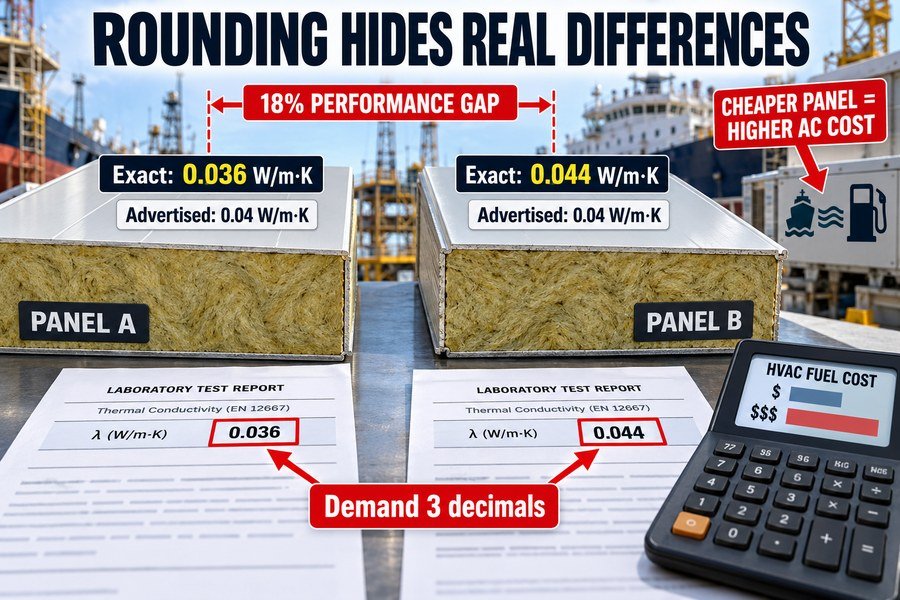
Suppliers like simple numbers. They often round the thermal conductivity on their brochures. This rounding tricks buyers into buying inferior panels.
How Mathematical Rounding Masks Two Distinct Performance Levels
You must ask for three decimal places. Let me show you how rounding masks two distinct performance levels. Standard EN 13162 provides rules for declaring thermal conductivity. Some suppliers ignore these strict rules and use basic math rounding to one or two decimal places. Imagine Supplier A produces a high-quality panel testing at 0.036 W/m·K. Supplier B produces a cheaper, lower-quality panel testing at 0.044 W/m·K. Supplier B decides to round their number to one decimal place. They advertise a lambda of 0.04 W/m·K. Supplier A also rounds their number to 0.04 W/m·K to keep their brochure simple. On paper, they look identical. You buy Supplier B because the price is two dollars lower per square meter.
The Cost of the 18 Percent Hidden Difference in Insulation
You missed the hidden difference. Let us calculate the cost of this 18% hidden difference in insulation. The actual value of 0.044 W/m·K is roughly 18% worse than 0.036 W/m·K. To find this, you take the difference of 0.008, and divide it by 0.044, which equals about 18%. This means the shipyard's HVAC system must work 18% harder to cool the cabin. The ship will burn more marine diesel oil to run the air conditioning. If the ship burns an extra 50 liters of fuel per day, the lifetime cost is huge. Do not let mathematical rounding trick you. Always demand the exact laboratory test report. Compare the exact numbers with three decimal places. This ensures you get the actual insulation performance you pay for.
| Supplier | Exact Test Result | Advertised Rounded Value | Actual Insulation Difference | Hidden Cost to Shipyard |
|---|---|---|---|---|
| Supplier A | 0.036 W/m·K | 0.04 W/m·K | Baseline high performance | Normal HVAC operation |
| Supplier B | 0.044 W/m·K | 0.04 W/m·K | 18% worse than Supplier A | Higher fuel consumption for AC |
Conclusion
Do not trust simple lambda values on spec sheets. Check the testing standards, ask for aged values, and demand precise decimals to ensure you buy the correct marine accommodation panels.
-
"Thermal Conductivity", http://hyperphysics.phy-astr.gsu.edu/hbase/Tables/thrcn.html. Published studies and technical references on mineral wool insulation report that apparent thermal conductivity generally increases with mean temperature, providing context for why a lower test temperature can produce a lower lambda value. Evidence role: mechanism; source type: paper. Supports: Rock wool thermal conductivity changes with mean testing temperature, and lower test temperatures can yield lower reported lambda values.. Scope note: A general study may support the direction and mechanism of the temperature effect, but the exact 0.034 and 0.038 W/m·K values would require data for the specific rock wool core and test setup. ↩
-
"New International Formulation for the Thermal Conductivity ...", https://www.nist.gov/system/files/documents/srd/jpcrd412012new033102.pdf. Reference data for liquid water list its thermal conductivity at room temperature at approximately 0.6 W/m·K, supporting the numerical comparison with insulating materials. Evidence role: statistic; source type: government. Supports: Liquid water has a thermal conductivity of about 0.60 W/m·K.. Scope note: The exact value varies with temperature and pressure, so the cited figure should be treated as an approximate room-temperature value. ↩
-
"Method for Measuring Thermal Conductivity of Small ...", https://ntrs.nasa.gov/api/citations/20090027866/downloads/20090027866.pdf. Reference data for dry air at near-room temperature report thermal conductivity close to 0.025–0.026 W/m·K, supporting the stated baseline for heat conduction through trapped air. Evidence role: statistic; source type: government. Supports: The air trapped inside rock wool has a thermal conductivity of about 0.025 W/m·K at room temperature.. Scope note: Values vary with temperature, pressure, humidity, and measurement convention. ↩
-
"Determination of Thermal Properties of Mineral Wool ... - PMC", https://pmc.ncbi.nlm.nih.gov/articles/PMC10488771/. Independent references on mineral wool insulation commonly place rock/mineral wool thermal conductivity in the approximate 0.03–0.04 W/m·K range, providing contextual support for the stated typical range. Evidence role: general_support; source type: encyclopedia. Supports: Typical high-quality rock wool for marine use ranges from 0.034 to 0.040 W/m·K.. Scope note: Most neutral sources report general building or industrial mineral wool data rather than marine-panel-specific performance, so the evidence supports the range contextually rather than proving every marine product specification. ↩
-
"Directive 96/98/EC", https://en.wikipedia.org/wiki/Directive_96/98/EC. European Commission materials on the Marine Equipment Directive describe conformity assessment by notified bodies for marine equipment placed on EU ships, supporting the role of approved third-party bodies in certification. Evidence role: definition; source type: government. Supports: Marine equipment certification may involve laboratories or notified bodies approved under the Marine Equipment Directive.. Scope note: The MED framework establishes conformity-assessment procedures but does not by itself guarantee that a particular certificate includes thermal-conductivity testing unless that test is within the certified scope. ↩
-
"Metal stud wall systems - Thermal disaster, or modern ...", https://impact.ornl.gov/en/publications/metal-stud-wall-systems-thermal-disaster-or-modern-wall-systems-w/. A building-physics or thermal-bridge study can support that metal framing and joint profiles increase effective wall U-values or equivalent conductivity by creating conductive heat-flow paths through insulation assemblies. Evidence role: mechanism; source type: paper. Supports: Thermal bridging from steel or aluminum panel joints can increase the overall thermal conductivity of the wall system by 20% to 30%.. Scope note: The 20%–30% range is likely assembly-specific; evidence from building-envelope studies may support the mechanism and comparable magnitude but may not directly measure marine accommodation panels. ↩
-
"Determination of Thermal Properties of Mineral Wool ... - PMC", https://pmc.ncbi.nlm.nih.gov/articles/PMC10488771/. Research on fibrous insulation reports that density, porosity, and compression affect thermal conductivity by changing air volume and heat-transfer paths, supporting the claim that compression can raise lambda. Evidence role: mechanism; source type: paper. Supports: Compressing rock wool insulation during assembly can increase the lambda value by 5% to 10%.. Scope note: The exact 5%–10% increase depends on the insulation type, density, degree of compression, and test conditions; a general fibrous-insulation source may not verify this precise range for every marine panel. ↩
-
"Thermal Property Standards", https://www.nist.gov/programs-projects/transport-property-measurements-semiconductors-and-energy-materials/thermal-0. Standards and laboratory references for insulation testing specify reporting thermal conductivity with a mean test temperature, supporting that lambda values are temperature-dependent and not directly comparable without test conditions. Evidence role: mechanism; source type: institution. Supports: A thermal conductivity value is incomplete or misleading unless the test temperature is stated.. Scope note: Such sources establish the reporting requirement and temperature dependence generally; they may not show this exact 10°C versus 24°C numerical example. ↩
-
"What Is the Purpose and Scope of the IMO FTP Code?", https://magellanmarinetech.com/what-purpose-scope-of-imo-ftp-code/. Marine fire-test rules and type-approval documentation for A-class divisions describe A-60 performance as an assembly test and often identify mineral-wool insulation thickness and density as part of approved constructions. Evidence role: case_reference; source type: institution. Supports: A-60 fire-rated marine panels commonly rely on denser mineral wool constructions than lower fire-rated panels.. Scope note: This would support the engineering context and examples of approved densities, but it would not prove that every manufacturer uses 120 or 150 kg/m³ for A-60 panels. ↩
-
"ISO 6946:2007 - Building components and building elements", https://www.iso.org/standard/40968.html. Building-physics references define U-value as the heat-transfer coefficient of a complete element or assembly, supporting the need to account for layers such as facings rather than relying only on core thermal conductivity. Evidence role: definition; source type: education. Supports: Thermal performance should be assessed for the complete composite panel, not only the insulation core.. Scope note: General U-value references support the assembly-level principle; a marine-panel-specific source would be needed to quantify the effect for a particular steel-faced product. ↩
-
"Assessment of the Performance of Hydrofluoroolefins ... - INFO", https://info.ornl.gov/sites/publications/Files/Pub200858.pdf. A technical or peer-reviewed source should document that closed-cell PUR/PIR insulation foams can exhibit initial thermal conductivity values near 0.022 W/m·K when low-conductivity blowing agents are present. Evidence role: statistic; source type: paper. Supports: Some specialized lightweight marine panels using PUR or PIR foam cores have very low initial lambda values, around 0.022 W/m·K.. Scope note: The value may vary by formulation, density, facing, test temperature, and whether the reported number is initial or aged; the source may not be specific to marine panels. ↩
-
"Microstructure and blowing agent concentration analysis in ...", http://adsabs.harvard.edu/abs/2019MS%26E..609f2016J. A peer-reviewed aging study should explain that closed-cell polyurethane or polyisocyanurate foams age partly because blowing agents diffuse out while air diffuses in, increasing effective thermal conductivity over time. Evidence role: mechanism; source type: paper. Supports: PUR/PIR foam cores can lose insulation performance over time because blowing agents diffuse out and are replaced by air.. Scope note: Such studies usually examine building-insulation specimens under controlled conditions; they support the physical mechanism but may not directly quantify performance loss in shipboard panels. ↩
-
"Hygrothermal Properties and Performance of Bio-Based ...", https://pmc.ncbi.nlm.nih.gov/articles/PMC11084737/. A building-physics or materials study should show that increased moisture content in mineral wool or rock wool insulation raises effective thermal conductivity and therefore reduces thermal resistance. Evidence role: mechanism; source type: paper. Supports: Moisture uptake in rock wool or mineral wool can reduce thermal resistance by increasing effective thermal conductivity.. Scope note: Most available evidence is from building-envelope research rather than marine service conditions; it supports the moisture-performance mechanism but not necessarily the article’s ten-year shipboard magnitude. ↩