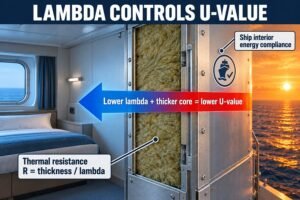
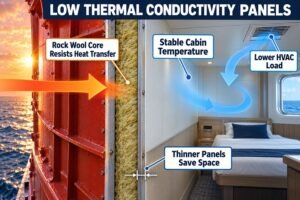
Struggling to meet strict shipyard energy specifications? Ignoring panel thermal conductivity leads to failed ship inspections. I will show you how to master U-values and secure lucrative interior projects.
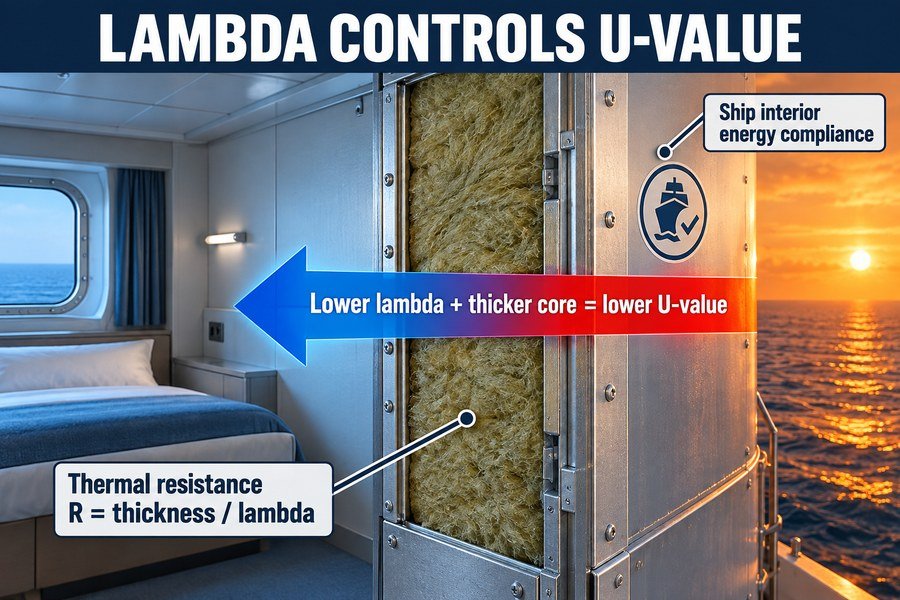
Thermal conductivity (lambda value) directly dictates marine accommodation panel U-values by measuring how easily heat passes through the core material. Lower lambda values and thicker cores create higher thermal resistance (R-value), which mathematically lowers the U-value, ensuring compliance with strict SOLAS and IMO energy efficiency requirements for ship interiors.
You might think all marine wall panels are the same, but the hidden math behind them can make or break your next big shipyard contract. Let us dive into the details.
How Does Thermal Conductivity Dictate Marine Interior Panel Heat Transfer?
High heat transfer ruins cabin comfort. If you choose the wrong core material, ship HVAC systems work overtime. Understanding thermal conductivity solves this expensive problem immediately.
Thermal conductivity (lambda, W/m·K) dictates heat transfer through marine interior panels based on three core material types: mineral wool (0.034-0.040 W/m·K) for fire-rated areas, aluminum honeycomb (high transfer, low weight) for non-fire zones, and polyurethane (0.022-0.028 W/m·K) for cold storage, directly governing the rate of thermal flow.
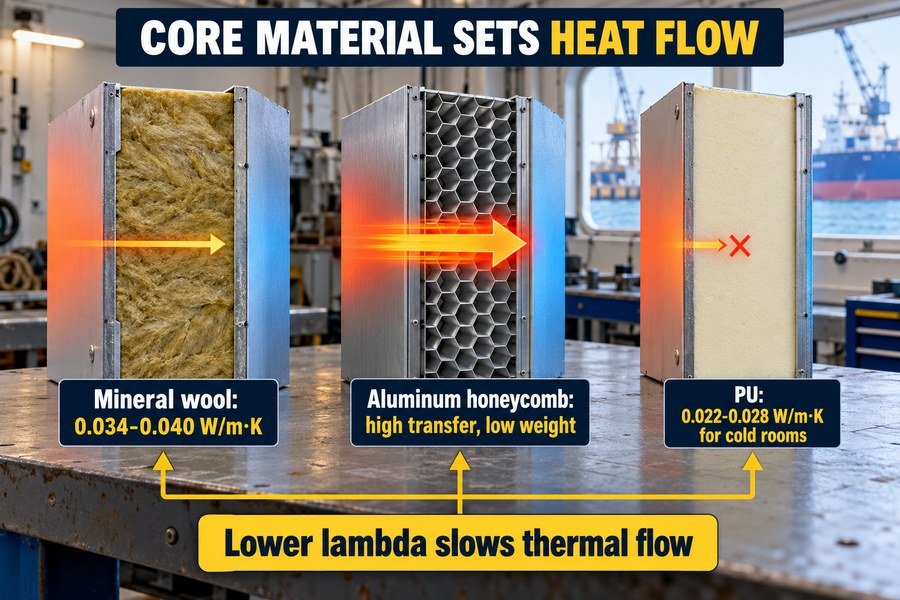
I deal with many procurement officers who buy materials from Asian factories for European shipyards. They often face strict heat transfer limits. Heat transfer happens when warmth moves from a hot area to a cold area. The core material of your marine panel controls this speed. We use thermal conductivity1 to measure this speed. Engineers call this the lambda value ($\lambda$). A low lambda value means the material stops heat very well. A high lambda value means heat passes through easily. I will break down the three main materials you will encounter.
Analyzing Mineral Wool Thermal Conductivity for Fire-Rated Areas
You must use mineral wool (rockwool) for A-class and B-class fire-rated bulkheads. The International Maritime Organization (IMO) requires these panels for safety. Mineral wool has a lambda value between 0.034 and 0.040 W/m·K2. This value comes directly from the ISO 10456 standard. Higher density rockwool provides better fire protection, but it often transfers heat slightly faster. You must balance fire safety with heat control.
Evaluating Aluminum Honeycomb for High Heat Transfer and Low Weight
Shipyards sometimes need very light panels for fast ferries or non-fire-rated zones. Aluminum honeycomb is the best choice for weight reduction. However, aluminum is metal. Metal transfers heat very quickly. Aluminum honeycomb panels have very high thermal conductivity. They do not insulate well. You cannot use them if the shipyard demands strict temperature control between two rooms.
Utilizing Polyurethane Panels for Cold Storage Areas
Ships have provision stores and cold rooms. These rooms need extreme temperature control. You must use polyurethane (PU) core panels here. Polyurethane has a very low lambda value between 0.022 and 0.028 W/m·K3. This low value stops heat from entering the freezing rooms. PU panels save a lot of energy, but they do not pass standard marine fire tests. You can only use them in specific, approved ship areas.
| Core Material Type | Typical Lambda Value (W/m·K) | Primary Shipboard Application | SOLAS Fire Rating Capability |
|---|---|---|---|
| Polyurethane (PU) | 0.022 - 0.028 | Provision stores, cold rooms | None (Combustible) |
| Mineral Wool (Rockwool) | 0.034 - 0.040 | Standard cabin bulkheads | A-Class and B-Class |
| Aluminum Honeycomb | High (Metal conduction) | Fast ferries, public spaces | C-Class (Non-combustible) |
How Do Core Thickness and Lambda Value Determine Marine Ceiling Panel U-Values?
Guessing panel thickness wastes your money. Using too much material kills your budget, while too little fails class approval. The math between thickness and lambda gives you the exact answer.
Core thickness (meters) and lambda value (W/m·K) determine marine ceiling panel U-values (W/m²·K) through a direct calculation: Thermal Resistance (R) equals thickness divided by lambda, and U-value equals 1 divided by total R. You must optimize both variables to meet specific 0.6 to 1.2 W/m²·K shipyard requirements.
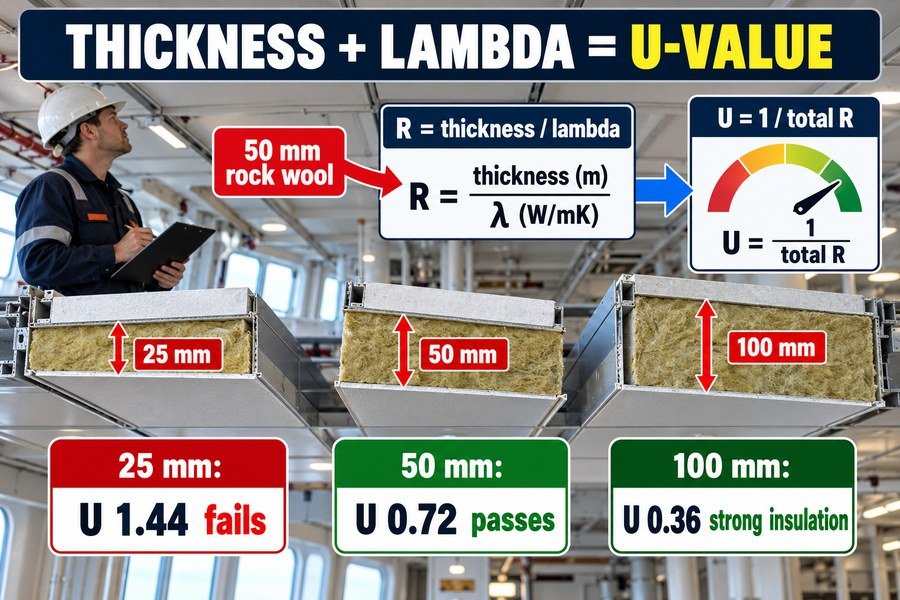
I remember a client who bought 25mm thick ceiling panels to save money on shipping. When the panels arrived in the United States, the shipyard rejected them. The U-value was too high. The shipyard required a U-value of 0.8 W/m²·K. My client did not know how to calculate this. You must understand the math to avoid this costly mistake. The calculation relies entirely on two things: how thick the panel is, and the lambda value of the core material. I will show you how to do the math step by step.
Calculating Thermal Resistance (R-Value) Using Core Thickness and Lambda
First, you must calculate the Thermal Resistance. We call this the R-value. The formula is simple. You take the thickness of the core material in meters and divide it by the lambda value4. Let us use a standard 50mm marine ceiling panel as an example. The thickness is 0.05 meters. A typical rockwool core has a lambda value of 0.036 W/m·K5. You divide 0.05 by 0.036. The result is an R-value of 1.38 m²·K/W. If you use a thicker panel, the R-value goes up. A higher R-value means better insulation.
Converting Total Thermal Resistance into Final Marine Ceiling Panel U-Values
Second, you must find the U-value. European and American shipyards always ask for U-values. The U-value is simply 1 divided by the total R-value6. Using our previous example, we divide 1 by 1.38. The result is a U-value of 0.72 W/m²·K. Many modern cruise ships and offshore platforms require exterior-facing ceiling panels to have a U-value between 0.6 and 1.2 W/m²·K according to the ASHRAE Fundamentals Handbook guidelines for marine vessels. Because 0.72 falls inside this range, the 50mm panel passes the requirement. If my client had used a 25mm panel (0.025m), the R-value would be 0.69. The new U-value would be 1 divided by 0.69, which equals 1.44 W/m²·K. This number is too high, and the shipyard will reject it.
| Panel Thickness (mm) | Core Thickness in Meters (m) | Rockwool Lambda (W/m·K) | Calculated R-Value | Final U-Value (W/m²·K) |
|---|---|---|---|---|
| 25 mm | 0.025 m | 0.036 | 0.69 | 1.44 (Fails typical spec) |
| 50 mm | 0.050 m | 0.036 | 1.38 | 0.72 (Passes typical spec) |
| 100 mm | 0.100 m | 0.036 | 2.77 | 0.36 (Excellent insulation) |
Why Are Accurate Marine Accommodation Panel Lambda Values Critical for HVAC Estimates?
HVAC engineers rely on your data. Give them wrong lambda values, and they will buy the wrong chillers. Accurate data prevents million-dollar equipment failures on the shipyard floor.
Accurate marine accommodation panel lambda values are critical for HVAC estimates because they dictate three main system components: the total cooling capacity (kW) required for chillers, the sizing of air handling unit (AHU) ductwork, and the electrical power load calculation for the ship's generators, ensuring regulatory EEDI compliance.
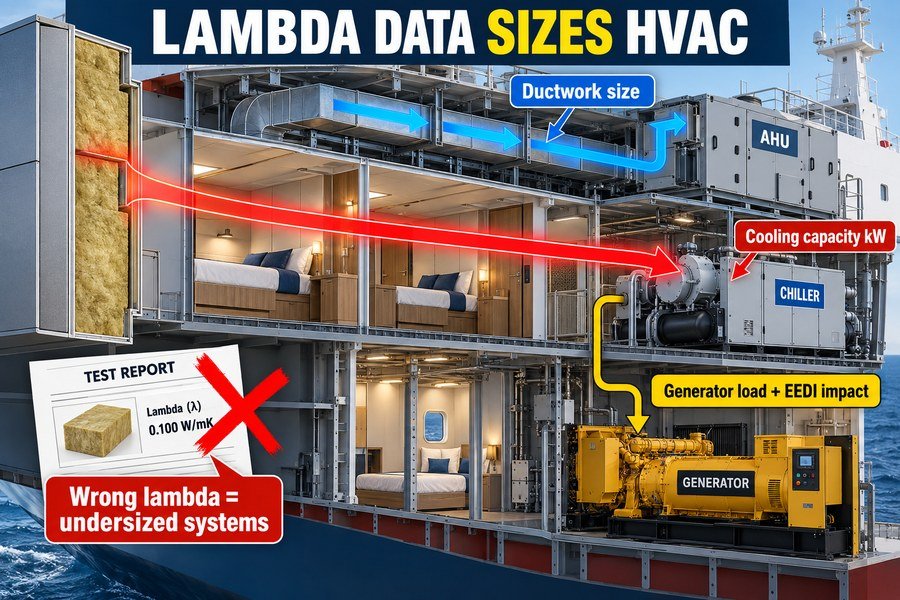
Shipyards do not buy wall panels just to make rooms look nice. They buy them to seal the indoor environment. The ship's HVAC (Heating, Ventilation, and Air Conditioning) system is the most expensive interior system. HVAC engineers design this system based on the numbers you provide. If you buy cheap panels from an unverified supplier in Asia, the factory might give you a fake lambda value. If you give this fake number to the shipyard, the whole engineering design fails. I have seen shipowners sue outfitters for this exact mistake. The lambda value directly impacts7 three massive parts of the ship's design.
Impact of Lambda Values on Total Cooling Capacity and Chiller Sizing
The ship's chillers provide all the cold water for the air conditioning. Engineers calculate the required cooling capacity in kilowatts (kW) based on how much heat enters through the walls. If you supply a panel with a stated lambda of 0.034, but the real lambda is 0.045, more heat enters the cabin than expected. The chillers will be undersized. The ship will stay hot in tropical waters. Replacing an undersized marine chiller costs between $50,000 and $100,000. You must provide honest test reports to prevent this disaster.
Relationship Between Panel Insulation and Air Handling Unit Ductwork Sizing
The Air Handling Unit (AHU) pushes cold air through the ship using steel ductwork. If the panel insulation is poor because of a high lambda value, the AHU must push more cold air to keep the cabin comfortable. More air requires larger steel ducts. Ship ceiling spaces are very tight. If the engineers must suddenly use larger ductwork because your panels lack thermal resistance, the pipes and cables will not fit in the ceiling. This causes huge construction delays.
Electrical Power Load Calculations and EEDI Compliance for Ship Generators
Every chiller and AHU motor runs on electricity from the ship's diesel generators. If the HVAC system must work harder due to bad panel insulation, it consumes more electricity. More electricity means burning more diesel fuel. The IMO enforces the Energy Efficiency Design Index (EEDI) under MEPC.328(76). Ships must prove they do not waste fuel. If your panels have high lambda values, the ship's fuel consumption goes up, and the vessel might fail its mandatory EEDI certification8.
| HVAC Component | Impact of Incorrect High Lambda Value | Estimated Financial Consequence for Shipyard |
|---|---|---|
| Water Chillers | System undersized; fails to cool ship | $50,000 - $100,000 for equipment replacement |
| AHU Ductwork | Ducts need to be larger; do not fit in ceiling | Massive labor costs to redesign ceiling pipes |
| Ship Generators | Increased electrical load; higher fuel burn | Fails EEDI compliance; daily fuel cost penalty |
How Do Wrong Lambda Values Distort Marine Accommodation Panel Heat Loss?
Underestimating heat loss causes freezing cabins. When panel suppliers fake test reports, the whole ship suffers. You must spot these calculation errors before installation begins.
Wrong lambda values distort marine accommodation panel heat loss by creating two severe calculation errors: underestimating the winter heating load which causes cabin temperatures to drop below the ISO 7547 standard of 22°C, and miscalculating condensation dew points which leads to hidden moisture damage inside the steel bulkheads.
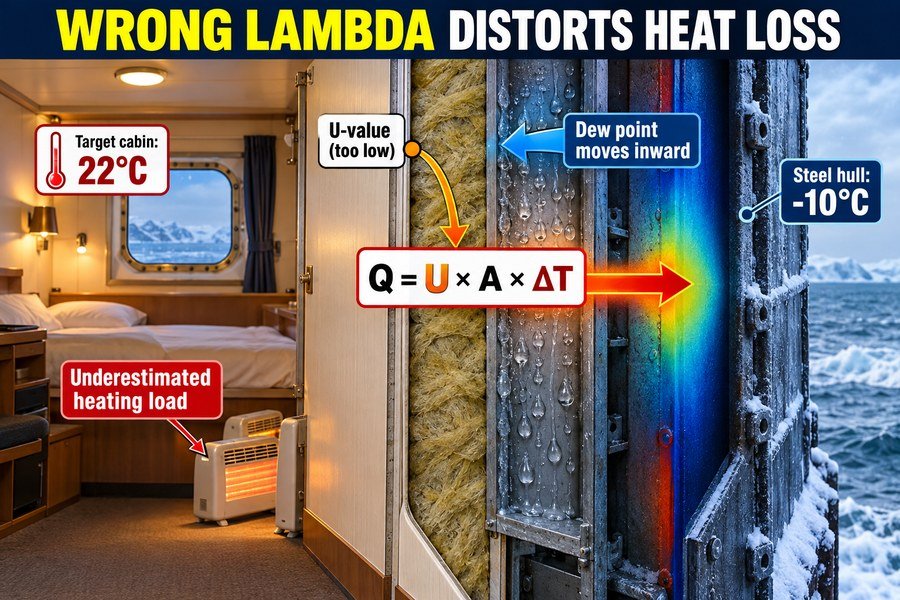
I always warn procurement officers about the danger of cold weather. Everyone thinks about air conditioning in the summer. But winter sailing in the North Sea or Alaska is brutal. The steel hull of the ship becomes freezing cold. Your marine interior panels are the only thing protecting the crew from that cold steel. We calculate heat loss using a formula: Heat Loss equals U-value multiplied by Area multiplied by Temperature Difference (Q = U × A × ΔT)9. Because the U-value comes from the lambda value10, a wrong lambda means your entire heat loss calculation is garbage. This distortion leads to two very specific, very expensive physical failures on the ship.
Preventing Cabin Temperature Drops Below ISO 7547 Standards in Winter
The maritime industry follows the ISO 7547 standard for shipboard air conditioning and heating. This standard dictates that indoor cabin temperatures must stay at 22°C during winter conditions. If you calculate your heat loss using a fake, overly optimistic lambda value (like 0.032 W/m·K), the engineers will think the panel traps heat well. They will install small electrical heaters. However, if the actual cheap rockwool has a lambda of 0.045 W/m·K, heat escapes very fast. The small heaters cannot keep up. The cabin temperature drops to 16°C or 17°C. The crew freezes, and the shipyard fails the delivery inspection.
Avoiding Hidden Moisture Damage by Correctly Calculating Condensation Dew Points
The second problem is much more dangerous because it is invisible. When warm, humid cabin air touches a cold surface, it turns into liquid water. We call this the dew point. If your panel's lambda value is worse than calculated, the back side of the panel (touching the cold steel ship hull) gets much colder than the engineers predicted. Condensation forms between the panel and the steel bulkhead. This water sits in the dark and rusts the ship's steel from the inside out. Fixing rusted internal bulkheads costs easily $500 per square meter in European repair yards. You must use accurate lambda data to ensure the panel surface stays above the dew point.
| Heat Loss Factor | Consequence of Distorted Lambda Calculation | Industry Standard Violated |
|---|---|---|
| Winter Heating Load | Cabin temperature falls below design limits | ISO 7547 (22°C design temp) |
| Dew Point Location | Condensation forms on cold hidden steel | Shipyard corrosion protection rules |
| Electrical Heaters | Installed heaters are too small for the room | Class society crew comfort rules |
How Does Marine Lining Panel Thermal Conductivity Link to Class-Approved U-Values?
Class surveyors reject unverified panels. If your test certificates do not match the installed materials, you lose the project. Connecting your conductivity tests to class approvals guarantees your payment.
Marine lining panel thermal conductivity links directly to class-approved U-values through three mandatory verification stages: initial laboratory testing under ISO 8301 to find the base lambda, mathematical U-value modeling submitted to societies like DNV or ABS, and final onboard thermal imaging inspections during sea trials to verify actual performance.
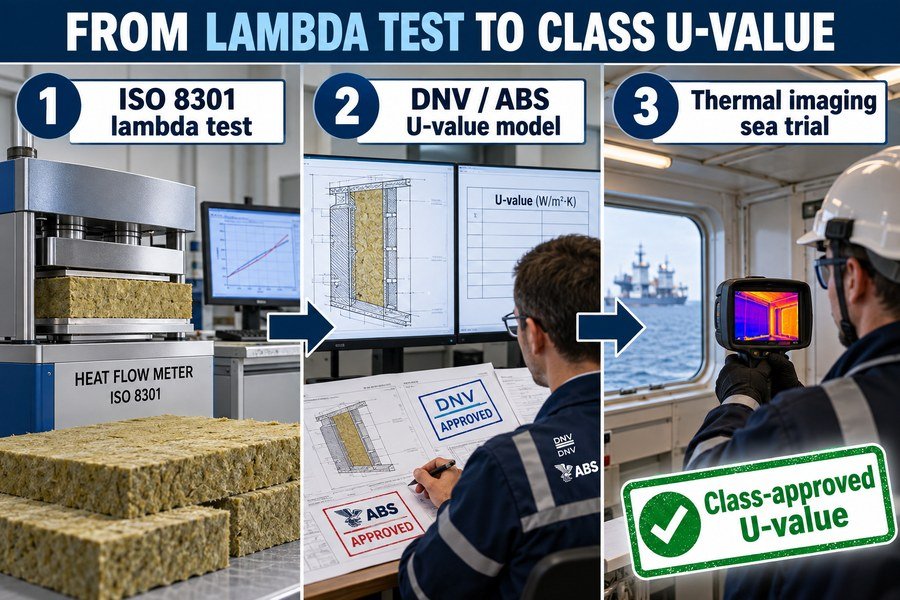
You buy high-quality panels to make a profit. But you do not get paid until the classification society signs the paperwork. Classification societies, like DNV in Norway or ABS in the United States, act as the police for shipbuilding. They do not trust sales brochures. They only trust verified data and physical proof. You cannot just tell a DNV surveyor that your panels have a good U-value. You must prove the link between the raw material's thermal conductivity and the final installed wall. I help my clients navigate this strict bureaucratic process. It always involves three mandatory stages. If you fail any stage, the shipyard will rip your panels out of the vessel.
Conducting Initial Laboratory Testing Under ISO 8301 for Base Lambda
The process starts before you even buy the panels. The Asian factory must send their raw core material to an independent, accredited laboratory. The lab tests the rockwool using the ISO 8301 standard. This standard uses a heat flow meter to find the exact thermal conductivity (lambda value). The lab gives you a certified test report. You must check this report. The report must clearly state the density of the wool and the final W/m·K number. I always verify that the lab has proper international accreditation.
Submitting Mathematical U-Value Modeling to Classification Societies Like DNV or ABS
Next, the shipyard's engineering team takes your ISO 8301 lab report. They use the lambda value to calculate the final U-value based on the panel thickness and the steel hull structure. They put these calculations into a formal thermal modeling report. They submit this report to DNV or ABS for drawing approval. The class surveyor reviews the math according to the specific rules for the classification of ships. The surveyor will stamp the drawings "Approved" only if your lambda values result in a U-value that meets the energy efficiency rules.
Passing Final Onboard Thermal Imaging Inspections During Sea Trials
The final test happens on the real ocean. The ship leaves the dock for sea trials. The class surveyors walk through the cabins holding FLIR thermal imaging cameras11. They look at the walls you installed. If the factory cheated and used low-quality rockwool with a bad lambda value, the thermal camera will show bright red hot spots or dark blue cold spots. The real-world U-value fails. The surveyor will reject the room immediately. You pass this stage only if the installed panels match the lab reports perfectly.
| Verification Stage | Responsible Party | Standard / Tool Used | Output Document |
|---|---|---|---|
| 1. Base Lambda Testing | Independent Laboratory | ISO 8301 Heat Flow Meter | Certified Lambda Test Report |
| 2. U-Value Modeling | Shipyard Engineers | DNV / ABS Class Rules | Approved Engineering Drawings |
| 3. Onboard Inspection | Class Surveyor | Thermal Imaging Camera | Final Sea Trial Acceptance Certificate |
Conclusion
Mastering thermal conductivity and U-values allows you to supply high-quality marine panels confidently. You will satisfy strict shipyard regulations, optimize HVAC designs, and win more profitable interior outfitting projects.
-
"7.6 Fundamentals of Heat Transfer", https://pressbooks-dev.oer.hawaii.edu/epet302/chapter/8-5/. A heat-transfer reference defines thermal conductivity as the material property governing conductive heat flow under a temperature gradient, commonly expressed in W/m·K and often denoted by λ or k. Evidence role: definition; source type: education. Supports: Thermal conductivity measures how readily heat moves through a material, and engineers use the lambda value to express it.. Scope note: This supports the general physics definition, not the performance of any specific marine panel product. ↩
-
"Determination of Thermal Properties of Mineral Wool ... - PMC", https://pmc.ncbi.nlm.nih.gov/articles/PMC10488771/. ISO 10456 and related building-material thermal tables report typical declared/design thermal conductivity values for mineral wool insulation in the approximate range of 0.034–0.040 W/m·K, depending on product type and conditions. Evidence role: statistic; source type: institution. Supports: Mineral wool used as insulation commonly has a lambda value around 0.034–0.040 W/m·K.. Scope note: The cited range is contextual and product-dependent; actual certified values should come from the panel or insulation manufacturer’s test data. ↩
-
"Porous Thermal Insulation Polyurethane Foam Materials - PMC", https://pmc.ncbi.nlm.nih.gov/articles/PMC10537539/. Technical references on polyurethane insulation report low thermal conductivity values for rigid polyurethane foam, commonly around 0.022–0.028 W/m·K, which explains its use in refrigerated and cold-storage applications. Evidence role: statistic; source type: research. Supports: Polyurethane core panels can have very low lambda values suitable for cold-room insulation.. Scope note: The range varies with foam formulation, blowing agent, aging, facing materials, temperature, and test method. ↩
-
"STEADY HEAT CONDUCTION IN PLANE WALLS", https://www.academia.edu/32611239/Kuliah_Perpindahan_panas_STEADY_HEAT_CONDUCTION_IN_PLANE_WALLS. Standard heat-transfer references define the thermal resistance of a plane homogeneous layer as thickness divided by thermal conductivity, R = L/k, supporting this calculation method for a single insulation layer. Evidence role: mechanism; source type: education. Supports: Thermal resistance can be calculated by dividing insulation thickness in meters by the material’s lambda value.. Scope note: This formula applies directly to a homogeneous layer and does not by itself include surface resistances, metal facings, joints, fasteners, or thermal bridges. ↩
-
"Determination of Thermal Properties of Mineral Wool ... - PMC", https://pmc.ncbi.nlm.nih.gov/articles/PMC10488771/. Published material data for mineral wool insulation commonly report thermal conductivity values around 0.035–0.040 W/m·K, providing contextual support for using 0.036 W/m·K as a representative calculation value. Evidence role: statistic; source type: institution. Supports: A rockwool or mineral-wool core can reasonably be modeled with a lambda value near 0.036 W/m·K for example calculations.. Scope note: Actual lambda values vary by product density, temperature, moisture condition, and certification method, so the cited figure should be treated as representative rather than universal. ↩
-
"A New Metre for Cheap, Quick, Reliable and Simple Thermal ...", https://pmc.ncbi.nlm.nih.gov/articles/PMC5620656/. Building-physics and heat-transfer references define thermal transmittance, or U-value, as the reciprocal of total thermal resistance, supporting the conversion U = 1/R for assemblies expressed in SI units. Evidence role: definition; source type: education. Supports: U-value is calculated as the reciprocal of total thermal resistance.. Scope note: The reciprocal relationship requires use of total assembly resistance; a core-only R-value will not equal the full tested assembly U-value if facings, air films, cavities, or thermal bridges are significant. ↩
-
"Thermal conductivity and resistivity", https://en.wikipedia.org/wiki/Thermal_conductivity_and_resistivity. Standard heat-transfer references define λ as thermal conductivity in Fourier’s law, where higher conductivity increases conductive heat flow through a material for a given area, thickness, and temperature difference. Evidence role: mechanism; source type: education. Supports: The lambda value of a wall panel directly affects heat transfer through the panel and therefore influences ship interior thermal design.. Scope note: This supports the physical mechanism but does not verify any particular supplier’s reported lambda value or the full installed performance of a marine wall panel. ↩
-
"- 1 - Note by the International Maritime Organization to the ...", https://seors.unfccc.int/applications/seors/attachments/get_attachment?code=MOE2AHKBQJAQLFCWO8EAVIYFKOE25OT4. IMO materials on MARPOL Annex VI and MEPC.328(76) describe the Energy Efficiency Design Index as a mandatory design-efficiency requirement for applicable new ships and link the index to installed power, fuel type, and CO₂ emissions factors. Evidence role: historical_context; source type: institution. Supports: EEDI is a mandatory IMO design-efficiency requirement, and higher onboard energy demand can be relevant to the vessel’s efficiency calculation.. Scope note: This supports the regulatory context for EEDI, but it does not directly prove that a wall panel’s lambda value alone would cause a vessel to fail certification. ↩
-
"18.5 Heat Exchangers", https://web.mit.edu/16.unified/www/FALL/thermodynamics/notes/node131.html. A building-physics or heat-transfer reference explains that steady-state heat transfer through a plane assembly is commonly calculated as heat flow equal to thermal transmittance multiplied by area and temperature difference. Evidence role: mechanism; source type: education. Supports: Heat loss through marine interior panels can be calculated using Q = U × A × ΔT.. Scope note: This supports the general heat-transfer equation; shipboard panel assemblies may require additional corrections for thermal bridges, air leakage, and boundary conditions. ↩
-
"A Computational Approach to Predicting Thermal ...", https://www.andrew.cmu.edu/user/ramesh/students/theses/Noreen_Saeed_2020_thesis.pdf. Thermal-engineering references define U-value as the reciprocal of total thermal resistance, while the resistance of a homogeneous layer is calculated from its thickness divided by thermal conductivity, showing how lambda contributes to the U-value of an assembly. Evidence role: definition; source type: education. Supports: A material’s lambda value is a key input used to derive the U-value of a panel assembly.. Scope note: This establishes the calculation relationship in idealized layer assemblies; real marine panels may also include joints, facings, fasteners, and air films. ↩
-
"Infrared Thermography Assessment of Thermal Bridges in ...", https://ui.adsabs.harvard.edu/abs/2014Sust....6.7107B/abstract. Infrared thermography guidance and building-envelope studies show that thermal cameras can identify temperature anomalies associated with insulation defects, air leakage, and thermal bridges. Evidence role: mechanism; source type: paper. Supports: Thermal imaging can reveal insulation or installation defects as visible hot or cold areas on wall surfaces.. Scope note: Thermal imaging indicates surface-temperature differences and possible defects; it does not directly measure U-value without controlled conditions and further analysis. ↩