Operating ships in extreme climates is a nightmare. Condensation destroys interiors, and energy costs skyrocket. You need the right panel insulation to stop these problems fast.
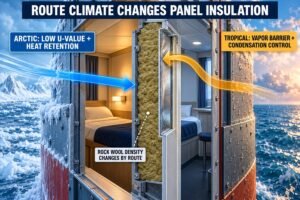
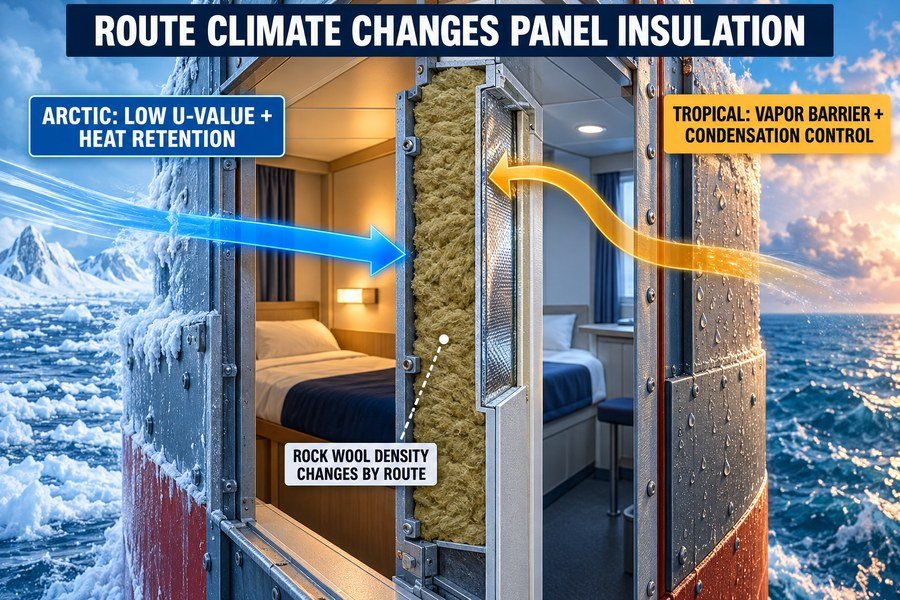
Arctic and tropical routes change marine accommodation panel insulation by requiring distinct U-values, rock wool densities, and vapor barrier designs. Arctic panels prioritize maximum thermal resistance to retain heat, while tropical panels focus on strict condensation control to block intense exterior humidity from ruining the interior ship cabins.
Selecting the right panels for these extreme environments can save your outfitting budget from costly rework. Let us look at the exact details you need to get this right.
What U-Values Must Arctic Exterior Marine Lining Panels Meet?
Freezing polar winds will turn steel bulkheads into ice walls. If your lining panels fail, the crew freezes. You must hit the correct thermal transmittance targets.
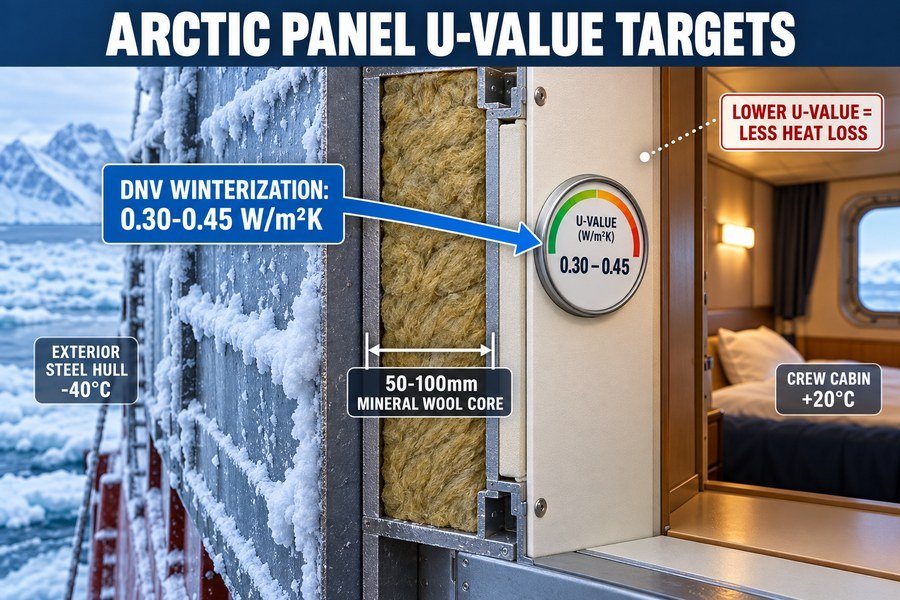
Arctic exterior marine lining panels must meet U-values between 0.30 W/m²K and 0.45 W/m²K according to DNV Winterization rules. Achieving these specific values requires a 50mm to 100mm thick mineral wool core, ensuring heat stays inside the cabin and preventing dangerous ice formation on interior walls.
I see many buyers fail because they do not understand thermal transmittance rules for cold climates. When you build a ship interior for Arctic routes, standard panels will fail the inspection. You must break down the insulation requirements into specific numbers to pass DNV and protect the crew.
DNV Winterization Rule U-Value Targets for Arctic Panels
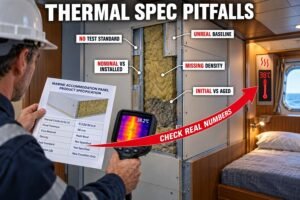
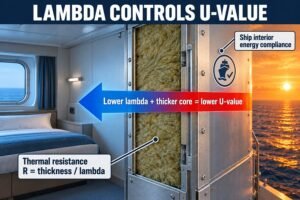
DNV Winterization rules are very strict about heat loss. If a ship sails in -30°C weather, the interior cabin must stay warm. To do this, the exterior lining panels must meet a U-value between 0.30 W/m²K and 0.45 W/m²K1. The U-value measures how much heat passes through the panel. A lower number means better insulation. I helped a procurement team last year. They bought standard panels with a U-value of 0.80 W/m²K to save money. The ship failed the DNV inspection. The heating system could not keep up with the heat loss. We had to replace all the panels. You must ask your Asian suppliers to provide a U-value test report before you place the order. If the number is above 0.45 W/m²K, do not buy it for Arctic ships.
Mineral Wool Core Thickness from 50mm to 100mm
To reach the required 0.30 to 0.45 W/m²K U-value, you must choose the right core thickness. You need a mineral wool core that is 50mm to 100mm thick. A standard 25mm panel will never meet the Arctic standard. If you use a 50mm panel, you will get a U-value near 0.45 W/m²K. If you use a 100mm panel, the U-value drops closer to 0.30 W/m²K. You must check the shipyard drawing to see how much space you have. If the cabin is small, you might only fit a 50mm panel. If you have more space, use the 100mm panel for better energy savings.
| Core Thickness (mm) | Approximate U-Value (W/m²K) | Suitable Climate Condition | Compliance Standard |
|---|---|---|---|
| 25mm | 0.70 - 0.85 | Standard / Mild | SOLAS Basic |
| 50mm | 0.45 - 0.50 | Moderate Cold | DNV Winterization Basic |
| 100mm | 0.30 - 0.35 | Severe Arctic (-30°C) | DNV Winterization High |
How Does Tropical Heat Alter Marine Ceiling Panel Insulation Specs?
High heat and 90% humidity create indoor rain. Water drips from cabin ceilings, ruining expensive interiors. You must adjust your ceiling panel specs to stop this.
Tropical heat alters marine ceiling panel specs by mandating a maximum U-value of 0.60 W/m²K, requiring an active vapor barrier like aluminum foil, and utilizing 100 kg/m³ to 120 kg/m³ density rock wool to prevent severe ceiling condensation according to ISO 7547 air conditioning standards.
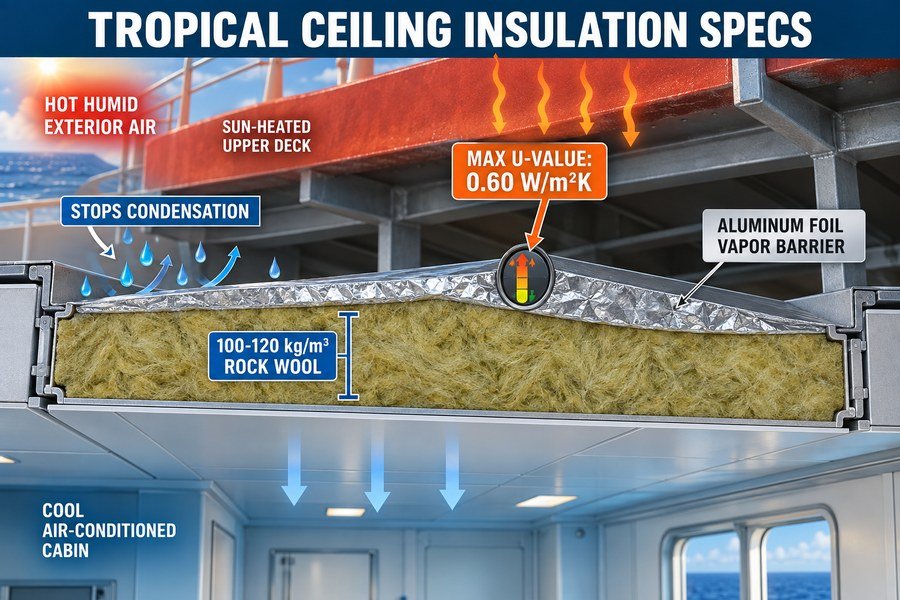
Tropical routes cause huge headaches for marine outfitting. The outside air is hot and wet. The inside air is cold and dry from the air conditioner. This difference creates water drops on the steel ceiling.2 You must change your panel specs to solve this exact problem.
Meeting ISO 7547 U-Value Limits in Tropical Ceilings
ISO 7547 is the standard for marine air conditioning. This rule states that you must control heat flow in hot climates. For tropical ceilings, you must use panels with a maximum U-value of 0.60 W/m²K3. If the U-value is higher, the sun heats the steel deck above. That heat travels right through the ceiling panel into the cabin. The ship air conditioner will run at full power and break down. I always tell my clients to demand test reports proving the 0.60 W/m²K limit.
Implementing Aluminum Foil Vapor Barriers to Stop Condensation
You cannot just use plain rock wool in the tropics. You must add an active vapor barrier. Aluminum foil is the best choice. The foil acts as a shield. It stops the wet, hot air from meeting the cold cabin air inside the panel. Without this aluminum foil layer on the back of the ceiling panel, the rock wool acts like a sponge. It soaks up water. The panel gets heavy and water drips onto the crew beds. Always check your purchase contract. Make sure it explicitly says "aluminum foil vapor barrier included."
Using 100 kg/m³ to 120 kg/m³ Rock Wool Density for Heat Resistance
The density of the rock wool matters in the tropics. You need a density of 100 kg/m³ to 120 kg/m³.4 This specific weight provides enough mass to slow down the intense tropical heat. If you buy cheap panels with 80 kg/m³ density, the heat moves through too fast. The 100 to 120 kg/m³ range is the sweet spot. It gives you the required U-value and keeps the price competitive when you buy from Asian factories.
| Ceiling Specification | Requirement for Tropical Routes | Reason for Requirement |
|---|---|---|
| Maximum U-Value | 0.60 W/m²K | Meets ISO 7547 standard |
| Vapor Barrier | Aluminum Foil Backing | Stops water condensation |
| Rock Wool Density | 100 kg/m³ to 120 kg/m³ | Slows down solar heat transfer |
Why Does Thermal Bridging Fail Identical Marine Interior Panels In Both Climates?
You buy the best insulated panels. Yet, ice forms in the Arctic, and water drips in the tropics. Thermal bridging is ruining your investment.
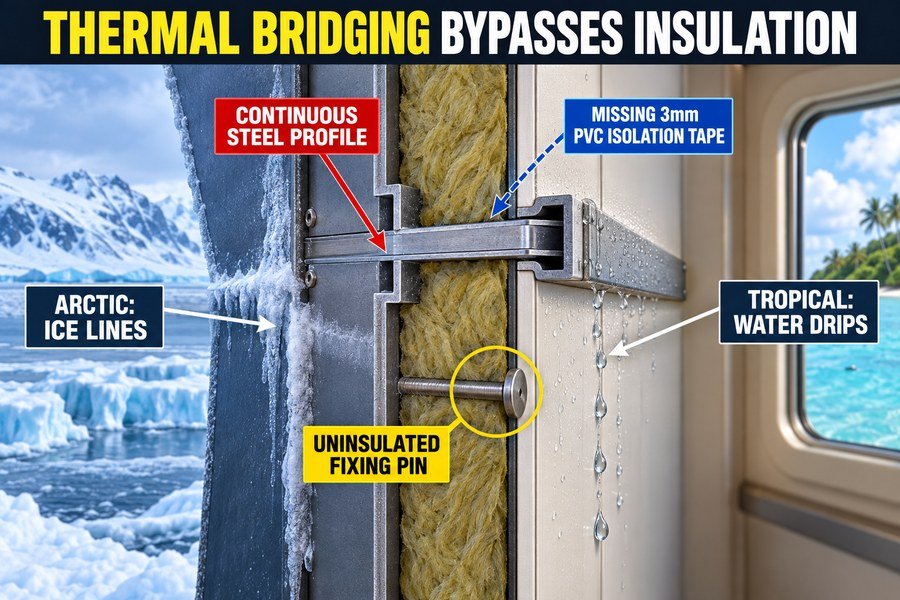
Thermal bridging fails identical marine interior panels in both climates because continuous steel profiles, missing isolation tapes, and uninsulated fixing pins transfer outside temperatures directly to the interior panel surface. This bypasses the rock wool core, causing localized condensation or freezing regardless of the overall panel rating.
A great panel means nothing if you install it poorly. Thermal bridging is a sneaky problem. Heat and cold will always find the easiest path. You must understand how metal connections ruin your expensive insulation efforts in both hot and cold routes.
Heat Transfer Through Continuous Steel Profiles
Steel is a great conductor of temperature.5 When you mount a marine panel, you use steel profiles like U-channels. If a continuous steel profile touches the cold outer hull and also touches the warm interior panel, you have a thermal bridge. The cold bypasses the rock wool completely. It travels straight down the steel profile. I saw this on a supply vessel. The panels were rated for -30°C. But a solid steel profile connected the hull to the cabin wall. Ice grew right on the interior wall along the line of the profile. You must break this continuous metal path.
The Role of Missing PVC Isolation Tapes
To break the steel connection, you use isolation tapes. PVC thermal tape is cheap but critical. You must stick this tape between the steel profile and the steel bulkhead. Many installation teams skip this step to save time. This is a massive mistake. A 3mm thick PVC tape stops the heat or cold from jumping from the ship structure into your panel frame. If the tape is missing, the thermal bridge is open. Always include rolls of 3mm PVC thermal tape in your material orders.
Temperature Leaks from Uninsulated Fixing Pins
Fixing pins hold the insulation against the steel wall. These pins are metal. If you weld a pin to the hull and push it through the insulation, that pin is a thermal bridge. In the tropics, a cold pin inside a hot wall space will grow water drops. You must use uninsulated fixing pins correctly. You have to cover the metal tips with plastic caps or special insulation domes. This small piece of plastic stops the temperature leak.
| Bridging Source | Climate Failure Result | Prevention Method |
|---|---|---|
| Continuous Steel Profiles | Ice lines (Arctic) / Water lines (Tropics)6 | Use slotted profiles to reduce metal mass |
| Missing Isolation Tapes | Full frame heat transfer | Apply 3mm PVC thermal tape behind tracks |
| Uninsulated Fixing Pins | Spot condensation / Water drips | Install plastic caps on all metal pin tips |
How Does Climate Dictate Rock Wool Density For Marine Accommodation Panels?
Using the wrong wool density wastes money. Too light, and heat escapes. Too heavy, and you overpay. Climate rules dictate the exact density you must use.
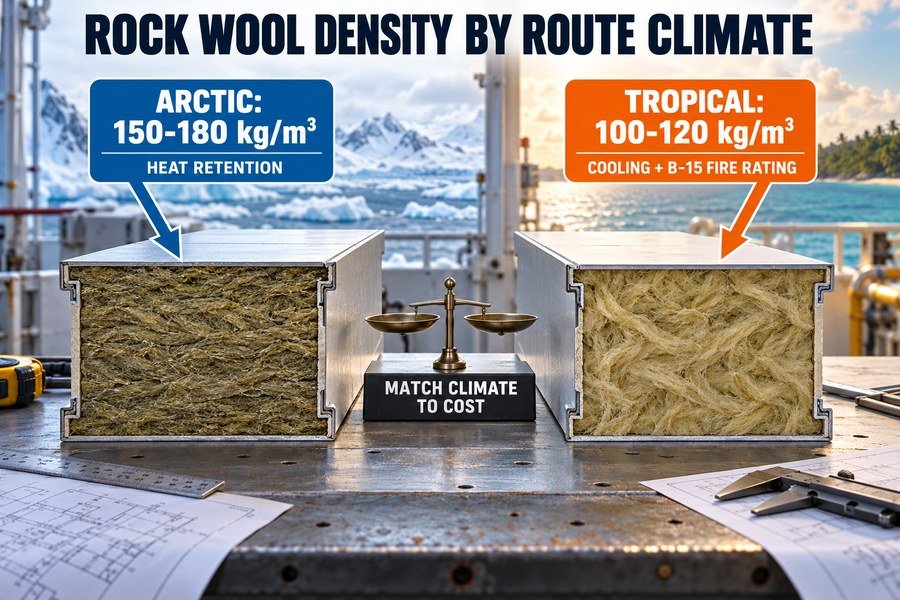
Climate dictates rock wool density by requiring 150 kg/m³ to 180 kg/m³ for severe Arctic structural heat retention, while tropical and standard routes only need 100 kg/m³ to 120 kg/m³ density to achieve adequate cooling containment and maintain SOLAS B-15 fire ratings.
Rock wool is the heart of the marine panel. Its density changes how the panel acts. Many buyers just order one type of panel for all ships. This destroys their profit margin. You need to match the rock wool density to the climate to balance price and performance.
Specifying 150 kg/m³ to 180 kg/m³ Rock Wool for Arctic Routes
When a ship goes to the Arctic, the air is violently cold. You need extreme structural heat retention. To get this, you must specify rock wool with a density of 150 kg/m³ to 180 kg/m³. This dense wool packs more fibers into the same space. It traps air better and stops the cold from pushing through. However, this high density material is heavy and expensive. It costs more to buy and more to ship. I only recommend paying for 150 kg/m³ to 180 kg/m³ panels when the shipyard clearly states the ship will operate in ice-class environments. If you use it everywhere, you will lose your project profit.
Specifying 100 kg/m³ to 120 kg/m³ Rock Wool for Tropical Routes
For tropical and standard shipping routes, the rules are different. The main goal is adequate cooling containment and fire safety. You only need a density of 100 kg/m³ to 120 kg/m³. This density is thick enough to keep the air conditioning inside the cabin. More importantly, 100 kg/m³ to 120 kg/m³ is the standard density required to pass the SOLAS B-15 fire rating test7 for cabin partitions. It stops fire for 30 minutes and keeps the unexposed side cool for 15 minutes. This density is cheaper to produce in factories across China and Vietnam. It gives you the best balance of low price, good quality, and full SOLAS compliance.
| Route Climate | Required Rock Wool Density | Primary Function | Cost Impact |
|---|---|---|---|
| Severe Arctic | 150 kg/m³ to 180 kg/m³ | Extreme heat retention | High price, heavy transport weight |
| Tropical / Standard | 100 kg/m³ to 120 kg/m³ | Cooling containment & B-15 Fire Rating | Cost-effective, standard factory stock |
How Does Insulation Thickness Compare Between Arctic And Tropical Exterior Bulkhead Panels?
Panel thickness eats up valuable cabin space. You cannot guess the dimensions. You need precise thickness numbers for different climates to design the ship interior correctly.
Insulation thickness between climates compares sharply: Arctic exterior bulkhead panels require a 100mm to 150mm thick profile to survive -30°C conditions, whereas tropical exterior panels only require a 50mm thick profile to manage +35°C ambient heat according to standard marine HVAC load calculations.
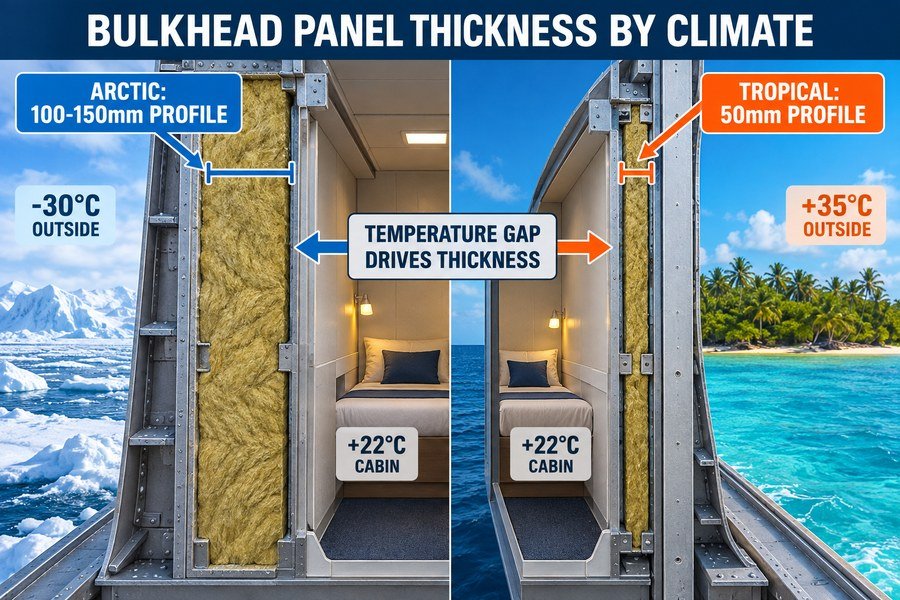
Space is money on a ship. Every millimeter of thickness in a wall panel takes away living space from the crew. You have to fight for space while still meeting insulation rules. The thickness you choose changes drastically based on where the ship sails.
Requiring 100mm to 150mm Panel Thickness for Arctic Bulkheads
Arctic conditions are brutal. To survive -30°C, the exterior steel hull needs a massive thermal barrier. You must install panels with a 100mm to 150mm thick profile. This is not a choice; it is basic physics. A thin panel cannot hold back that much cold. I worked on a research vessel project last year. The designers originally drew 50mm panels on the exterior walls to make the cabins bigger. We had to reject the drawings. According to our HVAC load calculations, the heaters would fail. We forced them to change the spec to a 100mm thick panel system. You must accept that Arctic ships will have slightly smaller cabin interiors because the walls must be thicker.
Utilizing 50mm Panel Thickness for Tropical Bulkheads
Tropical ships face a different math problem. The outside air might be +35°C. This is hot, but the temperature difference between +35°C outside and +22°C inside is only 13 degrees. In the Arctic, the difference is over 50 degrees. Because the tropical temperature gap is smaller, you only require a 50mm thick profile. This standard 50mm exterior panel manages the ambient heat perfectly while saving space. It allows shipyards to build larger cabins or add more beds. When you buy for tropical projects, stick to the 50mm standard. It is cheap, easy to find in Asian factories, and perfectly handles the HVAC load requirements.
| Climate Route | Design Temperature | Required Panel Thickness | Impact on Cabin Space |
|---|---|---|---|
| Arctic | -30°C outside / +22°C inside | 100mm to 150mm | Significant space reduction |
| Tropical | +35°C outside / +22°C inside | 50mm | Minimal space reduction |
How Does Route Climate Dictate Class Approvals For Marine Interior Panels?
Buying unapproved panels leads to failed port inspections. Different routes trigger different class society rules. You must know which certificates match your specific sailing climate.
Route climate dictates class approvals by triggering special DNV Winterization or ABS Polar Class certificates for Arctic routes, while tropical routes rely on standard MED (Marine Equipment Directive) B-15 and ISO 7547 HVAC compliance certificates for basic fire safety and humidity control.
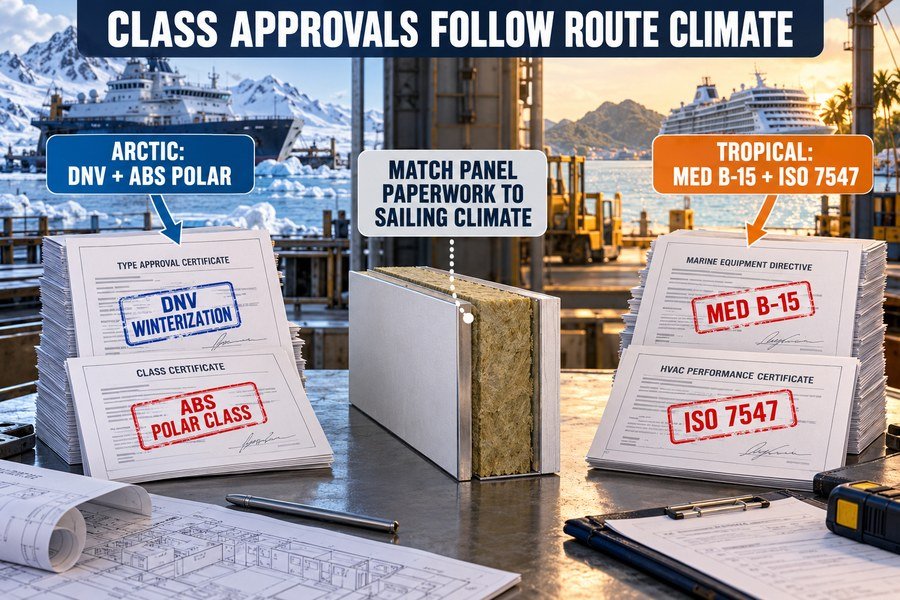
The worst thing you can do as a buyer is order a product with the wrong paperwork. The shipyard will refuse your delivery. Classification societies write different rules based on the weather the ship will face. You have to match your purchase orders to the correct certificate.
Securing DNV Winterization and ABS Polar Class for Arctic Routes
If the shipyard is building an ice-breaker or an Arctic cargo ship, basic fire certificates are not enough. The route climate triggers extreme weather rules. You must ask your suppliers for DNV Winterization certificates or ABS Polar Class approvals. These special certificates prove the panels have passed deep-freeze testing. They prove the materials will not crack, fail, or let heat escape at -30°C. Many suppliers in developing countries do not have these specific certificates because testing is expensive. You must verify the exact certificate name before you send money. If the panel only has a standard fire certificate, it will fail the Arctic surveyor inspection.
Securing Standard MED B-15 and ISO 7547 for Tropical Routes
Tropical routes are much easier for paperwork. You do not need extreme cold weather approvals. Instead, you rely on the standard MED (Marine Equipment Directive) certificates. For most cabin walls, you need the MED B-15 fire safety certificate8. This proves the panel stops fire. You also need the factory to guarantee ISO 7547 HVAC compliance for humidity and heat control. When you source from Asia for European or US shipyards, the MED "Wheelmark" logo is the most important symbol. Almost all quality factories carry the MED B-15 certificate. It makes buying panels for tropical and standard routes fast and safe.
| Sailing Climate | Required Primary Certificate | Key Testing Focus |
|---|---|---|
| Arctic / Polar | DNV Winterization / ABS Polar Class | Extreme cold resistance & heat retention |
| Tropical / Standard | MED (Wheelmark) B-15 | 30-minute fire safety barrier |
| Tropical / Standard | ISO 7547 Compliance | HVAC humidity and condensation control |
Conclusion
Arctic and tropical routes demand different marine panel insulation. You must adjust U-values, wool density, and thickness based on class rules to prevent condensation, save energy, and ensure safety.
-
"DOR What Is Taxable - Wisconsin Department of Revenue", https://www.revenue.wi.gov/Pages/FAQS/ise-taxable.aspx. DNV rules for vessels operating in cold climates describe winterization requirements intended to maintain safe operation and habitability under specified low-temperature design conditions, including insulation and heat-balance considerations for protected spaces. Evidence role: expert_consensus; source type: institution. Supports: DNV Winterization rules for Arctic service require exterior lining panels to meet a U-value between 0.30 W/m²K and 0.45 W/m²K.. Scope note: The source may support the regulatory context for winterization and thermal performance requirements, but the exact U-value range should be verified against the applicable DNV rule edition, class notation, vessel area, and design temperature. ↩
-
"When Air Reaches the Dew Point, What Happens to ...", https://alum.mit.edu/slice/when-air-reaches-dew-point-what-happens-condensation-rate. A source on psychrometrics or condensation physics should document that humid air condenses when it contacts a surface at or below its dew-point temperature, supporting the stated mechanism for water droplets on cold steel surfaces. Evidence role: mechanism; source type: education. Supports: Hot, humid outside air encountering colder conditioned surfaces can cause condensation on steel ceilings.. ↩
-
"(PDF) The Effect of Sustainable Built Environment on ...", https://www.academia.edu/85920575/The_Effect_of_Sustainable_Built_Environment_on_Sustainable_Consumption_Behavior_A_Study_on_Eco_City_Designs. A standards document, classification rule, or accredited test reference should be cited if it specifies a 0.60 W/m²K maximum U-value for tropical marine ceiling panels or for comparable ship accommodation insulation assemblies. Evidence role: statistic; source type: institution. Supports: Tropical marine ceiling panels are required or recommended to meet a maximum U-value of 0.60 W/m²K.. Scope note: If the available source gives general heat-transfer requirements rather than this exact ceiling-panel threshold, it would only contextualize the claim and not prove the stated limit. ↩
-
"Determination of Thermal Properties of Mineral Wool ... - PMC", https://pmc.ncbi.nlm.nih.gov/articles/PMC10488771/. A peer-reviewed study or technical reference on mineral-wool insulation should be cited to show how density affects thermal conductivity and heat-transfer performance, while separately verifying whether the 100–120 kg/m³ range is required for this marine ceiling application. Evidence role: mechanism; source type: paper. Supports: Rock wool density in the 100–120 kg/m³ range is needed to achieve the desired thermal resistance in tropical marine ceiling panels.. Scope note: General mineral-wool research can support the density–thermal-performance relationship but may not directly validate this exact density range for tropical ship ceilings. ↩
-
"List of thermal conductivities", https://en.wikipedia.org/wiki/List_of_thermal_conductivities. A materials reference or encyclopedia source can document that steel has substantially higher thermal conductivity than common insulation materials, supporting its relevance as a heat-transfer path in assemblies. Evidence role: definition; source type: encyclopedia. Supports: Steel readily conducts heat compared with insulation materials, making it relevant to thermal bridging.. Scope note: This supports the material-property premise, not the performance of any specific marine panel installation. ↩
-
"The moisture distribution in wall-to-floor thermal bridges and ...", https://pmc.ncbi.nlm.nih.gov/articles/PMC10171419/. A thermal-bridge or hygrothermal-performance source can support that localized conductive paths may lower interior surface temperatures enough to cause condensation or frost patterns, depending on ambient temperature and humidity. Evidence role: general_support; source type: research. Supports: Thermal bridges can produce localized surface condensation, frost, or visible moisture patterns under suitable climate conditions.. Scope note: This would support the general failure mode of surface condensation or frost at thermal bridges, not the specific table’s Arctic/tropical categories or any named vessel incident. ↩
-
"What Is the Purpose and Scope of the IMO FTP Code?", https://magellanmarinetech.com/what-purpose-scope-of-imo-ftp-code/. The IMO FTP Code/SOLAS fire-test framework defines B-class divisions by standard fire-test performance, including prevention of flame passage for 30 minutes and B-15 unexposed-face temperature-rise limits for 15 minutes, rather than by a prescribed rock-wool density. Evidence role: definition; source type: institution. Supports: 100 kg/m³ to 120 kg/m³ rock wool is the standard density required to pass the SOLAS B-15 fire rating test.. Scope note: This directly supports the B-15 performance criteria but does not prove that 100–120 kg/m³ rock wool is required or sufficient for any particular panel assembly. ↩
-
"How to choose the right marine wall panels for marine interior ...", https://magellanmarinetech.com/how-choose-right-marine-wall-panels-for-marine-interior-projects/. EU Marine Equipment Directive materials and IMO fire-test standards identify Wheelmark-approved marine equipment and define B-class fire divisions such as B-15 by fire-resistance performance, supporting the use of MED B-15 documentation for cabin wall fire safety; this establishes the regulatory category, not the performance of a particular supplier’s panel. Evidence role: definition; source type: government. Supports: MED B-15 is a relevant marine fire-safety certification category for cabin wall panels and indicates a defined fire-resistance performance.. Scope note: Supports the meaning and regulatory context of MED/Wheelmark and B-15, but product compliance must be verified against the actual certificate and notified-body listing. ↩