Are panel failures ruining your ship interior projects? Choosing the wrong core material wastes time and money. Let's compare aluminum honeycomb and rock wool to fix this problem.
Aluminum honeycomb provides superior rigidity, compressive strength, and shear strength for lightweight structural applications, while high-density rock wool offers unmatched fire rating and acoustic insulation at a lower price point. Your choice depends on whether weight savings or A-class fire certification is the primary shipyard requirement.
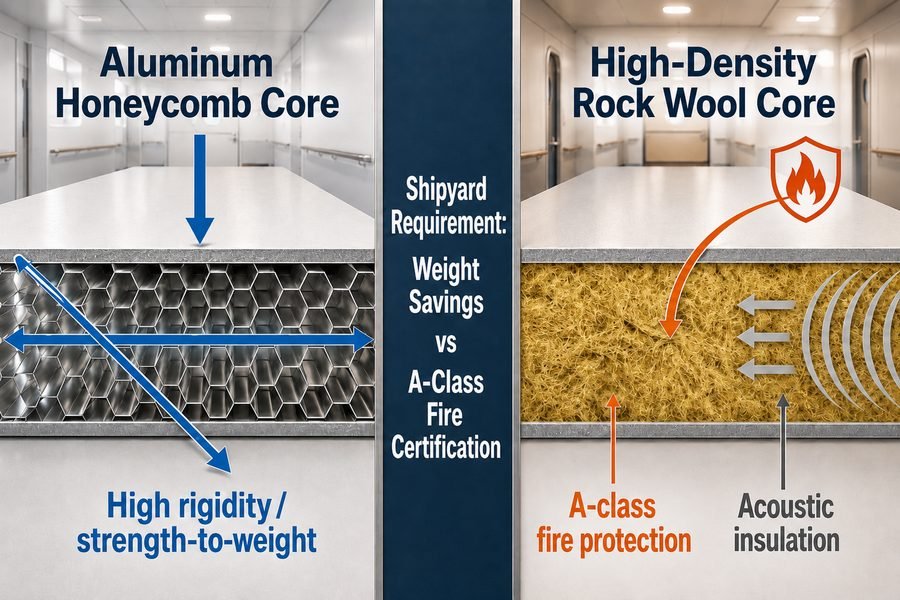
When I first started working in marine outfitting factories, I saw many panels warp or fail because the core material was wrong for the job. You need to know the mechanical limits of both aluminum honeycomb and rock wool to make smart purchasing choices. Here is a direct breakdown of how they perform under stress.
How Do Compressive Strength Values Compare Between Aluminum Honeycomb and Rock Wool Cores?
Does crushing damage cause your panels to fail inspection? Weak cores lead to expensive rework. We must look at exact compressive strength numbers to stop these losses.
Aluminum honeycomb delivers exceptional compressive strength ranging from 1.5 to 3.0 MPa, whereas high-density marine rock wool (120-150 kg/m³) provides much lower compressive resistance, typically between 0.04 and 0.08 MPa. Honeycomb is clearly better for load-bearing and preventing surface crushing.
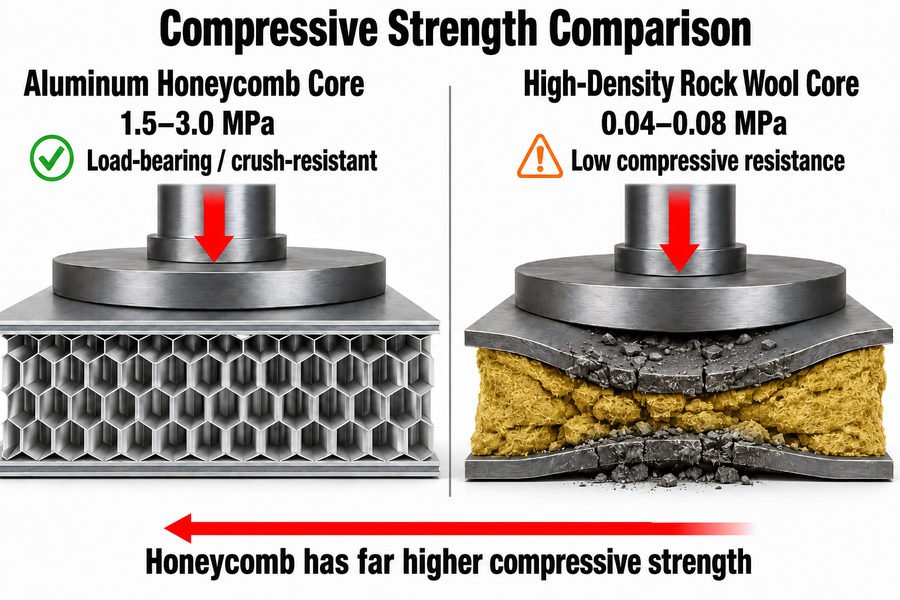
When we buy panels for ship interior decoration, we have to look at factory data sheets very carefully. Compressive strength tells us how much direct weight the panel can take before the core crushes flat. I always check these numbers against standards like ASTM C365 to ensure the products meet shipyard demands.
Compressive Strength Data for Aluminum Honeycomb Panels
Aluminum honeycomb is extremely strong under direct pressure. Based on standard 3003-grade aluminum, a core with a cell size of 6.4mm and a foil thickness of 0.05mm will give you a compressive strength of about 1.5 to 3.0 MPa1. This means you can clamp these panels tightly during installation, and they will not crush. You can also mount heavy fixtures directly onto the surface without the core collapsing inside. When I buy for projects in Europe, I always choose honeycomb for areas that need to hold heavy loads. The metal cell walls stand straight up, acting like hundreds of tiny pillars.
Compressive Strength Limits of Marine Rock Wool Cores
Rock wool is a completely different material. It is made of spun mineral fibers. Even when you buy high-density marine rock wool (between 120 and 150 kg/m³ density, like Paroc Marine boards), the compressive strength is only between 0.04 and 0.08 MPa. This is a very low number compared to honeycomb. If you press hard on a rock wool panel, the fibers inside will compress and not bounce back. This creates a permanent dent. Because of this, you must handle rock wool panels very carefully during transport from China or Vietnam. You cannot stack heavy items on top of them on the ship.
| Core Material | Compressive Strength (MPa) | Core Density Range | Primary Structural Benefit |
|---|---|---|---|
| Aluminum Honeycomb (6.4mm cell) | 1.5 - 3.0 MPa | 30 - 80 kg/m³ | Extremely high load-bearing capacity without crushing |
| High-Density Rock Wool | 0.04 - 0.08 MPa | 120 - 150 kg/m³ | Very little, primarily used for fire resistance, not strength |
Which Core Resists Point-Load Impact Better in Marine Accommodation Panels?
Worried about dents from luggage or tools hitting your walls? Impact damage causes immediate client complaints. Understanding point-load resistance stops these costly repairs.
Aluminum honeycomb resists point-load impacts better due to its rigid cellular structure which distributes force, handling impacts up to 50 Joules without face sheet puncture. Rock wool absorbs energy but allows permanent dents under lower impacts of 15 to 20 Joules, leaving visible surface damage.
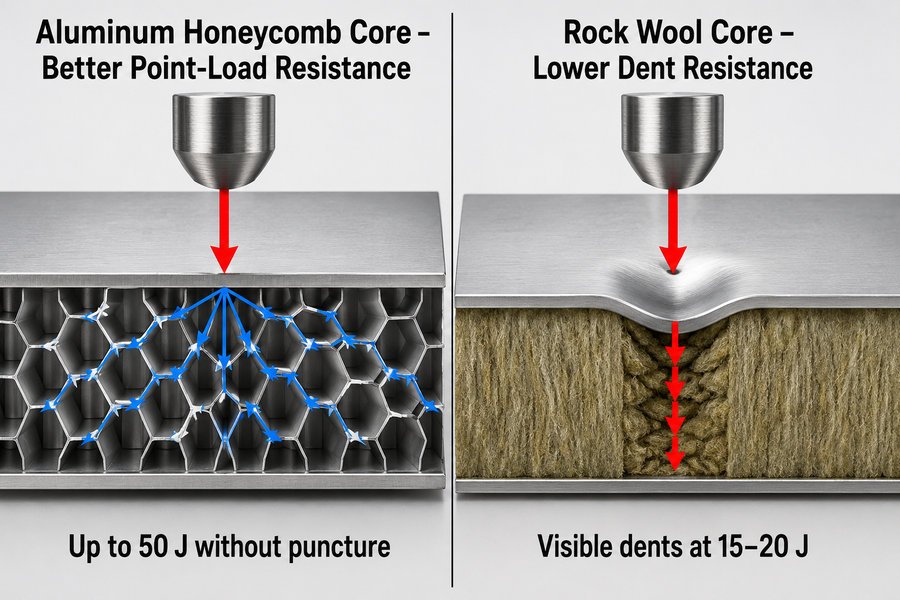
Impact resistance is a big problem in ship corridors. Passengers hit the walls with luggage. Crew members hit the walls with tool carts. If the wall panel cannot take the hit, you have to replace the whole section. This ruins your profit margin. I learned this the hard way on a cruise ship project years ago.
Point-Load Distribution in Aluminum Honeycomb Panels
When a sharp object hits an aluminum honeycomb panel, the force spreads out. The impact hits the steel or aluminum face sheet, and the rigid honeycomb cells directly behind it hold the metal skin in place. Testing shows that a standard aluminum honeycomb panel can handle an impact of up to 50 Joules without the face sheet breaking or bending too much.2 The cells might crush slightly right at the exact point of impact, but the damage stays very small. This keeps the wall looking clean and flat. This is why I always suggest honeycomb for high-traffic public areas on the ship.
Impact Absorption and Deformation in Rock Wool Cores
Rock wool panels fail point-load tests much faster. Because the rock wool fibers are soft, they cannot push back against the face sheet when something hits it. If a cart hits a rock wool panel with just 15 to 20 Joules of energy, the steel skin pushes into the core.3 The rock wool fibers break or compress, and they stay compressed. This leaves a permanent dent in the wall. The paint or PVC film on the outside will look terrible. To fix this, we sometimes have to order panels with thicker steel skins (like 0.8mm instead of 0.6mm) when using rock wool, which increases your purchasing cost.
| Core Type | Impact Resistance (Joules) | Damage Pattern After Heavy Impact | Best Location on Ship |
|---|---|---|---|
| Aluminum Honeycomb | Up to 50 Joules | Localized small mark, core supports skin | High traffic corridors, public spaces |
| Rock Wool Core | 15 - 20 Joules | Large permanent dent, core stays crushed | Private cabins, low traffic zones |
How Does Shear Strength Compare Between Aluminum Honeycomb and Rock Wool Cores Under Dynamic Loads?
Ship vibrations can tear weak wall panels apart. Do your panels crack under constant vessel movement? We need to compare shear strength to stop this failure.
Aluminum honeycomb provides high shear strength between 0.8 and 1.6 MPa, preventing core sliding under vessel vibration. Rock wool offers low shear strength around 0.02 to 0.05 MPa, making it prone to internal tearing under heavy dynamic loads unless reinforced with structural splines.
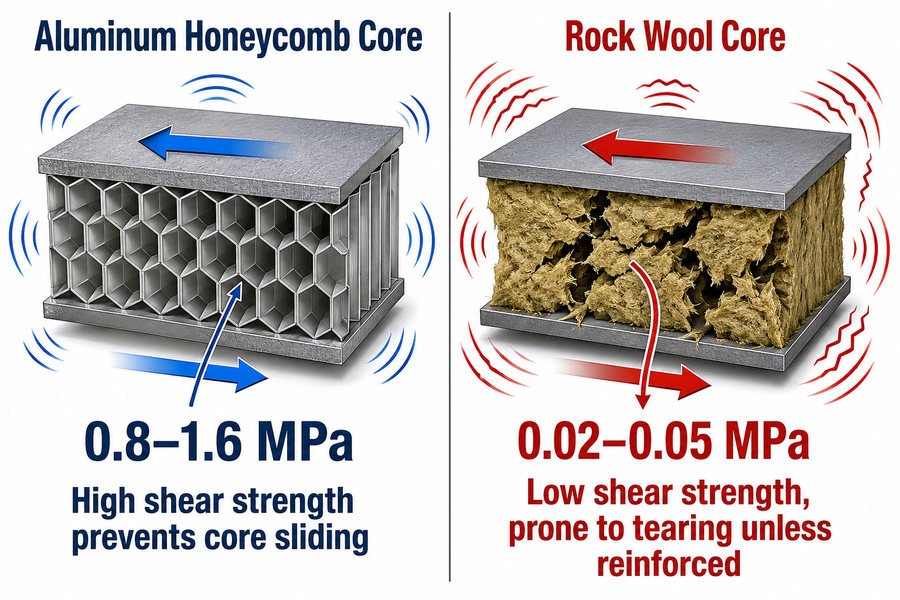
A ship is never still. The engines shake the floors and walls 24 hours a day. This shaking creates dynamic loads. Over time, dynamic loads pull the front skin of the panel one way and the back skin the other way. This is called shear stress. If the core has low shear strength, the panel will break apart from the inside.
Managing Dynamic Loads with Aluminum Honeycomb Shear Strength
Aluminum honeycomb is excellent for dynamic loads. The hexagon shapes of the cells lock the front and back skins together tightly. A standard honeycomb core gives you a shear strength between 0.8 and 1.6 MPa.4 This means the core will not slide or rip when the ship vibrates. The whole panel moves as one solid piece. In my factory days, we tested these panels on vibrating tables for days. The honeycomb panels never lost their shape. This high shear strength is exactly why shipyards ask for honeycomb in areas right above the engine room or near the propeller shafts.
Addressing Shear Weakness in Marine Rock Wool Cores
Rock wool struggles badly with shear stress. The shear strength of dense marine rock wool is very low, usually only 0.02 to 0.05 MPa.5 Under heavy vibration, the layers of stone wool fibers can actually rub against each other and tear. When the core tears internally, the panel loses all its strength and the steel skins can start to rattle. To solve this, we cannot just rely on the rock wool. We have to buy panels that have metal splines (small steel beams) built inside the rock wool core to hold the skins together. This makes the panel heavier and more expensive to manufacture.
| Feature | Aluminum Honeycomb | Rock Wool Core |
|---|---|---|
| Shear Strength Range | 0.8 - 1.6 MPa | 0.02 - 0.05 MPa |
| Performance Under Vibration | Excellent, panel remains rigid | Poor, fibers can tear internally |
| Need for Internal Reinforcement | None | High (requires internal steel splines) |
Which Core Holds Flatness Tolerance Over Long Spans in Marine Accommodation Panels?
Do your long ceiling panels sag over time? Sagging panels fail visual inspections instantly. Choosing the right core keeps large spans perfectly flat.
Aluminum honeycomb maintains strict flatness tolerances of ±1.0 mm over a 2.4-meter span due to its high stiffness-to-weight ratio. Rock wool panels often sag, showing tolerances of ±3.0 to ±5.0 mm over the same span, requiring closer support framing to stay flat.
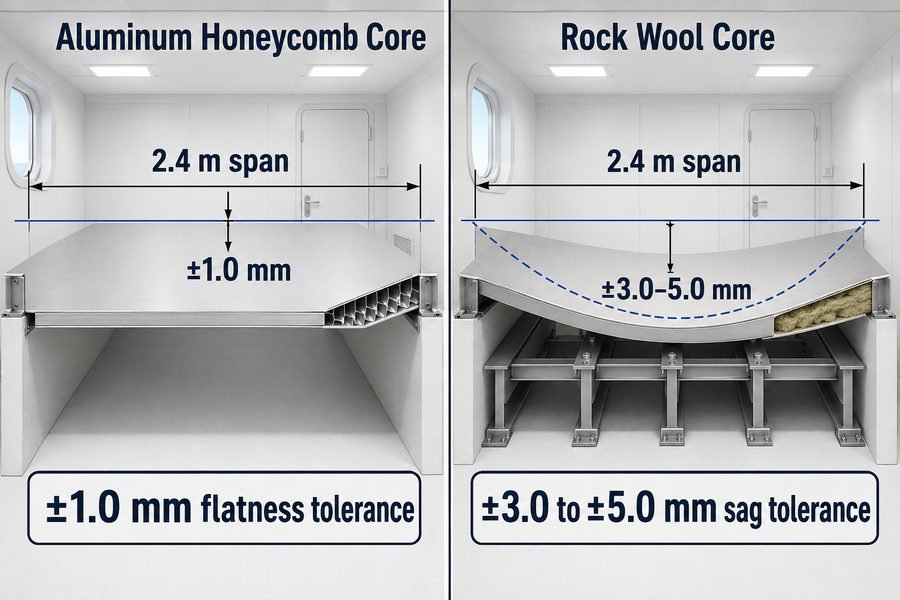
When you decorate a large dining room or lounge on a ship, you want to use large ceiling panels to save installation time. A common size is 2400mm (2.4 meters) long. But long panels want to bend in the middle because of gravity. Flatness is a huge indicator of quality. If the ceiling looks wavy, the shipyard will refuse to pay you.
Flatness Tolerances for Long Span Aluminum Honeycomb Panels
Aluminum honeycomb is very stiff and very light.6 This is the perfect combination for long spans. If you hold a 2.4-meter long honeycomb panel by the edges, it stays completely straight. The standard flatness tolerance for a high-quality honeycomb panel over this distance is just ±1.0 mm. You cannot see this small bend with your eyes. The ceiling will look like a perfect sheet of glass. Because it stays so flat, you need fewer metal support runners in the ceiling grid. This lowers your total material costs and speeds up the work for your installation team.
Sagging Risks and Support Needs for Rock Wool Panels
Rock wool panels are heavy and not stiff. A 2.4-meter long rock wool panel will sag in the middle under its own weight.7 The flatness tolerance for these panels is usually between ±3.0 mm and ±5.0 mm over a 2.4-meter span. A 5.0 mm sag is very easy to see, especially when the cabin lights turn on and cast shadows on the ceiling. To stop this from happening, you cannot use long spans freely. You must install extra support beams in the ceiling every 1.2 meters to hold the rock wool panels up. This takes more time and adds more steel cost to your project budget.
| Core Type | Flatness Tolerance (2.4m Span) | Support Grid Requirement | Visual Result |
|---|---|---|---|
| Aluminum Honeycomb | ±1.0 mm | Wide spacing (up to 2.4m) | Perfectly flat ceiling |
| Rock Wool Core | ±3.0 to ±5.0 mm | Tight spacing (every 1.2m) | Visible sagging without extra support |
How Does Aluminum Honeycomb Cell Geometry Affect Marine Accommodation Panel Rigidity?
Confused by different honeycomb sizes? The wrong cell size makes a weak panel. Understanding cell geometry helps you buy the exact rigidity you need.
Honeycomb rigidity depends entirely on cell size and foil thickness. Smaller cells (6.4mm) with 0.06mm foil maximize rigidity for high-stress areas. Larger cells (19.1mm) with 0.04mm foil reduce rigidity and cost but are sufficient for standard cabin ceilings.
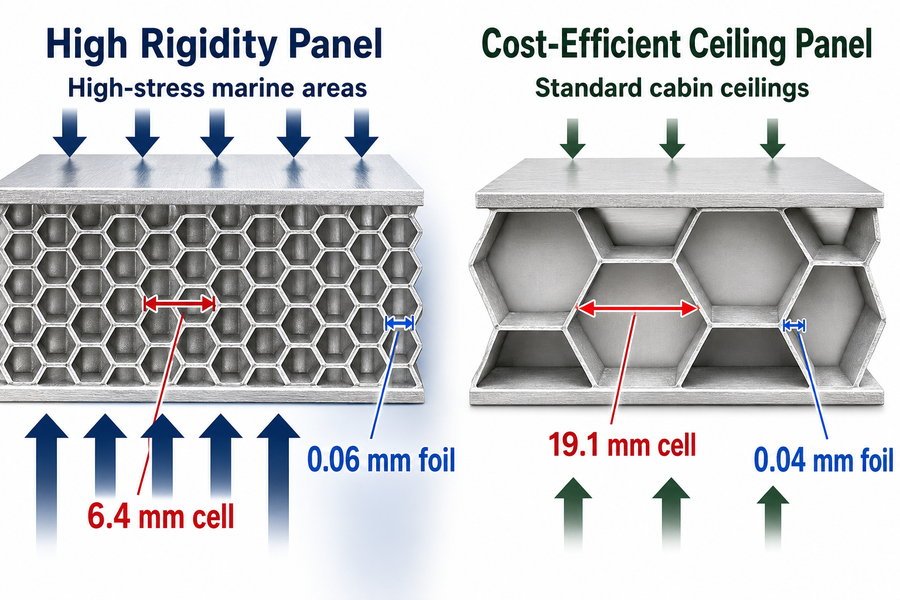
Many buyers think all aluminum honeycomb is the same. This is a big mistake. The strength of the panel comes directly from the shape and size of the little hexagons inside. When I negotiate with suppliers in Asia, I always ask for the specific cell size and foil thickness. If you do not ask, the factory might give you a weak core to save money.
Maximizing Rigidity with Small Cell Aluminum Honeycomb
To get the highest rigidity, you need small cells and thick aluminum foil8. A cell size of 1/4 inch (about 6.4mm) made with 0.06mm thick aluminum foil is very strong. Because the cells are small, there are many more cell walls packed into one square meter. This creates a very dense, rigid core. We use this specific geometry for wall panels in heavy work areas or for floor panels. The cost is higher because there is more aluminum metal inside the panel, but the mechanical performance is unbeatable.
Cost Reduction Strategies Using Large Cell Aluminum Honeycomb
If you want to lower your purchasing price, you can order panels with larger cells. A common size for saving money is a 3/4 inch (about 19.1mm) cell size using thinner 0.04mm foil. These panels have much less aluminum inside9, so the factory can sell them to you for less. The rigidity drops significantly compared to the 6.4mm cells. However, for a simple cabin ceiling that does not take any physical abuse, this lower rigidity is completely fine. As a buyer, knowing this difference allows you to match the exact panel strength to the shipyard's requirement without overpaying.
| Cell Size (mm) | Foil Thickness (mm) | Relative Rigidity | Best Application | Cost Level |
|---|---|---|---|---|
| 6.4 mm | 0.06 mm | Very High | Heavy-duty walls, flooring | High |
| 12.7 mm | 0.05 mm | Medium | Standard partition walls | Medium |
| 19.1 mm | 0.04 mm | Low | Non-load bearing ceilings | Low |
Aluminum Honeycomb vs Rock Wool Core: Which Core Resists Delamination Under Repeated Thermal Cycling?
Do panels peel apart when moving from hot to cold climates? Delamination destroys your project's lifespan. We must check thermal cycling resistance to prevent adhesive failure.
Rock wool resists thermal delamination better because its fibers expand very little, absorbing stress without breaking adhesive bonds. Aluminum honeycomb expands slightly with heat, putting shear stress on the glue line, requiring specialized high-temperature polyurethane adhesives to prevent delamination during severe thermal shifts.
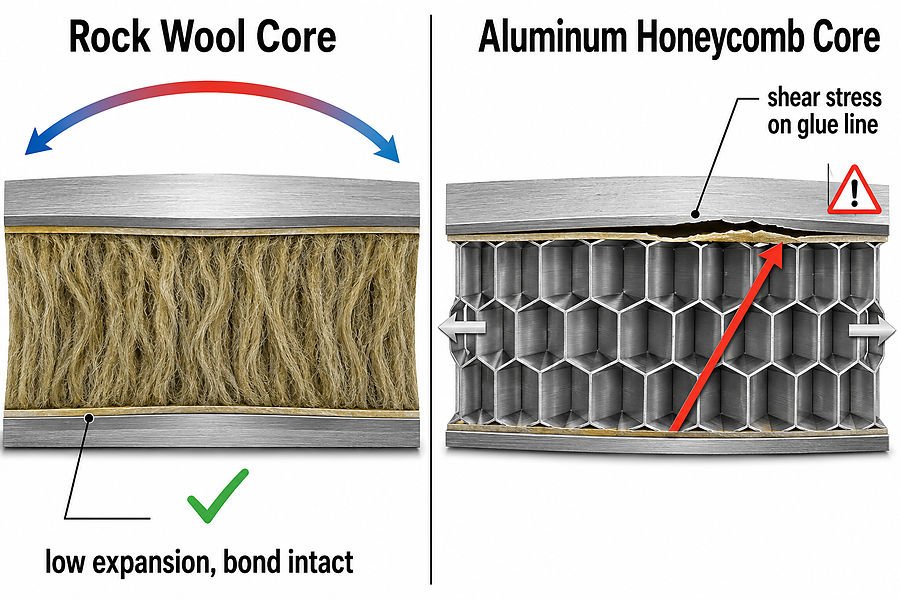
Ships travel all over the world. A ship might be in cold Northern Europe one month and hot Southeast Asia the next. The steel panels on the ship heat up and cool down over and over. This is called thermal cycling. When metal gets hot, it grows. When it gets cold, it shrinks. The glue holding the core to the skin has to survive this pulling and pushing, or the panel will peel apart (delaminate).
Thermal Stability and Delamination Resistance of Rock Wool Cores
Rock wool is very safe when it comes to thermal cycling. The coefficient of thermal expansion for rock wool is almost zero10. It does not grow or shrink when the temperature changes. When the steel face sheet gets hot and expands11, the soft rock wool fibers simply stretch a little bit to follow the steel. They do not fight against the glue. Because the core absorbs the movement, the adhesive line stays strong. You rarely see a rock wool panel delaminate just because of temperature changes. This makes it a very reliable choice for ships sailing in extreme weather.
Managing Thermal Expansion in Aluminum Honeycomb Adhesives
Aluminum honeycomb requires much more care. Aluminum metal expands when it gets hot. If the room gets hot, both the face sheet and the aluminum honeycomb core want to expand. This puts massive shear stress directly on the layer of glue between them12. If the factory uses cheap glue, the glue will crack, and the skin will pop off the core. To stop this, you must demand that your suppliers use high-quality, two-part Polyurethane (PU) adhesives. Two-part PU glue stays flexible after it cures, allowing it to stretch with the metal during thermal cycling13. I always check the factory's glue brand before placing an order.
| Core Material | Thermal Expansion Behavior | Stress on Adhesive Line | Delamination Risk |
|---|---|---|---|
| Rock Wool | Almost zero expansion | Low (fibers absorb movement) | Very Low |
| Aluminum Honeycomb | Expands with heat | High (direct shear stress on glue) | High (if cheap adhesive is used) |
Conclusion
Both cores have distinct mechanical limits. Aluminum honeycomb dominates in rigidity and strength, while rock wool provides basic structural integrity suited for fire-rated zones. Choose based on shipyard specs.
-
"Which Test Standards Validate Aluminum Honeycomb Core Marine ...", https://magellanmarinetech.com/which-test-standards-validate-aluminum-honeycomb-core-marine-accommodation-panels/. Peer-reviewed studies of aluminum honeycomb cores report out-of-plane compressive strengths in the MPa range and identify cell size, foil thickness, alloy, and density as controlling variables, supporting the plausibility of the stated range for a specified 3003 aluminum honeycomb core. Evidence role: statistic; source type: paper. Supports: A 3003-grade aluminum honeycomb core with 6.4 mm cells and 0.05 mm foil thickness has a compressive strength of about 1.5 to 3.0 MPa.. Scope note: The source may support comparable honeycomb geometries rather than this exact supplier panel or marine decorative laminate construction. ↩
-
"Sandwich Structures for Energy Absorption Applications: A Review", https://pmc.ncbi.nlm.nih.gov/articles/PMC8398022/. Low-velocity impact studies of aluminum honeycomb sandwich panels report that damage extent and face-sheet deformation depend on impact energy, face-sheet thickness, cell geometry, and support conditions, providing contextual support for a 50 J impact-resistance threshold in comparable panel constructions. Evidence role: statistic; source type: paper. Supports: A standard aluminum honeycomb panel can withstand an impact of up to 50 J without excessive face-sheet failure or deformation.. Scope note: The 50 J value is not universal; it must match the tested panel thickness, alloy, honeycomb geometry, and acceptance criteria for visible damage or structural failure. ↩
-
"Optimal sandwich panel's core design for an enhanced impact ...", https://pmc.ncbi.nlm.nih.gov/articles/PMC11731508/. Mechanical and impact-testing literature on mineral-wool sandwich panels describes low core stiffness and compressive deformation under localized loading, which can allow the metal facing to indent into the core at relatively low impact energies. Evidence role: mechanism; source type: paper. Supports: Rock wool core panels can deform under localized cart impacts of about 15–20 J, with the steel skin indenting into the core.. Scope note: The cited source would support the deformation mechanism and approximate vulnerability, but an exact 15–20 J threshold depends on panel facing thickness, mineral-wool density, adhesive bond, span, and test method. ↩
-
"Which Test Standards Validate Aluminum Honeycomb Core ...", https://magellanmarinetech.com/which-test-standards-validate-aluminum-honeycomb-core-marine-accommodation-panels/. A peer-reviewed materials or sandwich-structures source reporting ASTM C273-type shear tests for aluminum honeycomb cores gives shear strengths on the order of 1 MPa, supporting the stated magnitude for typical structural honeycomb cores. Evidence role: statistic; source type: paper. Supports: A standard aluminum honeycomb core has shear strength in the approximate range of 0.8–1.6 MPa.. Scope note: The exact range depends on alloy, foil thickness, cell size, density, bonding quality, and shear direction, so the citation would support typical values rather than every “standard” honeycomb core. ↩
-
"[PDF] Design Method of Bending Load-Carrying Capacity for Sandwich ...", https://scholarsmine.mst.edu/cgi/viewcontent.cgi?article=1976&context=isccss. A technical study or standards-based test report on mineral-wool or rock-wool sandwich-panel cores reporting shear strengths in the tens of kilopascals would support the stated order of magnitude for rock-wool core shear capacity. Evidence role: statistic; source type: paper. Supports: Dense marine rock wool cores typically have low shear strength, about 0.02–0.05 MPa.. Scope note: Evidence may describe construction or insulation-grade mineral wool rather than specifically “marine” rock wool, so it would contextualize the range unless the tested material is explicitly marine-certified. ↩
-
"Analysis of an Aircraft Honeycomb Sandwich Panel with ...", https://ntrs.nasa.gov/api/citations/20130011132/downloads/20130011132.pdf. A materials-engineering source on sandwich structures supports that aluminum honeycomb cores provide high stiffness-to-weight performance by separating thin face sheets with a lightweight cellular core. Evidence role: mechanism; source type: paper. Supports: Aluminum honeycomb panels combine low weight with high stiffness.. Scope note: This supports the general material behavior, not the article’s specific ±1.0 mm flatness tolerance over a 2.4 m span. ↩
-
"[PDF] Design Method of Bending Load-Carrying Capacity for Sandwich ...", https://scholarsmine.mst.edu/cgi/viewcontent.cgi?article=1976&context=isccss. A structural or materials source on mineral-wool-core sandwich panels can support that panel deflection increases with span and self-weight, and that lower core stiffness can make sagging a design concern. Evidence role: mechanism; source type: paper. Supports: A long rock wool panel can sag under its own weight when spanning between supports.. Scope note: The source may establish the deflection mechanism generally rather than proving that every 2.4 m rock wool panel will visibly sag under all installation conditions. ↩
-
"How Does Aluminum Honeycomb Core Boost Stiffness in ...", https://magellanmarinetech.com/how-aluminum-honeycomb-core-boost-stiffness-marine-accommodation-panels/. Cellular-solids mechanics literature describes honeycomb stiffness and strength as functions of relative density, which increases with greater foil-wall thickness and smaller cell dimensions; this supports the stated design principle for aluminum honeycomb cores. Evidence role: mechanism; source type: paper. Supports: To get the highest rigidity, you need small cells and thick aluminum foil.. Scope note: The source would support the general mechanical relationship, not the exact performance of the specific 6.4 mm / 0.06 mm product described here. ↩
-
"[PDF] Mechanical properties of hierarchical honeycomb structures", https://repository.library.northeastern.edu/files/neu:1673/fulltext.pdf. Honeycomb-core density models show that core density is governed largely by foil thickness and cell geometry, so increasing cell size and reducing foil thickness lowers the amount of aluminum per unit volume. Evidence role: mechanism; source type: paper. Supports: Panels with larger cells and thinner foil have much less aluminum inside.. Scope note: This supports the material-content claim, but it does not independently verify actual supplier pricing or cost savings. ↩
-
"Determination of Thermal Properties of Mineral Wool Required for ...", https://pmc.ncbi.nlm.nih.gov/articles/PMC10488771/. A materials data source on mineral wool should document its very low coefficient of thermal expansion relative to metals, supporting the statement that rock wool cores undergo little dimensional change under temperature variation. Evidence role: statistic; source type: paper. Supports: The coefficient of thermal expansion for rock wool is almost zero.. Scope note: Exact expansion values can vary by mineral wool formulation, density, binder content, and test method. ↩
-
"[PDF] Thermal Expansion - Rice University", https://www.owlnet.rice.edu/~msci301/ThermalExpansion.pdf. A reference table or educational source on thermal expansion should give positive coefficients of thermal expansion for steel, supporting the statement that steel face sheets expand when heated. Evidence role: definition; source type: education. Supports: When the steel face sheet gets hot, it expands.. Scope note: The source would support the general thermal-expansion behavior of steel, not the specific expansion of any particular ship panel design. ↩
-
"Numerical approach to calculate thermal expansion of honeycomb ...", https://ui.adsabs.harvard.edu/abs/2000AdCoM...9..387K/abstract. A mechanics or composite-sandwich study should explain that differential thermal expansion among face sheets, cores, and adhesive layers can generate interfacial shear stresses in bonded sandwich structures. Evidence role: mechanism; source type: paper. Supports: Thermal expansion in aluminum honeycomb sandwich panels can place high shear stress on the adhesive bond line.. Scope note: The source may establish the general mechanism of thermally induced interfacial shear stress rather than proving that stresses are always 'massive' in every aluminum honeycomb panel. ↩
-
"Thermal Stability and Heat Transfer of Polyurethanes for Joints ...", https://pmc.ncbi.nlm.nih.gov/articles/PMC11279557/. A polymer or adhesive engineering source should describe cured polyurethane adhesives as elastomeric or flexible and discuss their ability to accommodate deformation in bonded joints during thermal or mechanical loading. Evidence role: mechanism; source type: paper. Supports: Two-part polyurethane adhesives can remain flexible after curing and accommodate movement during thermal cycling.. Scope note: Flexibility and thermal-cycling performance depend strongly on the specific polyurethane formulation, cure conditions, and service temperature range. ↩