Weak panels ruin marine interiors. Sagging walls cost you shipyard approvals. Aluminum honeycomb cores fix this instantly by providing extreme rigidity without adding heavy weight.
Aluminum honeycomb cores boost marine panel stiffness through their hexagonal cellular geometry, which acts like an I-beam. This structure completely stops shear deformation, spreads out impact forces, and connects rigidly to face skins, giving a high strength-to-weight ratio that traditional solid or foam cores cannot match.
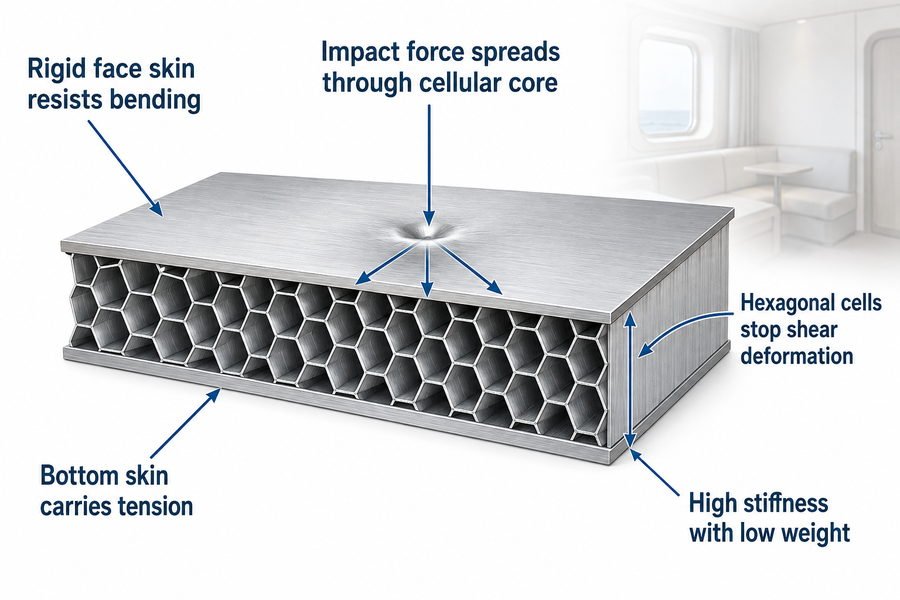
Let me show you how this core works. I see many buyers struggle with panel specs, so I will break down exactly how honeycomb stiffness affects your interior outfitting projects.
What Bending Stiffness Do Aluminum Honeycomb Core Marine Accommodation Panels Reach?
You worry about walls bending under pressure. A weak wall fails fire safety tests. Let us look at the exact numbers you need to know.
A standard 25mm thick marine aluminum honeycomb panel with 0.8mm steel skins reaches a bending stiffness (EI) of approximately 4.5 to 5.5 kN·m²/m. This specific stiffness range completely prevents visible bowing under standard 0.5 kPa shipboard cabin air pressure differences.
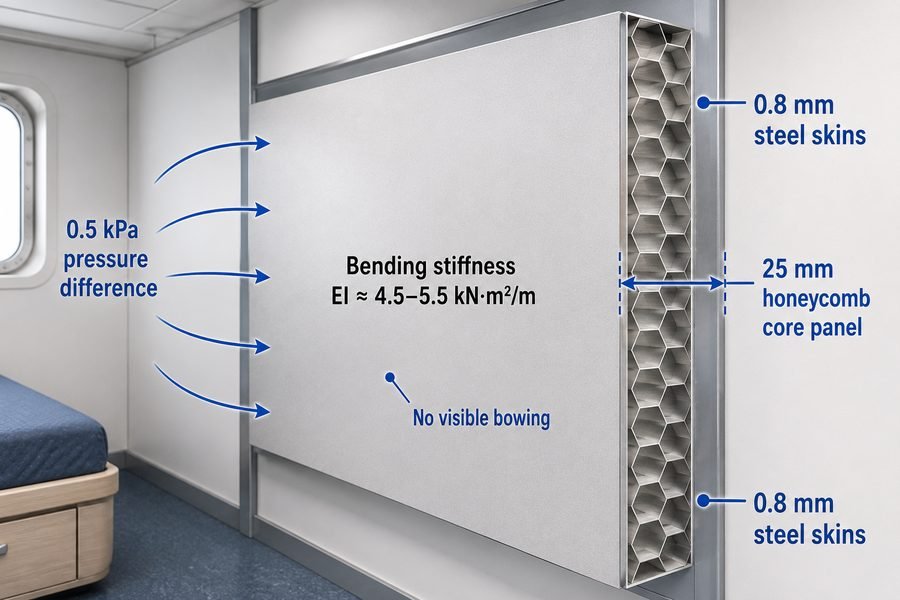
Explaining Bending Stiffness Values for 25mm Marine Panels
I remember my early days in the factory. We tested many panels. A normal 25mm thick aluminum honeycomb panel is very strong. If you use 0.8mm galvanized steel skins, the bending stiffness, or EI, is about 4.5 to 5.5 kN·m²/m. Where do these numbers come from? According to data from Hexcel Composites, a leading core maker, the hexagonal shape locks the face sheets together. This stops the skins from sliding. We call this shear stiffness. Because the skins cannot slide, the whole panel acts like a thick solid steel plate, but it is much lighter. Let me add a story. A buyer once bought cheap panels with low stiffness from an unknown factory. The panels bent 10mm when the ship's ventilation turned on. The cabin doors jammed tight. They had to tear down and replace the whole deck. Do not make this costly mistake. The 4.5 to 5.5 kN·m²/m range1 is your absolute safe zone for 25mm panels.
Impact of 0.5 kPa Cabin Air Pressure on Panel Bowing
You must meet shipyard demands. Ship HVAC systems push fast air into cabins. This creates a pressure difference between rooms. The standard marine rule, often based on ISO 7547 standards for air conditioning, uses a pressure difference of about 0.5 kPa2. Your panels must not bow under this pressure. If they bow, the ceiling joints break. The fire rating fails. A stiffness of 4.5 kN·m²/m means a standard 2.4-meter high wall panel will bend less than 2mm under this pressure. This tiny bend is invisible to the eye. Your European shipyard clients will accept this. You save money by not over-engineering the walls.
| Panel Thickness | Steel Skin Thickness | Approx. Bending Stiffness (EI) | Best Application |
|---|---|---|---|
| 15mm | 0.6mm | 1.8 - 2.2 kN·m²/m | Ceiling panels, light partitions |
| 25mm | 0.8mm | 4.5 - 5.5 kN·m²/m | Standard cabin bulkheads |
| 50mm | 1.0mm | 12.0 - 15.0 kN·m²/m | Public spaces, heavy load walls |
How Does Cell Size Affect Rigidity of Aluminum Honeycomb Core Marine Accommodation Panels?
Large cells save money but reduce strength. If you pick the wrong size, panels will dent easily. You must balance the cost and the core rigidity.
Cell size directly controls marine panel rigidity. Smaller cells (6.4mm) provide maximum shear strength and surface crush resistance for heavy-duty areas. Larger cells (19.1mm) reduce weight and cost but lower stiffness. Medium cells (12.7mm) offer the standard balance of rigidity and economy for normal cabin bulkheads.
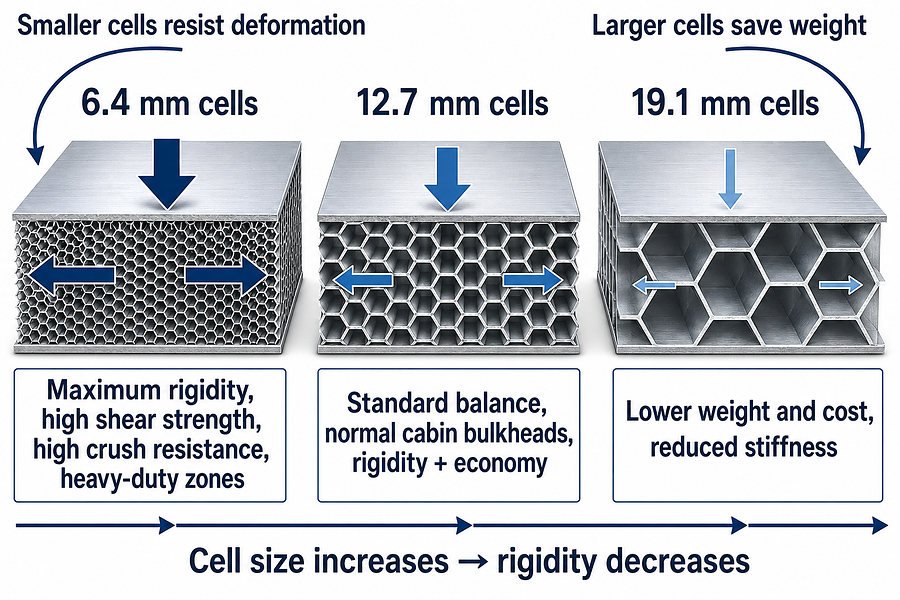
Using 6.4mm Small Cells for Maximum Surface Crush Resistance
The aluminum honeycomb core looks like a bee's nest. The size of each hole is the cell size. This size changes everything about the panel. If you buy panels, the factory will ask you what cell size you want. You must know the difference between 6.4mm, 12.7mm, and 19.1mm cells. Let us look at the 6.4mm cell first. This small cell size puts many aluminum walls in a small space. According to the Marine Composite Materials Handbook, a 6.4mm cell size gives a very high compressive strength of about 4.6 MPa3. This means the panel face will not dent if a heavy luggage cart hits it. It gives the best shear strength. You use this for high-traffic public spaces on the ship. But this small cell size is expensive because it uses a lot of aluminum foil.
Choosing 12.7mm Medium and 19.1mm Large Cells for Standard and Economy Panels
Next, we have the 12.7mm and 19.1mm cells. For standard cabin bulkheads, I always suggest the 12.7mm cell size. It has a compressive strength of about 2.0 MPa. This is strong enough for regular bedroom walls. It costs less than the 6.4mm size. The strict European shipyards accept this for normal rooms. The factory must give you the exact cell size you order. If you want to save more money, you can use the 19.1mm cell size. This large cell size drops the strength to about 1.0 MPa. The rigidity goes down fast. You should only use the 19.1mm size for ceiling panels where nobody walks or bumps into them. If you use 19.1mm for a wall, the skin might dimple. We call this the "telegraphing" effect.4 Your clients will reject the work.
| Cell Size (mm) | Approx. Compressive Strength | Cost Level | Recommended Marine Application |
|---|---|---|---|
| 6.4mm | 4.6 MPa | High | Corridors, public spaces, high-impact walls |
| 12.7mm | 2.0 MPa | Medium | Standard cabin sleeping room bulkheads |
| 19.1mm | 1.0 MPa | Low | Ceilings, decorative lightweight panels |
What Foil Thickness Is Standard for Aluminum Honeycomb Core Marine Accommodation Panels?
Thin foil breaks during shipping. Thick foil costs too much money. You need the exact foil thickness to win the bid and pass the inspection.
The standard aluminum foil thicknesses for marine accommodation panel cores are 0.04mm, 0.06mm, and 0.08mm. The 0.04mm foil is used for lightweight ceilings. The 0.06mm foil is the industry standard for standard cabin walls. The 0.08mm foil provides maximum impact resistance for corridors and high-vibration engine casing boundaries.
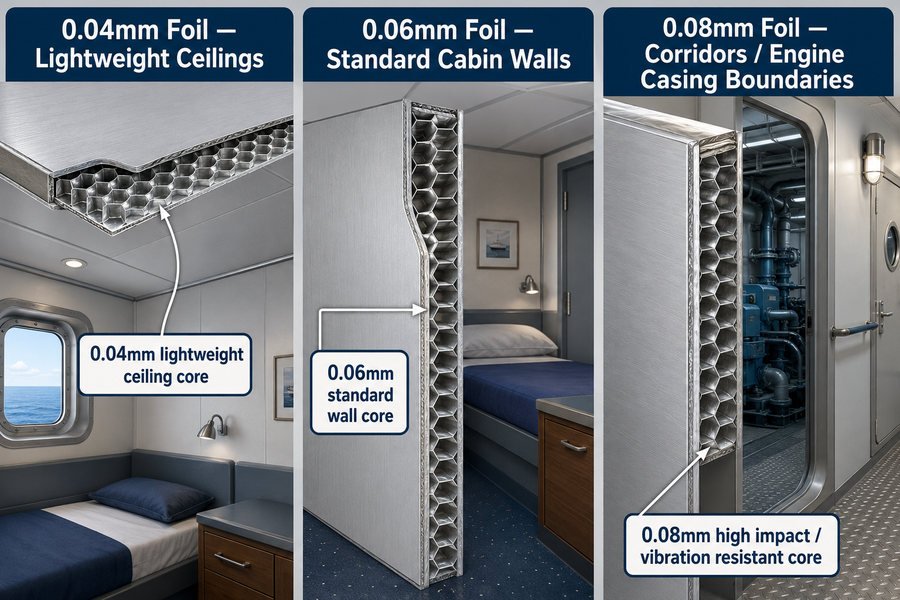
Applying 0.04mm and 0.06mm Foil for Marine Ceilings and Standard Cabins
The cell size is only half the story. The thickness of the flat aluminum foil wall also controls the stiffness5. We measure this foil thickness in millimeters. The three main options are 0.04mm, 0.06mm, and 0.08mm. I will explain each one so you can control your purchase price. The thinnest standard foil is 0.04mm. You use this only for marine ceiling panels. Ceilings do not take hits from people or bags. The 0.04mm foil keeps the ceiling very light, usually under 12 kg/m² for a complete panel. It saves your shipyard clients topside weight. For standard cabin walls, the industry standard is 0.06mm foil. When you ask a factory in Asia for a quote, they will usually price a 0.06mm foil core. This thickness gives the panel enough shear strength to hold a heavy 50kg wall cabinet. The marine class rules require bulkheads to support normal room loads.6 The 0.06mm foil easily meets this rule.
Utilizing 0.08mm Thick Foil for High-Vibration Marine Environments
Finally, we look at the 0.08mm foil. This foil is thick and heavy. You buy panels with 0.08mm foil for special, tough places. If the wall is near the main engine room, it will shake all day. The 0.08mm foil stops the core from tearing apart under high vibration. You also use it for main corridor walls where metal food carts might hit the panel. The thicker foil stops the core from crushing. You must check the foil thickness on the factory test report. Do not let bad suppliers trick you with thinner foil to save money. The 0.08mm foil also stops the core from crushing during hard shipyard installation work.
| Foil Thickness | Core Density (12.7mm cell) | Stiffness Level | Best Marine Location |
|---|---|---|---|
| 0.04mm | ~25 kg/m³ | Low | Accommodation ceilings only |
| 0.06mm | ~35 kg/m³ | Standard | Normal cabin dividing walls |
| 0.08mm | ~50 kg/m³ | High | Engine room boundaries, main halls |
Do Aluminum Honeycomb Core Marine Accommodation Panels Hold Stiffness Under Saltwater Exposure?
Saltwater rusts metal quickly. If moisture gets inside the panel, the core fails. You must ensure your panels keep their strength in harsh ocean air.
Aluminum honeycomb cores hold their stiffness under saltwater exposure through three protections: the marine-grade 3003 or 5052 aluminum alloy resists rust, the anti-corrosion chemical coating blocks oxidation, and the fully sealed panel edges prevent humid sea air from entering the core, ensuring structural integrity for 20-plus years.
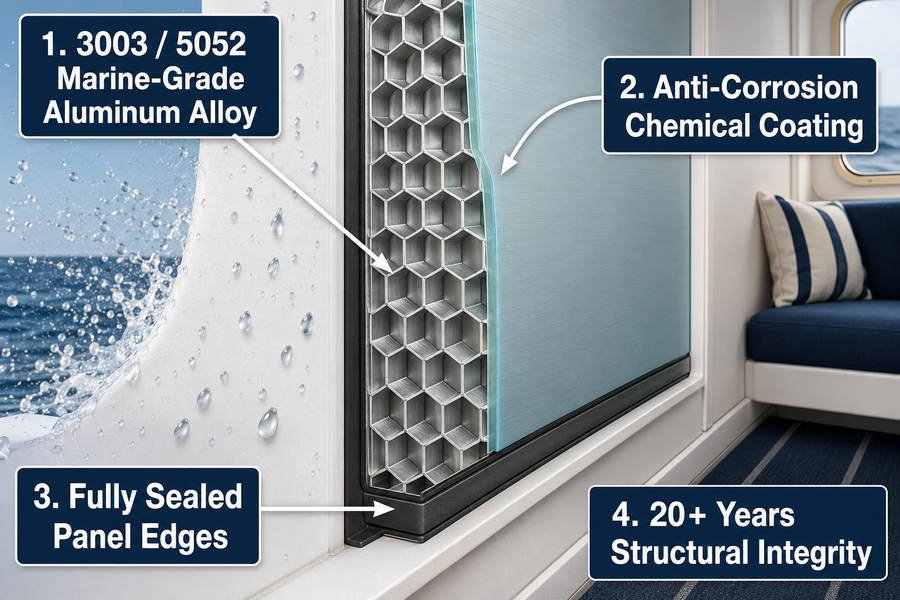
The Role of Marine-Grade 3003 and 5052 Aluminum Alloys in Core Protection
Marine panels live in the worst environment. Ocean air has heavy salt and water. Many buyers ask me if the hidden aluminum core will rot away and lose stiffness. If the factory builds it right, the answer is no. The core keeps its full strength through three main protections. First, we use marine-grade aluminum alloys. The standard materials are 3003 or 5052 series aluminum. According to the ASM Handbook of Aluminum, 5052 aluminum has high magnesium content. This special metal mix makes it highly resistant to salt spray corrosion7. It will not break down and turn weak like standard cheap 1000 series aluminum. It stays tough.
How Chemical Coatings and Sealed Edges Block Humid Sea Air
Second, the factory adds an anti-corrosion chemical coating. During production, the aluminum foil goes through a warm chemical bath. This puts a thin oxide layer8 on the metal. This layer blocks bad oxygen. It stops the aluminum from turning into white powder. If the core turns to powder, the wall stiffness drops to zero. Third, the panel edges must be fully sealed9. This is very important for you to check. I have seen cheap panels from bad factories with open metal edges. Humid sea air gets inside the panel. The glue fails, and the panel bends. A good panel uses tight steel edge profiles and strong marine-grade polyurethane glue. This totally seals the core inside. The moisture never reaches the aluminum foil. When you buy panels in Asia, always ask the factory about their edge glue. If it is cheap household glue, the edges will open in one year. Because of these three steps, your panels will stay rigid for over 20 years on a ship10.
| Protection Step | Material Used | How It Keeps the Panel Stiff |
|---|---|---|
| Metal Alloy | 3003 / 5052 Aluminum | Resists deep salt pitting and cracking naturally |
| Surface Treatment | Chemical conversion wash | Stops surface oxidation turning to white powder |
| Edge Sealing | Polyurethane glue + steel | Keeps 100% of humid ocean air out of the core |
How Does Aluminum Honeycomb Core Beat Paper Honeycomb in Marine Accommodation Panel Stiffness?
Paper cores are very cheap. But cheap paper fails in ships. You will lose your shipyard contracts if your panels become soft like wet cardboard.
Aluminum honeycomb completely beats paper honeycomb in marine panels across three factors: aluminum provides 10 times higher shear modulus, aluminum does not absorb moisture and lose strength like paper, and aluminum maintains 100% of its rigidity during a fire while paper cores burn and collapse instantly.
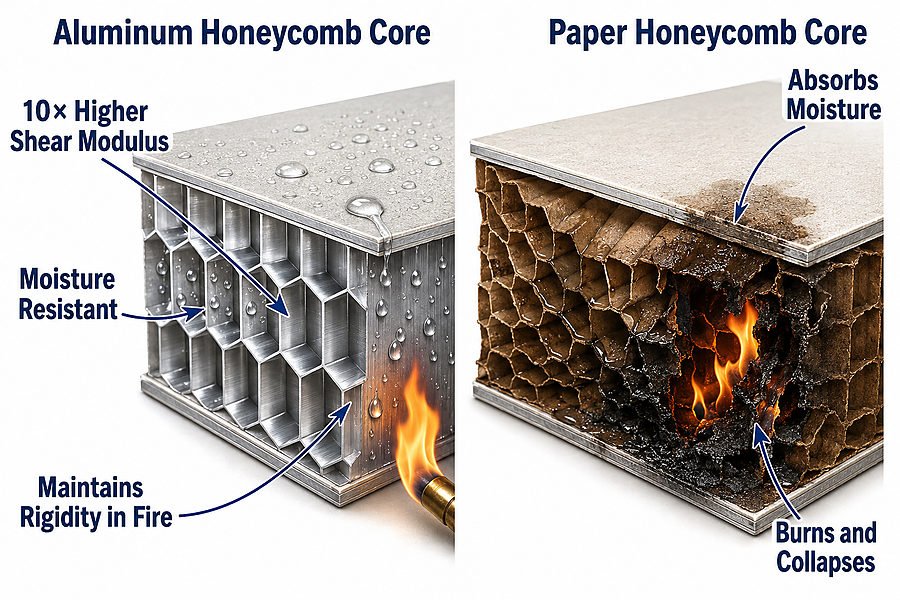
Comparing the Shear Modulus and Moisture Resistance of Aluminum vs Paper Cores
I know you want low prices to win bids. Some factories might offer you Nomex or aramid paper honeycomb cores. They will tell you it is the same as aluminum but much cheaper. Do not buy them for standard marine bulkheads. Aluminum beats paper in three critical ways. First, we look at the shear modulus. This measures how much the core resists sliding forces. A standard aluminum core has a high shear modulus of about 150 to 200 MPa. A marine paper core is only around 15 to 20 MPa.11 Aluminum is 10 times stiffer. When a big ship rolls in bad ocean weather, paper core panels will twist and squeak loudly. Aluminum panels stay totally solid and quiet. Second, moisture ruins paper. Even thick treated paper absorbs some water over time.12 Ships are very humid inside. If a bathroom pipe leaks, the paper core gets wet fast. It loses all its strength and becomes soft mush. Aluminum never absorbs water. It stays 100% rigid even if the cabin floods with water.
Structural Rigidity Under Fire Conditions for Marine Bulkheads
Third, and most important, is fire safety. SOLAS marine rules require panels to have strict fire ratings like B-15 or B-0.13 If a fire starts in a room, the wall must stand up straight. Aluminum melts at a high 660 degrees Celsius. It holds the hot steel skins together for a long time during a lab fire test. Paper cores burn or turn to black ash very fast.14 When the paper core burns away, the metal skins fall apart. The wall collapses. You must buy true aluminum cores to pass the marine fire tests and keep the stiffness. Do not trust sales people who say aramid paper is just as good for heavy ship walls. It is a trick to increase their profit margin.
| Performance Area | Aluminum Honeycomb | Aramid Paper Honeycomb |
|---|---|---|
| Shear Modulus | 150 - 200 MPa (Very Rigid) | 15 - 20 MPa (Flexible) |
| Water Absorption | 0% (Total strength kept) | High (Loses structural strength) |
| Fire Behavior | Melts at 660°C, keeps shape | Burns/chars fast, panel falls apart |
Why Specify Aluminum Honeycomb Core for Topside Weight-Sensitive Marine Accommodation Panels?
Heavy ships consume too much fuel. High weight on top decks makes ships roll dangerously. You must supply stiff but ultra-light panels to win orders.
You specify aluminum honeycomb cores for topside marine panels because they lower the center of gravity, reduce overall vessel fuel consumption, and allow shipyards to install larger cabins without violating stability rules. This core achieves high bending stiffness at merely 5% the weight of a solid aluminum block.
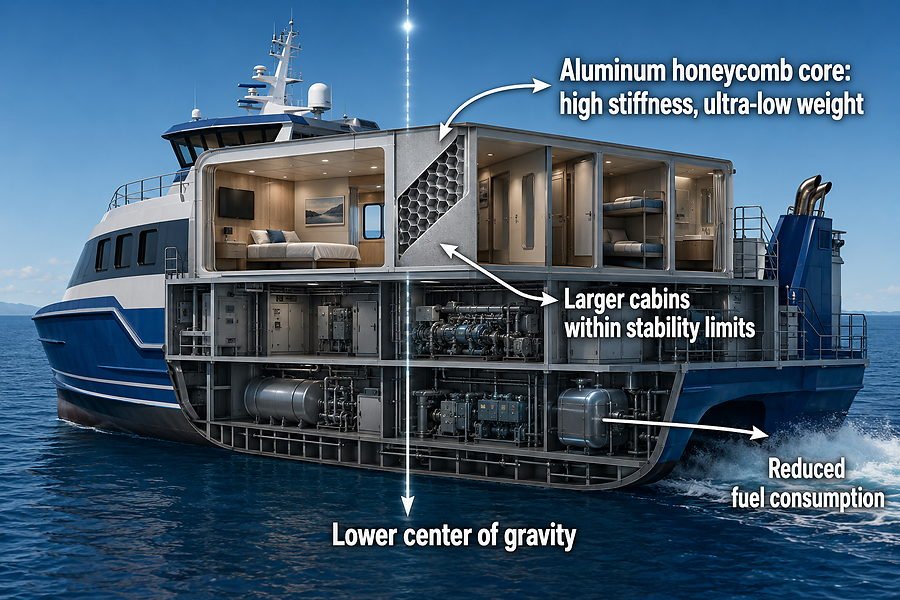
Lowering the Ship's Center of Gravity and Reducing Fuel Consumption
The top decks of a ship are called the topside. This high area is very sensitive to heavy weight. If you put heavy things high up in the air, the ship becomes unstable.15 It rolls too much in the rough waves. Ship designers calculate the ship's center of gravity very carefully. You specify aluminum honeycomb to solve this big problem for your clients. First, it lowers the center of gravity and reduces fuel use. An aluminum honeycomb core is 95% empty air. It weighs only about 25 to 50 kg per cubic meter.16 A solid mineral wool core, often used in old fire panels, weighs 120 to 150 kg per cubic meter. By switching to honeycomb for topside cabins, the shipyard saves tons of dead weight. Less weight means the ship engine burns less diesel fuel.17 This is a big selling point for ship owners. Shipyards pay high prices for this weight reduction. You can negotiate a better contract with the shipyard if you explain how much fuel your light panels will save them over 20 years.
Maximizing Cabin Size Without Violating Marine Stability Rules
Second, it allows shipyards to build bigger luxury cabins. Ship design rules, like the IMO Intact Stability Code, limit how much total weight can go on the top decks.18 If you use heavy solid panels, the shipyard must build smaller rooms to stay under the strict weight limit. But because your aluminum honeycomb panels are so light and stiff, they use only 5% the weight of a solid metal block. The shipyard can build large, wide passenger cabins on the top deck without breaking the safety stability rules. The high panel stiffness ensures these very large walls do not shake or rattle. This helps you sell high-value interior panels to big cruise ship and offshore platform projects.
| Core Material | Average Density | Topside Suitability | Impact on Ship Stability |
|---|---|---|---|
| Aluminum Honeycomb | 25 - 50 kg/m³ | Excellent | Keeps center of gravity very low |
| Mineral Wool Board | 120 - 150 kg/m³ | Poor | Raises center of gravity |
| Solid Wood / Plywood | 500 - 700 kg/m³ | Rejected | Dangerous for top deck stability |
Conclusion
Aluminum honeycomb cores deliver extreme bending stiffness, total moisture resistance, and crucial fire safety. Specifying correct cell sizes and foil thicknesses ensures shipyard approvals and slashes topside weight perfectly.
-
"[PDF] Sandwich Constructions - USNA", https://www.usna.edu/Users/mecheng/pjoyce/composites/Short_Course_2003/13_PAX_Short_Course_Sandwich-Constructions.pdf. A sandwich-panel mechanics source can support that flexural rigidity per unit width is calculated from the stiffness of the face sheets and their separation by the core, which is the basis for deriving an EI range for a 25 mm steel-skinned honeycomb panel. Evidence role: mechanism; source type: paper. Supports: The stated 4.5 to 5.5 kN·m²/m bending-stiffness range is an appropriate engineering range for 25 mm panels with 0.8 mm steel skins.. Scope note: This would support the calculation method, but the quoted numerical range still depends on the exact steel grade, skin thickness tolerance, honeycomb core properties, adhesive bond, and test method. ↩
-
"An Overview of the Ship Ventilation Systems and Measures to Avoid ...", https://www.academia.edu/83972751/An_Overview_of_the_Ship_Ventilation_Systems_and_Measures_to_Avoid_the_Spread_of_Diseases. A marine HVAC standard, classification-society rule, or shipbuilding technical guideline can support whether accommodation ventilation systems are designed for pressure differentials on the order of 500 Pa between spaces. Evidence role: general_support; source type: institution. Supports: Marine cabin or accommodation panels may need to resist an HVAC-related pressure differential of about 0.5 kPa.. Scope note: ISO 7547 may provide ventilation and air-conditioning design context without directly specifying a 0.5 kPa room-to-room pressure differential, so the source should be checked for the exact pressure criterion. ↩
-
"What Are Aluminum Honeycomb Panels?", https://magellanmarinetech.com/what-are-aluminum-honeycomb-panels/. A technical handbook or datasheet for aluminum honeycomb core should be used to verify that a 6.4 mm cell honeycomb can reach approximately 4.6 MPa compressive strength under specified alloy, foil-gauge, density, and test-method conditions. Evidence role: statistic; source type: institution. Supports: A 6.4 mm aluminum honeycomb cell size gives a compressive strength of about 4.6 MPa.. Scope note: Cell size alone does not determine compressive strength; the value is only directly supported if the cited source uses matching material density, foil thickness, alloy, and test method. ↩
-
"High Temperature Mechanical Properties of a Vented Ti-6Al-4V ...", https://pmc.ncbi.nlm.nih.gov/articles/PMC7372331/. Research on honeycomb sandwich panels describes local face-sheet indentation, dimpling, or core imprinting as a function of face-sheet support, core cell geometry, and localized loading; this supports the mechanism behind the stated telegraphing risk, though it may not establish a universal rejection criterion for marine walls. Evidence role: mechanism; source type: paper. Supports: Using large-cell honeycomb core in wall panels can increase the risk of visible face-sheet dimpling or telegraphing under localized loads.. Scope note: The source may support the general sandwich-panel mechanism rather than the specific 19.1 mm threshold or marine-client acceptance outcome. ↩
-
"vibration and acoustic properties of honeycomb sandwich structures ...", https://open.clemson.edu/all_theses/1668/. Sandwich-panel mechanics literature shows that honeycomb core geometry, including foil or cell-wall thickness, affects core density and shear properties, which in turn influence panel stiffness. Evidence role: mechanism; source type: paper. Supports: The thickness of the flat aluminum foil wall also controls the stiffness of an aluminum honeycomb panel.. Scope note: This supports the mechanical relationship in general; it does not verify the specific 0.04 mm, 0.06 mm, or 0.08 mm product thresholds used in the article. ↩
-
"part 171—special rules pertaining to vessels carrying passengers", https://www.ecfr.gov/current/title-46/chapter-I/subchapter-S/part-171. Marine classification rules for ship accommodation and outfitting specify design-load requirements for structural elements and fitted components, providing contextual support for the statement that bulkheads must be designed for ordinary service loads. Evidence role: general_support; source type: institution. Supports: Marine class rules require bulkheads to support normal room loads.. Scope note: Classification rules establish load requirements but do not by themselves prove that a 0.06 mm foil honeycomb core satisfies those requirements without product-specific testing or certification. ↩
-
"[PDF] Aluminum and Aluminum Alloys - NIST Materials Data Repository", https://materialsdata.nist.gov/bitstream/handle/11115/173/Aluminum%20and%20Aluminum%20Alloys%20Davis.pdf. A materials handbook or peer-reviewed corrosion study on AA5052 can substantiate that its aluminum-magnesium composition is associated with good resistance in marine or chloride-containing environments. Evidence role: expert_consensus; source type: paper. Supports: 5052 aluminum is highly resistant to salt spray corrosion.. Scope note: Corrosion resistance depends on temper, surface treatment, exposure duration, and maintenance; this evidence would not prove immunity to all salt-spray damage. ↩
-
"[PDF] Corrosion protection of aluminum alloys using a chromate ...", https://digitalcommons.uri.edu/cgi/viewcontent.cgi?article=2860&context=oa_diss. Technical literature on aluminum conversion coatings describes how chemical treatments form protective oxide or mixed oxide-hydroxide surface films that improve corrosion resistance and coating adhesion. Evidence role: mechanism; source type: paper. Supports: A chemical bath can create a thin protective oxide layer on aluminum that helps reduce corrosion.. Scope note: The exact chemistry and performance depend on the conversion process used, such as chromate, phosphate, or non-chromate systems. ↩
-
"What Are Aluminum Honeycomb Panels?", https://magellanmarinetech.com/what-are-aluminum-honeycomb-panels/. Studies and design guidance on sandwich panels identify unsealed edges as common paths for moisture ingress, which can promote corrosion, adhesive degradation, and delamination in service. Evidence role: mechanism; source type: paper. Supports: Fully sealed panel edges help prevent humid marine air and moisture from reaching the core and degrading the panel.. Scope note: This is contextual support for the importance of sealing; the degree of protection depends on panel design, sealant quality, and installation workmanship. ↩
-
"What Lifespan Can Be Expected from Marine Wall Panels?", https://magellanmarinetech.com/what-lifespan-can-expected-from-marine-wall-panels/. Marine durability guidance or long-term studies of aluminum or sandwich-panel structures can provide contextual support that corrosion protection, moisture exclusion, and proper sealing are key factors in multi-year structural performance. Evidence role: general_support; source type: institution. Supports: Panels made with suitable alloy selection, surface treatment, and sealed edges can remain rigid for over 20 years on a ship.. Scope note: This would not directly verify a 20-year service life for these panels; that claim requires product-specific test data, installation conditions, inspection regime, and exposure assumptions. ↩
-
"[PDF] Performance Evaluation Of Composite Sandwich Structures With ...", https://scholarsmine.mst.edu/context/matsci_eng_facwork/article/4255/viewcontent/Performance_evaluation_of_composite_sandwich_structures_with_additively_manufactured_aluminum_honeycomb_____.pdf. A peer-reviewed materials study or engineering handbook reporting typical shear moduli for aluminum and aramid-paper honeycomb cores would support the stated order-of-magnitude difference in stiffness. Evidence role: statistic; source type: paper. Supports: Aluminum honeycomb cores can have shear moduli around 150–200 MPa, while aramid-paper honeycomb cores may be much lower, around 15–20 MPa.. Scope note: Exact shear modulus depends strongly on core alloy or paper type, density, cell size, orientation, and test method, so the cited source should be framed as representative rather than universal. ↩
-
"Aramid Honeycomb Cores under Constant Pressure - PMC - NIH", https://pmc.ncbi.nlm.nih.gov/articles/PMC11280948/. A laboratory study on moisture uptake in aramid-paper or paper-based honeycomb cores would support the claim that treated paper cores can absorb moisture under humid or wet conditions. Evidence role: mechanism; source type: paper. Supports: Treated paper or aramid-paper honeycomb cores can absorb moisture over time.. Scope note: Moisture absorption rates vary with resin impregnation, edge sealing, facings, exposure time, and temperature; the source may support the general mechanism rather than the exact behavior of every marine panel. ↩
-
"[PDF] recommendation for fire test procedures for “a” and “b” class ...", https://wwwcdn.imo.org/localresources/en/KnowledgeCentre/IndexofIMOResolutions/AssemblyDocuments/A.163(ES.IV).pdf. The IMO SOLAS framework and the International Code for Application of Fire Test Procedures define fire-resisting divisions and test criteria, including B-class ratings such as B-0 and B-15, for shipboard construction. Evidence role: definition; source type: institution. Supports: Marine bulkhead panels may be required under SOLAS/IMO fire-safety rules to meet ratings such as B-0 or B-15.. Scope note: The applicability of a specific B-0 or B-15 rating depends on vessel type, location, flag-state implementation, and the approved arrangement, so the source supports the regulatory context rather than every bulkhead specification. ↩
-
"[PDF] Paper-Honeycomb cores for structural Sandwich Panels", https://www.fpl.fs.usda.gov/documnts/fplmisc/rpt1918.pdf. Thermal-degradation research on paper-based or aramid honeycomb materials can support the contextual claim that such cores char, decompose, or lose structural function when exposed to high temperatures or fire. Evidence role: mechanism; source type: paper. Supports: Paper or aramid-paper honeycomb cores can char or thermally degrade under fire exposure, reducing their structural contribution.. Scope note: Aramid papers are often flame-resistant and may char rather than sustain ordinary combustion; evidence should be used to support thermal degradation and strength loss, not an unconditional claim that all aramid cores burn rapidly. ↩
-
"[PDF] COURSE OBJECTIVES CHAPTER 4 4. STABILITY - USNA", https://www.usna.edu/NAOE/_files/documents/Courses/EN400/02.04%20Chapter%204.pdf. Naval-architecture references explain that raising weight above a vessel’s center of gravity raises the vertical center of gravity and can reduce metacentric height, thereby reducing initial stability. Evidence role: mechanism; source type: education. Supports: Placing heavy weight high on a ship can reduce stability.. Scope note: This supports the stability mechanism generally; the magnitude depends on the vessel’s geometry, loading condition, and stability criteria. ↩
-
"[PDF] Performance Evaluation Of Composite Sandwich Structures With ...", https://scholarsmine.mst.edu/context/matsci_eng_facwork/article/4255/viewcontent/Performance_evaluation_of_composite_sandwich_structures_with_additively_manufactured_aluminum_honeycomb_____.pdf. Engineering references on sandwich structures describe honeycomb cores as low-density cellular materials with high void volume, and manufacturer-independent material data report aluminum honeycomb densities in the approximate tens of kilograms per cubic meter range. Evidence role: definition; source type: research. Supports: Aluminum honeycomb cores are mostly void space and can have densities around 25–50 kg/m³.. Scope note: Published density ranges vary by alloy, foil thickness, cell size, and core grade; a source may support the general range rather than every commercial product. ↩
-
"Improving the energy efficiency of ships", https://www.imo.org/en/ourwork/environment/pages/improving%20the%20energy%20efficiency%20of%20ships.aspx. Studies of ship energy efficiency and resistance show that reducing vessel displacement can reduce required propulsive power and fuel consumption under comparable operating conditions. Evidence role: mechanism; source type: paper. Supports: Reducing ship weight can reduce fuel consumption.. Scope note: Fuel savings are not proportional in all cases and depend on hull form, speed, sea state, route, and operational profile. ↩
-
"[PDF] RESOLUTION MSC.267(85) (adopted on 4 December 2008 ...", https://wwwcdn.imo.org/localresources/en/KnowledgeCentre/IndexofIMOResolutions/MSCResolutions/MSC.267(85).pdf. The IMO Intact Stability Code sets stability criteria for vessels, including requirements related to righting levers, metacentric height, and loading conditions, which constrain permissible weight distribution in design and operation. Evidence role: expert_consensus; source type: institution. Supports: Marine stability rules can constrain the amount and placement of weight on upper decks.. Scope note: The Code does not usually state a simple universal top-deck weight limit; it constrains top-deck weight indirectly through compliance with vessel-specific stability criteria. ↩