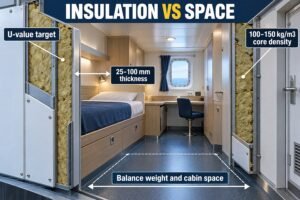
Ship interiors face extreme weather. Choosing the wrong panel insulation wastes money and ruins cabin comfort. I will show you how to match panel priorities to your ship's climate.
Operating climates shift marine panel priorities by altering heat transfer risks. Tropical climates prioritize deckhead panels to block solar radiation, while Arctic climates prioritize exterior bulkhead linings to stop freezing temperatures. Budgets, U-values, and thickness ratios must adjust to address these specific thermal loads according to ISO 7547 standards.
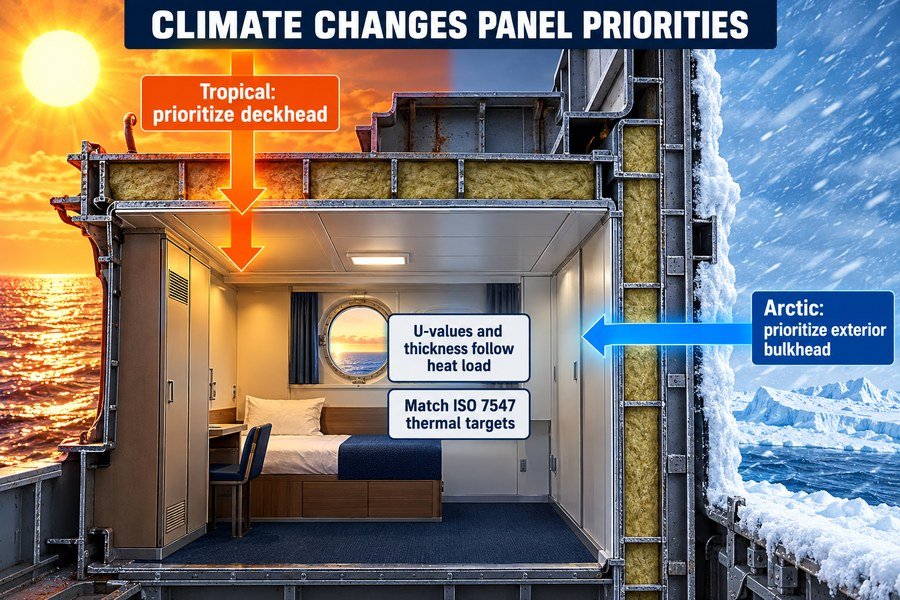
You cannot use the same outfitting plan for a ship sailing in the Middle East and a ship breaking ice in the Arctic. Let us look at how climate dictates your panel choices.
Why Do Tropical Marine Ceiling Panels Require Lower U-Values Than Bulkhead Panels?
Sun beating down on steel decks turns cabins into ovens. High U-values in ceilings overwork HVAC systems. Lowering the deckhead U-value solves this massive heat gain problem.
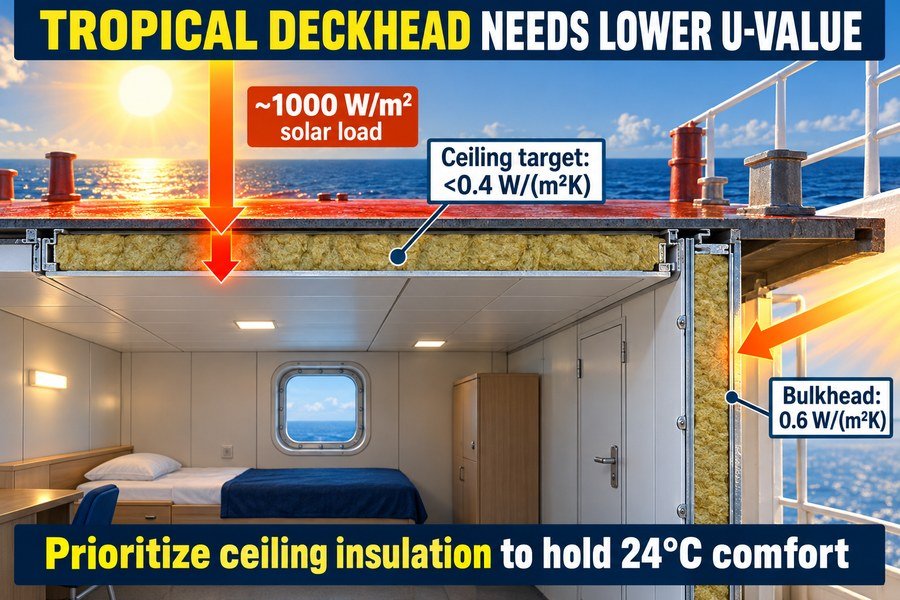
Tropical marine ceiling panels require lower U-values than bulkhead panels because horizontal steel decks absorb 1000 W/m² of direct solar radiation. To maintain SOLAS interior temperatures of 24°C, ceiling U-values must be under 0.4 W/(m²K), whereas vertical bulkheads only need 0.6 W/(m²K) due to angled sun exposure.
When I worked in the marine outfitting factory, I saw many buyers purchase the exact same panels for both the ceiling and the walls. This is a mistake for ships in hot climates. Let us break down exactly why you need different thermal resistance values for different surfaces.
Solar Heat Gain on Horizontal Ship Decks
The top of a ship takes a brutal beating from the sun. Near the equator, horizontal steel decks absorb approximately 1000 W/m² of direct solar radiation1. The steel heats up rapidly and transfers this heat straight down into the cabin below. Because the sun hits the deck directly from above for most of the day, the deckhead becomes the largest source of heat gain2.
Vertical bulkheads, on the other hand, do not face the sun directly all day. The angle of the sun means they absorb much less radiant heat. Therefore, you must stop the heat at the ceiling first. If you fail to insulate the ceiling properly, the cabin air conditioning will never keep up. The room will stay hot, and your client will complain.
Target U-Values for Tropical Ship Outfitting
To keep the cabin comfortable, we follow the ISO 7547 standard. This standard requires the interior temperature to stay around 24°C during summer conditions. To achieve this in the tropics, the marine ceiling panel must have a very low U-value. A lower U-value means less heat passes through the panel.
You must aim for a ceiling U-value of less than 0.4 W/(m²K)3. You can achieve this using high-density rockwool cores. For the vertical bulkheads, a U-value of 0.6 W/(m²K) is perfectly acceptable. The walls simply do not need the same level of thermal protection as the ceiling in a hot climate. Buying ultra-low U-value panels for interior walls is just wasting your budget.
| Specification Element | Marine Ceiling Panel (Deckhead) | Marine Bulkhead Panel (Wall) |
|---|---|---|
| Primary Heat Source | Direct horizontal solar radiation | Angled solar radiation and ambient air |
| Solar Load Exposure | ~1000 W/m² | ~400 W/m² |
| Required U-Value | < 0.4 W/(m²K) | 0.6 W/(m²K) |
| Core Material Density | 120 kg/m³ rockwool | 100 kg/m³ rockwool |
Why Are Exterior Marine Lining Panels the Top Arctic Insulation Priority?
Freezing winds attack a ship's outer steel. Poor exterior linings cause internal condensation and frozen cabins. Upgrading exterior bulkhead linings stops the cold before it enters.
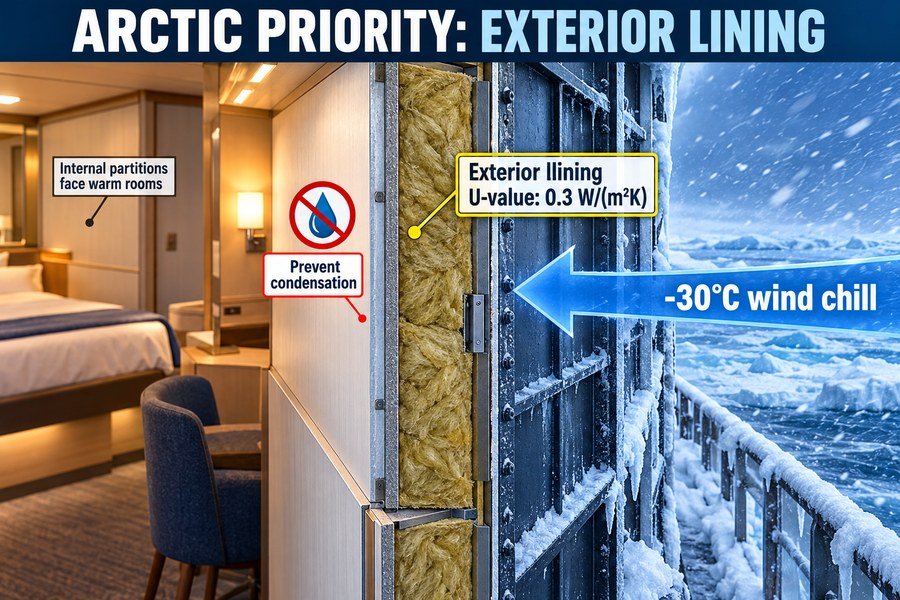
Exterior marine lining panels are the top Arctic priority because vertical steel hulls face extreme wind chill and -30°C ambient temperatures. They must prevent thermal bridging and condensation by utilizing thick mineral wool cores with a U-value of 0.3 W/(m²K), outperforming standard interior deckheads and internal partition bulkheads.
I once helped outfit a polar research vessel. The buyers initially wanted to spend their money on expensive interior cabin partitions. I told them to stop immediately. In freezing climates, the battle is won or lost at the outer edges of the ship.
The Impact of Freezing Winds on Steel Ship Hulls
When a ship sails in the Arctic, the ambient temperature easily drops to -30°C4. High winds across the ocean create a severe wind chill effect on the vertical steel hull. The steel becomes freezing cold. If the interior cabins touch this steel without proper insulation, the cold transfers instantly inside.
This makes the exterior marine lining panels the most important part of the room. These panels line the inside of the outer steel hull. Unlike internal partition bulkheads that only divide two warm rooms, the exterior lining must fight the freezing ocean air. Standard interior deckheads also do not face this severe wind chill unless they are directly under an exposed weather deck.
Preventing Condensation with High-Performance Lining Panels
The biggest danger in an Arctic cabin is not just the cold air. It is condensation. Warm, moist air from the cabin hits a poorly insulated, cold steel wall. The moisture turns into water. The water drips down the bulkhead, ruins the outfitting, and causes rust.
To stop thermal bridging and condensation, classification societies like DNV issue strict winterization rules. You must use thick mineral wool cores in your exterior lining panels. You must achieve a strict U-value of 0.3 W/(m²K). Standard interior bulkheads might only have a U-value of 0.8 W/(m²K). The exterior lining needs a massive performance upgrade to keep the steel sweat-free and the sailors warm.
| Insulation Factor | Exterior Lining Panel (Arctic) | Internal Partition Bulkhead | Standard Deckhead |
|---|---|---|---|
| Temperature Exposure | -30°C (External ambient) | 20°C (Internal ambient) | Varies by deck location |
| Condensation Risk | Extremely High | Low | Medium |
| Target U-Value | 0.3 W/(m²K) | 0.8 W/(m²K) | 0.5 W/(m²K) |
| Primary Core Requirement | Thick thermal mineral wool | Standard fire-rated rockwool | Standard fire-rated rockwool |
How Does Climate Shift Insulation Budgets Between Marine Ceiling and Bulkhead Panels?
Tight budgets force tough choices in marine outfitting. Spending equally on all panels wastes money. Shifting your budget based on climate ensures the best thermal protection per dollar.
Climate shifts insulation budgets by dictating heat loss areas. In tropical zones, 60% of the budget goes to upgraded ceiling panels to fight solar heat. In Arctic zones, 65% shifts to exterior bulkhead panels to combat freezing winds. Temperate climates allow an even 50/50 budget split between the two.
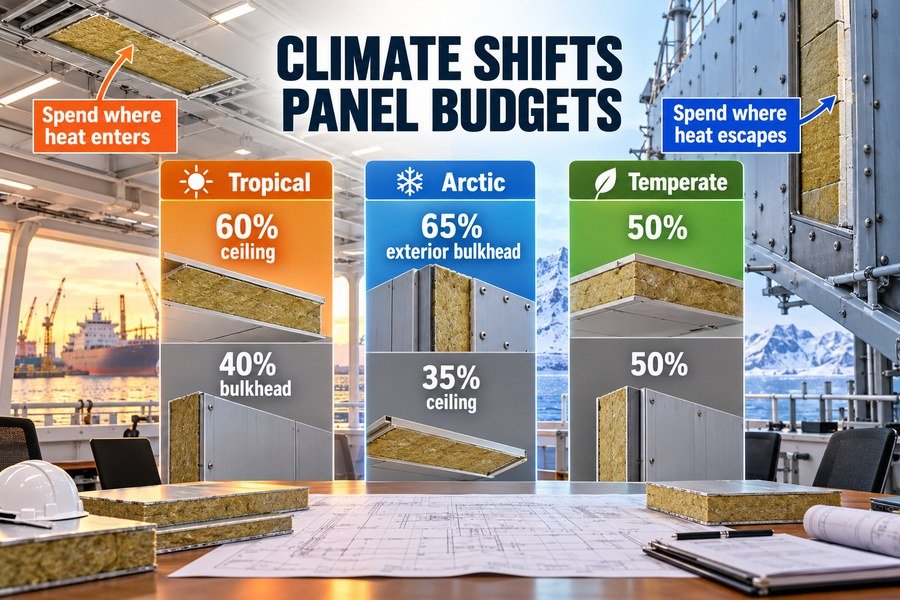
As a procurement officer, you need to control costs. I know you face pressure to find high-quality products at low prices. One of the best ways to save money is to allocate your budget where it matters most. You should not buy premium insulation for every single panel if the climate does not require it.
Budgeting for Tropical Marine Ceiling Upgrades
In tropical climates, you must spend your money on the ceiling. Because the deckhead takes the most solar heat5, you need high-density rockwool and thicker steel sheets. High-quality ceiling panels cost more. You might spend $35 to $45 per square meter for a premium tropical ceiling panel.
Because you are spending more here, you can save money on the internal bulkhead panels. You can buy standard A-Class fire-rated bulkheads for around $20 to $25 per square meter. In total, about 60% of your insulation budget should go toward the ceiling panels. This split ensures you pass the shipyard's HVAC tests without overspending on the walls.
Budgeting for Arctic and Temperate Climate Panels
In Arctic zones, the math completely reverses. The severe threat is the freezing wind against the vertical hull6. Therefore, you must buy premium exterior bulkhead linings. These heavy-duty panels can cost $40 to $50 per square meter. Standard ceiling panels can be used between interior decks, allowing you to save money there. In this scenario, 65% of your budget shifts to the bulkheads.
If your ship operates mostly in temperate climates, like the Mediterranean Sea, the weather is mild. You do not face extreme solar radiation or extreme freezing winds. In this case, you can split your budget evenly. A 50/50 budget split works perfectly. You can buy standard $25 per square meter panels for both the ceiling and the bulkheads, keeping your overall costs low and predictable.
| Operating Climate | Budget for Ceiling Panels | Budget for Bulkhead Panels | Typical Panel Cost / m² |
|---|---|---|---|
| Tropical | 60% | 40% | Ceiling: $40 / Bulkhead: $25 |
| Arctic | 35% | 65% | Ceiling: $25 / Bulkhead: $45 |
| Temperate | 50% | 50% | Ceiling: $25 / Bulkhead: $25 |
How to Distribute U-Values Between Marine Deckhead and Bulkhead Panels?
Meeting HVAC limits is hard. Randomly assigning insulation thickness leads to heavy, expensive cabins. Calculating precise U-value distributions keeps your ship light, compliant, and cost-effective.
To distribute U-values, calculate the total thermal load limit based on ISO 7547. Assign a 0.35 W/(m²K) U-value to deckheads in hot climates, and a 0.45 W/(m²K) U-value to bulkheads. In cold climates, reverse this by assigning 0.30 W/(m²K) to exterior bulkheads and 0.50 W/(m²K) to standard deckheads.
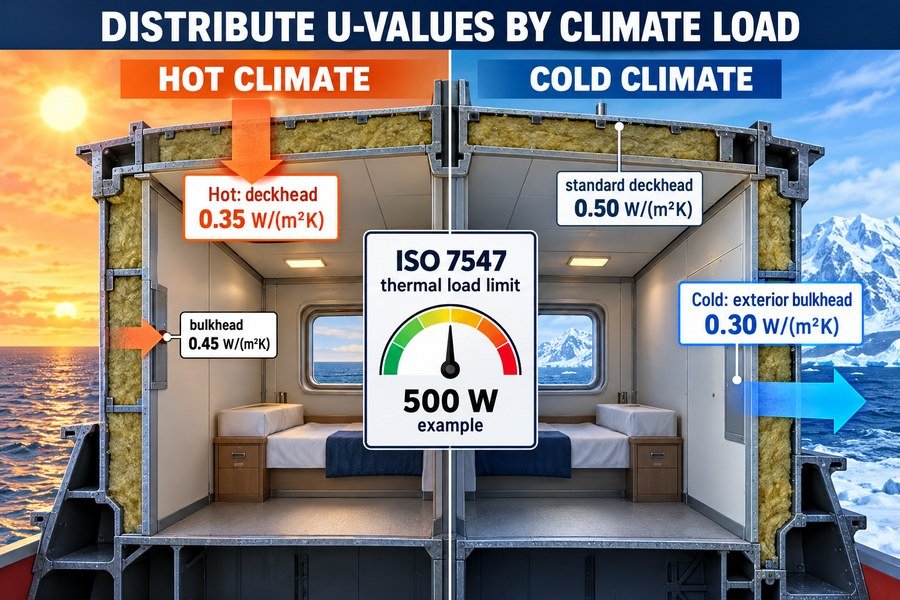
Shipyards in Europe will check your numbers carefully. They want to see that your interior outfitting matches the capacity of their air conditioning equipment. I always tell my clients to calculate the total room thermal load first, then distribute the U-values smartly.
Calculating U-Values for Hot Climate Operations
The ISO 7547 standard provides the formula for cabin air conditioning and ventilation. The shipyard will give you a total thermal load limit for the cabin. Let us say the cabin can only allow 500 Watts of heat transfer. You must divide this allowance between the ceiling and the walls.
For hot climates, you distribute the lowest U-value to the surface that gets the hottest. You assign a strict U-value of 0.35 W/(m²K) to the deckhead panels. Because you blocked the main heat source, you can be less strict with the walls. You can assign a U-value of 0.45 W/(m²K) to the bulkheads. This distribution keeps the total heat transfer under the 500-Watt limit. It also stops you from buying unnecessarily heavy panels for the walls.
Calculating U-Values for Cold Climate Operations
In cold climates, the heat transfer direction flips. You are losing heat from the cabin to the freezing ocean. The total thermal load limit works the same way, but the distribution must change. The freezing steel hull pulls the most heat out of the room.7
Therefore, you must assign the strongest insulation to the exterior bulkheads. You give the exterior bulkhead a U-value of 0.30 W/(m²K). This creates a very strong thermal barrier. Because the exterior wall is doing the heavy lifting, the standard deckheads between internal warm cabins do not need much help. You can assign a much higher U-value of 0.50 W/(m²K) to the standard deckheads. This keeps the ship's weight down while fully meeting ISO 7547 requirements.
| Climate Condition | Target Deckhead U-Value | Target Bulkhead U-Value | Primary Insulation Goal |
|---|---|---|---|
| Hot Climate | 0.35 W/(m²K) | 0.45 W/(m²K) | Block downward solar heat gain |
| Cold Climate | 0.50 W/(m²K) | 0.30 W/(m²K) | Block outward cabin heat loss |
| Mild Climate | 0.45 W/(m²K) | 0.45 W/(m²K) | General thermal stabilization |
How Does Climate Dictate the Thickness Ratio of Marine Ceiling Versus Bulkhead Panels?
Cabin space is extremely limited on ships. Using thick panels everywhere reduces valuable room space. Adjusting panel thickness ratios based on climate maximizes both insulation and living area.
Climate dictates thickness ratios by prioritizing the primary heat transfer surface. Tropical ships use a 1.5:1 ratio, utilizing 75mm ceiling panels and 50mm bulkhead panels. Arctic ships reverse this to a 1:2 ratio, pairing 50mm ceiling panels with 100mm exterior bulkhead panels to meet classification society winterization guidelines.
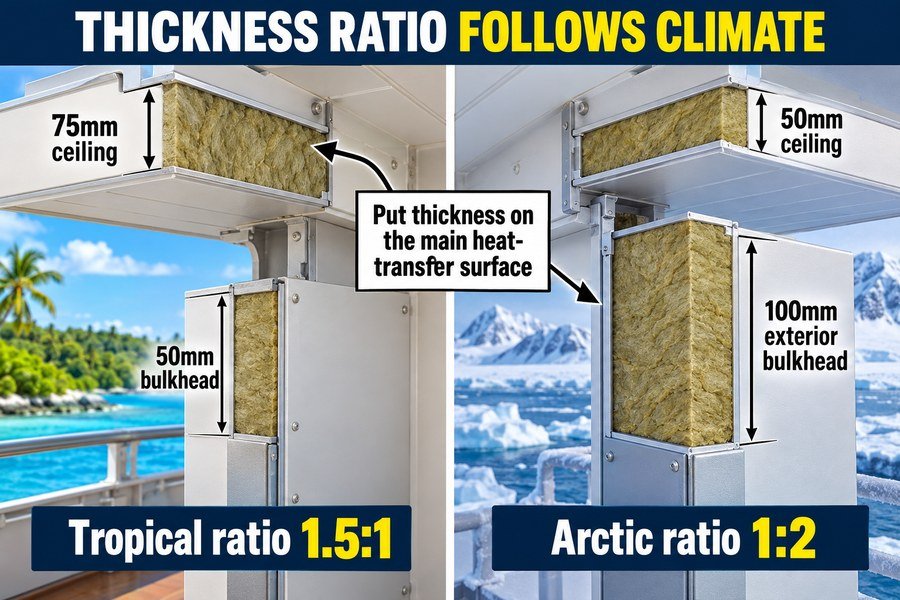
Space is money in the shipbuilding industry. Shipowners want the biggest possible cabins. Thick panels eat up floor space and reduce ceiling height. You must use the thinnest panels possible that still meet the climate requirements. By using a ratio, you put the thickness only where it is absolutely needed.
Implementing the 1.5:1 Thickness Ratio for Tropical Ships
In a tropical climate, we know the ceiling is the weak point8. Therefore, the ceiling needs more core material to achieve the required U-value. A common industry ratio for hot climates is 1.5:1.9 This means the ceiling panel is 1.5 times thicker than the bulkhead panel.
Practically, this means you will use a 75mm thick ceiling panel. This 75mm thickness holds enough rockwool to block the intense solar radiation from the steel deck above. For the bulkheads, you will use standard 50mm thick panels. The 50mm panel is thin enough to save valuable floor space in the cabin, but strong enough to meet standard fire regulations. This 1.5:1 ratio gives the crew maximum floor space while keeping the room cool.
Implementing the 1:2 Thickness Ratio for Arctic Ships
When outfitting a ship for the Arctic, you must follow strict winterization guidelines. Societies like Lloyd's Register require massive thermal protection against the hull. You cannot use a thin 50mm panel against freezing steel. It will fail.
Instead, you reverse the ratio to 1:2. The ceiling panel becomes the thinner component, and the exterior bulkhead becomes the thicker component. You will use a standard 50mm ceiling panel between the decks. For the exterior lining bulkhead, you will use a massive 100mm thick panel. This 100mm thickness is mandatory10 to hold the thick mineral wool needed to stop condensation and freezing. Even though the 100mm wall takes up more floor space, it is a non-negotiable requirement for Arctic survival.
| Climate Zone | Ceiling : Bulkhead Ratio | Ceiling Panel Thickness | Bulkhead Panel Thickness |
|---|---|---|---|
| Tropical | 1.5 : 1 | 75mm | 50mm |
| Arctic | 1 : 2 | 50mm | 100mm |
| Standard | 1 : 1 | 50mm | 50mm |
Conclusion
Operating climates completely change marine panel priorities. You must adjust your budgets, U-values, and panel thicknesses between bulkheads and deckheads to ensure SOLAS compliance, cabin comfort, and cost efficiency.
-
"Technical Memorandum 82021 Spectral Distribution of ...", https://ntrs.nasa.gov/api/citations/19810016493/downloads/19810016493.pdf. Clear-sky solar irradiance references report peak sea-level irradiance on sun-facing or horizontal surfaces near 1,000 W/m², supporting the order of magnitude used for tropical deck solar loading. Evidence role: statistic; source type: government. Supports: Near the equator, horizontal steel decks can receive about 1000 W/m² of direct solar radiation.. Scope note: The value is an approximate peak under clear-sky conditions; actual shipboard exposure varies with latitude, season, cloud cover, deck color, and solar angle. ↩
-
"Solar UV exposure of seafarers along subtropical and ...", https://pubmed.ncbi.nlm.nih.gov/23875870/. Marine HVAC heat-load guidance and ship accommodation studies identify solar gains through exposed decks and superstructures as major contributors to cooling load, which supports treating deckheads as a priority insulation surface in tropical service. Evidence role: expert_consensus; source type: paper. Supports: In hot climates, the deckhead can be the largest or a dominant source of cabin heat gain.. Scope note: This supports the general importance of deckhead solar heat gain; whether it is the single largest source depends on vessel geometry, glazing, ventilation rate, color, and occupancy loads. ↩
-
"Determination of Thermal Properties of Mineral Wool ... - PMC", https://pmc.ncbi.nlm.nih.gov/articles/PMC10488771/. Thermal-transmittance calculation references for mineral-wool insulated panels can show that low U-values on the order of 0.4 W/(m²K) are achievable with sufficient insulation thickness and conductivity, giving engineering context for the proposed ceiling target. Evidence role: mechanism; source type: research. Supports: A marine ceiling panel with a U-value below 0.4 W/(m²K) can reduce heat transfer and is technically achievable with mineral-wool insulation.. Scope note: Such sources support feasibility and heat-flow reduction, not that 0.4 W/(m²K) is a universal or mandatory marine ceiling requirement for all tropical ships. ↩
-
"Sea Surface Temperature", https://arctic.noaa.gov/report-card/report-card-2024/sea-surface-temperature-2024/. Meteorological and polar-shipping guidance documents report that Arctic winter operating environments can include air temperatures at or below −30°C, supporting the use of −30°C as a plausible cold-weather design condition. Evidence role: statistic; source type: government. Supports: When a ship sails in the Arctic, the ambient temperature easily drops to -30°C.. Scope note: This supports plausibility for Arctic winter operations, not that every Arctic voyage or route routinely reaches −30°C. ↩
-
"The Case of Accra, Ghana And - Scholars' Bank", https://scholarsbank.uoregon.edu/bitstreams/6359cbfe-9b77-45e8-ad4b-928f7a0ee377/download. A heat-transfer or solar-geometry source should support that exposed horizontal surfaces can receive substantial solar irradiance in low-latitude/tropical conditions, making overhead/deckhead areas important contributors to cooling load. Evidence role: mechanism; source type: education. Supports: In tropical climates, the deckhead receives the most solar heat and therefore deserves higher insulation priority.. Scope note: This would support the physical rationale for prioritizing overhead insulation, but it would not prove that every vessel’s deckhead is always the largest heat-gain surface. ↩
-
"Analysis and research on heat losses from tube for ...", https://ui.adsabs.harvard.edu/abs/2025HMT....61...61Y/abstract. A polar maritime operations or heat-transfer source should support that cold wind increases convective heat loss from exposed ship surfaces, making exterior bulkheads and hull-adjacent linings important in Arctic service. Evidence role: mechanism; source type: research. Supports: In Arctic zones, wind exposure along the hull can drive heat loss through vertical exterior surfaces.. Scope note: This would support the mechanism of wind-driven heat loss in Arctic conditions, but not the exact 65% budget allocation stated later in the article. ↩
-
"Heat transfer through metal-inclosed insulation", https://nvlpubs.nist.gov/nistpubs/jres/5/jresv5n2p385_A2b.pdf. Steel has relatively high thermal conductivity compared with insulation materials, and heat-transfer references describe greater heat loss where a conductive boundary separates warm interior air from a cold exterior environment; this supports the need for stronger insulation at exterior hull-facing bulkheads. Evidence role: mechanism; source type: education. Supports: A cold steel hull can be a major heat-loss path from a warm cabin in cold-climate operation.. Scope note: This provides physical context rather than proving that the hull is always the dominant heat-loss path for every cabin layout. ↩
-
"Comparative Evaluation of the Impact of Roofing Systems ...", https://stars.library.ucf.edu/cgi/viewcontent.cgi?article=1569&context=fsec. A naval-architecture or building-physics source should show that exposed horizontal decks can receive high solar gains and become a dominant path for heat transfer into spaces below; this supports treating the ceiling/deckhead as a critical insulation location in hot climates, though it does not by itself validate a specific panel thickness ratio. Evidence role: mechanism; source type: education. Supports: In tropical climates, the ceiling/deckhead is the weak point because solar radiation on the steel deck above increases heat transfer into the cabin.. Scope note: Contextual support only; solar heat-gain principles do not prove the article’s 1.5:1 ratio or 75 mm specification. ↩
-
"How to choose the right marine wall panels for marine interior ...", https://magellanmarinetech.com/how-choose-right-marine-wall-panels-for-marine-interior-projects/. A marine accommodation design standard or classification guidance should document whether ceiling insulation is commonly specified thicker than bulkhead insulation in hot-climate service; if it mentions only U-values or design temperatures, it would provide contextual support rather than direct evidence for the exact 1.5:1 ratio. Evidence role: expert_consensus; source type: institution. Supports: A 1.5:1 ceiling-to-bulkhead thickness ratio is a common industry ratio for ships operating in hot climates.. Scope note: The exact 1.5:1 ratio may be a design convention rather than a codified requirement, so available sources may support the principle but not the precise ratio. ↩
-
"How to choose the right marine wall panels for marine interior ...", https://magellanmarinetech.com/how-choose-right-marine-wall-panels-for-marine-interior-projects/. A class rule, polar-service guide, or technical insulation standard should be cited only if it explicitly requires a 100 mm exterior lining or equivalent thermal resistance for the stated Arctic condition; otherwise, the source can support the need for increased insulation against condensation and freezing but not the mandatory 100 mm dimension. Evidence role: general_support; source type: institution. Supports: A 100 mm exterior bulkhead lining is mandatory in Arctic outfitting to provide sufficient mineral-wool insulation against condensation and freezing.. Scope note: Likely requires direct project specifications or class-approved designs; general winterization rules may not mandate a universal 100 mm panel thickness. ↩