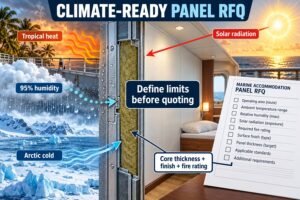
Sending an RFQ for marine panels without checking the climate data causes major condensation issues later. You lose money on rework. The fix is defining exact weather limits upfront.
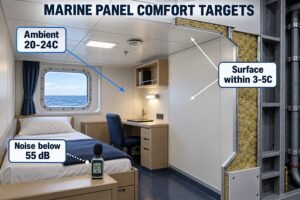
Climate dictates panel insulation core thickness, surface finishes, and fire ratings. An RFQ must address tropical heat, arctic cold, high humidity, and solar radiation to ensure panels prevent condensation, maintain interior temperatures between 20°C and 24°C per ISO 7547, and meet SOLAS fire safety regulations.
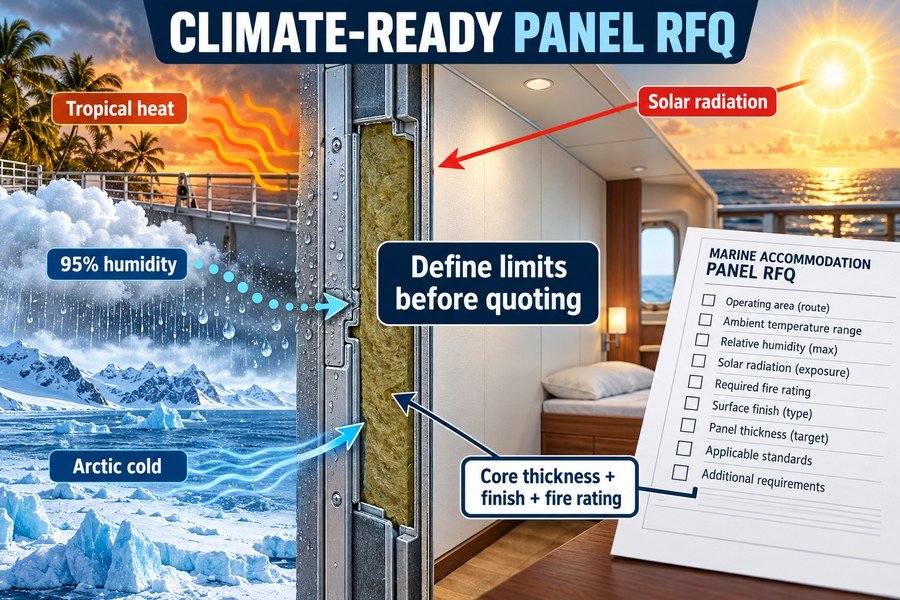
Let us look at the exact details you need to put in your next RFQ to avoid these common mistakes and get the right price from your supplier.
What Climate Data Is Essential in a Marine Accommodation Panel RFQ?
Guessing weather conditions leads to panels that warp or sweat. Crew cabins become damp and uncomfortable. You must give suppliers four exact data points in your RFQ.
An effective panel RFQ must specify four climate parameters: maximum summer temperature (often +45°C), minimum winter temperature (-20°C to -40°C), maximum relative humidity (up to 95%), and seawater temperature limits (32°C summer). These determine the U-value needed for the panel core.
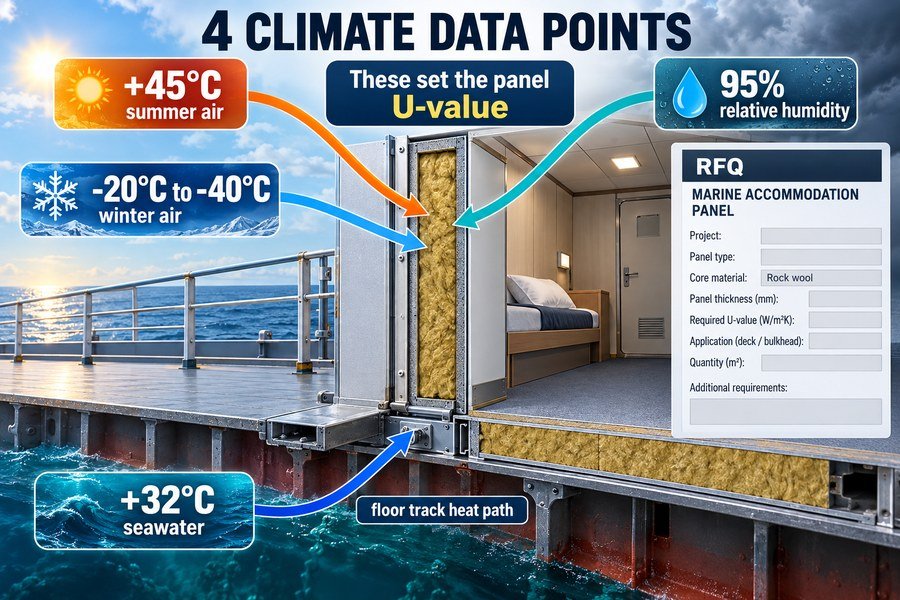
I see buyers send RFQs without weather details all the time. The supplier just quotes the cheapest standard panel. Later, the ship goes to the Middle East. The cabin gets too hot. The panels sweat. You must give the supplier these four exact numbers in your RFQ. I learned this the hard way at my first outfitting job. We had to rip out fifty cabin walls because the insulation was too thin for the real weather.
Setting Temperature and Humidity Baselines for Panel Cores
First, you need to state the maximum summer temperature. The standard outside air temperature for ships is +45°C.1 I always write this number in the RFQ. The ISO 7547 standard says the inside cabin must stay between 20°C and 24°C. The panel core needs to stop that 45°C heat from getting inside.
Next, you must state the maximum relative humidity. Ships work on the ocean. The air is wet. I tell buyers to put 95% relative humidity2 in the RFQ. If the humidity is high, poor panels will trap water inside the rock wool. The rock wool gets heavy. It falls down inside the steel skin. Then the insulation stops working completely.
Defining Winter and Seawater Conditions for Insulation
Third, you must list the minimum winter temperature. Most cargo ships use -20°C for normal winter routes.3 The panel supplier uses this number to choose the rock wool density.
Finally, you must give the maximum seawater temperature. I use 32°C for summer seawater in my RFQs based on DNV rules4. The ship hull touches the warm water. The steel deck gets hot. The bottom track of the accommodation panel touches that steel deck. If the water is 32°C, the heat travels up into the panel. The supplier needs to know this to provide the right floor insulation pad. If you miss even one of these four data points, you will buy the wrong panel.
| Climate Parameter | Standard Value to Put in RFQ | Authoritative Source | Impact on Panel Design |
|---|---|---|---|
| Maximum Summer Air | +45°C | ISO 7547 | Dictates panel core U-value |
| Maximum Humidity | 95% | DNV GL Rules | Requires vapor barrier film |
| Minimum Winter Air | -20°C to -40°C | IACS Standard | Determines rock wool density |
| Max Seawater Temp | +32°C | SOLAS Guidelines | Affects floor track insulation |
How to Specify Winter Temperatures for Exterior Marine Lining Panel RFQs?
Extreme cold freezes bulkheads. Ice forms inside cabins if the lining panel fails. You must define the lowest winter temperatures to get the right rock wool density.
To specify winter temperatures, state the operational minimum, typically -20°C for global sailing or -40°C for Polar Class ships per IACS rules. You must demand panels with a U-value below 0.6 W/m²K and ask for thermal break joints to stop freezing.
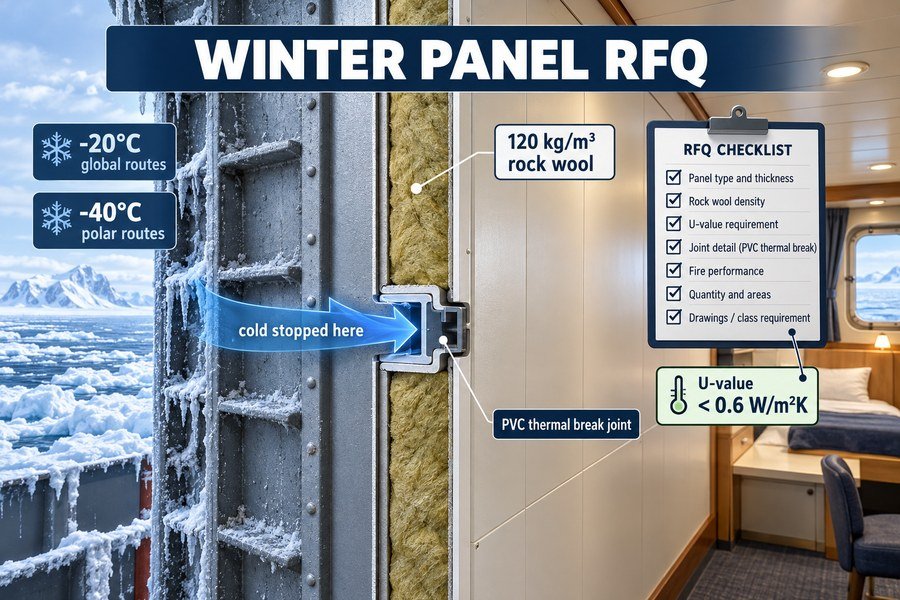
Winter temperatures destroy bad lining panels. The lining panel is the final wall between the cold steel hull and the warm cabin. If you buy a cheap panel, the cold passes right through it. I worked on a project where the interior walls literally grew ice. The buyer did not specify the winter limits in the RFQ. We had to fix it at a high cost. You must state the exact temperature and ask for two specific design features.
Calculating U-Values for Standard and Polar Winter Routes
You must tell the supplier where the ship goes. For standard global routes, you write -20°C in the RFQ. For ships going to the Arctic, you must follow IACS Polar Class rules. You write -40°C in the RFQ.
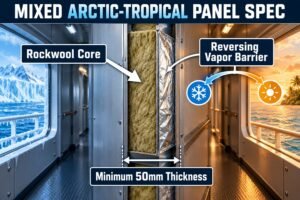
Then, you must demand a specific U-value. The U-value measures heat loss.5 A lower number is better. For a -20°C winter limit, tell the supplier you need a U-value below 0.6 W/m²K. To hit this number, the supplier must give you a 50mm thick panel. They must fill it with 120 kg/m³ density rock wool. If you do not give them this target, they will sell you a 0.9 W/m²K panel to win the bid. That panel will fail in the cold.
Requesting Thermal Break Joints to Prevent Cold Spots
Next, you must ask for thermal break joints. Standard marine panels connect with steel profiles. Steel conducts cold very fast. If the outside steel is -20°C, the cold travels through the steel joint right into the cabin.
You must ask the supplier: "Do your lining panels include a PVC thermal break in the joints?" A thermal break is a piece of plastic inside the metal joint. Plastic does not conduct cold. This small plastic piece stops the ice from forming.6 If the supplier says no, do not buy from them.
| Winter Route Type | RFQ Temperature Limit | Required Panel U-Value | Joint Requirement | Core Density |
|---|---|---|---|---|
| Standard Global | -20°C | < 0.6 W/m²K | Standard Thermal Break | 120 kg/m³ |
| Baltic Sea Winter | -30°C | < 0.5 W/m²K | Deep PVC Thermal Break | 150 kg/m³ |
| IACS Polar Class | -40°C | < 0.4 W/m²K | Double Thermal Break | 150 kg/m³ + Air Gap |
How to Specify Solar Loads in a Tropical Marine Ceiling Panel RFQ?
Sun beating down on the deck turns cabins into ovens. The AC runs constantly and fails. Your RFQ needs strict solar load limits for the ceiling panels.
Specify solar loads by stating the maximum deck surface temperature, often reaching 70°C in direct tropical sun. The RFQ must require ceiling panels with 50mm high-density rock wool, a PVC film resistant to UV degradation, and a heat transfer coefficient under 0.4 W/m²K.
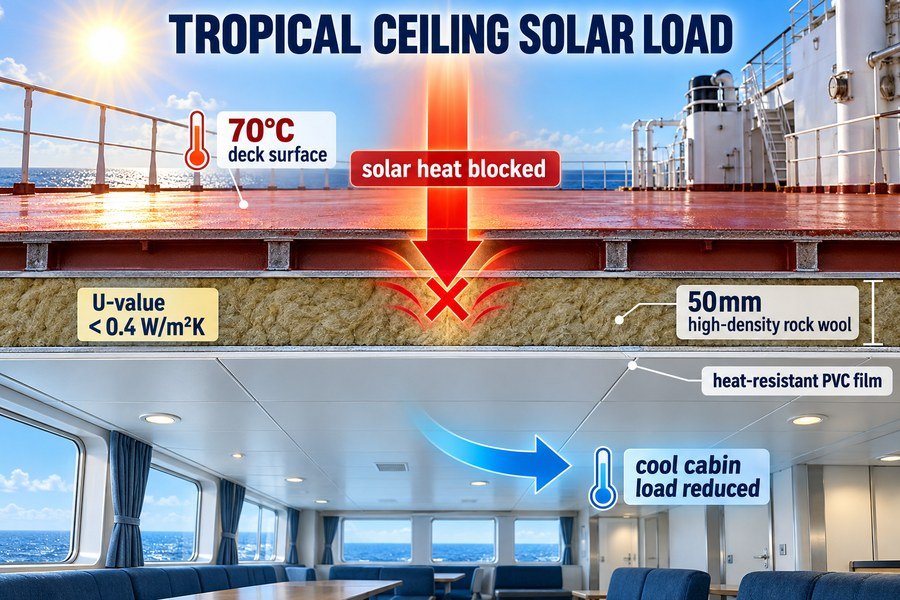
Ceiling panels take the most heat on the entire ship. The sun hits the steel deck above the cabin all day. The steel gets incredibly hot. I saw a project in Singapore where the crew could not sleep. The ceiling panels were too thin. The heat from the deck baked the room. You must ask the supplier to build a ceiling panel that can stop a huge solar load. You do this by setting three strict rules in your RFQ.
Handling 70°C Deck Surface Temperatures with 50mm Rock Wool
First, you must state the maximum deck surface temperature. The air might be 45°C, but the dark steel deck in the sun reaches 70°C7. You must write this 70°C number in your RFQ.
Then, you must specify the rock wool thickness. A standard 25mm ceiling panel is completely useless against 70°C. You must demand a 50mm thick ceiling panel8. You must also demand high-density rock wool. The density must be at least 120 kg/m³9. This thick, heavy rock wool acts as a shield against the solar load.
Choosing PVC Film and U-Values for Tropical Sun Limits
Second, you must talk about the surface finish. The heat bakes the paint on the panel. Over time, cheap finishes turn yellow and peel off. You must ask for a PVC film finish that resists heat degradation. Tell the supplier the film must survive constant 50°C ambient heat without bubbling.
Finally, you must set the heat transfer coefficient limit. For tropical ceilings, a U-value of 0.6 W/m²K is not good enough. You must require a U-value under 0.4 W/m²K10. This strict number forces the supplier to use premium materials. It keeps the cabin cool. It saves thousands of dollars in air conditioning fuel every month.
| Solar Load Parameter | RFQ Requirement for Ceiling Panels | Authoritative Source | Reason for Requirement |
|---|---|---|---|
| Max Steel Deck Temp | 70°C continuous | ASHRAE Marine | Defines peak heat source |
| Core Thickness | 50mm minimum | ISO 7547 | Stops radiant heat transfer |
| Core Density | 120 kg/m³ | SOLAS Fire Codes | Provides thermal mass |
| Panel U-Value | < 0.4 W/m²K | DNV GL Comfort Class | Reduces AC energy load |
| Surface Finish | Heat-resistant PVC film | Supplier Test Data | Prevents yellowing and peeling |
What Thermal and Fire Ratings Must a Marine Interior Panel Datasheet Confirm?
A cheap panel looks good but fails the port state inspection. Your ship gets detained. You must check three specific thermal and fire ratings before buying.
The datasheet must confirm three critical ratings: the SOLAS fire class (B-15, B-0, or C-class for cabins), the core rock wool density (typically 120 kg/m³ for B-15), and the panel's U-value (0.6 to 0.8 W/m²K). These ensure both thermal comfort and legal fire compliance.
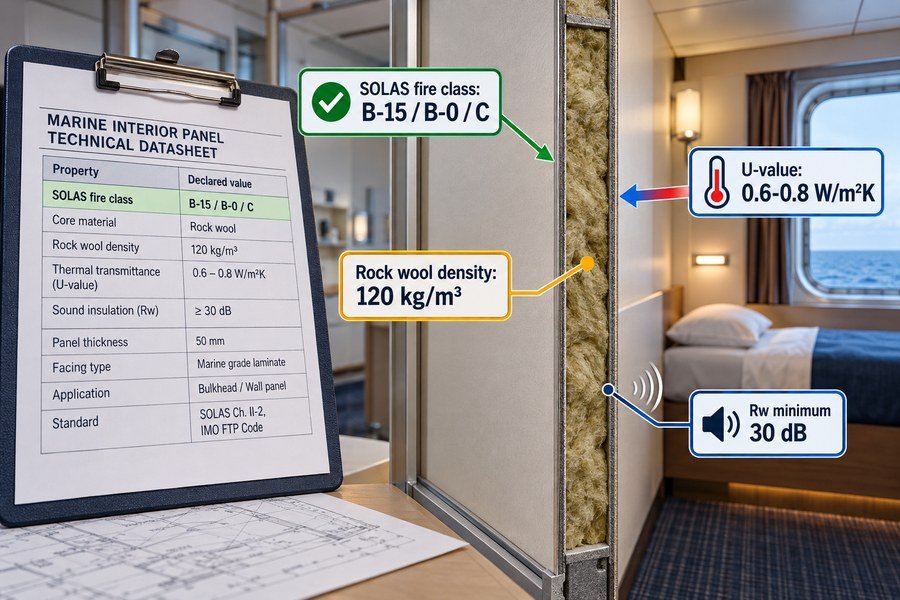
You cannot just trust an email from a sales rep. You must demand the official technical datasheet. At Magellan Marine, I always check the datasheet before I look at the price. If the datasheet is missing key ratings, the panel is usually fake or untested. The port inspector will check these ratings. If they fail, the ship cannot sail. You lose a lot of money. You must verify three specific ratings on every single datasheet.
Verifying SOLAS Fire Class Certifications for Cabin Walls
The first rating is the SOLAS fire class. SOLAS is the strict law for ship safety. Cabin divider walls usually need a B-15 rating.11 This means the panel stops fire and heat for 15 minutes. Some less important walls need a B-0 rating. This stops fire for 15 minutes but does not stop the heat. Small partitions might just need a C-class rating. You must read the datasheet. It must clearly say "B-15 Fire Rated" or "B-0 Fire Rated". If it just says "Fireproof," it is a fake panel.
Checking Rock Wool Density and Thermal U-Values
The second rating is the core rock wool density. The rock wool does the actual work. To pass a B-15 fire test, the rock wool density is almost always 120 kg/m³.12 You must look for this number. If the datasheet says 80 kg/m³, the panel will fail a real fire test.
The third rating is the U-value. As we discussed earlier, this is the heat loss number. A good B-15 panel will have a U-value between 0.6 and 0.8 W/m²K. This proves the panel keeps the crew warm in winter and cool in summer. The datasheet must list all three of these numbers clearly.
| Required Rating on Datasheet | Target Value | What It Proves | Authority |
|---|---|---|---|
| SOLAS Fire Class | B-15, B-0, or C-Class | Legal safety compliance | IMO / SOLAS |
| Rock Wool Density | 120 kg/m³ (for B-15) | Core material quality | Test Laboratories |
| Thermal U-Value | 0.6 to 0.8 W/m²K | Energy efficiency | ISO Standards |
| Sound Reduction (Rw)13 | Minimum 30 dB | Crew sleeping comfort | IMO Noise Code |
How to Verify Marine Accommodation Panel Thermal Claims Against Type Approvals?
Suppliers often lie about how well their panels stop heat. You trust their brochure and get burned. You must check their claims against real type approval certificates.
Verify thermal claims by checking three details on the Type Approval Certificate (MED/USCG): the tested insulation density matches the RFQ (e.g., 120 kg/m³), the approved panel thickness is exact (e.g., 50mm), and the certificate is currently valid on the DNV or ABS database.
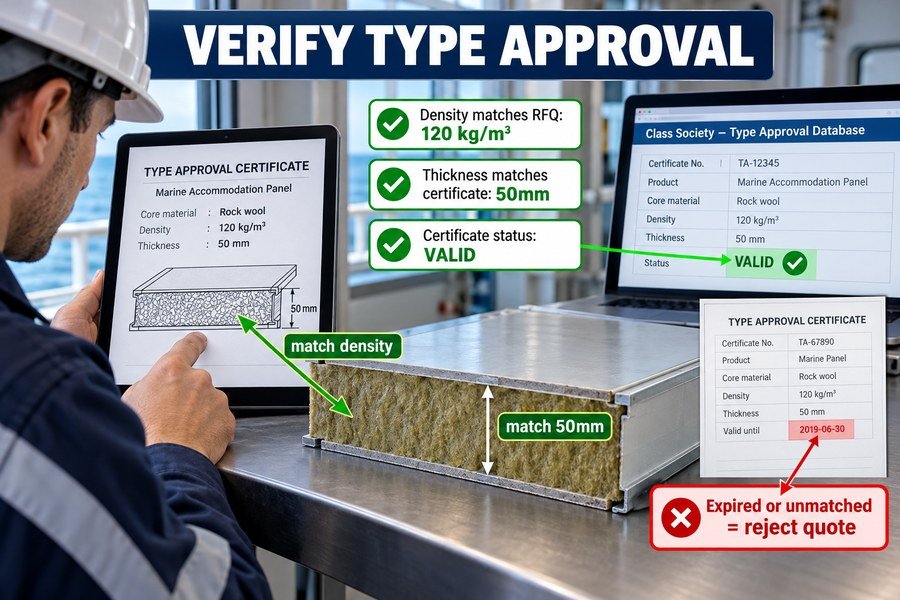
Brochures are just marketing. Anybody can print a brochure that says their panel is the best. I have seen suppliers send me a brochure showing a U-value of 0.4, but the actual panel they shipped was terrible. The only document that matters is the Type Approval Certificate. This is a legal document from a testing lab like DNV or ABS. You must check three exact details on this certificate to make sure the supplier is telling the truth.
Matching Tested Insulation Density and Thickness on Certificates
First, you must check the insulation density14. Look at the Type Approval Certificate. It will show a drawing of the tested panel. Read the notes on the drawing. If your RFQ asked for 120 kg/m³ rock wool, the certificate drawing must say 120 kg/m³. Sometimes a supplier will use a certificate for a heavy panel, but try to sell you a cheap, light panel.
Second, you must check the panel thickness. The thermal claim is only true for the exact thickness tested in the lab. If the certificate says the lab tested a 50mm panel, but the supplier is quoting you a 25mm panel, the thermal claim is completely false. The 25mm panel will perform much worse. You must match the quoted thickness to the certified thickness.
Checking the Expiry Date on Class Society Databases
Third, you must verify the certificate is still alive. Certificates expire after five years. A supplier might send you a certificate from 2018. It is useless today. You must look at the expiry date. Then, you must go online. Go to the DNV or ABS approval database. Type in the certificate number. Make sure the database says "Valid". If you skip these three checks, you are just gambling with your money and the ship's safety.
| Verification Step | Where to Look | Red Flag to Watch Out For | Action to Take |
|---|---|---|---|
| Check Density | Page 2 of Type Approval | Certificate says 120 kg/m³ but quote says 100 kg/m³ | Reject the quote immediately |
| Check Thickness | Product Description Section | Tested at 50mm, quoted at 25mm | Ask for 25mm specific test data |
| Check Validity Date | Front Page of Certificate | Date is more than 5 years old | Demand updated certificate |
| Check Database | DNV/ABS Online Portal | Certificate number not found | Report fake certificate |
What RFQ Questions Confirm Marine Interior Panel Thermal Bridging Performance?
Metal panel joints act like highways for cold air. Condensation ruins the cabin floor. You must ask suppliers three direct questions to stop thermal bridging.
To confirm thermal bridging performance, ask three questions: "Do your connection profiles include a PVC thermal break?", "What is the measured heat loss at the panel joints?", and "Do you provide anti-sweat tape for the floor tracks?" This stops condensation at the steel deck.
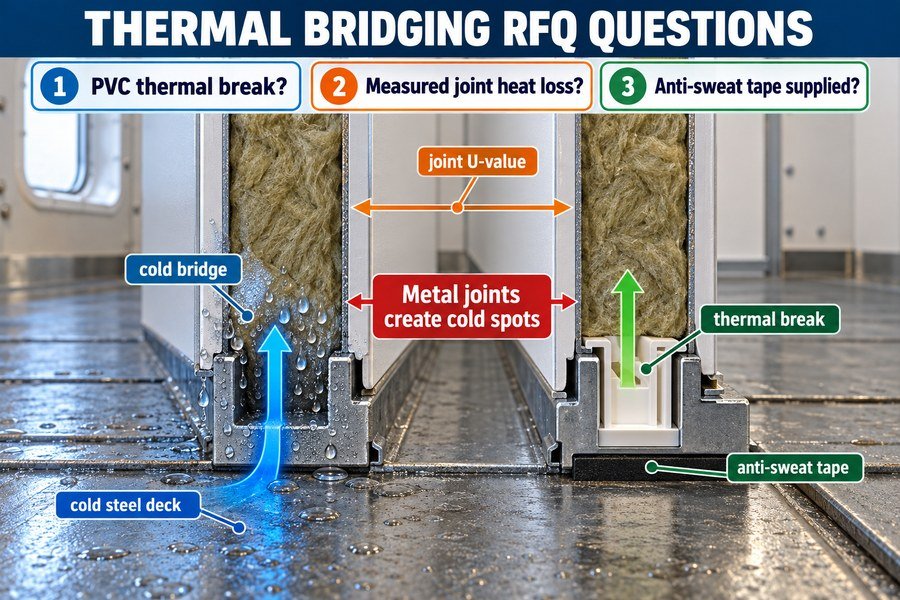
Thermal bridging is a hidden enemy. The panel itself might be great, but the metal joints ruin everything. Metal connects the cold outside to the warm inside. Heat travels fast through metal.15 This creates a cold spot inside the cabin. Water from the air turns into liquid on this cold spot. This is condensation. It drips down. It ruins carpets. It rusts the floor. You must stop thermal bridging by asking the supplier three hard questions in your RFQ.
Questioning the Use of PVC Thermal Breaks in Connection Profiles
First, ask: "Do your connection profiles include a PVC thermal break?" A standard H-profile joint is just solid steel. It acts like a bridge for the cold. A good profile has a piece of PVC plastic in the middle.16 The plastic breaks the bridge. The cold stops. If the supplier does not offer PVC thermal breaks, you will get condensation in cold climates.
Second, ask: "What is the measured heat loss at the panel joints?" Suppliers love to tell you the heat loss for the center of the panel. The center is easy. The joint is hard. Force them to give you the U-value for the connected joint.17 A good supplier will have test data for this. A bad supplier will try to change the subject.
Asking About Joint Heat Loss and Anti-Sweat Tape for Floor Tracks
Third, ask: "Do you provide anti-sweat tape for the floor tracks?" The bottom U-track of the panel sits directly on the steel deck of the ship. The deck gets very cold. The cold moves up into the U-track. Water forms at the base of your wall. Good suppliers sell a heavy rubber or foam anti-sweat tape. You put this tape between the steel deck and the U-track. It stops the cold. It stops the water. Ask these three questions, and you will buy a system that actually stays dry.
| RFQ Question to Ask Supplier | Good Answer | Bad Answer | Consequence of Bad Answer |
|---|---|---|---|
| PVC Thermal Breaks in Profiles? | "Yes, we use a 5mm PVC insert." | "Our steel is thick enough." | Cold transfers through the wall joints. |
| Measured Heat Loss at Joints? | "The joint U-value is 0.65 W/m²K." | "We only test the main panel." | You cannot predict condensation risks. |
| Anti-Sweat Tape for Tracks? | "Yes, we supply 3mm rubber tape." | "You can buy that locally." | Floor tracks will rust within a year. |
Conclusion
Climate data directly changes what panels you buy. Put exact temperatures, fire classes, and joint details in your RFQ to get the right price and pass all safety rules.
-
"(PDF) A study on the specification of minimum design air ...", https://www.academia.edu/79649605/A_study_on_the_specification_of_minimum_design_air_temperature_for_ships_and_offshore_structures. Classification rules for shipboard systems commonly specify 45°C ambient air as a design condition for unrestricted or tropical service, supporting the use of +45°C as a marine design baseline rather than as a universal meteorological maximum. Evidence role: statistic; source type: institution. Supports: The standard outside air temperature for ships is +45°C.. Scope note: The value is a classification/design assumption and may vary by flag, class notation, trade route, or edition of the rules. ↩
-
"IACS Req. 1991/Rev.8 2021/Corr.1 2022", https://www.classnk.or.jp/hp/pdf/info_service/iacs_ur_and_ui/ur_e10_rev.8_corr.1_jan_2022ul.pdf. Marine classification guidance on environmental conditions often uses high relative humidity values, including 95% RH, for shipboard equipment and accommodation design; this supports the RFQ humidity baseline as a conservative design condition, not as proof that all routes experience that humidity continuously. Evidence role: statistic; source type: institution. Supports: Buyers should specify 95% relative humidity as a maximum humidity condition for accommodation panel RFQs.. Scope note: Humidity design assumptions differ by standard, equipment category, and intended service area. ↩
-
"(PDF) A study on the specification of minimum design air ...", https://www.academia.edu/79649605/A_study_on_the_specification_of_minimum_design_air_temperature_for_ships_and_offshore_structures. Ship classification and marine HVAC design references commonly use -20°C as a winter ambient design temperature for non-polar service, supporting the statement as a typical baseline for ordinary routes rather than a limit for polar or ice-class operation. Evidence role: statistic; source type: institution. Supports: Most cargo ships use -20°C as the minimum winter design temperature for normal winter routes.. Scope note: The value may be lower for ice-class vessels, polar routes, naval specifications, or owner-specific requirements. ↩
-
"How does the temperature of ocean water vary?", https://oceanexplorer.noaa.gov/ocean-fact/temp-vary/. DNV and other marine classification references use about 32°C seawater as a summer cooling-water or environmental design condition, supporting the cited RFQ value as a rule-based design assumption rather than a measured maximum for every sea area. Evidence role: statistic; source type: institution. Supports: A maximum seawater temperature of 32°C is used in RFQs based on DNV rules.. Scope note: The applicable value depends on the vessel’s service notation, geographic operating area, and the edition of the classification rules used. ↩
-
"A New Metre for Cheap, Quick, Reliable and Simple Thermal ...", https://pmc.ncbi.nlm.nih.gov/articles/PMC5620656/. Thermal transmittance, or U-value, is defined as the rate of heat transfer through an element per unit area per degree of temperature difference; lower values indicate less heat flow under the same conditions. Evidence role: definition; source type: government. Supports: The U-value measures heat loss. A lower number is better.. ↩
-
"Heat-air-moisture modeling for prediction of interior surface ...", https://pmc.ncbi.nlm.nih.gov/articles/PMC10161374/. Thermal-bridging literature shows that low-conductivity thermal breaks in metal framing reduce conductive heat flow and increase interior surface temperatures, which lowers the risk of condensation or frost at cold bridges. Evidence role: mechanism; source type: government. Supports: A plastic thermal break inside a metal joint can prevent ice formation by interrupting conductive heat transfer through the joint.. Scope note: Most neutral sources discuss building-envelope or window-frame thermal breaks; the principle is applicable, but a marine lining-panel joint still requires assembly-specific validation. ↩
-
"Thermal Considerations of Polar Roving - MoonRanger - labs", https://labs.ri.cmu.edu/moonranger/instruments-environment-protections-and-testing/. A heat-transfer or naval-architecture source should be used to document that sun-exposed dark metal surfaces can reach temperatures far above ambient air temperature, with reported values around 70°C under high solar irradiance. Evidence role: general_support; source type: research. Supports: A dark steel deck exposed to tropical sun can reach about 70°C even when ambient air temperature is lower.. Scope note: Such temperatures depend on solar irradiance, coating color, wind speed, latitude, and deck construction, so the source would contextualize rather than universally prove a 70°C deck temperature. ↩
-
"How Does Moisture Impact Marine Lining Panel Thermal ...", https://magellanmarinetech.com/how-moisture-impact-marine-lining-panel-thermal-conductivity/. A marine insulation standard or technical study should be cited to show how insulation thickness affects heat transfer through ship accommodation boundaries and why thicker mineral-wool panels reduce conductive heat gain from a hot deck. Evidence role: mechanism; source type: institution. Supports: Specifying a 50 mm ceiling panel improves resistance to heat transfer from a hot deck compared with thinner panels.. Scope note: The source may support the heat-transfer principle and typical insulation practice, but it may not prescribe 50 mm as a universal minimum for every vessel or climate. ↩
-
"Determination of Thermal Properties of Mineral Wool ... - PMC", https://pmc.ncbi.nlm.nih.gov/articles/PMC10488771/. A materials or fire-safety source should be used to document typical density ranges and thermal/fire performance considerations for rock-wool insulation used in marine panels. Evidence role: general_support; source type: paper. Supports: High-density rock wool, around 120 kg/m³, is relevant to the thermal and fire-performance specification of marine ceiling panels.. Scope note: Density alone does not determine insulation performance; thermal conductivity, binder content, compression, installation gaps, and fire-rating test assemblies also affect results. ↩
-
"A study on energy savings and thermal", https://upcommons.upc.edu/bitstreams/7e9e217d-225e-43f9-96f9-1d777dec43ee/download. A building-physics or marine HVAC source should be cited to explain that lower U-values reduce steady-state conductive heat flow through envelope assemblies, supporting the use of stricter thermal transmittance limits in hot climates. Evidence role: mechanism; source type: education. Supports: Requiring a U-value below 0.4 W/m²K would reduce conductive heat gain through the ceiling compared with higher U-values.. Scope note: This supports the direction of the effect, but actual cabin temperature and fuel savings depend on vessel HVAC design, operating profile, solar exposure, air leakage, and internal loads. ↩
-
"Are Marine Fire Divisions the Same as Marine Panel Ratings?", https://magellanmarinetech.com/are-marine-fire-divisions-same-as-marine-panel-ratings/. SOLAS Chapter II-2 and the IMO Fire Test Procedures Code define fire-resisting divisions and classifications such as A, B, and C divisions, including insulation performance criteria for B-class divisions over specified time periods. Evidence role: expert_consensus; source type: institution. Supports: Marine cabin divider walls may be subject to SOLAS/IMO fire-class requirements, including B-class ratings such as B-15.. Scope note: The source can substantiate the classification framework, but the requirement that cabin divider walls 'usually' need B-15 depends on ship type, space category, flag administration, and approved fire-control plans. ↩
-
"How to choose the right marine wall panels for marine interior ...", https://magellanmarinetech.com/how-choose-right-marine-wall-panels-for-marine-interior-projects/. Published fire-test reports or technical studies on mineral-wool-cored marine panels can document the tested insulation density and assembly configuration used to achieve a B-15 classification. Evidence role: case_reference; source type: paper. Supports: Rock wool density is a relevant parameter in B-15 marine panel fire performance, and 120 kg/m³ may appear in tested B-15 assemblies.. Scope note: A source may show that 120 kg/m³ rock wool is used in some approved B-15 panel assemblies, but fire performance is determined by the tested complete assembly, not density alone. ↩
-
"What Are Cabin Noise Level Standards on Ships?", https://magellanmarinetech.com/what-are-cabin-noise-level-standards-on-ships/. The IMO Code on Noise Levels on Board Ships sets limits and guidance for shipboard noise exposure and accommodation comfort, providing regulatory context for acoustic performance requirements in crew spaces. Evidence role: historical_context; source type: institution. Supports: Acoustic performance of ship accommodation spaces is regulated or guided by the IMO Noise Code, and sound reduction may be relevant to crew comfort.. Scope note: The IMO Noise Code addresses onboard noise levels and measurement rather than prescribing a universal Rw value for every cabin wall panel; any 30 dB threshold should be verified against the project specification or applicable class/flag requirements. ↩
-
"How to choose the right marine wall panels for marine interior ...", https://magellanmarinetech.com/how-choose-right-marine-wall-panels-for-marine-interior-projects/. Type-approval and fire-test documentation for insulated marine panels typically identifies the tested product construction, including insulation material and relevant physical properties; this supports checking whether the quoted panel matches the certified configuration. Evidence role: general_support; source type: institution. Supports: The certified panel’s insulation density should match the density being quoted or supplied.. Scope note: The source would support the need to match certified construction details, but it may not require density to appear in the same location on every certificate drawing. ↩
-
"List of thermal conductivities", https://en.wikipedia.org/wiki/List_of_thermal_conductivities. Reference data on thermal conductivity show that common metals such as steel conduct heat far more readily than polymers and insulating materials, supporting the statement that metal components can transmit heat rapidly across an insulated assembly; the data are material-level values, not a test of this specific cabin joint. Evidence role: mechanism; source type: encyclopedia. Supports: Metal transfers heat quickly enough to make metal joints a thermal-bridging risk.. Scope note: Material conductivity data support the mechanism but do not quantify heat loss for the article’s specific panel system. ↩
-
"NEW MATERIALS AND CONCEPTS TO REDUCE ...", https://web.ornl.gov/sci/buildings/conf-archive/1985%20B3%20papers/054.pdf. Research and building-envelope references describe thermal breaks as low-conductivity materials inserted between conductive metal sections to reduce heat flow, supporting the use of a PVC or similar plastic insert in a connection profile; evidence from frames or façades is contextual if it does not test this exact panel joint. Evidence role: mechanism; source type: research. Supports: A low-conductivity PVC insert can interrupt a metal thermal bridge in a connection profile.. Scope note: Support may come from analogous metal-frame or façade systems rather than the exact H-profile described in the article. ↩
-
"exploration and minimization of thermal bridging", https://repositories.lib.utexas.edu/bitstreams/be880dc5-3c32-4bd0-be5e-ea1e2740b726/download. Thermal-bridge standards and studies distinguish heat flow through junctions from heat flow through uninterrupted building elements and use junction-specific calculations of heat flow and internal surface temperature, supporting separate assessment of connected joints; this supports the need for joint data but does not prove that supplier-reported values are independently tested. Evidence role: expert_consensus; source type: institution. Supports: Connected panel joints should be characterized separately because their thermal performance can differ from the center of the panel.. Scope note: The evidence would justify joint-specific assessment, not verify any particular supplier’s test method or quoted U-value. ↩