Ships traveling between freezing and tropical zones face massive condensation problems. Panels fail, moisture builds up, and this causes expensive refits. Here is how I solve this for my clients.
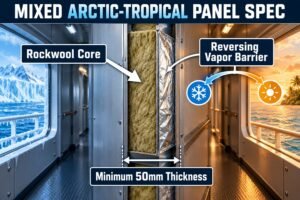
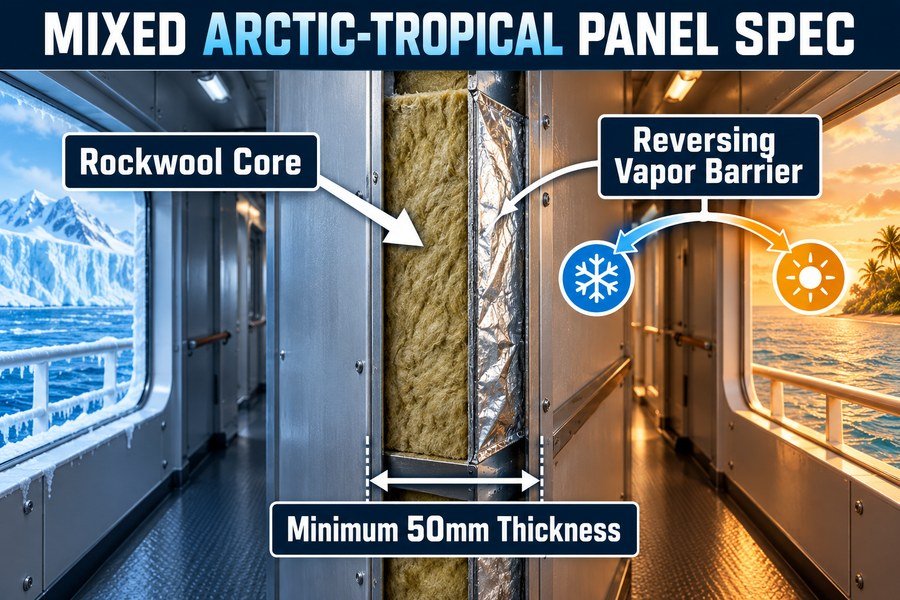
Specifying panels for mixed routes requires addressing three core elements: selecting structural core materials like high-density rockwool, integrating a vapor barrier system capable of handling reversing temperature gradients, and ensuring a minimum 50mm panel thickness to meet the rigorous thermal resistance values demanded by winterization classification rules.
When you buy outfitting products for high-end European and American shipyards, standard solutions are not enough. If you get the panel specifications wrong, the moisture damage will destroy the project and your profit margin. I see this happen too often. You must plan for both extremes.
What Core Materials Suit Marine Interior Panels Across Extreme Climates?
Choosing the wrong core material means your panels will sweat in the tropics and freeze in the Arctic. This leads to mold and ruined interiors. Let us look at the right choices.
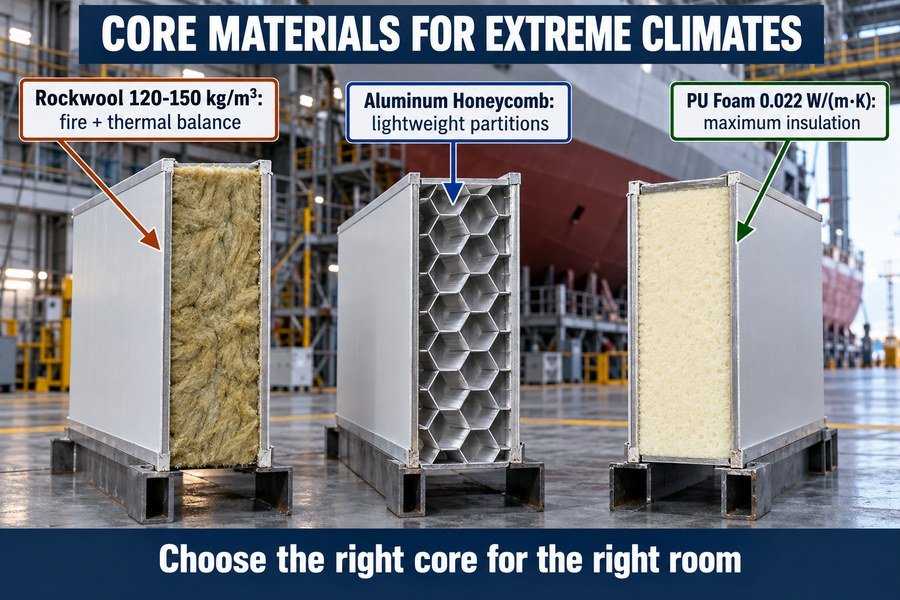
Three core materials suit extreme climates: high-density rockwool (120-150 kg/m³) for superior fire and thermal balance, aluminum honeycomb for weight reduction in non-fire-rated zones, and polyurethane (PU) foam for maximum thermal insulation where strict A-class fire ratings are relaxed.
High-Density Rockwool for Fire and Thermal Balance
I work with many buyers who purchase panels for large shipyards in the United States and Europe. They always ask me about the best core materials. I tell them they have three main choices, and we must look at all of them. First, we have high-density rockwool. According to the International Maritime Organization (IMO) SOLAS Chapter II-2, we must use non-combustible materials for main bulkheads. Rockwool with a density of 120 to 150 kg/m³ provides excellent fire resistance. It also offers a thermal conductivity of about 0.040 W/(m·K). This balance makes it the most common choice for mixed routes. It stops the cold from coming in and stops the heat from escaping. However, rockwool is quite heavy. If you use it everywhere, the ship becomes too heavy. This means the ship will burn more fuel.1
Aluminum Honeycomb and Polyurethane (PU) Foam for Specific Zones
Because rockwool is heavy, we must look at our second material: aluminum honeycomb. I advise my clients to use aluminum honeycomb panels for non-fire-rated cabin partitions. This material is very light. It helps the shipyard save weight. But its thermal insulation is not as good as rockwool. Therefore, you cannot use it on the outer boundaries of the ship. Finally, we have our third option: polyurethane (PU) foam. PU foam has an amazing thermal conductivity of 0.022 W/(m·K), based on ISO 7547 standards.2 This gives maximum thermal insulation against extreme cold. But PU foam is combustible. You can only use it in specific areas like provision stores or cold rooms where fire ratings are relaxed. You must understand all three materials to buy the right products. In my factory days, I saw many buyers fail because they only knew rockwool. Now at Magellan Marine, I make sure my clients choose the right core for the right room. By mixing these three options, you control costs and meet shipyard standards.
| Core Material Type | Density Range | Thermal Conductivity | Best Application Area |
|---|---|---|---|
| High-Density Rockwool | 120 - 150 kg/m³ | 0.040 W/(m·K) | A-Class fire-rated bulkheads |
| Aluminum Honeycomb | 30 - 50 kg/m³ | 1.200 W/(m·K) | Lightweight interior partitions |
| Polyurethane (PU) Foam | 40 - 45 kg/m³ | 0.022 W/(m·K) | Cold rooms and non-fire zones |
How to Balance Tropical and Polar Needs in One Exterior Bulkhead Panel?
An exterior bulkhead faces 35°C outside in the summer and -30°C in the winter. If it cannot handle both, water will pool inside the walls. Here is the exact solution.
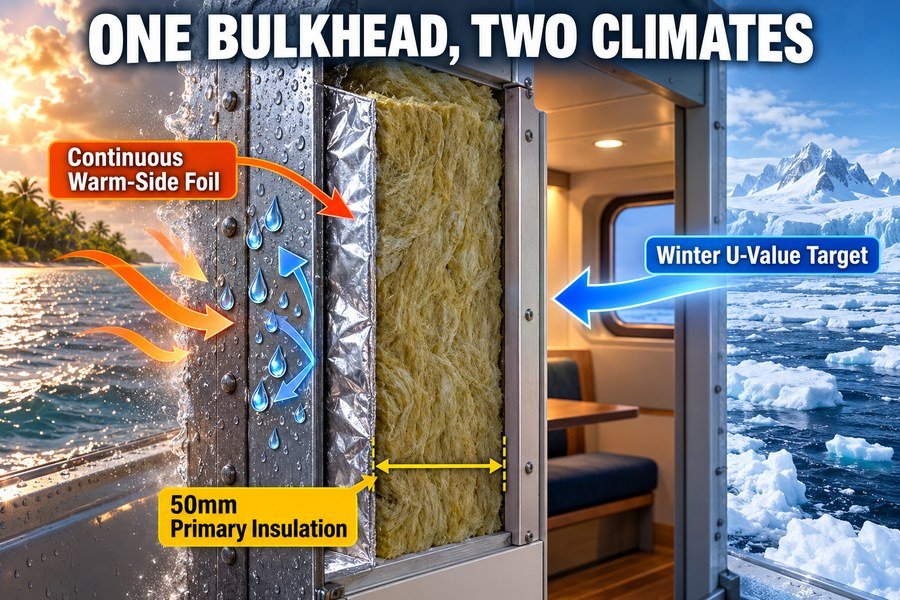
Balancing tropical and polar needs in one exterior bulkhead panel requires a dual-layer strategy: a minimum 50mm primary insulation layer that meets winter U-values, paired with a continuous warm-side vapor barrier to prevent summer humidity condensation.
Designing the 50mm Primary Insulation Layer for Winter
When you build a ship that sails across the globe, the exterior walls must do two very different jobs. This requires a strict dual-layer strategy. The first part of this strategy is the primary insulation layer. To stop the freezing Arctic air, the insulation must be thick enough. Based on DNV GL Winterization rules, we must achieve a specific U-value. For exterior boundaries, this U-value is often around 0.6 W/(m²K). To reach this number using standard rockwool, you need a minimum 50mm primary insulation layer3. I always tell my clients never to buy exterior panels thinner than 50mm. If you buy a 30mm panel to save money, it will fail the thermal test at the shipyard. The ship will lose heat too fast in the winter. The heating system will overwork, and the ship owner will complain. I have seen cheap panels from Asia fail this exact test in European shipyards. You must specify the 50mm thickness clearly on your purchase orders.
Installing a Continuous Warm-Side Vapor Barrier for Summer
The second part of the dual-layer strategy handles the tropical heat. In the tropics, the outside air is hot and full of moisture. The inside of the cabin is air-conditioned and cool. The moisture wants to push into the cool cabin. To stop this, you must install a continuous warm-side vapor barrier. This barrier is usually a layer of aluminum foil. You must place it on the side of the insulation that faces the hot outside air during the summer. If this barrier has holes, the moisture will get into the 50mm insulation. The rockwool will become wet. Wet rockwool loses its ability to block the cold.4 Then, when the ship sails back to the Arctic, that wet insulation will freeze solid. This destroys the panel from the inside. Therefore, you must buy panels where the factory guarantees a continuous, unbroken foil layer.
| Strategy Component | Purpose | Specific Requirement | Standard Reference |
|---|---|---|---|
| Primary Insulation | Retain heat in winter | Minimum 50mm thickness | DNV GL Winterization |
| Vapor Barrier | Stop moisture in summer | Continuous warm-side foil | ISO 7547 Guidelines |
Why Do Winter Climates Dictate Baseline U-Values for Global Marine Accommodation Panels?
You might think keeping a ship cool in the hot tropics is hard. But keeping it warm in the freezing Arctic is much harder. Here is the mathematical reason.
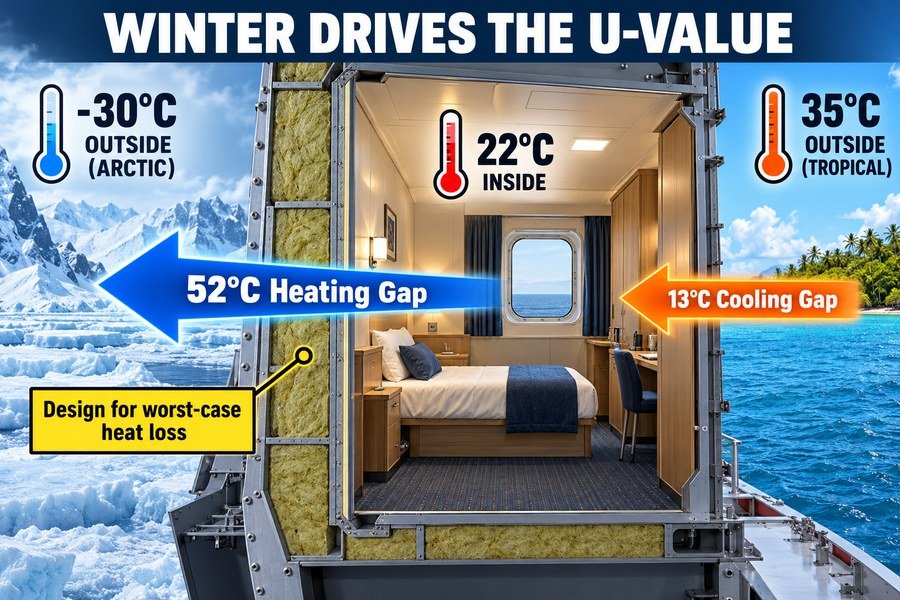
Winter climates dictate baseline U-values because heating a cabin to 22°C against a -30°C Arctic environment creates a massive 52°C temperature differential, requiring vastly more energy and insulation than cooling the same cabin against a 35°C tropical environment.
Calculating the 52°C Temperature Differential in Arctic Heating
I often explain this concept to buyers who do not have a strong engineering background. They ask me why we care so much about winter rules when the ship spends half its life in the tropics. The answer comes down to basic math and temperature differentials. Let us look at the heating requirement first. According to ASHRAE Marine guidelines and standard shipyard specifications, the inside of a passenger cabin must be kept at a comfortable 22°C. Now, imagine the ship is sailing in the Arctic. The outside temperature drops to -30°C. To find the difference, we do simple math. From -30°C to 22°C is a massive 52°C temperature differential. The marine accommodation panel must stop the heat from jumping across this huge gap. If the panel has a poor U-value, the heat escapes instantly. The ship's boilers and electrical heaters must run at maximum power just to keep the crew alive. This burns a massive amount of expensive fuel.
Comparing Energy Needs Against Tropical Cooling
Now let us look at the cooling requirement. The ship sails to the tropics. The outside temperature rises to 35°C. The cabin still needs to be at 22°C. The temperature differential here is only 13°C. Stopping heat from crossing a 13°C gap is very easy. It takes vastly more energy to fight a 52°C difference than a 13°C difference. This is exactly why winter climates dictate the baseline U-values for your panels. Maximum heat loss prevention is the primary design driver. Shipyards in the United States and Europe know this math very well. They will test your panels based on the worst-case winter scenario. If you buy panels that are only "good enough" for the tropics, you will fail the winter inspections. As a buyer, you must always look at the U-value test reports from the factory. Ensure the reports prove the panel can handle the 52°C differential.
| Climate Condition | Target Cabin Temp | Outside Ambient Temp | Temperature Differential |
|---|---|---|---|
| Arctic Winter | 22°C | -30°C | 52°C |
| Tropical Summer | 22°C | 35°C | 13°C |
How Do Dual-Climate Routes Complicate Marine Ceiling Panel Vapor Barriers?
The golden rule of insulation is simple: put the vapor barrier on the warm side. But what happens when the ship moves and the warm side flips? This causes huge problems.
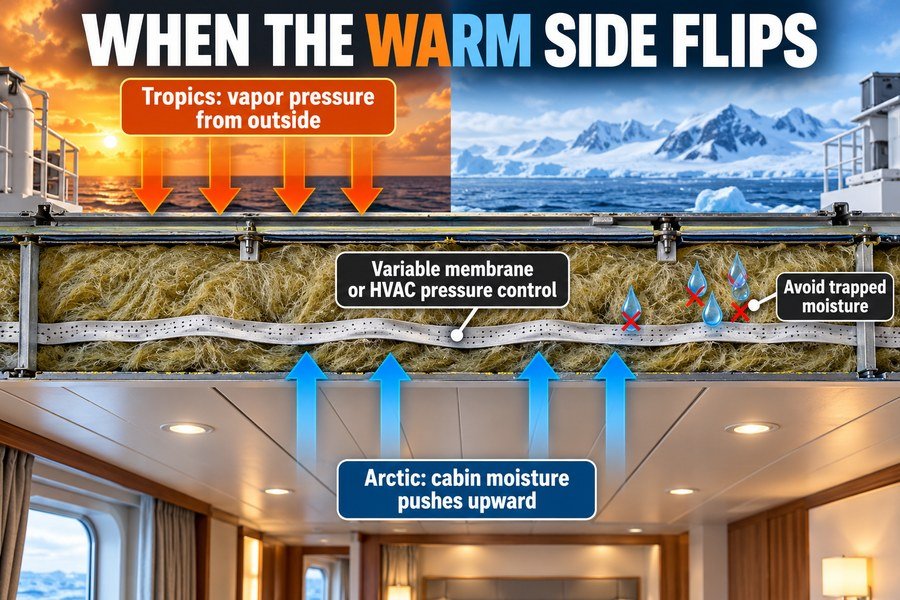
Dual-climate routes complicate marine ceiling panel vapor barriers because the high-vapor-pressure warm side shifts from the outside environment in the tropics to the inside cabin in the Arctic, requiring specialized variable-permeability membranes or double-barrier HVAC pressure management systems.
Managing the Shifting High-Vapor-Pressure Warm Side
When you buy ceiling panels for a ship that stays in one place, your job is easy. But dual-climate routes make things very complicated. The main problem is the shifting high-vapor-pressure warm side. Let me explain this simply. Moisture in the air always wants to move from the hot side to the cold side.5 In the tropics, the sun beats down on the steel deck above the ceiling. The outside environment is the warm side. The moisture tries to push down into the cool cabin. So, you put a vapor barrier on top of the ceiling panel. But three weeks later, the ship is in the Arctic. Now, the outside steel deck is freezing cold. The inside cabin is heated. The inside cabin becomes the warm side. Now, the moisture from the crew's breath and showers tries to push up into the ceiling. The warm side has completely shifted. If you only have one standard vapor barrier, moisture will get trapped on the wrong side and rot the ceiling.6
Utilizing Variable-Permeability Membranes and Double-Barrier HVAC Systems
To solve this shifting problem, you must use one of two specific solutions. You cannot ignore this if you want to sell to top shipyards. The first solution is using specialized variable-permeability membranes. These are smart materials. When the humidity gets too high on the wrong side, the pores in the membrane open up and let the moisture escape. This stops water from pooling inside the ceiling. The second solution is using double-barrier HVAC pressure management systems. In this method, you use standard vapor barriers, but you control the air pressure. According to ISO 7547, you keep the inside cabin at a slight positive pressure of about 50 Pa. This positive pressure physically pushes the moist air away from the hidden spaces above the ceiling. When I help clients source ceiling panels in Asia, I check if the supplier understands these two concepts. If they do not, I find another factory.
| Vapor Barrier Solution | How It Works | Best Application |
|---|---|---|
| Variable-Permeability Membrane | Changes pore size based on humidity to let trapped water escape | High-end passenger cabins |
| Double-Barrier HVAC Pressure | Uses 50 Pa positive air pressure to push moisture away | Commercial crew quarters |
Which Marine Interior Panels Pass Both Polar and Tropical Thermal Tests?
Shipyards require strict laboratory test reports. A panel that only passes tropical tests will be rejected at the dock. You need panels that survive both extreme environments.
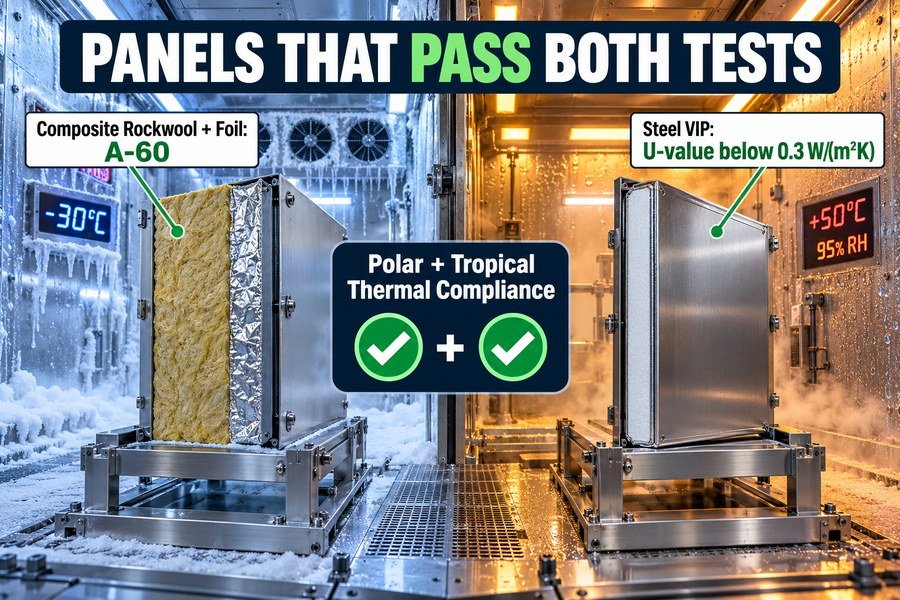
Two marine interior panels consistently pass both polar and tropical thermal tests: composite rockwool panels with built-in aluminum foil vapor barriers achieving A-60 fire ratings, and vacuum insulated panels (VIPs) encased in steel that maintain U-values below 0.3 W/(m²K).
Specifying Composite Rockwool Panels with Built-In Aluminum Foil
If you want to win contracts with strict European and American shipyards, you must provide test reports. You cannot just promise the panels are good. I always guide my clients to buy two specific types of panels that always pass both polar and tropical thermal tests. The first type is composite rockwool panels with built-in aluminum foil vapor barriers. These panels are the backbone of marine outfitting. The factory glues a thick layer of rockwool between two galvanized steel sheets. Crucially, they insert a continuous aluminum foil layer right behind the steel sheet. This combination passes the IMO FTP Code fire test to achieve A-60 fire ratings7. At the same time, the foil handles the tropical humidity, and the 50mm rockwool handles the Arctic cold. This panel is very cost-effective. You can buy them from good factories in China and Vietnam for a reasonable price. This helps you control your project budget while still delivering high quality to the shipyard.
Adopting Vacuum Insulated Panels (VIPs) for U-Values Below 0.3 W/(m²K)
The second type of panel is much more advanced. These are vacuum insulated panels (VIPs) encased in steel. VIPs are incredible. The factory takes a core material and removes all the air from it, creating a vacuum. Because heat needs air to travel, a vacuum stops heat transfer almost completely. These VIPs maintain U-values below 0.3 W/(m²K)8 in all conditions. This is more than twice as good as standard rockwool. Because they insulate so well, they can be much thinner. This saves valuable space inside the ship. However, VIPs are very expensive. You cannot cut them during installation. If you drill a hole in a VIP, you destroy the vacuum, and it becomes useless.9 I tell my buyers to use VIPs only in very critical areas where space is tight, and to use composite rockwool panels everywhere else. Understanding both options makes you a professional and reliable supplier to the shipyard.
| Panel Type | Key Feature | Fire Rating | Typical U-Value |
|---|---|---|---|
| Composite Rockwool with Foil | Built-in vapor barrier | A-60 | 0.6 W/(m²K) |
| Vacuum Insulated Panel (VIP) | Core vacuum stops heat transfer | B-15 to A-60 | < 0.3 W/(m²K) |
Conclusion
Specifying marine accommodation panels for mixed routes requires understanding core materials, moisture dynamics, and strict classification rules. By choosing the right insulation and vapor barriers, you guarantee compliance and shipyard success.
-
"Prediction of Resistance and Propulsion Power of Ships", https://www.academia.edu/32052238/Prediction_of_Resistance_and_Propulsion_Power_of_Ships. Naval-architecture and ship-energy-efficiency studies show that increased displacement or carried weight generally increases resistance and propulsion power demand, which in turn can raise fuel consumption for a given speed and route. Evidence role: mechanism; source type: paper. Supports: Using heavier materials throughout a ship can increase vessel weight and contribute to higher fuel consumption. Scope note: The size of the fuel penalty depends on hull form, operating speed, loading condition, weather, and machinery efficiency. ↩
-
"Thermal conductivity of selected foams and systems from ...", https://www.govinfo.gov/content/pkg/GOVPUB-C13-091b5604d9bfc93a42b7ea193ae65ea3/pdf/GOVPUB-C13-091b5604d9bfc93a42b7ea193ae65ea3.pdf. Standards and technical references for shipboard heat-transfer calculations list low thermal-conductivity values for polyurethane insulation, supporting the claim that PU foam offers stronger thermal insulation than many mineral-fiber cores. Evidence role: statistic; source type: institution. Supports: Polyurethane foam can have thermal conductivity near 0.022 W/(m·K) and is therefore used where high insulation performance is needed. Scope note: A value of 0.022 W/(m·K) is material- and formulation-specific; ISO 7547 may provide calculation conventions or reference values rather than certifying every PU foam product at that exact conductivity. ↩
-
"Determination of Thermal Properties of Mineral Wool ... - PMC", https://pmc.ncbi.nlm.nih.gov/articles/PMC10488771/. Standard heat-transfer calculations relate U-value to total thermal resistance, and mineral-wool thermal conductivities commonly reported near 0.035-0.040 W/(m·K) make a 50 mm layer consistent with a U-value on the order of 0.6-0.8 W/(m²·K), before accounting for facings, framing, and thermal bridges. Evidence role: mechanism; source type: education. Supports: A 50 mm layer of standard rockwool can be required to approach the cited U-value target. Scope note: This supports the engineering rationale only approximately; actual panel performance depends on the tested assembly, density, facings, joints, and metal framing. ↩
-
"Determination of Thermal Properties of Mineral Wool ... - PMC", https://pmc.ncbi.nlm.nih.gov/articles/PMC10488771/. Studies of mineral-wool and other porous insulation materials show that moisture increases effective thermal conductivity and reduces thermal resistance, supporting the claim that wet rockwool performs worse as insulation. Evidence role: mechanism; source type: paper. Supports: Wet rockwool loses insulating performance compared with dry rockwool. Scope note: The degree of performance loss depends on moisture content, density, temperature, and the specific mineral-wool product tested. ↩
-
"Water Vapor Generation in Residential Buildings", https://research.fs.usda.gov/download/treesearch/65595.pdf. Building-physics references explain that water vapor diffusion is driven by vapor-pressure gradients, which often but not always correspond to movement from warmer, more humid air toward colder surfaces or cavities. Evidence role: mechanism; source type: education. Supports: Moisture migration across a ceiling assembly is driven by vapor-pressure differences between warm and cold sides. Scope note: This supports the physical mechanism but should qualify the article's wording, because vapor movement follows vapor-pressure differences rather than temperature alone. ↩
-
"Moisture Durability with Vapor-Permeable Insulating ...", http://apps1.eere.energy.gov/buildings/publications/pdfs/building_america/moisture_durability_insulating_sheathing.pdf. Guidance on vapor retarders in mixed or reversing climates notes that impermeable layers can restrict drying and increase moisture accumulation risk in building assemblies when vapor-drive direction changes. Evidence role: expert_consensus; source type: government. Supports: A single fixed vapor barrier can trap moisture in assemblies exposed to changing vapor-drive directions, increasing deterioration risk. Scope note: Most available guidance concerns buildings rather than ship ceilings, so it supports the hygrothermal principle rather than proving this exact marine failure mode. ↩
-
"What Do A-Class, B-Class, and C-Class Divisions Mean in ...", https://magellanmarinetech.com/what-a-class-b-class-c-class-divisions-mean-in-marine-wall-ceiling-panels/. The IMO FTP Code and SOLAS fire-test framework define A-class divisions, including A-60, by non-combustibility and insulation-temperature criteria during a standard fire exposure; this supports the regulatory meaning of an A-60 rating. Evidence role: definition; source type: institution. Supports: Composite rockwool panels with foil can be specified to meet IMO FTP Code testing requirements for A-60 fire-rated marine divisions. Scope note: This source would define the test and rating criteria but would not prove that any specific composite rockwool panel has passed the test. ↩
-
"Vacuum insulation panel core materials and modelling the ...", https://dr.lib.iastate.edu/bitstreams/f77c7126-f49f-4b7f-b58d-7f1c941b1f20/download. Research on vacuum insulated panels reports very low effective thermal conductivity compared with conventional insulation, making low assembly U-values such as below 0.3 W/(m²K) technically achievable when panel thickness, edge effects, and installation details are properly designed. Evidence role: statistic; source type: paper. Supports: Vacuum insulated panels can achieve U-values below 0.3 W/(m²K) in suitably designed assemblies. Scope note: The source would support feasibility rather than the article's broader wording that such U-values occur in all conditions or for every steel-encased VIP assembly. ↩
-
"Impacts investigation of gas barrier on effective thermal ... - PMC", https://pmc.ncbi.nlm.nih.gov/articles/PMC10654575/. Studies of VIP durability note that puncturing the barrier envelope causes loss of vacuum and a substantial increase in thermal conductivity, supporting the warning that VIPs should not be cut or drilled after manufacture. Evidence role: mechanism; source type: paper. Supports: Puncturing or drilling a vacuum insulated panel damages the vacuum envelope and sharply reduces its insulation performance. Scope note: The term "useless" is a practical simplification; damaged VIPs may still provide some insulation, but much less than an intact evacuated panel. ↩