Buying wet units is hard. You want luxury for cruise ships but durability for cargo vessels. I will show you how customization solves this problem easily.
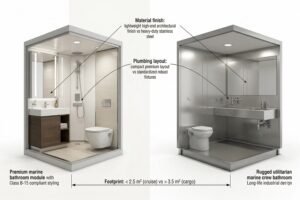
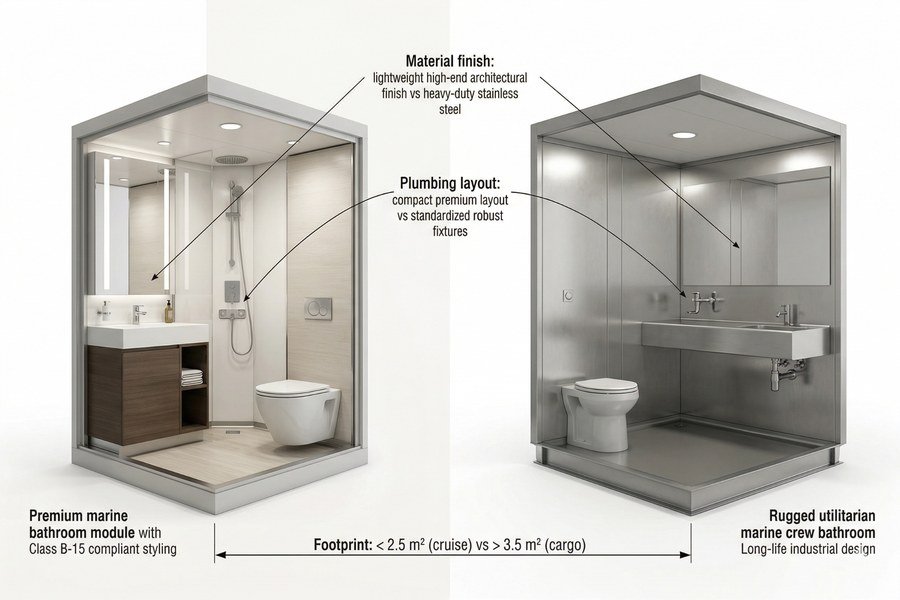
Prefabricated wet units are customized through three primary parameters: footprint size, material finish, and plumbing layout. Cruise ships require lightweight, high-end architectural finishes (Class B-15) under 2.5 square meters, while cargo vessels demand heavy-duty stainless steel surfaces and standardized, robust fixtures exceeding 3.5 square meters for crew longevity.
I have seen many buyers struggle to choose the right wet units. You might waste money if you pick the wrong design. Let us explore the specific features you need to know.
What accessibility features can be incorporated into marine wet units?
Disabled passengers face risks in standard marine bathrooms. You must meet maritime accessibility laws. I will explain the exact ADA and IMO compliant features you must include.
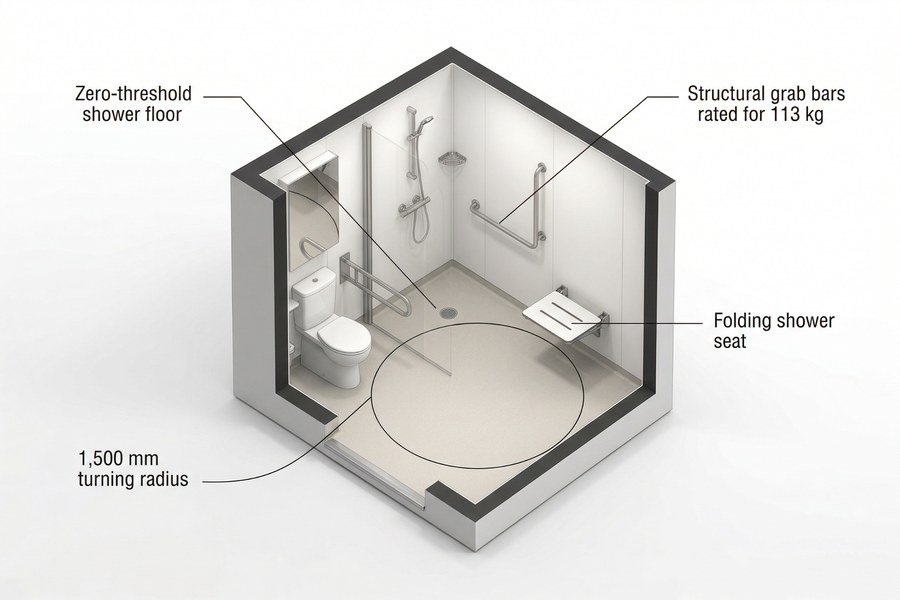
Marine wet units incorporate four essential accessibility features: zero-threshold shower floors, structural grab bars rated for 113 kg, compliant turning radiuses of 1,500 mm, and folding shower seats. These ensure strict compliance with the Americans with Disabilities Act (ADA) and IMO passenger ship regulations.
I often see ship interior projects fail final safety inspections. You must include all four accessibility features to pass these tests. I will explain each feature in detail.
Structural Requirements for Grab Bars and Seating
You must install strong structural grab bars. These bars help disabled passengers move safely. According to safety codes, these bars must support at least 113 kg of downward force. Standard domestic grab bars only support about 90 kg. They will break on a moving ship. You must instruct the factory to bolt these bars directly into the steel frame of the wet unit. You must never attach them only to the decorative wall panel.
Next, you must include folding shower seats. Disabled passengers use these seats when taking a shower. The shower seat must also support 113 kg. It must fold up to the wall to save space when other people use the bathroom. We usually specify 316L stainless steel hinges for these seats. This prevents rust.
Spatial Dimensions for Wheelchair Turning Radiuses
Wheelchair users need plenty of space to turn around inside the bathroom. You must design a clear turning radius of 1,500 mm. This dimension meets the Americans with Disabilities Act (ADA) requirements. It also satisfies the International Maritime Organization (IMO) passenger ship rules. Normal cargo ship bathrooms only have about 800 mm of free space.
Finally, you must install zero-threshold shower floors. A threshold is a small step that keeps water inside the shower. Wheelchairs cannot roll over a high step easily. A zero-threshold floor is completely flat at the entry. The factory must slope the floor pan gently toward the drain. The slope is usually 2 degrees. This slope guides the water away without creating a barrier. I once saw a shipyard lose $50,000 because they had to rebuild floors that had high thresholds.
| Accessibility Feature | Standard Cabin Wet Unit | Accessible Marine Wet Unit |
|---|---|---|
| Clear Turning Radius | 800 mm | 1,500 mm minimum |
| Shower Entry | 50 mm step threshold | Zero-threshold (flat entry) |
| Grab Bar Capacity | None required | 113 kg minimum load |
| Shower Seating | Standing only | Wall-mounted folding seat |
How are prefabricated wet units adapted for offshore platform accommodations?
Offshore platforms experience severe vibration and salt corrosion. Standard ship wet units fail quickly here. I will show you the structural adaptations needed for harsh offshore environments.
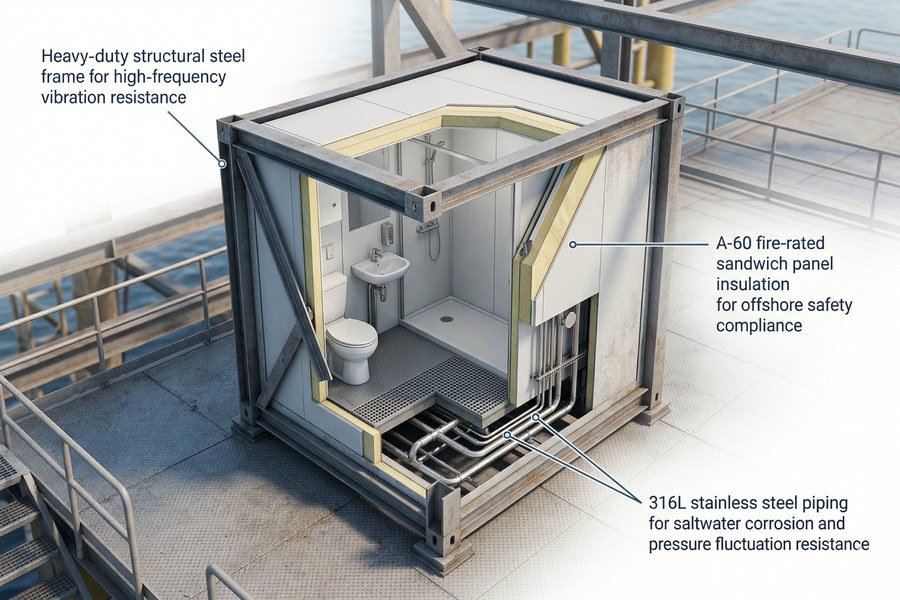
Offshore wet units require three critical adaptations: heavy-duty structural steel frames to withstand high-frequency vibrations, A-60 fire-rated sandwich panel insulation to meet strict offshore safety codes, and 316L stainless steel internal piping to resist aggressive saltwater corrosion and constant pressure fluctuations.
Offshore oil rigs and wind platforms are very tough places. I worked on a North Sea platform project five years ago. We learned that standard wet units do not survive. You must apply these three critical adaptations.
Managing Offshore Vibration with Heavy-Duty Structural Frames
Offshore platforms vibrate constantly because of heavy drilling machinery and large generators. These high-frequency vibrations destroy normal bathroom cabins. Therefore, factories must build the wet unit using heavy-duty structural steel frames. Standard cruise ship units use light-gauge steel that is 1.2 mm thick. Offshore units must use steel profiles that are at least 3.0 mm thick. The base frame must absorb the shaking. Factories also install rubber vibration dampeners under the floor pan. This stops the bathroom walls from cracking after a few months.
Upgrading to A-60 Fire Ratings and 316L Stainless Steel Piping
Fire is the biggest danger on an offshore platform. Standard passenger ships use B-15 fire-rated panels. These panels stop fire for 15 minutes. Offshore platforms require A-60 fire-rated sandwich panels. An A-60 panel stops fire and extreme heat for 60 full minutes. The factory fills these panels with high-density rock wool. This rock wool usually weighs 120 kg per cubic meter.
The last adaptation is the internal plumbing. Saltwater in the air causes fast corrosion. You cannot use standard 304 stainless steel or cheap copper pipes. You must upgrade all water supply lines to 316L stainless steel. The "L" stands for low carbon. This metal resists saltwater corrosion completely. It also handles the high water pressure on deep-sea rigs.
| Component Adaptation | Standard Ship Wet Unit | Offshore Platform Wet Unit |
|---|---|---|
| Structural Steel Thickness | 1.2 mm light gauge | 3.0 mm heavy-duty profile |
| Fire Rating Certification | B-15 (15 minutes) | A-60 (60 minutes) |
| Insulation Density | 80 kg/m³ rock wool | 120 kg/m³ rock wool |
| Internal Piping Material | Copper or 304 Stainless | 316L Stainless Steel |
What factors influence the cost of marine prefabricated wet units?
Budget overruns ruin interior outfitting projects. You need to control costs when sourcing from Asian factories. I will break down the exact price factors for these modular cabins.
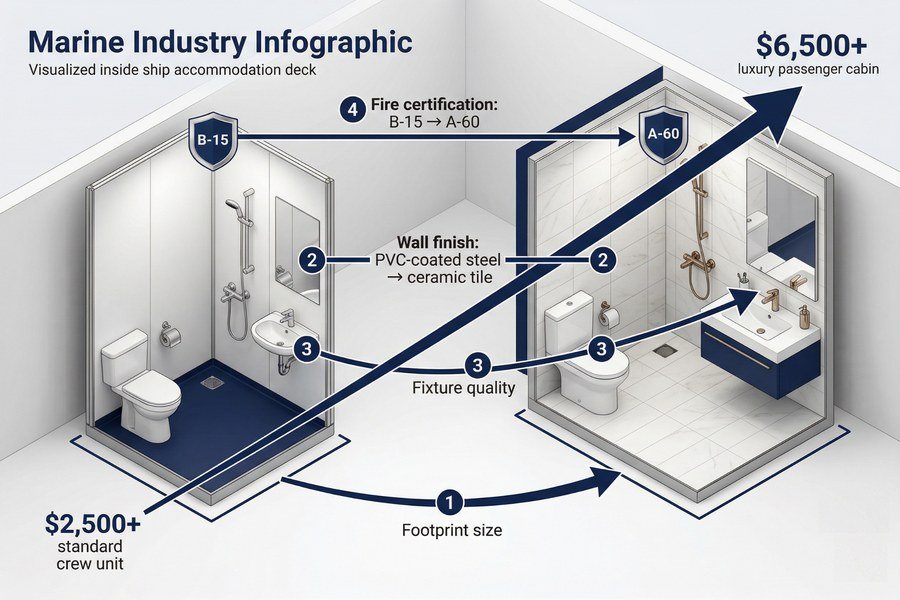
Four main factors influence marine wet unit costs: the physical footprint size, internal wall panel finishes (PVC-coated steel vs. ceramic tile), plumbing fixture quality, and required fire certification classes (B-15 vs. A-60). Prices typically range from $2,500 for standard crew units to over $6,500 for luxury passenger cabins.
Cost is always the most important topic for procurement officers. You buy products from developing countries to save money. But you must know what drives the price. I will explain the four cost factors clearly.
Impact of Physical Size and Panel Materials on Pricing
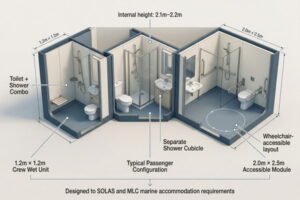
The physical footprint size is the first cost factor. A small crew bathroom is usually 1.2 meters by 1.2 meters. This requires less steel and less labor. A large passenger bathroom might be 2.0 meters by 2.5 meters. The larger size increases shipping costs because fewer units fit inside a shipping container.
The internal wall panel finish is the second cost factor. Standard units use PVC-coated galvanized steel panels. These are cheap and easy to clean. Luxury cruise ships use ceramic tiles or artificial marble. Factories must glue these tiles by hand. This manual labor increases the price fast. A basic PVC-coated unit costs around $2,500. A unit with custom ceramic tiles will cost over $6,500.
Cost Variations Driven by Plumbing Fixtures and Fire Certifications
Plumbing fixture quality changes the price greatly. Standard marine toilets and manual shower mixers are cheap. But if a shipyard wants vacuum toilets and electronic touchless faucets, the cost jumps. A single marine vacuum toilet can add $800 to the total unit price.
The final cost factor is the fire certification class. You need certificates from testing agencies like DNV or Lloyd's Register. A standard B-15 rated unit is the baseline price. If the ship requires an A-60 rated unit, the factory must use thicker steel and denser insulation. The A-60 testing process is also very expensive. This certification requirement usually adds a 30% price premium to the wet unit.
| Cost Factor Variable | Budget Option (Crew Cabin) | Premium Option (Cruise Cabin) | Estimated Cost Difference |
|---|---|---|---|
| Wall Finish Material | PVC-coated steel | Hand-laid ceramic tile | + $1,500 |
| Toilet System | Gravity flush toilet | Vacuum flush system | + $800 |
| Fire Rating Class | B-15 standard rating | A-60 heavy duty rating | + 30% overall |
| Floor Pan Type | Painted steel pan | Heated tile floor pan | + $600 |
What maintenance procedures apply to prefabricated wet units onboard ships?
Broken ship bathrooms cause crew dissatisfaction and passenger complaints. Poor maintenance leads to expensive plumbing failures. I will outline the essential maintenance steps to prevent this.
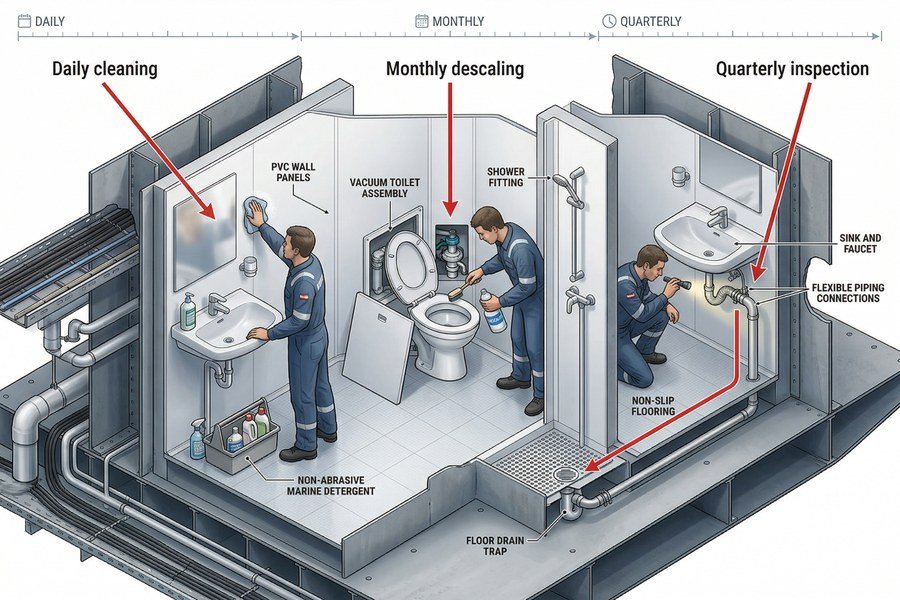
Shipboard wet unit maintenance involves three mandatory procedures: daily cleaning using non-abrasive marine-grade detergents to protect PVC surfaces, monthly descaling of vacuum toilet valves to prevent clogs, and quarterly inspections of flexible piping connections and floor drain traps to ensure water tightness and prevent greywater leaks.
Ships move constantly. This movement stresses every part of the cabin. Good maintenance keeps the wet units working perfectly. I will explain the three mandatory procedures your crew must follow.
Daily Cleaning and Monthly Vacuum Toilet Descaling
The crew must perform daily cleaning correctly. The wall panels in most wet units use a thin PVC film. You must use non-abrasive marine-grade detergents. The pH level of the cleaner must be neutral (around pH 7). If the crew uses harsh bleach or hard brushes, the PVC film will peel off in two years. This makes the bathroom look terrible.
The next procedure is monthly descaling of the vacuum toilet1. Vacuum toilets are very common on ships. They use less water. However, urine scale builds up inside the valves quickly. The crew must pour a special acid descaler into the toilet once a month. This chemical dissolves the calcium blocks. If you skip this step, the vacuum pressure will drop below 1.2 bar. The toilet will stop flushing, and the pipe will clog entirely.
Quarterly Inspections of Flexible Piping and Floor Drains
The third procedure happens every three months. The ship engineer must do a quarterly inspection of the hidden parts. Prefabricated wet units connect to the ship's main pipes using flexible hoses. These hoses vibrate. The engineer must open the service panel and check these connections. They must tighten any loose metal clamps. We recommend replacing these flexible hoses every 5 years.
The engineer must also check the floor drain traps. A water trap stops bad smells from entering the cabin. The crew must pour clean water into the drain to keep the trap full. They must also remove hair and dirt from the drain cover to prevent greywater from flooding the bathroom floor.
| Maintenance Task | Frequency | Action Required | Purpose |
|---|---|---|---|
| Surface Cleaning | Daily | Wipe with pH neutral detergent | Protect PVC wall finishes |
| Toilet Descaling | Monthly | Apply marine acid descaler | Maintain 1.2 bar vacuum pressure |
| Hose Inspection | Quarterly | Check and tighten pipe clamps | Prevent hidden water leaks |
| Drain Clearing | Quarterly | Remove debris from floor trap | Stop greywater flooding |
How are damaged prefabricated wet units repaired at sea?
A leaking wet unit at sea is a crisis. You cannot wait for drydock repairs. I will show you how to execute emergency fixes during voyages.
Repairing damaged wet units at sea requires three immediate actions: isolating the specific vacuum or water supply line, using marine-approved epoxy resins to seal wall panel punctures or floor pan cracks temporarily, and replacing modular internal components like shower mixers or toilet mechanisms from the onboard spare parts inventory.
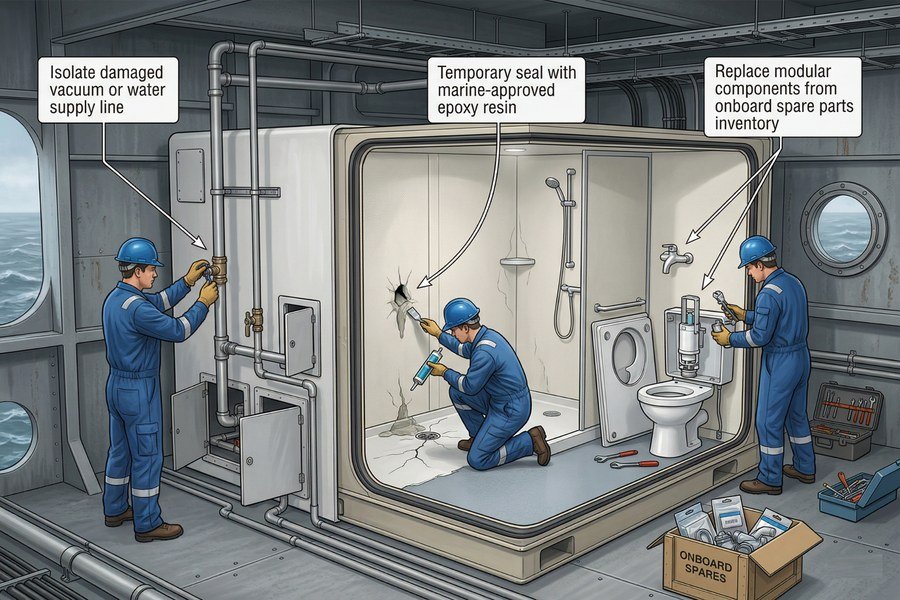
You cannot call a plumber when the ship is in the middle of the ocean. The ship engineer must fix the problem fast. I have helped ships manage these emergencies many times. You must follow these three immediate actions.
Isolating Supply Lines and Applying Marine Epoxy Resins
The first action is isolation. If a pipe bursts in the bathroom, water will flood the cabin quickly. The wet unit has a central service shaft. The engineer must open this shaft and close the isolation valves. This stops the water supply to that specific cabin only. The rest of the ship can still use water.
The second action is sealing physical damage. Sometimes a heavy object falls and cracks the shower floor pan. Sometimes a passenger punches a hole in the wall panel. The engineer must use marine-approved epoxy resins to fix this. Standard glue does not work. The engineer cleans the crack and applies the epoxy. The epoxy needs 24 hours to cure fully. This temporary seal stops water from leaking into the ship's steel hull. It prevents rust until the ship reaches a drydock.
Replacing Modular Components from Onboard Inventories
The third action is replacing broken parts. Prefabricated wet units use modular designs. This means you can swap parts easily. If a shower mixer breaks, you do not need to cut the wall. You just unscrew the old mixer and attach a new one.
However, you must have the spare parts on the ship. We tell every shipyard to buy a spare parts package. A good rule is to keep 5% extra parts. If you have 100 wet units, you must buy 5 extra toilets, 5 extra shower mixers, and 5 extra drain traps. The crew stores these in the ship's inventory room. When a part fails at sea, the engineer simply takes a spare part and replaces it in 30 minutes.
| Repair Action | Tool or Material Needed | Estimated Repair Time |
|---|---|---|
| Water Line Isolation | Manual valve wrench | 5 minutes |
| Floor Pan Crack Seal | Marine-grade epoxy resin | 24 hours (curing time) |
| Shower Mixer Swap | Standard hand tools | 30 minutes |
| Vacuum Valve Replace | Onboard spare parts kit | 45 minutes |
What is the expected service life of marine prefabricated wet units?
Frequent bathroom replacements destroy your operational budget. You need units that last for decades. I will reveal the true lifespan of these outfitting products.
The expected service life of a marine prefabricated wet unit spans three distinct timelines: decorative finishes last 7 to 10 years, internal plumbing mechanisms require replacement every 12 to 15 years, and the primary steel structural shell endures 20 to 25 years, matching the standard commercial lifespan of the vessel.
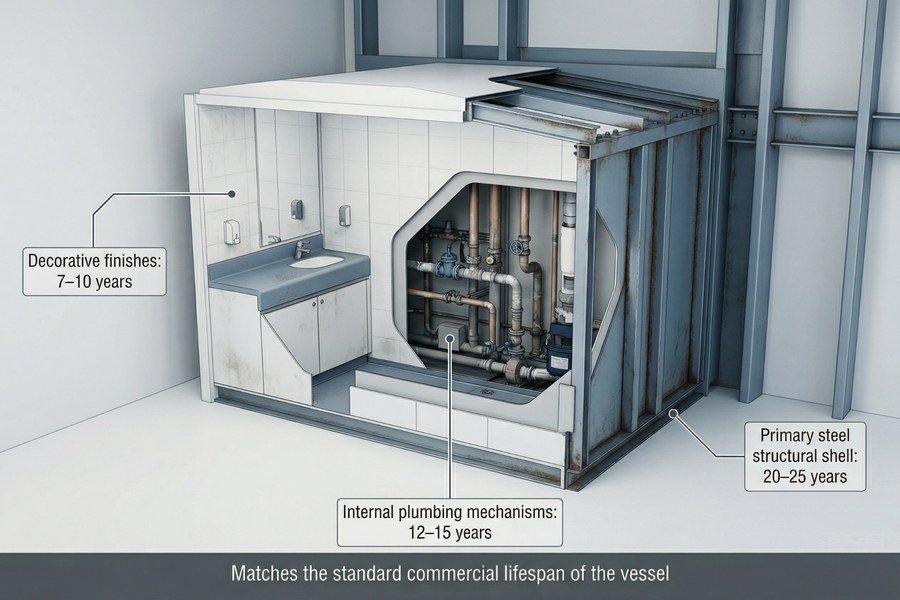
Shipowners want to know how long a product will last. They do not want to buy garbage. I always tell my clients the truth about lifespan. A wet unit does not fail all at once. The service life breaks down into three different timelines.
Lifespan of Decorative Finishes and Internal Plumbing Mechanisms
The decorative finishes fail first. Passengers touch the wall panels, the mirrors, and the door handles every day. The PVC film on the walls will usually look old after 7 to 10 years. The mirrors might show black spots around the edges because of the moisture. Shipowners usually remodel the cabin interiors at the 10-year mark. They apply new films over the old walls to make the bathroom look new again.
The internal plumbing mechanisms last a bit longer. Shower mixing valves, water pipes, and floor drains endure constant water flow. Based on data from top manufacturers, these mechanical parts usually last between 12 and 15 years. After 15 years, the rubber seals inside the pipes dry out. The metal springs inside the toilet valves break. You must plan to replace these mechanisms during the ship's third special survey in the drydock.
Longevity of the Primary Steel Structural Shell
The primary steel structural shell is the strongest part. Factories build the floor pan and the wall frames using thick galvanized steel. They weld the corners tightly. If the ship engineer maintains the unit and stops water leaks, this steel shell will not rust. This heavy structure easily endures 20 to 25 years.
This 25-year lifespan is very important. Classification societies like DNV expect a commercial ship to operate for 20 to 25 years. Therefore, the structural shell of the wet unit matches the total lifespan of the vessel itself. You will never need to replace the steel box unless there is a severe fire or a major hull collision.
| Wet Unit Component | Expected Service Life | Primary Cause of End of Life |
|---|---|---|
| PVC Wall Finishes | 7 to 10 years | Cosmetic wear and peeling |
| Faucets and Mixers | 12 to 15 years | Internal rubber seal failure |
| Flexible Water Hoses | 5 to 7 years | Material hardening and cracking |
| Steel Structural Shell | 20 to 25 years | Ship decommissioning / Scrap |
Conclusion
Marine wet units require careful customization, strict supplier evaluation, and diligent maintenance. Choosing the right features ensures compliance, extends service life, and keeps your outfitting projects highly profitable.
Keep Building Your Knowledge on Marine Wet Units
Now that you understand how wet units can be tailored to your specific vessel, make sure your next project is perfectly planned and fully compliant. Check out my other comprehensive guides:
Start with the fundamentals: What Are Prefabricated Wet Units?
Plan your cabin layout: What Are Standard Dimensions And Configurations For Ship Wet Units?
Ensure maritime compliance: What IMO Regulations Apply to Prefabricated Wet Units on Commercial Vessels?
-
Learn operation and maintenance steps to keep vacuum pressure above 1.2 bar and prevent flushing failures. ↩