Struggling to ensure your ship interiors pass strict inspections? Failing IMO compliance means costly delays. Let us break down the exact maritime rules your prefabricated wet units must meet today.
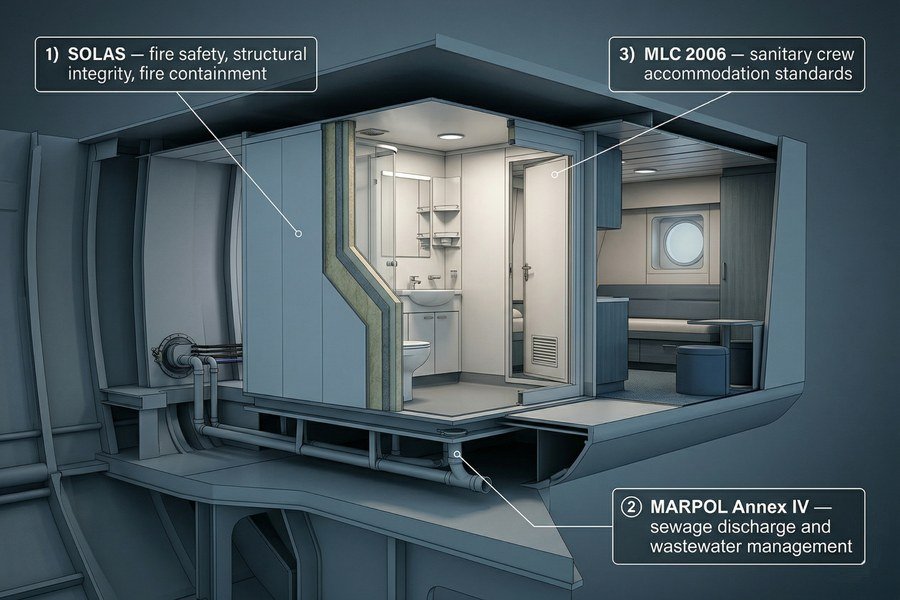
The International Maritime Organization (IMO) regulates prefabricated wet units through SOLAS for fire safety, MARPOL Annex IV for sewage discharge, and the MLC 2006 for crew accommodation standards. These comprehensive frameworks ensure structural integrity, prevent fire spread, and guarantee sanitary living conditions for all personnel on board commercial vessels.
Navigating these rules can be hard. But knowing them saves you money and time. Let us look closely at how each rule affects your purchase.
What Classification Society Requirements Govern Marine Wet Unit Installations?
Are you worried your wet units might fail class approval? A rejected unit stops the whole shipbuilding process. Here are the exact classification society standards you need to follow.
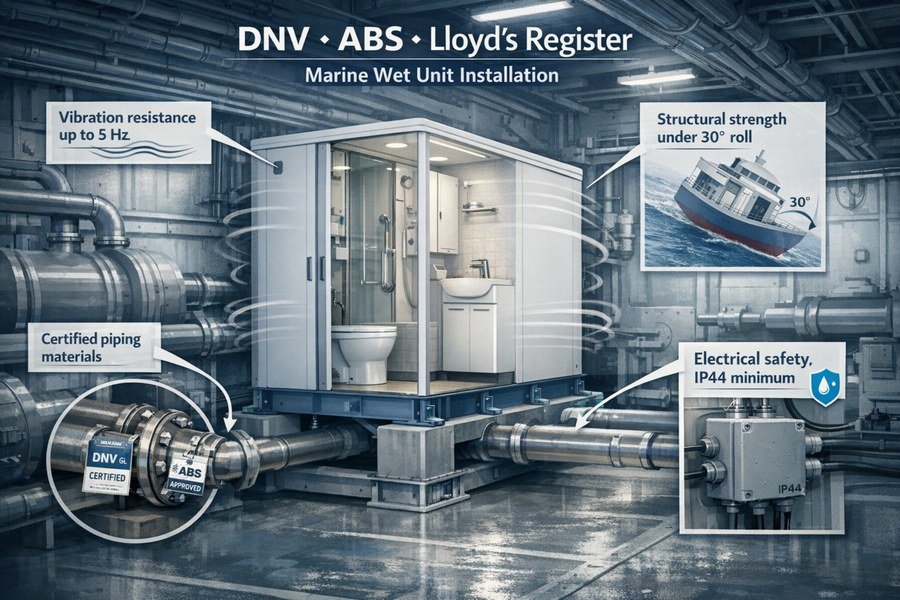
Classification societies like DNV, ABS, and Lloyd's Register require wet units to meet specific standards for vibration resistance up to 5 Hz, structural strength under 30-degree roll conditions, piping material certification, and electrical safety with an IP44 minimum rating to ensure safe integration into the vessel.
Vibration Resistance and Structural Strength Standards for Wet Units
I remember my early days at Magellan Marine. A client bought cheap wet units from an unknown factory. The ship went to sea, and the unit walls cracked. This happened because they ignored structural strength rules. Classification societies like DNV and ABS have very strict rules. DNV Part 3 Chapter 1 states that the ship structure will move. Your wet units must handle a 30-degree dynamic roll. The sea is rough. The ship rolls heavily. The wet unit must not break. Also, the ship engine causes heavy shaking. Lloyd's Register requires these units to withstand vibration resistance up to 5 Hz. If the frame is weak, the tiles will fall off. The base tray will crack. You must ask your supplier for test reports. These reports must show the unit passed the 5 Hz vibration test and the 30-degree roll test. Do not buy units without these clear test results.
Electrical Safety and Piping Material Certification in Wet Units
Water and electricity are a deadly mix. Therefore, classification societies focus heavily on electrical safety inside wet spaces. The International Electrotechnical Commission (IEC) sets the standard. IEC 600921 rules apply here. Every electrical outlet or light switch in a wet unit must have an IP44 minimum rating. This means the outlet is safe from splashing water. Inside the shower area, the rating must be even higher, usually IP55. You cannot use normal household lights. Furthermore, classification societies demand piping material certification. Every water pipe and drain must have a Type Approval Certificate. DNV and ABS will check these certificates. They want to see that the pipes will not melt or burst under pressure.
| Classification Requirement | Standard Value / Rule Source | Why You Need It |
|---|---|---|
| Vibration Resistance | Up to 5 Hz (Lloyd's Register) | Stops wall panels from cracking near the engine room. |
| Structural Strength | 30-degree dynamic roll (DNV Pt.3 Ch.1) | Keeps the cabin safe during heavy sea storms. |
| Electrical Safety | IP44 minimum rating (IEC 60092) | Prevents electric shocks from splashing water. |
| Piping Certification | Type Approval Certificates | Ensures pipes meet marine pressure and heat rules. |
What SOLAS Fire Safety Standards Affect Wet Unit Design and Materials?
Fire on a ship is a terrible danger. If your wet unit materials burn easily, the whole ship is at risk. Here is how SOLAS keeps ships safe.
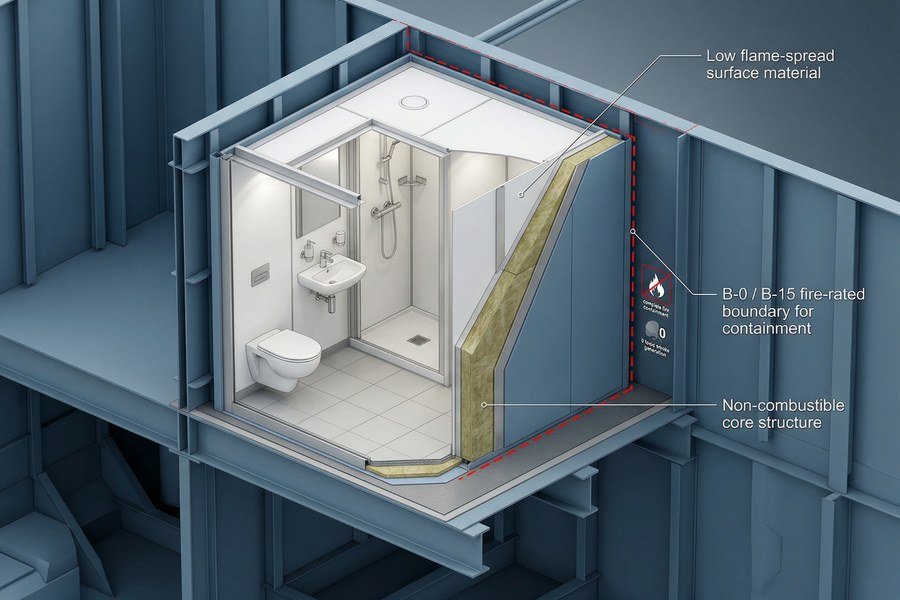
SOLAS Chapter II-2 mandates that marine wet units use low flame-spread surface materials, non-combustible core structures, and fire-rated boundaries. Depending on the adjacent space, wet units must integrate with B-0 or B-15 class bulkheads, ensuring zero toxic smoke generation and complete fire containment.
Low Flame-Spread Materials and Non-Combustible Cores in SOLAS
I have seen factory tests where bad wall panels catch fire in seconds. SOLAS Chapter II-22 exists to stop this. This rule book dictates exactly what materials you can buy. First, all surface materials must have low flame-spread features. This is tested under the IMO FTP Code Annex 1 Part 53. If a fire touches the wall, the fire must not travel fast. Second, the wall must have non-combustible core structures. You cannot use wood or cheap foam. You must use marine-grade rockwool. The rockwool density usually needs to be between 100 kg/m3 and 120 kg/m3. This heavy rockwool stops the heat. Furthermore, SOLAS strictly demands zero toxic smoke generation. Many plastics release deadly gas when they burn. On a ship, crew members cannot escape this gas. Your supplier must provide certificates showing the materials pass the smoke toxicity tests.
Implementing B-Class Fire Boundaries for Wet Units
A wet unit is essentially a box inside a room. This box must protect the people inside and outside. SOLAS defines fire-rated boundaries for this purpose. The rules depend on the adjacent space. If the wet unit is next to a normal cabin, it usually needs to integrate with a B-0 class bulkhead. A B-0 wall stops flames for 30 minutes, but it does not stop the heat rise. If the wet unit is next to a hallway or a high-risk area, you must use a B-15 class bulkhead. A B-15 wall stops flames and keeps the unexposed side cool for 15 minutes. The temperature on the safe side will not rise more than 140 degrees Celsius. You must check your ship plan. Tell your supplier if you need B-0 or B-15 fire ratings.
| SOLAS Requirement | Technical Standard / Source | Practical Benefit |
|---|---|---|
| Core Structures | Non-combustible rockwool (100-120 kg/m3) | Blocks high heat from entering the cabin space. |
| Surface Materials | Low flame-spread (FTP Code Annex 1) | Slows down the fire so the crew can escape. |
| Fire Boundaries | B-0 or B-15 class bulkheads | Contains the fire inside one single room. |
| Smoke Control | Zero toxic smoke generation | Prevents death by poisonous gas inhalation. |
How Are Prefabricated Wet Units Transported and Installed During Ship Construction?
Moving heavy wet units into a tight ship hull is a huge headache. A bad lift can break the floor base. Here is the step-by-step process for safe handling.
Prefabricated wet units are transported using heavy-duty flatbed trucks and loaded onto the ship via shipyard cranes. Inside, they are moved using air skates or pallet jacks, positioned onto leveled steel decks, and welded or bolted to the ship's main structure using adjustable base plates.
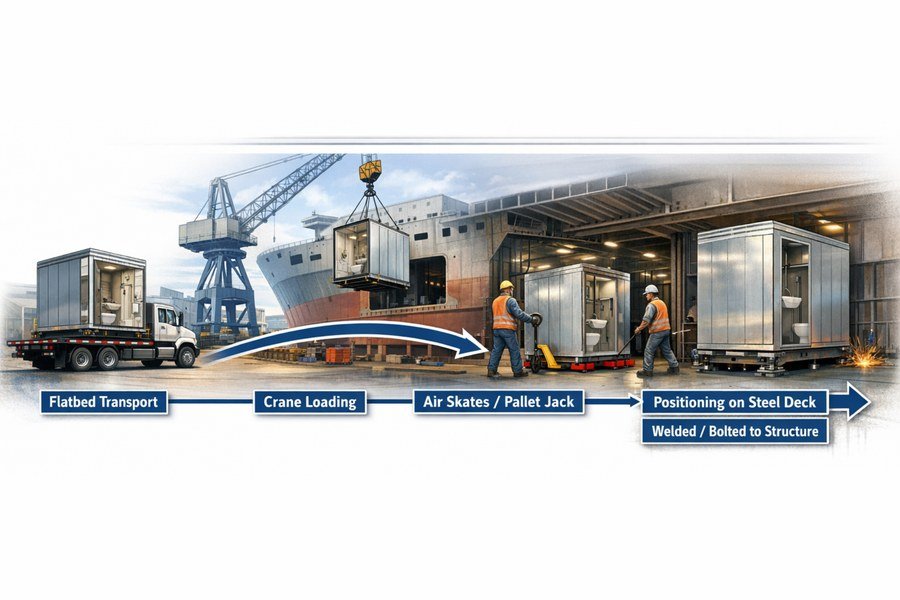
Transporting Wet Units from Factory Floor to Ship Deck
Shipping logistics can ruin a good product. I once saw a buyer lose three units because the truck hit a big bump. Prefabricated wet units are very heavy. A standard unit weighs between 300 kg and 800 kg. Factories must pack them securely. First, the factory loads them onto heavy-duty flatbed trucks. The truck drivers must drive slowly. When the truck arrives at the shipyard, the real work begins. Workers load the units onto the ship via shipyard cranes. The unit must have strong lifting eyes on the top roof. The crane hooks into these eyes. The crane operator lifts the unit high into the air and drops it down into the open ship hull. The lifting eyes must hold the entire 800 kg weight without bending.
Internal Movement and Deck Securing Methods for Wet Units
Once the unit is inside the hull, you cannot use a crane anymore. The space is too tight. Workers move them using air skates or heavy pallet jacks. Air skates use compressed air to float the heavy box across the steel floor. It makes moving an 800 kg box very easy. Next, workers position the unit onto leveled steel decks. Ships are rarely perfectly flat. Therefore, the unit has adjustable base plates. These plates usually have a 50 mm adjustment range. Workers turn the bolts until the unit is perfectly straight. Finally, the installation team secures the unit. They weld or bolt it to the ship's main structure. Welding provides the strongest hold, but bolting is easier to fix later.
| Installation Step | Equipment / Method Used | Key Value or Range |
|---|---|---|
| Road Transport | Heavy-duty flatbed trucks | Carries unit weights of 300 kg to 800 kg safely. |
| Ship Loading | Shipyard cranes | Uses strong top roof lifting eyes. |
| Internal Movement | Air skates or pallet jacks | Glides heavy units through narrow ship corridors. |
| Deck Securing | Welded or bolted adjustable plates | Allows 50 mm height adjustment for uneven decks. |
What Structural Considerations Apply When Integrating Wet Units Into Hull Design?
A ship bends and twists in the ocean waves. If your wet unit is too stiff, the walls will crack. Here is how to design for hull movement.
Integrating wet units requires accounting for deck deflection under heavy loads, hull vibration isolation using rubber shock mounts, and precise dimensional tolerances. The base tray must accommodate a steel deck camber of up to 2%, and clearance gaps of 15-20mm are strictly required around the unit.
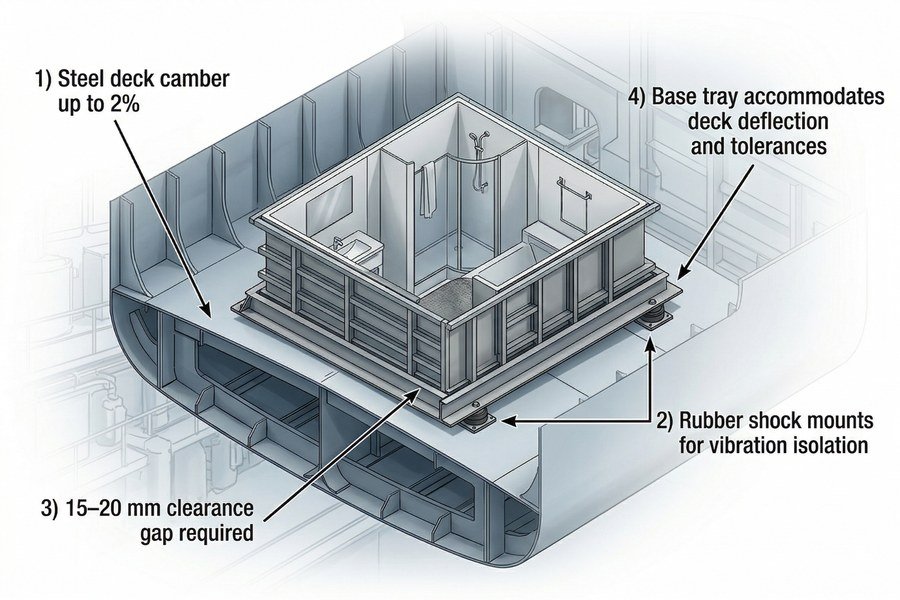
Managing Deck Deflection and Hull Vibration Isolation
Steel bends. When a ship carries heavy cargo, the steel deck sinks slightly in the middle. We call this deck deflection under heavy loads. A wet unit sits on this deck. If the unit does not bend with the deck, the unit's floor will crack. Water will leak everywhere. I helped a European shipyard fix this exact problem. We solved it by improving the hull vibration isolation. We placed rubber shock mounts under the wet unit base. These rubber pads are usually 10 mm to 15 mm thick. They have a shore hardness of 60 to 70. These mounts absorb the deck deflection. They also stop the engine shaking from reaching the passenger's feet. You must ask your designer to include these rubber mounts in the drawing.
Dimensional Tolerances and Deck Camber Adjustments
Shipbuilders work with large sheets of steel. They are not as precise as house builders. You must plan for precise dimensional tolerances. The deck is never completely flat. To let water run off the deck, shipbuilders build the deck with a slight curve. The base tray of the wet unit must accommodate a steel deck camber of up to 2%. Your unit feet must adjust to sit on this curved floor. Also, you cannot push the wet unit tightly against the steel wall. The steel wall gets hot and cold. It expands and shrinks. Therefore, clearance gaps of 15-20mm are strictly required around the unit. If you do not leave this 15-20mm gap, the steel wall will crush the wet unit over time.
| Structural Factor | Design Requirement / Value | Purpose of Design |
|---|---|---|
| Hull Vibration | Rubber shock mounts (10-15 mm thick) | Absorbs engine shaking and prevents tile cracks. |
| Deck Deflection | Flexible base tray design | Allows the unit to move when heavy cargo loads bend the ship. |
| Deck Camber | Base must accommodate up to 2% curve | Ensures the unit stands straight on a sloping steel floor. |
| Wall Clearances | 15-20mm gaps around the unit | Leaves room for steel walls to expand in hot weather. |
How Are Prefabricated Wet Units Connected to Ship Utility Systems?
Leaking pipes behind a cabin wall are a nightmare to fix. Poor connections cause huge water damage. Here is how you connect utilities correctly.
Wet units connect to ship utilities through centralized service shafts via flexible braided hoses for fresh water, gravity-fed or vacuum PVC piping for black/grey water discharge, plug-and-play marine-grade electrical connectors, and integrated HVAC spigots tied to the main vessel ducting.
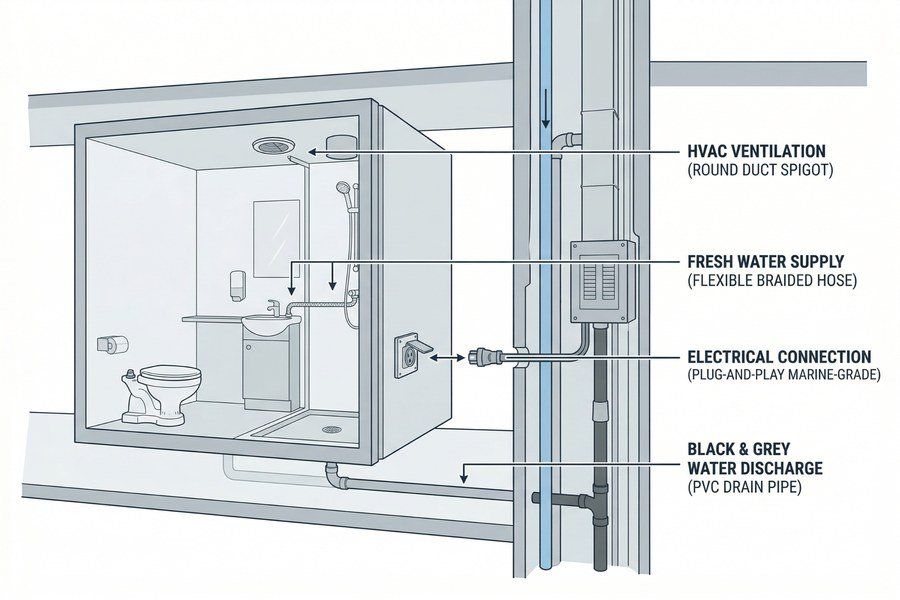
Connecting Fresh Water Supply and Black Water Discharge
Every wet unit needs water in and water out. You connect these through centralized service shafts located behind the unit. For fresh water, ships use flexible braided hoses. These hoses must withstand high pressure, usually up to 15 bar. They are flexible so they do not break when the ship vibrates. For the toilet and sink waste, we look at black/grey water discharge. Ships use either gravity-fed or vacuum PVC piping. Gravity systems just let the water fall. Vacuum systems actively suck the waste away. Vacuum systems operate at around -0.5 bar pressure. The PVC pipes must be marine grade, often PVC-U, to handle the harsh chemicals used to clean ship toilets. The connections must be perfectly sealed.
Integrating Electrical Wiring and HVAC Ducting in Wet Units
Lighting and air flow are just as important as water. To save time at the shipyard, factories use plug-and-play marine-grade electrical connectors. We often use brands like WAGO. You just push the wire in, and it clicks. This saves hours of labor. The electrician just plugs the unit into the ship's main power grid. For air quality, the bathroom must not smell bad. The unit has integrated HVAC spigots. These round metal tubes, usually 100 mm in diameter, sit on the roof. The shipyard workers connect these spigots to the main vessel ducting. A good marine HVAC system will provide 10 to 15 air changes per hour in a wet unit. This rapid air change keeps the bathroom dry and removes all bad odors quickly.
| Utility Connection | Component Used / Standard Value | Connection Method |
|---|---|---|
| Fresh Water Supply | Flexible braided hoses (15 bar rated) | Screws directly into the centralized service shafts. |
| Waste Discharge | Gravity or vacuum PVC piping (-0.5 bar) | Glued or flanged connections for black/grey water. |
| Electrical Power | Plug-and-play marine connectors | Snaps together for fast, safe shipyard wiring. |
| Air Ventilation | Integrated HVAC spigots (100 mm) | Ties directly into the main vessel ducting system. |
Conclusion
Buying compliant wet units requires strict adherence to IMO, SOLAS, and class society rules. By mastering structural integration and utility connections, you ensure vessel safety and project profitability.
Ready to Plan Your Compliant Ship Interior?
Understanding IMO regulations is just the first step. Equip yourself with the right knowledge to source, size, and customize the perfect wet units for your fleet:
Discover the core benefits: What Are Prefabricated Wet Units?
Find the right fit for your space: What Are Standard Dimensions And Configurations For Ship Wet Units?
Tailor designs to your vessel type: How Are Prefabricated Wet Units Customized For Cruise Ships Versus Cargo Vessels?
-
Understand mandatory electrical rules and IP ratings for wet areas to ensure safe, compliant lighting and outlets. ↩
-
Authoritative overview of mandatory shipboard fire-safety rules—essential for compliance, design and purchasing decisions. ↩
-
Explains the standardized laboratory test used to qualify low flame-spread surfaces—vital for suppliers and approvals. ↩