You found a great price for marine accomodation panels, and the supplier sent a certificate. But when the marine surveyor checks it, they reject your panels. Your project is now delayed. Here is how you fix this.
To avoid scope-mismatch pitfalls on marine accomodation panel certificates, buyers must verify five critical areas: the target flag state, exact configuration match, thickness limits, specific vessel types (like passenger ships), and approved surface finishes.
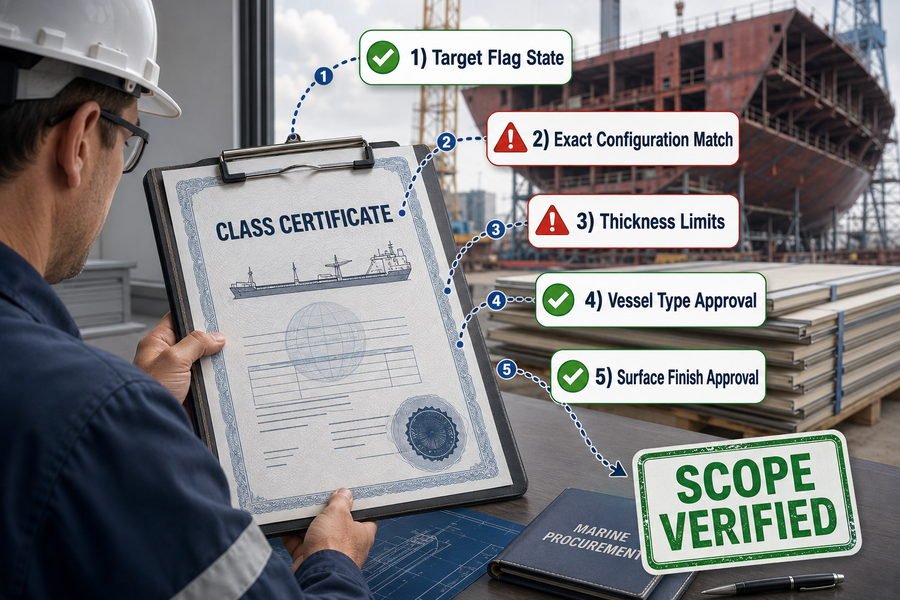
Missing even one of these details can force you to tear down completed interiors. I saw this happen many times during my factory days. Shipyards in Europe and the United States are very strict. Let me walk you through the specific checkpoints I use to keep my clients' projects on track and avoid wasting money.
Why Is a Single-Class Marine Accomodation Panel Certificate Insufficient for a Multi-Flag Vessel?
Buying panels with just DNV approval seems safe. But if your shipyard builds for US Coast Guard (USCG) and EU flags, one certificate might fail you completely. Let us look at why this happens.
A single-class certificate is insufficient for multi-flag vessels because different flag states require distinct regulatory approvals. You must secure a Marine Equipment Directive (MED) Wheelmark for European vessels, USCG approval for American waters, and dual-certification agreements for joint compliance.
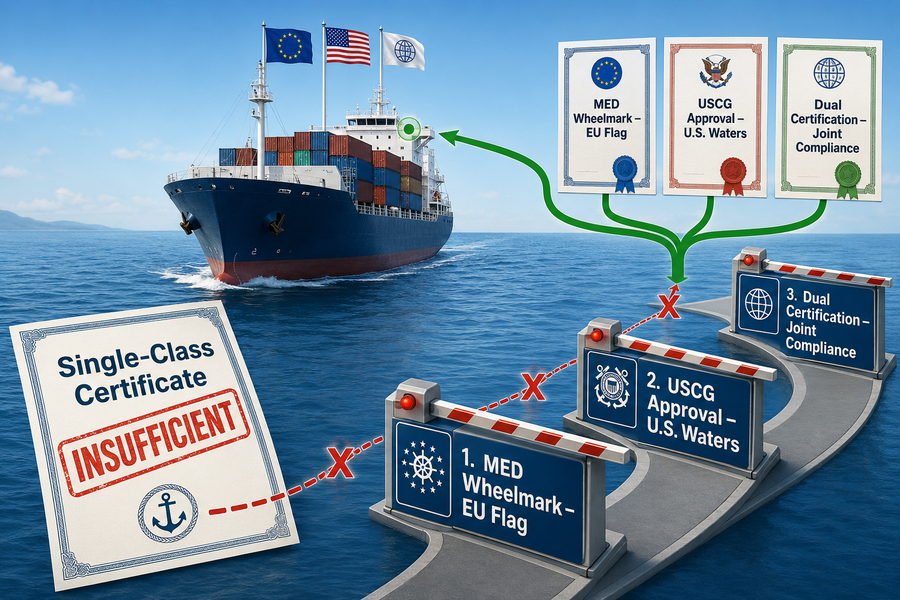
I often help procurement officers who buy from Asian factories. They find a great price on marine wall panels. The factory shows a China Classification Society (CCS) certificate. But the buyer is decorating a ship for a European owner. A single CCS certificate is useless here. You must look at the three specific approvals mentioned above.
The Necessity of MED Wheelmark for European Marine Panels
If your ship will fly a European flag, the marine panels must have the MED Wheelmark1. The European Union requires this mark to prove the product passes the IMO Fire Test Procedures (FTP) Code. According to the MED rules, the factory must pass both Module B (Type Examination) and Module D (Production Quality Assurance). A standard class certificate only covers the design. It does not cover the factory's daily quality control. Getting a MED certificate usually costs a factory around $5,000 to $8,000 per product type. If your supplier does not want to pay this, you cannot use their panels in Europe.
USCG Approval Requirements for American Vessel Interiors
Ships operating in American waters must follow the United States Coast Guard (USCG) rules. A standard DNV or ABS certificate is not enough. The certificate must explicitly state USCG approval and list a specific USCG approval number2. The USCG has very strict rules about non-combustible materials. If a marine fire door or panel lacks this number, the American surveyor will stop your installation immediately. I always tell my clients to ask the supplier for the exact 164-series USCG number before paying the deposit.
Leveraging Dual-Certification Agreements for Global Shipyards
To save time, you can use the Mutual Recognition Agreement (MRA). The EU and the US have an agreement. A product with a MED Wheelmark can get USCG approval without re-testing3. But the factory must apply for it. The certificate must show both the Wheelmark logo and the USCG approval number. This dual certification is the safest choice for procurement officers who decorate ships for global markets.
| Approval Type | Target Market | Regulatory Body | Estimated Factory Cost to Obtain | Key Identifier on Document |
|---|---|---|---|---|
| MED Wheelmark | European Union | EU Notified Bodies | $5,000 - $8,000 | Wheel logo with 4-digit number |
| USCG Approval | United States | US Coast Guard | $4,000 - $6,000 | 164.xxx approval number |
| Dual Certification | Global / US & EU | EU & USCG via MRA | $1,000 (Admin fee) | Both Wheelmark and USCG number |
How Does a Procurement Manager Spot a Mismatch Between Tested and Quoted Marine Accomodation Panel Configuration?
The quote says B-15 class, but the certificate might show a different core density. This hidden mismatch can ruin your shipyard's inspection. Learn how to spot it early.
A procurement manager spots a mismatch by comparing three elements on the certificate against the quote: the specific core material density, the joint profile design, and the exact insulation manufacturer. Every detail on the final product must match the laboratory test report perfectly.
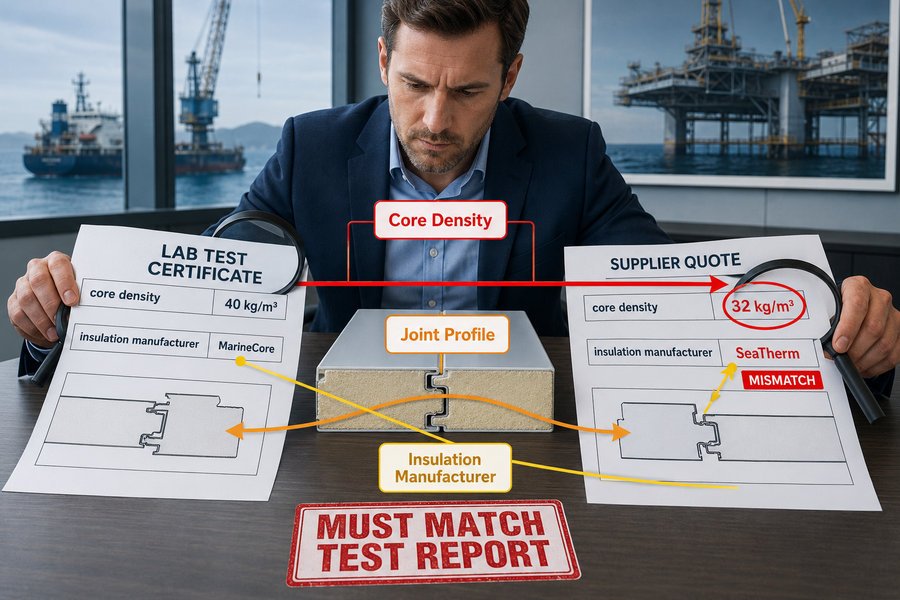
Many buyers only look at the price and the big "B-15" or "A-60" letters on the paper. They miss the technical details. In my experience, some Asian factories will quote a low price by changing the inside of the panel. You must check the three elements I listed above to protect yourself.
Checking Core Material Density Against Marine Panel Certificates
Marine panels use rockwool inside to stop fire.4 The laboratory tests a specific rockwool density. According to most B-15 marine wall panel certificates, the rockwool density must be exactly 140 kg/m³5. Some suppliers will quote you a panel with 120 kg/m³ rockwool to save about $2 per square meter. This is a mismatch. If the surveyor cuts the panel and measures the density, they will find the truth. Your certificate becomes invalid because the physical product does not match the tested product6. Always read the tested density on page two of the certificate.
Verifying Joint Profile Designs in Marine Fire Panels
The way two panels connect is critical for fire safety.7 The certificate will show a drawing of the joint. There are two common types: spline joints and tongue-and-groove joints. If the certificate shows a heavy steel spline joint, but the supplier quotes a cheaper tongue-and-groove design, you have a mismatch. Fire can leak through a weak joint. I once saw a buyer lose $20,000 because they accepted a different joint design to speed up production. The inspector made them replace every panel.
Confirming the Insulation Manufacturer for Certified Marine Panels
This is the most common trick. A factory passes the fire test using high-quality rockwool from a famous brand like Paroc or Rockwool. The certificate lists that specific brand. Later, to lower the price, the factory buys cheap rockwool from an unknown local supplier. You must ask the factory to confirm in writing that they will use the exact insulation brand listed on the type approval certificate.
| Configuration Element | What the Certificate Shows | What Cheap Quotes Often Hide | Risk of Mismatch |
|---|---|---|---|
| Rockwool Density | Minimum 140 kg/m³ | 120 kg/m³ to save money | Complete failure in fire test |
| Joint Profile | Steel spline insert | Simple folded edge | Fire leaks between panels |
| Insulation Brand | Approved brand (e.g., Paroc) | Unlisted local cheap brand | Certificate becomes legally void |
Why Does an Out-of-Scope Thickness Invalidate a Marine Accomodation Panel Class Certificate?
You ordered 25mm panels to save cabin space, but the certificate only covers 50mm. This out-of-scope thickness means your fire rating is now legally zero.
An out-of-scope thickness invalidates a marine accomodation panel certificate because fire containment relies on two strict physical boundaries: the minimum thickness required to stop heat transfer (insulation), and the maximum thickness allowed to control combustible mass. Altering these dimensions violates the IMO FTP Code.
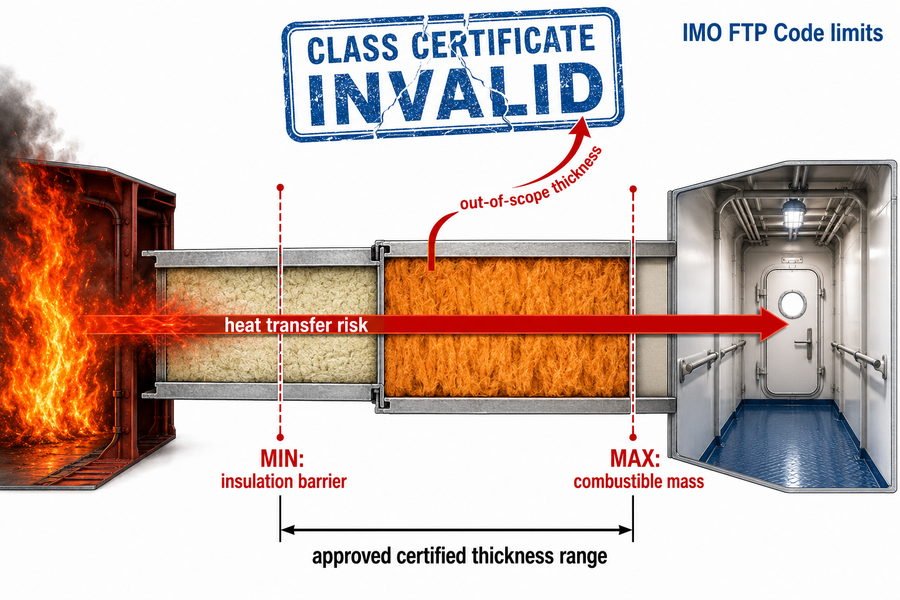
I understand the pressure. Shipowners want thinner panels to make the cabins larger. But you cannot just ask the factory to make the panel thinner. The thickness is the most important part of the fire test. You must understand the two physical boundaries to avoid buying useless panels.
How Minimum Thickness Ensures Heat Transfer Prevention in Marine Panels
A marine fire panel must stop heat from moving from a burning room to a safe room. According to the IMO FTP Code Part 3, the unexposed side of a B-15 panel cannot rise more than 140 degrees Celsius on average during a 15-minute test8. If a factory passes this test with a 50mm panel, the certificate is only valid for 50mm or thicker. If you buy a 25mm panel, there is simply not enough rockwool to stop the heat9. The temperature will rise too fast. The class society will immediately invalidate your certificate because a thinner panel cannot physically meet the insulation requirement.
How Maximum Thickness Controls Combustible Mass in Ship Interiors
You might think making a panel thicker is always safe. This is not true. Marine panels have PVC films and adhesives on the surface. These materials burn. The IMO FTP Code Part 510 controls how much smoke and fire these materials can make. This is called the combustible mass limit. If a certificate approves a 50mm panel, it calculates the total fire load based on that size. If you ask for a 100mm panel, you are adding more steel, but you might also be changing the structural balance and the amount of glue used inside. Some certificates explicitly state a maximum thickness limit11. Going over this limit voids the approval just as fast as going under it.
| Panel Thickness Request | Certificate Approved Size | IMO FTP Code Result | Legal Status for Shipyard |
|---|---|---|---|
| 25mm Panel | 50mm B-15 | Fails Heat Transfer limit | Invalid - Surveyor rejects |
| 50mm Panel | 50mm B-15 | Passes all limits | Valid - Safe to install |
| 100mm Panel | 50mm B-15 | May fail Combustible Mass | Requires new test or letter |
How Does a Shipowner Verify a Marine Ceiling Panel Certificate Covers Passenger Vessels?
Not all certificates work for cruise ships. Passenger vessels have much stricter fire rules. Using a standard cargo ship certificate will stop your project cold.
To verify a marine ceiling panel certificate covers passenger vessels, shipowners must check for two specific IMO SOLAS regulations: compliance with Safe Return to Port (SRtP) guidelines, and the low flame-spread characteristics mandated for high-occupancy corridors and stairway enclosures.
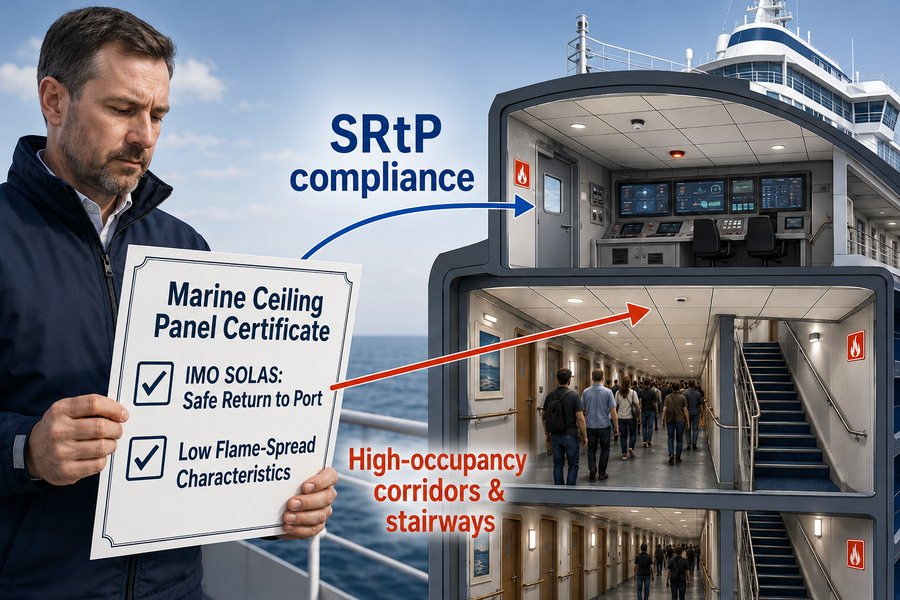
If your company does interior decoration for large shipyards in Europe or the US, you probably work on passenger ships. These ships are different from oil tankers. I always remind buyers that saving money on ceiling panels is dangerous if you buy the wrong type. You must verify the two specific regulations below.
Checking Marine Ceiling Panels for Safe Return to Port (SRtP) Compliance
Passenger ships over 120 meters long must follow Safe Return to Port (SRtP) rules.12 This means if a fire starts, the ship must remain safe enough for passengers to stay on board while it returns to land13. Ceiling panels on these ships must stay in place longer. They cannot collapse and block the escape routes. You must look at the class certificate. It must clearly state the ceiling panel is approved for use as a continuous "B" class ceiling. If the certificate says "For use in cargo ships only," you cannot use it.
Verifying Low Flame-Spread Characteristics for Passenger Vessel Corridors
Passenger ships have long corridors and big stairways. The IMO FTP Code Part 5 requires materials in these areas to have low flame-spread characteristics.14 This means the surface of the ceiling panel will not help the fire move down the hallway. You must check the certificate for Part 5 compliance. Some cheap ceiling panels are just painted steel without proper testing for smoke and toxicity. For passenger ships, the certificate must explicitly state that the panel produces a low volume of smoke and non-toxic gases15. If the panel does not have this exact phrasing, the shipyard will fine you for delays.
| Vessel Type | Key Regulatory Requirement | Certificate Must Show | Cost Impact for Buyer |
|---|---|---|---|
| Cargo Ship | Basic B-0 or B-15 Fire rating | IMO FTP Code Part 3 | Standard baseline price |
| Passenger Ship | Safe Return to Port (SRtP) | Continuous B-class approval | 15% to 25% higher price |
| Passenger Ship | Low Flame-Spread (Corridors) | IMO FTP Code Part 5 (Smoke/Tox) | Requires special paint/film |
Why Must a Designer Check Approved Finishes on a Marine Wall Panel Class Certificate?
Your designer picked a beautiful wood-grain PVC film. But if that exact film is not listed on the fire certificate, the surveyor will reject the entire room.
A designer must check approved finishes because the certificate restricts three critical finish variables: the exact material type (like PVC or PET), the maximum allowable film thickness, and the maximum calorific value. Exceeding these limits creates toxic smoke and voids the fire rating.
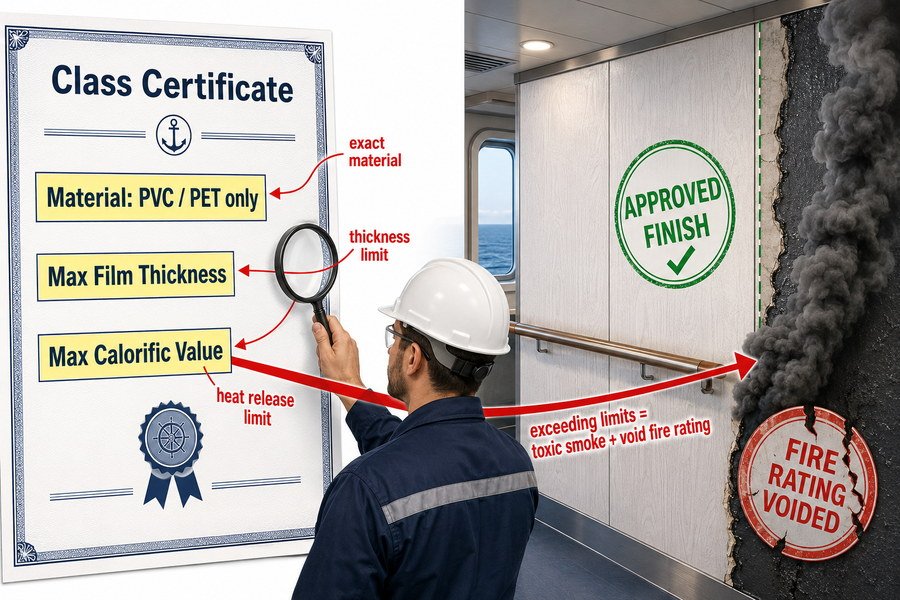
Designers love to create beautiful cabins. But in the marine outfitting world, safety always beats beauty. A factory will show you a catalog with hundreds of colors. But their fire certificate might only approve one specific type of plastic film. You must check the three finish variables before you sign the purchase order.
Matching the Exact Surface Material Type on Marine Panel Certificates
The certificate tests a specific surface material.16 Usually, this is a PVC (Polyvinyl Chloride) film or a PET (Polyethylene Terephthalate) film. If the certificate says "Approved for use with PVC film," you cannot use a melamine laminate finish on that same panel. The fire test only proves that the PVC film behaves safely when burning. If you change the chemical material type, the factory must provide a separate certificate for that new material.17 Never let a factory tell you "all finishes are the same." They are not.
Enforcing the Maximum Allowable Film Thickness for Marine Wall Panels
Thick films look better and resist scratching. But thick films add more fuel to a fire. The IMO FTP Code Part 5 is very strict about this. Most marine panel certificates state a maximum allowable film thickness of 150 microns (0.15mm) or 200 microns (0.20mm). If your designer chooses a luxury 300-micron film to make the wall feel like real wood, the panel is no longer certified. I always ask suppliers to print the film thickness on the commercial invoice to prove it matches the certificate.
Calculating the Maximum Calorific Value for Marine Panel Finishes
Calorific value is the amount of heat energy released when the finish burns. The IMO FTP Code states that combustible materials used on bulkheads and ceilings must not have a calorific value exceeding 45 MJ/m²18. The certificate will clearly list the maximum calorific value the laboratory tested. If your designer picks a heavy wallpaper or a thick glue, it might push the total heat value over 45 MJ/m². The surveyor will ask for the calculation. If you cannot prove the finish is under the limit, the panels will be rejected.
| Finish Variable | Common Certificate Limit | What Happens if Exceeded | Solution for Buyers |
|---|---|---|---|
| Material Type | PVC Film | Smoke toxicity fails test | Demand matching certificate |
| Film Thickness | Max 150 microns (0.15mm) | Panel adds too much fuel | Verify thickness on invoice |
| Calorific Value | Max 45 MJ/m² (per IMO) | Heat release violates rules | Ask factory for lab data |
How Does a QA Manager Request Written Scope Clarification From a Marine Panel Supplier?
Never trust a verbal "yes" from a sales rep. When the certificate is vague, your QA manager must get the truth in writing to protect your investment.
A QA manager requests written scope clarification through three steps: drafting a formal Technical Clarification Request (TCR), requiring the supplier to provide the original laboratory test report annex, and demanding a stamped confirmation letter from the classification society approving the specific project application.
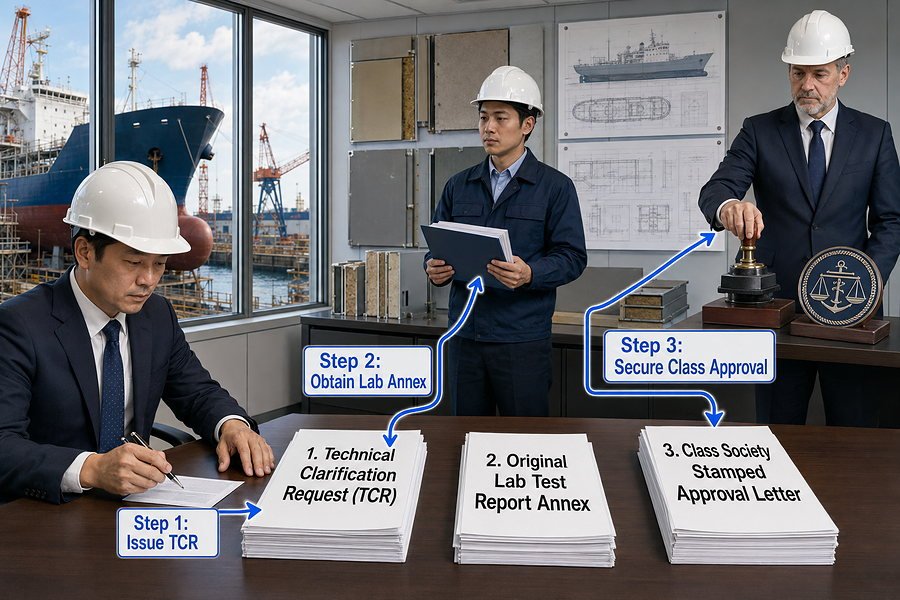
Communication with Asian suppliers can sometimes be difficult due to language barriers. A sales rep might say "Yes, no problem" just to get your order. If you have any doubts about the certificate scope, your Quality Assurance (QA) manager must take control. Follow these three steps to secure proof.
Drafting a Formal Technical Clarification Request for Marine Panels
Do not use WeChat or WhatsApp for important technical questions. Your QA manager must write a formal Technical Clarification Request (TCR) in an email. This document should list the exact ship hull number, the target flag state, the required thickness, and the chosen finish. Ask the supplier one simple question: "Does your certificate [Number X] fully cover the specifications listed above?" Make them reply to this specific email. This creates a legal record.19 If they lie, you have proof to demand a refund.
Reviewing the Original Laboratory Test Report Annex from Suppliers
The class certificate is usually just a two-page summary. The real details are in the original laboratory test report. The QA manager must ask the supplier to send the annex of this lab report. The annex contains the engineering drawings, the exact rockwool density used, and the glue amounts.20 Factories do not like sharing this because it reveals their secrets. But as a buyer spending thousands of dollars, you have the right to see the drawings to ensure the panel joints match what you are buying.
Securing a Stamped Confirmation Letter from the Classification Society
Sometimes the certificate is simply too vague. If the laboratory report is not clear enough, the QA manager must demand a stamped confirmation letter from the classification society (like DNV or Lloyd's Register). The supplier must contact the society, explain your specific project, and ask the society to issue a letter saying, "We confirm this panel is approved for this specific application." The society usually charges a small fee, about $300 to $50021, for this letter. It is the cheapest insurance you can buy.
| Clarification Step | Who Takes Action | Document Produced | Typical Time Needed |
|---|---|---|---|
| Draft Formal TCR | QA Manager | Technical Clarification Email | 1 Day |
| Request Lab Annex | Supplier | Lab Test Report Drawings | 2 - 3 Days |
| Get Class Letter | Supplier & Class Society | Stamped Approval Letter | 7 - 14 Days |
Conclusion
Always verify flag state, configuration, thickness, vessel type, and finish details. A rigorous check prevents costly delays and ensures your marine outfitting project passes inspection smoothly.
-
"How Does the IMO FTP Code Connect with Other Marine Fire Safety ...", https://magellanmarinetech.com/how-imo-ftp-code-connect-with-other-marine-fire-safety-frameworks/. EU Marine Equipment Directive materials explain that equipment placed on board EU-flagged ships must bear the wheel mark when it falls within the Directive’s listed equipment categories, with conformity assessed against applicable international instruments such as IMO fire-test standards. Evidence role: general_support; source type: government. Supports: If a ship flies a European flag, applicable marine wall panels must carry the MED Wheelmark.. Scope note: This supports the regulatory requirement in context; the exact obligation depends on whether the specific wall panel falls within a MED-listed equipment category. ↩
-
"46 CFR Part 164 -- Materials - eCFR", https://www.ecfr.gov/current/title-46/chapter-I/subchapter-Q/part-164. U.S. Coast Guard type-approval regulations and approved-equipment listings use approval numbers for materials and equipment, including 46 CFR Part 164 categories, indicating that approval documentation should identify the relevant Coast Guard approval number. Evidence role: general_support; source type: government. Supports: For U.S. vessel applications, relevant interior fire-safety materials should have documentation showing a specific USCG approval number.. Scope note: This supports the need for USCG approval identification; it does not independently prove that every surveyor will stop an installation immediately in all circumstances. ↩
-
"2004 U.S.-EU Marine Equipment Agreement - USTR", https://ustr.gov/archive/World_Regions/Europe_Middle_East/Europe/2004_US-EU_Marine_Equipment_Agreement/Section_Index.html. The EU–U.S. Mutual Recognition Agreement for marine equipment provides a framework under which certain MED-approved products may receive U.S. Coast Guard acceptance without duplicative testing, provided the equipment category is covered and the manufacturer completes the required approval process. Evidence role: mechanism; source type: government. Supports: A MED Wheelmark product can obtain USCG approval without re-testing under the EU–U.S. marine equipment Mutual Recognition Agreement when applicable conditions are met.. Scope note: The support is conditional: MRA coverage is category-specific and does not make USCG approval automatic merely because a product has a Wheelmark. ↩
-
"What Is the Purpose and Scope of the IMO FTP Code? - Magellan ...", https://magellanmarinetech.com/what-purpose-scope-of-imo-ftp-code/. Mineral wool, including rockwool, is widely described as a non-combustible insulating material used to improve the fire resistance of building and marine-type panel assemblies; this supports the material rationale but does not establish that every certified marine panel uses rockwool. Evidence role: mechanism; source type: paper. Supports: Marine panels use rockwool inside to stop fire.. Scope note: The support is contextual because panel constructions vary by certificate and manufacturer. ↩
-
"How to choose the right marine wall panels for marine interior ...", https://magellanmarinetech.com/how-choose-right-marine-wall-panels-for-marine-interior-projects/. Examples of B-15 marine panel type-approval certificates specify the tested mineral-wool core density as part of the approved construction, illustrating that density can be a certificate-controlled parameter; this does not prove that most B-15 certificates require exactly 140 kg/m³. Evidence role: case_reference; source type: institution. Supports: According to most B-15 marine wall panel certificates, the rockwool density must be exactly 140 kg/m³.. Scope note: The evidence would support certificate-specific density control, while the article’s broader word “most” would require a survey of multiple certificates. ↩
-
"RESOLUTION MSC.307(88) (adopted on 3 December ...", https://wwwcdn.imo.org/localresources/en/KnowledgeCentre/IndexofIMOResolutions/MSCResolutions/MSC.307(88).pdf. Marine type-approval and fire-test regimes generally tie approval to the tested construction, drawings, materials, and production conformity, so an unapproved change in the supplied product can undermine the basis for certification; the precise legal consequence depends on the flag state, class society, and approval terms. Evidence role: expert_consensus; source type: institution. Supports: Your certificate becomes invalid because the physical product does not match the tested product.. Scope note: This supports the conformity principle but not a universal rule that every mismatch automatically voids every certificate in the same way. ↩
-
"What Is the Purpose and Scope of the IMO FTP Code? - Magellan ...", https://magellanmarinetech.com/what-purpose-scope-of-imo-ftp-code/. Fire-resistance standards evaluate assemblies rather than isolated materials, and joint design can affect the passage of flame, smoke, or hot gases through a division; this supports the general importance of panel connections but not the specific buyer-loss anecdote. Evidence role: mechanism; source type: research. Supports: The way two panels connect is critical for fire safety.. Scope note: The source would support the fire-safety relevance of joints, while performance of a particular spline or tongue-and-groove joint depends on the tested assembly. ↩
-
"What Is the Purpose and Scope of the IMO FTP Code? - Magellan ...", https://magellanmarinetech.com/what-purpose-scope-of-imo-ftp-code/. The IMO FTP Code criteria for B-class divisions specify that the average temperature rise on the unexposed face must not exceed 140°C, with the B-15 designation corresponding to a 15-minute insulation period. Evidence role: definition; source type: institution. Supports: A B-15 marine fire panel must keep the average unexposed-side temperature rise within 140°C during a 15-minute fire test.. ↩
-
"R-value (insulation) - Wikipedia", https://en.wikipedia.org/wiki/R-value_(insulation). Heat-transfer references describe conductive thermal resistance as proportional to insulation thickness, supporting the mechanism that reducing mineral-wool thickness lowers resistance to heat flow and can increase the unexposed-face temperature rise. Evidence role: mechanism; source type: education. Supports: A thinner rockwool core provides less thermal resistance and may allow heat to pass through too quickly for the B-15 insulation requirement.. Scope note: This supports the physical mechanism generally; it does not by itself prove that a specific 25 mm marine panel would fail a particular IMO B-15 test without test data. ↩
-
"[PDF] RESOLUTION MSC.307(88) (adopted on 3 December 2010 ...", https://wwwcdn.imo.org/localresources/en/KnowledgeCentre/IndexofIMOResolutions/MSCResolutions/MSC.307(88).pdf. The IMO FTP Code identifies Part 5 as the surface-flammability test for surface materials and primary deck coverings, with criteria related to flame spread and heat release; smoke and toxicity are addressed separately in Part 2. Evidence role: definition; source type: institution. Supports: IMO FTP Code Part 5 regulates fire performance characteristics of surface materials used in ship interiors.. Scope note: This source only partly supports the sentence as written because Part 5 is not the main IMO FTP test for smoke and toxicity. ↩
-
"How Can Overseas Buyers Evaluate Type Approval Scope Before ...", https://magellanmarinetech.com/how-overseas-buyers-evaluate-type-approval-scope-before-ordering-marine-wall-ceiling-panels/. Marine equipment type-approval certificates for fire-rated divisions commonly state approved product ranges and limitations, including dimensions or thicknesses, supporting the claim that installations outside a stated maximum are not covered by that approval. Evidence role: case_reference; source type: institution. Supports: Some marine fire-panel certificates expressly limit the maximum approved thickness, and exceeding that limit can place the installation outside the certificate scope.. Scope note: This is certificate-specific and does not show that every 50 mm panel approval contains a maximum-thickness restriction or that all administrations apply identical wording. ↩
-
"[PDF] the imo passenger ship safety initiative", https://wwwcdn.imo.org/localresources/en/OurWork/Safety/Documents/Article-Seaways%20Magazine.pdf. IMO SOLAS amendments introduced Safe Return to Port requirements for passenger ships of 120 m or more in length, or having three or more main vertical zones, constructed on or after 1 July 2010. Evidence role: definition; source type: institution. Supports: Passenger ships over 120 meters long must comply with Safe Return to Port requirements.. Scope note: The rule is not based only on length; the SOLAS threshold also includes passenger ships with three or more main vertical zones and applies by construction date. ↩
-
"Passenger ships - International Maritime Organization", https://www.imo.org/en/OurWork/Safety/Pages/PassengerShips.aspx. IMO guidance on Safe Return to Port describes the objective that, after a defined fire or flooding casualty, essential systems and safe areas should remain available so that passengers and crew can stay on board while the ship proceeds to port. Evidence role: mechanism; source type: institution. Supports: Safe Return to Port rules are intended to let passengers remain safely on board while the vessel returns to port after certain casualties.. Scope note: This supports the general SRtP safety objective; detailed performance requirements depend on the ship design, casualty threshold, and applicable SOLAS regulations. ↩
-
"[PDF] RESOLUTION MSC.307(88) (adopted on 3 December 2010 ...", https://wwwcdn.imo.org/localresources/en/KnowledgeCentre/IndexofIMOResolutions/MSCResolutions/MSC.307(88).pdf. The IMO Fire Test Procedures Code Part 5 sets out the test for surface flammability, commonly used to demonstrate that exposed surfaces of ship materials have low flame-spread characteristics under SOLAS fire-safety requirements. Evidence role: definition; source type: institution. Supports: IMO FTP Code Part 5 is the relevant test framework for low flame-spread characteristics of shipboard materials.. Scope note: FTP Code Part 5 defines the test method; the requirement for where such materials must be used is established through SOLAS regulations and vessel-specific approvals. ↩
-
"What Is the IMO FTP Code for Marine Interior Materials?", https://magellanmarinetech.com/what-imo-ftp-code-for-marine-interior-materials/. IMO fire-safety requirements address smoke generation and toxicity for certain shipboard surface materials through FTP Code smoke and toxicity testing, supporting the need to verify certified limits for smoke and toxic combustion products in passenger-ship accommodation and escape areas. Evidence role: general_support; source type: institution. Supports: Passenger-ship ceiling materials used in relevant interior areas may need documented smoke and toxicity performance, not only flame-spread performance.. Scope note: The article’s wording should be checked against the exact certificate language, because IMO documentation usually refers to specified smoke-density and toxicity criteria rather than the informal phrase “non-toxic gases.” ↩
-
"[PDF] RESOLUTION MSC.307(88) (adopted on 3 December 2010 ...", https://wwwcdn.imo.org/localresources/en/KnowledgeCentre/IndexofIMOResolutions/MSCResolutions/MSC.307(88).pdf. The IMO FTP Code and marine type-approval practice evaluate surface flammability for the tested product construction, so approval evidence normally applies to the material combination described in the test report or certificate. Evidence role: expert_consensus; source type: institution. Supports: Marine panel fire certificates apply to the specific surface material tested, not automatically to all possible finishes.. Scope note: This supports the need to match the tested construction, but the exact scope of approval depends on the wording of the individual certificate and flag/class acceptance. ↩
-
"How Do Marine Panel Surface Finishes Affect Fire Safety ...", https://magellanmarinetech.com/how-marine-panel-surface-finishes-affect-fire-safety-compliance/. Classification-society and marine-equipment approval rules generally limit certificates to the product composition and construction tested; a change in surface chemistry may require retesting or a separate approval document. Evidence role: general_support; source type: institution. Supports: Changing the finish material type can invalidate reliance on the original panel certificate unless the new material is also covered.. Scope note: The source may state the general approval principle rather than specifically comparing PVC, PET, and melamine finishes. ↩
-
"RESOLUTION MSC.307(88) (adopted on 3 December ...", https://wwwcdn.imo.org/localresources/en/KnowledgeCentre/IndexofIMOResolutions/MSCResolutions/MSC.307(88).pdf. SOLAS Chapter II-2 fire-protection provisions state a 45 MJ/m² calorific-value limit for exposed surfaces and their substrates in specified accommodation, service, and control spaces, providing the regulatory basis for this threshold. Evidence role: definition; source type: institution. Supports: Combustible materials used on relevant bulkheads and ceilings are subject to a 45 MJ/m² calorific-value limit.. Scope note: The exact applicability depends on vessel type, space category, and the current incorporated text of SOLAS/FTP Code as adopted by the relevant flag administration. ↩
-
"5 FAM 140 ACCEPTABILITY AND USE OF ELECTRONIC ...", https://fam.state.gov/fam/05fam/05fam0140.html. The UNCITRAL Model Law on Electronic Commerce provides that electronic data messages should not be denied legal effect or evidential admissibility solely because they are electronic, supporting the use of formal email as a documentary record. Evidence role: general_support; source type: institution. Supports: A formal Technical Clarification Request sent and answered by email can create a legal record.. Scope note: Admissibility and contractual effect still depend on the governing law, record retention, authentication, and the specific facts of the transaction. ↩
-
"[PDF] RESOLUTION MSC.307(88) (adopted on 3 December 2010 ...", https://wwwcdn.imo.org/localresources/en/KnowledgeCentre/IndexofIMOResolutions/MSCResolutions/MSC.307(88).pdf. IMO fire-test procedures and related test-reporting requirements generally require reports to identify the test specimen’s construction, materials, dimensions, and test conditions, supporting the claim that laboratory documentation contains more technical detail than a summary approval certificate. Evidence role: general_support; source type: institution. Supports: The original laboratory test report annex for marine panels may contain detailed construction information such as drawings, material density, and adhesive details.. Scope note: Such standards may not require every proprietary detail, such as exact adhesive quantities, to be disclosed in a supplier-provided annex. ↩
-
"Federal Register, Volume 61 Issue 250 (Friday, December 27, 1996)", https://www.govinfo.gov/content/pkg/FR-1996-12-27/html/96-32801.htm. Published fee schedules from classification societies or recognized organizations commonly show fixed charges or hourly minimums for certificate, approval, or document-review services in the hundreds of dollars, providing contextual support for the stated fee range. Evidence role: statistic; source type: institution. Supports: A classification society confirmation letter may cost roughly $300 to $500.. Scope note: Fees vary by classification society, flag administration, project scope, urgency, and whether engineering review is required, so this range should not be treated as universal. ↩