Are you losing money because class societies reject your marine panels? Out-of-scope certificates destroy your profit margins. Here is how you can secure the right approvals before placing orders.
Overseas buyers must evaluate marine panel type approval scope by checking five key parameters: approved fire class rating (e.g., B-15, B-0), maximum allowable panel dimensions, approved core materials and densities, permitted joint profiles, and the specific certificate expiration date against the ship's delivery schedule.
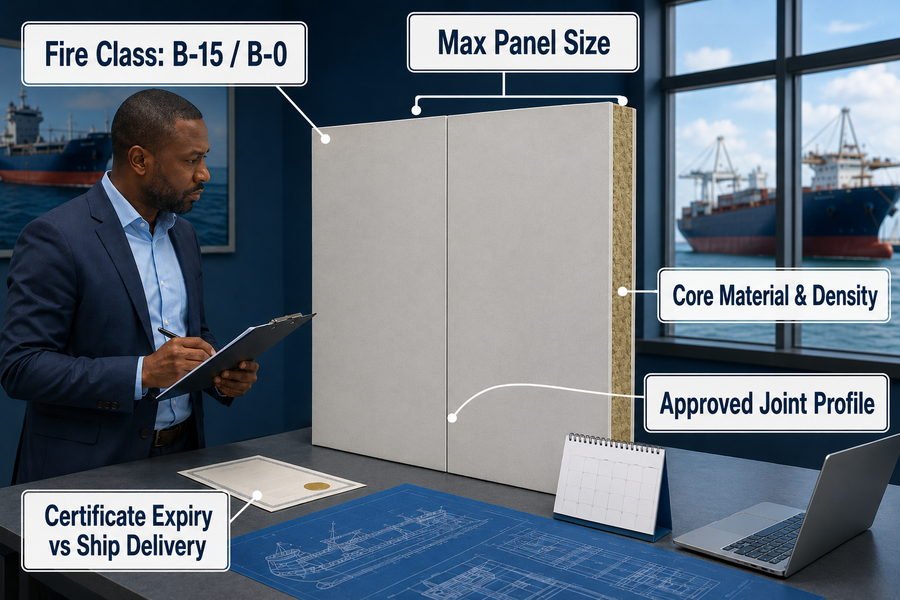
I see many procurement officers buy high-quality panels from Asia, only to face huge troubles when European or American shipyards reject them. You must understand the certificate details.
How to Read the Scope Section of a Marine Panel Type Approval Certificate?
Staring at a complex DNV or ABS certificate can make you dizzy. Missing the fine print leads to wrong purchases. Let us break down the exact sections you need.
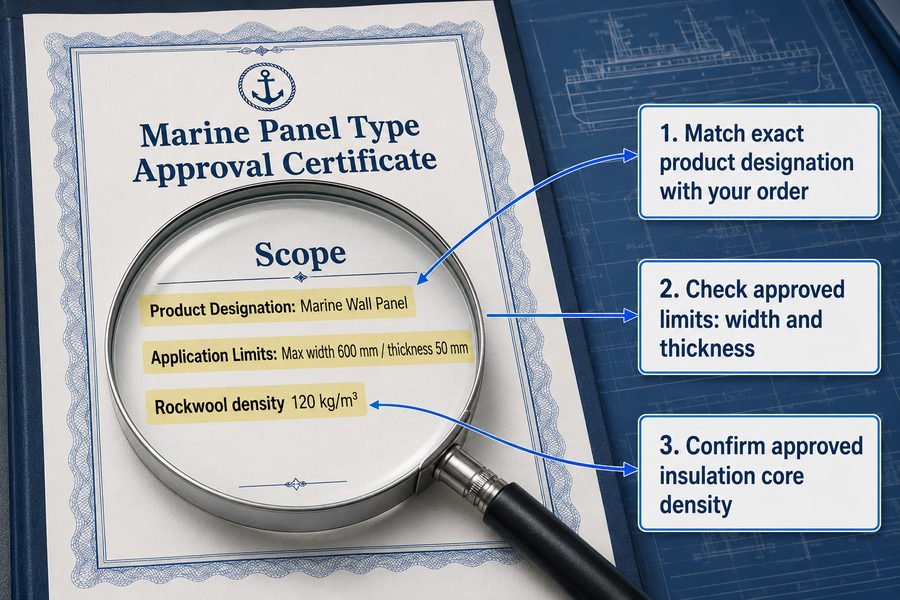
To read the scope section accurately, you must verify three specific elements: the exact product designation matching your order, the approved application limits including maximum width (e.g., 600mm) and thickness (e.g., 50mm), and the approved insulation core density (e.g., 120 kg/m3 for rockwool).
Verifying the Exact Marine Panel Product Designation
When you look at a marine type approval certificate, the first thing you must check is the exact product designation. This is the official name of the marine panel. Many suppliers in China or Vietnam will show you a certificate. But the certificate might belong to a different panel series. You must match the name on the certificate exactly with the name on your purchase contract. This is the first of the three specific elements you must verify. If your contract says "Type A-60 Wall Panel" and the certificate says "Type A-30 Wall Panel", the class surveyor will reject it. You cannot assume a supplier with one valid certificate has approvals for all their products. I always tell my clients to print the certificate and highlight the product name.
Checking Application Limits and Core Density on the Certificate
Next, you must check the approved application limits. This is the second element from our list. The certificate clearly states the maximum dimensions1 you can use. According to DNV guidelines, if a wall panel is tested at a maximum width of 600mm, you cannot order an 800mm wide panel and use the same certificate. The thickness is also strict. If the certificate says 50mm thickness, you cannot buy a 25mm panel expecting it to pass.
Finally, you must verify the approved insulation core density. This is the third element. For marine fire doors and wall panels, the core is usually rockwool. The certificate will state a specific density value. For a B-15 marine wall panel, the IMO FTP Code Part 3 requires a specific density to stop fire2. You will often see 120 kg/m3 listed for rockwool. If you order a cheaper panel with 100 kg/m3 density, it falls outside the approval scope. You will fail the inspection.
| Element to Verify | Where to Find It on Certificate | Common Accepted Value | Risk of Ignoring |
|---|---|---|---|
| Product Designation | Page 1, Header Section | Must match contract exactly | Total rejection by shipyard |
| Application Limits | Page 2, "Application/Limitation" | Max width 600mm, thickness 50mm | Panel cannot be installed |
| Core Density | Page 2, "Product Description" | Rockwool at 120 kg/m3 | Fails fire safety standards |
Why Are Out-of-Scope Marine Wall Panels Rejected Despite a Valid Type Approval?
You hold a valid certificate, but the surveyor still says no. This sudden rejection ruins your delivery schedule. The problem lies in hidden specification changes.
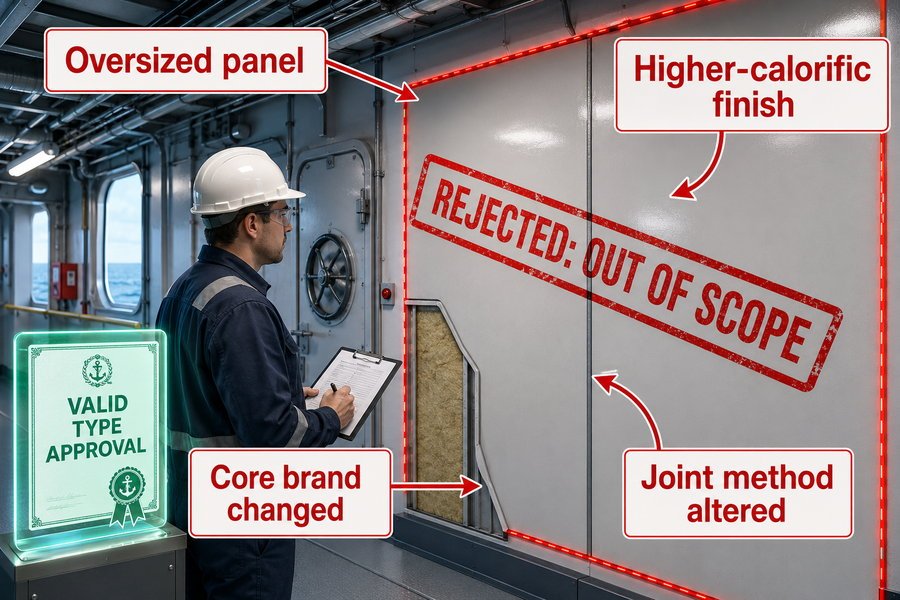
Marine wall panels are rejected despite valid type approvals for four main reasons: exceeding maximum approved dimensions, using a surface finish with higher calorific value than tested, substituting the core material brand, or altering the approved joint installation method between panels.
Exceeding Dimensions and Surface Finish Calorific Values
Many buyers think a valid certificate means they can buy any size. This is not true. Exceeding maximum approved dimensions is the first reason panels get rejected. If the test lab approved a marine wall panel up to 2.4 meters high, you cannot supply a 2.6-meter panel. The fire performance changes with size.3
The second reason is using a surface finish with a higher calorific value than tested. Shipyards want nice colors and patterns on the walls. Buyers order thick PVC films to get a wood look. But the SOLAS Chapter II-2 regulation states that surface materials must have low flame spread characteristics4. The maximum gross calorific value is usually limited to 45 MJ/m25. If your supplier uses a cheap, thick plastic film, the calorific value goes up. The surveyor will check the film specs. If it exceeds 45 MJ/m2, your panels will be rejected immediately, even if the base panel has a certificate.
Core Material Substitution and Joint Method Alterations
The third reason for rejection is substituting the core material brand. A type approval is tied to the specific materials used during the fire test. If the certificate lists "Brand X Rockwool," the factory cannot use "Brand Y Rockwool" just to save money. The supplier might tell you the density is the same. But the class society does not care. A change in brand means a change in scope.
The fourth reason is altering the approved joint installation method between panels. Marine panels connect using specific joints, like a spline or a tongue-and-groove system. The fire test covers exactly how these panels connect. If the approved drawing shows a 2mm gap limit with ceramic paper inside the joint, you cannot install them with a 5mm gap. The surveyor checks the installation manual against the certificate drawings. Any alteration voids the approval.
| Rejection Reason | Standard Reference | Typical Allowable Limit | Consequence |
|---|---|---|---|
| Exceeding Dimensions | IMO FTP Code Part 3 | Max height often 2500mm | Rework or total replacement |
| High Calorific Value | SOLAS Chapter II-2 | Maximum 45 MJ/m2 | Fire hazard, immediate rejection |
| Core Substitution | DNV Type Approval Rules | Must match tested brand | Certificate becomes invalid |
| Joint Method Alteration | Manufacturer Approved Drawings | Joint gap < 2mm | Fire can pass through gaps |
How Can QA Confirm a Delivered Marine Ceiling Panel Matches the Approved Type?
The supplier shipped your marine ceiling panels, but do they really match the certificate? Failing to check this costs you dearly during the final shipyard inspection.
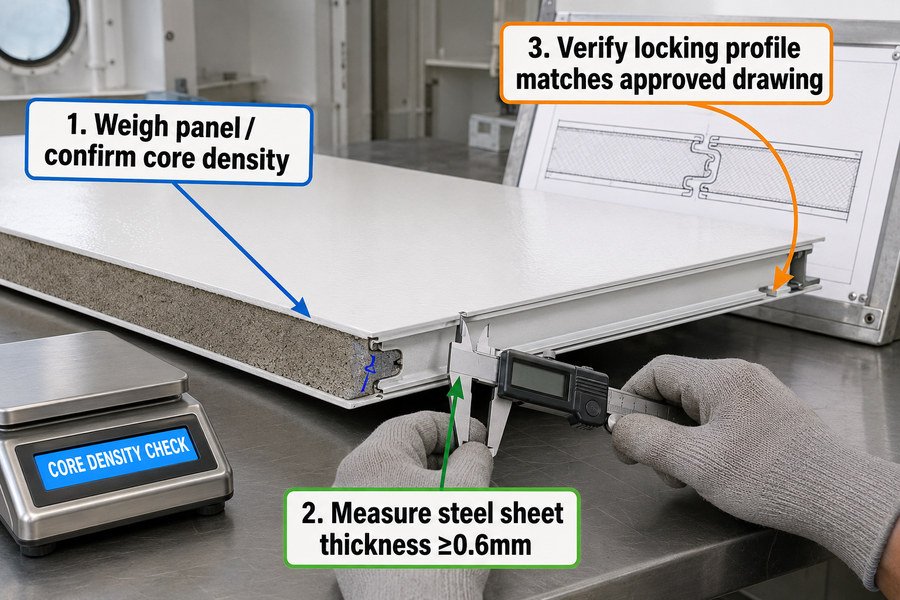
Quality Assurance can confirm delivered marine ceiling panels match the approved type through three checks: weighing the panel to confirm core density, measuring the steel sheet thickness (e.g., minimum 0.6mm galvanized steel), and visually verifying the approved locking profile against the certificate drawings.
Verifying Marine Ceiling Panel Core Density Through Weighing
When the container arrives from the factory, your Quality Assurance (QA) team must act. They cannot just look at the boxes. The first check is weighing the panel to confirm core density. Marine ceiling panels are usually lighter than wall panels, often requiring a B-0 fire rating6. But they still have strict density rules. The type approval might specify a rockwool density of 100 kg/m37. You cannot see the density from the outside. Your QA team must take a random panel, measure its exact volume, and weigh it on a calibrated scale. By subtracting the weight of the steel sheets, you can calculate the core density. If the calculated density is 80 kg/m3, the supplier cheated you. The panel does not match the approved type. I have seen many buyers lose money because they skipped this simple weighing step.
Measuring Steel Thickness and Inspecting Locking Profiles
The second check is measuring the steel sheet thickness. Marine ceiling panels use thin steel sheets to keep the weight down. However, the type approval dictates a minimum thickness to maintain structural integrity during a fire8. A common standard is minimum 0.6mm galvanized steel. Your QA inspector must use a digital micrometer to measure the bare steel. Do not measure the PVC film with the steel. The tolerance is usually very tight, like +/- 0.05mm. If the steel is only 0.4mm thick, it will warp too fast in a fire.
The third check is visually verifying the approved locking profile against the certificate drawings. Ceiling panels hang from the ship deck using specific profiles. The certificate includes a technical drawing of this edge profile. QA must put the physical panel next to the drawing. Is the fold angle correct? Is the lip length the same? If the physical locking profile differs from the drawing9, the panels will fall during a fire test.
| QA Check Step | Tool Required | Standard Specification | Purpose of Check |
|---|---|---|---|
| Weighing Core Density | Calibrated Scale & Tape Measure | e.g., 100 kg/m3 for B-0 | Ensure correct fire insulation |
| Measuring Steel Thickness | Digital Micrometer | e.g., 0.6mm bare steel | Confirm structural integrity |
| Inspecting Locking Profile | Certificate Drawing & Calipers | Match drawing exactly | Prevent ceiling collapse |
What Should Shipyard Engineers Ask Suppliers About Marine Wall Panel Type Approval Scope?
Relying on sales pitches leads to technical failures. If you do not ask the hard questions upfront, you will buy the wrong panels.
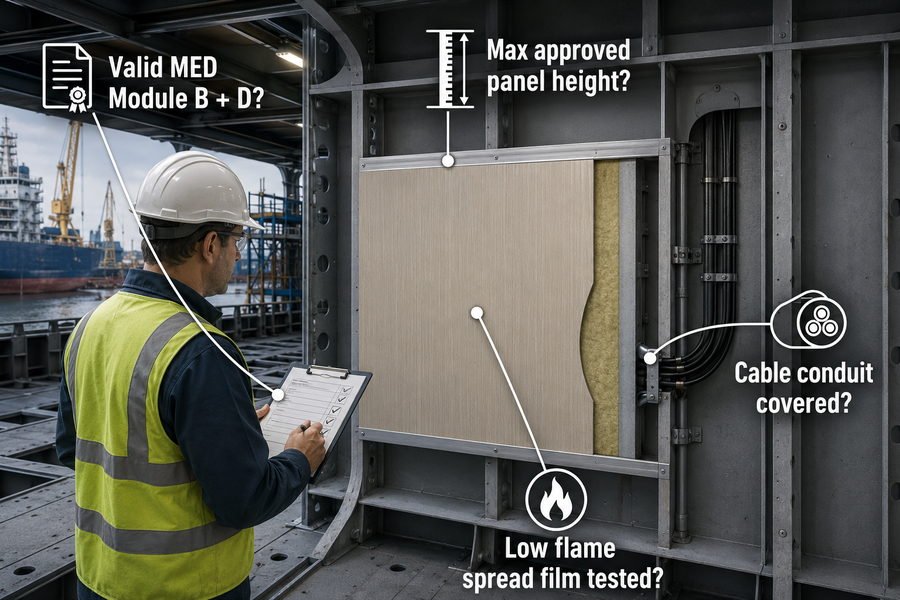
Shipyard engineers must ask suppliers four critical questions: Do you have a valid MED (Marine Equipment Directive) Module B and D? What is your maximum approved panel height? Is your cable conduit installation covered? And what specific surface films are tested for low flame spread?
Asking About MED Modules and Maximum Approved Panel Height
If you are buying for a European shipyard, you need the "Wheelmark10". The first question you must ask is: Do you have a valid MED Module B and D? Module B is the type examination certificate11. It proves the product passed the fire test. But Module B alone is useless. You also need Module D, which proves the factory has a quality system for mass production. Many small factories in Asia only have Module B. If you buy from them, the panels are illegal for European ships.
The second question is: What is your maximum approved panel height? Ship designs change. Sometimes you have high public spaces on a cruise ship. Standard panels are 2000mm to 2500mm high. If your ship space needs a 3000mm panel, you must ask if their scope covers this. The IMO FTP Code says you cannot just make a panel taller without a new test.12 If they say yes, ask to see the specific page on the certificate.
Clarifying Cable Conduit Rules and Surface Film Limitations
The third critical question is: Is your cable conduit installation covered? Ships have many wires. Electricians often cut holes in marine wall panels to run cables. But cutting a hole destroys the fire rating. Some marine panels are tested and approved with empty steel pipes inside them for cables. You must ask the supplier if their type approval covers these internal conduits.
The fourth question is: What specific surface films are tested for low flame spread? You cannot just glue any wallpaper on a marine panel. The surface film must comply with the IMO FTP Code Part 5 for low flame spread13. The thickness is strictly limited, usually around 0.15mm to 0.2mm for PVC or PET films. You must ask the supplier to provide the exact list of tested films. If your customer wants a special color, you must check if that specific film brand and thickness is on their approved list.
| Critical Question for Supplier | Reason to Ask | Required Proof from Supplier |
|---|---|---|
| Valid MED Module B and D? | Legal requirement for EU ships | Copies of both valid certificates |
| Maximum approved height? | Ensure panels fit ship design | Application limits section on cert |
| Cable conduit covered? | Allow safe electrical wiring | Approved technical drawings |
| Tested surface films? | Meet low flame spread rules | IMO FTP Code Part 5 test report |
Why Does Certificate Validity Matter When Ordering Marine Wall Panels for Long Newbuild Schedules?
Large cruise or cargo ship projects take years to build. A certificate that expires next month is a ticking time bomb for your procurement plan.
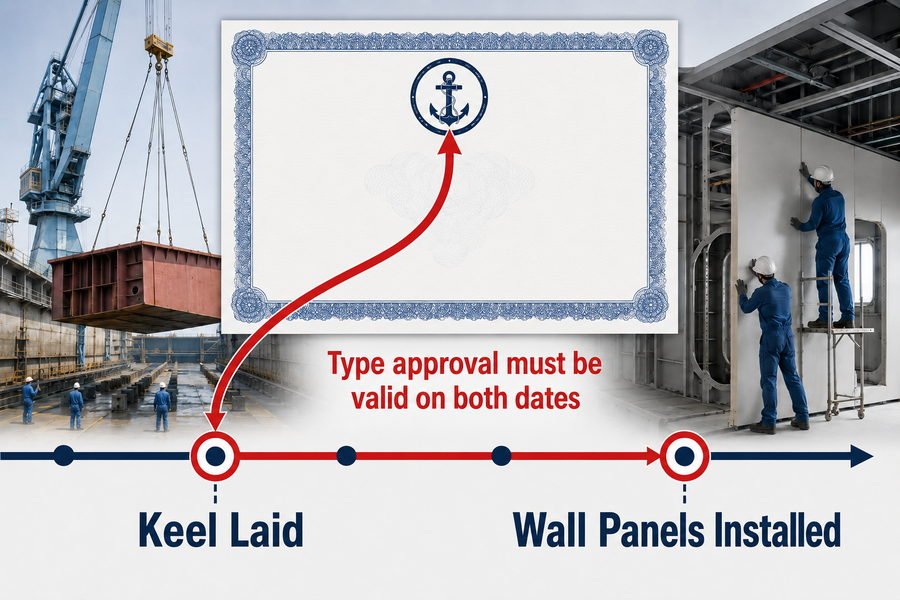
Certificate validity matters for long newbuild schedules because classification societies require the type approval to be valid on two key dates: the date the keel is laid, and the actual date the marine wall panels are installed on the vessel.
Matching Type Approval Validity with the Keel Laying Date
Shipbuilding takes a long time. You might sign a contract today for a ship that will be finished in three years. When you buy marine wall panels, you must look at the expiration date on the certificate. The first key date you must worry about is the date the keel is laid. This date marks the official start of the ship construction.14 According to classification society rules like DNV or ABS, the rules and regulations in force on the keel laying date apply to the whole ship15. If your panel's certificate is valid on the day the keel is laid, you have a good start. Standard type approval certificates are usually valid for 5 years. If the certificate expires one week before the keel is laid, the surveyor will reject your panels, even if you paid for them months ago.
Ensuring Certificate Validity During Actual Marine Panel Installation
The second key date is the actual date the marine wall panels are installed on the vessel. This is where many buyers get trapped. The keel was laid in 2024. You plan to install the panels in 2026. The certificate was valid in 2024, but it expires in 2025. You must ask the supplier: "Will you renew this certificate next year?"
Factories usually have a 3 to 6 month grace period to renew their certificates. But what if the factory goes bankrupt? What if the IMO changes the fire test rules and the old panel fails the new test? If the certificate is not valid when the workers actually bolt the panels into the ship, the class surveyor can stop the work. You must plan for this. I always advise my clients to ask suppliers for a written guarantee that they will maintain valid certificates for the entire duration of the newbuild schedule.
| Key Date for Validity | Why It Matters | Standard Rule | Action for Buyer |
|---|---|---|---|
| Keel Laying Date | Locks in the applicable rules | Cert must be valid on this day | Check cert dates before order |
| Installation Date | Surveyor checks parts on board | Cert should remain active | Get supplier renewal guarantee |
| Certificate Expiry Date | Usually a 5-year cycle | Marks end of legal approval | Monitor supplier renewal status |
How Can Project Managers Avoid Delays From Mismatched Marine Panel Type Approval Scope?
Delays cost thousands of dollars a day. Mismatched certificates are the top cause of hold-ups in marine outfitting. You need a solid prevention plan.
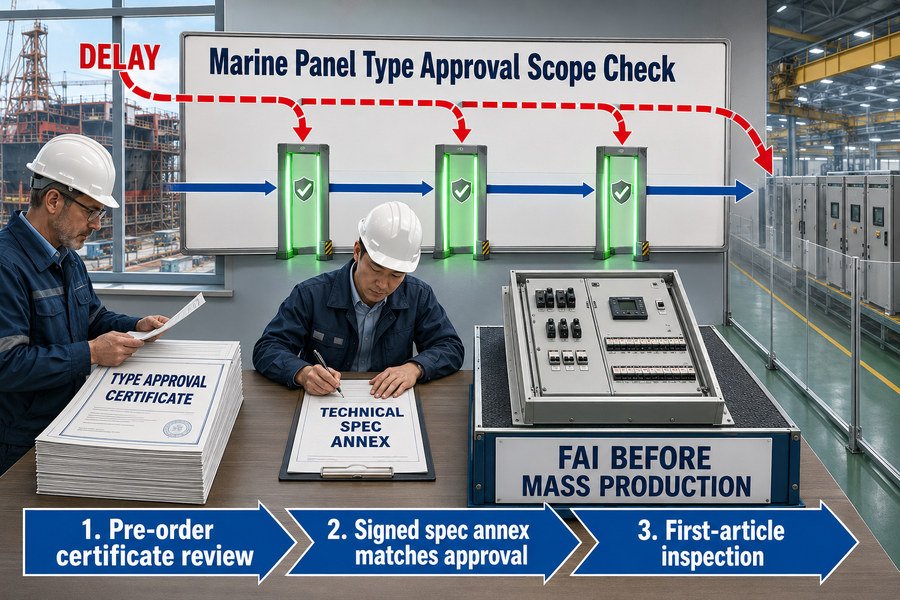
Project managers avoid delays by implementing three steps: conducting a pre-order certificate review with the class surveyor, demanding a signed technical specification annex matching the approval from the supplier, and requiring a first-article inspection (FAI) before mass production begins.
Conducting Pre-Order Certificate Reviews and Signing Technical Annexes
A dry dock delay can cost a shipyard $10,000 per day.16 You cannot afford mistakes. The first step project managers must take is conducting a pre-order certificate review with the class surveyor17. Do not trust your own eyes alone. Before you send the down payment to the supplier, take their type approval certificate and send it to your local DNV or ABS surveyor. Ask them: "Will you accept this panel for this specific room on my ship?" Getting their written approval first kills the risk.
The second step is demanding a signed technical specification annex matching the approval from the supplier. Your purchase contract is not enough. You need an annex that lists every technical detail: 50mm thickness, 120 kg/m3 density, 0.6mm steel, and 0.15mm PVC film. This annex must state that all these details strictly follow the provided type approval certificate. Both you and the factory boss must sign it. If they try to change materials later, this document gives you the legal power to reject the goods18.
Requiring First-Article Inspections (FAI) for Marine Panels
The third step is requiring a first-article inspection (FAI) before mass production begins. You order 5,000 panels. Do not let them make all 5,000 at once. Tell the factory to make just one panel first. This is standard in ISO 9001 quality systems.19 Send an inspector to the factory. The inspector will check this single panel against the technical annex and the type approval drawings.
The FAI process usually takes 1 or 2 days. The inspector will measure the dimensions, check the core density, and verify the joint profiles. If the first panel is wrong, you stop production. You fix the problem early. If you wait until all 5,000 panels arrive at the shipyard, and the surveyor finds they are out of scope, your project is dead. Implementing FAI is the best insurance policy against massive shipyard delays.
| Project Manager Step | Timing | Cost Impact | Goal |
|---|---|---|---|
| Pre-order Surveyor Review | Before signing contract | Free (usually included in class fees) | Ensure class society acceptance |
| Technical Spec Annex | During contract signing | Legal protection | Prevent unauthorized material changes |
| First-Article Inspection | Before mass production | 1-2 days inspection cost | Catch errors before full batch is made |
Conclusion
Always read the scope section carefully before you buy marine panels. Matching your order to the certificate details saves money, prevents shipyard delays, and protects your project reputation.
-
"How to choose the right fire class for marine wall panels?", https://magellanmarinetech.com/how-choose-right-marine-wall-panels-for-marine-interior-projects/. Marine fire-test and type-approval documentation records the dimensions and construction of tested specimens and commonly states limitations on approved sizes, supporting the need to check maximum panel dimensions on the certificate. Evidence role: mechanism; source type: institution. Supports: Marine panel certificates state approved application limits such as maximum dimensions, and panels outside those limits may not be covered by the certificate.. Scope note: A general standard or class rule supports why dimensions are controlled; the exact permissible width must be taken from the individual certificate or approval schedule. ↩
-
"What Is the Purpose and Scope of the IMO FTP Code? - Magellan ...", https://magellanmarinetech.com/what-purpose-scope-of-imo-ftp-code/. The IMO FTP Code Part 3 sets test procedures for A, B, and F class divisions and requires the tested construction, including insulation materials, to be documented; this supports checking the certified core specification, although the Code does not prescribe a universal rockwool density for every B-15 panel. Evidence role: definition; source type: institution. Supports: For marine fire-rated wall panels, the certified insulation core specification, including density where listed, must align with the tested and approved construction.. Scope note: The support is contextual: the FTP Code governs fire-test classification and documentation, while the specific approved density is determined by the tested design and certificate rather than by a single universal value in the Code. ↩
-
"[PDF] RESOLUTION MSC.307(88) (adopted on 3 December 2010 ...", https://wwwcdn.imo.org/localresources/en/KnowledgeCentre/IndexofIMOResolutions/MSCResolutions/MSC.307(88).pdf. The IMO FTP Code fire-resistance test procedure assesses divisions using defined test specimens and conditions, supporting the point that approval scope is tied to the tested configuration rather than arbitrary larger dimensions. Evidence role: mechanism; source type: institution. Supports: Marine wall panel fire performance and approval scope can depend on tested dimensions, so panels exceeding approved maximum dimensions may not be covered.. Scope note: The source establishes that fire performance is evaluated under specified test configurations; it may not directly quantify the performance change for every size increase. ↩
-
"[PDF] RESOLUTION MSC.61(67) (adopted on 5 December 1996 ...", https://wwwcdn.imo.org/localresources/en/KnowledgeCentre/IndexofIMOResolutions/MSCResolutions/MSC.61(67).pdf. SOLAS Chapter II-2 requires certain exposed interior surfaces on ships to have low flame-spread characteristics, supporting the regulatory basis for rejecting non-compliant surface finishes. Evidence role: general_support; source type: institution. Supports: SOLAS Chapter II-2 requires surface materials used in ship interiors to meet low flame-spread requirements.. Scope note: The regulation states the safety requirement; acceptance of a specific panel finish still depends on the relevant test certificate and surveyor assessment. ↩
-
"What Is the Purpose and Scope of the IMO FTP Code? - Magellan ...", https://magellanmarinetech.com/what-purpose-scope-of-imo-ftp-code/. SOLAS Chapter II-2 includes a limit on the calorific value of combustible veneers and similar surface materials, commonly cited as 45 MJ/m², supporting the stated threshold for evaluating finishes. Evidence role: statistic; source type: institution. Supports: The gross calorific value of certain marine interior surface finishes is commonly limited to 45 MJ/m² under SOLAS fire-safety requirements.. Scope note: The applicability of the 45 MJ/m² threshold depends on the location and material category specified in the regulation and the vessel’s approval context. ↩
-
"What Do A-Class, B-Class, and C-Class Divisions Mean in Marine ...", https://magellanmarinetech.com/what-a-class-b-class-c-class-divisions-mean-in-marine-wall-ceiling-panels/. The IMO Fire Test Procedures Code defines B-class divisions, including B-0, by non-combustibility, flame-passage, and temperature-rise criteria used in marine fire testing. Evidence role: definition; source type: institution. Supports: Marine ceiling panels often need to comply with a B-0 fire rating.. Scope note: This supports the meaning and regulatory context of the rating, not the frequency with which it is required for all ceiling panels. ↩
-
"How to Spot Unreliable Fire Test Reports for Marine Wall and ...", https://magellanmarinetech.com/how-spot-unreliable-fire-test-reports-for-marine-wall-ceiling-panels/. Marine product type-approval documentation for fire-rated panel assemblies commonly identifies the tested insulation material and its nominal density as part of the approved construction. Evidence role: case_reference; source type: institution. Supports: A type approval may specify a rockwool core density such as 100 kg/m3.. Scope note: A cited certificate or approval would demonstrate that such densities can be specified in approvals; it would not prove that 100 kg/m3 applies to every B-0 ceiling panel. ↩
-
"How Do Marine Panel Surface Finishes Affect Fire Safety ...", https://magellanmarinetech.com/how-marine-panel-surface-finishes-affect-fire-safety-compliance/. The IMO Fire Test Procedures Code evaluates B-class divisions as complete constructions under standard fire exposure, so material dimensions such as sheet thickness are relevant to whether the tested assembly corresponds to the approved design. Evidence role: mechanism; source type: institution. Supports: Steel sheet thickness matters because the approved fire-tested construction depends on specified material dimensions.. Scope note: The source would support the assembly-based fire-test rationale, but it may not state a universal minimum steel thickness for all ceiling panels. ↩
-
"Are Marine Fire Divisions the Same as Marine Panel Ratings?", https://magellanmarinetech.com/are-marine-fire-divisions-same-as-marine-panel-ratings/. Fire-test and type-approval regimes for marine divisions assess the tested assembly, including joints, edges, and fixing arrangements, making deviations from approved drawings relevant to conformity of the installed product. Evidence role: mechanism; source type: institution. Supports: A ceiling panel whose locking profile differs from the approved drawing may no longer match the fire-tested assembly.. Scope note: This supports why profile deviations can invalidate conformity; it does not directly prove that every differing profile will collapse in a fire test. ↩
-
"Directive 96/98/EC - Wikipedia", https://en.wikipedia.org/wiki/Directive_96/98/EC. The EU Marine Equipment Directive describes the wheel mark as the conformity mark for marine equipment that has completed the required EU conformity-assessment procedures for use on EU-flagged ships. Evidence role: definition; source type: government. Supports: European shipyard purchasing should verify that applicable marine panels have the EU Wheelmark.. Scope note: This supports the EU regulatory context for wheel-marked equipment generally; the exact applicability still depends on the equipment category and vessel flag. ↩
-
"Conformity Assessment of Medical Devices: An Overview from a ...", https://pmc.ncbi.nlm.nih.gov/articles/PMC12821529/. EU conformity-assessment rules for marine equipment identify Module B as EC type-examination, while production-phase modules such as Module D address quality assurance for manufacturing conformity. Evidence role: definition; source type: government. Supports: MED Module B refers to type examination and Module D relates to production quality assurance.. Scope note: The source would define the conformity-assessment modules; it may not independently verify any particular supplier’s certificates. ↩
-
"How Does the IMO FTP Code Connect with Other Marine Fire Safety ...", https://magellanmarinetech.com/how-imo-ftp-code-connect-with-other-marine-fire-safety-frameworks/. The IMO FTP Code specifies standardized fire-test procedures and approval conditions for shipboard materials and constructions, so dimensional changes outside the tested and approved specimen scope require assessment under the applicable approval rules. Evidence role: mechanism; source type: institution. Supports: Marine panels cannot automatically be made taller than the tested or approved scope without further approval or testing.. Scope note: The code supports the principle that approvals are tied to tested configurations; whether a specific height change requires a new test may depend on the approval certificate and the administration or notified body. ↩
-
"[PDF] RESOLUTION MSC.307(88) (adopted on 3 December 2010 ...", https://wwwcdn.imo.org/localresources/en/KnowledgeCentre/IndexofIMOResolutions/MSCResolutions/MSC.307(88).pdf. IMO FTP Code Part 5 sets the test method and criteria for surface flammability, commonly referred to as low flame-spread characteristics, for materials used on ships. Evidence role: definition; source type: institution. Supports: Decorative surface films on marine panels must be tested for low flame spread under IMO FTP Code Part 5 when used within the relevant regulated application.. Scope note: This supports the need for low flame-spread testing of surface materials; it does not by itself prove that a particular film brand, color, or thickness is approved. ↩
-
"[PDF] Circular Letter No.4204/Add.7 3 April 2020 To: All IMO Member ...", https://wwwcdn.imo.org/localresources/en/MediaCentre/HotTopics/Documents/Circular%20Letter%20No.4204-Add.7%20-%20Coronavirus.pdf. IMO and classification-society texts use the keel-laying date, or a comparable stage of construction, as a formal construction milestone for applying ship requirements. Evidence role: definition; source type: institution. Supports: The keel laying date is treated as the official start of ship construction.. Scope note: This supports keel laying as a regulatory construction milestone, not necessarily the commercial or physical start of all shipbuilding activity. ↩
-
"[PDF] solas - International Maritime Organization", https://wwwcdn.imo.org/localresources/en/publications/Documents/Supplements/English/QH110E_supplement_January2026.pdf. Statutory instruments such as SOLAS amendments commonly apply requirements by reference to whether a ship’s keel was laid before or after a specified date, and classification rules also identify construction-date triggers for newbuild requirements. Evidence role: general_support; source type: institution. Supports: The rules applicable to a newbuild are determined by a construction milestone such as the keel laying date.. Scope note: Classification societies may use contract date, keel-laying date, delivery date, or explicit transitional provisions depending on the rule; this source would support the general principle rather than prove a universal DNV/ABS rule. ↩
-
"Maintenance Delays for Conventional Navy Ships", https://www.cbo.gov/publication/61940. Maritime cost analyses and ship operating-cost references document that vessel downtime and repair delays can impose substantial daily costs, but the specific amount varies by vessel type, contract terms, berth charges, and lost charter or demurrage exposure. Evidence role: statistic; source type: paper. Supports: Dry dock delays can create significant daily financial losses, potentially on the order of thousands or tens of thousands of dollars per day.. Scope note: The source is likely to support the general magnitude of daily delay costs rather than prove a universal $10,000-per-day figure for every shipyard project. ↩
-
"Ship classification society - Wikipedia", https://en.wikipedia.org/wiki/Ship_classification_society. Classification-society and IACS materials describe class surveyors as responsible for verifying that materials, equipment, and installations comply with applicable class rules and approvals; this supports the need for surveyor confirmation before relying on a supplier certificate for a specific vessel application. Evidence role: expert_consensus; source type: institution. Supports: A project manager should have the class surveyor review type-approval documentation before ordering marine panels for a specific shipboard use.. Scope note: Such sources support the role of class surveyors generally; project-specific acceptance still depends on the vessel, notation, flag requirements, and the surveyor’s written determination. ↩
-
"[PDF] The Uniform Commercial Code Remedies of Rejection and ...", https://contentdm.washburnlaw.edu/digital/api/collection/wlj/id/3516/download. International sale-of-goods law, including the CISG, provides remedies where delivered goods do not conform to contract specifications, supporting the role of signed technical specifications in establishing nonconformity and rejection or avoidance rights. Evidence role: general_support; source type: institution. Supports: A signed technical specification annex can help a buyer reject goods if the supplier later changes the agreed materials or specifications.. Scope note: The legal remedy depends on the governing law, contract terms, severity of nonconformity, notice requirements, and whether the transaction falls under the cited legal regime. ↩
-
"First article inspection", https://en.wikipedia.org/wiki/First_article_inspection. ISO 9001 requires organizations to control production and service provision, including documented information and verification that process outputs meet specified requirements; this provides contextual support for first-article inspection as a common method of production verification, though ISO 9001 does not mandate FAI by name. Evidence role: mechanism; source type: institution. Supports: First-article inspection aligns with ISO 9001-style quality-control practices before mass production.. Scope note: The support is contextual because ISO 9001 establishes quality-management requirements but does not universally require a first-article inspection for every production run. ↩