Sourcing marine outfitting panels without the right class approval leads to shipyard rejections and delayed deliveries. Securing the correct certification saves you from massive financial losses and stressful compliance hurdles.
Marine panels require Type Approval from International Association of Classification Societies (IACS) members to verify IMO FTP Code compliance. The most universally recognized class societies for marine wall and ceiling panels include DNV (Det Norske Veritas), BV (Bureau Veritas), LR (Lloyd’s Register), ABS (American Bureau of Shipping), CCS (China Classification Society), and RINA. For European markets, MED (Wheelmark) certification is mandatory.
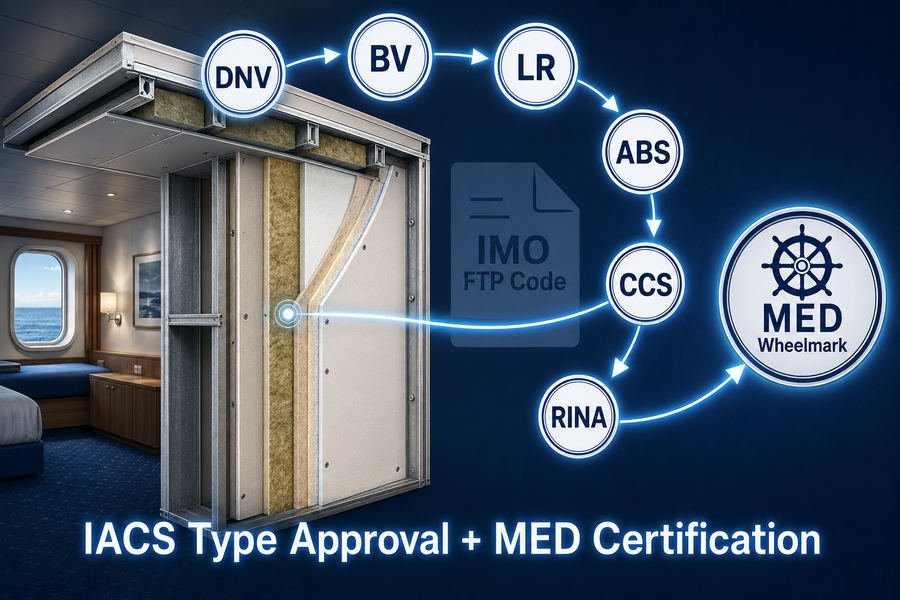
Navigating the long list of maritime certifications can feel hard. A single mistake means the shipyard guards will block your entire shipment at the gate. If you want to stop guessing and start specifying the right approvals for your target market, I will break down what each society brings to the table.
Which Class Societies Commonly Approve Marine Wall and Ceiling Panels?
Using uncertified panels risks dangerous fires and immediate contract termination. You must understand which testing bodies the global maritime industry actually trusts for interior outfitting.
Marine wall and ceiling panels are commonly approved by the "Big Six" IACS members: DNV, BV, LR, ABS, CCS, and RINA. These societies issue Type Approval Certificates confirming the panels meet IMO FTP Code Part 1 (Non-combustibility) and Part 5 (Surface Flammability), ensuring they are legally fit for commercial and passenger vessels.
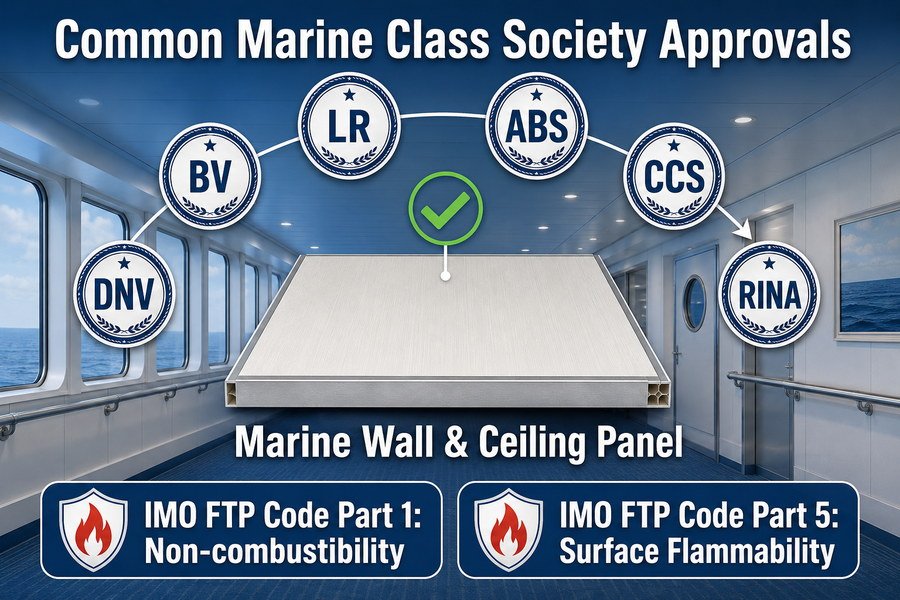
The Core IACS Societies for Panel Outfitting
I am Howard Tao. I help my clients solve marine outfitting problems. You must understand the main testing bodies first. The marine industry trusts the "Big Six" IACS members. DNV, BV, LR, ABS, CCS, and RINA are the primary authorities.1 I interact with these six societies every week. They issue Type Approval Certificates. You need these certificates to sell your panels. DNV comes from Norway. BV operates out of France. LR is based in the United Kingdom. ABS represents the United States. CCS is the Chinese authority. RINA operates from Italy. These six bodies inspect factories. They verify product quality. They ensure your panels belong on commercial and passenger vessels. You cannot sell marine panels without an approval from at least one of these organizations.2
The IMO FTP Code Foundation for Fire Safety
The societies do not invent their own fire rules. They all use the IMO FTP Code. This code sets the global rules. Type Approval Certificates confirm your panels pass specific fire tests. First, panels must meet IMO FTP Code Part 1. This part tests non-combustibility. The laboratory heats the core material in a furnace at 750°C for 30 minutes. The core must not burn. It must not release flammable gases. Second, the panels must meet IMO FTP Code Part 5. This part tests surface flammability. The decorative PVC film or laminate on the panel surface must not spread fire quickly. The critical heat flux at extinguishment must reach at least 20.0 kW/m².3 This stops small cabin fires from spreading. I always ask suppliers for both Part 1 and Part 5 test reports.
| Classification Society | Country of Origin | Primary Focus Area | Certificate Type Issued |
|---|---|---|---|
| DNV | Norway | Global shipping, cruise ships | Type Approval Certificate |
| BV | France | European and African routes | Type Approval Certificate |
| LR | United Kingdom | Traditional global shipping | Type Approval Certificate |
| ABS | United States | US waters, offshore platforms | Type Approval Certificate |
| CCS | China | Chinese domestic and export ships | Type Approval Certificate |
| RINA | Italy | Passenger ships, Mediterranean | Type Approval Certificate |
What Sets DNV, BV, LR, ABS, CCS, and RINA Apart in Marine Panel Approval?
Thinking all class society certificates carry the same weight in every market will ruin your procurement plan. Different societies dominate specific regions and vessel types.
The differences lie in regional dominance and historical focus. DNV is the global leader and cruise industry standard. BV dominates European and African routes. LR is the oldest with strict UK-focused prestige. ABS is the American standard linked to USCG. CCS is mandatory for Chinese-flagged vessels, while RINA holds strong influence in Italian passenger ship construction.
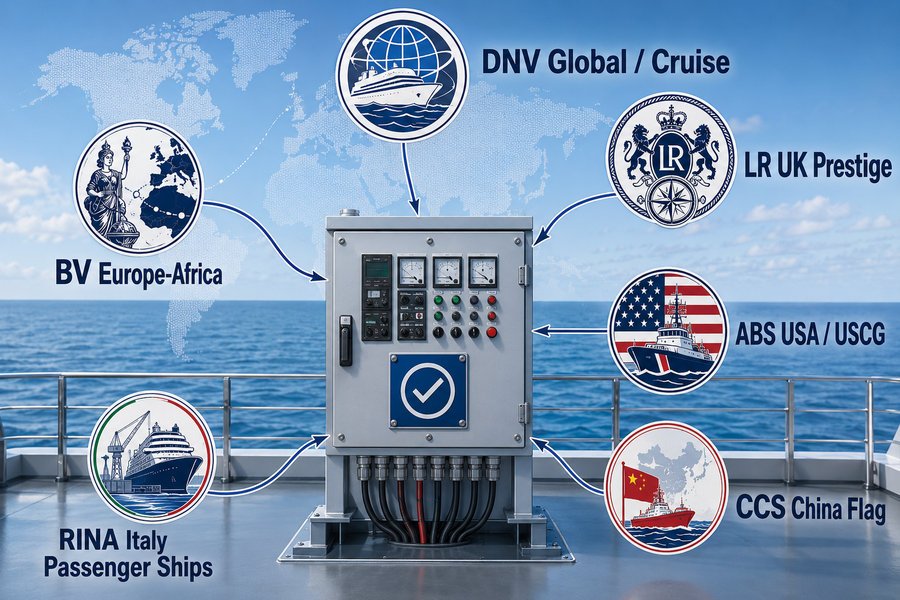
Regional Dominance of European and American Societies
You will see clear differences in regional dominance and historical focus. DNV acts as the global leader. It sets the cruise industry standard. Most high-end projects demand DNV. BV dominates European shipping lanes. It also controls many African routes. This happens because of old trade ties between Europe and Africa. LR holds the title of the oldest classification society. It maintains strict UK-focused prestige. Many traditional shipowners trust LR over anyone else. ABS serves as the American standard. ABS works closely with the USCG.4 You need ABS if your ship operates in US waters. You also need ABS for the US oil and gas industry. I always check the ship's final destination before I choose a society.
The Strategic Positioning of CCS and RINA in Shipbuilding
Asian and Mediterranean markets have their own strong leaders. CCS is mandatory for Chinese-flagged vessels.5 If a Chinese owner builds a ship for domestic rivers, you must provide CCS panels. RINA holds strong influence in Italy. Italy builds many luxury passenger ships. Shipyards use RINA for Italian passenger ship construction. RINA focuses heavily on passenger comfort and fire safety. I tell my clients to use RINA for Mediterranean ferry projects. You must match the society to the shipyard's location. You must also match the society to the vessel's flag.
| Society | Primary Region | Historical Focus | Key Vessel Strength |
|---|---|---|---|
| DNV | Global / Norway | Technical innovation | Cruise ships, advanced vessels |
| BV | Europe / Africa | Trade route compliance | General cargo, ferries |
| LR | United Kingdom | Maritime tradition | High-spec commercial ships |
| ABS | Americas | US regulations | Offshore, US-flagged vessels |
| CCS | China | Domestic growth | Bulk carriers, Chinese-flagged |
| RINA | Italy | Passenger safety | Italian cruise ships, yachts |
Which Class Societies Do European Shipyards Prefer for Marine Ceiling Panels?
Showing the wrong certificate to a European shipyard will instantly ruin your chances. You need to know exactly what buyers in Germany, France, or Italy expect.
European shipyards predominantly prefer DNV, BV, and LR for marine ceiling panels, but they absolutely mandate the MED (Marine Equipment Directive) "Wheelmark" certification. A DNV or BV Type Approval alone is insufficient for EU-flagged vessels; the certificate must explicitly include MED Modules B and D to verify compliance with European safety standards.
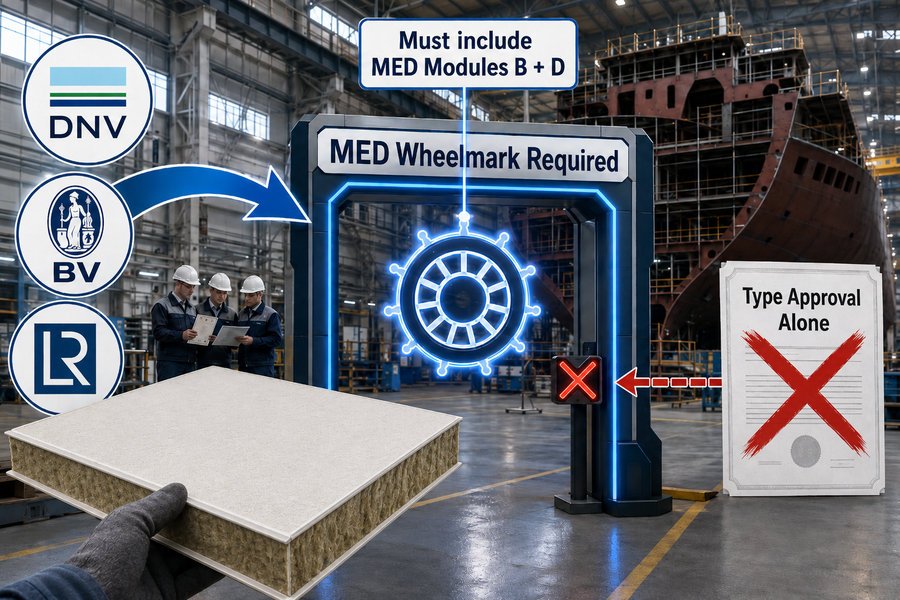
Why European Buyers Demand DNV, BV, and LR Approvals
European shipyards build the most advanced vessels. They mostly prefer DNV, BV, and LR for marine ceiling panels. These three societies have deep roots in Europe. German shipyards love DNV. French shipyards trust BV. British builders rely on LR. I see this preference in almost every European inquiry. You will struggle to sell ceiling panels in Europe without one of these three names. They represent the highest quality control. Buyers feel safe when they see these logos.
The Mandatory Requirement for MED Wheelmark Certification
A standard class certificate is not enough for Europe. European shipyards absolutely mandate the MED (Marine Equipment Directive) "Wheelmark" certification6. This mark proves compliance with European safety standards. A DNV or BV Type Approval alone is insufficient for EU-flagged vessels. You must check the certificate for specific modules. The certificate must explicitly include MED Module B. Module B is the EC Type Examination. It proves your prototype panel passed the fire tests. The certificate must also explicitly include MED Module D. Module D is the Production Quality Assurance. It proves your factory maintains quality during mass production. I always verify both modules. Your panels will stop at the customs gate without the Wheelmark.
| Certification Component | Description | Requirement Status for EU |
|---|---|---|
| DNV / BV / LR Base Approval | Basic society technical review | Preferred but not enough alone |
| MED Wheelmark | EU Marine Equipment Directive | Absolutely Mandatory |
| MED Module B | Prototype fire test examination | Mandatory part of Wheelmark |
| MED Module D | Factory quality control audit | Mandatory part of Wheelmark |
Which Class Societies Do Asian Shipbuilders Rely On for Marine Wall Panels?
Sourcing panels in Asia without understanding local surveyor preferences causes trouble. You must align your certificates with what the big Asian shipyards actually build.
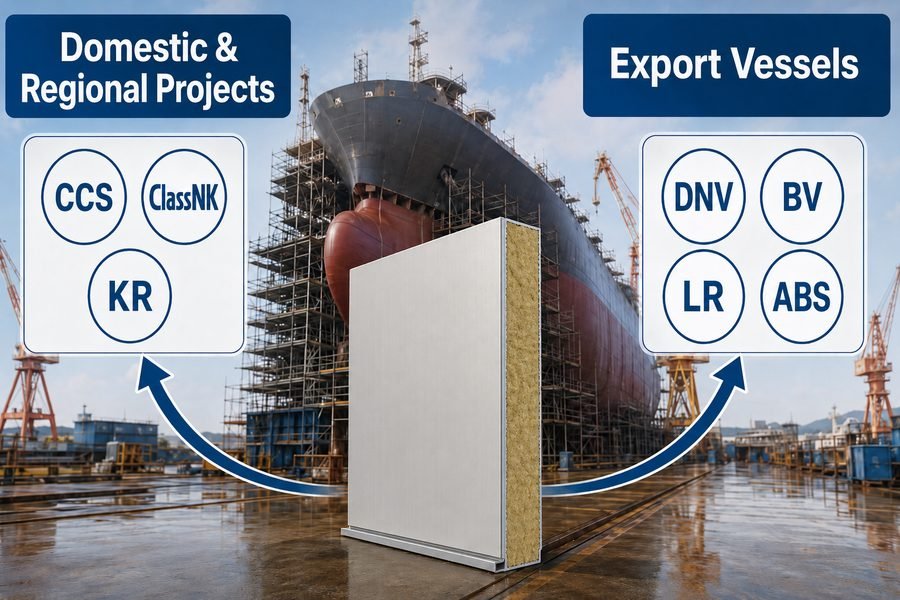
Asian shipbuilders rely heavily on CCS (China Classification Society) for domestic projects, and NK (ClassNK) or KR (Korean Register) for regional vessels. However, when Asian shipyards build export vessels for international owners, they strictly rely on DNV, BV, LR, or ABS approvals, demanding that local suppliers provide these international certificates.
Domestic Preferences in China, Japan, and Korea
Asian shipbuilders build massive volumes of ships7. They support their local classification societies. Chinese shipyards rely heavily on CCS (China Classification Society) for domestic projects. A Chinese cargo ship uses CCS panels. Japanese shipyards prefer NK (ClassNK). NK controls a huge portion of the Asian bulk carrier fleet. South Korean shipyards use KR (Korean Register) for their regional vessels. These local societies offer faster service and lower testing fees for local factories. I often help factories apply for CCS because the communication is easy. Local inspectors visit the factories quickly.
The Export Market Shift to International Societies
The rules change completely for export ships. Asian shipyards build many export vessels for international owners. These foreign owners do not want local Asian class certificates. The shipyards strictly rely on DNV, BV, LR, or ABS approvals for these projects. An owner in Greece will demand LR or ABS, even if a Chinese shipyard builds the boat. The shipyard will demand that local suppliers provide these international certificates. I always warn suppliers about this. You cannot offer a CCS panel for a DNV-classed export ship. You must invest in DNV or BV approvals if you want to join these profitable export supply chains.
| Vessel Destination | Building Location | Preferred Class Society | Reason for Preference |
|---|---|---|---|
| China Domestic | China | CCS | Mandatory for local flag |
| Japan Regional | Japan | NK (ClassNK) | Local support and trust |
| Korea Regional | South Korea | KR (Korean Register) | Local shipyard alignment |
| Europe Export | Any Asian Country | DNV, BV, LR | Shipowner mandate |
| US Export | Any Asian Country | ABS | USCG alignment |
Is CCS Approval for Marine Panels Accepted by Overseas Shipowners?
Buying cheaper CCS-approved panels seems like a smart way to save money until the shipowner rejects them. You must know exactly when CCS is acceptable globally.
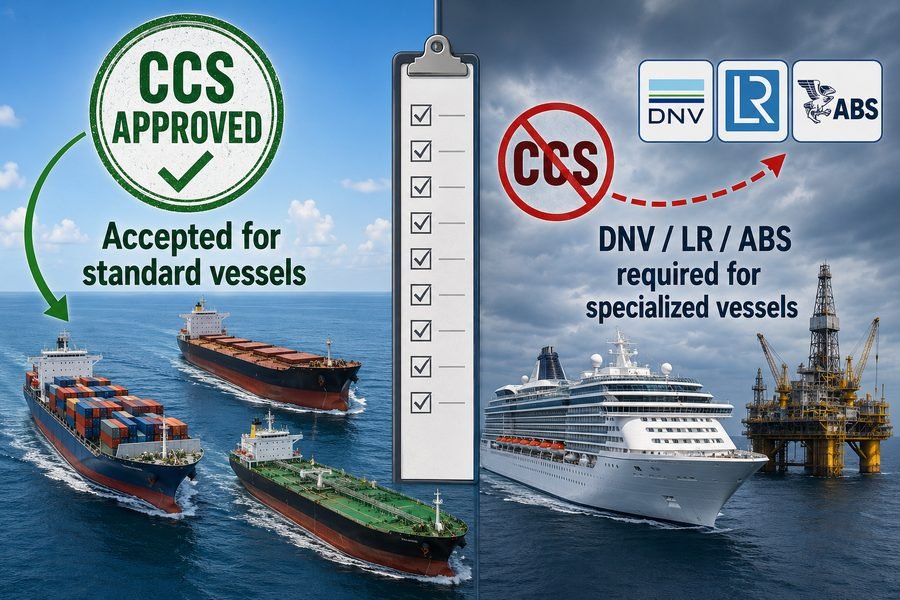
CCS approval is widely accepted by overseas shipowners for standard cargo vessels, bulk carriers, and tankers, as CCS is a fully recognized IACS member. However, for specialized vessels, high-end cruise ships, or offshore platforms, European or American shipowners often reject CCS and explicitly mandate DNV, LR, or ABS certifications instead.
The Acceptance of CCS in Standard Commercial Shipping
Many suppliers ask me about the global power of CCS. CCS is a fully recognized IACS member.8 This membership gives CCS strong credibility. CCS approval is widely accepted by overseas shipowners for standard cargo vessels. You can easily use CCS panels on simple ships. Bulk carriers moving iron ore accept CCS. Oil tankers also accept CCS. An owner in Southeast Asia or the Middle East will usually approve CCS without arguments. I save my clients money by using CCS panels for these cargo projects. The panels perform well and cost less.
Resistance from High-End and Offshore Sectors
The situation changes for expensive ships. You will face resistance from European or American shipowners. These owners often reject CCS for specialized vessels. They do not accept CCS for high-end cruise ships. They refuse CCS for offshore oil platforms. These projects carry high financial risks. The owners explicitly mandate DNV, LR, or ABS certifications instead.9 A cruise ship owner feels safer with DNV. An offshore platform operator demands ABS. I never quote CCS panels for a European cruise ship repair job. You must know the vessel type before you offer a CCS certificate.
| Vessel Type | Typical Shipowner Region | CCS Acceptance Level | Required Alternative (If Rejected) |
|---|---|---|---|
| Standard Cargo | Middle East, Asia | High | N/A |
| Bulk Carrier | Global | High | N/A |
| Specialized Vessel | Europe | Low | DNV or BV |
| High-End Cruise Ship | US, Europe | Very Low | DNV, RINA + MED |
| Offshore Platform | Americas | Very Low | ABS |
Supplying panels to cruise ships or navy ships involves the highest stakes in the marine industry. Failing to provide the top tier of certification guarantees rejection.
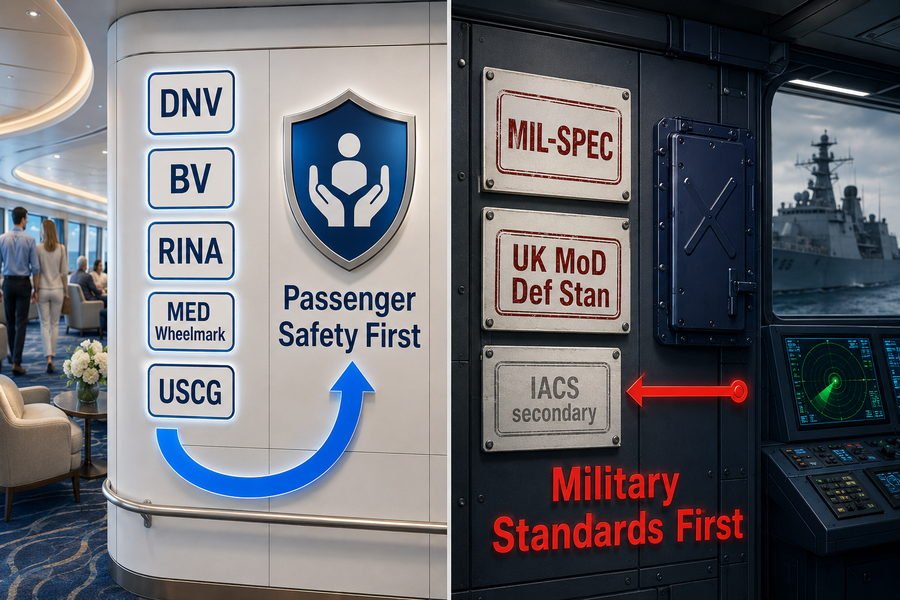
For cruise projects, DNV, BV, and RINA paired with MED Wheelmark and USCG (U.S. Coast Guard) approvals matter most to guarantee passenger safety. For naval panel projects, standard IACS class approvals are secondary; they require strict compliance with specific military standards, such as US Navy MIL-SPEC or UK MoD Def Stan.
Securing Certifications for the Global Cruise Industry
Cruise ships carry thousands of sleeping people. They require the strictest fire safety rules. For cruise projects, specific European societies lead the market. DNV, BV, and RINA matter most here. RINA is especially strong because Italy builds many cruise ships. You must pair these class approvals with MED Wheelmark. You also need USCG (U.S. Coast Guard) approvals. Most cruise ships visit American ports. The USCG inspects them. The USCG and MED have a mutual recognition agreement.10 This combination guarantees passenger safety. I always check for the USCG approval number on the certificate.
Military ships operate in war zones. They do not follow standard commercial rules. For naval panel projects, standard IACS class approvals are secondary. A DNV certificate means very little to a Navy admiral. Naval vessels require strict compliance with specific military standards. American projects demand the US Navy MIL-SPEC. British projects require the UK MoD Def Stan. These standards test for shock resistance from explosions11. They test for extreme vibration. Commercial panels usually fail these military tests. I tell suppliers to avoid naval projects unless they want to spend thousands of dollars on specialized blast testing.
| Project Type | Primary Authority | Key Standards to Meet | Focus Area |
|---|---|---|---|
| Cruise Ships | DNV, BV, RINA | MED Wheelmark, USCG | Passenger fire safety |
| US Naval Ships | US Navy | MIL-SPEC | Shock and blast resistance |
| UK Naval Ships | UK Ministry of Defence | Def Stan | Combat survivability |
Conclusion
Choosing the right classification society dictates your success in marine outfitting. You must match DNV, BV, LR, ABS, CCS, or military approvals to the specific shipyard, vessel type, and target market.
-
"International Association of Classification Societies - Wikipedia", https://en.wikipedia.org/wiki/International_Association_of_Classification_Societies. The International Association of Classification Societies lists DNV, Bureau Veritas, Lloyd’s Register, ABS, China Classification Society, and RINA among its member classification societies, supporting their status as recognized marine classification bodies. Evidence role: expert_consensus; source type: institution. Supports: DNV, BV, LR, ABS, CCS, and RINA are major recognized classification societies relevant to marine panel approval.. Scope note: The source establishes IACS membership and recognition, but it does not by itself prove that these six are the only or universally 'primary' authorities for all panel outfitting markets. ↩
-
"History of SOLAS fire protection requirements", https://www.imo.org/en/OurWork/Safety/Pages/History-of-fire-protection-requirements.aspx. IMO and flag-state marine equipment frameworks require shipboard fire-protection materials to meet specified approval and testing requirements before installation on SOLAS-regulated vessels, which contextualizes why classification-society or flag-administration approval is commercially necessary for marine panels. Evidence role: general_support; source type: government. Supports: Marine panels intended for regulated vessels generally require recognized approval before they can be accepted for shipboard use.. Scope note: This supports the need for approval for use or installation on regulated vessels, not an absolute legal ban on selling panels for every possible non-regulated application. ↩
-
"What Is the IMO FTP Code for Marine Interior Materials? - Magellan ...", https://magellanmarinetech.com/what-imo-ftp-code-for-marine-interior-materials/. The IMO FTP Code Part 5 surface flammability test includes criteria for flame spread and critical flux at extinguishment, including a 20.0 kW/m² threshold for certain bulkhead, ceiling, and deck finish materials. Evidence role: statistic; source type: government. Supports: IMO FTP Code Part 5 can require a critical heat flux at extinguishment of at least 20.0 kW/m² for relevant marine interior surface materials.. Scope note: The threshold depends on the material category and application, so the citation should be checked against the exact panel surface use being discussed. ↩
-
"Alternate Compliance Program: Vessel Inspection Alternatives", https://www.federalregister.gov/documents/2009/05/04/E9-10113/alternate-compliance-program-vessel-inspection-alternatives. U.S. Coast Guard guidance on recognized organizations and the Alternate Compliance Program identifies the American Bureau of Shipping as authorized to perform specified inspection and certification functions on behalf of the Coast Guard, supporting the existence of a formal ABS–USCG regulatory relationship. Evidence role: general_support; source type: government. Supports: ABS works closely with the USCG.. Scope note: This supports formal cooperation, but it does not prove that ABS is required for every vessel operating in U.S. waters. ↩
-
"RECOGNIZED ORGANIZATIONS", https://www.imo.org/en/OurWork/IIIS/Pages/Recognized-Organizations.aspx. Chinese maritime-administration or IMO recognized-organization documentation can show that China Classification Society is delegated to conduct statutory survey and certification work for Chinese-flagged ships, providing regulatory context for CCS use under the Chinese flag. Evidence role: general_support; source type: government. Supports: CCS is mandatory for Chinese-flagged vessels.. Scope note: Such evidence may establish delegation or recognition rather than an unconditional requirement that every Chinese-flagged vessel use CCS in all operating contexts. ↩
-
"Directive 96/98/EC - Wikipedia", https://en.wikipedia.org/wiki/Directive_96/98/EC. Directive 2014/90/EU establishes harmonised EU rules for marine equipment placed on board EU ships and requires compliant equipment to bear the Wheelmark as evidence of conformity with applicable safety requirements. Evidence role: definition; source type: government. Supports: European shipyards require MED Wheelmark certification for marine ceiling panels used on EU-flagged vessels.. Scope note: This supports the legal role of the Wheelmark for equipment covered by the Directive and installed on EU-flagged ships; it does not prove that every European shipyard requires it in every procurement case. ↩
-
"Peer Review of the Japanese Shipbuilding Industry 2026 - OECD", https://www.oecd.org/en/publications/peer-review-of-the-japanese-shipbuilding-industry-2026_717ba40f-en.html. UNCTAD shipbuilding statistics report that China, the Republic of Korea, and Japan account for the dominant share of global shipbuilding output by gross tonnage, supporting the characterization of East Asian shipyards as high-volume builders. Evidence role: statistic; source type: institution. Supports: Asian shipbuilders build massive volumes of ships.. Scope note: The data supports regional production scale, not specific class-society preferences within individual shipyards. ↩
-
"China Classification Society - Wikipedia", https://en.wikipedia.org/wiki/China_Classification_Society. The International Association of Classification Societies membership list identifies China Classification Society as an IACS member, supporting the statement that CCS has formal recognition within the principal international association of marine classification societies. Evidence role: definition; source type: institution. Supports: CCS is a fully recognized IACS member.. ↩
-
"[PDF] Structure, Equipment and Systems for Offshore Wind ... - BSEE.gov", https://www.bsee.gov/sites/bsee.gov/files/tap-technical-assessment-program/633ae.pdf. Government or industry guidance on offshore and high-specification marine projects commonly refers to classification or verification by recognized classification societies, including ABS, DNV, and Lloyd’s Register, which contextualizes why project specifications may name particular societies for risk-sensitive assets. Evidence role: general_support; source type: government. Supports: Owners in high-end cruise or offshore sectors may specify DNV, LR, or ABS certifications instead of accepting CCS.. Scope note: Such sources can support the regulatory and industry context for named classification societies, but they do not directly prove that all European or American owners reject CCS or universally mandate these alternatives. ↩
-
"United States and European Community Sign Mutual Recognition ...", https://ustr.gov/archive/Document_Library/Press_Releases/2004/February/United_States_European_Community_Sign_Mutual_Recognition_Agreement.html. European Commission and U.S. Coast Guard materials on the EU–U.S. Mutual Recognition Agreement describe marine equipment as a covered sector in which specified conformity-assessment results may be recognized across jurisdictions under defined conditions. Evidence role: general_support; source type: government. Supports: The USCG and MED have a mutual recognition agreement.. Scope note: This supports the existence and scope of mutual recognition for certain marine equipment approvals, but it does not show that every MED Wheelmark item is automatically accepted by the USCG or that the arrangement by itself guarantees passenger safety. ↩
-
"MIL-S-901 - Wikipedia", https://en.wikipedia.org/wiki/MIL-S-901. U.S. Department of Defense shipboard equipment standards such as MIL-S-901/MIL-STD-901 address high-impact shock testing for naval equipment, while related standards such as MIL-STD-167 address mechanical vibration requirements for shipboard equipment. Evidence role: mechanism; source type: government. Supports: Naval vessel standards test equipment for shock resistance from explosions and extreme vibration.. Scope note: The standards establish shock and vibration test frameworks for specified naval equipment; the exact applicability and severity depend on the contract, equipment class, and referenced standard revision. ↩