Buying marine accommodation panels without checking certificates leads to shipyard rejection. I see buyers lose thousands on useless panels. Here is how you verify class certificates before placing an order.
Overseas buyers verify marine accommodation panel certificates by systematically checking five elements: class society approval, certificate validity dates, exact model matching, correct vessel type scope, and specific fire rating requirements according to SOLAS regulations. This complete check prevents costly rework and shipyard rejections.
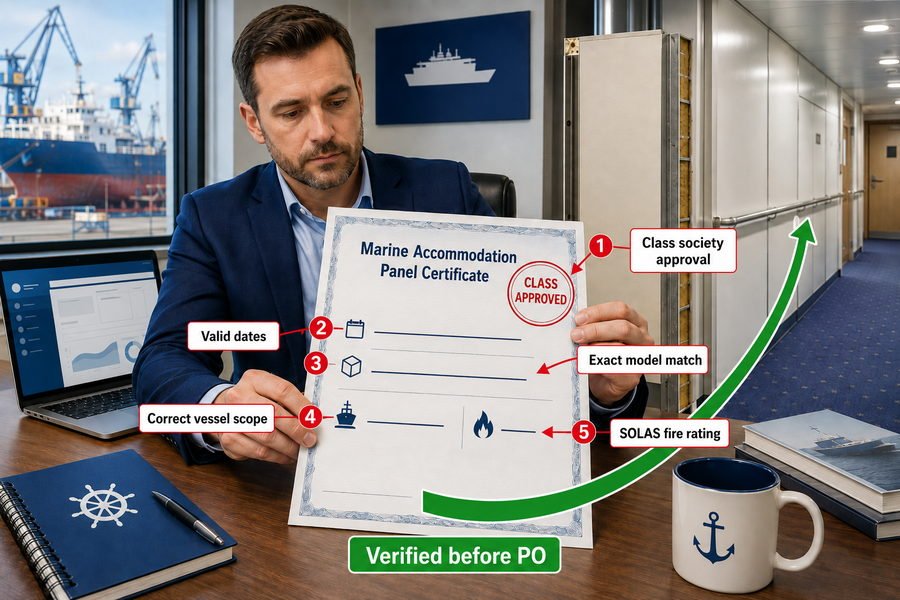
Let us look closely at the exact details you must check to keep your projects safe and profitable.
Which Certificate Details Must a Buyer Cross-Check Before Approving a Marine Accommodation Panel Sample?
Approving a sample blindly can ruin your project. A good-looking panel is useless if the paperwork is wrong. Let me show you what to check first.
Before approving a marine accommodation panel sample, buyers must cross-check four critical details: the specified fire class (A-60, B-15, B-0), acoustic reduction values (Rw), maximum approved panel dimensions, and core material density (e.g., rockwool at 120-150 kg/m³) to ensure shipyard compliance.
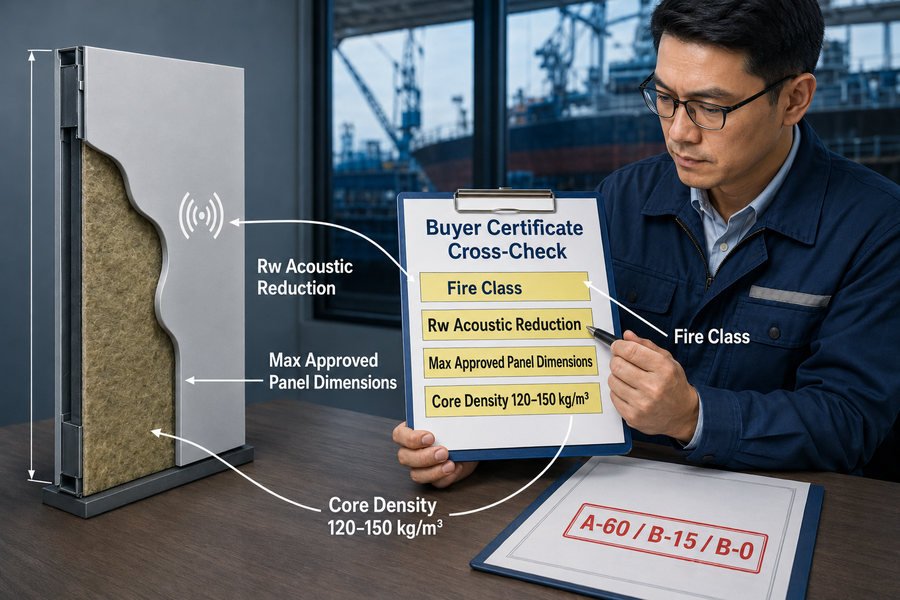
As a marine outfitting specialist, I always tell my clients to look past the shiny surface of a sample. You must verify the engineering facts. The paperwork tells the true story of the product. Let us break down the four exact details you must cross-check.
Cross-Checking Fire Class and Acoustic Reduction Values
The first thing you check is the fire class. Shipyards are very strict about this. The International Convention for the Safety of Life at Sea (SOLAS) Chapter II-2 dictates fire safety. A marine panel must have a clear rating like A-60 or B-15. An A-60 panel stops fire and smoke for 60 minutes. A B-15 panel stops fire for 30 minutes but only limits temperature rise for 15 minutes.1 If your shipyard asks for an A-60 panel, a B-15 certificate is totally useless.
Next, you must check the acoustic reduction value, usually marked as Rw. Passenger ships and offshore living quarters need quiet rooms. The IMO code often requires a sound reduction of at least 35 dB for cabin walls.2 Many high-end European cruise ships require 45 dB or more. If the certificate shows only 30 dB, the shipyard will reject your sample. You must compare the decibel number on the certificate directly with the shipyard's written specification.
Verifying Maximum Accommodation Panel Dimensions and Core Density
The third critical detail is the maximum approved panel dimensions. Class societies test panels at specific sizes. Usually, the standard width is 550mm or 600mm. The certificate will state the maximum width and height allowed. If you order a custom panel that is 1200mm wide, but the certificate only approves up to 600mm, the certificate becomes invalid. The shipyard inspector will not accept it.
The fourth detail is the core material density. The density of the rockwool inside the panel determines both the fire rating and the price.3 According to IMO Fire Test Procedures (FTP) Code Part 3, an A-60 wall panel usually requires a rockwool density between 120 kg/m³ and 150 kg/m³. Some factories try to lower the price by using 100 kg/m³ rockwool. This is dangerous. You must check that the core density written on the certificate matches the physical sample you receive.
| Detail to Cross-Check | Standard Value / Example | Why It Matters |
|---|---|---|
| Fire Class | A-60, B-15, B-0 | Meets SOLAS safety rules for different ship zones. |
| Acoustic Reduction (Rw) | 35 dB to 45 dB | Ensures passenger comfort and meets noise rules. |
| Maximum Dimensions | Width: 600mm | Larger sizes may fail fire tests and lose approval. |
| Core Material Density | 120 - 150 kg/m³ | Guarantees fire resistance and structural strength. |
How to Confirm a Marine Accommodation Panel Certificate Is Still Valid at PO Stage?
An expired certificate means the shipyard will reject the panels. I have seen buyers stuck with containers of useless goods. Here is how to check validity.
You confirm marine panel certificate validity by checking three dates: the Date of Issue, Date of Expiry, and the latest annual endorsement stamp. Additionally, verify the certificate number directly in the issuing class society's online database, such as DNV or ABS, to catch forged or revoked documents.
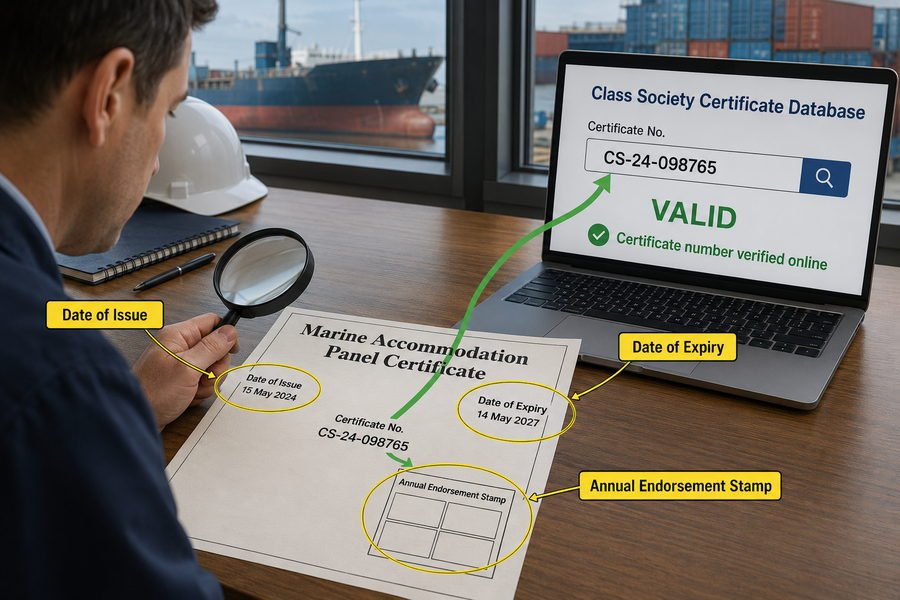
Paperwork can be tricky. Some suppliers use old certificates to get orders. They hope you will not look closely. I always perform a strict background check on the document before I issue a Purchase Order. You need to verify the dates and cross-check with the official database.
Checking Issue, Expiry, and Annual Endorsement Dates
You must start by reading the dates on the front page of the certificate. According to the International Association of Classification Societies (IACS) rules, a Type Approval Certificate is generally valid for five years from the Date of Issue. You must look at the Date of Expiry. If you place a PO in May 2026, and the certificate expires in June 2026, you will have a problem. The goods might arrive at the shipyard in July. By then, the certificate is dead. I always demand a certificate that is valid for at least six more months.
Also, some class certificates require an annual endorsement4. This means an inspector visits the factory every year to check their quality control. Look for a stamp or signature box on the second or third page. If the certificate is three years old but has no annual endorsement stamps, the certificate is automatically suspended5. You cannot use it.
Verifying Certificate Numbers in Class Society Databases
Looking at a PDF file is not enough. Sadly, some bad suppliers use Photoshop to change expiry dates. To protect yourself, you must use the internet. Every major class society has an online search tool. For example, DNV has the DNV Approval Finder. ABS has the ABS Type Approval database.
You must type the certificate number exactly as it appears on the paper into the official website. The online system will show you the real status. It will tell you if the certificate is "Valid," "Expired," or "Withdrawn." If the factory had poor quality in a recent audit, the class society might withdraw the approval. The factory will still show you the old PDF, but the online database will tell you the truth.
| Verification Step | Action Required | Result if Failed |
|---|---|---|
| Expiry Date Check | Read the Date of Expiry on the certificate. | Goods arrive with an invalid document. |
| Endorsement Check | Look for annual inspection stamps. | Certificate is suspended due to missing audits. |
| Online Database Check | Type the certificate number into DNV/ABS website. | You discover a forged or withdrawn certificate. |
Why Must the Marine Accommodation Panel Model on the Certificate Match the Quotation?
Many suppliers quote a cheap model but send a certificate for an expensive one. This mismatch causes massive headaches during final ship inspection.
The marine accommodation panel model on the certificate must exactly match the quotation because class societies only approve specific structural combinations. A mismatch in the model name means differences in steel thickness, adhesive type, or rockwool density, directly voiding the fire rating and leading to immediate installation rejection.
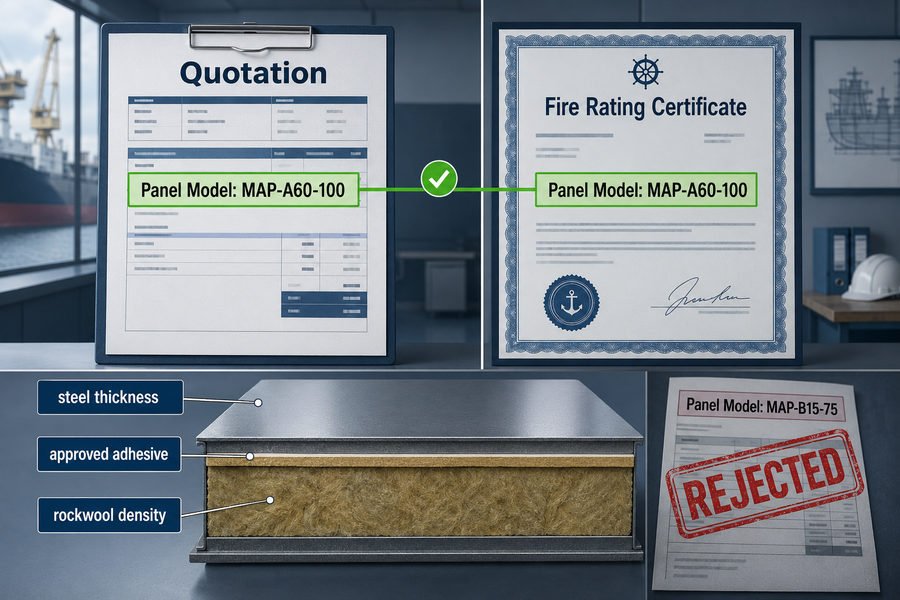
The model name is the most important link between what you pay for and what the class society tested. A supplier might quote you a model named "Type-A." But the certificate they send is for "Type-A Plus." This is a big trap. The shipyard will notice this difference. Let us explore why a mismatched model means different materials.
The Impact of Mismatched Steel Thickness and Adhesive Types
Every marine panel model is a precise recipe. When a class society approves a model, they record the exact steel thickness and the exact glue used.6 For example, a certified B-15 panel model might require a 0.6mm galvanized steel sheet on both sides. If the supplier quotes you a cheaper model, they might use 0.4mm steel. A 0.4mm steel sheet saves the factory about 15% in material costs. But it will warp and fail during a real fire.
The adhesive type is also tied to the model. IMO FTP Code Part 5 tests surface flammability.7 A high-quality model uses a certified two-component polyurethane adhesive. A cheaper, uncertified model might use a basic commercial glue that creates toxic black smoke when it burns8. If the quotation model does not perfectly match the certificate model, you are probably buying the dangerous, cheap glue.
How Core Density Changes Invalidate the Stated Model
The model name also locks in the rockwool density. As I mentioned before, density is money. Let us say the certificate is for model "Fire-Wall-60." The test report for "Fire-Wall-60" proves it uses 150 kg/m³ rockwool. If the supplier quotes you a variation, like "Fire-Wall-Light," they are changing the density. They might use 100 kg/m³ rockwool to offer you a lower price.
This lower price looks great on your spreadsheet. But the class society did not test the "Light" version. The fire rating is gone.9 When the shipyard inspector cuts the panel during installation, they will weigh the core. They will see it is too light. They will reject the entire batch. You must demand that every single letter and number in the quoted model name matches the certificate exactly.
| Material Element | High-Quality Model (On Certificate) | Cheap Mismatched Model (On Quotation) |
|---|---|---|
| Steel Surface Thickness | 0.6mm or 0.8mm | 0.4mm (Fails structural tests) |
| Adhesive Type | Two-component PU (Low smoke) | Standard commercial glue (High toxic smoke) |
| Rockwool Density | 120 - 150 kg/m³ | 80 - 100 kg/m³ (Fails fire resistance tests) |
How to Confirm a Marine Accommodation Panel Certificate Is Issued for the Correct Vessel Type?
Buying a panel approved for a cargo ship when you need it for a passenger cruise will fail. Different ships have different rules.
To confirm a marine accommodation panel certificate matches the correct vessel type, buyers must compare the "Application/Limitation" section of the document against the vessel's distinct SOLAS chapter requirements, distinguishing between offshore platforms, high-speed crafts (HSC), passenger ships, and standard cargo vessels.
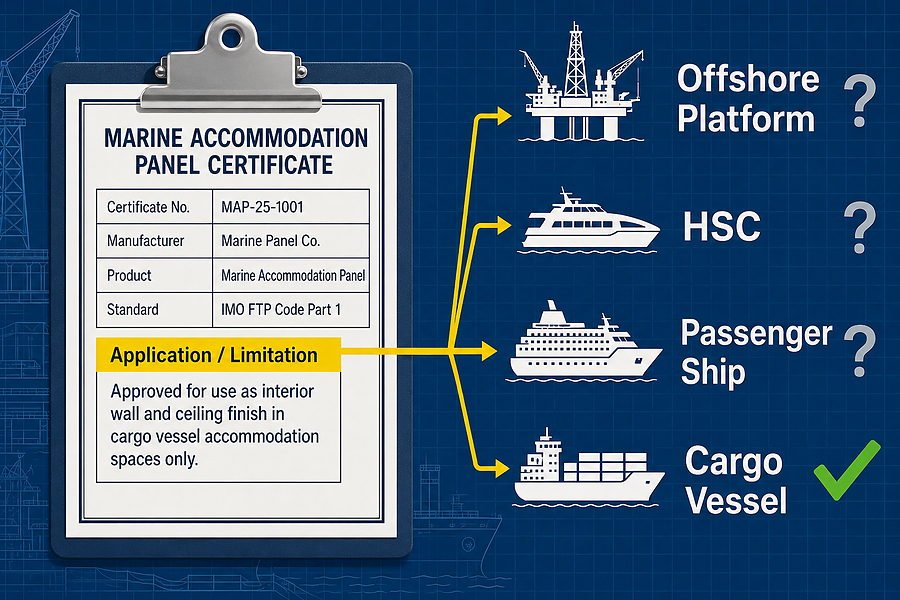
Not all ships are built the same. A bulkhead that works perfectly on a dirty oil tanker will be illegal on a luxury cruise ship. The class certificate always tells you where the panel is allowed to be used. You must read the fine print. Let us look at how you verify the vessel type.
Differentiating SOLAS Requirements for Passenger and Cargo Vessels
You must find the section on the certificate titled "Application/Limitation10". Here, the class society states clearly where the panel can go. Passenger ships carry hundreds of people who do not know how to escape a fire. Therefore, SOLAS Chapter II-2 places very strict rules on passenger vessels. Panels used here must pass extra tests for smoke generation and toxicity under IMO FTP Code Part 211.
If you are buying for a passenger ship, the certificate must explicitly say "Approved for use on passenger ships." Cargo vessels carry trained crew members. The rules are a bit lower. A certificate might say "Approved for use on cargo vessels only." If you buy this cargo-only panel for a passenger project, the surveyor will stop your work immediately. You must match the certificate wording to your end customer's ship type.
Special Rules for High-Speed Crafts and Offshore Platforms
High-speed crafts (HSC) and offshore oil platforms have totally different rules. An HSC, like a fast ferry, must be very light. Heavy steel panels will make the boat too slow. The IMO has a special rulebook called the HSC Code 200012. Certificates for these boats will show approval for lightweight materials, like aluminum honeycomb panels. If the certificate does not mention the HSC Code, do not buy it for a fast ferry.
Offshore platforms are the opposite. They face massive oil fires. They use the "H-Class" rating, like H-60 or H-120. These fires are much hotter than standard ship fires. A standard A-60 certificate is useless on an oil rig. The certificate must state "Approved for Offshore Installations." You must always ask your shipyard client what type of vessel they are building before you look at any certificates.
| Vessel Type | Key Regulation / Code | Certificate Requirement |
|---|---|---|
| Passenger Ships | SOLAS Chapter II-2 | Must pass strict smoke and toxicity tests. |
| Cargo Vessels | SOLAS Chapter II-2 | Standard A-Class and B-Class approvals. |
| High-Speed Crafts (HSC) | IMO HSC Code 2000 | Must be approved for lightweight materials. |
| Offshore Platforms | Mobile Offshore Drilling Units (MODU) | Requires H-Class high-temperature fire ratings. |
Which Red Flags Signal a Mismatch Between Marine Accommodation Panel Certificate and Vessel Class?
Sometimes the paperwork looks fine, but hidden details show it is wrong for your ship. I learned to spot these tricks the hard way.
Four main red flags signal a certificate mismatch: the absence of the MED "Wheelmark" for European vessels, missing USCG approval numbers for American waters, a listed fire rating lower than the shipyard specification, and limitations restricting the panel strictly to non-combustible core applications when a composite is needed.
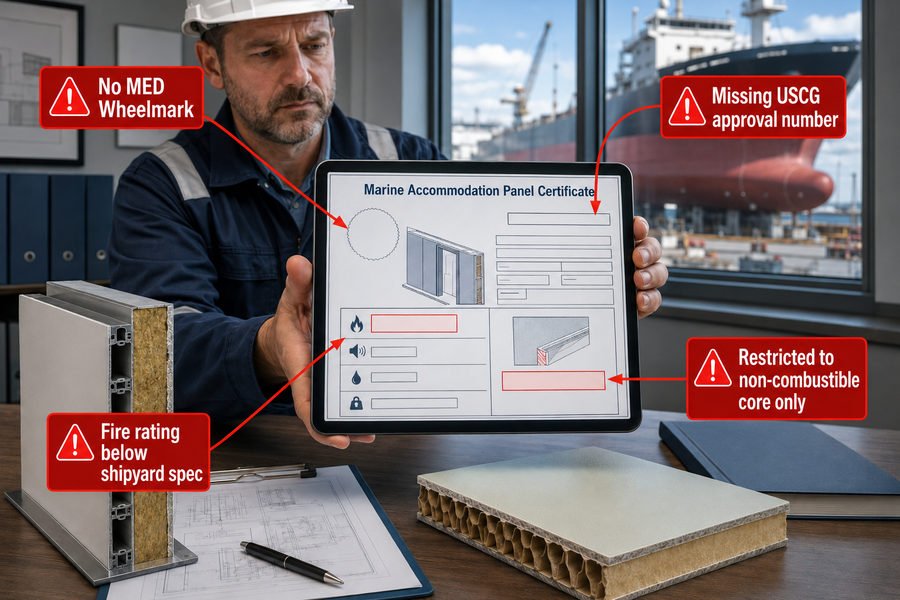
I have helped many clients fix massive mistakes just days before shipping. Usually, the mistake happens because the buyer ignored small warnings on the certificate. These warnings are red flags. Let us look at the four biggest red flags you must spot.
Spotting Missing MED Wheelmarks and USCG Approvals
The first red flag is missing regional approvals. If your client is building a ship that flies a European flag, the marine panels must comply with the Marine Equipment Directive (MED) 2014/90/EU13. This means the certificate must show a "Wheelmark" logo. If the certificate is from a good class society but has no Wheelmark, you cannot use it in Europe. This is a huge red flag.
The second red flag applies to the United States. Ships operating in US waters need United States Coast Guard (USCG) approval14. Thanks to a Mutual Recognition Agreement (MRA)15, a European MED certificate can often get a USCG approval number. The certificate must clearly print the USCG approval number, usually looking like "164.112/EC...". If your project is American and you do not see this number, stop the order.
Identifying Lower Fire Ratings and Core Material Restrictions
The third red flag is a sneaky fire rating change. Sometimes a supplier quotes you for an A-60 panel. But when you read the certificate, the fine print says "A-60 rating achieved only when used with additional 50mm insulation16." This means the panel itself is only A-30 or A-0. You would have to buy extra insulation to reach A-60. This kills your budget and installation time.
The fourth red flag is about material restrictions. Look closely at the "Limitations" section. The certificate might say "Approved only for use as a non-combustible core." This means the panel cannot have a decorative PVC film on top. If your client wants a wood-grain finish, which makes it a composite material, this certificate is wrong. Buying it will cause a disaster.
| Red Flag on Certificate | What It Means | Impact on Your Project |
|---|---|---|
| No MED Wheelmark | Does not meet EU Directive 2014/90/EU. | Banned from use on European flagged ships. |
| No USCG Number | Lacks US Coast Guard approval. | Cannot be used on American flagged vessels. |
| "Requires extra insulation" | The panel alone does not meet the fire rating. | Increases your material and labor costs heavily. |
| "Non-combustible use only" | The panel cannot have decorative finishes. | Shipyard rejects the panels for interior cabin use. |
How to Avoid PO Rework Caused by Wrong Marine Accommodation Panel Certification Scope?
Reworking a purchase order wastes weeks and kills your profit margin. You need a strict system to get the certification scope right the first time.
You avoid PO rework by implementing a three-step verification process: mandating the supplier sends the full certificate PDF before quoting, adding a specific clause in the PO tying payment to certificate compliance, and hiring a third-party surveyor to verify physical labels match the approved scope during pre-shipment inspection.
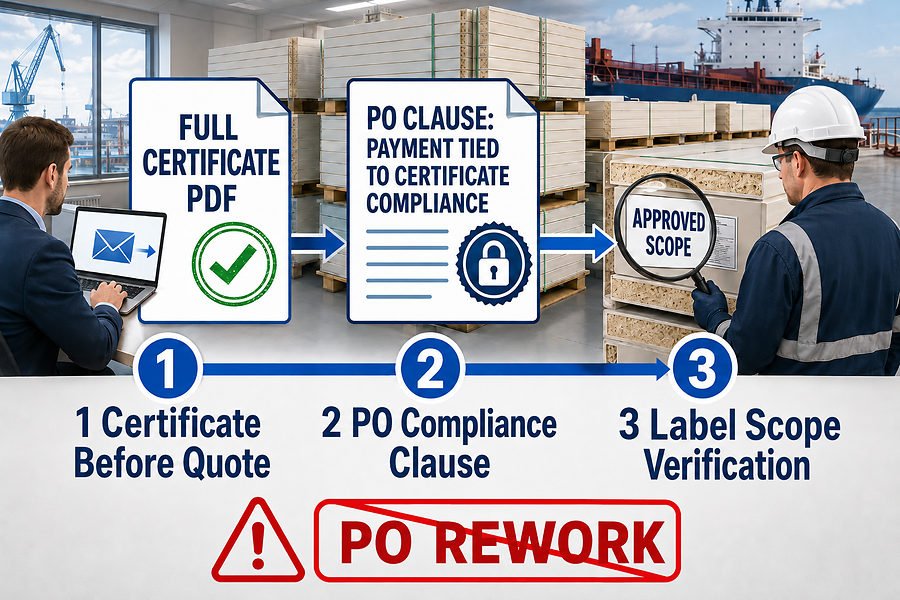
A bad certificate means you have to cancel the PO, fight for your deposit, and start over. Your boss will be angry, and your shipyard client will look for another supplier. You must control the process from the very beginning. Here is the three-step system I use to protect my clients.
Mandating Advance PDF Verification and Tying Payments to Compliance
The first step is simple but powerful. Never accept a price quotation without the certificate. I tell suppliers: "Do not send me a price until you send me the full PDF certificate17." This forces them to show their hand. I read every page. I check the fire class, the dimensions, and the vessel type. Only after the PDF passes my check do I look at the price.
The second step happens when you write the PO. You must add a tough legal clause. Do not just write "100 pcs Marine Panel." Write "100 pcs Marine Panel, exactly matching DNV Certificate No. 12345. Final balance payment of 30% will only be released after surveyor confirms the physical goods match this exact certificate.18" This makes the factory take you seriously. They know they will lose money if they play tricks.
Utilizing Third-Party Surveyors to Verify Physical Labels
The third step is your final wall of defense. A perfect PDF certificate is great, but the factory still needs to make the correct goods. You must hire a third-party surveyor19. Companies like SGS or local marine inspectors are very good at this. You send the surveyor to the factory right before the goods go into the shipping container.
The surveyor has one main job. They must check the physical labels glued to the back of the marine panels. According to class rules, every single panel must have a label showing the manufacturer name, the exact model number, the fire rating, and the class society stamp. The surveyor checks these physical labels against the PDF certificate you approved. If the label says "100 kg/m³" but the certificate says "150 kg/m³", the surveyor stops the shipment. This saves you from shipping garbage across the ocean.
| Verification Step | Action | Benefit |
|---|---|---|
| Step 1: Advance PDF | Demand full certificate before accepting quotes. | Filters out fake suppliers early. |
| Step 2: PO Clause | Tie the 30% balance payment to strict compliance. | Forces the factory to respect the quality rules. |
| Step 3: Third-Party Check | Surveyor matches physical labels to the PDF. | Stops wrong goods before they leave the country. |
Conclusion
Verify class certificates by checking validity dates, specific model numbers, and vessel types. This diligent process protects your marine outfitting projects, saves money, and ensures smooth shipyard installations.
-
"What Is the Purpose and Scope of the IMO FTP Code? - Magellan ...", https://magellanmarinetech.com/what-purpose-scope-of-imo-ftp-code/. The FTP Code and SOLAS definitions classify A-class divisions as preventing smoke and flame passage for a one-hour standard fire test, with A-60 insulation criteria maintained for 60 minutes; B-class divisions prevent flame passage for the first half hour, with B-15 insulation criteria maintained for 15 minutes. Evidence role: definition; source type: institution. Supports: A-60 and B-15 ratings correspond to defined fire-resistance and insulation-duration requirements.. Scope note: The wording in the article simplifies the formal temperature-rise criteria used in the test standard. ↩
-
"[PDF] MSC.337(91) (adopted on 30 November 2012) CODE ON NOISE ...", https://wwwcdn.imo.org/localresources/en/KnowledgeCentre/IndexofIMOResolutions/MSCResolutions/MSC.337(91).pdf. The IMO Code on Noise Levels on Board Ships includes airborne sound-insulation criteria for accommodation spaces, including Rw values around 35 dB for specified cabin-to-cabin partitions. Evidence role: statistic; source type: institution. Supports: IMO noise rules can require approximately 35 dB airborne sound reduction for cabin partitions.. Scope note: The exact required value depends on ship type, space adjacency, and the edition or implementation of the code; the source supports the 35 dB figure as a code criterion rather than a universal rule for every cabin wall. ↩
-
"Determination of Thermal Properties of Mineral Wool Required for ...", https://pmc.ncbi.nlm.nih.gov/articles/PMC10488771/. Studies of mineral-wool and sandwich-panel fire performance report that core properties such as density affect heat transfer, structural response, and fire-resistance behavior of insulated panels. Evidence role: mechanism; source type: paper. Supports: Rockwool core density is an important factor in the fire performance of marine accommodation panels.. Scope note: This supports the engineering relevance of rockwool density to fire performance; it does not independently prove a specific commercial price relationship or a universal density requirement for all A-60 panels. ↩
-
"[PDF] LIST OF CERTIFICATES AND DOCUMENTS REQUIRED", https://wwwcdn.imo.org/localresources/en/publications/Documents/IMO-Vega/B-FAL.2-Circ.133%20-%20List%20Of%20Certificates%20And%20Documents%20RequiredTo%20Be%20Carried%20On%20Board%20Ships,%202022%20(Secretariat).pdf. Classification society type approval procedures commonly require periodic or annual surveillance/endorsement to maintain certificate validity, supporting the article’s statement that some certificates need annual confirmation. Evidence role: mechanism; source type: institution. Supports: Some class certificates require an annual endorsement.. Scope note: The requirement is not universal; it depends on the issuing society, product category, and conditions printed on the certificate. ↩
-
"[PDF] Common Violations - CSA", https://csa.fmcsa.dot.gov/safetyplanner/documents/Forms/Common%20Violations_508.pdf. Classification society approval rules generally allow suspension or withdrawal of type approval when required surveillance, audits, or endorsements are not completed, supporting the compliance consequence described here. Evidence role: general_support; source type: institution. Supports: If required annual endorsement stamps are missing, the certificate may be suspended and should not be relied upon.. Scope note: A source may support suspension as an available or typical consequence rather than proving that suspension is automatic in every case. ↩
-
"[PDF] RESOLUTION MSC.307(88) (adopted on 3 December 2010 ...", https://wwwcdn.imo.org/localresources/en/KnowledgeCentre/IndexofIMOResolutions/MSCResolutions/MSC.307(88).pdf. Type-approval and fire-test documentation for marine fire divisions generally identifies the tested construction, including facing materials, insulation, joints, and bonding methods, supporting the claim that approval is tied to the tested material specification. Evidence role: expert_consensus; source type: institution. Supports: Class-society approval of a marine panel model is tied to the exact tested construction, including steel thickness and adhesive or bonding system.. Scope note: The source may describe documentation requirements generally rather than the exact paperwork practice of every class society. ↩
-
"[PDF] RESOLUTION MSC.307(88) (adopted on 3 December 2010 ...", https://wwwcdn.imo.org/localresources/en/KnowledgeCentre/IndexofIMOResolutions/MSCResolutions/MSC.307(88).pdf. The IMO Fire Test Procedures Code identifies Part 5 as the test for surface flammability of exposed surfaces, supporting the article’s description of the regulatory test category. Evidence role: definition; source type: government. Supports: IMO FTP Code Part 5 is the surface flammability test procedure.. ↩
-
"Physiological and toxicological aspects of smoke produced during ...", https://pubmed.ncbi.nlm.nih.gov/170077/. Fire-safety literature on polymeric adhesives and organic binders reports that combustion can produce dense smoke and toxic gases such as carbon monoxide and other irritant compounds, supporting the general hazard described for unsuitable adhesives. Evidence role: mechanism; source type: paper. Supports: Unsuitable commercial adhesives can generate dense and toxic smoke when burned.. Scope note: This supports the general combustion hazard of certain adhesives; it does not prove that every unspecified commercial glue will produce the same smoke toxicity under marine FTP test conditions. ↩
-
"How to choose the right fire class for marine wall panels?", https://magellanmarinetech.com/how-choose-right-marine-wall-panels-for-marine-interior-projects/. Marine fire-test and approval regimes treat a fire rating as applying to the specific tested assembly and approved construction, so untested changes to core density or model configuration cannot be assumed to retain the same rating. Evidence role: expert_consensus; source type: institution. Supports: Changing from the tested panel model or core density can invalidate reliance on the stated fire rating.. Scope note: The source may establish that ratings apply to tested assemblies, while the actual validity of a particular variant would still depend on the relevant class-society approval and permitted variation rules. ↩
-
"Are Marine Fire Divisions the Same as Marine Panel Ratings?", https://magellanmarinetech.com/are-marine-fire-divisions-same-as-marine-panel-ratings/. Type-approval certificates for marine fire-protection products commonly define an approved field of application and any limitations, supporting the need to verify that the certificate scope matches the intended vessel use. Evidence role: general_support; source type: institution. Supports: The class certificate states where a panel is allowed to be used, and buyers should check the Application/Limitation section.. Scope note: This supports the general certificate-checking practice; the exact heading and wording vary by flag administration, class society, and approval scheme. ↩
-
"What Smoke Toxicity and Density Limits Must Marine Wall and ...", https://magellanmarinetech.com/what-smoke-toxicity-density-limits-must-marine-wall-ceiling-panels-meet/. The IMO FTP Code Part 2 sets procedures for smoke and toxicity testing of materials used on ships, supporting the claim that smoke generation and toxic gas criteria are part of the regulatory approval basis for relevant SOLAS fire-safety applications. Evidence role: definition; source type: institution. Supports: Panels used on passenger ships may need to satisfy smoke and toxicity testing requirements under IMO FTP Code Part 2.. Scope note: The source establishes the test method and regulatory context; it does not by itself prove that every passenger-ship panel requires the same approval wording. ↩
-
"[PDF] RESOLUTION MSC.97(73) (adopted on 5 December 2000 ...", https://wwwcdn.imo.org/localresources/en/KnowledgeCentre/IndexofIMOResolutions/MSCResolutions/MSC.97(73).pdf. The IMO International Code of Safety for High-Speed Craft, 2000 provides the safety framework for high-speed craft and includes construction and fire-safety provisions, supporting the statement that HSC approvals are governed separately from ordinary SOLAS ship arrangements. Evidence role: historical_context; source type: institution. Supports: High-speed craft are subject to the IMO HSC Code 2000, and certificates for materials used on such craft should be checked against that code.. Scope note: This supports the existence and regulatory role of the HSC Code; product-specific approval for aluminum honeycomb or other lightweight panels must still be verified on the individual certificate. ↩
-
"Directive 96/98/EC - Wikipedia", https://en.wikipedia.org/wiki/Directive_96/98/EC. Directive 2014/90/EU establishes EU conformity requirements for specified marine equipment placed on board EU ships and requires compliant equipment to bear the wheel mark; applicability still depends on whether the product falls within the Directive’s listed equipment categories and current implementing regulations. Evidence role: definition; source type: government. Supports: Marine panels for ships flying a European flag must comply with MED 2014/90/EU and show a Wheelmark where the Directive applies.. Scope note: Supports the regulatory framework and marking requirement, but not whether a particular panel model is covered without checking the relevant MED item list and certificate scope. ↩
-
"46 CFR Part 181 -- Fire Protection Equipment - eCFR", https://www.ecfr.gov/current/title-46/chapter-I/subchapter-T/part-181. USCG marine equipment approval rules and approval lists document that certain shipboard fire-protection and structural fire-protection products require Coast Guard approval, including approval numbers for products accepted under recognized procedures; the requirement varies by vessel type, flag, route, and equipment category. Evidence role: definition; source type: government. Supports: Certain vessels and marine equipment used in U.S. service require United States Coast Guard approval.. Scope note: Contextual support only: it does not prove every ship operating in U.S. waters needs the same approval for every marine panel. ↩
-
"U.S. - E.U. Marine Equipment Agreement (2004)", https://ustr.gov/countries-regions/europe-middle-east/europe/marine-equipment-agreement-2004. EU–U.S. mutual recognition arrangements for marine equipment provide a framework under which specified equipment approved under one party’s system may be accepted by the other, and USCG guidance identifies corresponding approval-number formats for accepted products; acceptance is limited to covered equipment and the conditions stated in the approval. Evidence role: historical_context; source type: government. Supports: A European MED certificate can, for covered equipment, be used in connection with a USCG approval number under an EU–U.S. marine equipment mutual recognition framework.. Scope note: Supports the existence and function of the MRA, but not automatic acceptance of every MED-certified panel. ↩
-
"Are Marine Fire Divisions the Same as Marine Panel Ratings?", https://magellanmarinetech.com/are-marine-fire-divisions-same-as-marine-panel-ratings/. The IMO Fire Test Procedures Code defines A-class divisions by fire-resistance performance over specified times, including temperature-rise limits on the unexposed face; therefore an A-60 rating applies to the tested construction and any insulation specified in the approval, not necessarily to an uninsulated panel alone. Evidence role: mechanism; source type: institution. Supports: If an A-60 certificate states that extra insulation is required, the certified A-60 performance belongs to that insulated assembly rather than the bare panel.. Scope note: Supports the interpretation of conditional fire ratings generally; the exact rating of a specific panel requires its test report or approval certificate. ↩
-
"How Does the IMO FTP Code Connect with Other Marine Fire Safety ...", https://magellanmarinetech.com/how-imo-ftp-code-connect-with-other-marine-fire-safety-frameworks/. Type-approval documentation from a classification society describes certificates as identifying the approved product, manufacturer, relevant standards, and limitations of approval, which supports reviewing the certificate before commercial commitment. Evidence role: definition; source type: institution. Supports: Buyers should review the full certificate before accepting a quotation because it contains key compliance information such as product identity, approval scope, and limitations.. Scope note: This supports the function of certificates generally, but it does not verify that any particular supplier’s PDF is authentic or complete. ↩
-
"[DOC] SPD-Request-for-Bids-GOODS-One-Envelope ... - The World Bank", https://thedocs.worldbank.org/en/doc/8ea29759fc7848a6e9daa875bd8284b3-0290032021/original/SPD-Request-for-Bids-GOODS-One-Envelope-June-2021.docx. Standard public procurement and development-bank goods contracts commonly condition payment on delivery, inspection, and acceptance of conforming goods, supporting the use of payment milestones tied to verification of conformity. Evidence role: general_support; source type: institution. Supports: A purchase order can use a payment-retention clause to make final payment conditional on inspection confirming that goods conform to the certificate.. Scope note: Such sources support the contracting mechanism in general, not the specific 30% percentage or the enforceability of this exact wording in every jurisdiction. ↩
-
"Trade Guide: WTO PSI - International Trade Administration", https://www.trade.gov/trade-guide-wto-psi. The WTO Agreement on Preshipment Inspection defines preshipment inspection as verification of quality, quantity, price, or customs classification before export, supporting the role of independent inspection before shipment. Evidence role: definition; source type: institution. Supports: An independent third-party surveyor can be used before shipment to verify that goods conform to specified requirements.. Scope note: This provides a general international-trade definition of preshipment inspection and does not specifically address marine panels or a particular inspection company. ↩