Buying accommodation marine panels in Asia for Western projects is hard. Mismatched class certificates can stop your ship delivery. Here is why class rules differ and how to solve it.
Marine accommodation panel certificates differ across class societies because each society enforces unique testing interpretations, national flag state rules, and structural standards. While all follow baseline IMO SOLAS regulations, organizations like ABS, DNV, and Lloyd's Register apply different safety margins, fire testing tolerances, and factory audit frequencies.
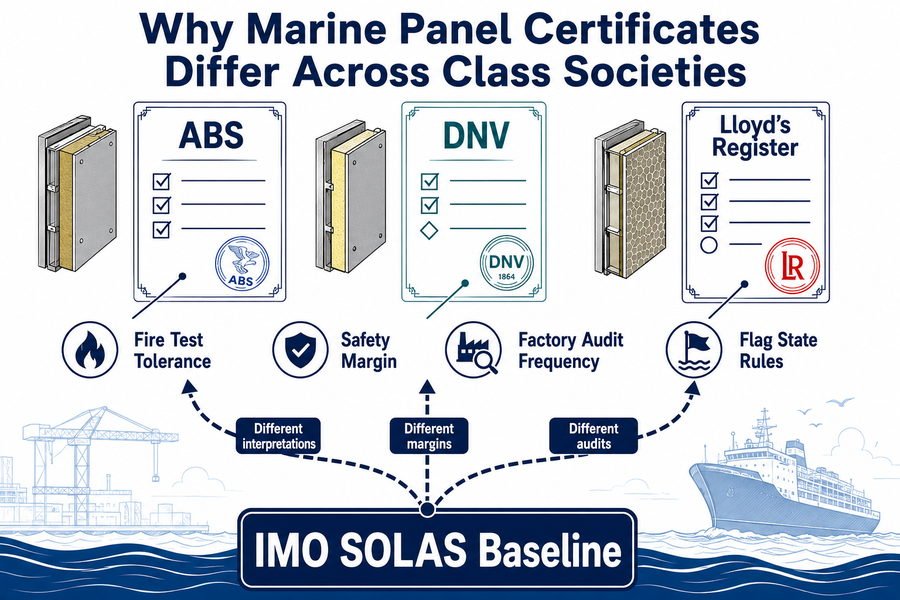
In my years at Magellan Marine, I have seen good interior outfitting projects fail just because of wrong paperwork. You might find a high-quality marine wall panel at a great price, but without the right class approval, it is useless to the shipyard. Let us break down how these certificates work and how to choose the right ones for your marine panels.
Does an ABS-Approved Marine Accommodation Panel Certificate Cover a Lloyd's Register Vessel?
You found a cheap panel with ABS approval, but your project needs Lloyd's Register (LR). Hoping they accept it will cause delays. The rules are strict.
An ABS-approved marine accommodation panel certificate does not automatically cover a Lloyd's Register vessel. Unless a specific Mutual Recognition (MR) agreement applies to that exact panel category, Lloyd's Register will demand its own Type Approval certificate or require an expensive case-by-case single voyage approval before installation.
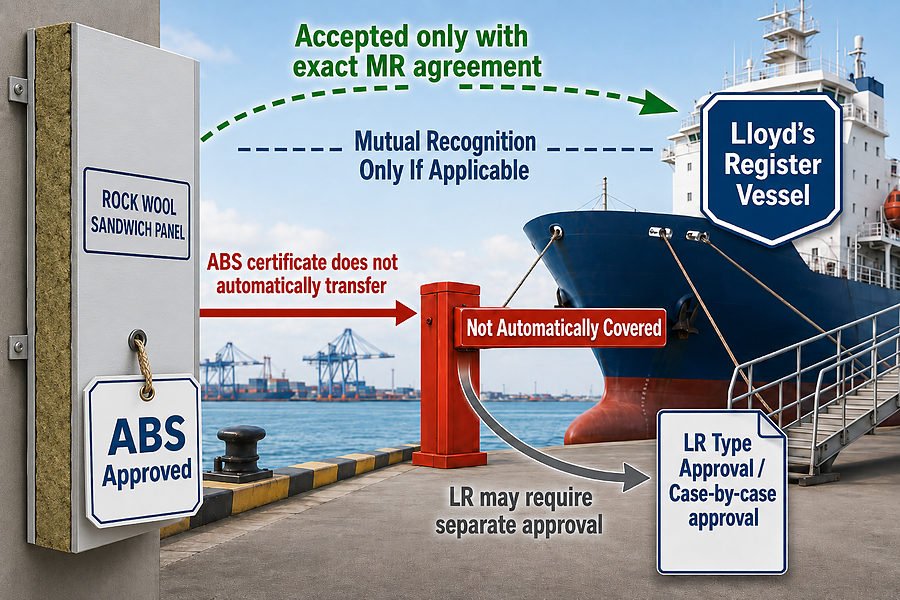
When I started helping clients buy marine panels, this was the biggest trap. A client bought 2,000 square meters of B-15 class marine wall panels. They had an ABS (American Bureau of Shipping) Type Approval. But the shipyard was building a ship under LR (Lloyd's Register) rules. The shipyard rejected the goods. Let me explain the two things that happen in this situation.
The Impact of Mutual Recognition Agreements on Type Approvals
First, you must look for a Mutual Recognition (MR) agreement. If your ABS-approved panel is a simple, low-risk item, LR might accept it. However, marine fire doors and fire-rated wall panels are high-risk life-safety items. They fall under the IMO Fire Test Procedures (FTP) Code1. For these high-risk items, Mutual Recognition almost never applies. Therefore, LR will demand its own Type Approval certificate. Getting a new Type Approval from LR takes about 3 to 6 months. It also costs between $8,000 and $15,000 for new fire tests at an approved laboratory. If your factory only has ABS, they cannot supply an LR project quickly.
Costs and Time Delays of Single Voyage Approvals for Marine Panels
If you cannot get a full Type Approval, your second option is a single voyage approval2. This means LR inspects just this one batch of panels for this specific ship. The LR surveyor will visit the factory. They will check the raw materials, the production line, and the test reports. According to standard class society fees, a surveyor costs about $600 to $900 per day. They might also demand a new burn test for a sample panel from your batch. A single IMO FTP Code Part 3 fire test costs around $4,000 to $6,000. This process easily adds 4 to 6 weeks to your lead time.
| Approval Method | Time Required | Estimated Cost | Risk of Rejection |
|---|---|---|---|
| Existing LR Type Approval | 0 days | $0 | Low |
| Mutual Recognition (MR) | 1-2 weeks | $0 - $500 (Admin fee) | High (Rare for fire panels) |
| Single Voyage Approval | 4-6 weeks | $5,000 - $8,000 | Medium |
| New LR Type Approval | 3-6 months | $8,000 - $15,000 | Low (Once approved) |
Is a Separate Certificate Required When Reusing a Marine Accommodation Panel on a CCS-Classed Vessel?
You have extra marine panels from an old project. You want to use them on a new China Classification Society (CCS) vessel. Doing this blindly risks severe fines.
Yes, reusing a marine accommodation panel on a CCS-classed vessel requires three specific documents: a valid CCS Type Approval certificate for the product model, a traceable Marine Product Certificate (batch certificate) linked to the new vessel, and a documented factory inspection report from the original production run.
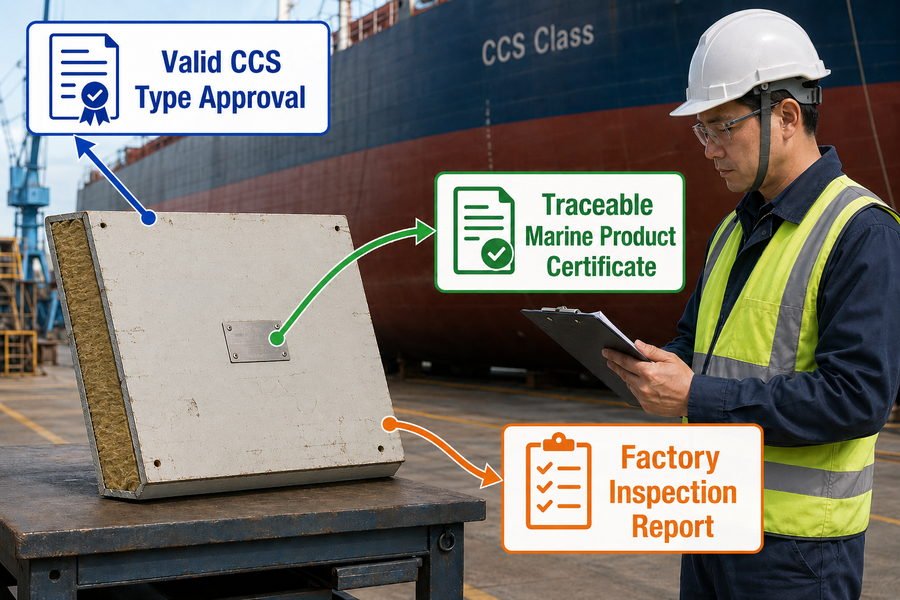
You cannot just take left-over marine ceiling panels and install them on a new ship. Even if the panels look brand new and sit in your warehouse, the China Classification Society (CCS) treats them strictly. Shipyards in China face heavy audits. If you supply reused panels, you must prove their origin. I always tell my buyers to secure three specific documents before moving old stock.
Obtaining the Necessary CCS Type Approval for Reused Panels
The first document you need is the CCS Type Approval certificate for the product model. This document proves the design of the panel meets the IMO SOLAS requirements3. You must check the expiration date on this certificate. CCS Type Approvals are usually valid for 4 to 5 years. If the original manufacturer's Type Approval expired while the panels sat in your warehouse, CCS will reject the panels. You cannot use them on the new vessel.
Securing the Marine Product Certificate for CCS Compliance
The second document is the Marine Product Certificate. We also call this the batch certificate. When a factory produces marine panels, the class surveyor issues a certificate for that exact batch. This certificate lists the ship name or hull number. If you reuse panels, the old batch certificate has the wrong ship name on it. You must apply to CCS to reissue or endorse the product certificate for the new hull number. This requires an admin fee of around $200 to $500. CCS might refuse this if the panels are too old.
Providing the Original Factory Inspection Report for Traceability
The third document is the factory inspection report. This report comes from the original production run. It proves the factory tested the thickness of the steel, the density of the rockwool core, and the strength of the glue. For example, a standard B-15 marine wall panel4 uses rockwool with a density of 120 kg/m3. The inspection report must show this exact number. Without this report, the CCS surveyor has no proof of the material quality inside the panel.
| Required Document | Purpose | Issuing Authority | Validity Detail |
|---|---|---|---|
| CCS Type Approval | Proves product design meets IMO standards | China Classification Society | Usually valid for 4-5 years |
| Marine Product Certificate | Links the specific panel batch to the ship | CCS Surveyor | Must match the new vessel hull number |
| Factory Inspection Report | Proves raw material quality (e.g., rockwool density) | Manufacturer QC / Surveyor | Must match the original production date |
How to Recognize Mutual Recognition Between Class Societies for Marine Interior Panels?
Paying for testing from 10 different class societies ruins your budget. You need to know when one certificate works for another. Here is the trick.
You can recognize Mutual Recognition (MR) between class societies by checking the IACS EU RO MR database, verifying the specific MR statement on the physical certificate, and ensuring the marine panel falls under the approved tier list of low-risk, standardized outfitting components.
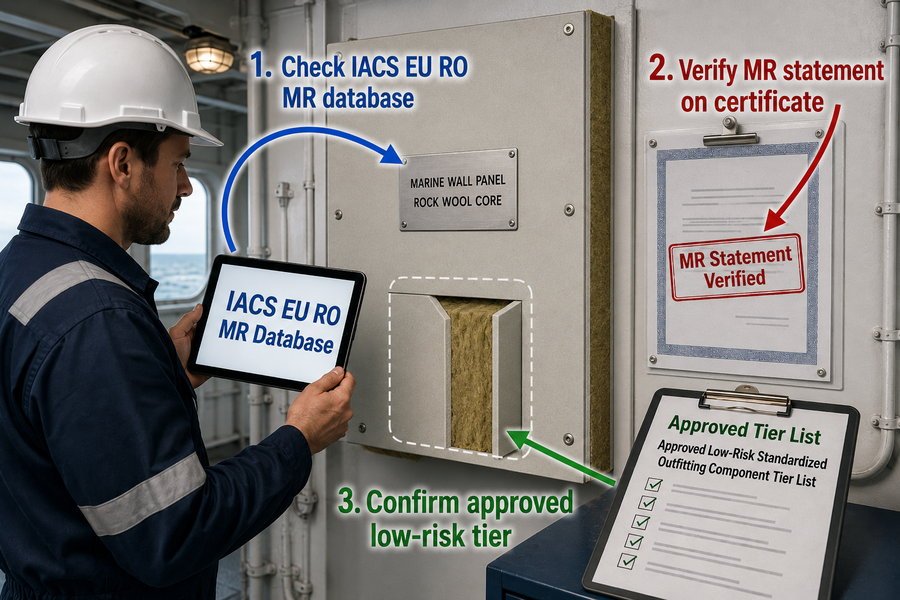
Many buyers ask me if they can buy a panel with a DNV certificate and use it on a Bureau Veritas (BV) ship. The answer is sometimes yes, but you must know how to check. The International Association of Classification Societies (IACS) created a system to stop double-testing. But it does not apply to everything. You must check three things to confirm if your certificate is accepted everywhere.
Using the IACS EU RO MR Database for Marine Panel Checks
The first step is checking the IACS EU RO MR database. EU RO stands for European Union Recognized Organisation. This database lists all the products that different class societies agree to accept from each other. You can visit the IACS website and search for your product category. If you are buying a marine fire door, you will not find it there. But if you are buying simple plastic pipes or basic electrical fittings, you will find them. You must check this database before you pay the supplier.
Verifying the Mutual Recognition Statement on Your Physical Certificate
The second step is looking at the physical certificate the factory gives you. A standard Type Approval certificate is not enough. The document must clearly say "EU RO Mutual Recognition Type Approval Certificate." If it just says "DNV Type Approval," then only DNV accepts it. Factories often trick buyers. They show a standard certificate and promise other classes will accept it. Always look for the exact "Mutual Recognition" words printed on the front page.
Identifying Approved Tier List Categories for Standardized Marine Outfitting
The third step is understanding the Tier list. IACS divides marine products into Tiers based on safety risk. Tier 1 to Tier 6 items include low-risk items like simple sensors, standard valves, and basic insulation. Marine panels that act as A-60 fire boundaries are high-risk.5 They are not on these Tier lists. This means fire-rated wall panels, ceiling panels, and marine fire doors always need specific class approvals.
| Checking Method | What to Look For | Result Meaning |
|---|---|---|
| IACS Database Search | Product category (e.g., Tier 1-6 items) | If listed, cross-acceptance is highly likely. |
| Certificate Title Check | "EU RO Mutual Recognition Type Approval" | If printed, the certificate is legally bound for MR. |
| Product Risk Assessment | Fire-rated vs. Non-fire-rated | Fire-rated panels (A-60, B-15) usually reject MR. |
Why Does One Marine Accommodation Panel Model Need Multiple Class Certificates for Export Projects?
It frustrates buyers when one factory has DNV, ABS, and BV certificates for the exact same wall panel. Why spend this much money? The market demands it.
One marine accommodation panel model needs multiple class certificates because export projects involve three conflicting parties: the shipyard building the vessel, the flag state where the ship registers, and the final shipowner. Each party often dictates a different preferred class society, forcing manufacturers to hold multiple approvals to secure global bids.
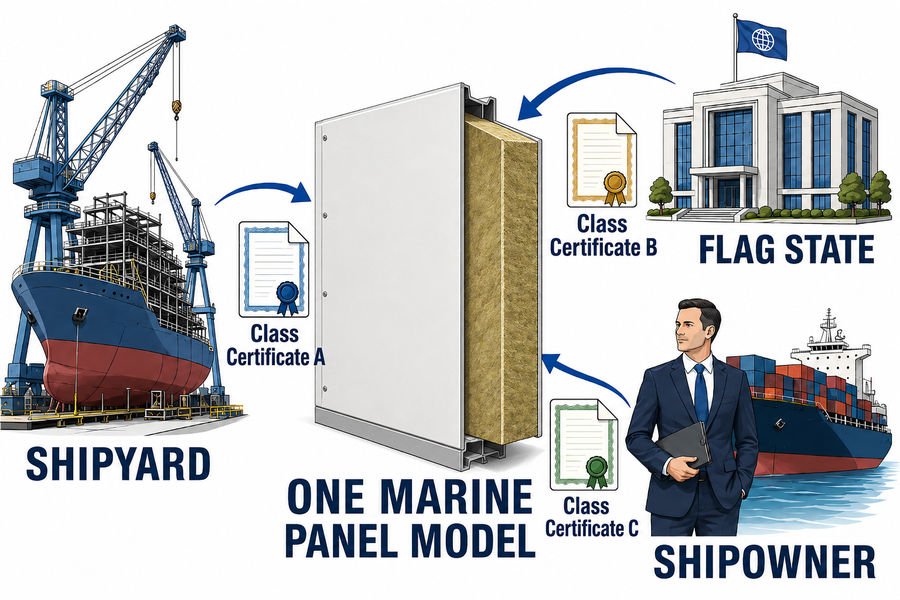
At Magellan Marine, we work with great factories in Asia. A good factory will spend over $50,000 just to hold multiple certificates for one type of A-60 marine wall panel. Buyers often ask why the factory does this. The answer is simple. Export projects have many bosses. To sell panels successfully, the factory must please three different parties at the same time.
How Shipyard Class Preferences Dictate Marine Panel Certificates
The first party is the shipyard. Shipyards choose a classification society to oversee the daily construction of the vessel.6 For example, a shipyard in China usually prefers the China Classification Society (CCS) because the local surveyors speak Chinese and respond quickly. A CCS surveyor charges around 3,000 RMB per day in China. If the factory does not have a CCS certificate, the shipyard will not buy the panel. The shipyard wants an easy inspection process.
The Impact of Flag State Regulations on Class Society Selection
The second party is the flag state. Every ship must fly a flag, like Panama, Liberia, or the United States. The flag state makes the laws for the ship.7 Some flag states only trust certain class societies.8 For example, if a ship flies the US flag, the United States Coast Guard (USCG) enforces the rules. The USCG strongly prefers ABS (American Bureau of Shipping).9 So, if the Chinese shipyard builds a ship for the US flag, the marine panels must have ABS approval, or a specific USCG approval number.
Meeting the Final Shipowner's Specific Class Society Demands
The third party is the final shipowner. Shipowners pay the bills. A shipowner in Norway might strongly prefer DNV because DNV is based in Norway. They trust DNV rules. Even if the shipyard wants CCS, and the flag state accepts ABS, the shipowner will write DNV into the final contract. The factory must have a DNV certificate to win this bid. This is why a top marine interior supplier must hold ABS, DNV, BV, and LR certificates all at once.
| Influencing Party | Primary Concern | Common Preferred Class | Example Impact on Supplier |
|---|---|---|---|
| Shipyard | Fast local inspections, low surveyor cost | Local society (e.g., CCS in China) | Must hold local cert for domestic sales |
| Flag State | National maritime law compliance | Varies (e.g., ABS for USA) | Must hold specific cert to enter waters |
| Shipowner | Insurance rates, brand trust, resale value | Major IACS (e.g., DNV, LR) | Must hold premium cert to win big bids |
How to Confirm a Marine Accommodation Panel Certificate Aligns With Vessel Flag and Class?
Sending the wrong panels to the shipyard creates a massive disaster. You must check the paperwork before you pay the supplier. Follow these steps.
To confirm a marine accommodation panel certificate aligns with the vessel, you must complete four steps: identify the vessel's official flag state, confirm the primary class society hired for the build, verify the Marine Equipment Directive (MED) wheelmark requirement, and cross-reference the panel's fire-rating against the ship's fire plan.
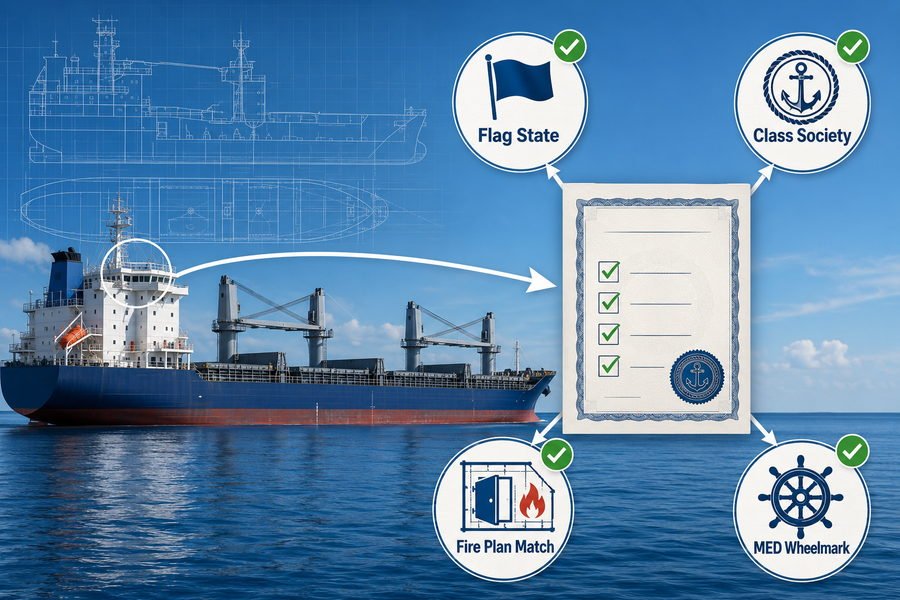
As a procurement officer, you protect your company's profit. If you buy marine ceiling panels and the class surveyor rejects them, you lose all the money. The panels will just sit in the scrap yard. You must act like a detective before you place the order. I use a strict four-step checklist to make sure the supplier's certificates perfectly match the ship's requirements.
Identifying the Vessel Flag State and Primary Class Society
The first step is identifying the vessel flag state. You must ask the shipyard, "Where will this ship register?" If it registers in the USA, you need USCG approval. If it registers in Panama, Panama rules apply.10 The second step is confirming the primary class society. Ask the shipyard who is doing the daily inspections. Is it DNV? Is it ABS? You must tell your supplier to provide the exact Type Approval from that specific society. Do not accept a BV certificate for an ABS project without written approval from the ABS surveyor first.
Verifying the Marine Equipment Directive (MED) Wheelmark Requirement
The third step is verifying the MED Wheelmark requirement. If the ship flies the flag of an EU country (like Germany or France), the marine panels must have a Wheelmark.11 The Wheelmark proves the item meets the Marine Equipment Directive. A factory gets a Wheelmark by completing Module B (Type Examination) and Module D (Production Quality Assurance). You must check the supplier's certificates to ensure both Module B and Module D are valid. If Module D is expired, the Wheelmark is invalid.
Cross-Referencing the Panel Fire-Rating with the Ship's Fire Plan
The fourth step is cross-referencing the panel fire-rating with the ship's fire plan. Every ship has a fire control plan approved by the class society. This plan shows exactly where to use A-60, A-30, B-15, or B-0 panels. An A-60 panel stops fire and heat for 60 minutes. A B-15 panel stops fire and heat for 15 minutes.12 You must check the supplier's certificate to ensure it matches the exact rating on the drawing. If the drawing says A-60, a B-15 certificate is a complete failure.
| Verification Step | Action Required | Fatal Mistake to Avoid |
|---|---|---|
| 1. Flag State & Class | Ask shipyard for flag and class details | Guessing the class society based on shipyard location |
| 2. MED Wheelmark | Check EU flag status and Module B/D | Accepting an expired Module D certificate |
| 3. Fire-Rating | Compare certificate to ship fire plan | Buying B-15 panels for an A-60 bulkhead area |
Which Class Approval Is Mandatory for a Chinese-Built Vessel Exported to Europe?
You buy panels from China for a ship going to Europe. You think CCS is enough because the shipyard is Chinese. You are wrong.
For a Chinese-built vessel exported to Europe, the mandatory approvals include the Marine Equipment Directive (MED) Wheelmark certification, the Type Approval from an EU-recognized class society like DNV or BV, and specific localized asbestos-free declarations required by the European port state control.
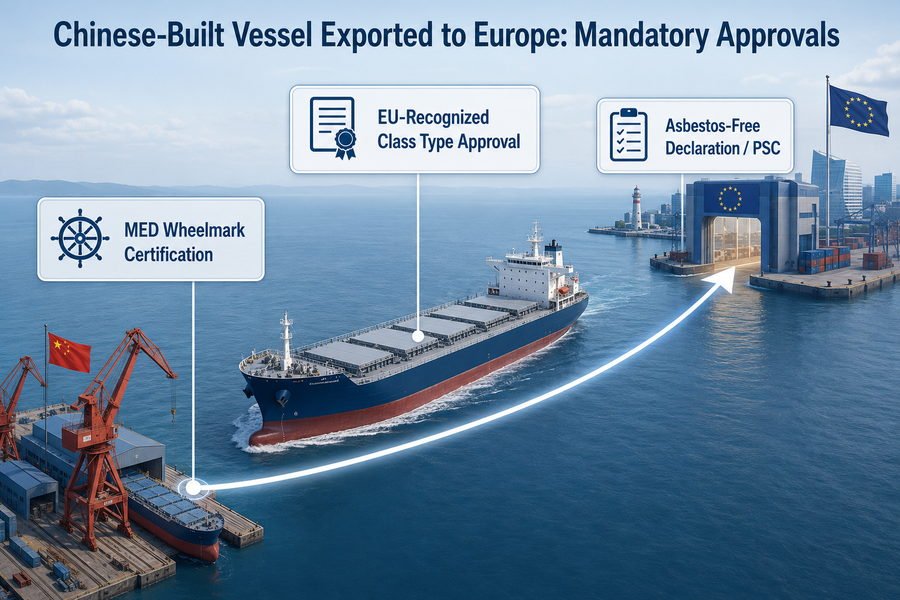
Many interior decoration companies buy cheap panels in China and Vietnam. The price is great. But when the ship sails to Europe, the port authorities will stop the ship if the paperwork is wrong. Europe has the strictest maritime rules in the world. You cannot use local Chinese standards for an export vessel. You must collect three specific approvals to clear European port state control.
Securing the Marine Equipment Directive (MED) Wheelmark Certification
The first mandatory approval is the Marine Equipment Directive (MED) Wheelmark. This is European law. If the ship flies an EU flag, every fire door, wall panel, and ceiling panel must have this mark. It looks like a small steering wheel. The supplier must give you a Declaration of Conformity13. This document proves the factory passed the fire tests according to European standards. Without the Wheelmark, the European authorities will force the shipowner to tear out the walls and rebuild the interior.
Obtaining Type Approval from EU-Recognized Societies like DNV or BV
The second mandatory approval is the Type Approval from an EU-recognized class society. Europe does not accept every class society in the world. They have a list of Recognized Organisations (ROs)14. DNV, Bureau Veritas (BV), and Lloyd's Register (LR) are on this list. If the Chinese shipyard uses a local society that is not recognized by the EU, the marine panels will fail the final inspection in Europe. You must ensure the panel's certificate comes from a major European society.
Providing Localized Asbestos-Free Declarations for European Port State Control
The third mandatory approval is the asbestos-free declaration. According to SOLAS Chapter II-1/3-515, new installation of materials containing asbestos is strictly prohibited. European port state control inspectors are very aggressive about this. They will board the ship and test the marine panels. Your Asian supplier must provide a signed and stamped Asbestos-Free Certificate. They must also provide test reports from a third-party laboratory proving the rockwool or ceramic core contains zero asbestos.
| Mandatory Approval | Governing Authority | Consequence of Missing Document |
|---|---|---|
| MED Wheelmark | European Union Law | Ship cannot fly an EU member state flag |
| EU-Recognized Type Approval | EU Recognized Organisations | Panels rejected during port state inspection |
| Asbestos-Free Declaration | SOLAS & Port State Control | Heavy fines and forced removal of materials |
Conclusion
Understanding class society certificates prevents costly delays. By checking class rules, MED requirements, and mutual recognition, you ensure your marine panels pass inspection and keep your projects profitable.
-
"What Is the Purpose and Scope of the IMO FTP Code? - Magellan ...", https://magellanmarinetech.com/what-purpose-scope-of-imo-ftp-code/. The IMO 2010 Fire Test Procedures Code specifies fire-test procedures for shipboard materials and constructions, including tests for A-, B-, and F-class divisions, which contextualizes why B-15 wall panels and fire-rated doors are treated as regulated fire-safety products. Evidence role: definition; source type: institution. Supports: Marine fire doors and fire-rated wall panels fall under the IMO Fire Test Procedures Code.. Scope note: The source supports the regulatory category and test framework, but it does not by itself determine how a particular classification society will treat a specific product approval. ↩
-
"Ship classification society - Wikipedia", https://en.wikipedia.org/wiki/Ship_classification_society. Classification-society rules and marine-equipment certification guidance allow certain products or installations to be accepted through project-specific survey, document review, and inspection when a standing type approval is not available, supporting the described case-by-case approval pathway. Evidence role: general_support; source type: institution. Supports: If full Type Approval is not available, a classification society may use a project-specific inspection or approval route for a specific vessel or batch.. Scope note: The terminology may differ by society and project; the source may describe individual product certification or project-specific acceptance rather than the exact phrase “single voyage approval.” ↩
-
"History of SOLAS fire protection requirements", https://www.imo.org/en/OurWork/Safety/Pages/History-of-fire-protection-requirements.aspx. The International Convention for the Safety of Life at Sea (SOLAS), administered by the International Maritime Organization, establishes fire-safety requirements for ships, including standards relevant to divisions, materials, and fire protection arrangements. Evidence role: general_support; source type: institution. Supports: Marine interior panel designs are assessed against IMO SOLAS fire-safety requirements.. Scope note: SOLAS establishes the regulatory framework; a separate class approval document would be needed to prove that a particular panel model complies. ↩
-
"How Are Integrity and Insulation Judged in Marine Panel Fire Tests?", https://magellanmarinetech.com/how-integrity-insulation-judged-in-marine-panel-fire-tests/. IMO fire-test procedures and classification-society rules define B-class divisions, including B-15, by fire-resistance performance criteria rather than by a single universal insulation density, providing context for why material properties such as insulation density are documented during production. Evidence role: definition; source type: institution. Supports: A B-15 marine wall panel is a fire-rated marine division for which material specifications and test documentation are relevant.. Scope note: This supports the B-15 classification framework but may not directly confirm that all B-15 wall panels require 120 kg/m³ rockwool; that figure may be manufacturer- or approval-specific. ↩
-
"What Is the Purpose and Scope of the IMO FTP Code? - Magellan ...", https://magellanmarinetech.com/what-purpose-scope-of-imo-ftp-code/. International maritime fire-safety rules and type-approval practice treat A-class divisions, including A-60 fire boundaries, as regulated fire-resisting construction whose performance is demonstrated by prescribed fire tests and approval procedures. Evidence role: expert_consensus; source type: institution. Supports: A-60 fire boundary panels are safety-critical fire-rated components and are treated differently from low-risk standardized outfitting items.. Scope note: This supports the fire-safety significance of A-60 panels generally; it does not by itself establish their exclusion from every mutual-recognition tier list without consulting the current EU RO MR product list. ↩
-
"RECOGNIZED ORGANIZATIONS", https://www.imo.org/en/OurWork/IIIS/Pages/Recognized-Organizations.aspx. IACS and IMO materials describe classification societies as organizations that develop technical rules and conduct surveys during ship design, construction, and operation to verify compliance with class and statutory requirements. Evidence role: definition; source type: institution. Supports: Shipyards use classification societies to oversee and verify vessel construction.. Scope note: This supports the general role of classification societies in construction oversight, but not the article’s specific claim about any one shipyard’s preference. ↩
-
"[PDF] Nationality and registration of Ships", https://wwwcdn.imo.org/localresources/en/OurWork/Legal/Documents/Presentation%20from%20Ms.%20Caracciolo%20-%20Nationality%20and%20registration%20of%20Ships.pdf. UNCLOS and IMO guidance state that ships have the nationality of the state whose flag they are entitled to fly, and that the flag state exercises jurisdiction and control over administrative, technical, and social matters on board. Evidence role: definition; source type: institution. Supports: Ships operate under a flag state, and that flag state has legal jurisdiction over the vessel.. ↩
-
"RECOGNIZED ORGANIZATIONS", https://www.imo.org/en/OurWork/IIIS/Pages/Recognized-Organizations.aspx. The IMO Code for Recognized Organizations and flag-administration guidance explain that flag states may delegate statutory survey and certification work only to recognized organizations they have authorized, which provides context for why acceptance of a classification society can vary by flag. Evidence role: mechanism; source type: institution. Supports: Flag states may accept only certain recognized classification societies for statutory work.. Scope note: This supports the mechanism of flag-state authorization; it does not prove that a particular flag state 'trusts' or rejects a specific class society without that state’s authorization list. ↩
-
"[PDF] Sources of Standards and Regulations in the Maritime Industry", https://www.webb.edu/wp-content/uploads/2025/01/Sources-of-Standards-and-Regulations.pdf. U.S. Coast Guard regulations and guidance identify ABS as a recognized classification society and describe circumstances in which the Coast Guard may rely on recognized classification societies for vessel plan review, inspection, or certification functions. Evidence role: case_reference; source type: government. Supports: For U.S.-flag vessels, USCG enforcement can involve ABS as a recognized classification society or accepted approval pathway.. Scope note: This would support the regulatory relationship between USCG and ABS, but it may not directly prove the stronger wording that USCG 'strongly prefers' ABS over other recognized organizations. ↩
-
"Marine Equipment on Board Vessels and Offshore Units or Facilities", https://www.federalregister.gov/documents/2024/09/18/2024-20380/marine-equipment-on-board-vessels-and-offshore-units-or-facilities. U.S. Coast Guard and flag-administration rules establish that certain marine equipment installed on vessels under their flag must meet the flag state’s approval or accepted-equivalence requirements. Evidence role: general_support; source type: government. Supports: Marine equipment approval requirements depend on the vessel’s flag state, such as U.S. Coast Guard approval for relevant equipment on U.S.-flag vessels and Panama flag requirements for Panama-flag vessels.. Scope note: The exact approval pathway depends on vessel type, statutory regime, and whether equivalence or mutual recognition is accepted for the specific equipment. ↩
-
"Directive 96/98/EC - Wikipedia", https://en.wikipedia.org/wiki/Directive_96/98/EC. Directive 2014/90/EU requires marine equipment falling within its scope and placed on board EU-flagged ships to comply with the Directive and bear the wheel mark after conformity assessment. Evidence role: definition; source type: institution. Supports: Marine panels that fall within the Marine Equipment Directive scope must carry the Wheelmark when installed on EU-flagged ships.. Scope note: The requirement applies only to equipment categories listed under the MED implementing acts; the source supports the regulatory framework rather than confirming any individual panel model. ↩
-
"[PDF] recommendation for fire test procedures for “a” and “b” class ...", https://wwwcdn.imo.org/localresources/en/KnowledgeCentre/IndexofIMOResolutions/AssemblyDocuments/A.163(ES.IV).pdf. The IMO Fire Test Procedures Code defines A-class and B-class divisions and specifies time-based integrity and insulation criteria, including A-60 and B-15 ratings based on standardized fire testing. Evidence role: definition; source type: institution. Supports: A-60 and B-15 fire ratings indicate defined fire-resistance and insulation performance periods under IMO fire-test standards.. Scope note: The standards do not mean that all heat transfer is stopped; they define permitted temperature rise and integrity performance under prescribed test conditions. ↩
-
"Notified body - Wikipedia", https://en.wikipedia.org/wiki/Notified_body. The MED conformity framework requires manufacturers to issue an EU declaration of conformity for compliant marine equipment, linking the product to the relevant approval module and notified-body assessment. Evidence role: mechanism; source type: government. Supports: A supplier’s Declaration of Conformity is part of the proof that covered marine equipment has passed the applicable European conformity-assessment process.. Scope note: This supports the document’s role in the MED process, but it does not by itself prove that any individual supplier’s certificate is valid or sufficient for a particular vessel inspection. ↩
-
"Ship classification society - Wikipedia", https://en.wikipedia.org/wiki/Ship_classification_society. EU rules on recognised organisations establish that only classification societies recognised under the EU framework may carry out certain statutory survey and certification functions for EU Member States; the Commission/EMSA lists identify recognised organisations such as DNV, Bureau Veritas, and Lloyd’s Register. Evidence role: definition; source type: government. Supports: Europe maintains an official list of recognised classification societies, and DNV, Bureau Veritas, and Lloyd’s Register are among the recognised organisations.. Scope note: This supports the EU-recognition framework for classification societies, but product-level acceptance may also depend on the flag administration, the specific certificate, and the applicable inspection regime. ↩
-
"Asbestos on board ships - International Maritime Organization", https://www.imo.org/en/OurWork/Safety/Pages/Asbestos.aspx. SOLAS regulation II-1/3-5 prohibits the new installation of materials containing asbestos on ships, providing the international legal basis for requiring asbestos-free documentation for new marine materials. Evidence role: expert_consensus; source type: institution. Supports: SOLAS Chapter II-1/3-5 prohibits new installation of materials containing asbestos on ships.. Scope note: This directly supports the prohibition on new asbestos-containing installations, but inspection practices and enforcement severity vary by flag state and port state control authority. ↩