
Are you struggling to meet fire codes while keeping ship cabins quiet and comfortable? Rock wool panels solve this, but picking the right core is a tough balancing act.
Rock wool cores balance safety and comfort by combining non-combustible mineral fibers for SOLAS-compliant fire resistance (A-Class and B-Class) with interconnected porous structures that trap sound waves and thermal energy. This achieves mandatory fire protection, noise reduction (around 30-45 dB), and temperature control in a single marine accommodation panel.
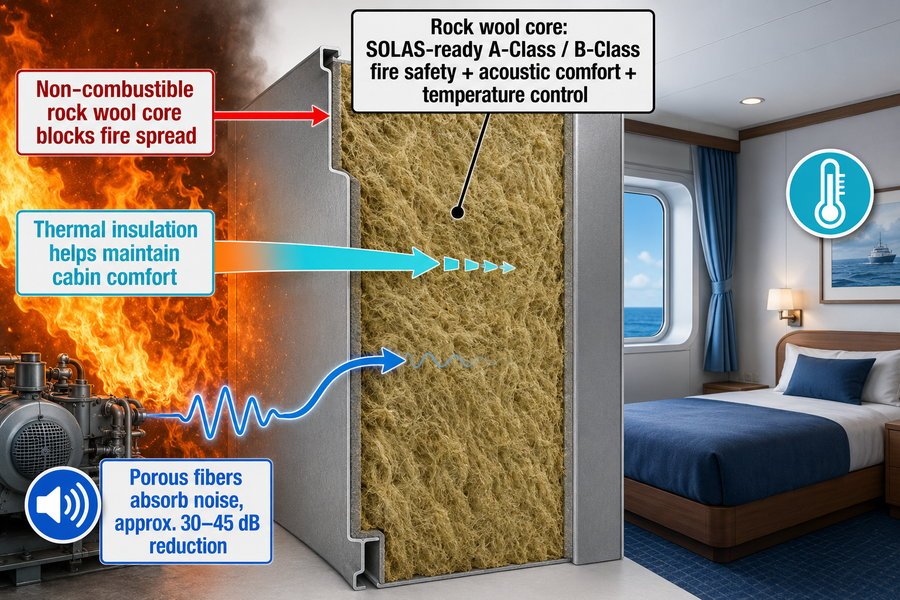
Choosing the wrong panel can lead to failed safety inspections or unhappy ship crews. It also wastes your project budget. Let us look closely at how different rock wool specifications handle these daily marine outfitting challenges.
What Rock Wool Core Specification Simultaneously Meets Fire and Acoustic Targets Without Over-Engineering?
Do you often pay too much for high-grade panels when standard ones work? Finding the exact specification prevents wasted budget while passing all safety and noise tests.
To meet both fire and acoustic targets without over-engineering, use a 120 kg/m³ to 150 kg/m³ density rock wool core. This specific range provides B-15 fire ratings for cabins and achieves a 35 dB sound reduction index, satisfying standard IMO noise regulations without adding unnecessary weight or excessive costs.
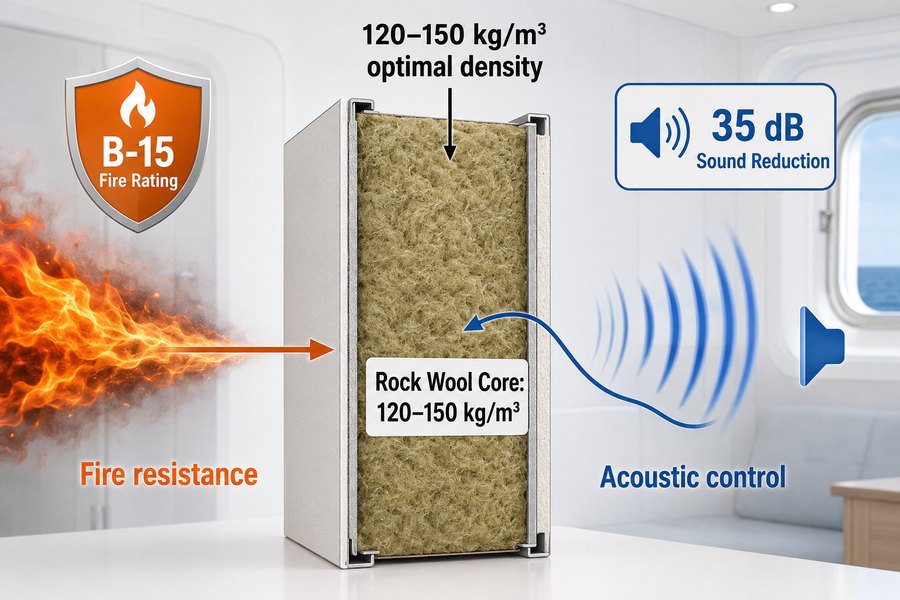
Achieving B-15 Fire Ratings with 120-150 kg/m³ Density Rock Wool
In my work at Magellan Marine, I see many buyers make a common mistake. They buy very thick, heavy panels for basic cabin walls. This is what we call over-engineering. You do not need the highest grade for every room. The standard for most interior cabin partitions is the B-15 fire rating. According to the International Convention for the Safety of Life at Sea (SOLAS) Chapter II-2, a B-15 panel must stop flames for 30 minutes and limit heat rise for 15 minutes1.
To pass this test, you only need a rock wool density between 120 kg/m³ and 150 kg/m³2. If you choose a 120 kg/m³ panel, you get a good balance. It passes the fire test easily. If you drop below 100 kg/m³, the panel might fail the heat rise test. If you go up to 180 kg/m³, you pay more money and add heavy weight to the ship structure. The 120-150 kg/m³ range is the sweet spot. It gives you the exact safety level the shipyard asks for.
Reaching 35 dB Acoustic Targets Without Over-Engineering
Noise is a big complaint on ships. The International Maritime Organization (IMO) sets rules for noise levels in the Resolution MSC.337(91)3. For standard crew cabins, you usually need a sound reduction index of at least 35 dB. The good news is that the same 120 kg/m³ to 150 kg/m³ density rock wool handles this perfectly.
Rock wool traps sound waves inside its open fiber structure4. When you use a 50mm thick panel with 120 kg/m³ density, the sound drops by about 35 dB. If you pay extra for 150 kg/m³, you might get 37 dB. A basic 120 kg/m³ panel costs about $18 to $22 per square meter in Asia. A heavier 180 kg/m³ panel can cost $28 to $35 per square meter. By sticking to the 120-150 kg/m³ range, you meet both fire and noise rules. You save money and keep the ship light.
| Rock Wool Density | Expected Fire Rating | Expected Acoustic Reduction | Estimated Cost (per sqm) | Best Application |
|---|---|---|---|---|
| 100 kg/m³ | B-0 | 30 dB | $15 - $18 | Basic visual dividers |
| 120 kg/m³ | B-15 | 35 dB | $18 - $22 | Standard crew cabins |
| 150 kg/m³ | B-15 / A-30 | 37 dB | $22 - $26 | Noisy crew cabins |
| 180 kg/m³ | A-60 (with 100mm) | 40+ dB | $28 - $35 | Heavy machinery rooms |
How Does Rock Wool Core Thickness Trade Off Against Usable Cabin Space?
Is limited cabin space causing design headaches? Every millimeter of wall panel eats into the living area, making thickness a critical factor for interior decorators.
Rock wool core thickness directly reduces usable cabin space. Standard 50mm panels save floor area for standard B-15 cabins, 25mm panels maximize space for light partitions, while 100mm panels provide A-60 fire ratings but consume the most room. You must balance exact fire requirements with available cabin footprint.
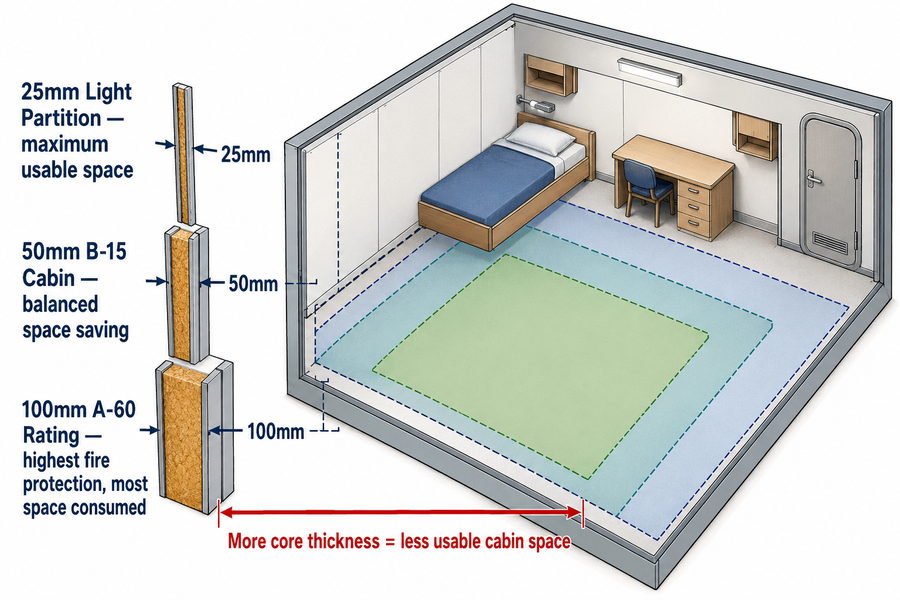
Saving Space with 25mm and 50mm Rock Wool Panels
Space is equal to money on a ship. When I worked in the factory, we produced panels of many sizes. The most popular size is the 50mm thick panel. This 50mm thickness is the global standard for B-15 cabin walls5. It is thick enough to hold the 120 kg/m³ rock wool and block 35 dB of noise6. It takes up a small amount of floor space. For a room that is 3 meters by 3 meters, using 50mm panels all around takes up very little area.
Sometimes, interior decorators need even more space. For example, they build small closets or toilet modules inside the cabin. For these light partitions, fire rules are not strict. Here, you can use 25mm thick panels. A 25mm panel uses half the space of a standard wall. But remember, a 25mm panel usually only has a C-Class or B-0 fire rating. It will also only block about 28 dB of sound. You trade fire and noise performance to gain extra millimeters of floor space.
Accommodating 100mm Panels for A-60 Fire Ratings
Some walls on the ship must be very safe. If a cabin is next to a dangerous area, SOLAS rules require an A-60 fire rating7. An A-60 wall must stop flames and heat for 60 minutes. To do this, you must use a 100mm thick rock wool panel8.
Using a 100mm panel means you lose a lot of usable cabin space. If you have a long corridor with 100mm panels on both sides, the walkway becomes 100mm narrower than if you used 50mm panels. You lose 5 centimeters on the left and 5 centimeters on the right. This makes a big difference when moving furniture. But you cannot avoid this trade-off. The shipyard must pass the A-60 test. You must plan the cabin footprint to accept the space lost to the 100mm thick walls.
| Panel Thickness | Fire Rating Class | Sound Reduction | Space Consumption | Typical Use Case |
|---|---|---|---|---|
| 25 mm | C-Class / B-0 | 28 dB | Minimal | Toilet modules, closets |
| 50 mm | B-15 | 35 dB | Standard | Normal cabin walls |
| 100 mm | A-60 | 42 dB | High | High-risk boundaries |
What Rock Wool Core Specification Suits Accommodation Areas Versus Engine Room Bulkheads?
Are you using the same panels everywhere on the ship? Engine rooms and sleeping quarters face completely different threats and require entirely different rock wool specifications.
Accommodation areas require 50mm thick, 120-150 kg/m³ rock wool for B-15 fire safety and basic comfort. In contrast, engine room bulkheads demand 100mm thick, 150-180 kg/m³ density rock wool to achieve strict A-60 fire ratings and block extreme mechanical noise, representing two completely distinct specification levels.
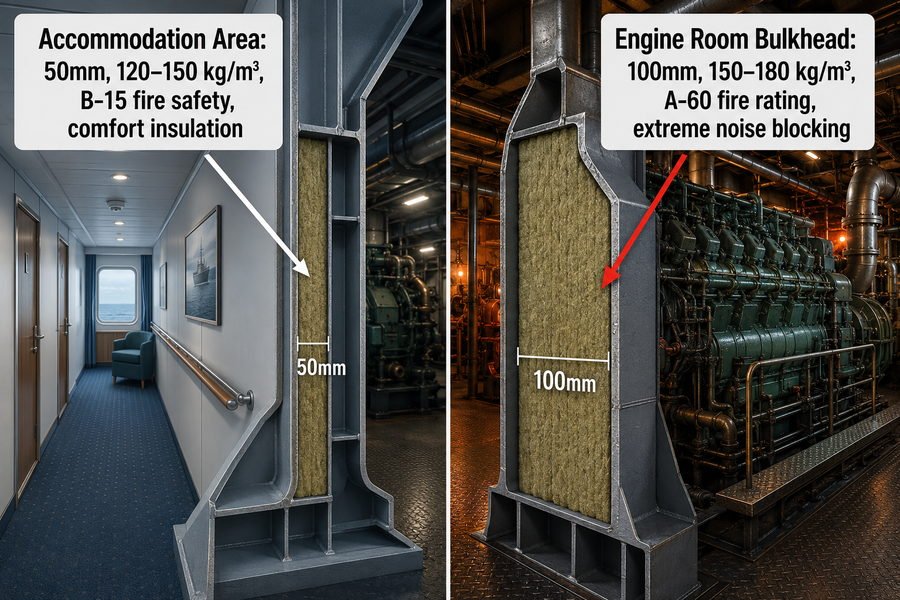
Rock Wool Specifications for Standard Accommodation Areas
Accommodation areas are where the crew sleeps, eats, and rests. The main goals here are basic safety and daily comfort. When my clients buy panels for these rooms, I always tell them to keep it simple. As we talked about earlier, a 50mm thick panel with 120 kg/m³ to 150 kg/m³ rock wool is perfect here.
This specification meets the SOLAS B-15 requirement.9 If a small fire starts in a trash can in one cabin, this panel holds the fire back for 30 minutes. This gives the crew enough time to wake up and leave. The noise in these areas is mostly human voices, footsteps, or light music. The 120-150 kg/m³ rock wool blocks 35 dB of this normal living noise. Because these panels only weigh about 16 to 18 kilograms per square meter, they are easy for workers to carry and install during the interior decoration process.
Upgrading Rock Wool for High-Risk Engine Room Bulkheads
Engine rooms are a totally different world. They are loud, hot, and full of fuel oil. A fire here is huge and hot. The walls separating the engine room from the rest of the ship must be much stronger. SOLAS requires an A-60 rating for these bulkheads.10
To get an A-60 rating, you must use 100mm thick rock wool11. But thickness alone is not enough. You must also increase the density. You need 150 kg/m³ to 180 kg/m³ rock wool. This heavy material stops the extreme heat of an oil fire from spreading. Also, large ship engines create low-frequency noise that is very hard to stop. Standard 120 kg/m³ panels vibrate and let the engine noise pass through. The dense 180 kg/m³ rock wool core acts as a heavy mass. It absorbs the deep engine rumble, often reducing noise by more than 40 dB12. These panels cost more, sometimes up to $40 per square meter, but they save lives and stop structural damage.
| Location Category | Required Fire Rating | Rock Wool Thickness | Rock Wool Density | Primary Threat to Stop |
|---|---|---|---|---|
| Accommodation Areas | B-15 | 50 mm | 120 - 150 kg/m³ | Small fires, human voices |
| Engine Room Bulkheads | A-60 | 100 mm | 150 - 180 kg/m³ | Oil fires, heavy engine noise |
Does Adding Air Gap Behind Rock Wool Marine Accommodation Panels Improve Acoustic Performance?
Are your cabin walls still letting noise through despite thick rock wool? A simple installation trick can block sound better than buying heavier, expensive panels.
Adding a 20mm to 50mm air gap behind rock wool marine panels significantly improves acoustic performance. This gap creates an isolation barrier that disrupts low-frequency sound transmission, boosting the overall sound reduction index by 3 to 5 dB without requiring thicker or denser rock wool materials.
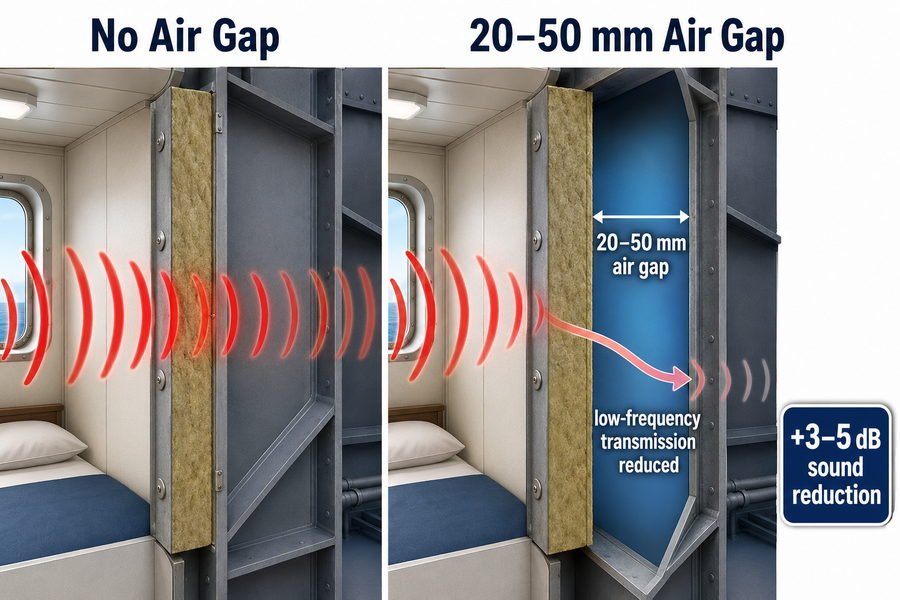
Creating an Isolation Barrier with a 20mm to 50mm Air Gap
Many buyers ask me how to get better noise control without spending more money on heavy panels. I always suggest using an air gap. When decorators install marine wall panels, they attach them to the steel structure of the ship. If the panel touches the steel directly, sound vibrations travel straight from the steel into the panel13 and into the room.
To stop this, you leave empty space between the steel hull and the back of the rock wool panel. A gap of 20mm to 50mm works best.14 This empty space creates an isolation barrier. Sound waves travel poorly through air compared to solid steel. When the sound hits the 20mm to 50mm air gap, the wave loses energy. Then, it hits the rock wool panel and loses even more energy. This double barrier system is highly effective for interior decoration projects.
Gaining a 3 to 5 dB Acoustic Boost from Air Gaps
The results of adding an air gap are easy to measure. Let us say you use a standard 50mm panel with 120 kg/m³ rock wool. Alone, it blocks 35 dB. If you leave a 50mm air gap behind it, the total system can now block 38 dB to 40 dB15. You get a clear 3 to 5 dB boost.
In human hearing, a 3 dB change is very noticeable16. A 5 dB drop makes a noisy pump sound much quieter. If you tried to get this same 5 dB boost by changing the panel, you would have to buy a much heavier 180 kg/m³ panel. That would cost you at least $10 more per square meter. By just leaving a 20mm to 50mm air gap, you get the acoustic performance for free. You just need to plan your cabin layout carefully to allow for this extra wall depth.
| Wall Installation Method | Panel Specification | Air Gap Size | Total Sound Reduction | Extra Material Cost |
|---|---|---|---|---|
| Direct flush mount | 50mm, 120 kg/m³ | 0 mm | ~35 dB | $0 |
| With Small Gap | 50mm, 120 kg/m³ | 20 mm | ~37 dB | $0 |
| With Large Gap | 50mm, 120 kg/m³ | 50 mm | ~39 - 40 dB | $0 |
| Upgrade Panel (No gap) | 50mm, 180 kg/m³ | 0 mm | ~38 dB | +$10/sqm |
How Does Rock Wool Core Contribute to Thermal Insulation Alongside Fire Protection in Marine Accommodation Panels?
Is your ship's HVAC system working too hard? Proper rock wool does more than stop fires; it acts as a powerful blanket that keeps cabin temperatures stable.
Rock wool cores provide excellent thermal insulation alongside fire protection due to their low thermal conductivity (typically 0.034 to 0.040 W/m·K at 20°C). The trapped air between mineral fibers blocks heat transfer, keeping cabins cool in summer and warm in winter, which significantly reduces HVAC energy consumption.
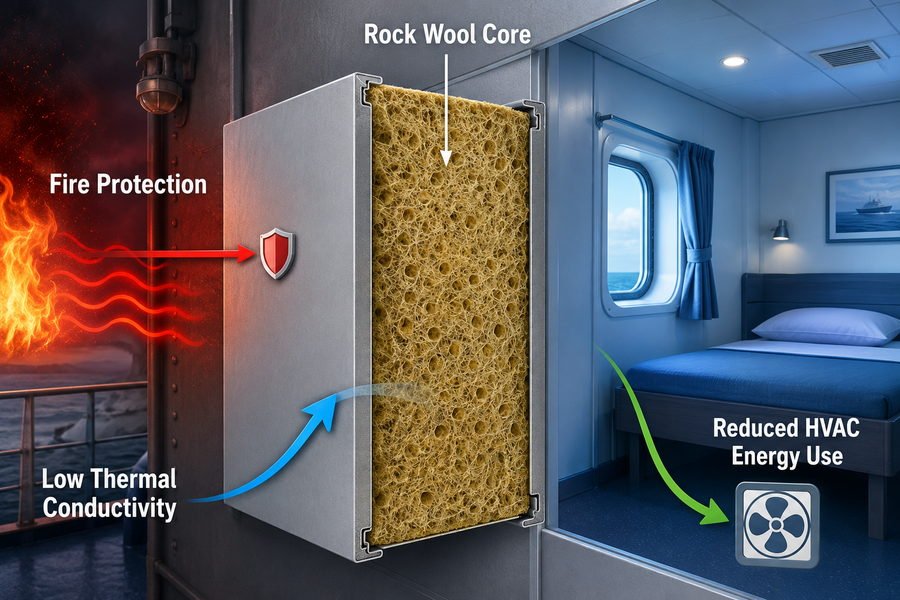
Analyzing the 0.034 to 0.040 W/m·K Thermal Conductivity of Rock Wool
We talk a lot about fire and noise, but temperature is just as vital. Ships travel through freezing oceans and hot tropical zones. The steel hull gets very cold or very hot. The rock wool inside your marine accommodation panels protects the crew from these outside extremes.
The scientific measure for this is thermal conductivity17. A lower number means better insulation. Marine-grade rock wool usually has a thermal conductivity between 0.034 and 0.040 W/m·K18 (Watts per meter-Kelvin) when measured at a normal room temperature of 20°C. For comparison, solid steel has a conductivity of around 45 W/m·K19. Steel moves heat very fast. Rock wool stops it. When you use a 50mm rock wool panel, the 0.034 to 0.040 W/m·K rating ensures that the cold from the steel hull does not easily reach the cabin interior.
How Trapped Air in Rock Wool Reduces Ship HVAC Energy Consumption
The secret to this thermal insulation is air. Rock wool is made of melted rock spun into thin threads. Between these millions of threads, there are tiny pockets of still air. Still air is a very bad conductor of heat.
Because the rock wool blocks the heat transfer, the ship's Heating, Ventilation, and Air Conditioning (HVAC) system does not have to work as hard. If the panels did not have rock wool, the cold ocean air would cool the room quickly. The heater would run all day. Running the heater burns ship fuel. Fuel is expensive. By using panels with good thermal insulation, you trap the controlled air inside the cabin. This lowers the energy consumption of the HVAC system.20 Over a long voyage, this saves the ship owner a lot of money in fuel costs.
| Material Feature | Metric/Value | Benefit to Ship Cabin | Economic Impact |
|---|---|---|---|
| Thermal Conductivity | 0.034 - 0.040 W/m·K | Blocks heat and cold from hull | Prevents temperature swings |
| Trapped Air Structure | High volume of still air | Keeps cabin air stable | Lowers HVAC load |
| Solid Steel Hull | ~45 W/m·K | Moves extreme temps fast | Wastes energy without panels |
Why Do Passenger Vessel Cabins Require Higher-Density Rock Wool Cores Than Cargo Ship Bulkheads?
Why do cruise ship owners demand more expensive panels? Passenger vessels face stricter noise and safety rules, making standard cargo ship bulkheads completely unacceptable for them.
Passenger vessel cabins require higher-density rock wool cores (150-180 kg/m³) compared to cargo ships (100-120 kg/m³) to meet stricter IMO regulations. Passengers expect premium acoustic privacy (often requiring 40-45 dB reduction) and enhanced fire evacuation times, whereas cargo ships only need basic 35 dB reduction and standard crew safety.
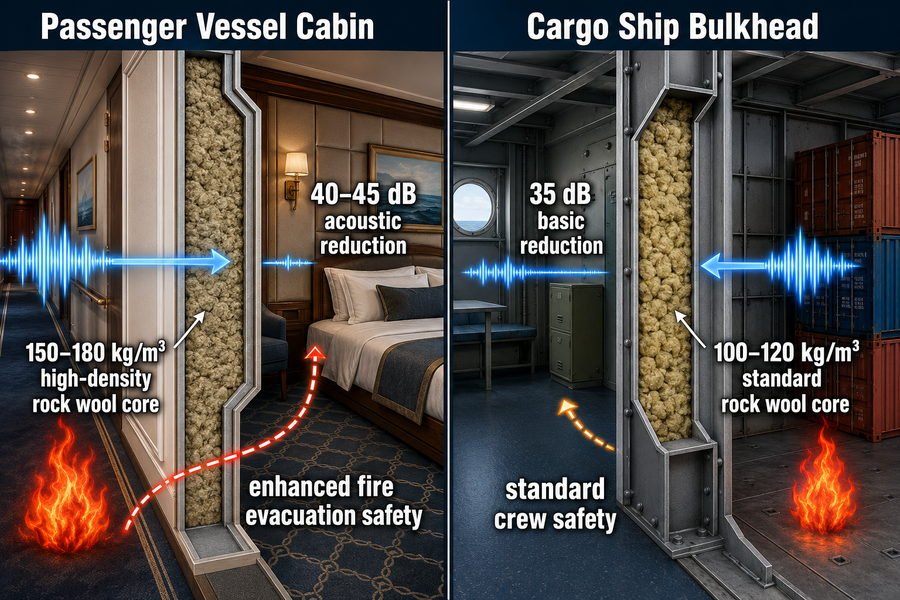
Meeting Premium 40-45 dB Privacy Demands for Passenger Vessels
When interior decoration companies take projects for cruise ships or large ferries, the rules change completely. Passengers pay good money for a ticket. They expect to sleep in a quiet room. They do not want to hear the person in the next cabin watching TV or talking.
Because of this, the acoustic privacy demands are very high. Shipyards often ask for a sound reduction of 40 to 45 dB between passenger cabins21. To reach 40-45 dB, a standard 120 kg/m³ rock wool core is too weak. You must upgrade to higher-density rock wool cores, usually between 150 kg/m³ and 180 kg/m³22. Sometimes, decorators even use double-layer panel systems. The 150-180 kg/m³ density packs more mineral fibers into the same space, creating a tighter trap for sound waves. It costs more money, but passenger satisfaction is the main profit model for cruise ships. Also, passenger ships carry thousands of people23. Evacuation takes longer. The denser rock wool gives a stronger, more stable barrier during fire emergencies, giving crowds more time to reach lifeboats.
Standard Cargo Ship Requirements at 35 dB and Lower Densities
Cargo ships are built for business and efficiency. They do not carry paying guests. They carry a small crew of professional sailors. The IMO rules for cargo ships are practical and basic.
For a cargo ship bulkhead, the acoustic requirement is usually just 35 dB. The crew understands they are on a working ship, so minor background noise is accepted. To meet this 35 dB rule, a rock wool core density of 100 kg/m³ to 120 kg/m³ is perfectly fine. The fire safety rules are also based on a smaller crew that is highly trained in fire drills. They evacuate quickly, so the standard B-15 rating24 from a 100-120 kg/m³ panel is sufficient. Using 150-180 kg/m³ panels on a cargo ship is usually a waste of the shipyard's budget.
| Vessel Type | Typical Rock Wool Density | Acoustic Target | Evacuation Needs | Cost Priority |
|---|---|---|---|---|
| Cargo Ship | 100 - 120 kg/m³ | 35 dB | Fast (trained crew) | Strict budget control |
| Passenger Vessel | 150 - 180 kg/m³ | 40 - 45 dB | Slow (large crowds) | Premium comfort |
Conclusion
Rock wool cores dictate marine panel success. By matching density and thickness to exact fire, noise, and thermal rules, you ensure ship safety, save space, and cut unnecessary costs.
-
"[PDF] recommendation for fire test procedures for “a” and “b” class ...", https://wwwcdn.imo.org/localresources/en/KnowledgeCentre/IndexofIMOResolutions/AssemblyDocuments/A.163(ES.IV).pdf. SOLAS Chapter II-2 and the IMO Fire Test Procedures Code define B-class divisions as preventing flame passage for 30 minutes, with B-15 requiring insulation performance for 15 minutes under the prescribed fire test. Evidence role: definition; source type: institution. Supports: A B-15 panel must resist flame passage for 30 minutes and satisfy the relevant temperature-rise limit for 15 minutes.. Scope note: This supports the regulatory definition of B-15, not the performance of any particular panel construction. ↩
-
"How to choose the right marine wall panels for marine interior ...", https://magellanmarinetech.com/how-choose-right-marine-wall-panels-for-marine-interior-projects/. Classification-society type approvals and fire-test certificates for marine B-15 wall or ceiling panels show that mineral-wool-core assemblies in the 120–150 kg/m³ range can achieve B-15 performance when tested as complete systems. Evidence role: case_reference; source type: institution. Supports: Rock wool panels with densities around 120–150 kg/m³ can be sufficient for B-15-rated marine partitions when used in approved assemblies.. Scope note: The evidence is assembly-specific; density alone does not guarantee B-15 compliance without the tested facings, joints, thickness, and installation method. ↩
-
"[PDF] MSC.337(91) (adopted on 30 November 2012) CODE ON NOISE ...", https://wwwcdn.imo.org/localresources/en/KnowledgeCentre/IndexofIMOResolutions/MSCResolutions/MSC.337(91).pdf. IMO Resolution MSC.337(91), the Code on Noise Levels on Board Ships, establishes mandatory measurement methods and maximum noise-level criteria for ship spaces, including accommodation areas. Evidence role: definition; source type: institution. Supports: The IMO regulates shipboard noise levels through Resolution MSC.337(91).. Scope note: The Code specifies allowable sound pressure levels in spaces; it does not by itself prescribe a single required partition sound reduction index such as 35 dB. ↩
-
"Acoustic Performance of Sound Absorbing Materials Produced from ...", https://pmc.ncbi.nlm.nih.gov/articles/PMC9105389/. Acoustics literature describes mineral wool as a porous fibrous absorber in which sound energy is dissipated through viscous and thermal losses as air moves through interconnected pores and fibers. Evidence role: mechanism; source type: paper. Supports: Rock wool reduces sound transmission or absorption through its porous fibrous structure.. Scope note: This supports the general absorption mechanism of mineral wool; the resulting dB reduction depends on the full panel assembly, thickness, air gaps, facings, and installation conditions. ↩
-
"What Is the Purpose and Scope of the IMO FTP Code? - Magellan ...", https://magellanmarinetech.com/what-purpose-scope-of-imo-ftp-code/. The IMO Fire Test Procedures Code defines B-class divisions, including B-15, as recognized fire-resistance categories for ship construction; it does not prescribe a universal 50 mm panel thickness, so the source supports the regulatory class rather than the asserted global dimensional standard. Evidence role: definition; source type: institution. Supports: 50 mm panels are presented as the global standard for B-15 cabin walls.. Scope note: Supports the existence and criteria of B-15 divisions, but not that 50 mm is universally required or standardized for all B-15 cabin walls. ↩
-
"How to choose the right marine wall panels for marine interior ...", https://magellanmarinetech.com/how-choose-right-marine-wall-panels-for-marine-interior-projects/. Laboratory studies of mineral-wool or rock-wool-filled sandwich panels report airborne sound insulation values in the broad range associated with light marine or building partitions, which is consistent with a 35 dB figure for some 50 mm assemblies; the exact value depends on panel skins, density, joints, mounting, and the test standard used. Evidence role: statistic; source type: paper. Supports: A 50 mm rock wool panel can block about 35 dB of noise.. Scope note: Contextual support only; a 35 dB rating should ideally be verified by a test certificate for the exact 50 mm panel assembly described. ↩
-
"Which vessel areas under SOLAS Chapter II-2 demand the strictest ...", https://magellanmarinetech.com/which-vessel-areas-under-solas-chapter-ii-2-demand-strictest-marine-panel-requirements/. SOLAS Chapter II-2 and the IMO fire integrity framework prescribe minimum fire integrity for divisions between accommodation areas and higher-risk spaces, including A-class and A-60 divisions in specified boundary cases; the required rating depends on the vessel type and the categories of the adjoining spaces. Evidence role: general_support; source type: institution. Supports: SOLAS rules require an A-60 fire rating when a cabin is next to a dangerous area.. Scope note: Supports that SOLAS can require A-60 boundaries in certain high-risk adjacencies, but not that every cabin next to any “dangerous area” always requires A-60. ↩
-
"How to choose the right marine wall panels for marine interior ...", https://magellanmarinetech.com/how-choose-right-marine-wall-panels-for-marine-interior-projects/. A-60 approval records and fire-test documentation for marine bulkhead assemblies specify the tested construction, including insulation material, density, thickness, facings, and fixing method; these sources can support a 100 mm rock-wool assembly only when the cited approval matches that exact design, because IMO rules are performance-based rather than thickness-based. Evidence role: case_reference; source type: government. Supports: A 100 mm thick rock wool panel is required to achieve an A-60 fire rating.. Scope note: Does not establish that all A-60 walls must be 100 mm; it only supports 100 mm as one tested and approved construction when documented by a relevant certificate. ↩
-
"Are Marine Fire Divisions the Same as Marine Panel Ratings?", https://magellanmarinetech.com/are-marine-fire-divisions-same-as-marine-panel-ratings/. SOLAS/IMO fire-test definitions support that a B-class division must prevent flame passage for 30 minutes and that a B-15 division must meet insulation-temperature limits for 15 minutes; this establishes the regulatory meaning of B-15 but does not by itself certify that a specific 50 mm, 120–150 kg/m³ panel assembly complies. Evidence role: definition; source type: institution. Supports: A 50 mm rock-wool panel with 120–150 kg/m³ density is described as meeting the SOLAS B-15 requirement.. Scope note: The source would define the B-15 requirement; compliance of the stated panel specification requires an assembly-specific fire test or type approval. ↩
-
"[PDF] MSC.99(73) - International Maritime Organization", https://wwwcdn.imo.org/localresources/en/KnowledgeCentre/IndexofIMOResolutions/MSCResolutions/MSC.99(73).pdf. SOLAS Chapter II-2 fire-integrity tables specify A-class integrity requirements for boundaries involving machinery spaces of category A, including A-60 in relevant adjacency cases; the exact rating depends on the vessel type and the category of the space on the other side of the bulkhead. Evidence role: expert_consensus; source type: institution. Supports: Bulkheads separating engine rooms from other ship spaces may be required by SOLAS to have an A-60 fire rating.. Scope note: The support is conditional because SOLAS ratings vary by ship type and adjacent space classification. ↩
-
"RESOLUTION MSC.307(88) (adopted on 3 December ...", https://wwwcdn.imo.org/localresources/en/KnowledgeCentre/IndexofIMOResolutions/MSCResolutions/MSC.307(88).pdf. Published fire-test or type-approval records for A-60 bulkhead assemblies commonly document mineral-wool insulation thickness and density as part of the tested construction, supporting the need for substantially heavier insulation than B-class panels; however, A-60 compliance is determined by the complete tested assembly, not by rock-wool thickness alone. Evidence role: case_reference; source type: institution. Supports: A-60 engine-room bulkheads are associated with approximately 100 mm mineral-wool insulation in tested marine fire-rated assemblies.. Scope note: This would provide contextual or example-based support, not a universal rule that every A-60 design must use exactly 100 mm rock wool. ↩
-
"(PDF) A Novel Acoustic Sandwich Panel Based on Sheep Wool", https://www.academia.edu/94861062/A_Novel_Acoustic_Sandwich_Panel_Based_on_Sheep_Wool. Acoustic laboratory studies of mineral-wool or sandwich-panel constructions report weighted sound-reduction values that can reach or exceed about 40 dB depending on panel mass, core, facings, and installation conditions; such data support the plausibility of the stated reduction but do not guarantee the same result for low-frequency engine noise on board a ship. Evidence role: statistic; source type: paper. Supports: Dense rock-wool-core panels can reduce transmitted noise by more than 40 dB in some tested configurations.. Scope note: Laboratory sound-reduction ratings may not match installed ship performance, especially at low frequencies and around flanking paths. ↩
-
"[PDF] Analysis And Experimental Validation Of Structure-Borne Noise ...", https://docs.lib.purdue.edu/cgi/viewcontent.cgi?article=3275&context=icec. Studies of structure-borne sound transmission describe how rigid mechanical connections can transmit vibration from a supporting structure into attached panels, providing the physical basis for avoiding direct contact between the hull and interior lining. Evidence role: mechanism; source type: paper. Supports: If the panel touches the steel directly, sound vibrations travel straight from the steel into the panel and into the room.. Scope note: This supports the general vibration-transmission mechanism; it does not by itself quantify performance for the specific marine wall panel assembly described. ↩
-
"Airborne sound insulation performance of lightweight double leaf ...", https://pmc.ncbi.nlm.nih.gov/articles/PMC11666719/. Building-acoustics references on double-leaf partitions and cavity absorbers show that an air cavity behind a lining can improve sound insulation by reducing direct mechanical coupling and altering transmission through the assembly. Evidence role: mechanism; source type: paper. Supports: A 20 mm to 50 mm air gap between the steel hull and rock wool panel creates an effective isolation barrier.. Scope note: Such sources support the benefit of an air cavity in principle; the precise claim that 20–50 mm is the optimal range would require test data for the exact panel, mounting, and ship structure. ↩
-
"[PDF] Discussion of acoustic environment guide criteria for the design and ...", https://nvlpubs.nist.gov/nistpubs/Legacy/RPT/nbsreport10316.pdf. Laboratory measurements and acoustic models for double-panel or lined wall systems report that adding an air cavity can increase transmission loss compared with a flush-mounted single lining, supporting the direction of the claimed dB improvement. Evidence role: statistic; source type: research. Supports: Adding a 50 mm air gap behind a 50 mm, 120 kg/m³ rock wool panel can raise total sound reduction from about 35 dB to about 38–40 dB.. Scope note: A source may substantiate a comparable 3–5 dB improvement for similar assemblies, but exact 38–40 dB values depend on test standard, frequency range, panel facing, mounting method, and boundary conditions. ↩
-
"Physics 4060, Acoustics Laboratory - HyperPhysics", http://hyperphysics.phy-astr.gsu.edu/hbase/Ph4060/p406i.html. Psychoacoustic references commonly explain that changes of a few decibels in sound level are perceptible to human listeners, giving context for why a 3 dB reduction can matter in perceived noise control. Evidence role: expert_consensus; source type: education. Supports: A 3 dB change in sound level is noticeable to human hearing.. Scope note: Perceived loudness depends on frequency, background noise, listener sensitivity, and whether the comparison is immediate; the source would contextualize rather than prove noticeability in every cabin environment. ↩
-
"Heat Transfer in Fibrous Insulations - NC State University", https://mae.ncsu.edu/pmmf/heat-transfer-in-fibrous-insulations/. A standard heat-transfer reference defines thermal conductivity as the material property governing heat flow through a temperature gradient, so lower conductivity corresponds to greater resistance to conductive heat transfer for the same thickness. Evidence role: definition; source type: education. Supports: Thermal conductivity is the scientific measure used to compare how readily materials conduct heat, and a lower value indicates better insulation performance.. ↩
-
"Determination of Thermal Properties of Mineral Wool Required for ...", https://pmc.ncbi.nlm.nih.gov/articles/PMC10488771/. Published material-property data for mineral wool/stone wool insulation commonly report thermal conductivity values in the approximate range of 0.03–0.04 W/m·K near room temperature, supporting the stated order of magnitude for rock-wool insulation panels. Evidence role: statistic; source type: paper. Supports: Marine-grade rock wool usually has a thermal conductivity between 0.034 and 0.040 W/m·K when measured near normal room temperature.. Scope note: Such sources usually describe mineral wool or stone wool insulation generally; they may not verify every marine-grade product or certification-specific panel assembly. ↩
-
"[PDF] Thermal Conductivity of the Elements - Standard Reference Data", https://srd.nist.gov/jpcrdreprint/1.3253100.pdf. Engineering material-property tables list thermal conductivity values for carbon and structural steels on the order of tens of W/m·K, with many common steels near roughly 45 W/m·K at room temperature. Evidence role: statistic; source type: research. Supports: Solid steel has a thermal conductivity of around 45 W/m·K, far higher than rock wool insulation.. Scope note: Steel conductivity varies by alloy composition, temperature, and treatment; the cited value should be read as an approximate comparison value rather than a universal constant for all ship steels. ↩
-
"[PDF] Module 4 – Ship Board Energy Management", https://wwwcdn.imo.org/localresources/en/OurWork/Environment/Documents/Air%20pollution/M4%20energy%20management%20onboard%20final.pdf. Energy-efficiency literature on building envelopes and thermal insulation shows that reducing conductive heat transfer through insulated assemblies lowers heating and cooling loads, which in turn can reduce HVAC energy demand. Evidence role: mechanism; source type: government. Supports: Using thermally insulated panels can lower HVAC energy consumption by reducing heat transfer between the cabin and exterior environment.. Scope note: Evidence from building or general thermal-envelope studies supports the physical mechanism; ship-specific fuel savings depend on vessel design, climate route, HVAC operation, and insulation installation quality. ↩
-
"[PDF] RESOLUTION A.468(XII) adopted on 19 November 1981 CODE ON ...", https://wwwcdn.imo.org/localresources/en/KnowledgeCentre/IndexofIMOResolutions/AssemblyDocuments/A.468(12).pdf. A marine accommodation acoustics standard or classification-society guidance can document typical airborne sound-insulation targets for cabin-to-cabin partitions on passenger vessels, placing a 40–45 dB target within common practice rather than treating it as a universal statutory rule. Evidence role: general_support; source type: institution. Supports: Passenger-vessel projects often specify 40–45 dB sound reduction between cabins.. Scope note: Support is likely to be contextual because acoustic privacy targets vary by flag state, class notation, vessel specification, and the metric used, such as Rw, DnT,w, or STC. ↩
-
"optimizing sandwich panels with graded tubular cell core ...", https://arxiv.org/pdf/2401.11412. Technical literature on mineral-wool sandwich panels can support the general relationship between core density, panel construction, and airborne sound-insulation performance, while noting that the achieved dB rating depends on the full assembly rather than density alone. Evidence role: mechanism; source type: paper. Supports: Higher-density rock wool cores, commonly in the 150–180 kg/m³ range, are used to improve acoustic performance in passenger-vessel partitions.. Scope note: A source may support the acoustic mechanism generally but may not prove that 150–180 kg/m³ is always required for a 40–45 dB marine partition. ↩
-
"[PDF] MSC 108-10-1 - Online training material on domestic ferry safety ...", https://wwwcdn.imo.org/localresources/en/OurWork/Safety/Documents/MSC%20108-10-1%20-%20Online%20training%20material%20on%20domestic%20ferry%20safety%20(China).pdf. IMO or educational maritime sources can document that large passenger ships may carry several thousand passengers and crew, supporting the scale difference between passenger vessels and cargo ships. Evidence role: general_support; source type: institution. Supports: Passenger ships can carry thousands of people, creating a different evacuation context from cargo ships.. Scope note: This supports the general capacity contrast, not the exact evacuation performance of any particular vessel design. ↩
-
"What Is the Purpose and Scope of the IMO FTP Code? - Magellan ...", https://magellanmarinetech.com/what-purpose-scope-of-imo-ftp-code/. The IMO Fire Test Procedures Code and SOLAS fire-protection framework define fire-resisting divisions such as B-class divisions and the B-15 rating, supporting the article’s use of B-15 as a recognized maritime fire-safety classification. Evidence role: definition; source type: institution. Supports: B-15 is a recognized maritime fire-resistance rating relevant to ship accommodation bulkheads and panels.. Scope note: This establishes the meaning of B-15 but does not by itself verify that a 100–120 kg/m³ rock-wool panel will achieve B-15 without a certified assembly test. ↩