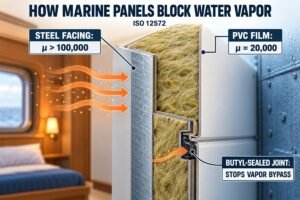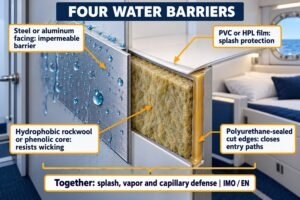
Damp cabin walls ruin your shipyard handover. Salt makes normal air act like a wet sponge on your panels. You must understand salt-driven moisture to prevent costly corrosion claims.
Salt-laden air worsens humidity exposure on marine interior panels through three mechanisms: lowering the moisture condensation point from 80% to 75% relative humidity, trapping liquid water film on PVC surfaces, and accelerating galvanic and crevice corrosion on hidden galvanized steel profiles and rockwool backing under ISO 9223 standards.
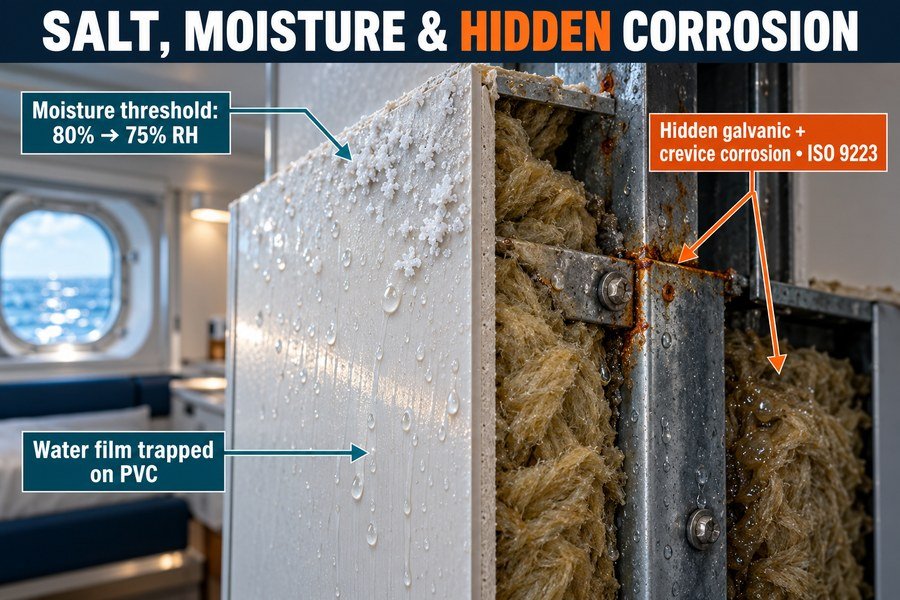
I once visited a European offshore vessel project where the wall panels started bubbling before sea trials even finished. The purchasing manager blamed the panel glue, but the real culprit was salty air mixing with cabin humidity. If you ignore how salt changes moisture behavior, your project budget will disappear into replacement panels and air freight fees. Read on to see how I protect marine interiors from this invisible threat.
How Does Airborne Sea Salt Increase Moisture Retention on Marine Interior Panels?
Dry cabins still develop wet, sticky walls at sea. Airborne salt crystals pull water straight from the air. This hidden moisture ruins panel surfaces and triggers warranty disputes.
Airborne sea salt increases moisture retention on marine interior panels via three physical processes: deliquescence of sodium chloride at 75% relative humidity, hygroscopic absorption by magnesium chloride down to 33% relative humidity, and hysteresis that keeps salt-coated PVC films wet down to 45% relative humidity.
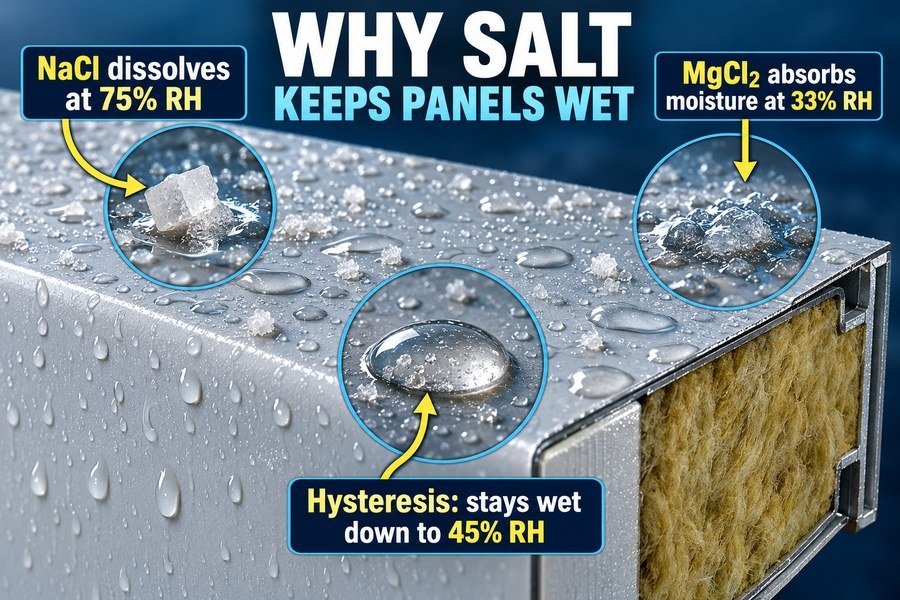
Deliquescence of Sodium Chloride and Hygroscopic Absorption of Magnesium Chloride on Panel Surfaces
When I worked on the factory floor, I tested how raw steel and PVC sheets reacted to ocean air. Many buyers think water only condenses on a wall panel when cabin humidity hits 100% or when the steel temperature drops below the dew point. That rule only applies to clean air. According to ISO 9223 corrosion standards, clean steel needs about 80% relative humidity at 20°C to form a wet film. Sea air changes this math completely because sea salt contains multiple chemical compounds.
The first compound is sodium chloride, which makes up about 77% of sea salt by weight. According to IUPAC chemical data, sodium chloride has a deliquescence point of 75.3% relative humidity at 25°C1. When cabin air reaches 75% humidity, dry sodium chloride crystals on your marine wall panel dissolve and pull water vapor out of the air. This creates a conductive liquid brine on the panel surface.
The second compound is magnesium chloride, which makes up about 10% of sea salt. Magnesium chloride is much more aggressive because it shows strong hygroscopic absorption at very low humidity levels. Based on ASTM E104 standard tables for humidity control, magnesium chloride absorbs moisture from the air starting at just 33% relative humidity2. Even in an air-conditioned cabin kept at 50% humidity, traces of magnesium chloride keep a microscopic layer of water trapped against your decorative PVC film and panel joints.
Crystallization Hysteresis and Prolonged Wetting on Marine PVC Decorative Films
The third process that hurts your panels is crystallization hysteresis. Once salt crystals dissolve into liquid brine on a panel during a humid morning, they do not dry out when the cabin humidity drops back below 75%. Instead, the liquid salt droplet stays wet until the relative humidity drops down to its efflorescence point of 43% to 45%3.
I saw this problem firsthand on a tugboat project built in Southeast Asia and delivered to a European owner. The cabin HVAC system maintained 55% relative humidity during the day, so the project engineer assumed the walls were dry. However, morning deck washing pushed cabin humidity to 78% for just twenty minutes. Because of hysteresis, the salt-coated PVC panels stayed wet for the remaining 23 hours of the day. That constant wetness broke down the adhesive along the panel edges within four months, costing the contractor $18,000 in repair labor.
| Salt Moisture Mechanism | Chemical Compound Involved | Trigger Relative Humidity (at 25°C) | Drying Threshold (Efflorescence) | Authoritative Reference Standard |
|---|---|---|---|---|
| Salt Deliquescence | Sodium Chloride (NaCl - 77% of sea salt) | 75.3% RH | 43% to 45% RH | ISO 9223 / IUPAC Data |
| Hygroscopic Absorption | Magnesium Chloride (MgCl2 - 10% of sea salt) | 33.0% RH | 22% to 25% RH | ASTM E104 |
| Crystallization Hysteresis | Mixed Marine Sea Salt Brine | Stays wet after 75% RH spike | Requires drop below 45% RH | ISO 12944-2 |
Why Does Salty Humidity Corrode Hidden Marine Interior Panel Profiles and Backing?
Your cabin walls look spotless from the corridor. Behind the panel, salty humidity is eating the steel frame. Soon, rust stains bleed through joints and fail shipyard inspections.
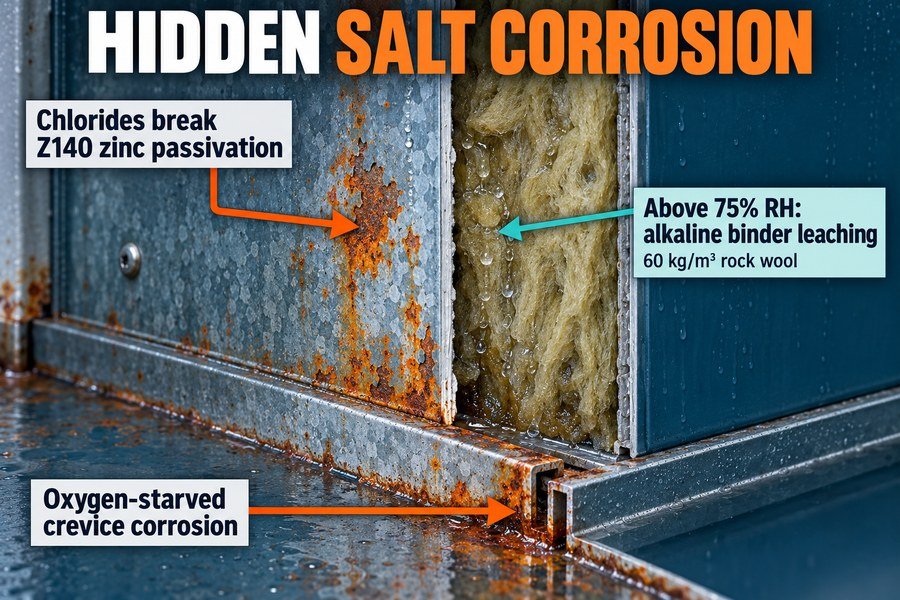
Salty humidity corrodes hidden marine interior panel profiles and backing because chloride ions break down zinc passivation layers on Z140 galvanized steel, create oxygen-starved crevice corrosion inside C-channel joints, and leach alkaline binders from 60 kg/m³ rockwool cores when moisture exceeds 75% relative humidity.
Chloride Breakdown of Zinc Passivation Layers on Galvanized Steel Profiles
When you buy a standard B-15 marine wall panel from an Asian factory, the front face usually has a 150-micron PVC film, while the back face only has a thin zinc coating or a 5-micron backer paint. In a dry environment, galvanized steel protects itself by forming a thin, stable zinc carbonate passivation layer4. However, when salty humidity gets behind the panel, chloride ions attack this protective shield.
According to EN 10346 standards for hot-dip galvanized steel, a standard Z140 coating has 140 g/m² of zinc total on both sides, which equals a zinc thickness of only 10 microns per side. When chloride ions mix with moisture above 75% relative humidity, they convert insoluble zinc carbonate into soluble zinc hydroxychloride (simonkolleite)5. In an ISO 9223 C4 marine environment, zinc corrodes at a rate of 2.1 to 4.2 microns per year. This means a budget Z140 profile behind a damp bulkhead can lose its entire zinc layer and start showing red iron rust in just 2.5 to 4 years.
Crevice Corrosion in C-Channel Joints and Binder Leaching in Rockwool Backing
The second issue happens inside the bottom C-channel track and the tongue-and-groove joints. Salty water droplets roll down the back of the panel and collect inside the 0.8 mm steel floor track. Because air cannot circulate inside that tight gap, the trapped water runs out of dissolved oxygen. This creates an anodic corrosion cell6 where the metal inside the joint dissolves three times faster than flat steel. I always tell buyers to check the bottom C-channel first when inspecting an old cabin because that is where structural failure begins.
The third failure happens inside the mineral wool insulation core. Standard B-15 panels use 60 kg/m³ to 100 kg/m³ rockwool glued to the steel skins with polyurethane adhesive. Rockwool fibers are held together by phenolic resin binders, and the fibers themselves contain trace silicates. When salty humidity exceeds 75% RH and condenses inside the rockwool, the moisture leaches alkaline ions from the wool fibers. This raises the pH of the trapped water above 9.5, which strips the zinc coating off the inside of the steel skin and destroys the polyurethane glue bond. Under ASTM C795 guidelines for insulation in contact with metal, wet insulation loaded with external chlorides acts like a poultice that holds corrosive brine flat against the steel backing 24 hours a day.
| Hidden Panel Component | Standard Material Spec | Primary Corrosion Mechanism | Failure Timeline in Salty Humidity | Reference Standard |
|---|---|---|---|---|
| Back Steel Skin | 0.6 mm Steel with Z140 Zinc (10 microns/side) | Chloride conversion of zinc carbonate to soluble salts | White rust in 6 months; red rust in 2.5 to 4 years | EN 10346 / ISO 9223 |
| Bottom C-Channel & Joints | 0.8 mm to 1.2 mm Galvanized Profile | Oxygen-starved crevice corrosion in stagnant brine | Structural pitting within 18 to 30 months | ISO 12944-2 |
| Rockwool Insulation Core | 60 to 100 kg/m³ Mineral Wool | Alkaline binder leaching and poultice delamination | Glue failure and panel bulging in 12 to 24 months | ASTM C795 / EN 13162 |
How Does Sea Salt Bypass Positive-Pressure HVAC to Reach Marine Accommodation Panels?
Shipyards trust positive-pressure HVAC to block outside air. Yet salt still coats your new cabin panels. Relying on air pressure alone leaves your interior package vulnerable to rust.
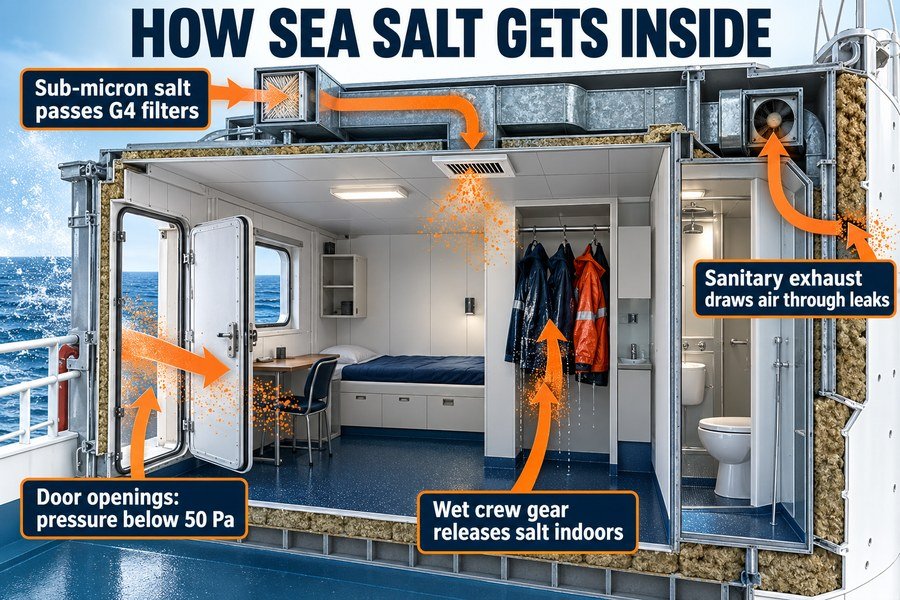
Sea salt bypasses positive-pressure HVAC to reach marine accommodation panels through four pathways: sub-micron aerosol penetration through G4 intake filters, pressure drops below 50 Pascals during door openings, wet crew gear evaporation inside changing rooms, and negative-pressure air leaks around sanitary exhaust fans.
Sub-Micron Salt Aerosol Penetration Through HVAC Filters and Door Pressure Drops
Many shipyard engineers tell me that their accommodation block is completely sealed because the HVAC system keeps the interior at a positive pressure. According to ISO 7547 standards for marine air conditioning, accommodation blocks are designed to maintain an overpressure of 20 to 50 Pascals compared to the outside deck7. In theory, air only flows outward. In reality, sea salt still gets inside every single day through four physical pathways.
First, the HVAC intake itself pumps salt directly into the cabins. Most marine air handling units use standard G4 coarse filters or F7 medium filters along with a basic droplet separator. According to ISO 16890 filter testing standards, a G4 filter stops large water droplets over 10 microns, but it captures less than 30% of sub-micron particles under 1 micron (PM1). Breaking ocean waves generate billions of fine sea salt aerosols measuring 0.1 to 2.5 microns8. These tiny salt particles pass right through G4 intake filters, travel down the supply ducts, and land directly on your cabin wall and ceiling panels.
Second, the 20 to 50 Pascal positive pressure collapses the moment a crew member opens an exterior weather door. When a 900 mm wide deck door swings open during a 20-knot wind, wind pressure easily exceeds 60 Pascals. Outside sea air rushes into the entryway corridor at 3 to 5 meters per second, coating the nearby panels with wet salt mist before the door closer can pull the door shut.
Crew Gear Evaporation and Negative-Pressure Leaks from Sanitary Exhaust Systems
The third pathway is the crew itself. On offshore support vessels and merchant ships, deckhands walk into the changing rooms wearing wet foul-weather jackets, boots, and life vests soaked in seawater. Standard seawater contains 35 grams of salt per liter. When twenty crew members hang wet gear in a locker room, the warm cabin air evaporates the water and releases fine salt dust as the fabric dries and rubs together.
The fourth pathway comes from the sanitary and galley exhaust fans. Under ISO 7547 rules, wet spaces like bathrooms, laundries, and galleys must run under negative pressure—typically minus 10 to minus 30 Pascals—so smells do not enter the bedrooms. If the exhaust fan dampers are unbalanced, or if bulkhead cable penetrations near the outer hull are poorly sealed, the negative pressure sucks raw, unconditioned sea air through tiny hull gaps9 directly into the interstitial space behind your marine wall panels. During a retrofit inspection I led in 2024, we found thick white salt crusts behind a bathroom wet unit because the exhaust fan was pulling salty air through an unsealed deck drain pipe penetration.
| Salt Intrusion Pathway | Governing Parameter / Value | Why Standard HVAC Fails to Stop It | Applicable Marine Standard |
|---|---|---|---|
| HVAC Supply Intake | Aerosols sized 0.1 to 2.5 microns | G4 filters capture less than 30% of PM1 salt aerosols | ISO 16890 / EN 779 |
| Exterior Door Opening | Cabin pressure drops below 20 to 50 Pa | 20-knot deck wind exerts over 60 Pa of inward pressure | ISO 7547 |
| Wet Crew Gear Drying | 35 grams of salt per liter of seawater | Evaporating gear sheds fine dry salt crystals indoors | IMO MSC.1/Circ.1500 |
| Sanitary Exhaust Suction | Negative pressure of -10 to -30 Pa | Pulls raw sea air through unsealed hull penetrations | ISO 7547 |
What Salt and Humidity Loads Hit Marine Wall Panels Near Deck Doors?
Corridor panels near weather deck doors fail first. Every crew exit blasts the walls with wet, salty air. Standard cabin panels cannot survive this harsh entryway zone.
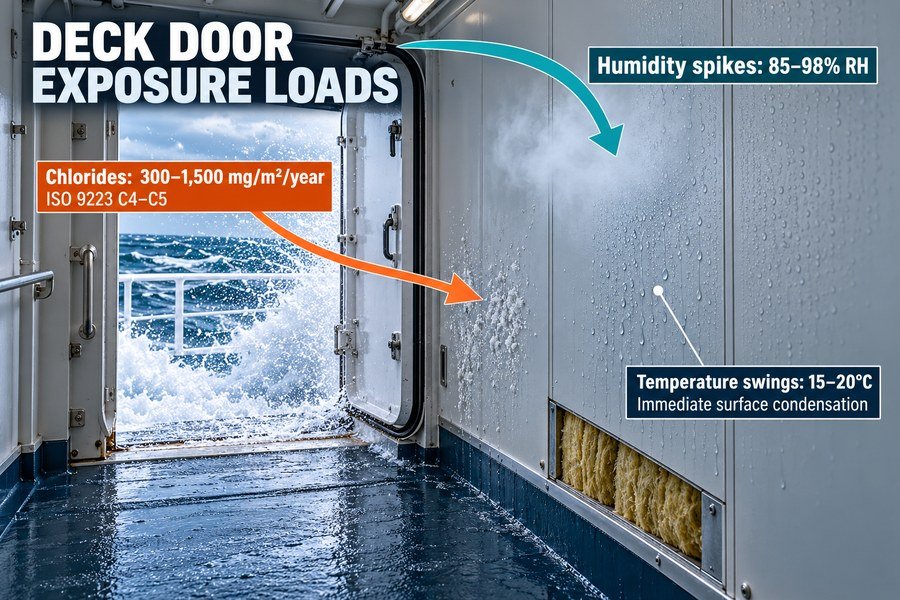
Marine wall panels near deck doors face three severe environmental loads: airborne chloride deposition rates of 300 to 1,500 mg/m²/year under ISO 9223 C4-C5 categories, relative humidity spikes reaching 85% to 98%, and rapid temperature swings of 15°C to 20°C that trigger immediate surface condensation.
High Chloride Deposition Rates and Extreme Humidity Spikes in Deck Entry Corridors
If you buy the exact same wall panel specification for both upper-deck captain cabins and main-deck entrance corridors, you will face warranty claims within twelve months. The first 3 to 5 meters of corridor inside a weather deck door experience an environment that is closer to the open deck than an indoor room.
First, look at the airborne chloride deposition rate. According to ISO 9223 corrosion classifications, a standard indoor ship cabin falls under category C2 or C3, where airborne salt deposition stays below 60 mg/m²/year10. However, the corridor right inside an exterior deck door experiences category C4 or C5-M (Marine) exposure during rough seas. In this zone, chloride deposition jumps to 300 to 1,500 mg/m²/year because wind-driven sea spray blows in on crew boots and air gusts. That is up to 25 times more salt hitting the PVC film and corner profiles than in a standard bedroom.
Second, these entryway panels suffer extreme relative humidity spikes. While ISO 7547 sets the indoor design humidity at 40% to 60% RH, tropical ocean air outside the door frequently sits at 85% to 98% relative humidity11. Every time the shift changes, a cloud of 95% RH air fills the airlock and corridor. Because the panel surfaces are already coated with deliquescent salt from previous door openings, those panels absorb moisture within seconds.
Thermal Shock and Dew Point Condensation on Marine Wall Panels Near Weather Doors
The third load is rapid thermal shock and dew point condensation. According to ISO 7547 design rules, a ship operating in tropical waters cools its interior cabins to 25°C at 50% relative humidity, while the outside air is 35°C at 85% relative humidity. Under psychrometric chart calculations, outside air at 35°C and 85% RH has a dew point of 32.1°C.
When that hot, humid air rushes through the deck door and hits a corridor wall panel cooled to 25°C, the panel temperature is 7.1°C below the incoming air's dew point. In the winter or in North Sea operations, the reverse happens: cold outside air drops the steel doorway bulkhead temperature by 15°C to 20°C, causing warm indoor air to condense inside the panel joints. I always advise procurement officers to upgrade the first 5 meters of entryway panels from standard PVC-laminated Z140 steel to either Z275 galvanized steel or 316L stainless steel skins. Paying an extra $12 to $18 per square meter for those 20 panels saves you from replacing corroded walls at a foreign port for $300 per square meter.
| Environmental Load Factor | Standard Cabin Zone (Interior) | Deck Door Entryway Zone (0 to 5m) | Impact on Marine Wall Panels | Reference Standard |
|---|---|---|---|---|
| Chloride Deposition Rate | Less than 60 mg/m²/year (ISO C2/C3) | 300 to 1,500 mg/m²/year (ISO C4/C5) | Rapid pitting at cut edges and bottom tracks | ISO 9223 |
| Relative Humidity Range | Controlled at 40% to 60% RH | Spikes of 85% to 98% RH | Instant salt deliquescence and wet film formation | ISO 7547 |
| Temperature Differential | Stable within ±2°C | Swings of 15°C to 20°C at doorway | Surface temperature drops 7°C below dew point | ASHRAE / ISO 7547 |
How Does Salty Diffuser Air Affect Surface Moisture on Marine Ceiling Panels?
Brown rust rings around ceiling air diffusers look terrible. Cold air blowing across salty ceiling panels creates constant water droplets. This ruins your ceiling finish before vessel delivery.
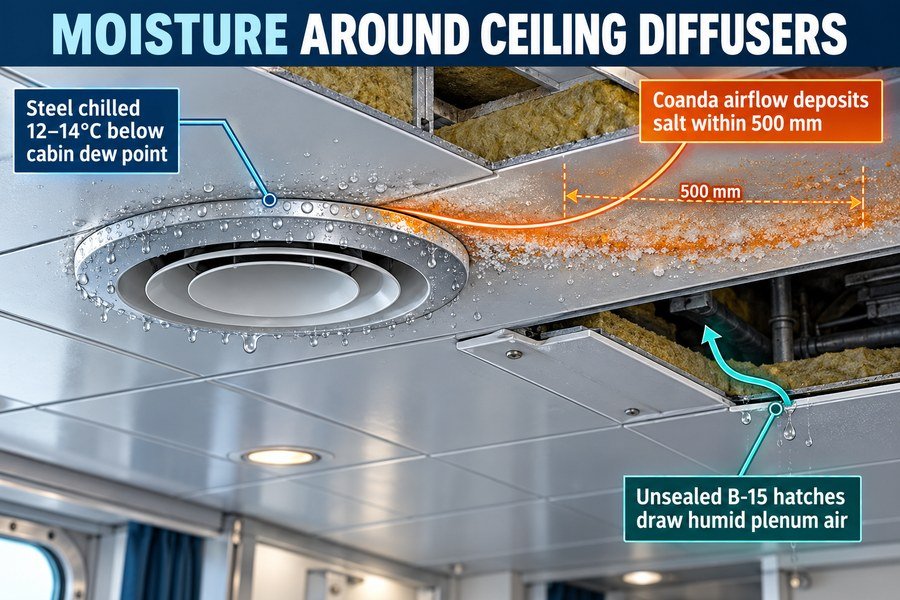
Salty diffuser air affects surface moisture on marine ceiling panels by cooling steel surfaces to 12°C-14°C below the cabin dew point, depositing salt along Coanda-effect airflow paths within 500 mm of vents, and drawing humid plenum air through unsealed B-15 ceiling inspection hatches.
Sub-Dew-Point Cooling and Coanda-Effect Salt Deposition Around Ceiling Diffusers
Marine ceiling panels—especially 300 mm wide B-15 or C-class strip ceilings—often show premature rust and peeling film right around the HVAC supply diffusers. When I inspected a passenger ferry in Indonesia two years ago, the owner rejected 400 square meters of cabin ceilings because brown rust halos appeared around every single air vent. The procurement team thought the factory supplied defective steel, but the problem was caused by how cold diffuser air interacts with salt and moisture on ceiling panels.
First, HVAC supply air leaves the ceiling diffuser at a low temperature of 12°C to 14°C so it can cool the 25°C cabin. Because the ceiling panels sit right next to the metal diffuser neck, the cold supply air chills the surrounding 0.6 mm steel ceiling panels down to 13°C or 14°C. If a cabin door opens or a crew member takes a hot shower, cabin air at 26°C and 65% relative humidity has a dew point of 18.9°C (or even lower around 14°C when salt is present12). Because the chilled ceiling panel is below the dew point, heavy condensation forms on the ceiling surface immediately.
Second, air leaving a ceiling diffuser hugs the horizontal ceiling surface because of a fluid dynamics phenomenon called the Coanda effect13. High-velocity supply air travels horizontally across the ceiling panel for 300 mm to 500 mm before dropping into the room. Any sub-micron sea salt particles14 that bypassed the HVAC filters get scrubbed directly onto the rough PVC texture within this 500 mm radius. This builds a concentrated salt ring right on the coldest part of the ceiling.
Humid Plenum Air Infiltration Through Unsealed B-15 Ceiling Hatches and Joints
The third mechanism involves the void space above the ceiling, known as the plenum. As the high-velocity supply air blows across the face of the ceiling panels, it creates a low-pressure Venturi suction zone15 right around the diffuser cone.
If your installation crew leaves tiny 1 mm gaps in the M-profile ceiling joints, or if they install cheap B-15 ceiling inspection hatches without proper EPDM rubber gaskets, that suction pulls warm, humid, salty air down from the ceiling plenum void. When warm plenum air hits the back and edges of the 13°C ceiling panel around the diffuser, water condenses right on the raw cut steel edges16 of the diffuser cutout. Since factory workers or shipyard installers cut diffuser holes on-site with electric shears, those cut edges have zero PVC film protection and almost no zinc left. Without rubber edge trim or anti-corrosion primer on the cutout, red rust bleeds onto the visible white ceiling face within three to six months.
| Diffuser Moisture Factor | Physical Parameter / Value | Affected Ceiling Panel Zone | Recommended Prevention Step | Reference Standard |
|---|---|---|---|---|
| Sub-Dew-Point Chilling | Supply air at 12°C to 14°C | Diffuser flange and adjacent strip panels | Insulate diffuser neck with 19 mm closed-cell foam | ISO 7547 |
| Coanda-Effect Scrubbing | High airflow velocity (2.5 to 4 m/s) | 300 mm to 500 mm radius around vent | Specify smooth, easy-clean 150-micron PVC or PVDF finish | EN 13501 / IMO FTPC |
| Plenum Air Suction | Venturi low-pressure zone at gaps | Raw cut steel edges of diffuser holes and hatches | Seal B-15 hatches with EPDM gaskets and prime cut edges | SOLAS II-2 |
How Is Salt-and-Humidity Exposure Defined in Marine Accommodation Panel Specifications?
Vague purchasing specs lead to cheap panels that rust quickly. Factories will supply thin zinc coatings if you let them. Clear testing standards protect your company from bad suppliers.
Salt-and-humidity exposure in marine accommodation panel specifications is defined by four benchmark standards: ISO 9227 neutral salt spray testing for 240 to 500 hours, ISO 6270-2 cyclic condensation testing at 40°C and 100% humidity, EN 10346 Z140-Z275 zinc coating weights, and IMO FTPC Part 5 low-flame-spread film ratings.
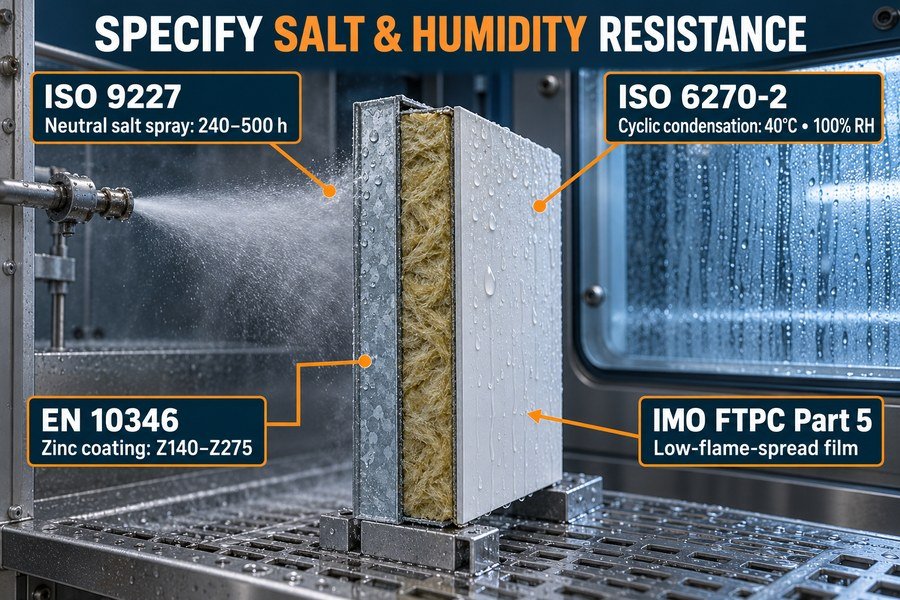
Laboratory Salt Spray and Cyclic Humidity Testing Under ISO 9227 and ISO 6270-2
When you send a request for quotation (RFQ) to a marine panel manufacturer in China or Vietnam, writing "marine grade anti-rust wall panel" on your purchase order means nothing. If a supplier wants to cut their price by $1.50 per square meter to win your order, they will reduce the zinc coating and use cheap glue. To protect your company when supplying European or US shipyards, you must lock down four specific technical benchmarks in your purchasing contract.
First, specify neutral salt spray resistance under ISO 9227 (or the equivalent ASTM B117 standard). In this test, panel samples are placed in a chamber at 35°C and sprayed continuously with a 5% sodium chloride solution at a pH of 6.5 to 7.2. For standard indoor cabin panels, you should require at least 240 hours of ISO 9227 testing with zero blistering on the PVC surface and less than 2 mm of rust creep from a scribed scratch mark. For panels near deck doors or wet corridors, demand 500 hours of salt spray resistance.
Second, require cyclic humidity and condensation testing under ISO 6270-2. In this test, panels sit in a heated water-bath chamber at 40°C and 100% condensing relative humidity for 240 to 480 hours. This test checks whether the polyurethane glue holding the PVC film and the rockwool core will delaminate when soaked in warm moisture. If a factory uses low-grade glue, the PVC film will peel at the edges after 120 hours in an ISO 6270-2 chamber.
Specifying EN 10346 Zinc Coating Weights and IMO FTPC Part 5 Protective Films
Third, explicitly write the galvanized steel coating weight using EN 10346 standards. Many budget factories quietly use Z60 or Z80 steel (only 60 to 80 g/m² of zinc), which belongs in dry office buildings on land, not on ships. Your specification must mandate a minimum of EN 10346 Z140 (140 g/m² total zinc, or 10 microns per side) for dry cabins, and Z200 or Z275 (200 to 275 g/m² total zinc, or 14 to 20 microns per side) for corridors, ceilings around diffusers, and wet spaces. Moving from Z80 to Z200 only increases the panel manufacturing cost by about $0.80 to $1.20 per square meter on a typical $22 to $28 per square meter B-15 wall panel, but it doubles the corrosion lifespan17.
Fourth, define the decorative surface film thickness and certification under IMO 2010 FTP Code Part 5 (and Part 2 for smoke and toxicity)18. Do not accept 80-micron or 100-micron domestic PVC films because thin films have microscopic pinholes that let salty water touch the steel underneath. Specify a 120-micron to 150-micron marine-grade PVC film (or a 25-micron PVDF coating for high-humidity zones) certified to IMO FTPC Part 5 with a protective peel-off film on both the front and back surfaces during sea shipping.
| Specification Parameter | Testing / Material Standard | Standard Cabin Requirement | High-Risk Zone Requirement (Doors/Wet Areas) | Cost Impact per m² |
|---|---|---|---|---|
| Neutral Salt Spray Test | ISO 9227 / ASTM B117 (5% NaCl at 35°C) | Minimum 240 hours (no blisters) | Minimum 500 hours (under 2 mm scribe creep) | Included in QA testing |
| Cyclic Humidity Test | ISO 6270-2 (40°C at 100% RH) | Minimum 240 hours (no film peeling) | Minimum 480 hours (no core delamination) | Included in QA testing |
| Galvanized Zinc Weight | EN 10346 Hot-Dip Galvanized | Z140 (140 g/m² / 10 microns per side) | Z200 to Z275 (14 to 20 microns per side) | +$0.80 to $1.50 / m² |
| Decorative Film & Fire Spec | IMO 2010 FTPC Part 5 & Part 2 | 120-micron PVC film + 5-micron back epoxy | 150-micron PVC film or 316L Stainless Skin | +$1.00 to $15.00 / m² |
Conclusion
Salt lowers condensation thresholds and accelerates hidden rust on marine panels. Specifying Z275 galvanized steel, 150-micron PVC film, and ISO 9227 testing protects your interior projects from moisture failure.
-
"Deliquescence of NaCl Confined in Nanoporous Silica", https://pubmed.ncbi.nlm.nih.gov/36037488/. Published thermodynamic and aerosol-chemistry data report that crystalline sodium chloride deliquesces at about 75.3% relative humidity at 25°C, supporting the stated humidity threshold for NaCl brine formation. Evidence role: statistic; source type: paper. Supports: Sodium chloride has a deliquescence relative humidity of about 75.3% at 25°C.. Scope note: The value applies to pure sodium chloride under controlled conditions; mixed marine salts, surface contamination, and temperature changes can shift the practical threshold. ↩
-
"Humidity Fixed Points of Binary Saturated Aqueous Solutions", https://pmc.ncbi.nlm.nih.gov/articles/PMC5295834/. ASTM E104 humidity-control data and related saturated-salt tables list magnesium chloride solutions as maintaining approximately 33% relative humidity at 25°C, which supports magnesium chloride’s strong moisture affinity at comparatively low RH. Evidence role: statistic; source type: institution. Supports: Magnesium chloride is associated with moisture uptake or equilibrium humidity near 33% RH at 25°C.. Scope note: A saturated-salt equilibrium RH is not identical to an onset point for all solid magnesium chloride particles; hydration state, impurities, and temperature affect actual absorption behavior. ↩
-
"Salt crystallization and deliquescence triggered by ...", https://arxiv.org/html/2510.27309v1. Aerosol and salt-crystallization studies report that sodium chloride droplets can remain liquid below the deliquescence relative humidity and crystallize only near 43–45% RH, supporting the hysteresis between deliquescence and efflorescence. Evidence role: mechanism; source type: paper. Supports: Dissolved sodium chloride brine can remain wet until relative humidity falls to roughly 43–45% due to crystallization hysteresis.. Scope note: The 43–45% range is well established for pure or laboratory-generated NaCl particles; mixed sea-salt brines and surface geometry can produce different crystallization thresholds. ↩
-
"Corrosion and corrosion products of hot dipped galvanized ...", https://www.academia.edu/121964527/Corrosion_and_corrosion_products_of_hot_dipped_galvanized_steel_during_long_term_atmospheric_exposure_at_different_sites_world_wide. A corrosion science source should support that zinc and galvanized coatings exposed to atmospheric carbon dioxide and moisture can develop basic zinc carbonate corrosion products that reduce further corrosion under relatively benign conditions. Evidence role: mechanism; source type: paper. Supports: In a dry environment, galvanized steel protects itself by forming a thin, stable zinc carbonate passivation layer.. Scope note: This support is contextual because passivation stability depends on humidity, pollutants, wet-dry cycling, and chloride exposure rather than dry conditions alone. ↩
-
"Formation of Corrosion Products on Open and Confined ...", https://www.academia.edu/16356874/Formation_of_Corrosion_Products_on_Open_and_Confined_Zinc_Surfaces_Exposed_to_Periodic_Wet_Dry_Conditions. A peer-reviewed corrosion study should support that chloride-containing humid environments alter zinc corrosion chemistry and can produce zinc hydroxychloride phases such as simonkolleite on galvanized steel. Evidence role: mechanism; source type: paper. Supports: When chloride ions mix with moisture above 75% relative humidity, they convert insoluble zinc carbonate into soluble zinc hydroxychloride (simonkolleite).. Scope note: The source may show formation of simonkolleite under chloride exposure rather than a direct one-step conversion from zinc carbonate, so the citation should be used to support the corrosion-product pathway rather than every chemical detail of the sentence. ↩
-
"(PDF) Pitting and Crevice Corrosion", https://www.academia.edu/67113081/Pitting_and_Crevice_Corrosion. A corrosion engineering source should support that differential aeration in crevices can deplete oxygen inside the crevice and make the occluded region anodic relative to better-aerated surrounding metal, accelerating localized attack. Evidence role: mechanism; source type: education. Supports: Because air cannot circulate inside that tight gap, the trapped water runs out of dissolved oxygen. This creates an anodic corrosion cell where the metal inside the joint dissolves faster than flat steel.. Scope note: This supports the crevice-corrosion mechanism generally; it does not by itself quantify the article’s claimed acceleration rate or prove failure in a specific C-channel geometry. ↩
-
"50 Subpart 72.20—Accommodations for Officers and Crew", https://www.govinfo.gov/content/pkg/CFR-2014-title46-vol3/pdf/CFR-2014-title46-vol3-sec72-15-20.pdf. A marine HVAC standard or classification guidance should substantiate that accommodation ventilation systems are commonly designed with a small positive pressure differential relative to adjacent exterior or less-clean spaces. Evidence role: general_support; source type: institution. Supports: ISO 7547-based marine accommodation HVAC design uses a 20 to 50 Pa overpressure relative to the outside deck.. Scope note: The exact 20–50 Pa range should be checked against the applicable ISO 7547 edition or vessel-class requirements, because pressure values can vary by ship type and design specification. ↩
-
"2024 News & Events: Ocean Spray Is Relatively Lifeless", https://csl.noaa.gov/news/2024/417_0826.html. Atmospheric aerosol studies report that sea spray aerosol is generated by breaking waves and bubble bursting and includes submicron and micron-scale sea-salt particles within roughly the 0.1–2.5 µm range. Evidence role: mechanism; source type: paper. Supports: Breaking waves generate fine sea-salt aerosols in the 0.1 to 2.5 micron range.. Scope note: Such sources support the generation mechanism and particle-size range, but may not directly verify the article’s quantitative wording “billions” for every local shipboard condition. ↩
-
"Building Science Introduction - Air Flow", https://basc.pnnl.gov/information/building-science-introduction-air-flow. Building-science and ventilation references explain that exhaust-driven negative pressure causes infiltration through leaks and penetrations, supporting the mechanism by which unconditioned exterior air can be drawn into wall or service cavities. Evidence role: mechanism; source type: government. Supports: Negative pressure from exhaust systems can draw outside air through small leaks or penetrations.. Scope note: General infiltration literature supports the pressure-driven airflow mechanism; ship-specific leakage paths and salt loading would still depend on vessel construction and local exposure. ↩
-
"Atmospheric Site Data – Corrosion", https://public.ksc.nasa.gov/corrosion/atmospheric-site-data/. Published summaries of ISO 9223 chloride-deposition classes report threshold ranges used to distinguish low and higher marine atmospheric salinity, which can contextualize the article’s comparison of interior and entryway exposure levels. Evidence role: definition; source type: institution. Supports: ISO-based corrosion classifications associate lower corrosivity environments with lower airborne chloride deposition thresholds.. Scope note: Care is needed because ISO 9223 commonly reports chloride deposition in mg/m²/day rather than mg/m²/year; the source should be checked against the article’s stated unit. ↩
-
"47. Relative humidity over the oceans", https://www.gfdl.noaa.gov/blog_held/47-relative-humidity-over-the-oceans/. Meteorological and ocean-climate references report high relative humidity over tropical oceans, supporting the plausibility of very humid air entering deck-adjacent spaces. Evidence role: statistic; source type: government. Supports: Tropical marine air commonly reaches high relative humidity levels, including values in the 85% to 98% range.. Scope note: Regional and seasonal variation is substantial, so the source should support typical tropical marine humidity rather than every vessel route or time of day. ↩
-
"Effect of relative humidity on corrosion of steel under sea salt ...", https://experts.umn.edu/en/publications/effect-of-relative-humidity-on-corrosion-of-steel-under-sea-salt-/. Atmospheric-corrosion literature supports that hygroscopic salts, including chloride salts, can absorb moisture and form conductive surface films below water-saturation conditions, providing a mechanism for salt-assisted wetting and corrosion near cool metal surfaces. Evidence role: mechanism; source type: paper. Supports: Salt contamination can allow moisture accumulation on a surface at temperatures or humidities below those required for pure-water condensation.. Scope note: Such sources support salt-induced surface wetting and deliquescence behavior, but they may not directly prove that the air dew point itself becomes 14 °C in this installation. ↩
-
"Coandă effect", https://en.wikipedia.org/wiki/Coand%C4%83_effect. Fluid-mechanics references describe the Coanda effect and ceiling-attached wall jets, supporting the claim that supply air from a ceiling diffuser can remain attached to an adjacent ceiling surface before mixing into the room. Evidence role: definition; source type: encyclopedia. Supports: Supply air from a ceiling diffuser can attach to and travel along the ceiling due to the Coanda effect.. Scope note: This supports the general airflow mechanism, but diffuser geometry and room airflow measurements would be needed to verify the exact attachment distance in a particular cabin. ↩
-
"HVAC filtration for controlling infectious airborne disease ...", https://pmc.ncbi.nlm.nih.gov/articles/PMC7127325/. Aerosol-science studies report that marine sea-salt aerosol spans a wide particle-size range, including fine and submicron fractions, supporting the plausibility that small chloride-containing particles may be present in marine indoor or ventilation air. Evidence role: general_support; source type: paper. Supports: Marine air can contain sub-micron sea salt particles that may enter ventilation airflow if not effectively filtered.. Scope note: This supports the existence of submicron sea-salt aerosol, but it does not demonstrate the filtration performance or deposition pattern of the vessel’s specific HVAC system. ↩
-
"Bernoulli's principle", https://en.wikipedia.org/wiki/Bernoulli%27s_principle. Fluid-dynamics and ventilation references explain that high-velocity flow can reduce local static pressure and entrain surrounding air, supporting the proposed suction mechanism near gaps around diffuser assemblies. Evidence role: mechanism; source type: education. Supports: High-velocity diffuser airflow can create a local low-pressure or entrainment zone capable of drawing nearby air through gaps.. Scope note: The source would establish the pressure/entrainment principle, not the magnitude of suction at the specific ceiling joints or hatches described. ↩
-
"Atmospheric Corrosion of Different Steel Types in Urban and ...", https://pmc.ncbi.nlm.nih.gov/articles/PMC11679332/. Corrosion-engineering guidance supports that exposed or damaged coated-steel edges are more vulnerable to corrosion in chloride-containing humid environments because the protective coating is interrupted at the cut edge. Evidence role: mechanism; source type: government. Supports: Unprotected raw cut steel edges around diffuser openings are more susceptible to chloride-related corrosion than intact coated panel surfaces.. Scope note: This supports the corrosion vulnerability of unprotected cut edges, but it does not independently verify the article’s three-to-six-month rust timeline. ↩
-
"DoD 2013-3557", https://www.waru.edu/sites/default/files/Migrated/CopDocuments/Examination%20of%20Zinc%20Galvanized%20Steel%20Corrosion%20Rates%20in%20Various%20Atmospheric%20and%20Soil%20Exposure%20Conditions.pdf. Corrosion-engineering literature generally finds that, for galvanized steel in a given atmosphere, service life is approximately proportional to available zinc coating thickness or mass, supporting the directional claim that heavier zinc coatings extend time to red rust. Evidence role: mechanism; source type: research. Supports: Increasing zinc coating mass on galvanized steel can substantially increase corrosion service life, often approximately in proportion to coating thickness under comparable exposure conditions.. Scope note: The exact doubling from Z80 to Z200 depends on environment, coating quality, cut edges, maintenance, and whether corrosion begins from scratches or exposed steel. ↩
-
"What Is the Purpose and Scope of the IMO FTP Code?", https://magellanmarinetech.com/what-purpose-scope-of-imo-ftp-code/. The IMO 2010 FTP Code sets fire-test procedures for materials used on ships; Part 5 concerns surface flammability, while Part 2 concerns smoke and toxicity testing. Evidence role: definition; source type: government. Supports: IMO 2010 FTP Code Part 5 addresses surface flammability testing, and Part 2 addresses smoke and toxicity testing for maritime materials.. Scope note: The source establishes the scope of the FTP Code parts, not whether a particular PVC film or panel has passed them. ↩