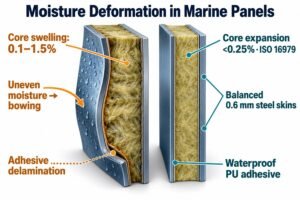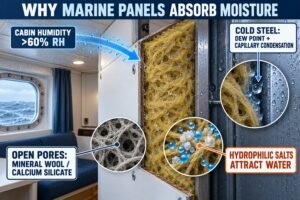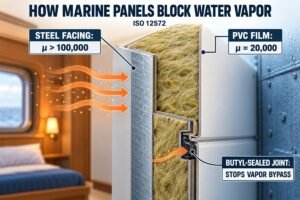
Land wall panels rot and peel within months at sea. Peeling PVC film ruins your shipyard handover and delays payments. Understanding marine humidity differences protects your outfitting budget.
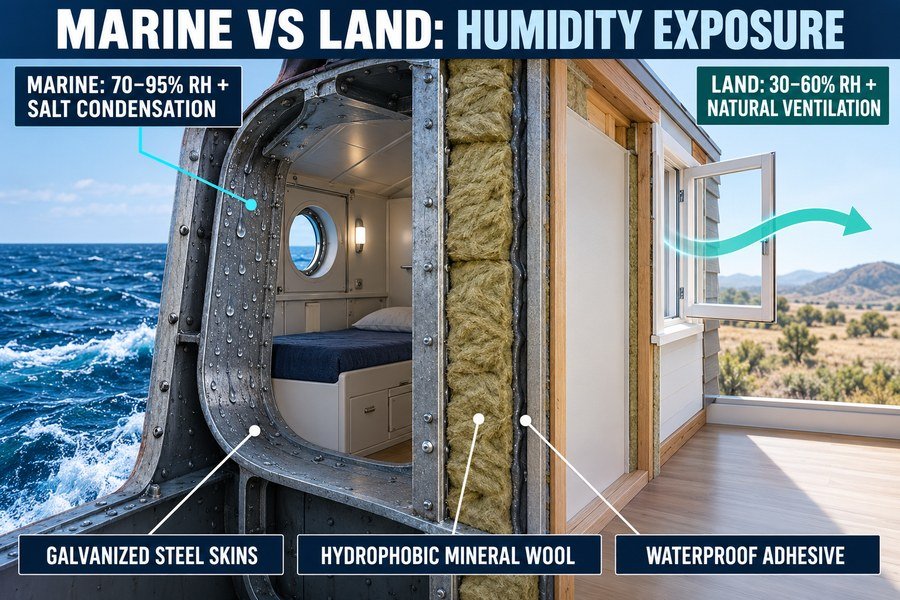
Marine interior panels face constant 70% to 95% relative humidity (RH) and salt-laden condensation inside sealed steel hulls, whereas land-building panels experience fluctuating 30% to 60% RH with natural ventilation (ISO 7547, ASHRAE Standard 55). Therefore, marine panels require galvanized steel skins, hydrophobic mineral wool, and waterproof adhesives.
Many procurement managers buy cheaper land-grade materials for ship cabins and regret it during sea trials. I saw this happen when I worked at a marine outfitting factory a few years ago. A contractor bought standard interior wall panels to save $4 per square meter on an offshore accommodation vessel. Within four months at sea, the PVC film bubbled and rust bled through the joints. The European shipyard rejected the entire deck, and the replacement cost $85,000 in materials and air freight. Below, I break down the exact humidity numbers, hull physics, and material specifications you need so you never face that kind of loss.
What Relative Humidity Levels Do Marine Interior Panels Face at Sea?
Guessing ocean moisture levels leads to rusted cabin bulkheads. Rust stains force you to rip out finished walls before vessel delivery. Exact humidity data helps you buy right.
At sea, marine interior panels face relative humidity (RH) across three zones: 40% to 70% RH in HVAC-controlled cabins (ISO 7547), 75% to 90% RH in naturally ventilated corridors and mess rooms, and 90% to 100% RH in wet spaces like galleys, laundries, and sanitary units (IMO MSC/Circ.1120).
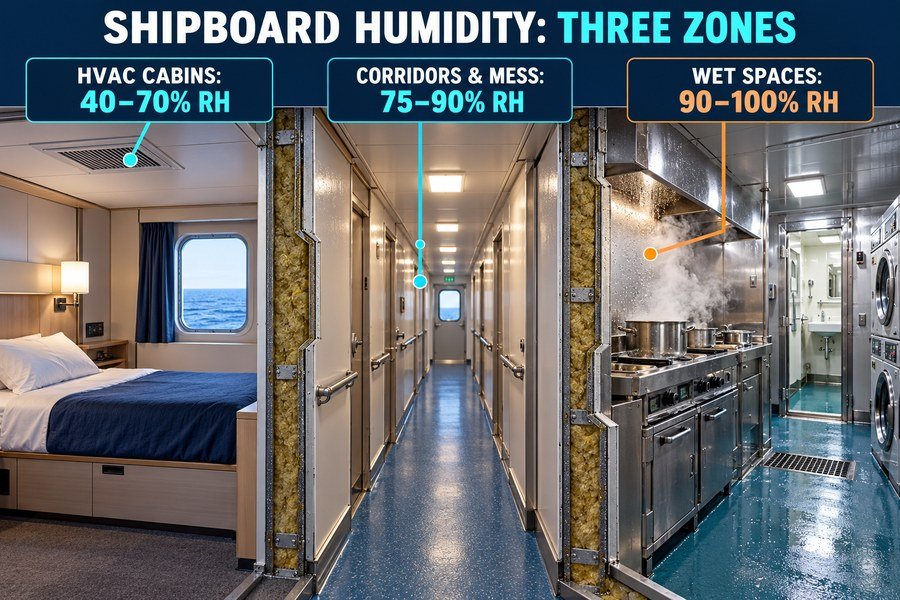
Relative Humidity Levels in HVAC-Controlled Ship Cabins and Public Corridors
Shipboard humidity is never uniform across a deck. When I review panel schedules for clients at Magellan Marine, I always divide the vessel into three moisture zones before quoting prices. The first zone covers HVAC-controlled sleeping cabins, dayrooms, and wheelhouses. According to ISO 7547 (Ships and marine technology — Air-conditioning andobilation of accommodation spaces), the design indoor relative humidity is 50% RH at 27°C in summer and 30% to 40% RH at 22°C in winter. However, actual sea readings in these cabins sit between 40% and 70% RH1 because crew members open cabin doors and adjust thermostats.
The second zone covers naturally ventilated or semi-conditioned corridors, stairways, and mess rooms. These spaces experience 75% to 90% RH. Crew members walk in from open weather decks all day, and the air handling units struggle to remove the extra moisture. Standard B-15 rockwool wall panels in these corridors sit in damp air for months at a time. If your supplier uses thin steel sheets with poor zinc coating in these corridors, white rust appears around the H-profiles within 60 days.
Extreme Moisture Levels in Shipboard Galleys, Laundries, and Sanitary Spaces
The third zone covers wet spaces, including galleys, pantries, laundries, drying rooms, and modular sanitary units. Under IMO MSC/Circ.1120 and ISO 15382 guidelines for marine accommodation drainage and ventilation, these rooms operate at 90% to 100% RH. Hot water washdowns at 60°C and steam from cooking kettles push the air past its saturation point every single day.
Two years ago, I inspected a ferry retrofit where the buyer installed standard PVC-laminated galvanized panels inside a ship laundry room to cut costs by $8 per square meter. The constant 95% RH and detergent steam penetrated the micro-pores of the PVC film in 90 days.2 The glue failed, and the rockwool core absorbed 3 kg of water per square meter. For this third zone, you must specify stainless steel 304 or 316L panels or heavy-duty PVDF-coated sheets.
| Shipboard Moisture Zone | Typical Relative Humidity (RH) | Ambient Temperature Range | Authoritative Standard | Recommended Marine Panel Surface |
|---|---|---|---|---|
| Zone 1: HVAC Cabins & Wheelhouse | 40% – 70% RH (50% design) | 20°C – 27°C | ISO 7547 | 0.6 mm Galvanized Steel (Z140) + 0.15 mm PVC Film |
| Zone 2: Corridors, Stairs & Mess Rooms | 75% – 90% RH | 18°C – 32°C | ISO 7547 / IACS Rec. 105 | 0.6 mm Galvanized Steel (Z200) + 0.18 mm PVC Film |
| Zone 3: Galleys, Laundries & Wet Units | 90% – 100% RH (Condensing) | 25°C – 45°C | IMO MSC/Circ.1120 | 0.6 mm Stainless Steel (SUS 304/316L) or Z275 Steel |
Why Do Marine Interior Panels Face Higher Humidity Than Land-Building Panels?
Treating a ship like an office building destroys your interior panels. Swollen cores jam cabin doors and anger European shipowners. You must understand the four marine moisture drivers.
Marine interior panels face 25% to 40% higher humidity than land panels due to four factors: surrounding ocean air at 80% to 95% RH (ISO 7547), rapid climate zone crossings within days, hygroscopic salt aerosols (0.05 to 0.5 mg/m³), and cold steel hull boundaries causing severe hidden condensation.
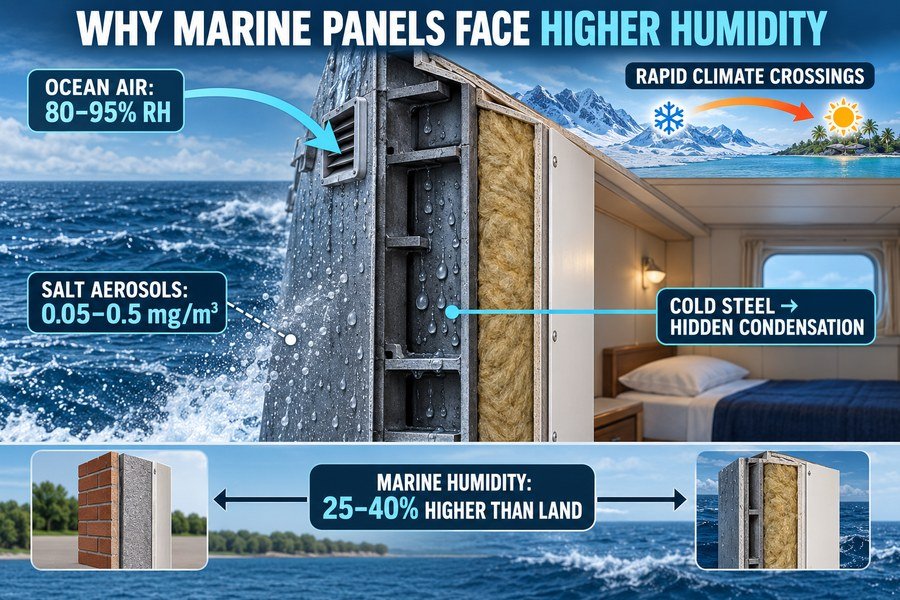
Ocean Air Saturation and Rapid Climate Crossings Around Marine Panels
Many interior decoration buyers ask me why a wall panel that lasts 20 years in a Jakarta or Rotterdam hotel fails in 12 months on a vessel. The first factor is the surrounding ocean boundary layer. On land, commercial buildings operate at 30% to 60% RH according to ASHRAE Standard 55, because dry soil and pavement absorb heat and lower ambient humidity. At sea, water covers 100% of the surrounding surface. ISO 7547 states that outdoor marine air stays at 80% to 95% RH at 35°C in tropical waters. Every cubic meter of outside air entering the ship carries 28 to 35 grams of water vapor, compared to 10 to 14 grams in a typical land city.
The second factor is rapid climate zone crossing. A land building sits in one climate forever, so its wall panels adjust to gradual seasonal shifts over 90 days. A container ship or offshore supply vessel sails from Rotterdam (-5°C and 85% RH in winter) to Singapore (+32°C and 90% RH) in 14 to 18 days. This rapid 37°C temperature swing expands and contracts the steel panel skins by 0.4 mm per linear meter3 (based on a thermal expansion coefficient of 12 × 10-6 K-1 for carbon steel). This movement stresses the panel joints and pumps humid air straight into the mineral wool core.
Airborne Salt Aerosols and Cold Steel Hull Condensation Behind Marine Panels
The third factor is hygroscopic salt aerosols. According to ISO 9223 (Corrosion of metals and alloys — Corrosivity of atmospheres), marine atmospheres fall into Category C5-M, carrying 0.05 to 0.5 mg/m³ of airborne sodium chloride (NaCl) particles. These microscopic salt crystals enter the accommodation block on crew clothing and through ventilation louvers. Salt is hygroscopic, which means it pulls water out of the air once relative humidity hits 75% (the deliquescence point of NaCl).4 When salt settles on a marine wall panel or ceiling grid, the panel surface stays wet even when the cabin feels dry to your hand.
The fourth factor is the cold steel hull boundary. Land buildings use brick, aerated concrete, or gypsum walls that insulate well and allow slow vapor diffusion. Ships have a 12 mm to 25 mm outer steel hull sitting directly in seawater that ranges from -2°C to +32°C (ISO 7547). This cold steel shell sits just 100 mm behind your B-15 cabin lining panel. Warm indoor air hits the cold space behind the panel and turns into liquid water immediately.
| Environmental Driver | Marine Vessel Condition | Land Commercial Building Condition | Authoritative Reference | Direct Impact on Interior Panels |
|---|---|---|---|---|
| Surrounding Outdoor Air RH | 80% – 95% RH continuously | 30% – 60% RH average | ISO 7547 / ASHRAE 55 | Constant high vapor pressure against panel skins |
| Climate Shift Speed | 30°C – 40°C change in 10–14 days | Gradual change over 90–120 days | IMO MSC Guidelines | Thermal expansion opens tongue-and-groove joints |
| Salt Aerosol Concentration | 0.05 – 0.5 mg/m³ NaCl (Category C5-M) | Less than 0.003 mg/m³ (Category C2) | ISO 9223 | Salt attracts moisture at 75% RH and pits steel |
| Exterior Envelope Material | 12–25 mm Steel Plate in seawater | 150–300 mm Brick, Concrete, or Curtain Wall | ISO 10456 | Severe cold bridging and hidden condensation |
What Causes Persistent High Humidity Around Marine Accommodation Panels?
Temporary dry air never lasts inside a working vessel. Hidden dampness breeds black mold behind your wall panels within weeks. Identifying the four internal moisture sources stops damage.
Persistent high humidity around marine accommodation panels comes from four continuous sources: wet-air intake through ship HVAC systems (15 to 30 m³/h per person per ISO 7547), bilge and ballast tank evaporation, high-density crew respiration and showering, and negative-pressure seawater air infiltration through deck doors.
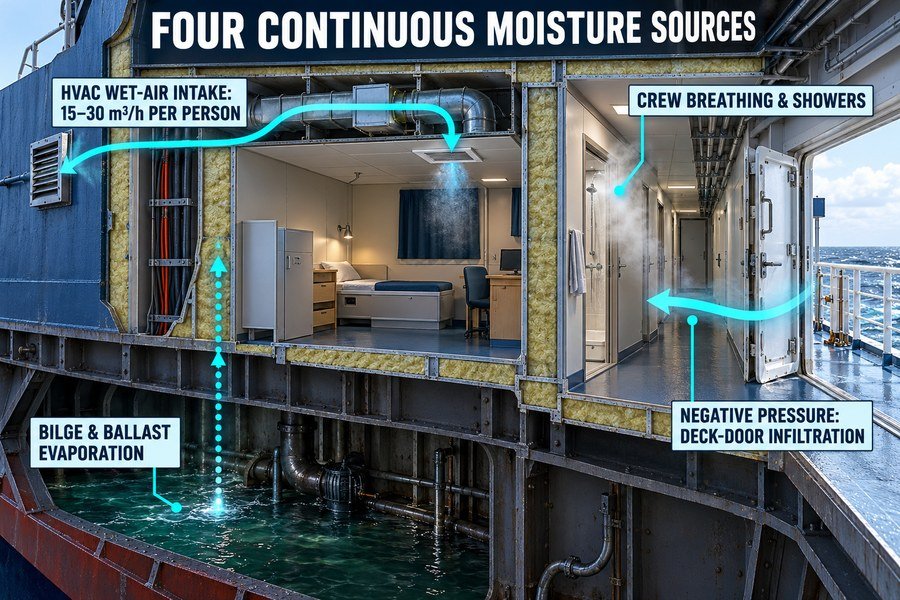
HVAC Wet-Air Intake and Bilge Water Evaporation Inside Ship Superstructures
Even when a ship has a modern air-conditioning plant, moisture builds up behind marine accommodation panels every hour. The first source is wet-air intake through the ship HVAC system. Under ISO 7547, marine air conditioning systems must supply at least 0.008 m³/s (28.8 m³/h) of fresh outdoor air per person, or 30% to 40% of the total air circulation volume, to keep carbon dioxide levels safe and replenish toilet exhausts. When the ship sails through the Indian Ocean or Southeast Asia at 32°C and 90% RH5, the cooling coils must condense out 12 to 18 grams of water per kilogram of dry air. If the shipyard sized the chiller purely for sensible cooling (temperature drop) rather than latent cooling (moisture removal), cold but damp air at 16°C and 85% RH blows directly onto the marine ceiling panels.
The second source is bilge and ballast tank evaporation. At the bottom of the hull and in pipe trunks beneath the accommodation deck, bilge wells collect oily water, condensates, and washdown runoff at 25°C to 40°C. Warm vapor rises through unsealed cable penetrations, pipe sleeves, and stairwells. When I helped troubleshoot a mold outbreak on a bulk carrier in 2024, we found that a single unsealed 150 mm cable trunk from the lower deck was feeding 4 liters of water vapor per day directly into the cavity behind the main deck corridor wall panels.
High-Density Crew Moisture Loads and Deck Door Air Infiltration
The third source is high-density crew respiration, perspiration, and showering. Ship cabins are compact, typically measuring 7.5 m² to 14 m² under the Maritime Labour Convention (MLC 2006) guidelines, compared to 30 m² to 50 m² per person in land offices. According to ASHRAE Fundamentals data, one adult releases 1.5 to 3.0 kg of water vapor every 24 hours through breathing and sweat. In addition, almost every marine cabin has a private wet unit (prefabricated bathroom). A single 10-minute hot shower releases 200 to 500 grams of steam. When the crew member opens the wet unit door after showering, a wave of 95% RH steam rolls out and hits the B-15 cabin bulkhead panels.
The fourth source is negative-pressure seawater air infiltration through weather deck doors. Galley exhaust fans and sanitary extraction fans pull air out of the accommodation block at 50 to 150 m³/h per wet room (ISO 7547). This extraction often creates a slight negative pressure of -5 to -15 Pascals inside corridors. Every time a sailor opens an exterior watertight door to the main deck, raw ocean air rushes in and soaks the corridor wall panels and ceiling joints.
| Internal Moisture Source | Moisture Input Rate / Metric | Primary Affected Panel Area | Governing Standard | Field Mitigation Strategy |
|---|---|---|---|---|
| HVAC Fresh Air Intake | 28.8 m³/h per crew member at 80–95% RH | Marine ceiling panels & cabin linings | ISO 7547 | Use PVDF or 0.18 mm PVC around air diffusers |
| Bilge & Pipe Trunk Evaporation | 2 – 6 liters/day through deck penetrations | Lower deck corridor & bulkhead panels | SOLAS Reg. II-2/9 | Seal all cable and pipe transits with MCT blocks |
| Crew Respiration & Showering | 1.5 – 3.0 kg/day + 200–500 g/shower | Cabin partition walls & wet unit doors | MLC 2006 / ASHRAE | Specify SUS 304 threshold profiles & waterproof glue |
| Deck Door Air Infiltration | -5 to -15 Pa negative pressure draw | Weather-deck entrance & lobby panels | ISO 7547 | Install airlocks and Z275 galvanized panels at entrances |
How Do Sealed Ship Hulls Trap Moisture Around Marine Interior Panels?
Moisture enters a ship cabin easily but cannot escape. Trapped water rots rockwool insulation and ruins fire ratings fast. Understanding hull vapor trapping saves your outfitting project.
Sealed ship hulls trap moisture around marine interior panels through three mechanisms: zero-permeability welded steel plating (0.0 g/m²·day vapor transmission), dead-air cavities of 50 to 150 mm behind B-15 linings, and steel structural thermal bridges that drop cavity temperatures below the 18°C to 24°C dew point.
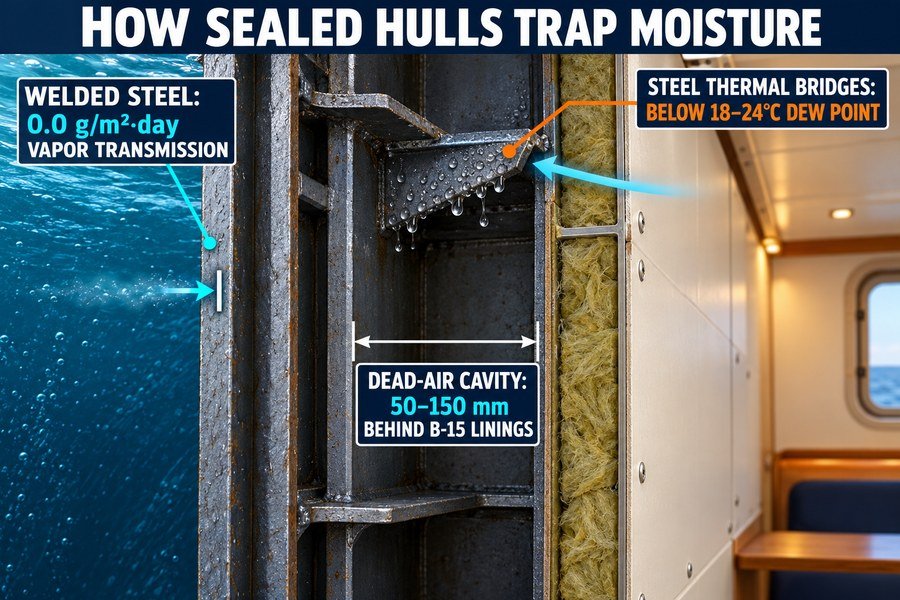
Zero-Permeability Steel Hull Plating and Dead-Air Cavities Behind Marine Linings
In land buildings, moisture that gets inside a wall cavity can dry toward the outside through brick mortar, house wrap, or concrete block. According to ASTM E96 (Standard Test Methods for Water Vapor Transmission of Materials), standard concrete and brick walls have a water vapor transmission rate (WVTR) of 15 to 50 g/m²·day6. A ship hull is completely different. The first trapping mechanism is zero-permeability welded steel plating. Marine hulls use 10 mm to 25 mm welded A-grade or AH36 steel plates coated with 250 to 400 microns of epoxy paint. This steel envelope has a WVTR of exactly 0.0 g/m²·day. It is a hermetically sealed steel box. Any water vapor that gets behind your marine wall panels has zero path to escape outward.
The second mechanism is the dead-air cavity behind B-15 and B-0 lining panels. During ship interior installation, workers mount vertical steel top-hat profiles and bottom U-channels 50 mm to 150 mm inward from the ship hull stiffeners to leave room for electrical cables, fire hydrant pipes, and hull frames. This 50 mm to 150 mm gap forms a sealed, unventilated air pocket behind the marine wall panels7. Unlike the cabin side, which gets conditioned air movement at 0.15 to 0.25 m/s (ISO 7547), the air velocity inside this back cavity is 0.0 m/s. Once humid air enters this dead space, it stays trapped against the unpainted or lightly primed back of your wall panel.
Steel Frame Thermal Bridges and Dew Point Condensation on Panel Backs
The third mechanism is steel structural thermal bridging. Steel has a thermal conductivity ($\lambda$) of 50 W/m·K according to ISO 10456, which is more than 1,200 times higher than rockwool insulation (0.038 to 0.042 W/m·K). Even when the shipyard pins 50 mm of A-60 mineral wool onto the steel bulkhead, the T-bulb stiffeners, deck beams, and steel mounting brackets act as cold bridges.
Let me give you a real engineering calculation we use at Magellan Marine. Suppose a vessel is sailing in the North Sea where seawater is 8°C, and the crew keeps the cabin at 24°C and 70% RH. Based on psychrometric charts (ASHRAE Fundamentals), the dew point of that cabin air is 18.2°C. When warm cabin air leaks through the unsealed M-profile or H-profile joints of a marine wall panel into the back cavity, it hits steel hull stiffeners sitting at 12°C to 15°C. Because 15°C is below the 18.2°C dew point, the vapor condenses into liquid water droplets at a rate of 50 to 150 grams per square meter per day8. That water runs down the hull stiffeners, pools inside the bottom floor U-channel, and wicks straight up into the bottom edge of your marine interior panel.
| Hull Trapping Mechanism | Marine Engineering Value | Land Building Equivalent | Authoritative Standard | Resulting Failure Mode in Panels |
|---|---|---|---|---|
| Outer Envelope Permeability | 0.0 g/m²·day (Welded Steel Hull) | 15 – 50 g/m²·day (Brick / Concrete) | ASTM E96 | 100% of moisture remains trapped inside the hull |
| Behind-Panel Air Cavity | 50 – 150 mm gap at 0.0 m/s airflow | Vented rainscreen or breathable stud wall | ISO 7547 | Stagnant damp air rots the back steel sheet |
| Structural Thermal Bridge | 50 W/m·K steel conductivity vs 18.2°C dew point | 0.8 – 1.4 W/m·K concrete / wood studs | ISO 10456 / ASHRAE | Liquid water pools in bottom U-channels and rusts panels |
How Does 24/7 Vessel Operation Keep Humidity High Around Marine Interior Panels?
Land offices dry out every night, but ships never sleep. Non-stop moisture cycles delaminate cheap PVC films within six months. You must plan for continuous 24/7 vessel workloads.
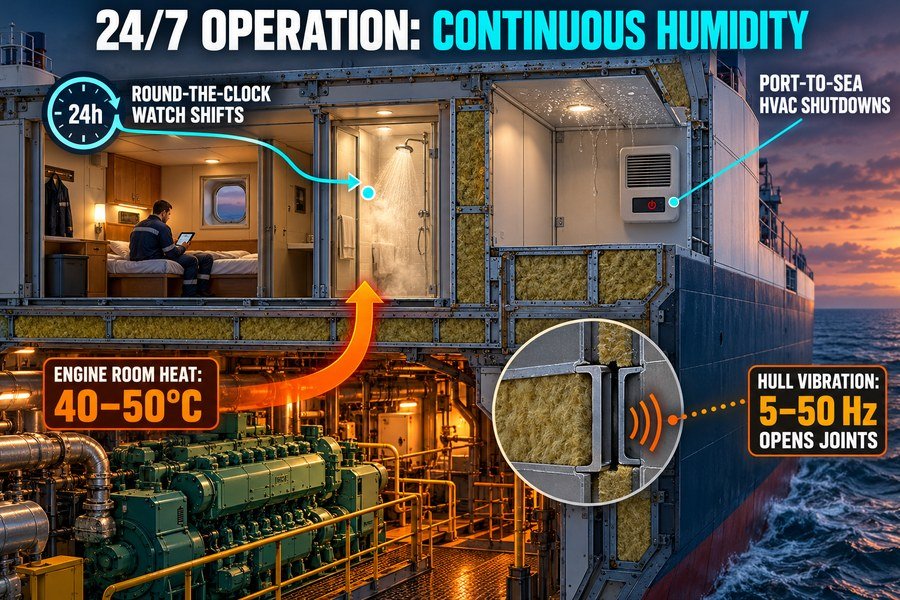
Continuous 24/7 vessel operation keeps humidity high around marine interior panels via four operational realities: round-the-clock watch shifts using cabins and showers, 40°C to 50°C engine room heat transfer driving vapor upward, constant hull vibration (5 to 50 Hz) opening panel joints, and port-to-sea HVAC shutdowns.
Round-the-Clock Crew Watch Shifts and Engine Room Heat Vapor Drive
When you supply panels for a land office building, the building empties at 6:00 PM. That gives the walls 12 to 14 hours every night to dry out and equalize with the HVAC system. Ships operate on a completely different schedule. The first operational reality is round-the-clock watch shifts. Commercial vessels and offshore platforms run on three 4-hour or two 6-hour watch rotations (STCW Code guidelines). At 2:00 AM, 6:00 AM, and 2:00 PM, crews are changing shifts, cooking hot meals in the galley, washing work clothes in the laundry, and taking hot showers9. Because these spaces never have an "off" period, the rockwool core and PVC surface of your marine panels never get a drying cycle. Moisture absorption is cumulative day after day.
The second operational reality is engine room heat transfer driving vapor upward. Directly below the accommodation block sits the engine room, where diesel generators, main engines, and steam boilers operate 24 hours a day. Under ISO 8861 (Shipbuilding — Engine-room ventilation in diesel-propelled ships), machinery space temperatures reach 40°C to 50°C continuously10. This constant heat source creates a thermal stack effect and a vapor pressure differential of 3.0 to 5.5 kPa11 between the lower machinery spaces and the air-conditioned cabins above (at 24°C). That pressure pushes hot, humid air upward through every microscopic gap in the A-60 deckhead insulation and into the accommodation wall cavities.
Continuous Hull Vibration on Panel Joints and Port HVAC Shutdowns
The third operational reality is continuous hull vibration. According to ISO 20283-5 (Mechanical vibration — Measurement of vibration on ships), ship superstructures experience continuous mechanical vibration between 5 Hz and 50 Hz with velocity amplitudes of 1.5 to 6.0 mm/s from the main engine and propeller blades. On land, a wall panel stands completely still after installation. On a ship, that 5 Hz to 50 Hz vibration flexes the tongue-and-groove or H-profile joints of marine wall panels by 0.5 mm to 1.5 mm thousands of times every hour. If your installer used cheap, rigid acrylic caulk instead of flexible marine polyurethane or neutral-cure silicone sealant, the seal cracks within 30 days. Once the joint cracks, humid cabin air pumps in and out of the panel core with every wave the ship hits.
The fourth operational reality is port-to-sea HVAC shutdowns and generator changeovers. When a ship enters dry-dock, waits at anchorage, or switches auxiliary generators in port, engineers often shut down the main air-conditioning chillers for 4 to 48 hours to save fuel or perform maintenance. Without active dehumidification, indoor cabin humidity jumps from 55% RH to over 85% RH within two hours12. When the crew restarts the cold chiller water at 7°C, severe thermal shock causes instant surface condensation across every marine ceiling panel and fire door frame on the deck.
| 24/7 Operational Factor | Measured Shipboard Value | Authoritative Reference | Physical Effect on Marine Panels | Required Procurement Countermeasure |
|---|---|---|---|---|
| Crew Watch Rotation | 3 shifts/day (Zero downtime) | IMO STCW Code | Zero drying recovery time in wet units and galleys | Specify 2K polyurethane glue with 0% water solubility |
| Engine Room Heat Drive | 40°C – 50°C (3.0–5.5 kPa vapor pressure) | ISO 8861 | Upward moisture migration into lower deck cabins | Require vapor-tight foil backing on deckhead insulation |
| Propeller & Engine Vibration | 5 – 50 Hz at 1.5 – 6.0 mm/s velocity | ISO 20283-5 | Flexes panel joints by 0.5–1.5 mm, breaking rigid seals | Use high-elasticity marine silicone (≥25% movement capability) |
| Port & Dry-Dock HVAC Stops | RH spikes from 55% to >85% in 2 hours | ISO 7547 | Rapid surface condensation upon chiller restart | Specify Z200/Z275 zinc coating on BOTH sides of steel sheets |
How Do Shipboard Humidity Conditions Shape Marine Accommodation Panel Specifications?
Ordering standard wall panels for marine projects causes total inspection failure. Class surveyors will reject uncertified, water-logged panels immediately. Use these exact humidity specifications on your next purchase order.
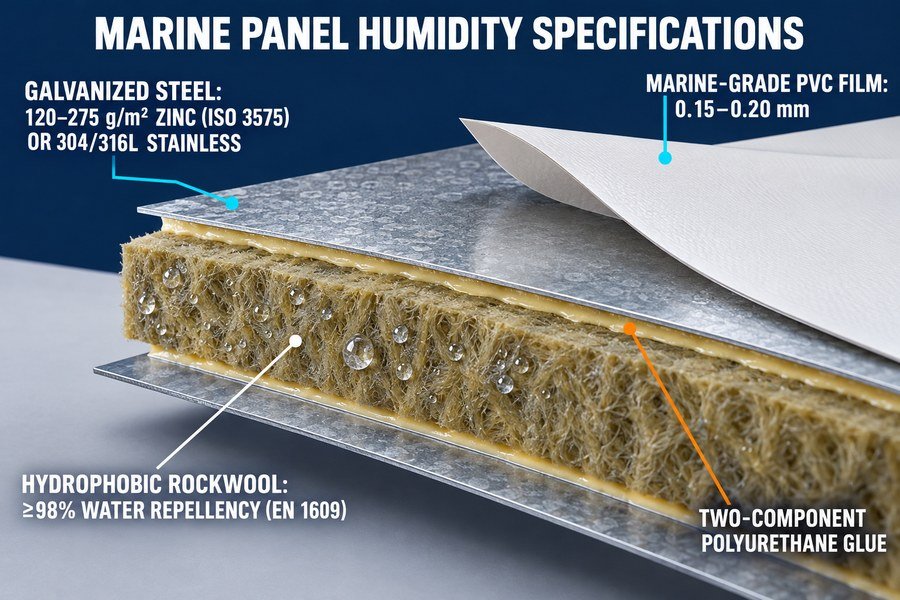
Shipboard humidity conditions dictate four mandatory marine accommodation panel specifications: hot-dip galvanized steel sheets with 120 to 275 g/m² zinc coating (ISO 3575) or 304/316L stainless steel, hydrophobic rockwool cores with ≥98% water repellency (EN 1609), two-component polyurethane glue, and 0.15 to 0.20 mm marine-grade PVC film.
Galvanized or Stainless Steel Skins and Hydrophobic Rockwool Core Specifications
When you source marine wall panels and ceiling panels from factories in China or Vietnam for European or US shipyard projects, you cannot simply write "B-15 marine wall panel" on your purchase contract. Dishonest factories will cut corners to give you a low price of $16 per square meter, and you will pay for it when the panels rust at sea. To beat shipboard humidity, you must lock down four technical specifications.
First, specify the exact steel substrate and zinc coating weight. Both the front and back skins of a marine panel must use structural-grade hot-dip galvanized steel (GI) with a thickness of 0.5 mm to 0.7 mm and a zinc coating mass of 120 to 275 g/m² (designated as Z120 to Z275 under ISO 3575 and EN 10346). Never accept cheap electro-galvanized steel (SECC), which only has 20 to 30 g/m² of zinc and rusts inside a humid hull cavity within 90 days. Remember that the back steel sheet of the panel faces the unventilated hull cavity, so it needs at least a 5 to 10-micron epoxy back-primer over the zinc layer. For galleys, laundries, and sanitary units (90% to 100% RH), upgrade the skin to 0.5 mm or 0.6 mm SUS 304 or SUS 316L stainless steel.
Second, specify a hydrophobic mineral wool core. To pass IMO FTP Code Part 1 (Non-combustibility test) and Part 3 (B-15 and B-0 fire resistance), the panel uses a high-density rockwool core of 120 to 150 kg/m³. You must require a water repellency rate of at least 98% and short-term water absorption (Wp) of ≤ 1.0 kg/m2 tested to EN 1609 (Thermal insulating products for building applications — Determination of short term water absorption). Standard land rockwool absorbs water like a sponge, gains 400% of its weight, slumps down inside the panel13, and leaves the top 300 mm of your bulkhead without fire protection.
Two-Component Polyurethane Adhesives and Marine-Grade PVC Film Lamination
Third, specify the exact adhesive used to bond the PVC film to the steel sheet and the steel sheet to the rockwool core. Cheap workshops use water-based polyvinyl acetate (white glue) or low-grade contact cement to save $0.80 per square meter. Under 80% RH and 35°C marine conditions, water-based glue re-emulsifies and loses bond strength. You must require a moisture-curing, two-component polyurethane (2K PU) adhesive applied at 80 to 120 g/m². After curing, the panel must maintain a 90-degree peel strength of at least 25 N/cm after a 72-hour high-humidity aging test at 40°C and 95% RH (ISO 9142).
Fourth, specify a 0.15 mm to 0.20 mm marine-grade PVC decorative film or a 25 to 30-micron PVDF fluorocarbon coating. The PVC film must hold IMO FTP Code Part 5 (Low Flame Spread) and Part 2 (Smoke and Toxicity) MED Module B and D certificates from a recognized class society like DNV, Lloyd's Register, ABS, or BV. Thinner 0.08 mm land-grade PVC films have microscopic pinholes that let salt moisture reach the steel underneath.
At Magellan Marine, we supply fully certified B-15 composite rockwool wall panels matching all four of these humidity specifications at $22 to $32 per square meter FOB China (compared to $55 to $85 per square meter from European manufacturers), and we upgrade wet-space SUS 304 stainless steel panels for $38 to $48 per square meter. Putting these four exact numbers into your supplier contract guarantees you get European shipyard quality at Asian factory pricing, with zero delamination claims during vessel warranty periods.
| Panel Component | Dry Cabin Spec (40–70% RH) | Wet Space Spec (90–100% RH) | Test / Quality Standard | Typical FOB Asia Price Impact ($/m²) |
|---|---|---|---|---|
| Steel Sheet & Coating | 0.6 mm HDG Steel, Z140–Z200 (140–200 g/m² zinc) + Epoxy Back Coat | 0.6 mm SUS 304 / 316L Stainless Steel or Z275 HDG Steel | ISO 3575 / EN 10346 | Base ($22–$28/m²) vs +$12–$18/m² for SUS 304 |
| Rockwool Insulation Core | 120–140 kg/m³ density, ≥98% hydrophobicity | 140–150 kg/m³ density, ≥98.5% hydrophobicity (Wp ≤ 1.0 kg/m2) | IMO FTP Code Part 1 & EN 1609 | Included in standard marine grade (+$1.50/m² vs land core) |
| Laminating Adhesive | 2-Component Polyurethane (2K PU) at 80–100 g/m² | Marine 2K PU at 100–120 g/m², Peel Strength ≥25 N/cm | ISO 9142 / IMO FTP Part 5 | +$0.80 – $1.20/m² over cheap water-based glue |
| Surface Decorative Layer | 0.15 – 0.18 mm Marine Low-Flame-Spread PVC Film | 0.20 mm Antibacterial Marine PVC or 30 μm PVDF Coating | IMO FTP Code Part 2 & Part 5 | +$1.00 – $2.50/m² over thin 0.08 mm land film |
Conclusion
Ships face 70% to 100% humidity inside sealed, vibrating steel hulls. Specifying Z120-Z275 galvanized steel, 98% hydrophobic rockwool, and polyurethane glue guarantees durable, class-approved marine interior panels.
-
"Monitoring of indoor air quality at a large sailing cruise ship ...", https://pubmed.ncbi.nlm.nih.gov/39798295/. Field studies of indoor air quality or thermal comfort on ships that report measured relative humidity in crew cabins can substantiate that operational accommodation spaces vary around nominal HVAC design conditions. Evidence role: statistic; source type: paper. Supports: Operational ship cabins commonly experience relative humidity values in the approximate 40% to 70% RH range.. Scope note: Measured ranges are likely to depend on vessel type, voyage area, season, occupancy, and HVAC operating practices, so a source may support the range contextually rather than universally. ↩
-
"Water Vapor Permeation in Plastics", https://www.pnnl.gov/main/publications/external/technical_reports/PNNL-26070.pdf. Polymer-barrier and building-material studies report that PVC films have finite water-vapor permeability and that high humidity can promote moisture transport through laminated surfaces and degrade adhesive bonds. Evidence role: mechanism; source type: paper. Supports: High relative humidity and steam exposure can allow moisture transmission through PVC-laminated surfaces and contribute to adhesive failure.. Scope note: This would support the plausibility of moisture penetration and bond degradation, but it would not independently prove the reported 90-day failure in the specific ferry retrofit. ↩
-
"Linear Thermal Expansion Coefficient for Metals", https://ptacts.uspto.gov/ptacts/public-informations/petitions/1491794/download-documents?artifactId=OiIYcNwd703zOLOuG0n0MVZm1Rb0E3n3fSGcUltnbiMG7_j3IpW6vFQ. Engineering material references give carbon steel a linear thermal expansion coefficient of about 12 × 10⁻⁶ K⁻¹; applying ΔL = αLΔT to a 37°C change gives approximately 0.44 mm per meter, supporting the stated expansion magnitude but not by itself proving joint damage. Evidence role: mechanism; source type: education. Supports: A 37°C temperature swing can cause carbon-steel panel skins to expand or contract by about 0.4 mm per meter.. Scope note: The calculation supports dimensional movement only; actual stress at panel joints depends on restraint, geometry, fasteners, and installation details. ↩
-
"Humidity-Driven Chloride Protonation and Surface Enrichment ...", https://pmc.ncbi.nlm.nih.gov/articles/PMC13492281/. Atmospheric chemistry and aerosol studies report that sodium chloride particles deliquesce at about 75% relative humidity at room temperature, supporting the mechanism by which deposited sea salt can form liquid brine films under humid conditions. Evidence role: mechanism; source type: paper. Supports: Sodium chloride becomes liquid brine by absorbing moisture from air once relative humidity reaches roughly 75%.. Scope note: The exact deliquescence relative humidity varies modestly with temperature, impurities, and particle composition. ↩
-
"Indo-Pacific Ocean warming is changing global rainfall ...", https://research.noaa.gov/indo-pacific-ocean-warming-is-changing-global-rainfall-patterns/. Climatological data for tropical maritime regions show that near-surface air temperatures around 30–32°C with very high relative humidity are common in parts of the Indian Ocean and Southeast Asian seas, supporting the use of these values as representative design conditions. Evidence role: general_support; source type: government. Supports: Ships operating in the Indian Ocean or Southeast Asia can encounter outdoor air conditions around 32°C and 90% relative humidity.. Scope note: Regional climate datasets support typical environmental conditions but do not prove the exact conditions encountered by a specific ship voyage. ↩
-
"Permeability of Common Building Material to Water Vapor", https://www.uaf.edu/ces/publications/database/energy/permeability-water-vapor.php. ASTM E96/E96M defines laboratory methods for measuring water-vapor transmission through materials; published material-property tables can be used to contextualize typical vapor-transmission values for masonry assemblies. Evidence role: statistic; source type: government. Supports: Standard concrete and brick walls can have measurable water-vapor transmission rates in the range stated.. Scope note: ASTM E96 provides the test method, not universal WVTR values for all brick or concrete walls; values vary by material composition, thickness, coatings, and test conditions. ↩
-
"How to choose the right marine wall panels for marine interior ...", https://magellanmarinetech.com/how-choose-right-marine-wall-panels-for-marine-interior-projects/. Marine accommodation-fire-protection and interior-fitting documentation describes lining systems installed on furring profiles or subframes with service voids behind panels, which can create concealed cavities when not intentionally ventilated. Evidence role: general_support; source type: institution. Supports: Marine lining panels are often mounted off the hull or bulkhead on profiles, leaving behind-panel service cavities that may be poorly ventilated.. Scope note: Whether a given cavity is sealed and unventilated depends on the vessel design, installation detailing, penetrations, and ventilation strategy; the source is likely to support the construction pattern rather than prove zero ventilation in all cases. ↩
-
"Psychrometric Calculator", https://people.tamu.edu/~i-choudhury/psych.html. Psychrometric references show that air at 24°C and 70% relative humidity has a dew point near 18°C, so contact with surfaces at 12–15°C can cause condensation; condensation-rate estimates require heat-and-moisture-transfer assumptions beyond the dew-point calculation. Evidence role: mechanism; source type: paper. Supports: Warm, humid cabin air can condense on hull or stiffener surfaces below its dew point, though the precise daily condensate rate depends on boundary conditions.. Scope note: The dew-point mechanism is directly supported, but the stated 50–150 g/m²·day condensation rate is model-dependent and would need a separate hygrothermal calculation or field measurement for direct proof. ↩
-
"Water Vapor Generation in Residential Buildings", https://research.fs.usda.gov/download/treesearch/65595.pdf. Building-science or indoor-air research sources can show that cooking, laundry, and showering are major indoor moisture-generation activities, supporting the mechanism by which continuously used ship accommodation spaces may experience persistent humidity loads. Evidence role: mechanism; source type: research. Supports: Galley cooking, laundry, and showers add moisture to indoor air and can contribute to sustained humidity in continuously occupied accommodation spaces.. Scope note: Most moisture-generation studies are based on buildings rather than ships, so the source would support the physical mechanism rather than quantify shipboard accumulation directly. ↩
-
"(PDF) Ventilation of engine rooms in diesel engines ships", https://www.academia.edu/83972749/Ventilation_of_engine_rooms_in_diesel_engines_ships. A ship-engine-room ventilation standard, classification-society rule, or marine-engineering text can document typical design air-temperature assumptions or allowable temperature rises for diesel machinery spaces, providing support for the stated engine-room heat environment. Evidence role: statistic; source type: institution. Supports: Diesel-propelled ship machinery spaces can operate at elevated temperatures in the approximate 40°C–50°C range.. Scope note: Design temperatures vary with ambient conditions, ventilation rate, vessel type, and equipment load, so the cited range may be representative rather than universally continuous. ↩
-
"Water Vapor Generation in Residential Buildings", https://research.fs.usda.gov/download/treesearch/65595.pdf. Psychrometric tables and building-physics sources can verify that warmer humid air has substantially higher water-vapor pressure than cooler conditioned air, and that buoyancy-driven stack effect can move air through leakage paths between zones. Evidence role: mechanism; source type: education. Supports: A temperature and humidity difference between hot machinery spaces and cooler cabins can create vapor-pressure gradients and buoyancy-driven upward air movement.. Scope note: The exact 3.0–5.5 kPa differential depends on assumed temperature, relative humidity, pressure, and leakage conditions; a general source supports the calculation basis and mechanism rather than the precise ship-specific value. ↩
-
"The effects of building-related factors on classroom ... - PMC", https://pmc.ncbi.nlm.nih.gov/articles/PMC4470893/. A field study or simulation of air-conditioning shutdown in humid occupied spaces can show that relative humidity can rise rapidly when cooling and dehumidification stop, supporting the plausibility of fast RH increases during HVAC interruptions. Evidence role: statistic; source type: paper. Supports: Stopping active air-conditioning and dehumidification can cause indoor relative humidity to rise rapidly in humid, occupied spaces.. Scope note: The exact increase from 55% to over 85% within two hours is highly dependent on outdoor humidity, ventilation, moisture generation, cabin volume, and surface moisture storage; contextual evidence may not prove this exact shipboard rate. ↩
-
"The Influences of Moisture on the Mechanical, Morphological ...", https://pmc.ncbi.nlm.nih.gov/articles/PMC7288152/. Building-physics studies of mineral wool insulation report that moisture uptake can reduce thermal and mechanical performance and that wetting may alter dimensional stability or compressive behavior. Evidence role: mechanism; source type: paper. Supports: Non-hydrophobic or wetted mineral wool can absorb moisture and suffer performance or dimensional degradation relevant to panel durability.. Scope note: Available neutral studies may support moisture-related performance degradation in mineral wool, but the exact ‘400% weight gain’ and panel slumping scenario would need product-specific testing or failure analysis. ↩