Heavy, sagging ship panels ruin interior projects fast. Hidden moisture destroys insulation and delays shipyard handovers. Understanding core water uptake helps you source dry, stable panels every time.
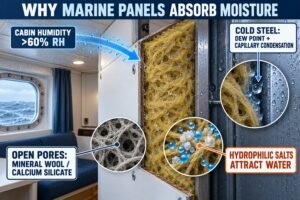
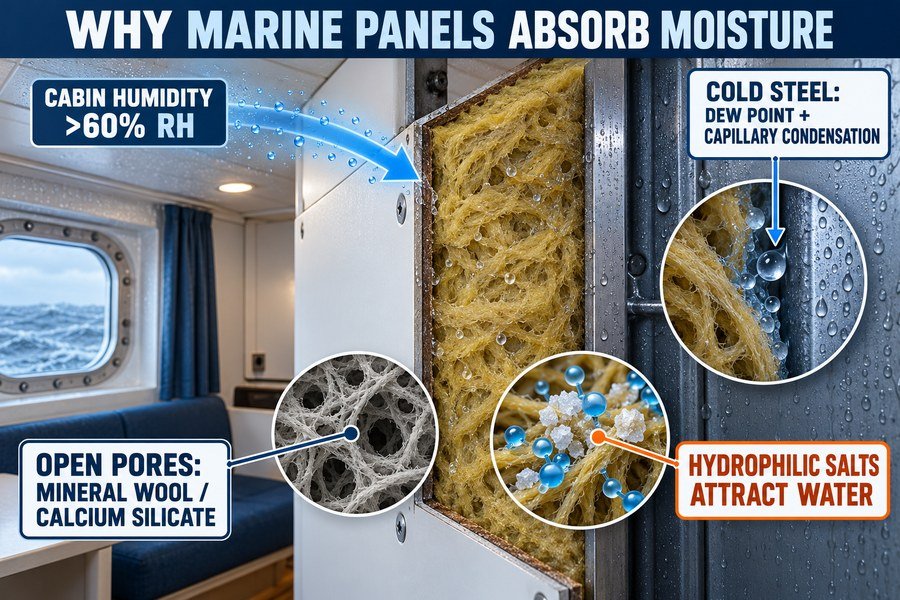
Hygroscopic moisture absorption in marine interior panels is caused by four main factors: high cabin relative humidity above 60%, open porous core structures in mineral wool or calcium silicate, hydrophilic chemical salts in raw fibers, and micropore capillary condensation occurring when steel bulkheads cool below the dew point.
I once visited a European shipyard where a procurement manager faced a $45,000 back-charge. Her B-15 cabin panels gained weight and warped before sea trials even started. The Asian factory blamed the ocean air during shipping, but the real problem started inside the panel core during manufacturing. If you buy marine wall panels and ceiling panels from factories in China or Vietnam for European or American shipyards, you must understand how moisture enters these panels. This guide shows you the exact physical causes and how you can stop moisture damage before you sign your next purchase order.
What Is Hygroscopic Moisture Absorption in Marine Interior Panel Cores?
Wet panels fail fire tests and ruin cabin finishes. Unchecked vapor uptake turns certified cores into heavy sponges. Knowing how hygroscopic absorption works protects your budget and project timeline.
Hygroscopic moisture absorption is the physical and chemical process where dry panel cores capture water vapor directly from ambient air through three stages: surface molecular adsorption, bulk vapor diffusion into internal pores, and equilibrium moisture stabilization across rockwool, ceramic fiber, and calcium silicate insulation materials.
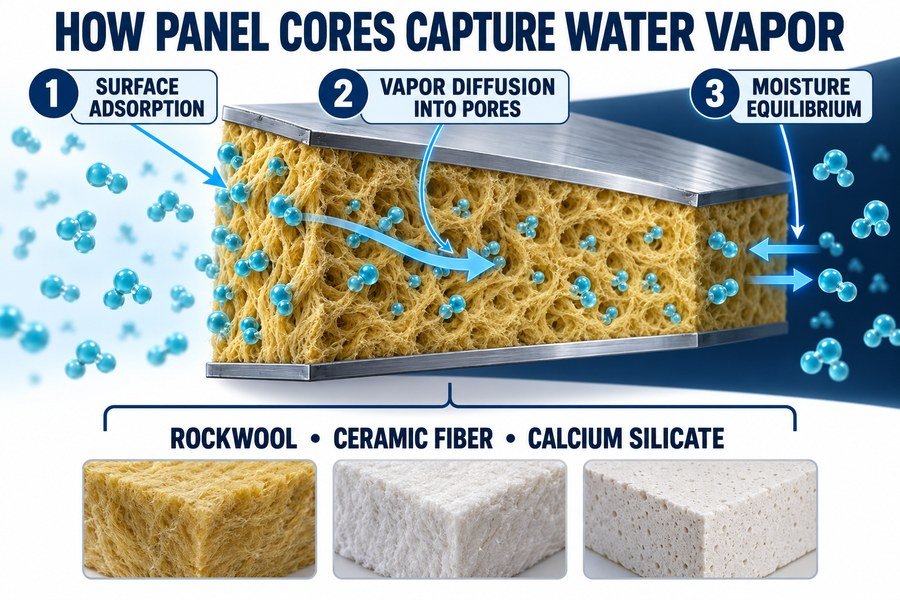
Three Stages of Water Vapor Capture in Marine Panel Cores
When I worked on the factory floor before joining Magellan Marine, I tested hundreds of core samples in climate chambers. Many buyers think a panel only gets wet if rain or seawater hits it. That idea is wrong. Hygroscopic moisture absorption1 happens when water gas in the air attaches to dry insulation fibers without any liquid leak.
This process happens in three clear stages. First, surface molecular adsorption starts the moment a panel leaves the hot pressing line. Water molecules in the factory air stick to the outer mineral fibers through weak electrical forces called hydrogen bonds2. Second, bulk vapor diffusion pushes those water molecules deeper into the middle of the 25 mm or 50 mm panel core. The water gas moves from high-humidity cabin air into the dry air pockets inside the panel. Third, equilibrium moisture stabilization happens when the water content inside the panel matches the humidity of the room. According to ASTM C1104 and ISO 12571 standards3, a high-grade marine panel must stop absorbing moisture once weight gain reaches 0.5% to 1.0% at 95% relative humidity.
Comparing Moisture Absorption Limits Across Rockwool, Ceramic Fiber, and Calcium Silicate Cores
Different core materials react very differently to humid air. You normally buy three main core types for marine accommodation zones: rockwool, ceramic fiber, and calcium silicate. Rockwool is the most common core for B-0 and B-15 walls, costing about $18 to $28 per square meter for a finished panel. Good marine rockwool has a density of 120 kg/m³ to 160 kg/m³ and absorbs less than 1.0% moisture by weight under ASTM C1104. Ceramic fiber is used in high-heat A-60 bulkheads and costs $25 to $40 per square meter. If ceramic fiber is not treated, it can absorb 2.0% to 3.5% moisture by weight. Calcium silicate boards are rigid cores used in luxury yacht and cruise panels, costing $32 to $55 per square meter. Because calcium silicate has millions of tiny pores, untreated boards can absorb up to 8.0% moisture from humid air under ISO 12571 testing.
| Core Material Type | Typical Density Range | Max Allowable Moisture Absorption (ASTM C1104 / ISO 12571) | Untreated Moisture Uptake at 90% RH | Typical Finished Panel Price (FOB China/Vietnam) |
|---|---|---|---|---|
| Marine Rockwool Core | 120 – 160 kg/m³ | Less than 1.0% by weight | 3.0% – 5.5% by weight | $18 – $28 / m² |
| Ceramic Fiber Core | 128 – 160 kg/m³ | Less than 1.5% by weight | 2.0% – 3.5% by weight | $25 – $40 / m² |
| Calcium Silicate Core | 220 – 450 kg/m³ | Less than 2.0% by weight | 5.0% – 8.0% by weight | $32 – $55 / m² |
How Does Cabin Humidity Drive Moisture Uptake in Marine Accommodation Panels?
Humid ship cabins silently attack your interior panels day and night. High vapor pressure forces water past panel joints. Controlling humidity drivers stops core damage before walls swell.
Cabin humidity drives moisture uptake through three mechanisms: partial vapor pressure gradients pushing water from 70%–95% relative humidity air into dry cores, daily HVAC temperature cycling creating suction across bulkheads, and direct vapor permeation through unsealed tongue-and-groove joints, acoustic perforations, and electrical cutouts.
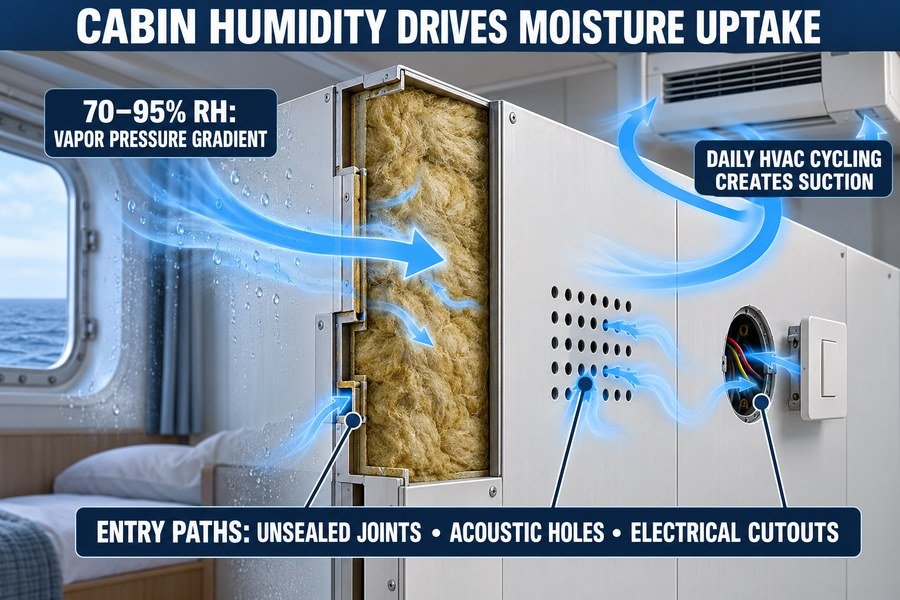
Vapor Pressure Gradients and HVAC Temperature Cycling in Ship Cabins
In my work at Magellan Marine, I often see panels fail during the outfitting stage at the shipyard before the ship's air conditioning is turned on permanently. Ship cabins experience huge swings in moisture. According to ISO 7547, ship HVAC systems are designed to keep cabin relative humidity between 40% and 60% at 22°C. However, during shipyard installation in coastal ports or tropical routes, cabin relative humidity often reaches 70% to 95% at 32°C.
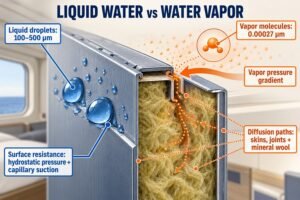
This creates the first mechanism: a partial vapor pressure gradient. At 32°C and 85% relative humidity, the cabin air has a water vapor pressure of about 4,040 Pascals (Pa)4. Inside a dry panel core stored at 20°C and 50% relative humidity, the vapor pressure is only 1,170 Pa. Under ISO 12572 vapor transmission rules, that 2,870 Pa pressure difference pushes water gas straight toward the panel core like wind blowing through a screen. The second mechanism is daily HVAC temperature cycling. When crew members turn cabin coolers on and off, or when the ship sails from warm water to cold water, the air inside the panel core cools down and shrinks. This cooling creates a slight vacuum of 50 to 150 Pa inside the panel5, which sucks humid cabin air right into the insulation every single day.
Vapor Permeation Through Unsealed Panel Joints, Perforations, and Cutouts
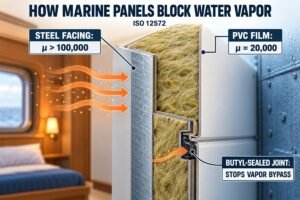
The front and back of a marine wall panel have 0.6 mm or 0.7 mm galvanized steel skins covered with 0.15 mm PVC film. Solid steel stops water vapor completely. So how does the humid air get inside? That brings us to the third mechanism: direct vapor permeation through open edges and holes. First, standard tongue-and-groove (T&G) panel joints have a 0.5 mm to 1.5 mm clearance gap for fast installation. Without silicone sealant or EPDM rubber gaskets, humid air flows directly against the exposed rockwool edge inside the joint. Second, acoustic panels in engine control rooms or mess halls have thousands of 2.0 mm perforations covering 15% to 22% of the steel face, leaving the core wide open to air. Third, shipyard workers cut 68 mm to 80 mm holes for light switches and sockets. If workers do not tape those cut edges with aluminum foil tape, each cutout adds 15 to 25 grams of water per month into the core.
| Cabin Environment Condition | Air Temperature & Relative Humidity | Water Vapor Pressure (ISO 12572) | Main Entry Path into Panel Core | Average Monthly Moisture Gain per Panel (1.2 m × 2.4 m) |
|---|---|---|---|---|
| Controlled Sea Trial Cabin | 22°C at 50% RH | 1,320 Pa | Micro-gaps in unsealed T&G joints | 10 – 25 grams |
| Humid Outfitting Quayside | 32°C at 85% RH | 4,040 Pa | Exposed top/bottom edges & switch cutouts | 120 – 280 grams |
| Wet Laundry / Galley Corridor | 35°C at 95% RH | 5,340 Pa | Acoustic perforations & HVAC suction cycling | 350 – 650 grams |
Why Do Porous Marine Interior Panel Cores Absorb Moisture From Humid Air?
Cheap porous cores drink up humid sea air during ocean shipping. Wet insulation loses thermal value and breeds corrosion under steel skins. Choosing low-porosity cores prevents costly claims.
Porous marine interior panel cores absorb moisture from humid air for three reasons: open-cell void volumes exceeding 90% that let air circulate freely, massive internal fiber surface areas offering millions of water binding sites, and hydrophilic alkali oxides plus uncured binder salts that chemically attract water molecules.
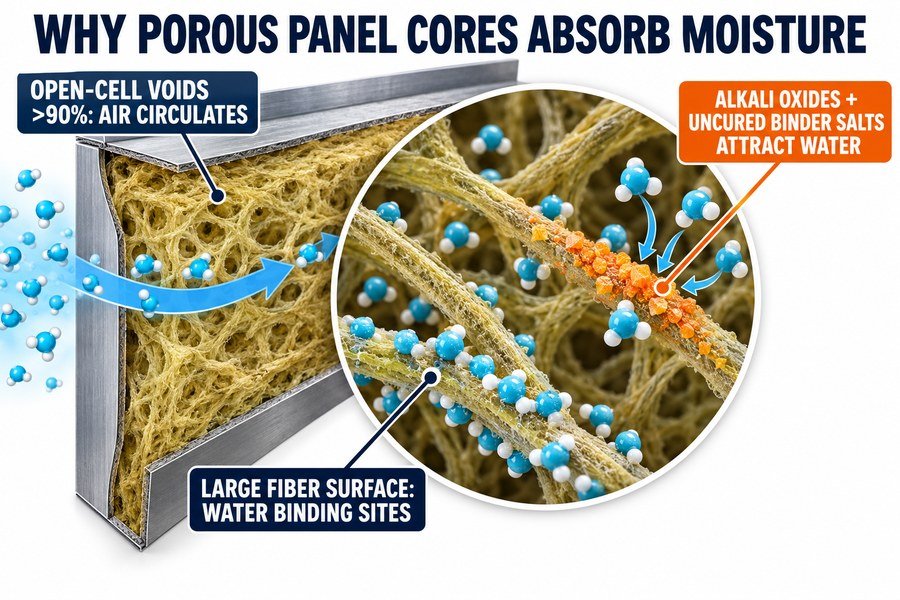
Open-Cell Void Volume and Internal Fiber Surface Area in Marine Insulation
When you compare price quotes from three different Asian panel factories, the panel skins might look identical. The real price difference hides inside the core structure. Porous cores absorb water from humid air for three clear physical and chemical reasons. The first reason is open-cell void volume exceeding 90%. Marine rockwool with a density of 140 kg/m³ is made from melted basalt rock spun into thin threads. Because rock itself has a true density of about 2,800 kg/m³, a 140 kg/m³ rockwool core is actually 5% solid rock and 95% empty air space. Unlike closed-cell foam where air pockets are sealed off, rockwool and calcium silicate have interconnected open pores. Humid air moves through the entire thickness of the panel with almost zero resistance.
The second reason is the massive internal fiber surface area. Under ASTM C612 testing for mineral fiber block and board insulation, average fiber diameters range from 4.0 to 6.0 micrometers (microns)6. If a factory uses old spinning equipment, it produces coarse fibers mixed with "shot" (tiny unspun rock beads) and micro-cracks. A single square meter of 50 mm marine rockwool contains over 1,200 square meters of internal fiber surface area. Every square centimeter of that fiber surface provides a landing spot where water vapor molecules can stick and build up a thin water film.
Hydrophilic Alkali Oxides and Uncured Binder Salts in Low-Cost Cores
The third reason is chemical attraction caused by hydrophilic alkali oxides and uncured binder salts. When a budget supplier tries to cut rockwool cost by $3 per square meter, they often buy blast-furnace slag wool instead of pure basalt rockwool. Slag wool contains high levels of calcium oxide (CaO), sodium oxide (Na2O), and potassium oxide (K2O), often totaling 25% to 35% of the chemical makeup7. According to EN 1609 short-term water absorption tests, when alkali oxides exceed 18%, they react with moisture in the air to form basic hydroxide salts. These salts act like dry table salt on a rainy day: they chemically pull water out of the air. In addition, cheap factories speed up their curing ovens to save natural gas. That leaves uncured urea-formaldehyde or phenol-formaldehyde binder salts on the fibers, which doubles the moisture uptake rate within 48 hours of sea transport.
| Core Quality Grade | Open-Cell Porosity Volume | Alkali Oxide Content (CaO + Na2O + K2O) | Binder Curing Level | Short-Term Water Absorption (EN 1609 Limit: ≤ 1.0 kg/m²) |
|---|---|---|---|---|
| Tier-1 Pure Basalt Rockwool | 93% – 94% | 12% – 16% (Low Hydrophilicity) | 100% Cured at 230°C | 0.25 – 0.45 kg/m² |
| Tier-2 Mixed Basalt/Slag Wool | 94% – 95% | 18% – 24% (Moderate Hydrophilicity) | 90% Cured at 195°C | 0.85 – 1.40 kg/m² |
| Budget Slag Wool Core | 95% – 97% | 26% – 35% (High Salt Attraction) | Under-cured at 170°C | 2.10 – 3.80 kg/m² |
How Does Micropore Capillary Condensation Increase Moisture Uptake in Marine Interior Panels?
Hidden liquid water forms inside panels even when cabin air feels dry. Microscopic pores condense vapor into heavy droplets. Understanding capillary condensation helps you avoid soaked wall panels.
Micropore capillary condensation increases moisture uptake through three physical actions: the Kelvin effect condensing vapor into liquid below 100% relative humidity inside pores smaller than 50 nanometers, concave water menisci bridging intersecting fibers, and thermal bridging against cold steel hulls that accelerates internal droplet pooling.
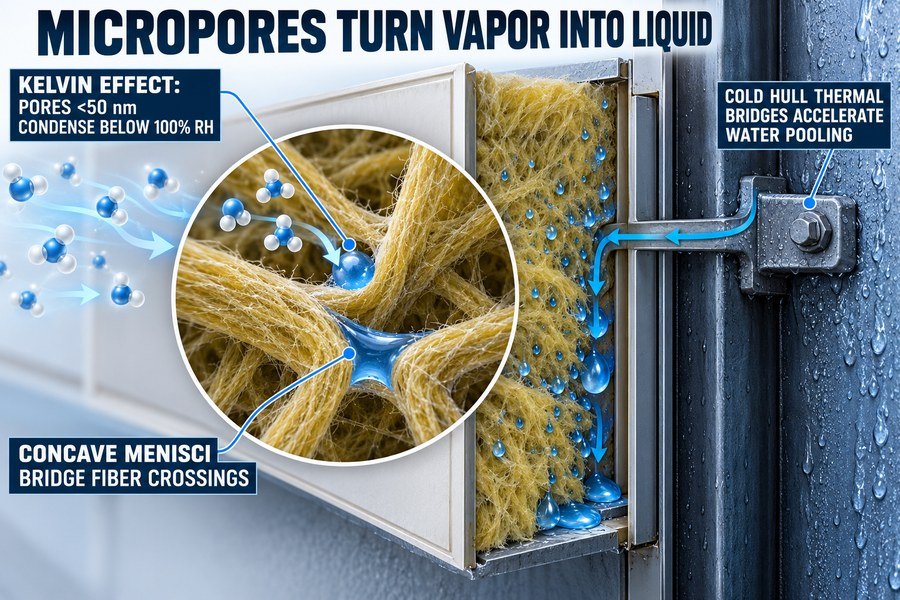
The Kelvin Effect and Concave Water Menisci in Sub-50-Nanometer Core Pores
Many procurement officers ask me how liquid water can appear inside a sealed marine panel when the cabin relative humidity is only 65% or 75%. Normally, water vapor in open room air only turns into liquid water when relative humidity hits 100% (the dew point). However, inside microscopic spaces, the rules of physics change through three specific actions.
First, the Kelvin effect lowers the saturation vapor pressure inside tiny pores smaller than 50 nanometers (nm)8. In calcium silicate cores and around the intersecting binder joints of rockwool fibers, there are millions of wedge-shaped micropores measuring between 2 nm and 50 nm wide. According to thermodynamics and ISO 13788 hygrothermal calculations, inside a 5 nm pore, water vapor turns straight into liquid water at just 68% relative humidity. Inside a 2 nm micropore, liquid condensation starts at only 52% relative humidity9. Second, once those tiny liquid droplets form, they create concave water menisci (curved water bridges) where two mineral fibers cross each other at sharp angles. Surface tension pulls more water vapor from the surrounding air into that curved bridge, making the liquid droplet grow 5 to 10 times faster than normal surface adsorption.
Thermal Bridging Against Cold Steel Hulls Accelerating Internal Water Pooling
The third physical action is thermal bridging against cold steel hulls and deckheads. Marine lining panels are mounted 25 mm to 50 mm away from the ship's outer steel hull or bulkhead. When a vessel operates in the North Sea or North Atlantic, the outer steel bulkhead temperature often drops to 2°C to 8°C, while the heated cabin side stays at 22°C. Steel C-profiles, top tracks, and fixing brackets connect the panel to the cold ship structure, creating a thermal bridge. The back steel skin of your lining panel cools down to 10°C or 12°C. The relative humidity inside the micropores right next to that cold back skin jumps from 60% to over 90% within two hours10. Micropore capillary condensation goes into overdrive along the back 10 mm of the core, creating up to 450 grams of pooled liquid water per square meter11 that rusts the galvanized steel skin from the inside out.
| Micropore / Fiber Wedge Diameter | Critical Relative Humidity for Liquid Condensation (Kelvin Effect) | Typical Location Inside Marine Panel Core | Liquid Water Accumulation Rate (ISO 13788) |
|---|---|---|---|
| 2 – 5 Nanometers | 52% – 68% RH | Calcium silicate gel pores & binder micro-cracks | 0.5 – 1.2% weight gain (Steady baseline) |
| 10 – 50 Nanometers | 78% – 94% RH | Intersecting rockwool fiber wedges & shot edges | 2.5 – 6.0% weight gain (Rapid bridging) |
| Cold Back-Skin Zone (10°C) | 85% – 98% Local RH | Back 10 mm of core touching cold hull brackets | 8.0 – 15.0% weight gain (Liquid pooling) |
What Core Treatments Reduce Hygroscopic Moisture Absorption in Marine Interior Panels?
Untreated cores soak up water during container transit from Asia. Wet deliveries delay shipyard installation and trigger penalties. Specifying proven core treatments guarantees dry panels upon arrival.
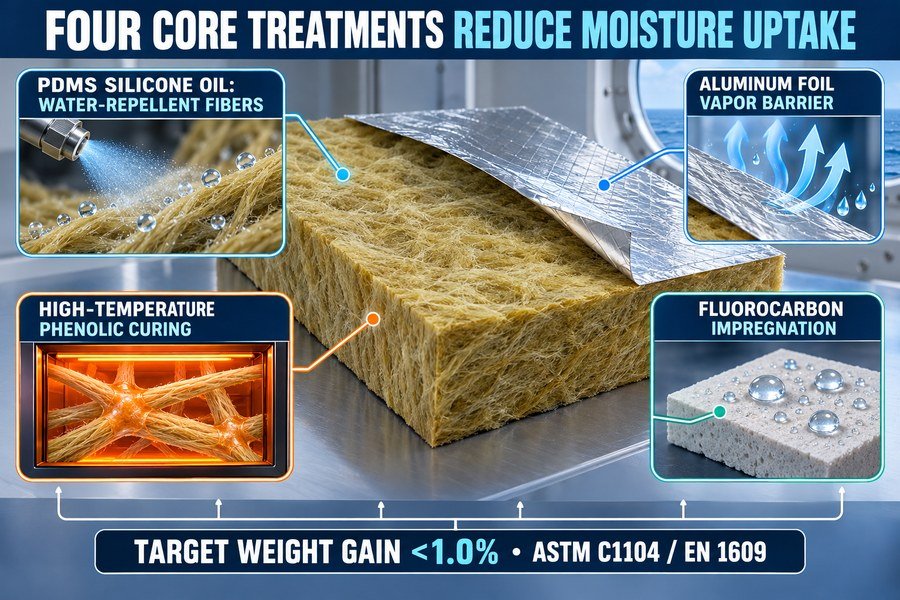
Four core treatments reduce hygroscopic moisture absorption in marine interior panels: polydimethylsiloxane silicone oil fiber spraying, high-temperature thermoset phenolic resin curing, fluorocarbon water-repellent chemical impregnation, and factory-applied aluminum foil vapor barrier lamination, cutting total weight gain below 1.0% under ASTM C1104 and EN 1609 standards.
Silicone Oil Fiber Spraying and High-Temperature Phenolic Resin Curing
When I help clients audit suppliers in China and Vietnam, I always check how the factory treats the core before lamination. You do not need to pay European prices to get moisture-proof panels, but you must specify the exact chemical treatment in your purchase contract. There are four proven treatments that stop hygroscopic moisture absorption, and we will look at the first two here.
First, polydimethylsiloxane (PDMS) silicone oil fiber spraying is the most cost-effective method for rockwool cores. During the fiber spinning stage, nozzles spray 0.2% to 0.5% silicone oil emulsion onto the hot mineral fibers. This forms a thin hydrophobic shield around every fiber, raising the water contact angle above 120 degrees12 and achieving a minimum 98.0% hydrophobicity rate under GB/T 10299 and EN 1609. It adds only $0.40 to $0.70 per square meter to the panel cost while staying below the calorific value limits of IMO FTPC Part 1 (ISO 1182 non-combustibility)13. Second, high-temperature thermoset phenolic resin curing locks the binder so it cannot attract water. The factory must bake the rockwool core in curing ovens at 220°C to 240°C for at least 8 minutes, using 2.5% to 3.5% silane-modified phenolic resin. Complete curing eliminates free hydrophilic salts and keeps ASTM C1104 water vapor absorption below 0.6% by weight.14
Fluorocarbon Chemical Impregnation and Aluminum Foil Vapor Barrier Lamination
For tougher environments like wet spaces, galleys, and ocean shipping in humid seasons, you should use the third and fourth treatments. Third, fluorocarbon water-repellent chemical impregnation is ideal for rigid calcium silicate cores and ceramic fiber boards. The core board is dipped or vacuum-coated with a 1.0% to 1.8% fluorocarbon polymer bath. This treatment seals sub-50 nm micropores against capillary condensation without blocking fire resistance, reducing calcium silicate moisture absorption from 8.0% down to less than 1.2%15 for an extra cost of $1.50 to $2.50 per square meter. Fourth, factory-applied aluminum foil vapor barrier lamination stops humid air from ever touching the core during transport or inside damp hull spaces. For acoustic panels or single-skin ceiling panels, bonding a 25-micron to 50-micron reinforced aluminum foil sheet over the exposed mineral wool back reduces water vapor transmission by 99.5% under ISO 1257216, costing just $0.80 to $1.30 per square meter.
| Core Treatment Method | Target Core Material | Moisture Uptake After Treatment (ASTM C1104) | Hydrophobicity Rate (EN 1609 / GB/T 10299) | Added Cost per Square Meter | IMO FTPC Part 1 Fire Compliance |
|---|---|---|---|---|---|
| PDMS Silicone Oil Spraying (0.3%) | Rockwool | 0.3% – 0.8% by weight | ≥ 98.5% | +$0.40 – $0.70 / m² | Passes ISO 1182 & ISO 1716 |
| Silane-Modified Phenolic Curing (230°C) | Rockwool & Ceramic | 0.4% – 0.6% by weight | ≥ 98.0% | +$0.30 – $0.50 / m² | Passes ISO 1182 & ISO 1716 |
| Fluorocarbon Impregnation (1.5%) | Calcium Silicate | 0.8% – 1.2% by weight | ≥ 99.0% | +$1.50 – $2.50 / m² | Passes ISO 1182 Non-Combustible |
| 50-Micron Aluminum Foil Barrier | Ceiling & Acoustic Cores | Less than 0.2% by weight | 99.5% Vapor Block | +$0.80 – $1.30 / m² | MED Module B & D Certified |
How Does Hygroscopic Weight Gain Cause Sagging in Marine Ceiling Panels?
Sagging marine ceilings fail shipyard inspections and look terrible. Extra water weight bends thin steel skins and loosens hangers. Knowing exact load limits prevents ceiling collapse at sea.
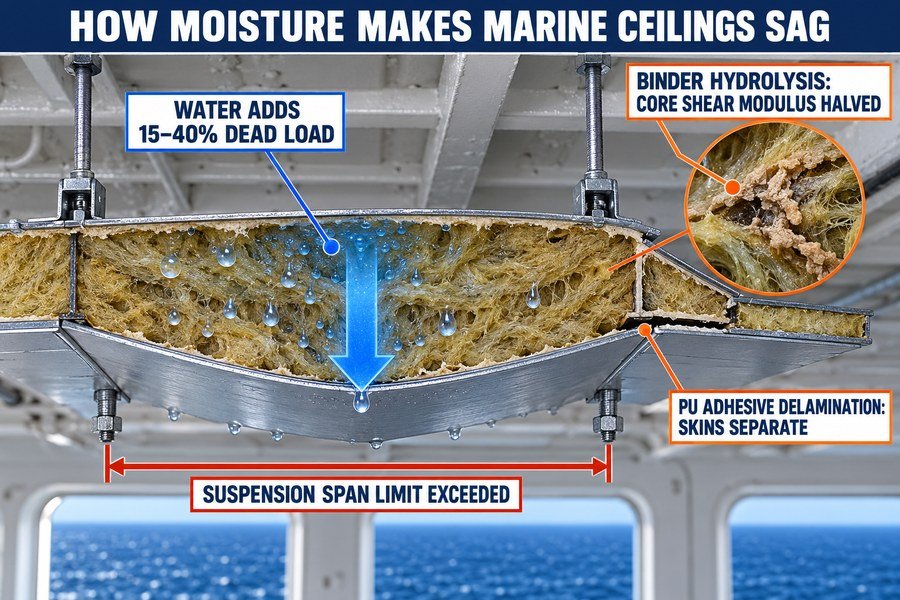
Hygroscopic weight gain causes sagging in marine ceiling panels through three failure mechanisms: dead-load mass increases of 15% to 40% exceeding suspension span limits, moisture-induced binder hydrolysis reducing core shear modulus by half, and polyurethane adhesive delamination separating galvanized steel skins from wet insulation cores.
Dead-Load Weight Increases and Moisture-Induced Binder Hydrolysis in Ceiling Cores
Last year, I helped a client solve an urgent problem on a passenger ferry building project in Europe. Her 300 mm wide B-15 marine ceiling panels sagged by 8 mm in the center after sitting in high humidity for six weeks. The shipyard inspector rejected the entire deckhead because EN 13964 suspended ceiling standards allow a maximum deflection of Span/500 (which is 4.0 mm over a 2,000 mm span).
Why does hygroscopic moisture ruin ceilings so fast? It happens through three structural failure mechanisms. The first mechanism is a dead-load mass increase of 15% to 40%17. A dry B-15 marine ceiling panel (25 mm thick, 0.5 mm steel face, 140 kg/m³ rockwool core) weighs about 9.5 kg/m². When untreated rockwool sits in humid hull air and suffers capillary condensation on its exposed top side, it absorbs 1.5 kg to 3.8 kg of water per square meter. That raises the panel weight to 11.0–13.3 kg/m², pushing the thin 0.5 mm steel skin past its bending limit over a 2,000 mm to 2,400 mm span. The second mechanism is moisture-induced binder hydrolysis. Water molecules attack the chemical bonds of the phenolic resin holding the rockwool fibers together.18 Within 30 days at 85% relative humidity, binder hydrolysis reduces the core shear modulus from 1.2 MPa down to 0.5 MPa.19 The rockwool core turns soft and loses its stiffness, so it pushes down like dead weight on the thin bottom steel sheet.
Polyurethane Adhesive Delamination Between Galvanized Steel Skins and Wet Cores
The third failure mechanism is polyurethane (PU) adhesive delamination between the galvanized steel skin and the wet insulation core. A marine ceiling panel works like an I-beam only when the top insulation core stays tightly glued to the bottom steel pan using 120 to 180 g/m² of two-component polyurethane fire-retardant glue. According to SOLAS Chapter II-2 and IMO FTPC Part 3, ceiling panels must maintain structural integrity during both normal ship vibration and fire exposure. However, when moisture accumulates at the boundary where the rockwool fibers meet the glue line, two bad things happen. First, alkaline water from the wet rockwool (with a pH of 8.5 to 10.0) breaks down cheap one-component moisture-cure PU glue, cutting tensile bond strength from 0.08 MPa down to less than 0.02 MPa20. Second, ship engine vibrations at 15 to 35 Hz shake the heavy, water-logged core loose from the steel skin. Once the core delaminates over 30% of the panel area, mid-span deflection jumps above 6.0 mm and the ceiling visibly sags.
| Moisture Weight Gain Level | Total Ceiling Panel Weight (Base: 9.5 kg/m²) | Core Shear Modulus Retention | PU Glue Tensile Bond Strength | Mid-Span Deflection (2,000 mm Span) | EN 13964 Inspection Result (Limit: ≤ 4.0 mm) |
|---|---|---|---|---|---|
| Dry Certified Core (< 1% Gain) | 9.5 – 9.6 kg/m² | 100% (1.20 MPa) | 0.08 – 0.10 MPa | 1.5 – 2.2 mm | PASS (Flat & Rigid) |
| Moderate Uptake (15% Weight Gain) | 10.9 kg/m² | 65% (0.78 MPa) | 0.04 – 0.05 MPa | 3.8 – 4.5 mm | BORDERLINE / WARNING |
| Severe Uptake (35% Weight Gain) | 12.8 kg/m² | 42% (0.50 MPa) | < 0.02 MPa (Delaminated) | 6.5 – 11.0 mm | FAIL (Visible Sagging) |
Conclusion
Humidity, porous cores, and capillary condensation drive water into marine panels. Specify pure basalt rockwool with 98% hydrophobicity, two-component PU glue, and aluminum foil barriers to prevent ceiling sagging.
-
"An Overview of the Water-Porous Building Materials Interactions", https://repository.si.edu/bitstreams/1d42b046-a256-4d24-9c40-10a3e3c09851/download. Building-physics literature defines hygroscopic sorption as the uptake of water vapor from surrounding air by porous or fibrous materials without requiring direct liquid-water contact. Evidence role: definition; source type: research. Supports: Hygroscopic moisture absorption can wet dry insulation fibers through airborne water vapor even when there is no liquid leak.. Scope note: This supports the general phenomenon but does not quantify moisture uptake for the specific marine panel cores discussed in the article. ↩
-
"Surface Water H-bonding Network is Key Controller of ... - PMC", https://pmc.ncbi.nlm.nih.gov/articles/PMC9007919/. Surface-science studies of water adsorption on mineral and oxide surfaces describe hydrogen-bonding and electrostatic interactions as mechanisms by which water molecules attach to hydrophilic mineral surfaces. Evidence role: mechanism; source type: paper. Supports: Water molecules can adhere to outer mineral fibers through weak interactions such as hydrogen bonds.. Scope note: Such evidence explains the surface-chemistry mechanism generally and may not be specific to the exact mineral fibers or factory conditions in the article. ↩
-
"THERMAL INSULATION MATERIALS TEST METHOD ...", https://www.nist.gov/document/tim-applicationpdf. ASTM C1104/C1104M and ISO 12571 are standardized methods used to measure water-vapor sorption or moisture content of insulation and building materials under controlled humidity conditions. Evidence role: definition; source type: institution. Supports: ASTM C1104 and ISO 12571 are relevant standards for assessing moisture absorption or sorption behavior in insulation or building materials.. Scope note: The standards establish test methods; they do not by themselves prove the article’s stated 0.5%–1.0% marine acceptance limit unless a separate specification adopts that threshold. ↩
-
"Vapor Pressure Calculator", https://www.weather.gov/epz/wxcalc_vaporpressure. Psychrometric relationships define actual water-vapor pressure as relative humidity multiplied by saturation vapor pressure at the air temperature, giving values near 4.0 kPa for air at 32°C and 85% RH. Evidence role: mechanism; source type: research. Supports: Air at 32°C and 85% relative humidity has an actual water vapor pressure of approximately 4,040 Pa.. Scope note: The source would verify the calculation method and approximate value, not the specific cabin conditions at a shipyard. ↩
-
"Effects from the Reduction of Air Leakage on Energy ... - INFO", https://info.ornl.gov/sites/publications/files/Pub46425.pdf. The ideal gas law and enclosure-pressure studies show that cooling air in a confined cavity lowers its internal pressure relative to the surroundings, producing pressure differences that can draw outside air through leaks. Evidence role: mechanism; source type: paper. Supports: Cooling of air inside a panel cavity can create a negative pressure that draws humid surrounding air into the cavity through leaks or openings.. Scope note: This evidence supports the physical mechanism; the 50–150 Pa range depends on cavity volume, leakage, temperature change, and panel construction and would require project-specific calculation or testing. ↩
-
"Fine Mineral Fibers", https://www.epa.gov/sites/default/files/2016-10/documents/fine-mineral-fibers.pdf. Studies of man-made vitreous fibers report mineral wool fiber diameters in the low-micrometre range, consistent with a 4–6 μm order of magnitude for many rockwool products. Evidence role: statistic; source type: paper. Supports: Mineral wool fibers commonly have average diameters of several micrometres, making the stated 4.0–6.0 μm range plausible for rockwool boards.. Scope note: This contextual support may not show that ASTM C612 itself specifies this exact range, and fiber diameter can vary by manufacturer and production process. ↩
-
"CHEMICAL AND PHYSICAL INFORMATION - NCBI - NIH", https://www.ncbi.nlm.nih.gov/books/NBK600969/. Published chemical analyses of blast-furnace slag and slag-based mineral wool show substantial calcium oxide content with smaller alkali-oxide fractions, supporting the claim that slag-derived wool can have a different oxide chemistry from basalt-based wool. Evidence role: general_support; source type: paper. Supports: Slag wool can contain significant CaO, Na2O, and K2O fractions, affecting its chemical behavior relative to basalt rockwool.. Scope note: The cited composition ranges may vary by slag source and may not directly confirm the article’s stated 25–35% combined total for every budget slag wool core. ↩
-
"The Kelvin equation", https://glass.rutgers.edu/sites/default/files/uploads/kelvinEq.pdf. Thermodynamic treatments of capillary condensation describe how nanoscale pore curvature changes the equilibrium vapor pressure of water, providing the physical basis for condensation below bulk saturation in pores of this scale. Evidence role: mechanism; source type: paper. Supports: The Kelvin effect can lower the saturation vapor pressure of water inside pores smaller than 50 nm.. Scope note: This supports the general mechanism for nanopores but does not by itself verify the pore-size distribution of the specific marine panel cores discussed. ↩
-
"The Kelvin equation", https://glass.rutgers.edu/sites/default/files/uploads/kelvinEq.pdf. A source applying the Kelvin equation to water-filled nanopores can support the order of magnitude of relative-humidity thresholds for capillary condensation in nanometer-scale pores. Evidence role: statistic; source type: paper. Supports: Water can condense in very small pores at relative humidities well below 100%, with lower thresholds for smaller pores.. Scope note: The exact RH thresholds depend on temperature, pore geometry, contact angle, and whether the quoted dimension is pore radius or diameter, so the source may contextualize rather than exactly reproduce these two figures. ↩
-
"Chapter 10b: The Psychrometric Chart (Updated 7/22/2014)", https://people.ohio.edu/urieli/thermo/Applied/Chapt.7_11/Chapter10b.html. Hygrothermal or psychrometric references show that cooling moist air or porous material at constant water-vapor content raises local relative humidity because saturation vapor pressure decreases with temperature. Evidence role: mechanism; source type: institution. Supports: Cooling near a thermal bridge can sharply increase local relative humidity in adjacent pores.. Scope note: Such sources support the direction and plausibility of the RH increase, but a two-hour rise from 60% to over 90% would require a specific transient heat-and-moisture simulation or measurement for the panel assembly. ↩
-
"The moisture distribution in wall-to-floor thermal bridges and ...", https://pmc.ncbi.nlm.nih.gov/articles/PMC10171419/. Interstitial-condensation standards and hygrothermal studies commonly express condensate accumulation as mass per unit area, which can contextualize whether hundreds of grams per square meter is a plausible modeled moisture load. Evidence role: statistic; source type: institution. Supports: Capillary condensation and thermal bridging can produce measurable liquid-water accumulation in building or marine panel assemblies, reported in grams per square meter.. Scope note: A general standard or study may support the metric and plausible range, but the stated value of 450 g/m² would need a matching model, test condition, or case study for this exact panel configuration. ↩
-
"Silicone Oil-Grafted Low-Hysteresis Water-Repellent Surfaces", https://pmc.ncbi.nlm.nih.gov/articles/PMC9982814/. Peer-reviewed studies of PDMS and silicone-based coatings show that their low surface energy can make mineral or inorganic fiber surfaces hydrophobic and substantially increase water contact angles; this supports the proposed mechanism, but not the exact contact-angle value for this manufacturing process. Evidence role: mechanism; source type: paper. Supports: PDMS silicone oil on mineral fibers forms a hydrophobic shield and can raise the water contact angle above 120 degrees.. Scope note: The source would support the hydrophobization mechanism; the specific 120-degree value would still require product-specific test data. ↩
-
"How Does IMO MSC.307(88) Apply To Marine Interior Panels?", https://magellanmarinetech.com/how-imo-msc-30788-apply-to-marine-interior-panels/. The IMO 2010 FTP Code Part 1 and ISO 1182 specify non-combustibility test criteria for marine materials, including heat-release and related performance limits; this supports the regulatory context, but not compliance of a silicone-treated panel without test certification. Evidence role: definition; source type: institution. Supports: Silicone-treated rockwool panels can remain within the calorific-value limits required by IMO FTP Code Part 1 and ISO 1182 non-combustibility testing.. Scope note: Official standards can document the criteria; product-specific compliance must be shown by accredited fire-test results. ↩
-
"Low Formaldehyde Binders for Mineral Wool Insulation - PMC", https://pmc.ncbi.nlm.nih.gov/articles/PMC8995714/. Research on mineral-wool binders and ASTM C1104/C1104M documentation can support the relevance of binder chemistry and water-vapor sorption testing for mineral fiber insulation; however, the specific 0.6% value and elimination of hydrophilic residues require direct analytical or laboratory evidence. Evidence role: statistic; source type: paper. Supports: Complete phenolic resin curing eliminates free hydrophilic salts and keeps ASTM C1104 water-vapor absorption below 0.6% by weight.. Scope note: Contextual literature may support the mechanism and test method, but the numerical threshold is product- and process-specific. ↩
-
"Cost-Effective Preparation of Hydrophobic and Thermal ... - PMC", https://pmc.ncbi.nlm.nih.gov/articles/PMC10780754/. Materials studies on hydrophobized calcium silicate show that lowering pore-surface energy can reduce capillary water uptake in nanoporous calcium silicate insulation; this supports the mechanism, while the sub-50 nm pore size and 8.0% to 1.2% reduction require treatment-specific test data. Evidence role: mechanism; source type: paper. Supports: Fluorocarbon impregnation seals fine calcium-silicate pores against capillary condensation and reduces moisture absorption from 8.0% to below 1.2%.. Scope note: The likely evidence is contextual unless it studies the same fluorocarbon chemistry, board density, and test method. ↩
-
"Permeability of Common Building Material to Water Vapor", https://www.uaf.edu/ces/publications/database/energy/permeability-water-vapor.php. ISO 12572 defines methods for determining water-vapour transmission properties of building materials, and materials data generally identify aluminum foil laminates as high-resistance vapour barriers; this supports the barrier principle, but not the exact 99.5% reduction for this panel assembly. Evidence role: general_support; source type: institution. Supports: A 25–50 micron reinforced aluminum foil backing can reduce water vapor transmission by 99.5% under ISO 12572.. Scope note: The cited source would need to match foil thickness, reinforcement, adhesive, seams, and test conditions to directly prove the percentage reduction. ↩
-
"The Influences of Moisture on the Mechanical, Morphological ...", https://pmc.ncbi.nlm.nih.gov/articles/PMC7288152/. Research on mineral wool and fibrous insulation exposed to high humidity or liquid water reports measurable water uptake that increases specimen mass and can affect mechanical performance, providing contextual support for moisture-driven dead-load increases. Evidence role: statistic; source type: paper. Supports: Hygroscopic or condensing moisture can increase the dead-load mass of a marine ceiling core by 15% to 40%.. Scope note: The exact 15% to 40% range would require test data for the same rockwool density, facing condition, exposure duration, and panel geometry. ↩
-
"Aging Properties of Phenol-Formaldehyde Resin Modified by ...", https://pmc.ncbi.nlm.nih.gov/articles/PMC6290587/. Materials literature on phenol-formaldehyde and related organic binders describes moisture- and chemically assisted degradation pathways that can weaken binder networks, giving mechanistic context for loss of cohesion in bonded mineral wool. Evidence role: mechanism; source type: paper. Supports: Moisture can chemically degrade phenolic resin binder in rockwool, weakening the bonds that hold fibers together.. Scope note: A general polymer-degradation source would not by itself prove the rate or severity of hydrolysis in a specific marine rockwool ceiling core. ↩
-
"Which Mechanical Properties of Rock Wool Core Matter Most for ...", https://magellanmarinetech.com/which-mechanical-properties-rock-wool-core-matter-most-marine-accommodation-panels/. Accelerated-aging studies of mineral-wool or sandwich-panel cores under high humidity can document reductions in shear stiffness after moisture exposure, which would support the asserted relationship between humidity aging and loss of core shear modulus. Evidence role: statistic; source type: paper. Supports: Thirty days at 85% relative humidity can reduce rockwool core shear modulus from 1.2 MPa to 0.5 MPa through binder hydrolysis.. Scope note: The exact reduction from 1.2 MPa to 0.5 MPa in 30 days at 85% relative humidity requires directly comparable test data; broader aging studies would only provide contextual support. ↩
-
"Strength and durability of one-part polyurethane adhesive ...", https://research.fs.usda.gov/treesearch/5964. Polyurethane adhesive literature reports that moisture, alkaline conditions, and hydrolysis can degrade urethane bonds and reduce adhesive strength, supporting the proposed mechanism of bond weakening at a wet mineral-wool interface. Evidence role: mechanism; source type: paper. Supports: Alkaline moisture from wet rockwool can degrade one-component moisture-cure polyurethane glue and reduce tensile bond strength from 0.08 MPa to less than 0.02 MPa.. Scope note: The specific pH range and bond-strength drop from 0.08 MPa to below 0.02 MPa require data for the same adhesive chemistry, substrate preparation, and aging exposure. ↩