Selecting the correct fire safety rating for marine panels prevents costly project delays and ensures safety compliance.
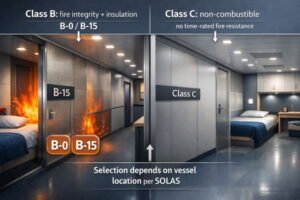
Class B panels require strict fire integrity and insulation ratings (B-0 or B-15) for corridor and cabin divisions, while Class C panels must only meet non-combustibility standards without time-bound fire resistance. Choosing between them depends entirely on the specific location within the vessel as mandated by SOLAS regulations.
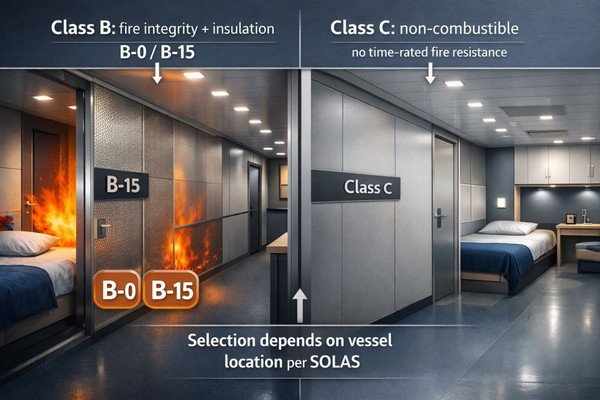
Engineers and procurement officers frequently misunderstand the nuances between these two classifications, leading to overspending on unnecessary specs or rejection by class surveyors.
What Defines the Fire Rating Standards for Class B and Class C Panels?
Misinterpreting fire codes is the number one reason for failed inspections during new build or refurbishment projects.
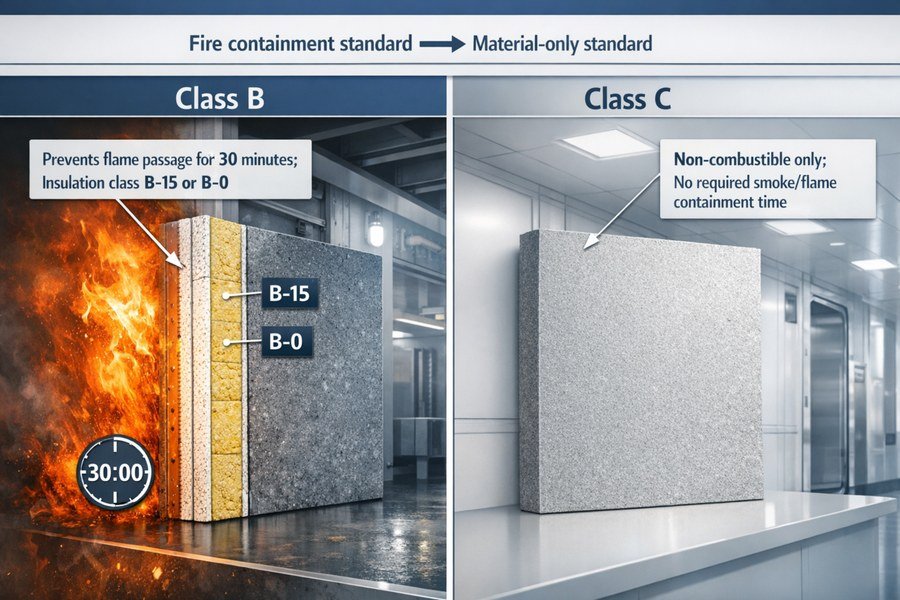
SOLAS Chapter II-2 and the IMO 2010 FTP Code define Class B panels as divisions preventing flame passage for 30 minutes with specific insulation periods (B-15 or B-0), whereas Class C panels are defined solely as non-combustible materials with no requirements for smoke or flame containment time limits.
Understanding SOLAS B-Class Integrity Requirements
The International Convention for the Safety of Life at Sea (SOLAS) sets rigorous standards for Class B divisions. These panels are effectively "firewalls" used to compartmentalize accommodation spaces. To achieve a Class B rating, the aluminum honeycomb panel1 must undergo a standard fire test. The criteria are strict: the panel must prevent the passage of flame and smoke for 30 minutes.
Furthermore, the "insulation" value distinguishes the sub-ratings. A B-15 panel must keep the unexposed side cool (average temperature rise not exceeding 140°C) for 15 minutes. A B-0 panel maintains integrity for 30 minutes but has no insulation requirement. Achieving B-15 with aluminum honeycomb often requires filling the cells with rockwool or adding ceramic fiber layers, as aluminum transfers heat rapidly.
Criteria for Class C Non-Combustible Materials
Class C requirements are significantly simpler. According to the IMO 2010 FTP Code2 Part 1, the material need only be "non-combustible." There is no requirement for the panel to stop a fire for 30 minutes or block heat transfer.
These panels are strictly for use where fire risk is negligible or where they do not form a safety boundary. The testing involves heating the material to 750°C in a furnace to ensure it does not burn or produce excessive smoke. This makes the manufacturing process for Class C aluminum honeycomb panels faster, as they do not require the complex thermal breaks found in Class B variants.
| Feature | Class B-15 Panel | Class B-0 Panel | Class C Panel |
|---|---|---|---|
| SOLAS Definition | Fire integrity (30 min) + Insulation (15 min) | Fire integrity (30 min) | Non-combustible material only |
| IMO Test Standard | FTP Code Part 3 | FTP Code Part 3 | FTP Code Part 1 |
| Flame Blocking | Minimum 30 Minutes | Minimum 30 Minutes | Not Required |
| Temp. Limit (Unexposed) | < 140°C rise for 15 min | No limit | No limit |
| Typical Core Material | Alum. Honeycomb + Insulation/Rockwool | Alum. Honeycomb | Pure Alum. Honeycomb |
Where Should Class B and Class C Panels Be Installed According to SOLAS?
Installing a Class C panel on a corridor bulkhead is a critical safety violation that will halt vessel delivery.
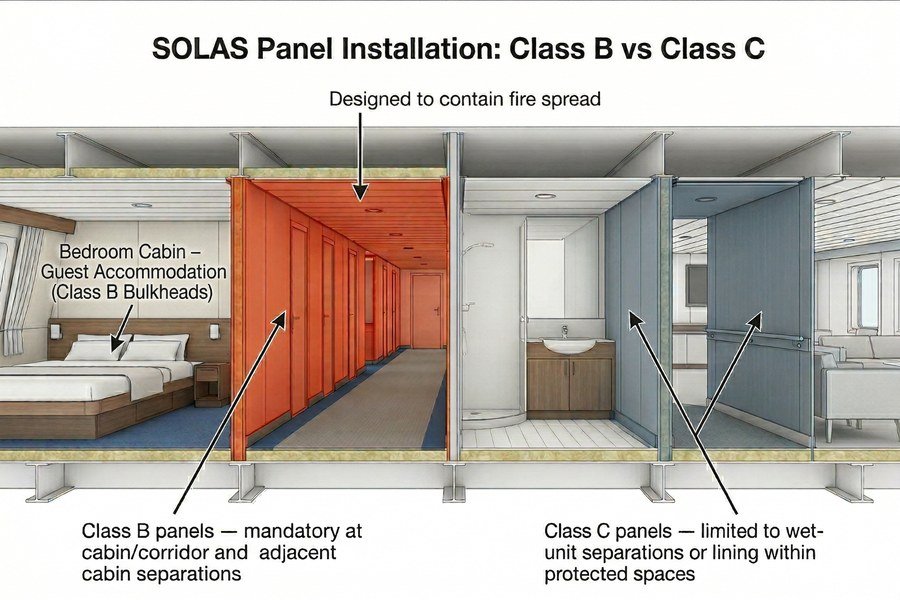
Class B panels are mandatory for bulkheads and ceilings separating cabins from corridors or adjacent cabins to contain fire spread, while Class C panels are restricted to low-risk applications such as bulkheads separating wet units (bathrooms) or as lining panels within an already protected space.
Mandatory Locations for Class B Partitions
SOLAS regulations dictate that escape routes must be protected. Therefore, the walls forming the corridor are almost always Class B-15. This ensures that if a fire starts in a cabin, the crew has at least 15 minutes of thermal protection and 30 minutes of smoke protection to escape through the corridor.
Additionally, partitions between two sleeping cabins are typically required to be Class B (often B-15 or B-0 depending on the vessel type and sprinkler systems). Using aluminum honeycomb panels here is advantageous because they are lightweight, but you must verify the certificate explicitly states "Class B Bulkhead."
Permissible Zones for Class C Applications
Class C panels have limited utility but are essential for weight and cost saving in specific zones. The most common application is the wet unit (bathroom) module. Since the bathroom is located inside the cabin (which is already a fire-protected box), the walls separating the bathroom from the sleeping area can often be Class C.
Another application is lining. If you have a steel hull wall that forms the ship's structure (A-Class), you might cover it with a decorative panel. This lining panel does not need to stop fire (the steel does that); it just needs to not add fuel to the fire. Therefore, a Class C aluminum honeycomb panel is perfect for wall linings and ceilings inside a room that do not serve as a fire barrier.
| Location | Required Fire Rating | Recommended Panel Type |
|---|---|---|
| Cabin-to-Corridor Wall | Class B-15 | B-15 Alum. Honeycomb (Insulated) |
| Cabin-to-Cabin Wall | Class B-15 or B-0 | B-15/B-0 Alum. Honeycomb |
| Bathroom (Wet Unit) | Class C | Class C Alum. Honeycomb |
| Cabin Ceiling | Class B-15 or B-0 | B-Class Ceiling Panel |
| Wall Lining (on Steel) | Class C | Class C Lining Panel |
How Do Class B & C Aluminum Honeycomb Panel Materials Differ?
Visual similarity between these panels often masks significant structural differences that affect weight, sound reduction, and fire-rating capabilities.
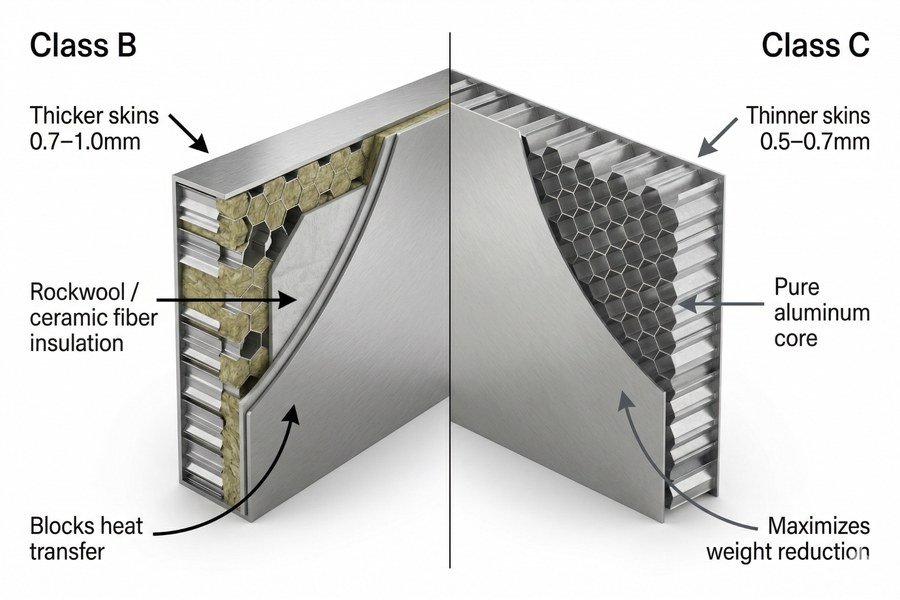
Class B aluminum honeycomb panels are built upon an aluminum honeycomb core, but feature thicker skins (0.7mm to 1.0mm) and are enhanced with internal insulation materials—such as rockwool fillers or hard ceramic fiber boards—to block heat transfer. In contrast, Class C panels utilize thinner skins (0.5mm to 0.7mm) and rely entirely on a pure aluminum core to maximize weight reduction.
Structural Composition of Class B-15 Panels
To pass the rigorous IMO B-15 thermal test, a standard aluminum honeycomb core is insufficient because aluminum conducts heat too efficiently. Manufacturers must modify the internal structure to create a reliable thermal break.
- Composite Cores: The honeycomb cells are often completely filled with rockwool (typically 100-140 kg/m³ density). Alternatively, a multi-layer sandwich design is used: Aluminum/Steel Skin + Ceramic Fiber Board + Honeycomb + Ceramic Fiber Board + Skin. (Note: Hard fire-resistant boards are used instead of soft wool in this structure to maintain high peeling strength and prevent delamination.)
- High-Temp Adhesives: The adhesive used must be specially formulated to withstand high temperatures without delaminating during a fire.
- Skin Thickness & Finish: To prevent buckling under intense heat, the face skin is usually 0.7mm or thicker. It is commonly coated with a low flame-spread PVC film (approx. 150 microns) to meet aesthetics and marine safety compliance.
Material Specs for Class C Lightweight Panels
Class C panels are engineered for superior rigidity and extreme weight savings. While they must be constructed from approved non-combustible materials (like aluminum), they are not required to provide thermal insulation against fire. This allows for a much simpler construction.
- Pure Honeycomb: The core is 100% aluminum foil with no insulation fillers. Typical cell sizes range from 6mm to 19mm.
- Thinner Skins: To minimize weight, manufacturers typically specify 0.5mm or 0.7mm aluminum face skins.
- The Weight Advantage: A Class C panel might weigh only 4.5-6.5 kg/m², whereas a B-15 panel often weighs 12-16 kg/m² due to the heavy insulation materials. This drastic weight saving is crucial for fuel efficiency in high-speed ferries, cruise ships, and offshore living quarters.
| Specification | Class B-15 Panel (Typical) | Class C Panel (Typical) |
|---|---|---|
| Standard Thickness | 25mm / 50mm | 10mm / 15mm / 25mm |
| Face Skin Material | 0.7mm - 1.0mm (Alum / Galv. Steel) | 0.5mm - 0.7mm (Aluminum) |
| Core Composition | Honeycomb + Rockwool/Ceramic | Pure Aluminum Honeycomb |
| Approx. Weight | 12 - 16 kg/m² | 4.5 - 6.5 kg/m² |
| Sound Reduction (Rw) | 30 dB - 35 dB | 15 dB - 20 dB |
What Is the Cost Gap Between Class B & C Aluminum Honeycomb Panels?
Understanding the price gap allows for smarter budget allocation without compromising compliance.
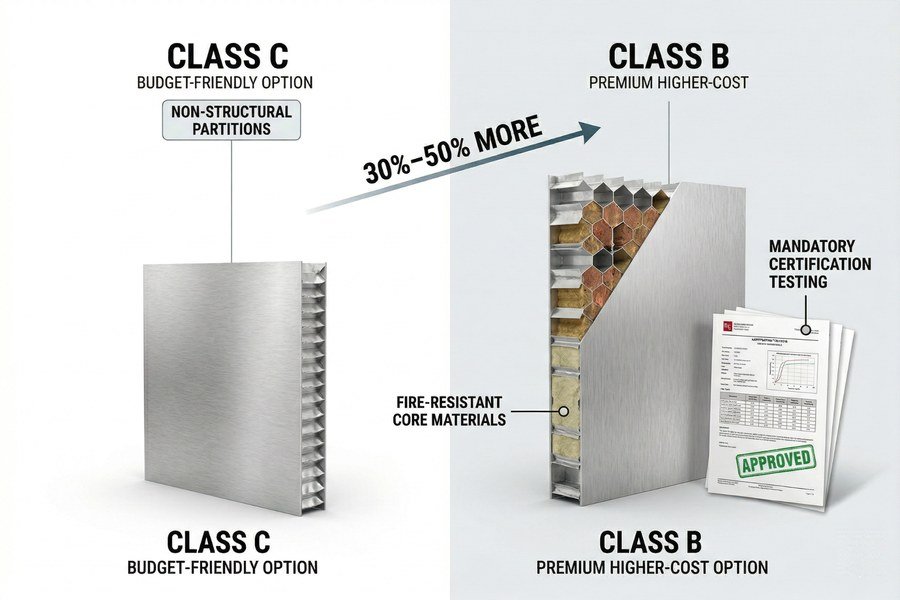
Class B aluminum honeycomb panels generally cost 30% to 50% more than Class C panels due to the expensive fire-resistant core materials and the high cost of mandatory certification testing, while Class C panels offer a budget-friendly option for non-structural partitions.
Market Price Analysis for Class B Panels
The production of Class B panels involves higher raw material costs, specifically for fire-retardant adhesives3 and insulation fillers like rockwool or calcium silicate boards. Furthermore, the certification process is a major cost driver. Obtaining a Type Approval Certificate4 (from DNV, ABS, or BV) requires destroying multiple sample panels in fire tests, costing manufacturers tens of thousands of dollars. These costs are amortized into the per-meter price.
In the current Asian market (China/Vietnam), a high-quality B-15 aluminum honeycomb panel typically ranges from $55 to $85 USD per square meter. This price varies based on the finish (PVC film vs. powder coating) and the specific certification authority required by the shipyard.
Cost Breakdown for Class C Panels
Class C panels are commodity items in comparison. The manufacturing process is straightforward lamination. Since the "non-combustibility" test is cheaper and the materials are standard industrial grade (pure aluminum), the price is significantly lower.
Procurement officers can expect to pay between $35 and $55 USD per square meter for Class C aluminum honeycomb panels. For a project requiring 2,000 square meters of wall paneling, incorrectly specifying Class B panels for areas where Class C is permitted (like bathroom dividers or linings) could result in overspending by $40,000 to $60,000. However, never swap B for C to save money if the fire plan dictates a fire division; the cost of replacing it later is ten times higher.
| Cost Factor | Class B Panel Impact | Class C Panel Impact |
|---|---|---|
| Base Material Cost | High (Insulation + Adhesives) | Low (Aluminum only) |
| Certification Cost | High (Fire Integrity Tests) | Low (Non-combustibility Test) |
| Logistics (Weight) | Heavier (Higher shipping cost) | Lighter (Lower shipping cost) |
| Est. Market Price | $55 - $85 USD / m² | $35 - $55 USD / m² |
| Installation Labor | Moderate (Requires heavy lifting) | Low (Easy handling) |
Conclusion
To maximize safety and budget, use Class B-15 panels ($55-$85/m²) strictly for corridor and cabin divisions, and utilize lightweight Class C panels ($35-$55/m²) for bathroom partitions and wall linings.
-
Learn how aluminum honeycomb panels must be constructed and tested to meet SOLAS fire integrity and insulation limits—essential for marine designers and builders. ↩
-
Access the official IMO FTP Code 2010 PDF to verify test methods, definitions and SOLAS compliance for Class B/C panel requirements. ↩
-
Discover adhesive types, fire ratings and compatibility with insulation to reduce fire risk and ensure long-term panel integrity. ↩
-
Get step‑by‑step guidance on approval procedures, required fire tests, and typical costs from major classification societies. ↩