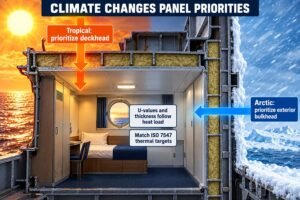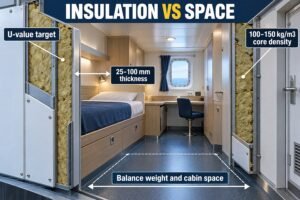
Are your cabin temperatures fluctuating despite thick insulation? You might be facing thermal bridges. This hidden flaw ruins energy efficiency and passenger comfort on your ships.
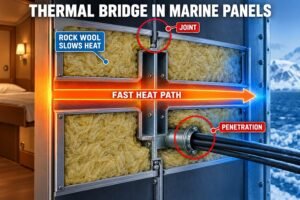
A thermal bridge in a marine accommodation panel is a localized area with higher thermal conductivity than the surrounding insulation. It creates a path of least resistance for heat transfer, typically occurring at metal framing, panel joints, and penetrations, leading to energy loss and condensation issues.
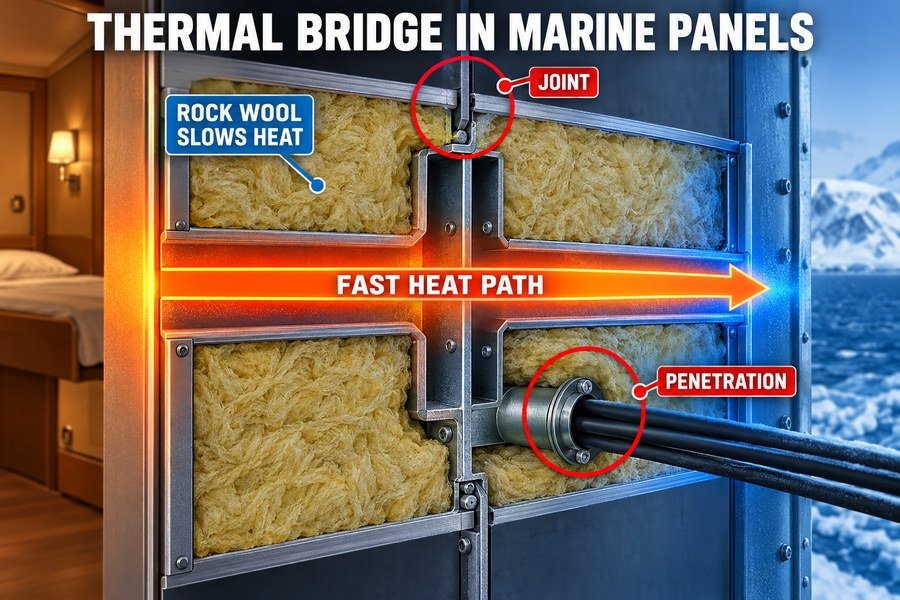
Let us look closely at how this heat loss happens. This knowledge will help you avoid costly mistakes in your shipbuilding projects.
What Causes Thermal Bridges in Marine Interior Panels?
Wondering why your high-grade panels still leak heat? The answer lies in how they are built. Unchecked heat leaks mean rejected shipyard inspections.
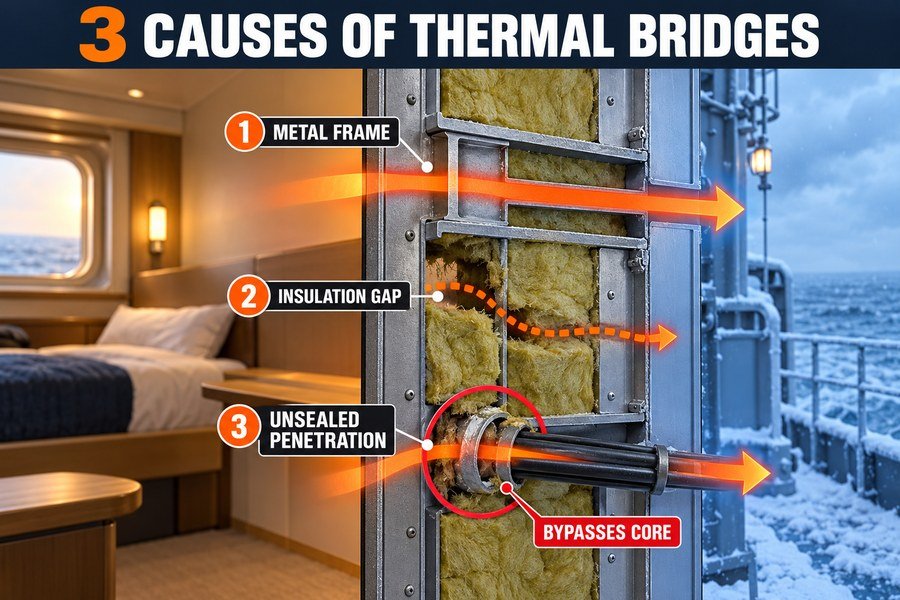
Thermal bridges in marine interior panels are caused by three main factors: continuous metal framing connecting hot and cold faces, poor insulation packing at panel joints, and uninsulated penetrations for cables or pipes. These elements bypass the core insulation, driving rapid heat exchange.
The Problem of Continuous Metal Framing in Marine Panels
In my years working at the marine outfitting factory, I saw many panels built with solid steel or aluminum frames. These frames hold the panel together. But they also cause the first main issue. Steel has a thermal conductivity of about 45 W/(m·K)1 according to general engineering data. Mineral rockwool only has a thermal conductivity of about 0.034 W/(m·K)2. When the metal frame touches both the hot side and the cold side of the panel, it creates a fast track for heat.3 The heat ignores the rockwool and travels straight through the steel. European shipyards are very strict about this. They will test the panels. If the framing allows too much heat through, they will reject the entire batch. You must look for panels with broken thermal bridges. These panels use a special PVC or composite insert to stop the heat from crossing the metal frame.
Poor Insulation Packing and Uninsulated Penetrations
The second cause is poor insulation packing at the panel joints. During factory production, workers place rockwool blocks inside the metal skin. If the rockwool does not fit tightly against the edges, empty gaps form. Air fills these gaps. Heat moves very easily through these empty air pockets. The third cause is uninsulated penetrations. During installation on the ship, workers cut holes for electrical cables or water pipes. When they cut these holes, they break the rockwool barrier. If the installation team does not seal these holes with fire-rated putty or insulated sleeves, the hole becomes a massive thermal bridge. Heat passes right through the open space. I always advise my clients to check the factory assembly process. You need to ensure the factory packs the rockwool very tightly with a density of at least 120 kg/m³ to prevent internal gaps.
| Cause of Thermal Bridge | Material Involved | Typical Thermal Conductivity | Impact on Heat Transfer |
|---|---|---|---|
| Continuous Framing | Galvanized Steel | ~45 W/(m·K) | Very High |
| Poor Insulation Packing | Trapped Air | ~0.026 W/(m·K) (convective) | Medium |
| Uninsulated Penetrations | Copper Pipes / Air | ~380 W/(m·K) (copper) | Very High |
| Intact Panel Core | Rockwool (120 kg/m³) | ~0.034 W/(m·K) | Very Low |
Why Do Insulated Marine Accommodation Panels Lose Heat at Joints?
Are you dealing with cold drafts between cabin walls? Joint failures are a nightmare for procurement officers. A bad joint destroys a good panel.
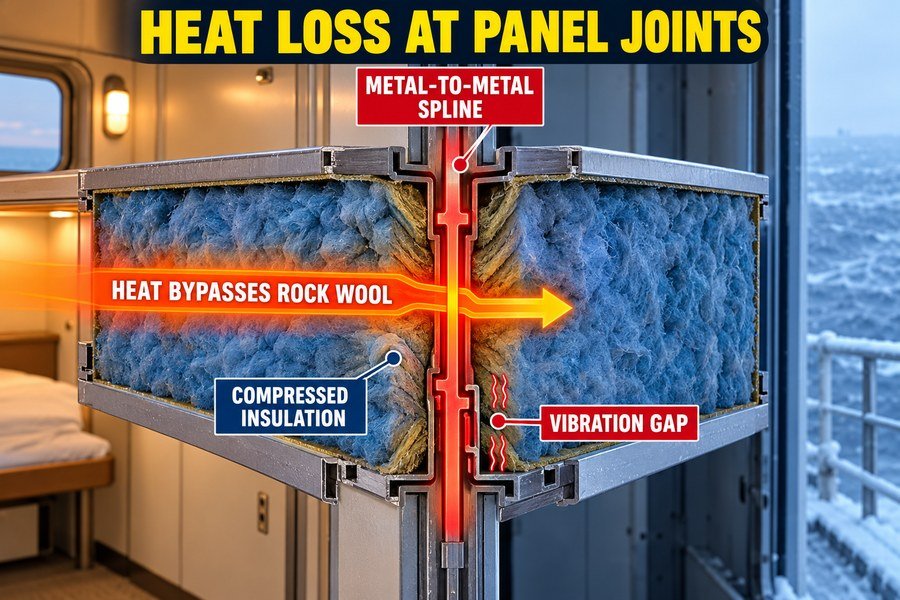
Marine accommodation panels lose heat at joints due to three specific issues: metal-to-metal contact at the connection splines, compressed insulation during installation, and gaps caused by continuous ship engine vibration. These weaknesses allow thermal energy to bypass the thick rockwool core entirely.
Metal-to-Metal Contact at the Connection Splines
Joints are the weakest link in any marine bulkhead system. The first reason panels lose heat here is metal-to-metal contact. Most standard marine panels use a metal spline or a tongue-and-groove system to lock together. When you push two panels together, the steel edge of one panel directly touches the steel edge of the other panel. This connection forms a continuous metal bridge from the warm cabin to the cold corridor.4 Heat loves metal. It travels rapidly through the steel joint. I have helped clients redesign their purchasing requirements to solve this. We changed their orders from standard metal joints to joints that include a thin layer of ceramic tape or a thermal break profile. This simple change blocks the direct metal contact and stops the heat leak.
Compressed Insulation and Gaps from Ship Engine Vibration
The second reason is compressed insulation. When installation teams force panels together on the deck, they often crush the rockwool near the edges. Rockwool works because it traps tiny pockets of air.5 When you crush it, you squeeze the air out. The crushed rockwool loses its insulation power. The R-value drops significantly at the joint. The third reason is ship engine vibration. A ship is always moving. The engines create constant vibration. Over a few months at sea, this vibration shakes the panels. The joints slowly loosen. Microscopic gaps open up between the panels. Warm air escapes through these new gaps.6 This is why you must buy panels with high-quality locking mechanisms. A cheap joint might save you a few dollars up front, but it will fail at sea and cause passenger complaints.
| Joint Failure Type | Mechanism of Heat Loss | Prevention Strategy | Cost Impact to Fix Later |
|---|---|---|---|
| Metal-to-Metal Splines | Direct conduction through steel | Use thermal break PVC profiles | High |
| Compressed Insulation | Loss of trapped air pockets | Ensure precise factory tolerances | Very High |
| Vibration Gaps | Convection through open cracks | Use flexible fire-rated sealants | Medium |
How Does Heat Bypass the Core of a Marine Interior Panel?
Frustrated that your 50mm rockwool core is not stopping heat? Heat is lazy and finds the easiest way around. You need to know how.
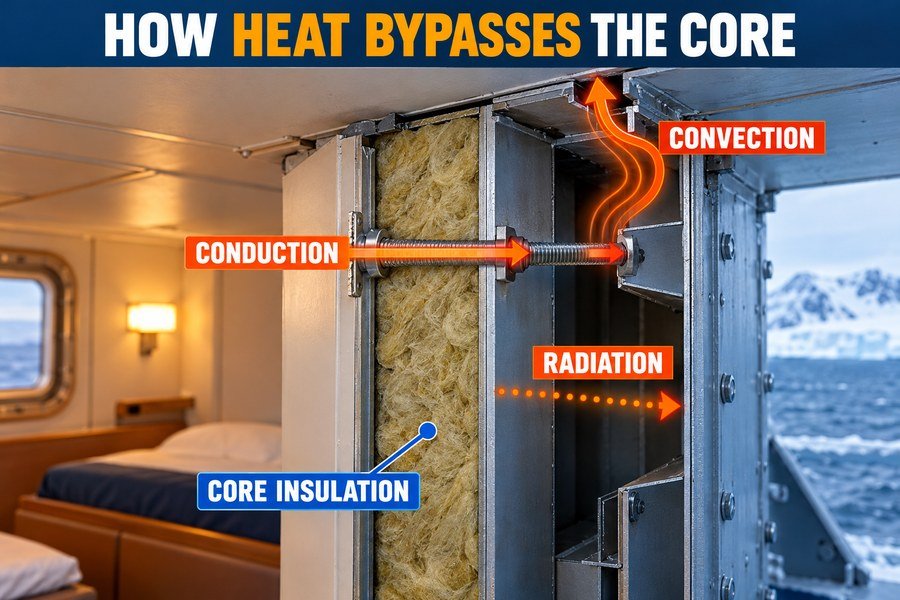
Heat bypasses the marine interior panel core through three primary mechanisms: conduction through structural metal fasteners, convection through unsealed air gaps, and radiation across empty joint spaces. Even with premium rockwool, these pathways allow heat to travel around the insulation rather than through it.
Heat Conduction Through Structural Metal Fasteners
The first way heat bypasses the core is through conduction. Conduction happens when heat travels through solid objects. In marine outfitting, we use many metal fasteners. We use steel screws, rivets, and bolts to hold the panel skins to the internal frame. These small metal parts go straight through the panel. They connect the hot side directly to the cold side. The 50mm thick rockwool cannot stop this. The heat just moves right through the steel screw.7 I always remind my clients to look closely at the fastener layout. If a factory uses too many screws, they create too many thermal bridges.8 You should ask your Asian suppliers if they use staggered fastening or insulated rivet heads. This small detail separates a cheap panel from a premium panel used in US shipyards.
Heat Convection and Radiation in Unsealed Air Gaps
The second way heat bypasses the core is through convection. Convection happens when moving air carries heat. If the panel joints are not sealed properly with silicone or fire putty, warm air inside the cabin rises.9 It finds the tiny cracks at the ceiling joint and escapes. The heat simply flows out of the room. The third way is radiation. Radiation happens when heat jumps across an empty space. If the factory did not pack the rockwool tightly, large empty voids exist inside the panel. Heat radiates from the hot steel skin, jumps across the empty void, and hits the cold steel skin on the other side.10 The rockwool is completely useless in this situation. You must ensure your suppliers use high-density rockwool and strict quality control to eliminate internal voids.
| Heat Transfer Mechanism | How It Bypasses the Core | Real-World Example in Cabins |
|---|---|---|
| Conduction | Travels through solid metal | Steel screws and connection splines |
| Convection | Warm air flows through cracks | Unsealed gaps at the ceiling track |
| Radiation | Heat jumps across empty voids | Poorly packed rockwool leaving hollow spots |
How Much Do Thermal Bridges Lower a Marine Interior Panel's U-Value?
Are your panels failing thermal specifications? Thermal bridges silently ruin your numbers. Let us look at the real data behind this drop.
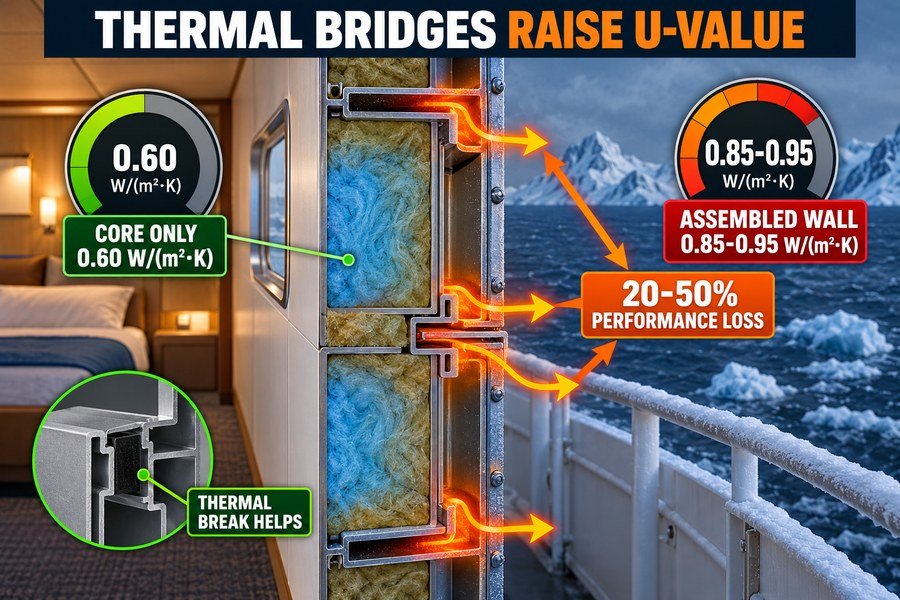
Thermal bridges can lower a marine interior panel's overall U-value by 20% to 50%, depending on the framing design. A panel with a theoretical core U-value of 0.60 W/(m²·K) can easily degrade to 0.90 W/(m²·K) in real-world testing due to steel framing and joint connections.
Analyzing the Theoretical vs Real U-Value Drop
In the marine industry, the U-value measures how much heat a panel loses. A lower number is always better. Many buyers look at the factory catalog and see a great U-value. But that number is often just the theoretical value of the rockwool core alone. According to the ISO 10211 standard for calculating thermal bridges11, the real U-value is much worse. The thermal bridges at the edges and joints destroy the panel's overall performance. I have seen standard 50mm A-0 class panels with a core U-value of 0.60 W/(m²·K). But when the testing lab measures the entire assembled bulkhead, the total U-value drops by 20% to 50%12. The result is often around 0.85 to 0.95 W/(m²·K). This difference is huge. It means the ship's HVAC system has to work much harder to keep the rooms cool or warm.
The Financial Impact of High U-Values on Shipyards
Why does this drop in U-value matter to you? It directly affects the cost of running the ship. If the U-value is 50% worse than expected, the shipowner must burn more fuel to run the air conditioning. US and European shipyards know this. They will ask you for the real, tested U-value of the assembled wall, not just the center of the panel. If you buy cheap panels from a supplier who does not account for thermal bridges, the shipyard might reject them. A standard 50mm marine wall panel costs around $25 to $35 per square meter in China. But if you have to replace 2,000 square meters of rejected panels, you will lose tens of thousands of dollars. Always ask your supplier for the U-value report that includes the joints and frames.
| Panel Component | Theoretical U-Value W/(m²·K) | Real-World U-Value W/(m²·K) | Performance Loss |
|---|---|---|---|
| Center of Panel (Core Only) | 0.60 | 0.60 | 0% |
| Panel with Standard Steel Frame | 0.60 | 0.85 | ~41% Worse |
| Panel with Heavy Spline Joints | 0.60 | 0.95 | ~58% Worse |
| Panel with Thermal Break Frame | 0.60 | 0.68 | ~13% Worse |
How Do Thermal Bridges Affect Marine Interior B-15/A-60 Fire Ratings?
Are you worried your panels will fail SOLAS fire tests? Thermal bridges do more than lose heat. They can compromise your entire fire rating.
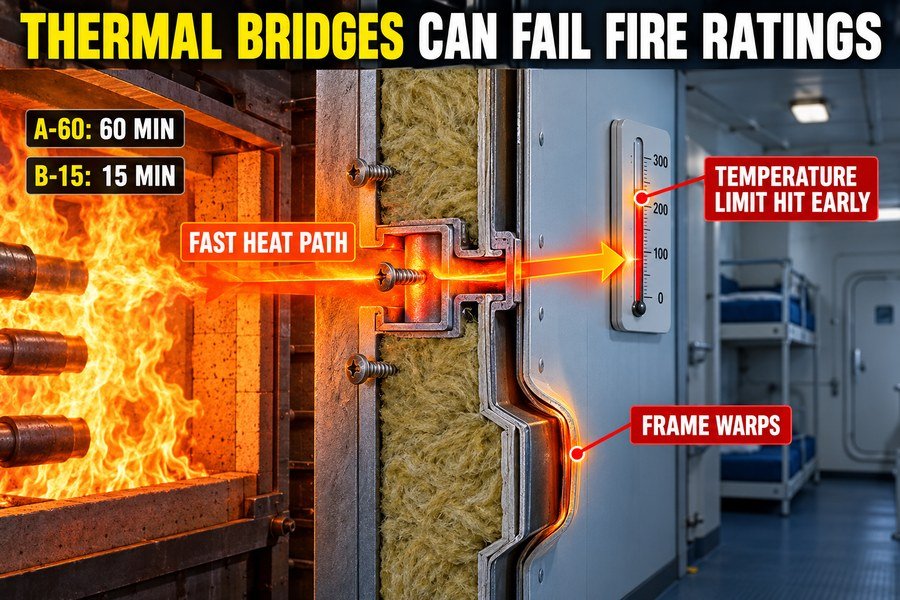
Thermal bridges negatively affect marine interior B-15 and A-60 fire ratings in two critical ways: they create fast pathways for fire heat to reach the unexposed side, causing premature temperature failure, and they cause metal frames to warp early, compromising the structural integrity of the bulkhead.
Premature Temperature Failure on the Unexposed Side
Fire testing is the most important part of marine outfitting. Under the IMO FTP Code Part 3, an A-60 bulkhead must stop a fire for 60 minutes13. During this time, the average temperature on the unexposed side cannot rise more than 140°C above the original temperature. Also, no single point can rise more than 180°C. Thermal bridges ruin this. In a fire test, the furnace reaches over 900°C very quickly. The first way thermal bridges cause failure is by transferring this intense heat directly to the unexposed side. The solid metal joints or screws act like heat pipes. While the rockwool stays cool, the metal joint gets incredibly hot. The thermometer on the joint will quickly hit the 180°C limit. The panel fails the test at 35 or 40 minutes, long before the 60-minute goal.
Structural Warping of Metal Frames in Fire Tests
The second critical way thermal bridges affect fire ratings is through structural warping. Metal expands when it gets hot. Because a thermal bridge transfers heat so fast, the metal frame heats up unevenly. The hot side expands much faster than the cold side. This uneven expansion makes the panel bend and twist14. When the panel warps, it pulls the joints apart. Once the joints open, actual flames and hot gases can shoot through the gaps. This completely destroys the integrity of the B-15 or A-60 rating. To prevent this, good suppliers use special ceramic fiber packing inside the panel joints. This ceramic packing costs a little more, but it blocks the heat and keeps the frame stable during a fire.
| Fire Rating | Test Duration | Max Point Temp Rise allowed | Common Thermal Bridge Failure Point |
|---|---|---|---|
| B-15 | 15 minutes | 225°C | Unsealed cable penetrations |
| A-30 | 30 minutes | 180°C | Metal-to-metal connection splines |
| A-60 | 60 minutes | 180°C | Continuous steel floor tracks |
Where Do Cold Spots Form on Marine Accommodation Panels?
Are passengers complaining about wet walls? Condensation ruins the cabin experience. You must know exactly where these cold spots hide.
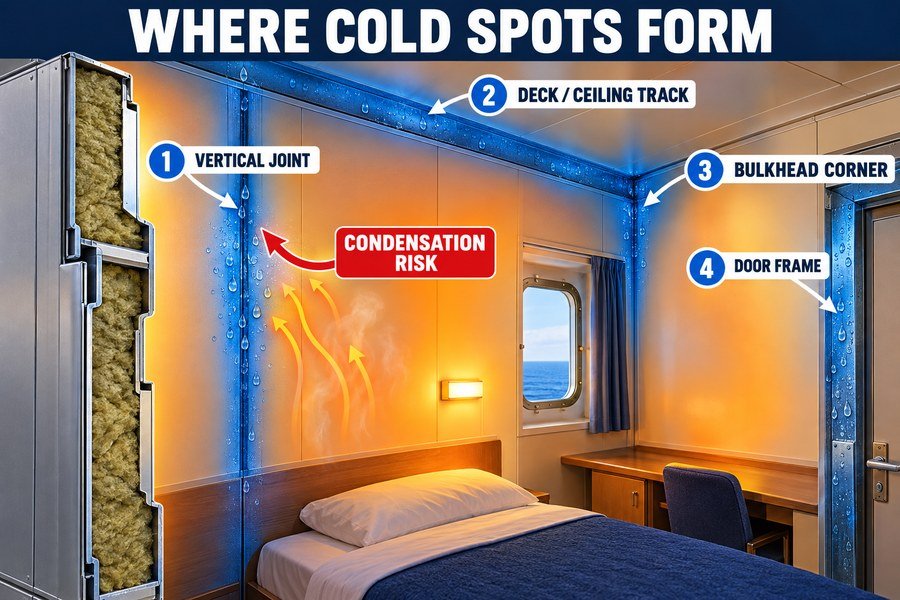
Cold spots form on marine accommodation panels in four main locations: vertical connection joints between panels, horizontal tracks at the deck and ceiling, corners where bulkheads meet, and around uninsulated window or door frames. These areas lack continuous insulation, causing localized temperature drops.
Cold Spots at Vertical Panel Joints and Horizontal Tracks
When the warm, humid air inside a ship cabin meets a cold surface, the water in the air turns into liquid. This is condensation.15 It causes rust and mold.16 To stop it, you must find the cold spots. The first major location is the vertical connection joint between two panels. As we discussed earlier, these joints are often solid metal. They let the cold from the ship's hull travel right into the room. The surface of the joint becomes much colder than the rest of the wall. The second location is the horizontal track at the deck and the ceiling. The steel floor track connects directly to the ship's steel deck. The deck is often very cold. The cold moves up the track and cools the bottom edge of the wall panel.
Cold Spots at Bulkhead Corners and Door Frames
The third location is the corners where two bulkheads meet. Corners are difficult to insulate properly. Factory workers often struggle to push the rockwool all the way into the sharp corner profile. This leaves an empty pocket. Without rockwool, the corner becomes a severe cold spot. The fourth location is around window and door frames. A heavy A-60 marine fire door has a thick steel frame. This frame connects the inside of the cabin to the outside corridor. If the supplier does not inject insulation into the door frame cavity, the solid metal becomes freezing cold. According to general HVAC guidelines, if the surface temperature drops below the dew point, you will get water droplets. You must tell your installation team to spray expanding foam or pack extra rockwool around all door frames and corners.
| Location of Cold Spot | Reason for Temperature Drop | Risk of Condensation |
|---|---|---|
| Vertical Panel Joints | Solid metal connection splines | High |
| Deck and Ceiling Tracks | Direct contact with cold ship hull | High |
| Bulkhead Corners | Missing rockwool in tight spaces | Medium |
| Marine Door Frames | Uninsulated hollow steel profiles | Very High |
Conclusion
Thermal bridges cause serious heat loss, lower fire ratings, and create condensation in marine panels. By controlling metal joints and insulation gaps, you will deliver safer, high-quality projects for your shipyards.
-
"Thermal conductivity of selected materials", https://nvlpubs.nist.gov/nistpubs/legacy/nsrds/nbsnsrds8.pdf. Engineering reference data list carbon steel thermal conductivity in the range of roughly 45 W/(m·K), supporting the comparison between metal framing and insulation materials. Evidence role: statistic; source type: education. Supports: Steel has a thermal conductivity of about 45 W/(m·K).. Scope note: Exact conductivity varies by steel grade, temperature, and manufacturing condition. ↩
-
"Determination of Thermal Properties of Mineral Wool ... - PMC", https://pmc.ncbi.nlm.nih.gov/articles/PMC10488771/. Published mineral wool insulation data commonly report thermal conductivity values near 0.034–0.040 W/(m·K), supporting the article’s order-of-magnitude contrast with steel framing. Evidence role: statistic; source type: institution. Supports: Mineral rockwool has a thermal conductivity of about 0.034 W/(m·K).. Scope note: The exact value depends on product density, temperature, test standard, and manufacturer formulation. ↩
-
"Thermal bridge", https://en.wikipedia.org/wiki/Thermal_bridge. Building-physics literature defines a thermal bridge as a localized path of higher heat flow where a more conductive material crosses or interrupts an insulating layer, supporting the mechanism described for continuous metal framing. Evidence role: definition; source type: education. Supports: A continuous metal frame connecting both sides of an insulated panel creates a thermal bridge that increases heat transfer.. Scope note: Most sources discuss buildings rather than marine panels, but the heat-transfer principle is the same for layered assemblies. ↩
-
"exploration and minimization of thermal bridging", https://repositories.lib.utexas.edu/bitstreams/be880dc5-3c32-4bd0-be5e-ea1e2740b726/download. Heat-transfer literature describes a thermal bridge as a conductive path through a building or enclosure element that bypasses insulation, increasing heat flow where conductive materials such as metal connect warm and cold sides. Evidence role: mechanism; source type: education. Supports: A metal-to-metal panel spline can act as a thermal bridge between warm and cold spaces.. Scope note: This support explains the general heat-transfer mechanism; it may not address this specific marine panel joint design unless a marine-specific source is used. ↩
-
"International Journal of Heat and Mass Transfer", https://htp.engin.umich.edu/wp-content/uploads/sites/119/2024/05/Wet-insulation.pdf. Mineral wool insulation is described as a fibrous material whose thermal resistance depends largely on immobilized air within its structure, which reduces conductive and convective heat transfer. Evidence role: mechanism; source type: research. Supports: Rockwool insulates by trapping air in its fibrous structure.. Scope note: This supports the insulation principle for mineral wool generally, not necessarily the performance of a particular marine-grade rockwool panel. ↩
-
"PATH | Insulation and Air Sealing", https://www.huduser.gov/archives/portal/consumer/insulation_air_sealing.html. Building-physics and enclosure guidance identifies air leakage through cracks and joints as a pathway for convective heat loss when pressure and temperature differences exist across an assembly. Evidence role: mechanism; source type: government. Supports: Gaps at panel joints can allow warm air leakage and associated convective heat loss.. Scope note: This supports the general air-leakage heat-loss mechanism; additional marine vibration evidence would be needed to prove that a given shipboard panel joint will open under service conditions. ↩
-
"Code Compliant Insulation Approaches under the 2021 IECC", https://smartenergy.illinois.edu/wp-content/uploads/2025/03/Code-Compliant-Insulation-FINAL.pdf. Building-physics references describe metal fasteners penetrating insulation as point thermal bridges because metals such as steel have much higher thermal conductivity than mineral wool, allowing localized conductive heat flow through the insulated layer. Evidence role: mechanism; source type: paper. Supports: Steel screws passing through an insulated panel can conduct heat across the insulation layer and act as thermal bridges.. Scope note: The evidence is likely drawn from building-envelope research rather than marine cabin panels specifically, so it supports the heat-transfer mechanism by analogy. ↩
-
"NEW MATERIALS AND CONCEPTS TO REDUCE ...", https://web.ornl.gov/sci/buildings/conf-archive/1985%20B3%20papers/054.pdf. Thermal-bridge calculation standards and envelope studies treat repeated metal penetrations as additive point thermal bridges, meaning that increasing the number of conductive fasteners increases the total heat-loss contribution. Evidence role: expert_consensus; source type: institution. Supports: A higher density of metal screws or fasteners increases the number of point thermal bridges and can raise total heat transfer through an insulated assembly.. Scope note: Such sources generally quantify building-envelope fasteners; the principle applies to insulated marine panels, but the magnitude depends on panel geometry and installation details. ↩
-
"Sealing Air Leaks: Basement", https://www.energystar.gov/saveathome/seal_insulate/do-it-yourself-guide/sealing-air-leaks-basement. Heat-transfer references identify convection as heat transfer by fluid motion, and air-leakage research shows that gaps in envelope joints permit warm air movement that can transport heat across assemblies. Evidence role: mechanism; source type: government. Supports: Unsealed joints or cracks can allow warm air movement, producing convective heat transfer that bypasses insulation.. Scope note: The source may address buildings or general heat transfer rather than ship cabins; it supports the physical mechanism, not a measured loss rate for this panel design. ↩
-
"THERMAL RADIATION HEAT TRANSFER", https://ntrs.nasa.gov/api/citations/19710021465/downloads/19710021465.pdf. Heat-transfer textbooks and reference sources define thermal radiation as electromagnetic heat transfer that can occur across a vacuum or air space between surfaces, supporting the statement that opposing metal skins separated by an empty void can exchange radiant heat. Evidence role: definition; source type: education. Supports: Thermal radiation can transfer heat across an empty or air-filled void between a hot surface and a colder surface.. Scope note: This supports the radiation mechanism in an air gap; actual heat flow also depends on surface temperature, emissivity, geometry, and any convection within the void. ↩
-
"An AI-based approach to thermal bridge analysis - PMC", https://pmc.ncbi.nlm.nih.gov/articles/PMC12378188/. ISO 10211 specifies numerical methods for calculating heat flows and surface temperatures associated with thermal bridges, supporting its use as a reference framework for assessing non-uniform heat transfer paths. Evidence role: definition; source type: institution. Supports: ISO 10211 is a relevant standard for calculating thermal bridges.. Scope note: The standard is primarily framed for building construction applications, so it contextualizes the method rather than directly validating marine-panel performance values. ↩
-
"Thermal Bridging in Concrete Sandwich Walls", https://scholarsarchive.byu.edu/cgi/viewcontent.cgi?article=6423&context=facpub. Research on insulated assemblies with metal frames, joints, or other thermal bridges shows that whole-assembly thermal transmittance can be substantially higher than center-of-panel values, supporting the plausibility of a large U-value penalty from edges and joints. Evidence role: general_support; source type: paper. Supports: Thermal bridges at panel edges and joints can cause the measured U-value of an assembled panel to be much worse than the core-only value.. Scope note: Such studies support the mechanism and magnitude contextually, but they may not directly prove the stated 20–50% range for every 50 mm A-0 marine bulkhead panel. ↩
-
"What Is the Purpose and Scope of the IMO FTP Code?", https://magellanmarinetech.com/what-purpose-scope-of-imo-ftp-code/. The IMO Fire Test Procedures Code defines A-class divisions, including the requirement that an A-60 division maintain insulation performance for 60 minutes under the prescribed fire test conditions. Evidence role: definition; source type: institution. Supports: Under the IMO FTP Code Part 3, an A-60 bulkhead must stop a fire for 60 minutes and meet specified unexposed-side temperature-rise limits.. ↩
-
"Thermal Distortions", https://wp.optics.arizona.edu/optomech/wp-content/uploads/sites/53/2016/08/15-Thermal-Distortions-1.pdf. Engineering literature on steel structures exposed to fire explains that through-thickness temperature gradients produce differential thermal expansion and thermal stresses that can cause bending or distortion of structural members; this supports the mechanism in general rather than proving the behavior of a specific marine panel design. Evidence role: mechanism; source type: paper. Supports: Uneven heating from a thermal bridge can cause differential thermal expansion that bends or twists a metal panel or frame during a fire test.. Scope note: Contextual support only; actual warping depends on panel geometry, restraints, materials, and the fire-test configuration. ↩
-
"Condensation: Dew, Fog and Clouds", https://www.atmos.colostate.edu/~davet/AT350/07.FogCloud.Fall2009.pdf. A thermodynamics or building-science source should support that condensation occurs when moist air contacts a surface at or below the air’s dew-point temperature. Evidence role: definition; source type: education. Supports: Condensation forms when warm humid indoor air meets a sufficiently cold surface.. Scope note: This supports the physical definition of condensation generally, not the specific conditions inside a ship cabin. ↩
-
"Corrosion of metallic fasteners in low-sloped roofs", https://nvlpubs.nist.gov/nistpubs/Legacy/IR/nistir88-4008.pdf. A public-health or materials-science source should document that persistent condensation or moisture supports mold growth and can accelerate corrosion of metals. Evidence role: general_support; source type: government. Supports: Condensation can contribute to rust and mold.. Scope note: The evidence would support moisture-related mold and corrosion risks broadly; it may not quantify risk in marine accommodation panels specifically. ↩