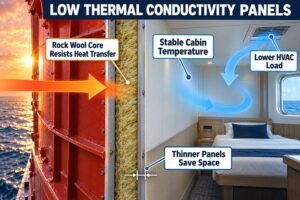
High cabin noise causes crew fatigue and ruins passenger comfort on your ship projects. Are you struggling to meet strict European shipyard standards? Here are the exact regulations you need.
Marine cabin noise limits are governed globally by the IMO Code on Noise Levels on Board Ships (Resolution MSC.337(91)), alongside local flag state requirements, classification society notations like DNV Silent, and specific shipyard contractual standards.
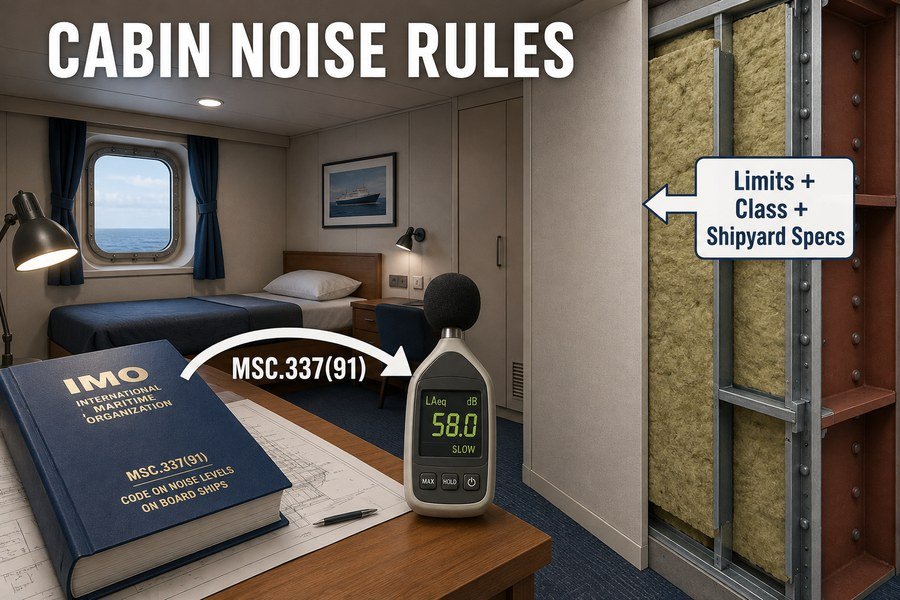
Let us look closer at the specific rules you must follow when buying marine wall panels and doors for your next big interior project.
What Cabin Noise Limits Does the IMO Code Define for Ships?
Buying cheap wall panels might save money today, but failing IMO noise inspections will cost you the whole project. What are the actual numbers you must hit?
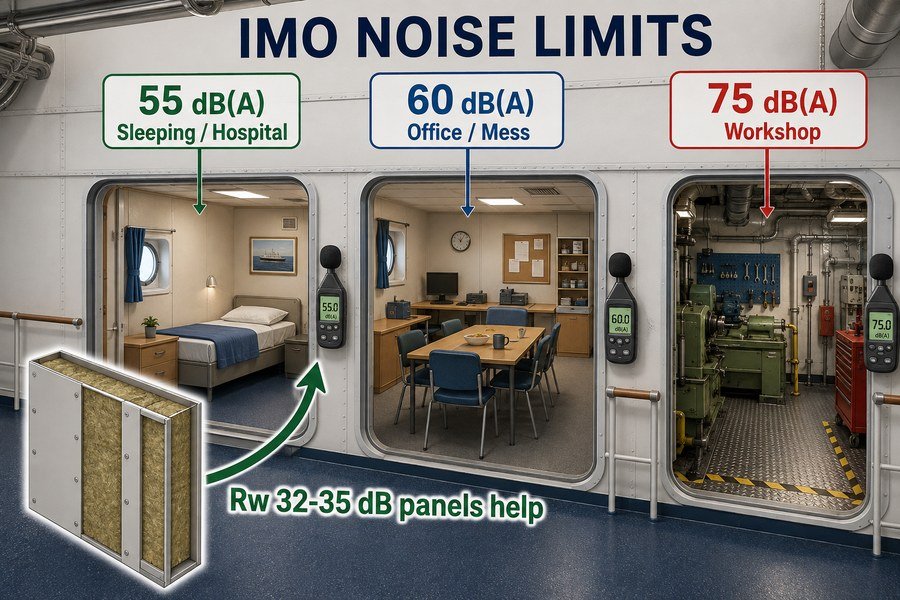
The IMO Code (MSC.337(91)) sets mandatory airborne noise limits ranging from a strict 55 dB(A) for hospitals and sleeping cabins, 60 dB(A) for offices and messes, up to 75 dB(A) for workshops, covering the entire spectrum of accommodation spaces.
Understanding the IMO MSC.337(91) Airborne Noise Standards for Sleeping and Medical Rooms
When I talk to buyers sourcing materials from Asian factories, they always ask me what the baseline legal requirement is. The International Maritime Organization (IMO) published Resolution MSC.337(91), which became mandatory under SOLAS regulation II-1/3-12. According to this official code, the noise limit for sleeping cabins and ship hospitals is exactly 55 dB(A). You cannot go above this number. A normal conversation is about 60 dB(A), so 55 dB(A) is fairly quiet. To achieve this, the marine wall panels and marine fire doors you buy must block the engine noise effectively. If you buy a standard 50mm rockwool wall panel from China, you must ask the supplier for the acoustic test report. The panel needs a Sound Reduction Index (Rw) of at least 32 dB to 35 dB to help keep the room below that 55 dB(A) limit.
Noise Limits for Marine Working and Recreation Spaces
The IMO rules change based on what people do in the room. You do not need to spend money on top-tier acoustic panels for every single room. For offices and mess rooms (where the crew eats), the IMO limit goes up to 60 dB(A). This gives you some flexibility. You can use slightly cheaper marine interior outfitting products here because the room is allowed to be louder. For service spaces like workshops, the limit is much higher at 75 dB(A). The IMO knows that tools and machinery make noise. I always tell my clients to match their material purchases to these exact limits. Do not buy an expensive Rw 44 dB panel for a workshop. Save your budget for the sleeping cabins.
| Marine Space Category | IMO MSC.337(91) Noise Limit | Recommended Panel Rw Rating |
|---|---|---|
| Hospitals & Sleeping Cabins | 55 dB(A) | 35 dB to 44 dB |
| Offices & Mess Rooms | 60 dB(A) | 30 dB to 35 dB |
| Workshops & Service Spaces | 75 dB(A) | 25 dB to 30 dB |
How Do IMO Noise Limits Vary by Marine Cabin Type and Category?
Not all ship cabins need the same sound insulation. Using expensive high-reduction panels everywhere kills your budget. How do the limits change across different ship rooms?
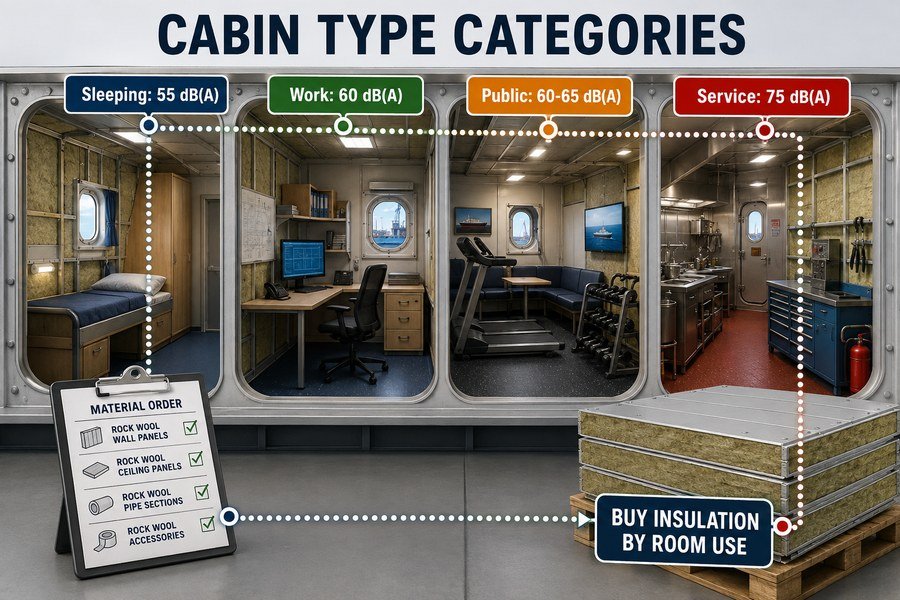
IMO noise limits categorize ship spaces into four main types: sleeping areas (55-60 dB(A)), work spaces like offices (60 dB(A)), public recreation areas (60-65 dB(A)), and service spaces like galleys and workshops (75 dB(A)), balancing comfort with operational reality.
Acoustic Requirements for Marine Sleeping and Work Areas
The IMO code breaks the ship down very logically. The first two types are sleeping areas and work spaces. For sleeping areas, comfort is the top priority because crew fatigue causes accidents. The IMO requires standard crew cabins to stay at or below 60 dB(A) on older ships, but for ships built after 2014, the limit is 55 dB(A). Work spaces like the ship office also require focus, so the IMO limits them to 60 dB(A). When you negotiate with factories in Vietnam or China, you need to buy B-15 marine wall panels for these areas. A standard B-15 wall panel costs around $15 to $20 per square meter. It usually provides around Rw 32 dB of sound reduction, which is enough to meet these limits if the ship's steel structure is properly insulated.
Sound Regulations for Marine Public and Service Spaces
The third and fourth types are public recreation areas and service spaces. Public spaces include lounges and gyms. Here, the IMO allows limits between 60 dB(A) and 65 dB(A). People are talking or exercising, so a little background engine noise is acceptable. The fourth category is service spaces. This includes galleys (kitchens) and small workshops, where the IMO limit is 75 dB(A)1. When you buy materials for these noisy service spaces, you can focus on fire ratings instead of acoustics. You can buy a basic A-0 or B-0 marine fire door for $150 to $200, rather than spending $400 on a specialized acoustic door. Knowing these four categories helps you buy the exact right product without wasting money.
| IMO Room Type | Specific Room Example | Max Noise Limit dB(A) | Focus for Procurement |
|---|---|---|---|
| Sleeping Areas | Crew Cabins, Hospitals | 55 dB(A) | High acoustic rockwool core |
| Work Spaces | Ship Offices | 60 dB(A) | Medium acoustic insulation |
| Public Areas | Gyms, Lounges | 60 - 65 dB(A) | Basic B-15 wall panels |
| Service Spaces | Galleys, Workshops | 75 dB(A) | Fire safety over acoustics |
Which Vessel Size Threshold Triggers Mandatory IMO Cabin Noise Compliance?
You might think these strict noise rules apply to every small boat you work on. If you assume wrong, you waste money. What size ship actually triggers this rule?
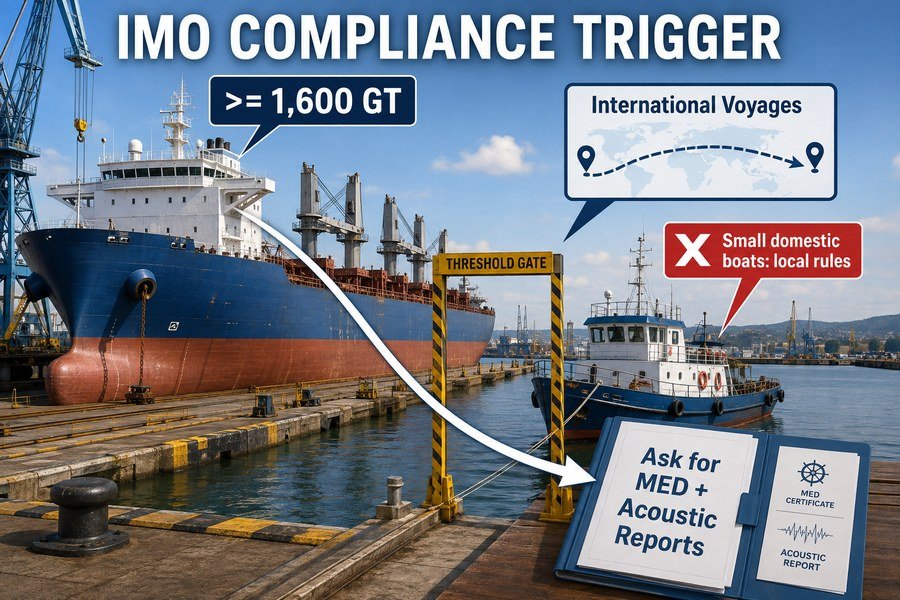
Mandatory IMO cabin noise compliance under MSC.337(91) is triggered by two specific vessel thresholds: the ship must be a new commercial vessel of 1,600 gross tonnage (GT) or above, and it must be engaged in international voyages.
The 1,600 Gross Tonnage (GT) Rule for Ships
I see many procurement officers get confused about when they actually need to buy high-end acoustic panels. The IMO MSC.337(91) code does not apply to small fishing boats or tiny coastal ferries. The primary rule is that the vessel must be 1,600 gross tonnage (GT) or larger. Gross tonnage is a measure of the ship's overall internal volume2. If the shipyard in Europe is building a massive 10,000 GT cruise ship or a 50,000 GT bulk carrier, these noise limits are absolute law. If you are buying marine ceiling panels for a small 800 GT river tugboat, this specific IMO code is not legally binding. However, you should still provide good quality materials. But knowing the 1,600 GT threshold means you do not have to stress over providing expensive Rw 44 dB acoustic certificates for tiny domestic boats.
The International Voyage Requirement for IMO Compliance
The second major trigger is the type of voyage. The IMO is an international body. Therefore, their strict noise rules apply to ships engaged in international voyages3. If a 2,000 GT ship only travels up and down the coast of one country, local maritime laws apply, not necessarily the full IMO SOLAS noise code. But since your company decorates large ships for European and US shipyards, almost all of your projects will be international. This means you must ask your Asian suppliers for proper test reports. Make sure the marine fire doors and wall panels have MED (Marine Equipment Directive) approval4 and clear acoustic data. If the supplier cannot give you a valid lab report proving their panel reduces noise, you will fail the final ship inspection.
| Compliance Threshold | IMO MSC.337(91) Requirement | Procurement Action Required |
|---|---|---|
| Vessel Size | >= 1,600 Gross Tonnage (GT) | Must buy certified acoustic panels |
| Vessel Size | < 1,600 Gross Tonnage (GT) | Standard marine panels acceptable |
| Voyage Type | International Voyages | Full MED and acoustic certificates needed |
| Voyage Type | Domestic / Inland Only | Follow local national rules |
How Do Project-Specific Marine Noise Requirements Exceed Minimum IMO Limits?
European shipyards often reject materials that pass IMO basics. Why? Because their luxury clients demand complete silence. How much stricter do these private project rules get?
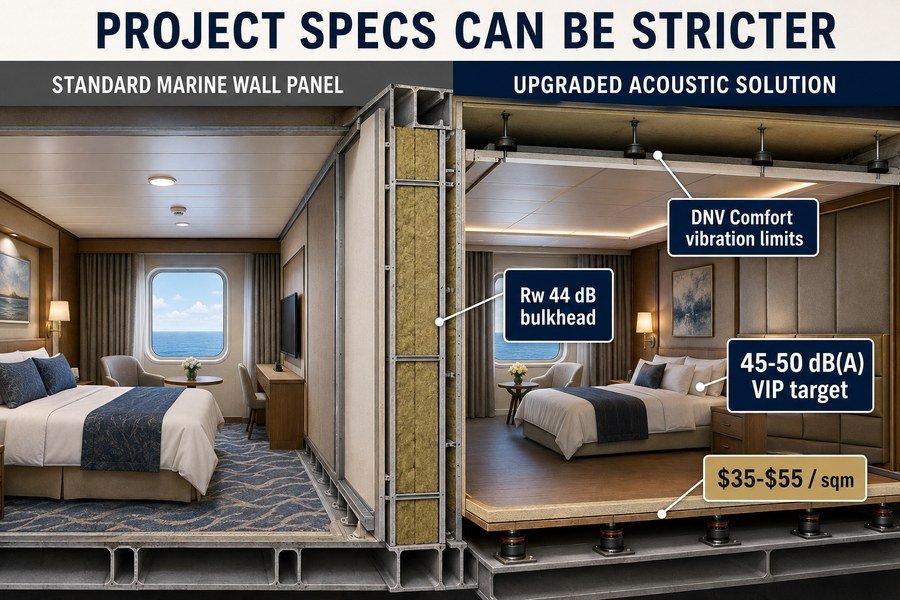
Project-specific requirements exceed IMO minimums by enforcing stricter decibel limits (often 45-50 dB(A) for VIP cabins), requiring specific acoustic insulation ratings (like Rw = 44 dB for partition bulkheads), and adding vibration limits dictated by class comfort notations like DNV Comfort Class.
Upgrading Decibel and Rw Limits for Luxury Marine Projects
Working with large shipyards in Europe and the United States brings a big challenge. They rarely settle for the basic IMO limit of 55 dB(A). They build luxury cruise ships, expedition vessels, and high-end offshore platforms. In their contracts, they will often demand 45 dB(A) or 50 dB(A) for VIP passenger cabins. That 10 dB difference is huge in the world of acoustics.5 To reach this, you cannot use a standard $15/sqm marine wall panel. You must buy double-skin panels or composite panels with a Sound Reduction Index (Rw) of 44 dB or higher. These specialized acoustic bulkheads can cost between $35 and $55 per square meter. When you negotiate with suppliers in China, you must clearly state you need "Rw 44 dB panels." If you just ask for "marine wall panels," they will quote you the cheap ones, and the European shipyard will reject them during installation.
Meeting Advanced Vibration and Class Comfort Notations
Beyond just airborne noise (people talking, music), European shipyards also test for structural vibration. IMO sets basic rules, but shipyards often use Classification Societies like DNV or Lloyd's Register to set stricter standards. For example, DNV has a special notation called "Comfort Class V(1)". This notation puts strict limits on how much the floor and walls can shake. To meet DNV Comfort Class, you must buy floating floor systems and anti-vibration mounts for your marine ceiling panels. A basic ceiling panel might cost $12/sqm, but an acoustic ceiling system suspended on rubber vibration isolators will cost around $25/sqm. I always advise buyers to read the technical specifications from the shipyard very carefully. Look for words like "DNV Comfort" or "ABS HAB+". If you see those, you know you must buy premium acoustic materials.
| Feature | IMO Minimum Standard | EU Shipyard Contractual Standard (e.g. DNV Comfort) |
|---|---|---|
| VIP/Passenger Cabin Noise | 55 dB(A) | 45 dB(A) to 50 dB(A) |
| Required Panel Rw Rating | Rw 32 - 35 dB | Rw 44 - 46 dB |
| Vibration Limits | Basic minimums | Strict Comfort Class notation limits |
| Panel Cost Estimate | $15 - $20 / sqm | $35 - $55 / sqm |
What Is the Difference Between Regulatory and Contractual Marine Cabin Noise Limits?
Confusing the bare minimum law with what the shipyard actually wants will get your materials rejected. What is the real difference between these two sets of rules?
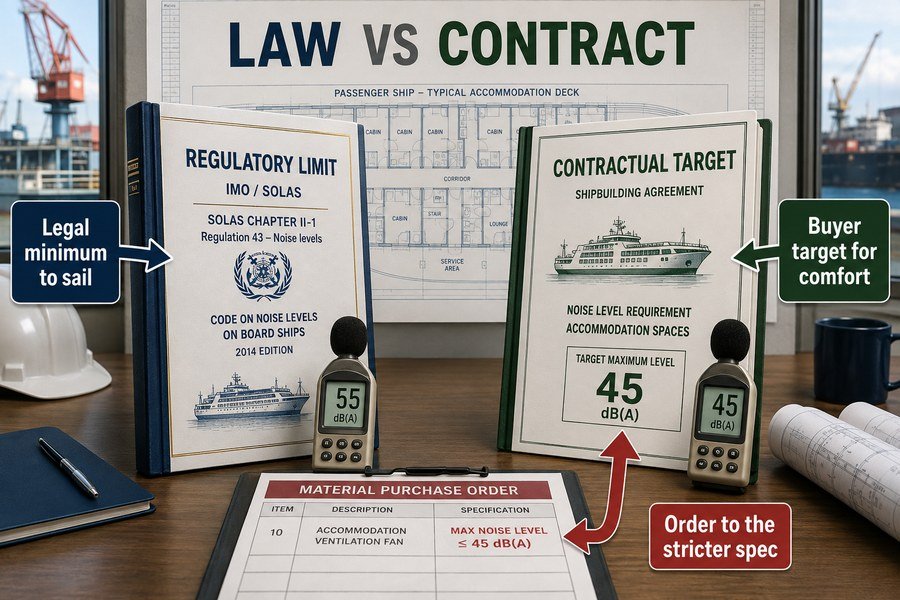
Regulatory limits are the legal minimums set by the IMO (like 55 dB(A) for cabins) required for the ship to sail, while contractual limits are stricter, buyer-defined targets (like 45 dB(A)) written into the shipyard agreement to ensure higher commercial quality.
Understanding Regulatory Marine Cabin Noise Baselines
As a marine outfitting specialist, I spend a lot of time explaining the difference between the law and the contract to my clients. Regulatory limits are the laws of the ocean. They come from the IMO, the flag state (the country where the ship is registered), and international treaties like SOLAS. For cabin noise, the regulatory baseline is usually that 55 dB(A) limit we discussed earlier. If a ship fails to meet the regulatory limit, the port authorities will not let it sail. It is a matter of basic health and safety for the crew. When you ask a factory for a marine fire door, they will usually give you a door that meets these regulatory baselines. The factory's standard certification covers the law, but nothing more.
Contractual limits are completely different. They are private agreements between the ship owner and the shipyard. If a rich company orders a cruise ship, they want it to be silent. They will write a target of 45 dB(A) into the contract. This is a contractual limit to guarantee commercial quality and passenger happiness. If the ship tests at 50 dB(A), it is perfectly legal to sail (because it beats the 55 dB(A) regulatory rule). However, the shipyard has broken the contract. The ship owner can refuse to pay or demand a massive discount. This is why procurement officers face so much pressure. You must buy materials that meet the strict contractual limit, not just the basic regulatory limit. Always ask the shipyard for the exact acoustic specifications before you place a large order in Asia.
| Comparison Point | Regulatory Marine Noise Limits | Contractual Marine Noise Limits |
|---|---|---|
| Source of Rule | IMO, SOLAS, Flag State Laws | Private contract between Owner & Shipyard |
| Main Purpose | Crew health and basic safety | Passenger comfort and luxury quality |
| Example dB Limit | 55 dB(A) for sleeping cabins | 45 dB(A) for VIP sleeping cabins |
| Consequence of Failure | Ship is banned from sailing | Shipyard faces heavy financial penalties |
Conclusion
Knowing these noise limits helps you buy the right marine wall panels and doors. You can balance your budget and keep strict European shipyards happy on every single project.
-
"Physical influences on seafarers are different during their voyage ... - PMC", https://pmc.ncbi.nlm.nih.gov/articles/PMC7141673/. IMO noise-code tables identify service spaces such as galleys and workshops and state maximum A-weighted noise limits for those spaces, providing support for the 75 dB(A) figure. Evidence role: definition; source type: institution. Supports: IMO noise rules set a 75 dB(A) limit for specified service spaces such as galleys and small workshops.. Scope note: The source supports the general service-space limit, but some specific machinery or workshop areas may have different limits depending on classification and code applicability. ↩
-
"Gross tonnage - Wikipedia", https://en.wikipedia.org/wiki/Gross_tonnage. Gross tonnage is defined under the International Convention on Tonnage Measurement of Ships as a dimensionless measure derived from the total volume of all enclosed spaces of a ship. Evidence role: definition; source type: institution. Supports: Gross tonnage measures a ship’s internal enclosed volume rather than weight.. Scope note: The source defines the measurement concept; it does not address acoustic-panel procurement requirements. ↩
-
"SOLAS Convention - Wikipedia", https://en.wikipedia.org/wiki/SOLAS_Convention. SOLAS generally applies to ships engaged on international voyages, and its noise-level requirements are implemented through SOLAS provisions that incorporate the IMO Code on Noise Levels on Board Ships. Evidence role: general_support; source type: institution. Supports: IMO/SOLAS noise compliance is primarily tied to ships engaged in international voyages.. Scope note: This supports the international-voyage framework at the convention level; flag states or coastal states may apply equivalent or additional noise requirements to domestic vessels. ↩
-
"Directive 96/98/EC", https://en.wikipedia.org/wiki/Directive_96/98/EC. The EU Marine Equipment Directive 2014/90/EU establishes conformity-assessment and wheel-marking requirements for marine equipment placed on board EU ships when that equipment is subject to international instruments. Evidence role: definition; source type: government. Supports: Marine equipment for relevant European ship projects may need MED conformity approval in addition to acoustic documentation.. Scope note: This supports why MED approval may be relevant for EU-flag or EU-regulated projects; it does not prove that every wall panel, ceiling panel, or acoustic certificate in the article falls within MED scope. ↩
-
"Physics 4060, Acoustics Laboratory - HyperPhysics", http://hyperphysics.phy-astr.gsu.edu/hbase/Ph4060/p406i.html. Standard acoustics references describe the decibel scale as logarithmic, with a 10 dB change corresponding to a tenfold change in sound intensity, which explains why a 10 dB noise-limit reduction is acoustically significant. Evidence role: mechanism; source type: education. Supports: A 10 dB reduction is a major acoustic change rather than a small linear adjustment.. Scope note: Perceived loudness depends on frequency, background noise, and listener conditions, so the source supports the general acoustic significance rather than the exact design cost impact. ↩