You receive a shipyard noise specification, but translating those raw dB(A) numbers into exact marine panel acoustic ratings feels impossible. This mismatch causes procurement delays and expensive material rejections.
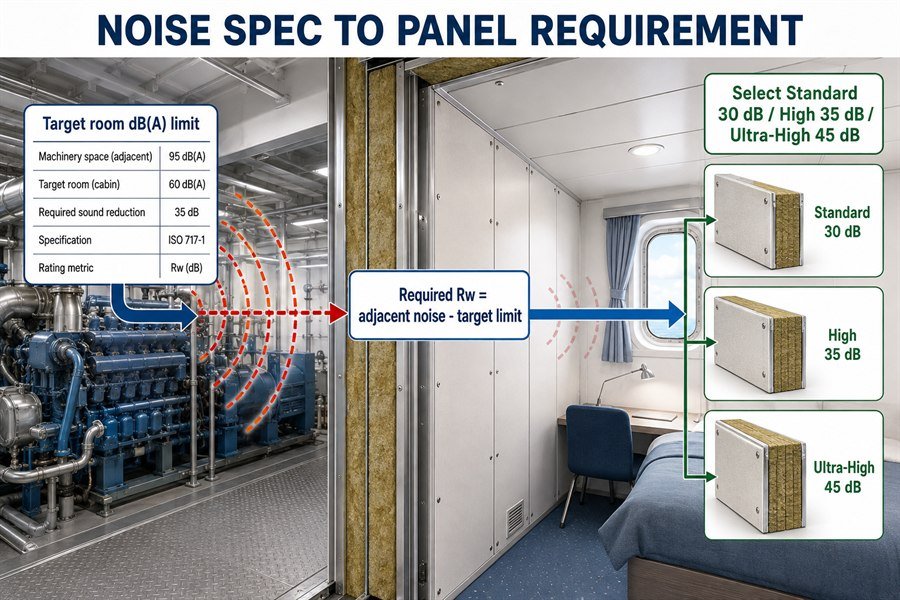
To translate a project noise specification into panel requirements, you must evaluate the target room's dB(A) limit, calculate the required transmission loss (Rw) based on adjacent noise sources, and select wall and ceiling panels from three certified acoustic classes (Standard 30 dB, High 35 dB, and Ultra-High 45 dB) that bridge that gap.
I have seen many procurement officers struggle with this exact problem. During my time working in the marine outfitting factory, I watched buyers waste thousands of dollars buying the wrong panels. Now at Magellan Marine, I help clients turn those confusing noise limits into clear, actionable purchasing requirements. Let me break down the exact steps to do this.
How Is a Marine Cabin dB(A) Target Matched to a Panel Acoustic Class?
A strict dB(A) target on paper means nothing if you order the wrong panel class. Choosing blindly leads to failed sea trials and very costly interior refits.
A marine cabin dB(A) target is matched to a panel acoustic class by taking the loudest adjacent noise source, subtracting the target cabin limit, and selecting from three main panel acoustic classes: Standard (30-32 dB), High Acoustic (35-40 dB), or Ultra-High Acoustic (45-50+ dB) that covers the exact difference.
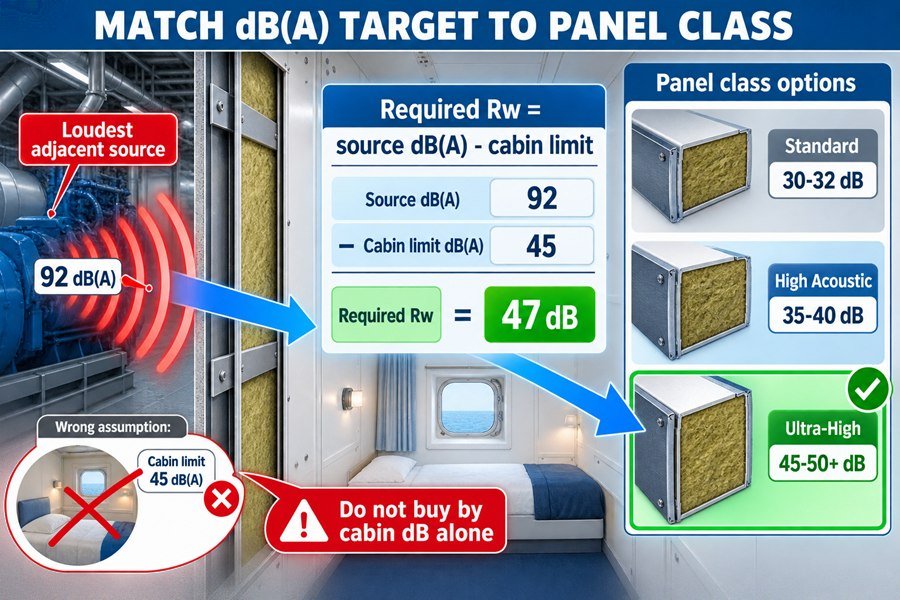
Many buyers look at a cabin target of 45 dB(A) and mistakenly think they need a 45 dB panel. This is incorrect. You must calculate the difference between the rooms. In this section, I will explain how to calculate the requirement and how to match it to the three specific panel classes I mentioned earlier.
Calculating the Required Sound Reduction Index (Rw) for Marine Panels
To find the right panel, you must use a simple formula. You take the noise level of the space next door and subtract your target cabin noise limit1. The result is the minimum Sound Reduction Index (Rw) your panel must have. The International Maritime Organization (IMO) sets these limits in Resolution MSC.337(91). For example, if you have an engine casing room producing 80 dB(A) of noise, and it sits right next to a passenger cabin that has a strict limit of 45 dB(A), the math is easy. You subtract 45 from 80. The difference is 35. This means the wall panel dividing these two rooms must block at least 35 dB of sound. If you buy a panel with an Rw rating of 30 dB, the cabin will reach 50 dB(A). The ship will fail inspection. You must know the noise levels of all surrounding rooms before you can pick a panel.
Matching the Calculated Rw to Standard Panel Acoustic Classes
Once you have your calculated Rw number, you must select the right panel. The market offers three main acoustic classes. You must know all three to avoid overspending. First, we have the Standard Acoustic Class. These panels offer an Rw of 30 to 32 dB. They use a standard 50mm rockwool core with a density of 120 kg/m3. They cost around $18 to $22 per square meter. Second, we have the High Acoustic Class. These panels offer an Rw of 35 to 40 dB. Manufacturers achieve this by adding a thin steel sheet inside the rockwool core. They cost around $30 to $35 per square meter. Third, we have the Ultra-High Acoustic Class. These panels offer an Rw of 45 to 50+ dB. They are usually 100mm thick or use double-wall construction with special sound-dampening materials. These cost $50 to $70 per square meter. You just match your calculated Rw to the lowest class that meets the requirement.
| Acoustic Panel Class | Typical Rw Rating (dB) | Panel Thickness (mm) | Estimated Cost ($/m2) | Best Application Area |
|---|---|---|---|---|
| Standard Acoustic | 30 - 32 dB | 50mm | $18 - $22 | Between two quiet passenger cabins |
| High Acoustic | 35 - 40 dB | 50mm | $30 - $35 | Between cabin and public corridor |
| Ultra-High Acoustic | 45 - 50+ dB | 100mm (or Double) | $50 - $70 | Between cabin and machinery space |
What Acoustic Value Must a Marine Bulkhead Panel Meet for a 60 dB(A) Target?
If the project specification says a cabin must not exceed 60 dB(A), what panel do you actually buy? Guessing the Rw value will quickly destroy your materials budget.
For a 60 dB(A) target, a marine bulkhead panel must meet an acoustic value between 15 dB and 45 dB (Rw), depending entirely on three adjacent spaces: a 75 dB corridor (requires 15 dB Rw), an 85 dB machinery room (requires 25 dB Rw), or a 105 dB engine room (requires 45 dB Rw).
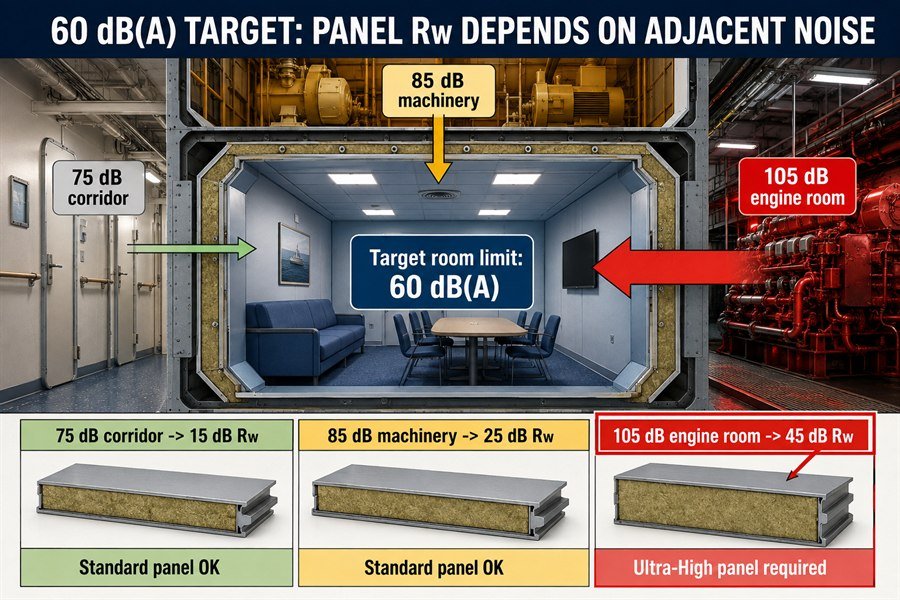
A 60 dB(A) target is usually for a workshop, a control room, or a utility space. The target number alone tells you nothing about the panel you need to buy. You have to look at what is on the other side of the wall. Let us look at the three different adjacent room scenarios I mentioned.
Panel Acoustic Requirements for Low-Noise Adjacent Corridors
The first scenario is when your 60 dB(A) room is next to a normal ship corridor. According to IMO regulations, a normal corridor usually has a maximum noise level of 75 dB(A). You subtract the 60 dB target from the 75 dB corridor noise. The difference is 15 dB. Your marine panel only needs an acoustic value (Rw) of 15 dB. This is very low. Almost any marine panel on the market can achieve this. Even the cheapest standard B-15 fire-rated panel provides about 30 dB of sound reduction. In this specific case, you do not need to worry about acoustics at all. You just buy the standard $18 per square meter panel. The fire rating will dictate your purchase, not the sound requirement.
Panel Acoustic Requirements for High-Noise Machinery Spaces
The situation changes completely when your 60 dB(A) room sits next to loud machinery. We have two scenarios here. The second scenario is a standard machinery room. These rooms generate about 85 dB(A) of noise2. Subtracting 60 from 85 means your panel needs an Rw of 25 dB. Again, a standard 50mm B-15 marine panel easily blocks 30 dB3. You are still safe with the basic panel. However, the third scenario is the main engine room. Large diesel engines can easily produce 105 dB(A) of noise4. To reach your 60 dB(A) target inside the adjacent room, your panel needs to block 45 dB of sound (105 minus 60). A standard panel will fail completely. You must buy an Ultra-High Acoustic panel. This panel will have special membranes and will cost over $50 per square meter. You can see how the exact same 60 dB target creates completely different panel requirements.
| Adjacent Room Type | Adjacent Noise Level (dB) | Target Room Limit (dB) | Required Panel Rw (dB) | Panel Type Needed |
|---|---|---|---|---|
| Passenger Corridor | 75 dB(A) | 60 dB(A) | 15 dB | Standard B-15 Panel (30 dB Rw) |
| Standard Machinery | 85 dB(A) | 60 dB(A) | 25 dB | Standard B-15 Panel (30 dB Rw) |
| Main Engine Room | 105 dB(A) | 60 dB(A) | 45 dB | Ultra-High Acoustic Panel (45+ dB Rw) |
How Does a Stricter Cabin Noise Limit Raise Marine Panel Sound Ratings?
Shipowners now demand much quieter cabins for better comfort. A small drop in the noise limit drastically changes the physical type of panel you must purchase from the factory.
A stricter cabin noise limit raises marine panel sound ratings by requiring two structural upgrades: thicker core materials (increasing from a 50mm to a 100mm rockwool core) and the addition of sound-dampening membranes, which together boost the panel's Sound Reduction Index (Rw) from a standard 30 dB to over 45 dB.
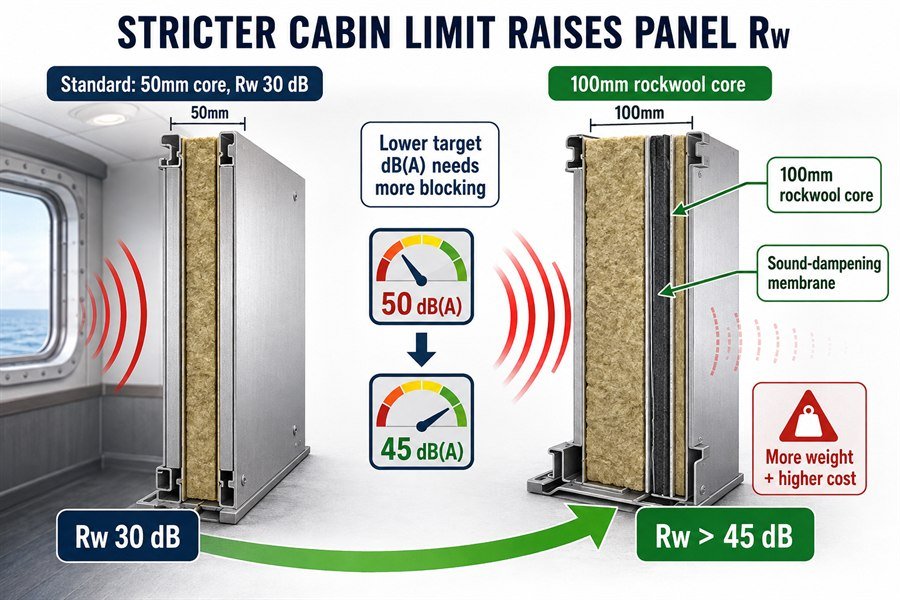
When a shipyard changes a cabin noise limit from 50 dB(A) down to 45 dB(A), it sounds like a small change. But for procurement, it is a huge problem. You cannot just use the same panels. To block that extra sound, the factory must physically change the panel construction using two specific methods.
Upgrading Marine Panel Core Thickness for Stricter Noise Limits
The first structural upgrade a factory makes is increasing the core thickness. Sound travels through vibration. More mass blocks more vibration5. A standard marine panel has a 50mm thick rockwool core. This standard core blocks about 30 to 32 dB of sound6. If the new, stricter noise limit requires a 40 dB sound reduction, the 50mm core is not enough. The factory will upgrade the panel to a 100mm thick rockwool core7. This extra mass absorbs much more low-frequency noise. However, this upgrade causes major issues for buyers. A 100mm panel takes up more space in the cabin. It also weighs twice as much. This increases your shipping costs from Asia. You will fit fewer panels into a 40-foot shipping container, which raises the final landed cost of your materials.
Adding Sound-Dampening Membranes to Marine Bulkhead Panels
The second structural upgrade involves adding sound-dampening membranes inside the panel. Sometimes, increasing the thickness to 100mm is impossible because the ship design does not have enough space. To meet the stricter noise limit while keeping the panel thin, factories add heavy barrier layers. A common method is inserting a 1mm or 2mm galvanized steel plate right in the middle of the rockwool core. Another method uses a viscoelastic sound-damping sheet under the decorative surface. These membranes stop high-frequency sound waves from passing through the panel. By combining a dense rockwool core with these solid metal membranes, factories can push a 50mm panel to an Rw of 40 dB, or a 100mm panel to an Rw of over 50 dB. These membranes add about $12 to $20 per square meter to the panel price.
| Structural Upgrade Method | Original Panel Rw | Upgraded Panel Rw | Impact on Panel Weight | Estimated Price Increase |
|---|---|---|---|---|
| Increase Core to 100mm | 32 dB | 38 - 40 dB | + 8 to 10 kg/m2 | + $10 - $15 / m2 |
| Add 1mm Steel Membrane | 32 dB | 38 - 42 dB | + 7.8 kg/m2 | + $12 - $18 / m2 |
| Double Wall + Membranes | 32 dB | 48 - 52+ dB | + 15 to 20 kg/m2 | + $35 - $45 / m2 |
How to Define Marine Panel Requirements for Multiple Cabin Noise Levels?
A cruise ship has passenger cabins, crew quarters, and utility spaces, all with very different noise limits. Buying one premium panel type for everything will completely destroy your purchasing budget.
To define marine panel requirements for multiple cabin noise levels, you must segment the project into three distinct zones: high-comfort passenger cabins (requiring 45 dB Rw premium panels), standard crew quarters (requiring 35 dB Rw panels), and utility spaces (requiring standard 30 dB Rw panels) to optimize material costs.
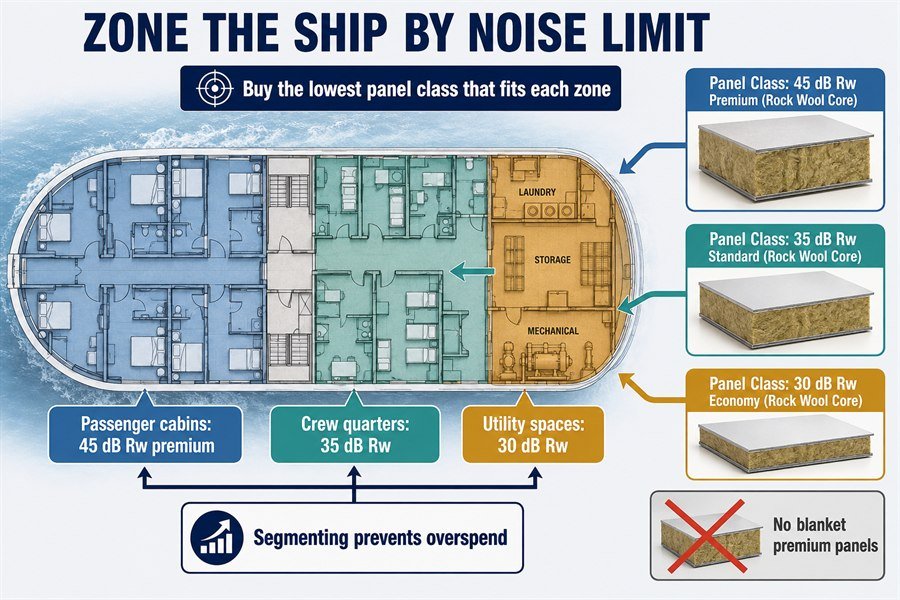
When I review a ship's general arrangement plan, I always separate the rooms into different acoustic zones. If you treat the whole ship as one zone, you will waste a lot of money. You must define the requirements based on the three distinct zones I just mentioned.
Defining Panel Requirements for High-Comfort Passenger Cabins
The first zone includes high-comfort passenger cabins. Shipowners want passengers to sleep perfectly. IMO regulations usually limit passenger cabin noise to 45 dB(A) or 50 dB(A). Because these cabins sit next to busy corridors or entertainment spaces, the walls need maximum sound blocking. For this zone, you must define the panel requirement at 45 dB Rw or higher8. You will need to purchase Ultra-High Acoustic panels. These will cost around $50 to $60 per square meter. Because they are expensive, you must carefully calculate exactly how many square meters you need for just this zone. Do not buy one extra panel of this type if it is not going into a passenger area. This strict control keeps your costs down.
Defining Panel Requirements for Crew Quarters and Utility Spaces
The second and third zones allow you to save money. The second zone is the standard crew quarters. IMO regulations allow a slightly higher noise limit here, typically 60 dB(A). Therefore, the panels separating crew cabins from normal corridors do not need extreme ratings. You can define this requirement at 35 dB Rw. High Acoustic panels with a simple steel insert work perfectly here, costing only about $30 to $35 per square meter. The third zone includes utility spaces, storage rooms, and workshops. These areas often have limits of 75 dB(A) to 85 dB(A). For this zone, you define the requirement at the basic 30 dB Rw level. You can use standard $18 to $22 per square meter panels. By segmenting the ship into these three zones, you buy exactly what you need. You avoid paying $50 per square meter for a storage room wall.
| Ship Zone Category | Typical IMO Noise Limit | Required Panel Rw | Panel Class to Purchase | Cost Estimate ($/m2) |
|---|---|---|---|---|
| High-Comfort Passenger Cabins | 45 - 50 dB(A) | 45+ dB | Ultra-High Acoustic | $50 - $60 |
| Standard Crew Quarters | 60 dB(A) | 35 - 38 dB | High Acoustic | $30 - $35 |
| Utility & Storage Spaces | 75 - 85 dB(A) | 30 - 32 dB | Standard Acoustic | $18 - $22 |
How to Avoid Over-Specifying Marine Panel Acoustics Beyond Cabin Noise Limits?
Ordering high-acoustic panels for every room feels safe, but it drastically inflates your material costs and adds unnecessary weight to the ship.
You can avoid over-specifying marine panel acoustics by executing three strategies: cross-referencing exact IMO noise limits for each room type, utilizing the existing steel bulkhead sound reduction (which provides ~35 dB natively), and selecting standard B-15 panels for non-critical partitions instead of paying for premium acoustic upgrades.
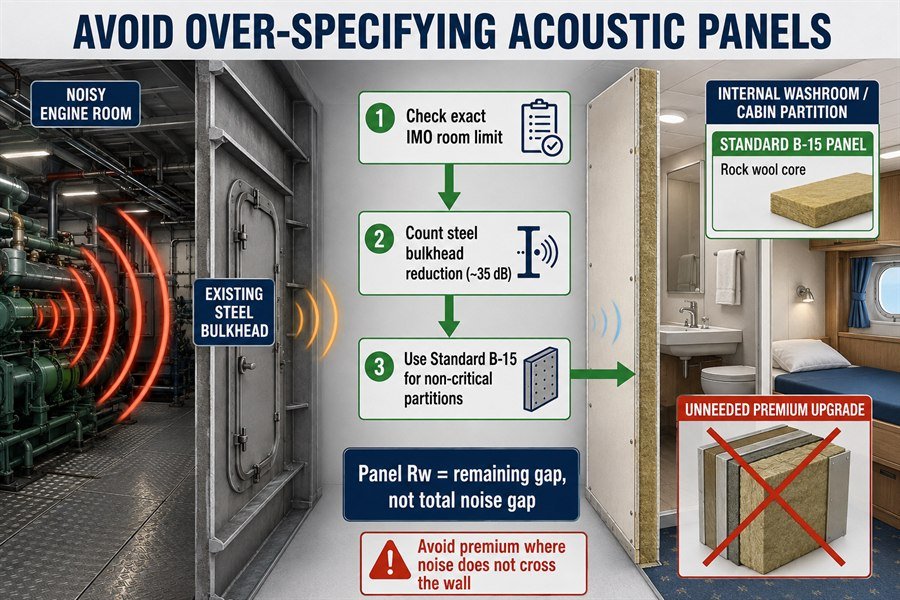
Over-specifying is a common mistake for buyers who lack technical expertise. They see a strict noise limit and panic. They buy the thickest, heaviest panel for every wall. At Magellan Marine, I always teach clients to use three specific strategies to buy the right panel without spending extra money.
Cross-Referencing IMO Noise Limits and Leveraging Steel Bulkheads
The first strategy is cross-referencing the exact IMO MSC.337(91) noise limits for every single room9. Never assume two rooms have the same target. Write the exact limit on your building plan. The second strategy is the most important: you must utilize the sound reduction of the ship's existing steel structure. Many buyers forget this. The ship is made of steel. A bare 6mm or 8mm steel bulkhead natively blocks about 35 dB of sound all by itself. If you have an engine room at 105 dB(A) and a cabin at 60 dB(A) next to it, the total difference is 45 dB. If a solid steel wall already stands between them, that steel wall blocks 35 dB. Your marine interior panel only needs to block the remaining 10 dB. You do not need to buy a 45 dB Rw Ultra-High panel. You just buy a standard panel. Understanding the steel structure saves you massive amounts of money.
Selecting Standard B-15 Panels for Non-Critical Partitions
The third strategy involves selecting standard B-15 panels10 for non-critical interior partitions. When building the inside of a cabin, you have to build the washroom unit walls. The washroom is inside the cabin. There is no loud engine next to it. The only noise comes from the shower. Therefore, you do not need any special acoustic upgrades for these dividing walls. You must specify standard B-15 panels for these internal partitions. A standard panel costs around $20 per square meter. A premium acoustic panel costs over $45 per square meter. If a ship has 500 cabins, and each cabin has 15 square meters of internal partition walls, choosing the standard panel saves you $187,500. You must only pay for acoustic performance where the noise actually crosses the wall.
| Strategy to Avoid Over-Specifying | Action Required | Cost Saving Impact | Weight Saving Impact |
|---|---|---|---|
| Cross-Reference IMO Limits | Match exact room targets to panel Rw | Prevents blanket premium upgrades | Avoids heavy 100mm panels everywhere |
| Leverage Steel Bulkheads | Subtract 35 dB for existing steel walls | Drops panel requirement by 1 to 2 classes | Saves up to 10 kg/m2 on lining panels |
| Select Standard B-15 Partitions | Use basic panels for internal washrooms | Saves ~$25 per square meter | Keeps internal cabin weight very low |
Conclusion
Translating noise specs into panel requirements controls your budget and ensures compliance. By matching the required Rw, segmenting room zones, and avoiding over-specification, you purchase exactly what the ship needs without wasting money.
-
"Analysis between weighted sound reduction index according to ISO ...", https://www.academia.edu/21437199/Analysis_between_weighted_sound_reduction_index_according_to_ISO_717_1_and_indices_according_to_ISO_16717_1. Architectural acoustics references describe airborne sound insulation as the level difference between source and receiving rooms, with single-number ratings such as Rw used to characterize partitions; this supports the subtraction method as a preliminary sizing approach, while actual cabin levels also depend on spectrum, absorption, leakage, and flanking transmission. Evidence role: mechanism; source type: education. Supports: A preliminary panel Rw requirement can be estimated by taking the adjacent-room noise level minus the target cabin noise level. Scope note: Contextual support only; Rw is a laboratory-weighted index and does not by itself guarantee an in-situ A-weighted cabin level. ↩
-
"Occupational Noise Exposure - Overview - OSHA", https://www.osha.gov/noise. Measurements reported in shipboard noise studies show machinery-space noise levels commonly falling in the mid-80 dB(A) range or higher, providing contextual support for using 85 dB(A) as a representative machinery-room design assumption. Evidence role: statistic; source type: paper. Supports: Standard machinery rooms generate about 85 dB(A) of noise. Scope note: Measured machinery-space levels vary substantially by vessel, equipment load, distance from sources, and acoustic treatment, so 85 dB(A) should be treated as an illustrative value rather than a universal standard. ↩
-
"How to choose the right marine wall panels for marine interior ...", https://magellanmarinetech.com/how-choose-right-marine-wall-panels-for-marine-interior-projects/. Acoustic test data for specific 50 mm marine sandwich or fire-rated partition panels report weighted sound reduction indices near 30 dB, supporting the order-of-magnitude assumption for comparable tested constructions. Evidence role: general_support; source type: institution. Supports: A standard 50 mm B-15 marine panel can provide about 30 dB of sound reduction. Scope note: B-15 is a fire classification, not an acoustic rating; the 30 dB value must be verified for the exact panel assembly and installation details. ↩
-
"Physical influences on seafarers are different during their voyage ... - PMC", https://pmc.ncbi.nlm.nih.gov/articles/PMC7141673/. Occupational and marine-engine noise studies document sound levels around or above 105 dB(A) near large diesel engines and in engine-room environments, supporting the claim that such levels are plausible for main-engine spaces. Evidence role: statistic; source type: paper. Supports: Large diesel engines can produce noise levels of about 105 dB(A). Scope note: The cited levels generally describe measurements near operating engines or within engine rooms and may not represent the average level throughout every main engine room. ↩
-
"[PDF] Ultrasonic, Normal-Incidence Insertion Loss through Common ...", https://physics.byu.edu/docs/thesis/269. Standard architectural-acoustics treatments of the mass law state that, for a limp or homogeneous barrier, airborne sound transmission loss generally increases as surface mass increases, providing the physical basis for using heavier panel constructions to improve sound insulation. Evidence role: mechanism; source type: education. Supports: Increasing panel mass can reduce vibration transmission and improve airborne sound insulation. Scope note: The mass law is a simplified model; real sandwich marine panels also depend on stiffness, damping, joints, and installation details. ↩
-
"How to choose the right marine wall panels for marine interior projects?", https://magellanmarinetech.com/how-choose-right-marine-wall-panels-for-marine-interior-projects/. Published specifications or approval documentation for mineral-wool-cored marine accommodation panels can be used to show that 50 mm panels are commonly tested with weighted sound reduction values in the low-30 dB range. Evidence role: general_support; source type: institution. Supports: A 50 mm rockwool-core marine panel typically provides about 30-32 dB of airborne sound reduction. Scope note: Such values are product- and test-configuration-specific, so they support the claim as a typical range rather than as a universal standard. ↩
-
"Airborne sound insulation performance of lightweight double ...", https://pmc.ncbi.nlm.nih.gov/articles/PMC11666719/. Laboratory studies and technical guidance on porous/mineral-wool sandwich constructions report that increasing absorber or core thickness can improve low-frequency acoustic performance and transmission loss, supporting the use of thicker cores when higher sound insulation is required. Evidence role: mechanism; source type: paper. Supports: Moving from a 50 mm to a 100 mm rockwool core is a plausible structural upgrade for meeting stricter sound-reduction requirements. Scope note: The source would support the acoustic mechanism and design direction, not prove that every 100 mm marine panel reaches a specific Rw value without testing. ↩
-
"How to Match a Marine Accommodation Panel System to the ...", https://magellanmarinetech.com/how-match-marine-accommodation-panel-system-to-the-correct-noise-path/. Standards and technical references on airborne sound insulation define weighted sound reduction index, Rw, as a laboratory rating for partition sound insulation and provide context for specifying higher-rated partitions in noise-sensitive accommodation spaces. Evidence role: definition; source type: research. Supports: High-comfort passenger cabin partitions should be specified at 45 dB Rw or higher. Scope note: Such sources explain the Rw metric and its relevance but may not directly prove that 45 dB Rw is mandatory for every passenger-cabin application. ↩
-
"Physical influences on seafarers are different during their voyage ...", https://pmc.ncbi.nlm.nih.gov/articles/PMC7141673/. IMO Resolution MSC.337(91), the Code on Noise Levels on Board Ships, sets maximum A-weighted noise levels by shipboard space type, including accommodation, service, navigation, and machinery spaces. Evidence role: definition; source type: institution. Supports: IMO MSC.337(91) provides room-specific shipboard noise limits that should be checked rather than assumed. Scope note: The source supports the existence of room-type limits, but project-specific limits may also depend on vessel class, flag-state implementation, and contractual specifications. ↩
-
"What Do A-Class, B-Class, and C-Class Divisions Mean in Marine ...", https://magellanmarinetech.com/what-a-class-b-class-c-class-divisions-mean-in-marine-wall-ceiling-panels/. SOLAS and the IMO Fire Test Procedures framework define B-class divisions, including B-15, by fire-resistance and construction criteria for shipboard divisions; this establishes the fire-safety meaning of the panel class rather than its acoustic adequacy. Evidence role: definition; source type: institution. Supports: B-15 panels are a recognized shipboard division class, making the specification meaningful for internal partitions. Scope note: The source defines the B-15 classification but does not by itself prove that a B-15 panel is acoustically sufficient for all non-critical cabin partitions. ↩