Are your ship interior projects facing delays from failed fire safety checks? Rejected materials cost you time and money. Let us see how the IMO FTP Code solves this problem.
The IMO FTP Code, or International Code for Application of Fire Test Procedures, provides international standards for laboratory testing, type approval, and fire test procedures. It strictly regulates marine products, including non-combustible materials, fire doors, wall panels, and ceiling linings, to ensure passenger and crew safety against fire hazards.
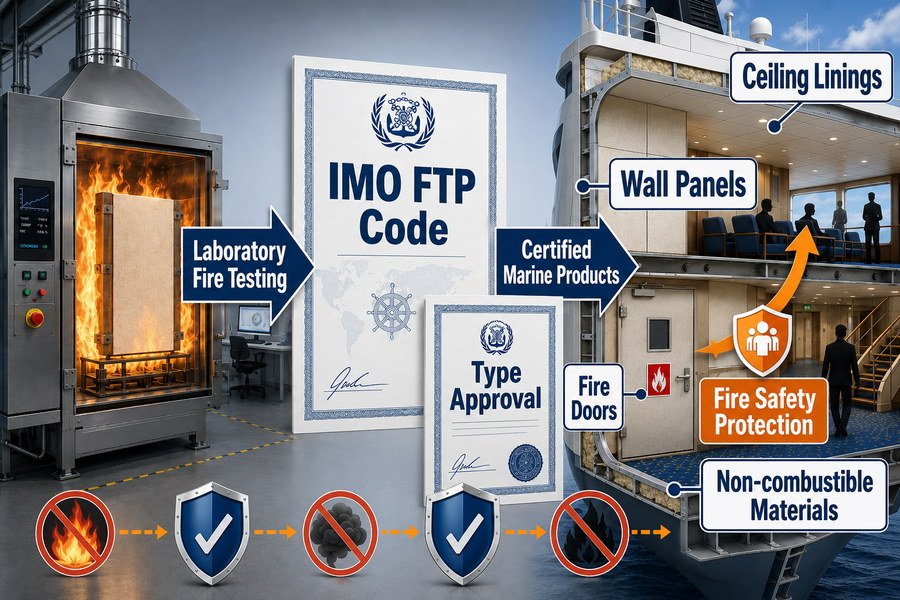
Understanding these rules can feel like reading a foreign language. However, missing a small detail might mean replacing an entire cabin's wall panels. Let us break down exactly what you need to know to buy the right materials the first time.
What Fire Safety Objectives Does the IMO FTP Code Aim to Achieve?
Do fires on ships keep you awake at night? A small spark in a cabin can turn into a disaster. The IMO FTP Code objectives prevent this exact nightmare.
The IMO FTP Code aims to achieve four primary fire safety objectives: preventing fire occurrence, restricting flame spread, containing fires within specific zones (like A-Class or B-Class bulkheads), and limiting toxic smoke emission. This holistic approach ensures sufficient time for safe evacuation and effective firefighting on board.
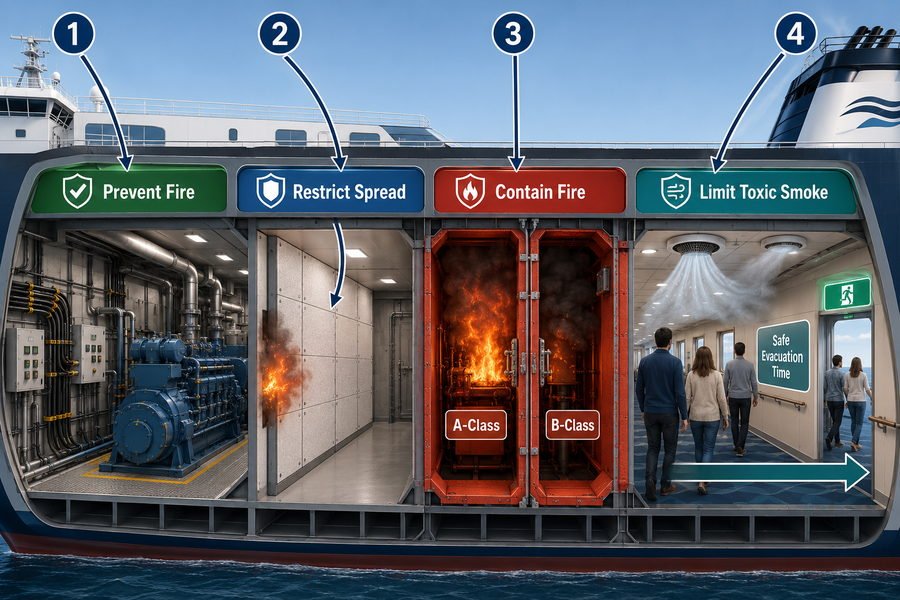
I remember a time when a client bought cheap panels that caught fire during a simple welding test in the shipyard. It was a costly mistake. The IMO FTP Code sets rules to stop this. Let us look at the first two goals: preventing fire occurrence and restricting flame spread.
Preventing Fire Occurrence and Restricting Flame Spread on Ships
According to the SOLAS Convention Chapter II-2, materials used in ship interiors must not easily ignite. For example, primary deck coverings must not ignite when exposed to a radiant heat of 5.0 kW/m² for at least 15 minutes1, as required by IMO FTP Code Part 5. This stops small accidents from starting a fire. Next is restricting flame spread. If a fire starts, it must move very slowly across the surface. Wall and ceiling panels must have low flame-spread characteristics. During testing under Part 5, the critical heat flux at extinguishment (CFE) must be greater than or equal to 20.0 kW/m² for bulkhead materials2. If the flame moves too fast, the material fails the test.
Containing Fires and Limiting Toxic Smoke Emission During Evacuation
Now let us look at containing fires and limiting toxic smoke. Containing fires means keeping the fire trapped in one single room. This is done using fire doors and bulkheads. An A-60 class bulkhead, defined by the IMO, must stop smoke and flame for a full 60 minutes3. Furthermore, the temperature on the safe, unexposed side must not rise more than 140°C above the starting room temperature. If it fails, the heat will start a fire in the next room. Finally, limiting toxic smoke is vital. More people on ships are hurt by smoke than by actual flames4. IMO FTP Code Part 2 tests for smoke and toxicity. For example, the maximum average rate of heat emission (MARHE) must not exceed 90 kW/m² for wall linings. During tests, the carbon monoxide (CO) gas limit must stay below 1450 ppm.
| Fire Safety Objective | IMO FTP Code Reference | Specific Value or Criteria |
|---|---|---|
| Preventing Fire Occurrence | Part 5 (Deck Coverings) | Withstand 5.0 kW/m² radiant heat for 15 mins without ignition. |
| Restricting Flame Spread | Part 5 (Surface Flammability) | Critical heat flux at extinguishment (CFE) ≥ 20.0 kW/m². |
| Containing Fires | Part 3 (A-60 Bulkheads) | Block fire for 60 mins; unexposed temp rise ≤ 140°C. |
| Limiting Toxic Smoke | Part 2 (Smoke and Toxicity) | Carbon monoxide (CO) emission ≤ 1450 ppm during tests. |
Which Marine Interior Materials Fall Under the IMO FTP Code Scope?
Are you unsure if your purchased panels need IMO certification? Buying uncertified products causes huge financial losses when shipyards reject them. The Code clearly lists what materials need testing.
The IMO FTP Code scope comprehensively covers six main material categories: non-combustible materials, fire-restricting materials, structural insulation (A and B Class), surface finishes and floor coverings, textiles and furniture, and bedding components. Procurement officers must ensure all wall panels, ceilings, and fire doors have valid Type Approval Certificates.
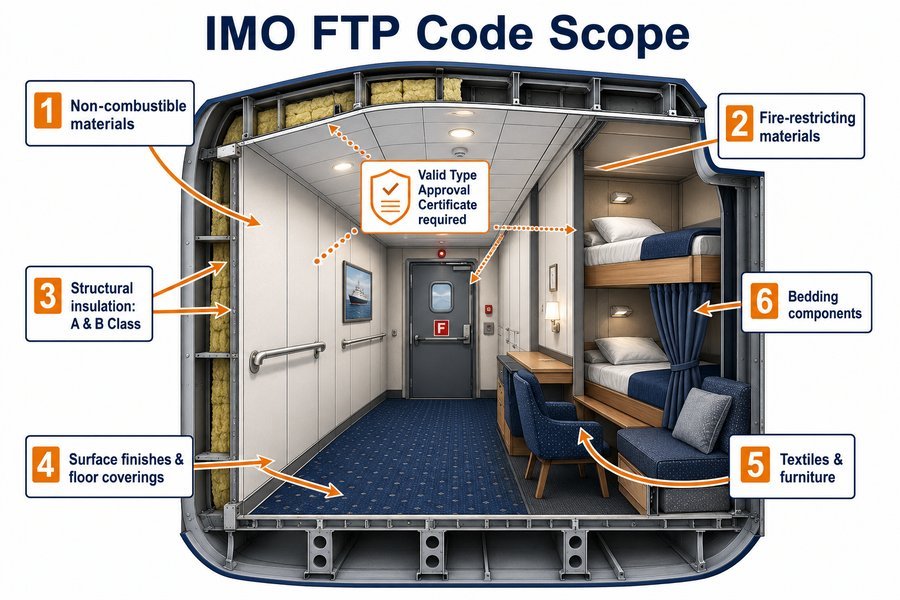
When I worked in the marine outfitting factory, we made sure every single core material was tested before it was glued. The IMO FTP Code scope is very broad. You must know what falls into each bucket. Let us start with the first three structural categories.
Non-Combustible Materials, Fire-Restricting Materials, and Structural Insulation
First, we have non-combustible materials. These form the core of your marine wall panels. Under IMO FTP Code Part 1, a material is non-combustible if it does not burn or give off flammable vapors in a test furnace heated to 750°C for 30 minutes5. The internal temperature rise of the furnace must not exceed 30°C. Second, we have fire-restricting materials. These are lightweight materials often used on high-speed craft and must pass specific heat release tests under Part 106. Third, we have structural insulation. This category includes your A-Class and B-Class fire doors and assembled panels. Tested under Part 3, a B-15 marine wall panel must maintain its structure and stop flames for 30 minutes, keeping the unexposed side temperature rise below 140°C for the first 15 minutes7.
Surface Finishes, Textiles, Furniture, and Bedding Components
Next, let us talk about the last three categories that cover the visible interior. Fourth, surface finishes and floor coverings. This refers to the PVC film or decorative laminate glued to your ceiling panels. They must pass Part 5 for low flame spread. The rules say the calorific value of any combustible material added to a non-combustible base must not exceed 45 MJ/m² for a 2mm thick layer8. Fifth, we evaluate textiles and furniture. If you buy curtains or chairs for a ship, they fall under Parts 7 and 8. Curtains, for example, must not catch fire when exposed to a 40mm propane flame for 15 seconds. Finally, bedding components like mattresses must pass Part 9. A marine mattress must resist ignition from a smoldering cigarette left on it for 1 hour.
| Material Category | IMO FTP Code Part | Primary Testing Standard |
|---|---|---|
| Non-Combustible Materials | Part 1 | Withstand 750°C furnace for 30 minutes. |
| Structural Insulation | Part 3 | Maintain integrity for 30-60 minutes (A or B Class). |
| Surface Finishes | Part 5 | Combustible base value ≤ 45 MJ/m² (for 2mm thick). |
| Textiles and Furniture | Parts 7 & 8 | Resist 40mm propane flame for 15 seconds. |
Does the IMO FTP Code Apply to All Vessel Types or Only SOLAS Ships?
Thinking of using normal building materials on a small boat? Assuming these strict rules only apply to large cruise ships is a dangerous trap. Let us clarify which vessels must follow these rules.
The IMO FTP Code primarily applies to ships subject to the SOLAS Convention, including commercial cargo ships over 500 gross tonnage and all passenger ships. However, it also extends to High-Speed Craft (HSC), Mobile Offshore Drilling Units (MODU), and often serves as a baseline for domestic inland vessel regulations.
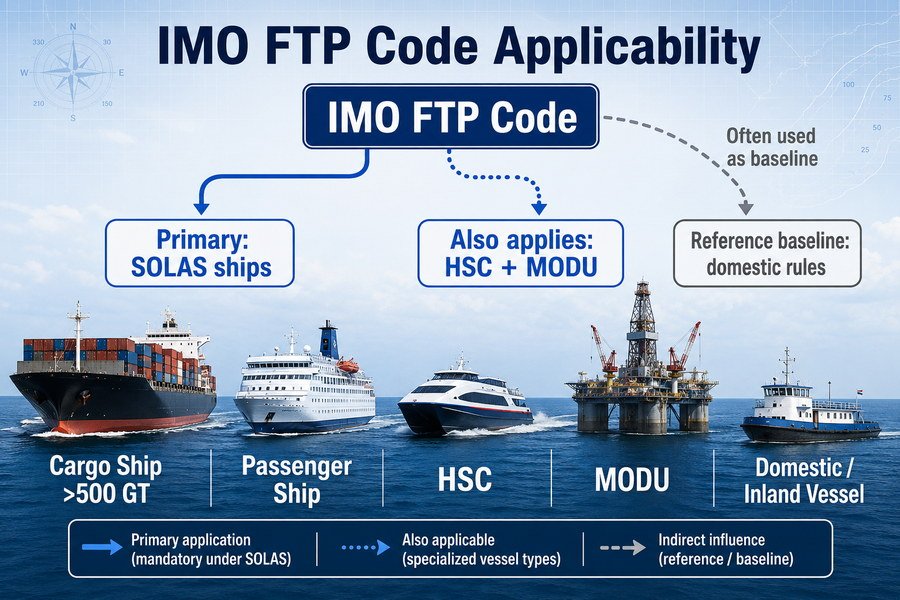
Many clients ask me if they can skip IMO testing for smaller projects to save money. The short answer is usually no. The IMO FTP Code is deeply linked to maritime law. Let us examine the different vessel classifications.
Application to SOLAS Cargo Ships, Passenger Ships, and High-Speed Craft
First, let us look at commercial cargo ships and passenger ships. The International Convention for the Safety of Life at Sea (SOLAS) Chapter II-2 explicitly requires that any cargo ship of 500 gross tonnage (GT) or more must use interior materials tested under the FTP Code9. You cannot use standard house drywall here. For passenger ships, the rules are even stricter. Regardless of their physical size, if a ship carries more than 12 passengers on international voyages, it is legally a passenger ship10. It must strictly use FTP Code approved wall panels and fire doors everywhere. Next, we have High-Speed Craft (HSC). These light, fast boats have their own rules, known as the 2000 HSC Code. However, they still rely heavily on the FTP Code, specifically Part 10 for fire-restricting materials11, to ensure they do not add heavy weight while remaining fire-safe.
Application to Mobile Offshore Drilling Units and Domestic Inland Vessels
Now let us consider other marine structures. Mobile Offshore Drilling Units (MODU) are like massive floating factories. Under the 2009 MODU Code, the interior walls and ceilings in the crew accommodation areas must meet the exact same IMO FTP Code standards as large commercial ships12. For example, the sleeping corridors on an oil rig must be made of B-0 or B-15 class divisions. Finally, what about domestic inland vessels? While SOLAS only strictly governs international waters, many local maritime authorities adopt the IMO FTP Code as their baseline safety standard. Even if a ferry only travels on a local river, the buyer will likely ask you for an IMO Type Approval Certificate to prove the marine ceiling panel is safe.
| Vessel Type | Regulatory Framework | FTP Code Applicability |
|---|---|---|
| Cargo Ships (≥ 500 GT) | SOLAS Chapter II-2 | Mandatory for all structural and interior outfitting. |
| Passenger Ships (> 12 pax) | SOLAS Chapter II-2 | Mandatory, with highest strictness for escape routes. |
| High-Speed Craft (HSC) | 2000 HSC Code | Mandatory, relies heavily on Part 10 (lightweight rules). |
| MODU (Oil Rigs) | 2009 MODU Code | Mandatory for all crew accommodation spaces. |
Are Marine Wall and Ceiling Panels Explicitly Covered by the IMO FTP Code?
Are you confused about which specific tests your panels must pass? Guessing wrong means the shipyard will return your products. Yes, wall and ceiling panels are explicitly covered and tested.
Yes, marine wall and ceiling panels are explicitly covered. They must undergo testing for non-combustibility of core materials (Part 1), fire resistance of the structural division (Part 3 for B-Class or A-Class), low flame spread of surface veneers (Part 5), and low smoke and toxicity emissions (Part 2).
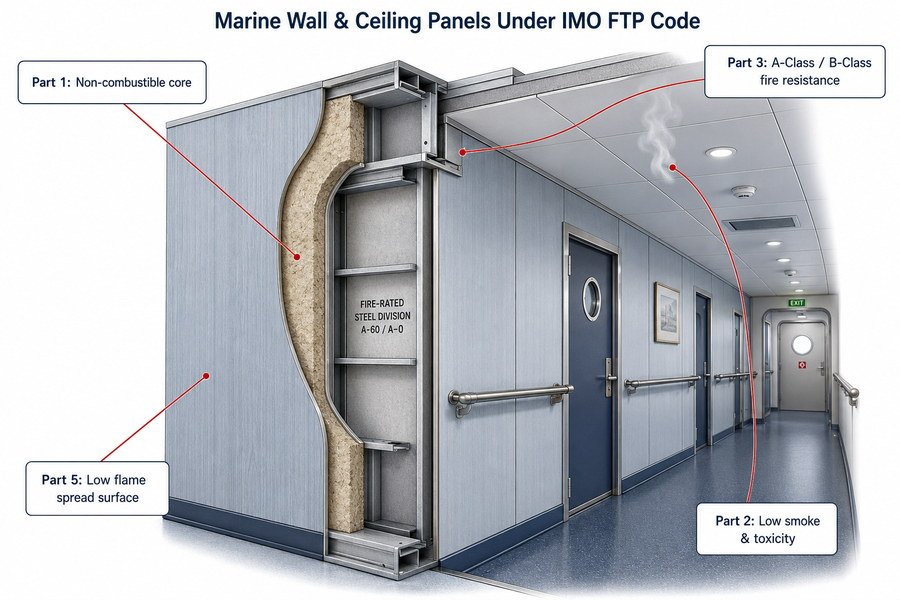
I once helped a client who bought beautiful, cheap wall panels, but the local surveyor rejected them completely. Why? Because only the surface was tested, not the core. Marine wall panels and ceiling panels are highly regulated products. They must pass four distinct tests to be sold legally.
Testing Non-Combustibility and Fire Resistance of Marine Panels
First, let us discuss non-combustibility and fire resistance. The hidden core material inside the panel, usually rock wool or aluminum honeycomb, must pass IMO FTP Code Part 113. The rock wool must have a density of at least 100 to 120 kg/m³14. This high density provides proper insulation and ensures the material remains non-combustible at 750°C. Next, the entire assembled panel must pass Part 3 for fire resistance. The factory puts the whole panel into a furnace. If you are selling a B-15 marine wall panel, the test requires exposing the 50mm thick panel to a standard fire curve that reaches 842°C at 30 minutes15. The panel must not break or collapse, and the unexposed side must not exceed a 140°C average temperature rise for the first 15 minutes of the test.
Evaluating Low Flame Spread, Smoke, and Toxicity of Panel Surfaces
Second, we must evaluate the decorative surface finishes. The PVC film or painted metal coating on your ceiling panels cannot spread fire easily. This falls under Part 5. During the test, the surface veneer (typically 0.15mm to 0.6mm thick PVC film) is exposed to a radiant heat panel. The flame must not spread quickly across the board, and the heat released must be very low. Finally, we look at smoke and toxicity under Part 2. When the surface film eventually burns, it must not release deadly gases into the cabin. The IMO rules state that the maximum concentration of Hydrogen Chloride (HCl) must not exceed 600 ppm, and Hydrogen Cyanide (HCN) must not exceed 140 ppm16. If your panels pass all four of these parts, you have a solid product.
| IMO FTP Code Part | Testing Focus | Standard Panel Requirement |
|---|---|---|
| Part 1 | Core Material | Core remains non-combustible at 750°C. |
| Part 3 | Total Assembly | B-15 panel survives 842°C fire curve for 30 mins. |
| Part 5 | Surface Veneer | PVC film limits flame spread speed and heat release. |
| Part 2 | Gas Emissions | HCl gas ≤ 600 ppm; HCN gas ≤ 140 ppm. |
Does the IMO FTP Code Regulate Both Bulkhead Linings and Ceiling Linings?
Do ceiling linings need the exact same fire rating as wall panels? Treating them the same can lead to overpaying or failing inspections. Let us compare the specific rules for both.
Yes, the IMO FTP Code regulates both. While both require non-combustible cores (Part 1) and low flame-spread surfaces (Part 5), bulkhead linings often face stricter B-Class fire resistance tests (Part 3) to prevent room-to-room fire spread, whereas ceiling linings focus more on preventing flame spread across the overhead space.
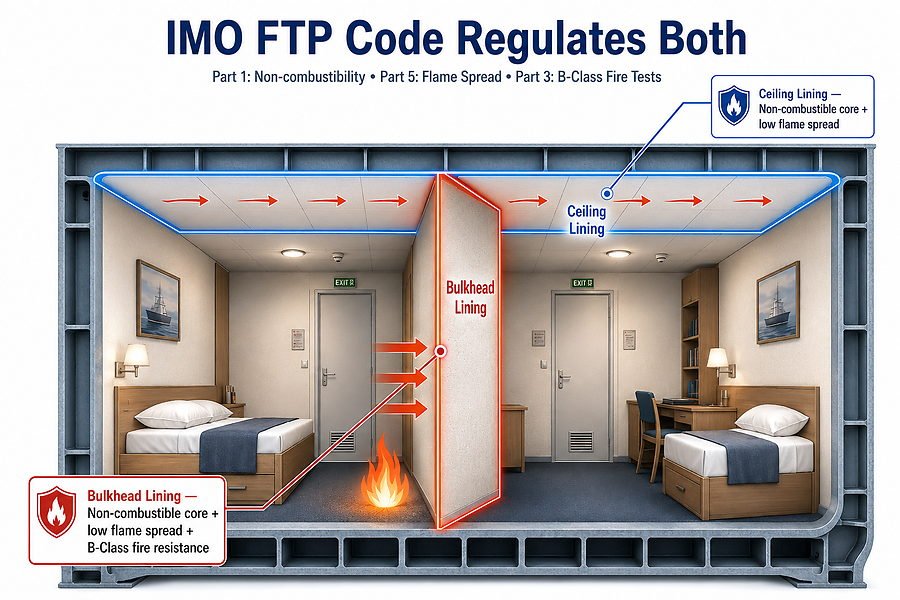
As an outfitting specialist, I often see buyers over-specify their ceiling panels, wasting thousands of dollars on their budget. Yes, the IMO FTP Code regulates both bulkhead (wall) linings and ceiling linings, but their main jobs during a fire are slightly different.
Fire Resistance Requirements for Bulkhead Linings
Let us start with bulkhead linings. Bulkheads are vertical walls that separate cabins and public corridors. Their main job is to stop a fire from moving from one room to another. Because of this, they face very strict fire resistance tests under Part 317. A standard marine wall panel acting as a B-15 bulkhead must have continuous structural integrity. For instance, the steel sheet used on the surface is usually 0.5mm or 0.6mm thick galvanized steel. During the fire test, the connecting joints between the wall panels are heavily tested to ensure no flames pass through the cracks for a full 30 minutes18. Both the core material (under Part 1) and the decorative surface (under Part 5)19 must be certified. You cannot cut corners on bulkhead panels.
Overhead Flame Spread Rules for Marine Ceiling Linings
Now let us examine marine ceiling linings. Ceilings are horizontal. Fire naturally travels upward, so a fire will hit the ceiling fast and try to run along the surface across the entire room. Therefore, while ceilings still need non-combustible cores, the critical regulatory focus is on overhead flame spread under Part 5. Ceiling panels are often lighter than wall panels, sometimes using 0.5mm thick aluminum instead of steel to save weight on the ship. According to SOLAS Chapter II-2 Regulation 5, the total volume of combustible facings, mouldings, and decorations in any ceiling space must not exceed a volume equivalent to a 2.5mm thick veneer20. Ceiling linings must also be installed so they do not collapse quickly, blocking the crew's escape routes. You must check the certificate to ensure the product is approved for use as a "ceiling" and not just a "bulkhead."
| Feature Comparison | Bulkhead Linings (Walls) | Ceiling Linings (Overhead) |
|---|---|---|
| Primary Fire Goal | Stop fire moving room-to-room. | Stop fire spreading across the room. |
| Structural Material | Typically 0.5mm-0.6mm galvanized steel. | Often 0.5mm aluminum (lighter weight). |
| Key FTP Code Part | High focus on Part 3 (Fire Resistance). | High focus on Part 5 (Flame Spread). |
| Combustible Volume | Subject to room fuel load limits. | Must not exceed equivalent of 2.5mm veneer. |
What Ship Areas Require IMO FTP Code-Compliant Panels?
Are you buying expensive fire-rated panels for every single room? You might be wasting money. Different ship areas have different fire risks and need different grades of compliant panels.
IMO FTP Code-compliant panels are required in all enclosed spaces. High-risk areas like engine rooms and galleys require A-Class divisions (A-60). Accommodation spaces, like cabins and corridors, strictly require B-Class divisions (B-15). Even low-risk sanitary spaces require C-Class divisions built from approved non-combustible materials to ensure total vessel safety.
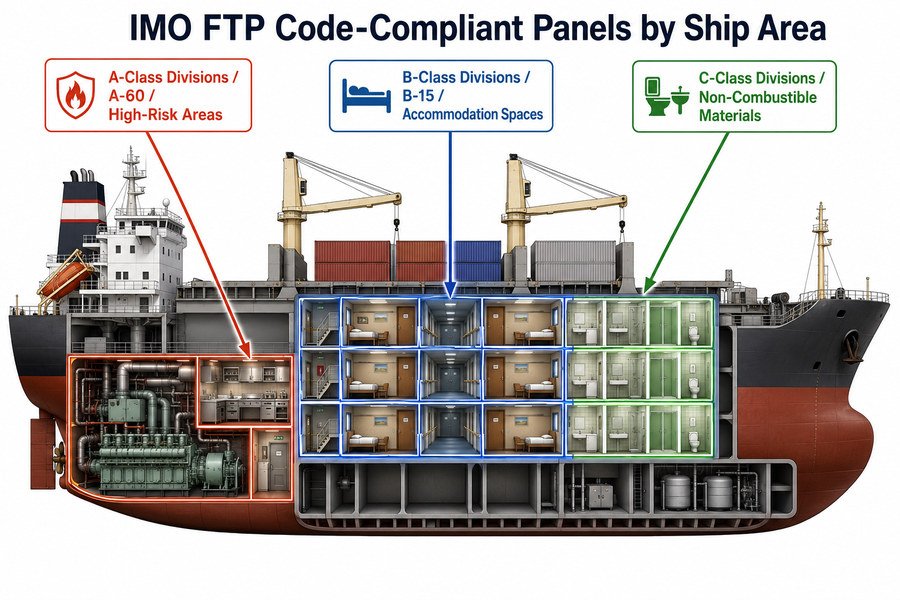
When quoting a ship interior project, you need to know exactly where the panels will go. Using an expensive A-60 marine wall panel inside a simple bathroom is a massive waste of your purchasing budget. Let us break down the ship areas based on the IMO FTP Code fire risk rules.
High-Risk Machinery Spaces, Galleys, and Accommodation Areas
First, let us look at high-risk machinery spaces, galleys, and accommodation areas. Machinery spaces (engine rooms) and galleys (kitchens) are Category A fire risks.21 The bulkheads separating these hot rooms from passenger cabins must be A-Class divisions, usually A-6022. These walls use heavy steel bulkheads insulated with 50mm to 75mm thick ceramic wool or rock wool with a density of 120 kg/m³, capable of stopping a fire completely for 60 minutes. Moving into accommodation areas, like passenger cabins and crew sleeping quarters, the requirement changes to B-Class divisions. The walls dividing two adjacent cabins are typically B-15 class23. This provides 15 minutes of temperature control. This is enough time for the crew to wake up, grab their gear, and escape.
Requirements for Low-Risk Sanitary Spaces and Corridors
Next, let us talk about corridors and low-risk sanitary spaces. Corridors are the main escape routes. The walls facing the corridor must be at least B-15. Furthermore, the marine fire door installed in this corridor wall must also be B-15 rated to match the wall's integrity perfectly. Finally, we have low-risk sanitary spaces, like small public toilets or the en-suite bathrooms inside the cabins. These wet areas have very few combustible items. Therefore, the IMO rules allow the use of C-Class divisions here. A C-Class marine wall panel24 does not need to meet any specific fire resistance time (like 15 or 60 minutes) or temperature rise limits. However, the materials must still be 100% non-combustible under Part 1 of the FTP Code. Knowing these zones helps you buy exactly what you need without overspending.
| Ship Area | Fire Risk Level | Required Fire Division Class |
|---|---|---|
| Engine Rooms & Galleys | High (Category A) | A-Class (typically A-60). |
| Cabin to Cabin Walls | Medium | B-Class (typically B-15). |
| Escape Corridors | Medium-High | B-Class (walls and fire doors must match). |
| Sanitary Spaces (Toilets) | Low | C-Class (must be non-combustible). |
Conclusion
The IMO FTP Code ensures marine materials save lives. By understanding its strict testing scope and area applications, you can procure safe, compliant panels and avoid costly shipyard delays.
-
"[PDF] RESOLUTION MSC.307(88) (adopted on 3 December 2010 ...", https://wwwcdn.imo.org/localresources/en/KnowledgeCentre/IndexofIMOResolutions/MSCResolutions/MSC.307(88).pdf. The IMO FTP Code test procedures for primary deck coverings provide the applicable radiant-panel ignition criteria used to assess whether shipboard deck-covering materials are sufficiently resistant to ignition. Evidence role: case_reference; source type: institution. Supports: Primary deck coverings must not ignite when exposed to a radiant heat of 5.0 kW/m² for at least 15 minutes under the IMO FTP Code.. Scope note: The source would substantiate the regulatory test criterion, not independently prove that the criterion prevents all small-accident fires. ↩
-
"How Do Marine Panel Surface Finishes Affect Fire Safety ...", https://magellanmarinetech.com/how-marine-panel-surface-finishes-affect-fire-safety-compliance/. The IMO FTP Code surface flammability test specifies critical heat flux at extinguishment as a criterion for evaluating flame spread on bulkhead, wall, and ceiling surface materials. Evidence role: case_reference; source type: institution. Supports: Bulkhead materials are assessed under IMO FTP Code surface flammability requirements using a CFE threshold of at least 20.0 kW/m².. Scope note: The source would verify the testing criterion and material category; it would not by itself establish real-world fire-spread performance in every ship configuration. ↩
-
"[PDF] RESOLUTION MSC.307(88) (adopted on 3 December 2010 ...", https://wwwcdn.imo.org/localresources/en/KnowledgeCentre/IndexofIMOResolutions/MSCResolutions/MSC.307(88).pdf. SOLAS and the IMO FTP Code define A-class divisions as fire-resisting divisions that prevent the passage of smoke and flame for the specified test duration, with A-60 corresponding to a 60-minute rating. Evidence role: definition; source type: institution. Supports: An IMO-defined A-60 class bulkhead must prevent the passage of smoke and flame for 60 minutes in the relevant fire-resistance test.. Scope note: The definition supports the laboratory classification requirement; actual containment also depends on installation quality, penetrations, and door or joint performance. ↩
-
"[PDF] LIST OF INVESTIGATIONS INTO CASUALTIES WHICH HAVE BEEN ...", https://wwwcdn.imo.org/localresources/en/OurWork/IIIS/Documents/Lessons%20learned%20English/s%20III%208.1.pdf. Marine casualty and fire-safety literature commonly identifies smoke inhalation and toxic combustion products as major causes of injury and death in compartment fires, providing context for the emphasis on smoke-control requirements aboard ships. Evidence role: statistic; source type: government. Supports: Smoke exposure causes more harm to people on ships than direct flame contact.. Scope note: The source should be checked for ship-specific casualty data; broader compartment-fire evidence would support the mechanism but only indirectly support the comparative claim for ships. ↩
-
"[PDF] RESOLUTION MSC.307(88) (adopted on 3 December 2010 ...", https://wwwcdn.imo.org/localresources/en/KnowledgeCentre/IndexofIMOResolutions/MSCResolutions/MSC.307(88).pdf. The IMO FTP Code Part 1 non-combustibility test specifies exposure in a furnace at approximately 750°C and evaluates flaming, mass loss, temperature rise, and related criteria for classifying materials as non-combustible. Evidence role: definition; source type: institution. Supports: Under IMO FTP Code Part 1, a material is non-combustible if it does not burn or give off flammable vapors in a test furnace heated to 750°C for 30 minutes.. Scope note: The source should be checked against the current consolidated FTP Code text because acceptance criteria may include additional parameters beyond the simplified wording in the article. ↩
-
"[PDF] RESOLUTION MSC.101(73) (adopted on 5 December 2000 ...", https://wwwcdn.imo.org/localresources/en/KnowledgeCentre/IndexofIMOResolutions/MSCResolutions/MSC.101(73).pdf. The IMO FTP Code Part 10 sets out fire-restricting-materials testing for high-speed craft, including heat-release, smoke, and toxicity-related performance requirements used to assess fire growth potential. Evidence role: definition; source type: institution. Supports: Fire-restricting materials are lightweight materials often used on high-speed craft and must pass specific heat release tests under Part 10.. Scope note: This supports the regulatory context and test category; it does not establish that every lightweight material used on high-speed craft is fire-restricting unless the material is certified under the relevant procedure. ↩
-
"[PDF] RESOLUTION MSC.307(88) (adopted on 3 December 2010 ...", https://wwwcdn.imo.org/localresources/en/KnowledgeCentre/IndexofIMOResolutions/MSCResolutions/MSC.307(88).pdf. IMO fire-test provisions for B-class divisions require an integrity period of 30 minutes and insulation criteria based on limiting the average temperature rise on the unexposed face, with B-15 indicating compliance with the insulation criterion for 15 minutes. Evidence role: definition; source type: institution. Supports: A B-15 marine wall panel must maintain its structure and stop flames for 30 minutes, keeping the unexposed side temperature rise below 140°C for the first 15 minutes.. Scope note: The wording should be aligned with the exact regulatory terms, since the standard commonly distinguishes integrity from insulation and may specify both average and maximum temperature-rise limits. ↩
-
"[PDF] RESOLUTION MSC.307(88) (adopted on 3 December 2010 ...", https://wwwcdn.imo.org/localresources/en/KnowledgeCentre/IndexofIMOResolutions/MSCResolutions/MSC.307(88).pdf. SOLAS and IMO FTP Code provisions on low flame-spread surface materials include limits on the calorific value of combustible veneers or surface materials applied to non-combustible substrates, commonly expressed per unit area for a specified thickness. Evidence role: general_support; source type: institution. Supports: The calorific value of any combustible material added to a non-combustible base must not exceed 45 MJ/m² for a 2mm thick layer.. Scope note: This citation would support the regulatory basis for a calorific-value limit, but the exact 45 MJ/m² value and 2 mm reference should be verified against the applicable edition and material category. ↩
-
"Summary of SOLAS chapter II-2 - International Maritime Organization", https://www.imo.org/en/ourwork/safety/pages/summaryofsolaschapterii-2-default.aspx. IMO SOLAS Chapter II-2 and the International Code for Application of Fire Test Procedures establish fire-safety construction and material-testing requirements for SOLAS cargo ships of 500 gross tonnage and above; the source supports the regulatory basis, though the exact required fire class depends on the space, boundary, and flag-state implementation. Evidence role: general_support; source type: institution. Supports: SOLAS cargo ships of 500 GT or more must use interior materials that satisfy FTP Code fire-testing requirements.. Scope note: The source may not support the phrase “any” for every interior material without reference to the specific ship area and fire-safety table. ↩
-
"Passenger ships - International Maritime Organization", https://www.imo.org/en/OurWork/Safety/Pages/PassengerShips.aspx. SOLAS defines a passenger ship as a ship carrying more than twelve passengers, which supports the article’s classification statement for international SOLAS voyages. Evidence role: definition; source type: institution. Supports: A ship carrying more than 12 passengers on international voyages is classified as a passenger ship under SOLAS.. ↩
-
"[PDF] RESOLUTION MSC.307(88) (adopted on 3 December 2010 ...", https://wwwcdn.imo.org/localresources/en/KnowledgeCentre/IndexofIMOResolutions/MSCResolutions/MSC.307(88).pdf. The IMO FTP Code includes Part 10, which specifies a test for fire-restricting materials used in high-speed craft; this supports the connection between HSC fire-safety requirements and FTP Code testing, although it does not by itself establish every design obligation under the 2000 HSC Code. Evidence role: definition; source type: institution. Supports: High-Speed Craft rules rely on FTP Code Part 10 for fire-restricting materials.. Scope note: This supports the role of FTP Code Part 10, but the full HSC compliance framework also depends on the 2000 HSC Code and vessel category. ↩
-
"[PDF] 2009 MODU Code - International Maritime Organization", https://wwwcdn.imo.org/localresources/en/publications/Documents/Supplements/English/QA810E_supplement_January2024_PQ.pdf. The 2009 IMO MODU Code contains fire-protection requirements for accommodation spaces and references IMO fire-test procedures for materials and divisions; this supports the general claim that MODU accommodation interiors are subject to IMO FTP-based standards, though equivalence to all requirements for commercial ships should be checked against the specific MODU chapter and space classification. Evidence role: general_support; source type: institution. Supports: The 2009 MODU Code applies IMO FTP-based fire-safety standards to crew accommodation interiors on mobile offshore drilling units.. Scope note: The source may support FTP-based fire testing for MODUs but not the stronger phrase “exact same” across all ship types and spaces. ↩
-
"History of SOLAS fire protection requirements", https://www.imo.org/en/OurWork/Safety/Pages/History-of-fire-protection-requirements.aspx. The IMO FTP Code Part 1 sets out the non-combustibility test for materials used in ship construction, including furnace exposure at approximately 750°C as part of the classification procedure. Evidence role: definition; source type: institution. Supports: The hidden core material inside the panel, usually rock wool or aluminum honeycomb, must pass IMO FTP Code Part 1.. ↩
-
"Determination of Thermal Properties of Mineral Wool ... - PMC", https://pmc.ncbi.nlm.nih.gov/articles/PMC10488771/. Technical literature on mineral wool fire insulation reports that higher-density rock wool products are commonly used where thermal insulation and fire performance are required, providing context for the specified density range. Evidence role: general_support; source type: paper. Supports: The rock wool must have a density of at least 100 to 120 kg/m³.. Scope note: This source would support the relationship between mineral wool density and insulation/fire performance, but may not establish 100–120 kg/m³ as a universal IMO-mandated minimum for all marine panels. ↩
-
"Are Marine Fire Divisions the Same as Marine Panel Ratings?", https://magellanmarinetech.com/are-marine-fire-divisions-same-as-marine-panel-ratings/. The IMO FTP Code fire-resistance procedure for divisions uses a standard time-temperature curve; the curve reaches about 842°C at 30 minutes, which is the exposure condition relevant to B-class fire testing. Evidence role: mechanism; source type: institution. Supports: For a B-15 marine wall panel, the test requires exposing the 50mm thick panel to a standard fire curve that reaches 842°C at 30 minutes.. ↩
-
"[PDF] RESOLUTION MSC.307(88) (adopted on 3 December 2010 ...", https://wwwcdn.imo.org/localresources/en/KnowledgeCentre/IndexofIMOResolutions/MSCResolutions/MSC.307(88).pdf. The IMO FTP Code Part 2 smoke and toxicity test specifies maximum gas concentration limits for combustion products, including HCl and HCN, for materials assessed under the code. Evidence role: statistic; source type: institution. Supports: The IMO rules state that the maximum concentration of Hydrogen Chloride (HCl) must not exceed 600 ppm, and Hydrogen Cyanide (HCN) must not exceed 140 ppm.. ↩
-
"[PDF] RESOLUTION MSC.307(88) (adopted on 3 December 2010 ...", https://wwwcdn.imo.org/localresources/en/KnowledgeCentre/IndexofIMOResolutions/MSCResolutions/MSC.307(88).pdf. The FTP Code identifies Part 3 as the fire-resistance test procedure for A, B, and F class divisions, including bulkheads and decks. Evidence role: definition; source type: institution. Supports: Bulkhead linings face fire-resistance testing under FTP Code Part 3.. ↩
-
"[PDF] recommendation for fire test procedures for “a” and “b” class ...", https://wwwcdn.imo.org/localresources/en/KnowledgeCentre/IndexofIMOResolutions/AssemblyDocuments/A.163(ES.IV).pdf. SOLAS defines B-class divisions as divisions constructed to prevent the passage of flame for the first half hour of the standard fire test, which supports the 30-minute integrity requirement for B-class bulkhead assemblies. Evidence role: definition; source type: institution. Supports: The joints in B-class bulkhead panels must prevent flame passage for 30 minutes during testing.. Scope note: This supports the regulatory integrity criterion for B-class divisions generally; it does not by itself verify a particular panel joint design or product certificate. ↩
-
"[PDF] RESOLUTION MSC.307(88) (adopted on 3 December 2010 ...", https://wwwcdn.imo.org/localresources/en/KnowledgeCentre/IndexofIMOResolutions/MSCResolutions/MSC.307(88).pdf. The FTP Code separates non-combustibility testing in Part 1 from surface flammability testing in Part 5, providing regulatory context for requiring evidence for both the core material and exposed decorative surface of marine linings. Evidence role: definition; source type: institution. Supports: Marine lining assemblies may need certification for non-combustible core materials under FTP Code Part 1 and surface flammability under Part 5.. Scope note: This establishes the relevant FTP Code test categories; whether both tests are mandatory depends on the vessel area, product construction, and approval conditions. ↩
-
"[PDF] MSC.13(57) - International Maritime Organization", https://wwwcdn.imo.org/localresources/en/KnowledgeCentre/IndexofIMOResolutions/MSCResolutions/MSC.13(57).pdf. SOLAS Chapter II-2 Regulation 5 limits the total volume of combustible facings, mouldings, decorations, and veneers in specified accommodation and service spaces to a volume equivalent to a 2.5 mm veneer on the combined wall and ceiling area. Evidence role: general_support; source type: institution. Supports: SOLAS imposes a 2.5 mm veneer-equivalent limit on certain combustible facings, mouldings, decorations, and veneers.. Scope note: The SOLAS wording applies to specified spaces bounded by non-combustible bulkheads, ceilings, and linings, not literally to every “ceiling space” in isolation. ↩
-
"[PDF] RESOLUTION A.122(V) adopted on 25 October 1967 ...", https://wwwcdn.imo.org/localresources/en/KnowledgeCentre/IndexofIMOResolutions/AssemblyDocuments/A.122(5).pdf. SOLAS Chapter II-2 defines “machinery spaces of category A” and separately treats galleys as service spaces relevant to structural fire protection tables; this supports the article’s high-risk framing but not the exact wording that galleys are themselves Category A machinery spaces. Evidence role: definition; source type: institution. Supports: Machinery spaces and galleys are treated as high fire-risk spaces in ship fire-protection requirements.. Scope note: The source may distinguish machinery spaces of category A from galleys, so it supports the risk classification context rather than the article’s wording exactly. ↩
-
"[PDF] RESOLUTION A.122(V) adopted on 25 October 1967 ...", https://wwwcdn.imo.org/localresources/en/KnowledgeCentre/IndexofIMOResolutions/AssemblyDocuments/A.122(5).pdf. SOLAS structural fire-protection tables specify A-class fire integrity for many boundaries separating machinery spaces of category A from accommodation spaces, with A-60 required in common passenger-ship arrangements; applicability depends on vessel type and the exact spaces being separated. Evidence role: expert_consensus; source type: institution. Supports: Bulkheads separating high-risk machinery spaces from accommodation areas commonly require A-class fire divisions, often A-60.. Scope note: The required rating varies by ship type, gross tonnage, and space category, so the source supports the general rule but not every possible layout. ↩
-
"[PDF] RESOLUTION MSC.307(88) (adopted on 3 December 2010 ...", https://wwwcdn.imo.org/localresources/en/KnowledgeCentre/IndexofIMOResolutions/MSCResolutions/MSC.307(88).pdf. The IMO FTP Code defines B-class divisions and the B-15 rating by reference to standard fire testing and temperature-rise limits maintained for 15 minutes; this supports the technical meaning of B-15 but does not by itself prove that every cabin-to-cabin wall must use that rating. Evidence role: definition; source type: institution. Supports: B-15 divisions provide a 15-minute fire-resistance/temperature-control performance under the IMO testing framework.. Scope note: The definition supports what B-15 means; the required use of B-15 for cabin partitions must be checked against the applicable SOLAS table and vessel category. ↩
-
"[PDF] RESOLUTION MSC.307(88) (adopted on 3 December 2010 ...", https://wwwcdn.imo.org/localresources/en/KnowledgeCentre/IndexofIMOResolutions/MSCResolutions/MSC.307(88).pdf. The IMO FTP Code and SOLAS terminology describe C-class divisions as constructed of approved non-combustible materials without the same smoke/flame and temperature-rise time criteria applied to A- and B-class divisions; this supports the article’s distinction, subject to the applicable ship-specific fire plan. Evidence role: definition; source type: institution. Supports: C-class marine wall panels are non-combustible divisions without a specified 15- or 60-minute fire-resistance rating.. Scope note: The source defines the class generally; it does not establish that all sanitary spaces on all vessels may use C-class divisions. ↩