You meet standard safety rules, but your panels still fail the project inspection. It is painful to lose money on rejected materials. Let us see why projects demand higher standards.
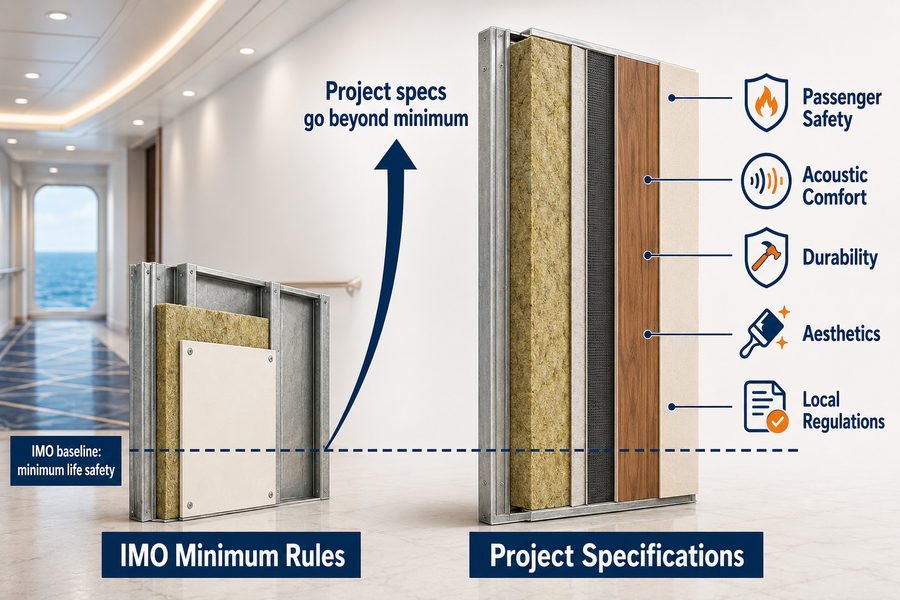
Project specifications exceed IMO rules for marine panels to address five main factors: enhanced passenger safety, superior acoustic comfort, extreme durability requirements, specific aesthetic demands, and localized environmental regulations. IMO provides only the minimum baseline for life safety at sea, not the maximum operational or commercial standard.
I remember a project where we used standard B-15 panels. The shipyard rejected them for poor sound reduction. If you just follow IMO, you might fail the actual project requirements. Let us dig into the details.
Why Do Shipowner Specs for Marine Panels Often Exceed IMO Minimums?
Shipowners face high costs from insurance and crew turnover. Basic rules do not solve these business problems. Upgrading panel specs helps owners save money and keep their crew happy.
Shipowners exceed IMO minimums for marine panels to achieve three goals: lower insurance premiums through enhanced fire ratings (like A-60 over B-15), reduced maintenance costs via thicker steel skins (0.8mm instead of 0.6mm), and better crew retention by improving thermal and acoustic comfort in living quarters.
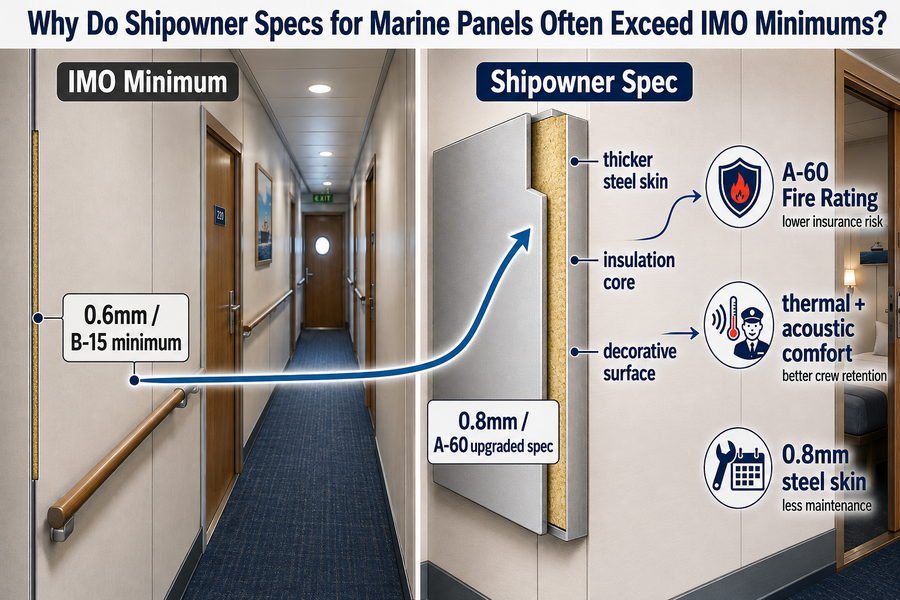
Shipowners look at the long-term cost of a vessel. The IMO only looks at basic safety. As a marine outfitting specialist, I often see shipowners rewrite the rulebook to protect their investment. Let us look at the three specific ways they do this.
Lowering Insurance Premiums with Higher Fire Ratings
IMO regulations might only require a B-15 panel for a standard crew cabin partition. However, shipowners often upgrade these to A-30 or A-60 panels. They do this to get better rates from Protection and Indemnity (P&I) insurance clubs. A standard B-15 rockwool panel costs around $25 per square meter. An A-60 panel costs about $45 per square meter. According to Lloyd's Register guidelines, upgrading fire zones can drop annual insurance premiums by 5% to 10%. Over a 20-year ship lifespan, the owner saves much more money on insurance than they spend on the thicker panels.
Reducing Maintenance Costs with Thicker Steel Skins
IMO does not mandate the thickness of the steel skin on a fire panel1. It only tests how the panel handles fire. The market standard for a galvanized steel skin is 0.6mm. But shipowners know that crew members carry heavy tools and equipment. A 0.6mm panel will dent easily. Shipowners usually specify 0.8mm or 1.0mm steel skins. A 0.6mm panel looks terrible after 5 years. A 0.8mm panel can last 15 years without needing replacement. This reduces long-term repair costs.
Improving Crew Retention via Thermal and Acoustic Comfort
IMO focuses mainly on fire, not noise. A standard B-15 panel has an acoustic rating of about 30 dB. Shipowners want 35 dB to 40 dB to meet ILO MLC 2006 guidelines for crew rest. Quiet cabins help crew sleep better. Happy crews stay with the company longer.
| Goal | IMO Minimum Standard | Typical Shipowner Specification | Added Cost Estimate |
|---|---|---|---|
| Fire Rating | B-15 for basic cabins | A-30 or A-60 | +$20 per square meter |
| Durability | No strict skin thickness | 0.8mm to 1.0mm steel skin | +$8 per square meter |
| Acoustic Comfort | ~30 dB sound reduction | 35 dB to 40 dB reduction | +$15 per square meter |
How Do Cruise Projects Add Custom Rules on Marine Panels Beyond IMO?
Cruise ships sell a luxury vacation experience. Basic fire panels look cheap and transmit too much engine noise. Custom rules fix these commercial flaws to keep passengers happy.
Cruise projects add custom rules on marine panels beyond IMO by mandating four specific upgrades: elevated acoustic reduction (up to 45 dB), specialized decorative finishes (like low-flame-spread PVC laminates), concealed joint profiles for aesthetics, and lightweight core materials (like aluminum honeycomb) to reduce overall vessel draft.
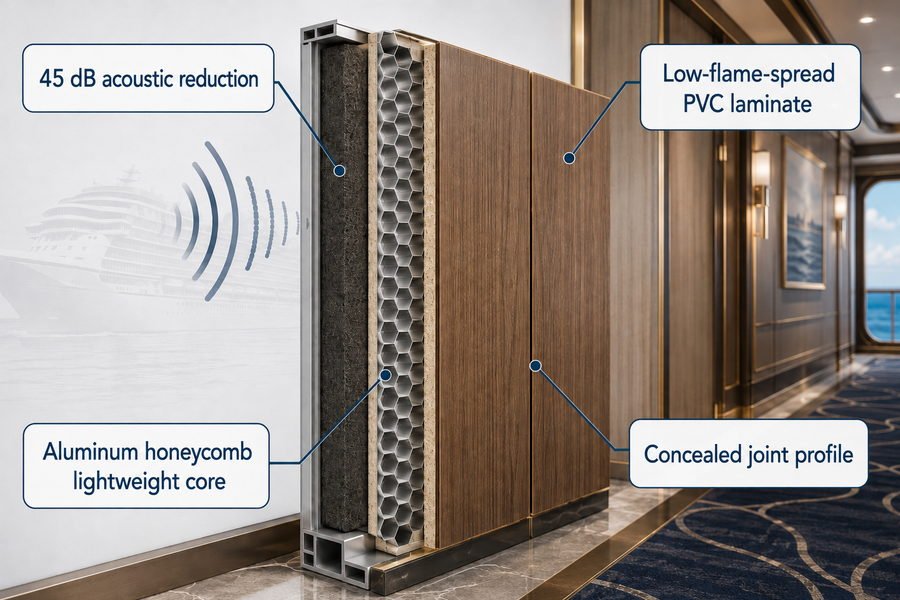
Working on cruise ship interiors is very different from commercial cargo ships. The project managers for cruise ships care about the passenger experience above everything else. IMO rules do not care if a cabin looks pretty or sounds quiet. Here is how cruise projects change the rules.
Meeting Elevated Acoustic Reduction Demands
IMO does not strictly regulate passenger cabin noise. But cruise lines cannot sell tickets if passengers cannot sleep. Cruise specs usually follow DNV Comfort Class rules2. Standard rockwool marine panels offer about 32 dB of sound reduction. Cruise ships demand double-skin panels with air gaps. They also use heavy acoustic rubber membranes inside the panel to hit 44 dB to 45 dB. This stops sound from traveling between cabins.
Applying Specialized Decorative Finishes
IMO only requires the surface to be fire-safe3. Cruise lines require the surface to look like a luxury hotel. They use 150-micron PVC decorative films. These films look like wood or fabric but still pass IMO Part 5 low-flame-spread tests. Standard painted steel is not accepted in passenger areas.
Mandating Concealed Joint Profiles for Aesthetics
A standard marine panel uses an exposed H-profile joint to connect two panels. Cruise ship designers hate exposed metal lines. They reject standard joints and demand flush, concealed joints. The gap tolerance between panels must be less than 2mm. This makes the wall look like one solid, continuous piece.
Utilizing Lightweight Core Materials for Vessel Draft Reduction
A cruise ship has thousands of cabins. A standard rockwool panel weighs 18 kg per square meter. Cruise ships use aluminum honeycomb panels that weigh 8 to 10 kg per square meter. Saving 8 kg per square meter across 100,000 square meters saves 800 tons of weight4. This improves fuel efficiency5 and lets the ship carry more entertainment equipment.
| Custom Upgrade | Standard Marine Panel | Cruise Ship Specification | Primary Benefit |
|---|---|---|---|
| Acoustics | 32 dB reduction | 44 to 45 dB reduction | Passenger sleep quality |
| Finish | Standard white paint | 150-micron PVC film | Luxury aesthetic |
| Joints | Exposed H-profile | Concealed flush joint | Continuous wall look |
| Core Material | Rockwool (18 kg/m2) | Aluminum Honeycomb (9 kg/m2) | Fuel savings |
Warships face bomb threats and extreme system vibrations. Normal commercial marine panels will break apart under combat conditions. Stricter navy standards keep the crew safe and systems running.
Naval vessels require stricter marine panel standards than IMO to ensure three combat-specific capabilities: high shock resistance against underwater explosions (Mil-S-901D), strict electromagnetic interference (EMI) shielding to protect radar systems, and extreme weight reduction using advanced composite materials instead of standard heavy steel rockwool panels.
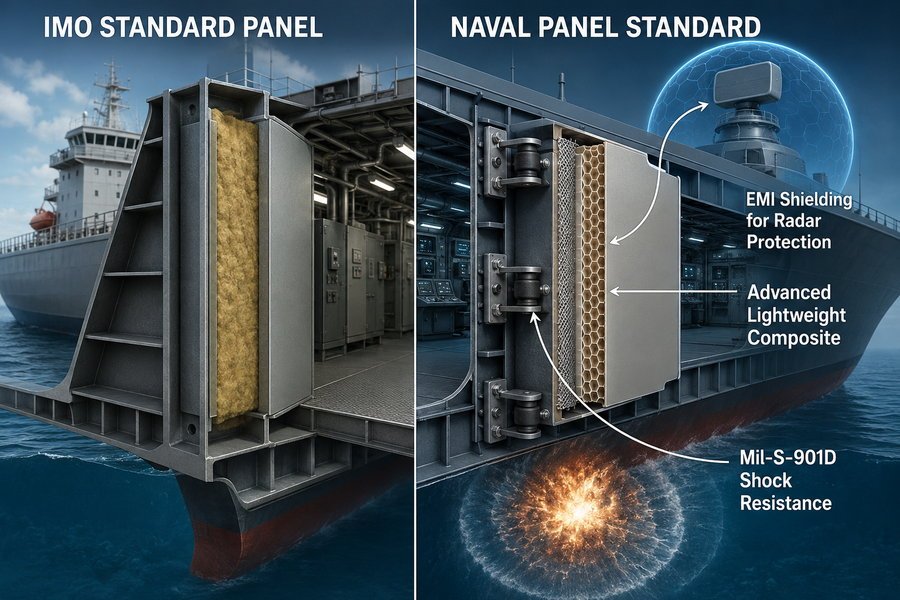
I have helped source materials for government vessels, and their rulebooks are massive. The IMO assumes a ship operates in peace. Naval standards assume the ship will be attacked. You cannot use normal materials here. The testing is brutal and necessary.
Ensuring High Shock Resistance Against Explosions
IMO tests panels by putting them in a static fire furnace. Navies test panels by hitting them with explosives. For example, the US Navy uses the MIL-S-901D shock test standard6. A standard commercial panel joint will snap at 15g of shock force. The heavy steel panels will fall on the crew. Navy panels use reinforced steel framing profiles. They also use shock-absorbing rubber mounting tracks. This allows the wall to flex and withstand 50g impacts without falling apart.
Implementing Strict Electromagnetic Interference (EMI) Shielding
Modern warships use highly sensitive radar and communication systems. Standard marine panels leak radio waves easily. Navy panels must block these signals. They add a copper mesh or a conductive gasket layer inside the panel joints. According to military specs, this provides 60 dB to 80 dB of radio frequency attenuation in the 100 MHz to 10 GHz range7. This stops enemy forces from hacking or jamming the ship's internal networks.
Mandating Extreme Weight Reduction with Composite Materials
Navies want their ships to be fast and carry heavy weapons. Heavy walls slow the ship down. They replace standard steel and rockwool with aluminum honeycomb or composite carbon fiber. A navy-grade lightweight bulkhead panel costs about $120 to $150 per square meter. This is much more than the $30 for commercial rockwool. But it drops the panel weight from 18 kg/m2 to just 6 kg/m2.
| Combat Requirement | Commercial IMO Standard | Naval Specification | Standard Reference |
|---|---|---|---|
| Shock Resistance | Static structural tests | Withstand 50g explosion impact | MIL-S-901D |
| Signal Security | No shielding | 60-80 dB EMI attenuation | MIL-STD-461 |
| Weight Limit | ~18 kg/m2 (Rockwool) | ~6 kg/m2 (Composite/Aluminum) | Project Specific |
How Do Offshore Specs Reshape Marine Panel Compliance Beyond IMO?
Oil rigs operate in harsh, wet, and corrosive places. Standard marine panels rust and fail quickly on a rig. Offshore specs demand heavy-duty materials to prevent disasters.
Offshore specifications reshape marine panel compliance beyond IMO by enforcing three critical enhancements: extreme corrosion resistance using SUS316L stainless steel, higher blast ratings (such as H-120 and H-60) for hydrocarbon fires, and specialized moisture barriers to prevent rockwool degradation in high-humidity oceanic environments.
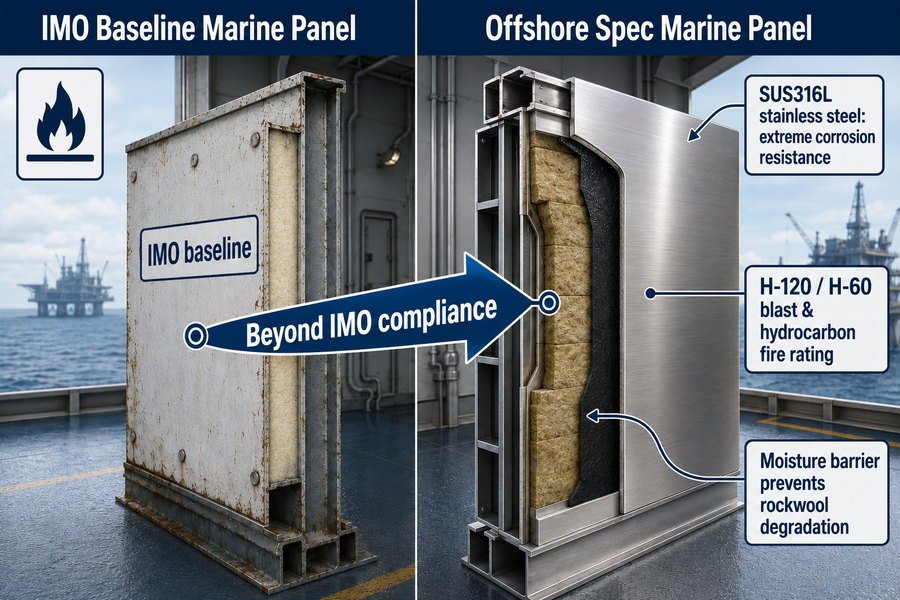
When you supply an offshore oil platform, you must forget standard commercial ship rules. The environment is salty, wet, and highly explosive. An oil fire is much hotter than a normal ship fire. Offshore regulations reflect these extreme dangers. Let us break down the three main changes.
Enforcing Extreme Corrosion Resistance with Stainless Steel
IMO allows panels to use basic galvanized steel. Offshore rigs follow rules like the NORSOK M-501 standard. They require 316L stainless steel skins or heavy marine-grade paint systems (like 300 microns of epoxy coating). A standard galvanized steel panel will start rusting after just two years on an offshore rig. A 316L stainless steel panel will last 20 years.8 The cost jumps from $30 per square meter for galvanized to $90 per square meter for stainless steel, but it is necessary for safety.
Upgrading Blast Ratings for Hydrocarbon Fires
IMO uses A-Class fire ratings. An A-Class fire reaches 927°C in 60 minutes. Offshore rigs handle oil and gas. They use H-Class ratings per DNV-OS-D301 rules. A hydrocarbon fire reaches 1100°C in just 5 minutes.9 Standard rockwool melts. H-120 panels require dense ceramic fiber packing and thicker steel plates to survive this massive heat blast.
Integrating Specialized Moisture Barriers
Standard rockwool absorbs water easily. Offshore platforms are surrounded by ocean spray and high humidity. If rockwool gets wet, it loses its fire-blocking power. Offshore panels use a sealed vapor barrier. This is usually a 50-micron aluminum foil wrap completely sealing the insulation block. This keeps the inside dry and maintains the fire rating.
| Offshore Requirement | IMO Commercial Standard | Offshore Standard | Material Used |
|---|---|---|---|
| Corrosion | Galvanized Steel | NORSOK M-501 | SUS316L Stainless Steel |
| Fire Type | Cellulosic (A-Class) | Hydrocarbon (H-Class) | Ceramic Fiber Packing |
| Humidity | Bare insulation | Vapor sealed | 50-micron aluminum wrap |
Why Do Yacht Builders Demand Marine Panel Standards Above IMO?
Yachts are expensive floating homes for rich buyers. Cheap industrial panels ruin the luxury feel. Builders demand absolute perfection in finish, weight, and sound control.
Yacht builders demand marine panel standards above IMO to guarantee three luxury outcomes: near-zero acoustic transmission (exceeding 50 dB reduction), flawlessly flat surfaces to support high-end veneers like marble or exotic woods, and ultra-lightweight cores to maintain high-speed performance for the owner.
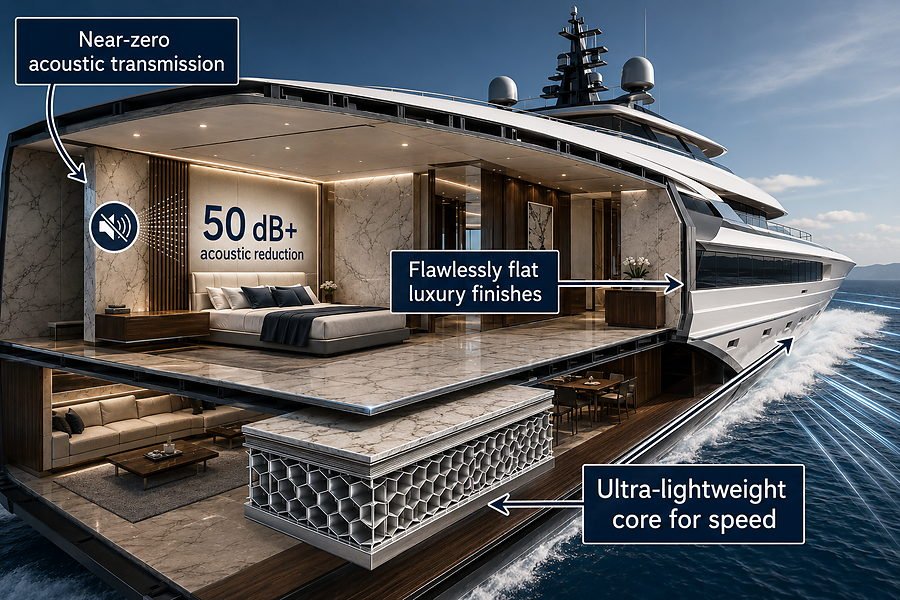
Selling to a yacht builder is very difficult. They have the highest quality standards in the world. The IMO rules are just the starting point for them. The end user is a billionaire who expects perfection. If the panel vibrates or looks wavy, they will return it. Here is what yacht builders actually look for.
Guaranteeing Near-Zero Acoustic Transmission
IMO has no strict cabin noise rules. However, Large Yachts under the LY3 code demand absolute silence. A standard commercial panel blocks 32 dB of noise. This is too loud for a yacht owner sleeping next to the engine room. Yachts use constrained layer damping panels10. These panels use rubber layers between steel plates. They cost around $200 per square meter but achieve 50 to 55 dB of sound reduction.
Providing Flawlessly Flat Surfaces for High-End Veneers
A commercial ship panel has a flatness tolerance of 2mm per meter. Yachts require a tolerance of less than 0.5mm per meter. The shipyard will glue expensive materials to your panel. They use marble, leather, or exotic wood veneers. Some of these woods cost $500 per square meter. If your panel is not perfectly flat, the wood will bubble or crack over time. The panel must be completely smooth.
Supplying Ultra-Lightweight Cores for High-Speed Performance
Yachts need to go fast. Every extra kilo slows the boat down and burns more fuel. Yacht builders reject heavy rockwool. They use Nomex honeycomb or PET foam cores covered in very thin aluminum sheets. This drops the weight to about 4 kg per square meter11.
| Luxury Outcome | Commercial Tolerance | Yacht Tolerance | Solution Used |
|---|---|---|---|
| Acoustic Control | 32 dB | >50 dB | Constrained layer damping |
| Surface Flatness | 2.0 mm per meter | <0.5 mm per meter | High-precision pressing |
| Weight Control | 18 kg per square meter | 4 kg per square meter | Nomex or PET foam cores |
How Can Suppliers Align Marine Panels With IMO and Project Specs?
Selling marine panels means matching rules with what the client really wants. You will lose the job if you only quote basic panels. Here is how you can adapt to win more orders.
Suppliers can align marine panels with IMO and project specs by adopting a three-step strategy: maintaining a modular product line with interchangeable skins and cores, obtaining dual certifications (like MED and USCG) to cover multiple regions, and proactively requesting project-specific acoustic and weight targets during the initial quotation phase.
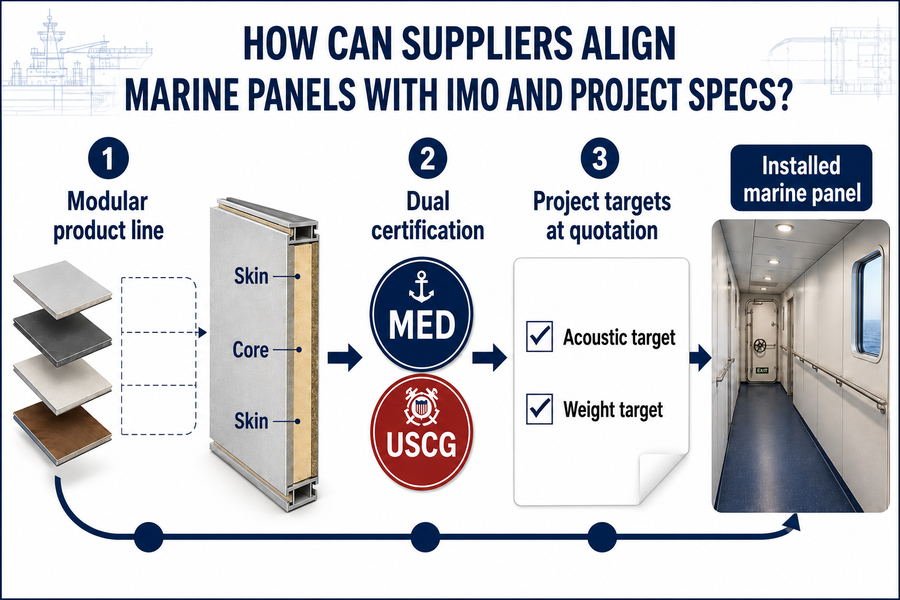
As someone who worked in a marine outfitting factory, I learned that you cannot force one product on every buyer. A procurement officer needs a supplier who understands the project. If you just send a standard catalog, you will fail. You need a smart strategy. Let us review the three steps to align with the market.
Maintaining a Modular Product Line
Do not just sell one type of A-Class panel. You need a base rockwool core, but you must offer options. You should offer skins in 0.6mm PVC-coated steel for commercial ships, 0.8mm painted steel for heavy duty, and 316L stainless steel for offshore. This modular approach lets you build the exact panel the shipyard needs without redesigning your whole factory line.
Obtaining Dual Certifications for Global Reach
IMO is the base rule. But to sell globally, you need local approvals. You need the Marine Equipment Directive (MED) "Wheelmark"12 to sell to European shipyards. You need the United States Coast Guard (USCG) approval for American projects. Getting both costs around $10,000 to $15,000 for a fire test at a lab like DNV or ABS. But having both certificates proves your quality and opens up global markets instantly.
Proactively Requesting Project-Specific Targets
When a buyer asks you for "A-30 panels," do not just quote your cheapest option. Ask them important questions. Ask: "What is your acoustic dB requirement and weight limit13?" This shows the buyer that you understand shipyard needs. It also stops the shipyard from rejecting your goods later because they were too heavy or too loud.
| Strategy Step | Action Required | Result for Supplier |
|---|---|---|
| Modular Products | Offer different skins and cores | Match multiple project types easily |
| Dual Certification | Pay for MED and USCG lab tests | Sell to Europe and America |
| Proactive Quoting | Ask for dB and weight limits | Prevent product rejection |
Conclusion
Project specs exceed IMO rules to ensure better safety, luxury, and durability for specific ship types. By understanding these exact needs, you can provide the marine panels your clients truly want.
-
"What Is the Purpose and Scope of the IMO FTP Code? - Magellan ...", https://magellanmarinetech.com/what-purpose-scope-of-imo-ftp-code/. IMO fire-test standards for marine divisions describe performance-based fire-resistance classifications and test procedures, supporting the point that compliance is assessed by fire performance rather than by a universal prescribed steel-skin thickness. Evidence role: definition; source type: institution. Supports: IMO does not mandate the thickness of the steel skin on a fire panel; it tests how the panel handles fire.. Scope note: The source would support the regulatory framework in general; individual flag states, class rules, or product approvals may still impose construction details in specific cases. ↩
-
"(PDF) NOISE AND VIBRATIONS ON BOARD CRUISE SHIPS", https://www.academia.edu/7913564/NOISE_AND_VIBRATIONS_ON_BOARD_CRUISE_SHIPS_ARE_NEW_STANDARDS_EFFECTIVE. DNV’s Comfort Class notation describes voluntary criteria and measurement procedures for onboard noise and vibration comfort, including passenger-area accommodation spaces, which provides context for why cruise specifications may reference these rules. Evidence role: expert_consensus; source type: institution. Supports: Cruise ship specifications commonly reference DNV Comfort Class rules for passenger comfort, including noise-related requirements.. Scope note: This supports the existence and relevance of DNV Comfort Class criteria, but it does not prove that all or most cruise lines adopt them in every project. ↩
-
"[PDF] RESOLUTION MSC.61(67) (adopted on 5 December 1996 ...", https://wwwcdn.imo.org/localresources/en/KnowledgeCentre/IndexofIMOResolutions/MSCResolutions/MSC.61(67).pdf. The IMO FTP Code includes Part 5 test procedures for surface flammability, supporting the point that regulated interior surface materials are assessed for fire-performance characteristics such as low flame spread. Evidence role: definition; source type: institution. Supports: IMO requirements for interior surface finishes focus on fire-safety performance, including low flame spread under FTP Code Part 5.. Scope note: The source clarifies IMO fire-test requirements for surface materials but does not address cruise-line aesthetic requirements or material acceptance practices. ↩
-
"SI Units | NIST - National Institute of Standards and Technology", https://www.nist.gov/pml/owm/metric-si/si-units. The arithmetic follows directly from multiplying an 8 kg/m² mass reduction by 100,000 m², yielding 800,000 kg, or 800 metric tonnes; this verifies the stated weight-saving calculation. Evidence role: statistic; source type: other. Supports: An 8 kg/m² reduction over 100,000 m² corresponds to an 800-ton total weight reduction.. Scope note: This verifies only the calculation, not whether the assumed panel area or material weights are representative of a specific cruise ship. ↩
-
"Improving the energy efficiency of ships", https://www.imo.org/en/ourwork/environment/pages/improving%20the%20energy%20efficiency%20of%20ships.aspx. Naval-architecture and ship-energy-efficiency literature generally identifies vessel displacement and lightweight design as factors affecting propulsion power demand and fuel consumption, supporting the mechanism that reducing ship weight can improve fuel efficiency. Evidence role: mechanism; source type: paper. Supports: Reducing cruise-ship weight can improve fuel efficiency by lowering displacement-related propulsion energy demand.. Scope note: The support is general; the actual fuel saving depends on hull form, operating profile, speed, loading condition, and machinery efficiency. ↩
-
"MIL-S-901 - Wikipedia", https://en.wikipedia.org/wiki/MIL-S-901. MIL-S-901D defines U.S. Navy high-impact shock testing for shipboard machinery, equipment, systems, and structures, supporting the statement that naval procurement uses this standard for shock qualification. Evidence role: definition; source type: government. Supports: The US Navy uses the MIL-S-901D shock test standard.. Scope note: The standard supports the existence and naval use of the shock-test framework, but it does not by itself verify the article’s later quantitative 50g panel-performance claim. ↩
-
"Low Cost Embedded Copper Mesh Based on Cracked ... - PMC", https://pmc.ncbi.nlm.nih.gov/articles/PMC8879047/. Studies of electromagnetic shielding effectiveness report attenuation in decibels across defined frequency ranges and show that conductive meshes, gaskets, or layered assemblies can achieve attenuation on the order of 60–80 dB under controlled RF test conditions. Evidence role: statistic; source type: paper. Supports: Navy panel joints can provide 60 dB to 80 dB of radio frequency attenuation in the 100 MHz to 10 GHz range.. Scope note: Such evidence would be contextual unless it tests the same naval panel joint design; shielding performance varies with material, seams, grounding, aperture size, and test method. ↩
-
"Atmospheric Corrosion of Different Steel Types in Urban and Marine ...", https://pmc.ncbi.nlm.nih.gov/articles/PMC11679332/. Atmospheric-corrosion classifications such as ISO 9223 identify offshore and marine atmospheres as very high to extreme corrosivity environments and provide zinc corrosion-rate ranges relevant to galvanized steel durability; this supports the general expectation of rapid degradation in offshore exposure, but it does not directly verify the article’s exact two-year and twenty-year service-life figures for specific panel assemblies. Evidence role: general_support; source type: institution. Supports: Galvanized steel panels may corrode quickly in offshore service, while 316L stainless steel is expected to provide substantially longer corrosion resistance.. Scope note: Contextual support only: corrosion-rate standards and marine-material studies support the direction of the claim, but exact service life depends on coating thickness, fabrication details, maintenance, exposure zone, and design. ↩
-
"[PDF] DET NORSKE VERITAS UNITED STATES DEPARTMENT OF THE ...", https://www.bsee.gov/sites/bsee.gov/files/research-guidance-manuals-or-best-practices/fact-sheet/dnvreportvoli1.pdf. Hydrocarbon fire curves used in offshore and petrochemical fire testing rise much more rapidly than the ISO 834 cellulosic building-fire curve, reaching approximately 1,100°C within the first few minutes; this supports the temperature-time contrast, though the exact curve used can vary by standard and test protocol. Evidence role: definition; source type: institution. Supports: Hydrocarbon fire ratings are based on a rapid temperature-rise curve that reaches about 1,100°C within minutes.. Scope note: The source should be used to substantiate the standard hydrocarbon fire curve, not to prove that every offshore incident follows the same temperature profile. ↩
-
"Sound transmission through a damped sandwich panel - ADS", https://ui.adsabs.harvard.edu/abs/1982JSV....80..315N/abstract. A peer-reviewed acoustics source on constrained-layer damping sandwich structures supports that viscoelastic interlayers between stiff facings dissipate vibration energy and can improve sound-transmission loss; it does not by itself verify the article’s stated yacht-specific price or 50–55 dB performance figure. Evidence role: mechanism; source type: paper. Supports: Yachts use constrained layer damping panels with rubber or viscoelastic layers between steel plates to reduce transmitted noise.. Scope note: Supports the acoustic mechanism generally, but not the exact cost or performance values unless the source reports comparable marine panel tests. ↩
-
"[PDF] Performance Evaluation Of Composite Sandwich Structures With ...", https://scholarsmine.mst.edu/context/matsci_eng_facwork/article/4255/viewcontent/Performance_evaluation_of_composite_sandwich_structures_with_additively_manufactured_aluminum_honeycomb_____.pdf. A technical study or materials database on honeycomb or foam-core sandwich panels can document that lightweight cores with thin metallic facings may achieve low areal densities in the range discussed; such evidence is material-specific and should not be read as proving that all yacht panels weigh exactly 4 kg/m². Evidence role: statistic; source type: paper. Supports: Using Nomex honeycomb or PET foam cores with thin aluminum facings can reduce panel weight to approximately 4 kg per square meter.. Scope note: The supported value will depend on facing thickness, core density, resin system, and panel specification. ↩
-
"Directive 96/98/EC - Wikipedia", https://en.wikipedia.org/wiki/Directive_96/98/EC. EU guidance on the Marine Equipment Directive explains that covered marine equipment placed on board EU ships must meet MED conformity-assessment requirements and bear the Wheelmark, supporting the claim that MED approval is relevant for access to EU-regulated shipbuilding and supply chains. Evidence role: historical_context; source type: government. Supports: The MED Wheelmark is needed to sell qualifying marine equipment into European-regulated shipyard projects.. Scope note: This supports the regulatory need for EU-flagged vessels and covered equipment, but it does not prove that every European shipyard purchase requires MED approval. ↩
-
"What Is The Typical Range Of Weight Per Square Meter For Marine ...", https://magellanmarinetech.com/what-is-typical-range-of-weight-per-square-meter-for-marine-wall-panels/. IMO rules and ship-design guidance identify onboard noise limits and vessel weight control as material design constraints, providing contextual support for asking shipyards about acoustic performance and weight before quoting A-class panels. Evidence role: general_support; source type: institution. Supports: Shipyards may require panel suppliers to meet project-specific acoustic and weight targets, so suppliers should ask for those requirements before quoting.. Scope note: The sources would support the relevance of noise and weight constraints generally, not the specific assertion that noncompliant panels will always be rejected by a shipyard. ↩