Are your marine interior panels failing safety inspections? Using non-compliant materials risks rejected projects and costly shipyard delays. Discover how to meet SOLAS standards and keep your projects moving forward safely.
SOLAS Chapter II-2 requires marine wall and ceiling panels to be strictly non-combustible, restrict flame spread, limit smoke toxicity, and maintain structural fire protection classes (A, B, or C class) depending on the space they divide, ensuring full passenger safety and vessel integrity.
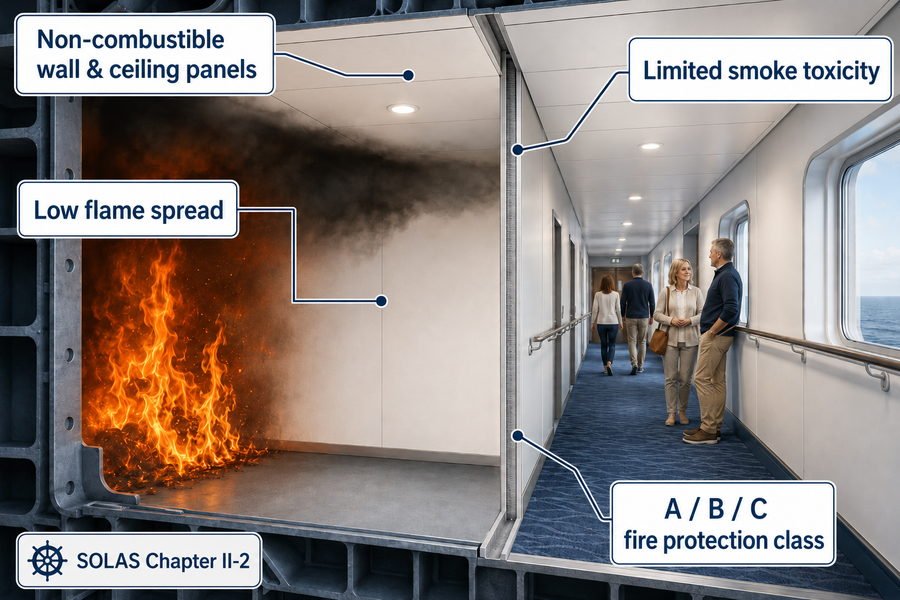
Let us look closer at these regulations. Understanding these rules will help you avoid buying the wrong materials from overseas factories.
Why does SOLAS Chapter II-2 apply to marine interior panels?
Wondering why interior panels face such strict rules? A small fire can spread rapidly on a ship. This chapter exists to stop fires before they trap crew and passengers.
SOLAS Chapter II-2 applies to marine panels to achieve three goals: preventing fire occurrence, slowing flame spread across surfaces, and maintaining the ship's structural integrity. This ensures safe evacuation routes and protects critical areas like control stations and passenger cabins from rapid fire destruction.
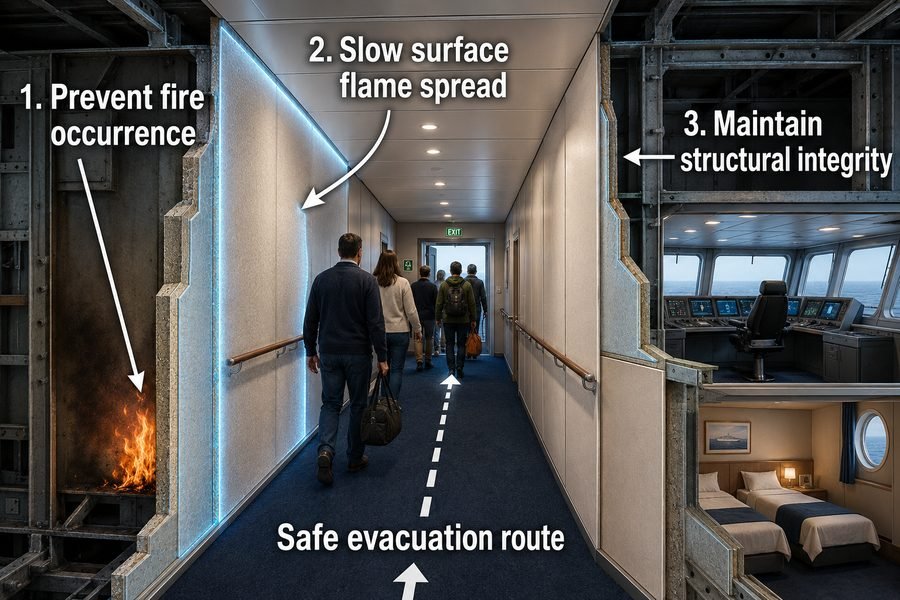
When I worked at a marine outfitting factory, I saw many panel tests. I learned exactly why these rules exist. Fire at sea is very dangerous. You cannot run outside. You must fight the fire inside the ship. Therefore, SOLAS Chapter II-2 is very important. It focuses on three main goals.
Preventing Fire Occurrence in Cabin Spaces
The first goal is preventing the fire from starting. SOLAS requires non-combustible cores for panels.1 This means the inside of the wall panel cannot burn easily. Most marine wall panels use rockwool. High-quality rockwool has a density of 100 to 120 kilograms per cubic meter. It will not catch fire from a small spark. This stops fires before they grow.
Slowing Flame Spread Across Interior Surfaces
The second goal is slowing flame spread. Even if a fire starts, the wall surface must slow it down. The PVC or metal finish on the panel must resist fire. The IMO FTP Code Part 5 tests this. The surface must not help the fire move down the hallway. This gives people time to run away.
Maintaining Structural Integrity for Safe Evacuation
The third goal is maintaining structural integrity. The walls and ceilings must not fall down during a fire. A-Class divisions must stay strong for 60 minutes. They must block smoke and flames. According to the IMO FTP Code, an A-Class test reaches 927°C after one hour.2 The wall must survive this heat. This protects the escape routes.
| Fire Safety Goal | Panel Requirement | Authoritative Source | Metric / Value |
|---|---|---|---|
| Prevent Occurrence | Non-combustible core | IMO FTP Code Part 1 | Zero self-ignition at 750°C |
| Slow Flame Spread | Low flame spread finish | IMO FTP Code Part 5 | Travel distance < 500 mm in test |
| Maintain Integrity | Structural strength | SOLAS Ch II-2 Reg 9 | Withstand 927°C for 60 mins (A-Class) |
These three goals guide every rule in the book. You must remember them when you buy panels. They ensure your ship decoration project passes all safety checks.
Which SOLAS Chapter II-2 rules govern marine interior materials?
Feeling lost in the heavy marine rulebook? Missing a specific rule can hold up your whole project. Let us break down the exact rules you need to follow for your panels.
The primary SOLAS Chapter II-2 rules governing marine interior materials are Regulation 3 (Definitions of A, B, and C class divisions), Regulation 5 (Fire growth potential), Regulation 6 (Smoke generation and toxicity), and Regulation 9 (Containment of fire based on space categories).
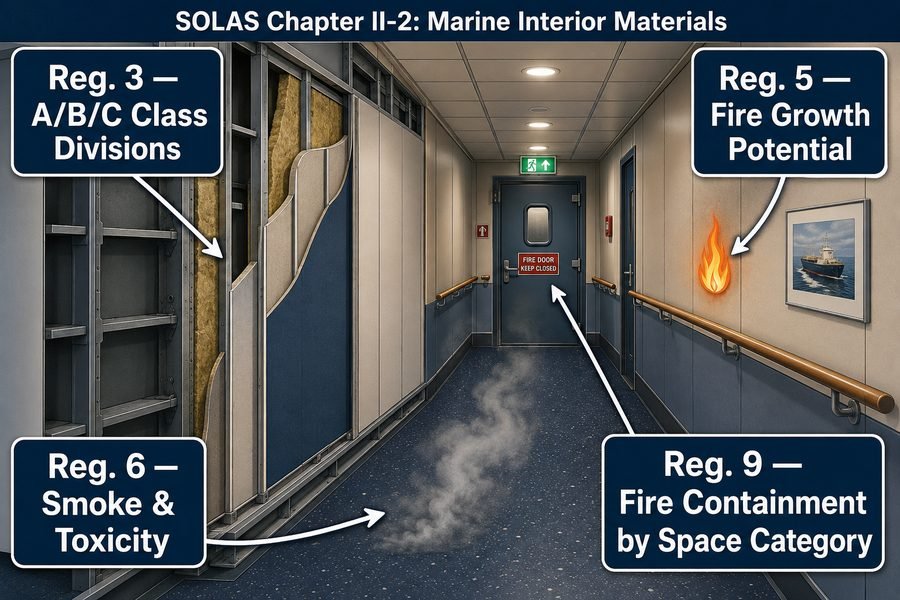
At Magellan Marine, buyers often ask me which rules matter most. They want to buy cheap panels from Asia. But the panels must pass the rules. You must know these four specific regulations. They control how you buy marine wall and ceiling panels.
Regulation 3 and 9: Defining and Containing Fire Zones
Regulation 3 defines the fire classes. It explains A-Class, B-Class, and C-Class. Regulation 9 tells you where to put them. The ship is divided into fire zones. For example, a hallway might need a B-15 panel. A B-15 panel costs about $25 to $35 per square meter in China. An engine room wall needs an A-60 panel. An A-60 panel costs about $45 to $60 per square meter. You must read Regulation 9 to buy the correct class.
Regulation 5: Limiting Fire Growth Potential on Surfaces
Regulation 5 controls the surface materials. It limits the fire growth potential. This rule limits the thickness of combustible veneers. A veneer is the colored film on the panel. For escape routes, the veneer must be very thin. It usually cannot exceed 1.5 millimeters. The calorific value must be less than 45 Megajoules per square meter (MJ/m²).3 This is an exact number from the IMO rules.
Regulation 6: Controlling Smoke Generation and Toxicity
Regulation 6 controls the smoke. Toxic smoke kills people faster than fire. The panel materials must not produce dark smoke. They must not release poison gas when they burn. The IMO FTP Code Part 2 tests this. The test measures carbon monoxide (CO). The limit is 1450 parts per million (ppm).4 Your panel supplier must prove their panels stay below this limit.
| SOLAS Regulation | Main Focus | Application to Marine Panels | Key Testing Standard |
|---|---|---|---|
| Regulation 3 | Definitions | Defines A, B, and C Class limits | IMO FTP Code Part 3 |
| Regulation 5 | Fire Growth | Limits veneer thickness | IMO FTP Code Part 5 |
| Regulation 6 | Smoke Toxicity | Restricts toxic gas emissions | IMO FTP Code Part 2 |
| Regulation 9 | Fire Containment | Dictates where panels are used | Ship Fire Control Plan |
Knowing these four rules makes communication with local sales easier. You can ask them direct questions about Regulation 5 or Regulation 9.
How does SOLAS Chapter II-2 define non-combustible marine panels?
Confused about what "non-combustible" really means? Guessing wrong leads to failed inspections. Let us clear up the exact test standards required to pass this strict definition.
SOLAS defines a non-combustible marine panel as a material that neither burns nor gives off flammable vapors in sufficient quantity for self-ignition when heated to 750°C. This must be proven strictly through the IMO 2010 FTP Code Part 1 furnace test certification.
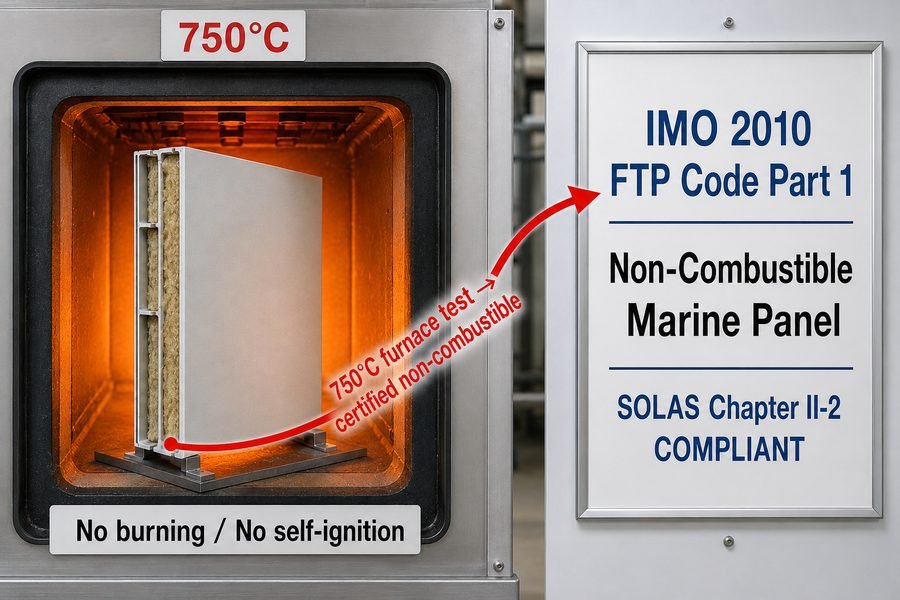
The term "non-combustible" is not a simple adjective. It is a strict legal definition. In the marine industry, you cannot just say a panel is fireproof. You must prove it in a laboratory. The SOLAS rules are very clear about this test.
Understanding the 750°C Furnace Test Requirement
The test uses a special furnace. The laboratory heats the furnace to exactly 750°C. They put the panel core material inside. The material stays in the furnace for 30 minutes. The temperature of the material cannot rise more than 50°C above the furnace temperature. This means the material cannot create its own heat. The rockwool inside the panel must pass this test.
Proving Zero Flammable Vapors and No Self-Ignition
The material cannot give off flammable vapors. Vapors are gases. If the material gets hot, it might release gas. This gas might catch fire. The rule says there must be no self-ignition. The material cannot burst into flames inside the 750°C furnace. Also, the material cannot lose more than 50% of its weight during the test. If it loses too much weight, it fails.
Securing IMO 2010 FTP Code Part 1 Certification
All these rules are in the IMO 2010 FTP Code Part 1.5 You must ask your supplier for this specific certificate. The test costs about $2,000 to $4,000 at a real laboratory. A cheap factory might try to skip this test. Do not buy from them. Without this paper, the shipyard will reject your panels.6
| Non-Combustible Test Metric | Authoritative Limit | IMO Source Document |
|---|---|---|
| Furnace Test Temperature | 750°C | FTP Code Part 1 |
| Maximum Temperature Rise | 50°C above furnace temp | FTP Code Part 1 |
| Maximum Flaming Time | 10 seconds total | FTP Code Part 1 |
| Maximum Weight Loss | 50% of initial mass | FTP Code Part 1 |
I always tell my clients to check the test date. The certificate must be valid. Buying real non-combustible panels protects your profits and your reputation.
Which SOLAS Chapter II-2 clauses must procurement check before buying marine panels?
Worried about buying the wrong panels from overseas? Buying blind wastes your tight project budget. You must check specific clauses to ensure the quality and certification are correct.
Procurement officers must verify three key elements: the Type Approval Certificate (MED/USCG) proving FTP Code compliance, the exact fire rating (A-15, B-15, etc.) matching the ship's fire plan under Regulation 9, and the maximum allowable combustible veneer thickness under Regulation 5.
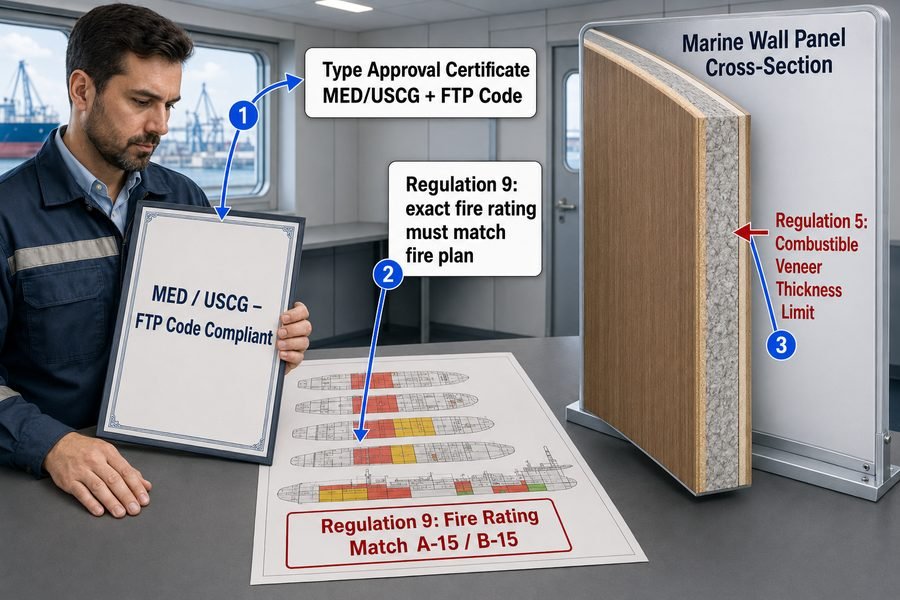
As a procurement officer, your job is hard. You want competitive prices. You want good quality. You buy from Asia to save money. But you must control the risks. I help buyers do this every day. You must check three main things before you pay the deposit.
Verifying the Type Approval Certificate for Global Compliance
First, you must verify the Type Approval Certificate. This is usually the MED wheelmark for European projects. It might be the USCG certificate for American projects. This paper proves the factory passed the fire tests. A factory with this paper makes good products. You should ask the sales agent for this paper immediately. If they do not speak English well, just ask for "MED Certificate".
Matching the Fire Rating to the Ship Fire Plan (Regulation 9)
Second, you must match the fire rating to the drawing. The shipyard gives you a fire plan. This plan uses Regulation 9. It tells you where to put A-class and B-class panels.7 A standard B-15 wall panel costs $25 to $35 per square meter. A B-0 panel is a little cheaper. You must order exactly what the plan says. If you buy B-0 when you need B-15, you must buy them again.
Checking Maximum Combustible Veneer Thickness (Regulation 5)
Third, you must check the veneer thickness. This is the plastic film on the panel. Regulation 5 limits this thickness. For most areas, the film must be thinner than 2.0 millimeters.8 The calorific value must be below 45 MJ/m². You must ask the factory to confirm this number in writing. This ensures the panels are legally safe for the shipyard.
| Procurement Checklist Item | SOLAS Reference | What to Ask the Asian Supplier |
|---|---|---|
| Type Approval Certificate | General Compliance | "Please send valid MED/USCG certificate." |
| Fire Rating Match | Regulation 9 | "Are these strictly B-15 rated panels?" |
| Veneer Thickness | Regulation 5 | "Is the PVC film under 2.0 mm thick?" |
| Calorific Value | Regulation 5 | "Is the calorific value < 45 MJ/m²?" |
Checking these three items solves many communication problems. It also controls your lead time, because you avoid ordering the wrong products.
How does SOLAS Chapter II-2 differ for passenger vs cargo ship panels?
Think all ships use the same panels? Applying cargo rules to a passenger ship is a disaster. Passenger ships require much higher safety levels for interior materials.
SOLAS Chapter II-2 enforces stricter rules for passenger ships than cargo ships by requiring more extensive A-Class structural boundaries, limiting B-Class combustible volumes, mandating lower smoke toxicity limits in escape routes, and demanding automatic sprinkler systems in spaces with interior finishes.
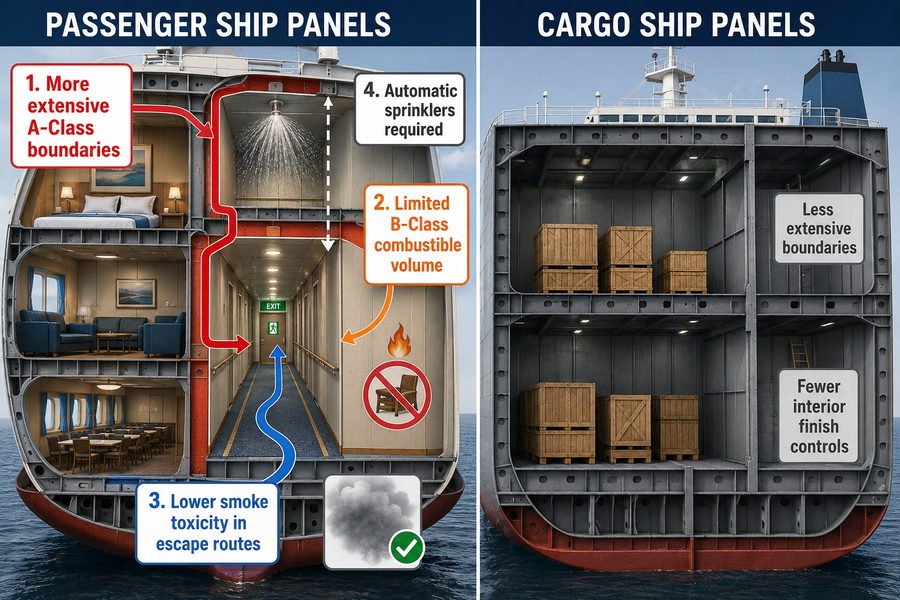
A passenger ship carries many people. A cargo ship carries very few people. Therefore, the rules are very different. If you buy panels for a cruise ship, you must spend more money. The rules are much stricter.
Extensive A-Class Boundaries for Passenger Ship Corridors
Passenger ships need more A-Class boundaries. The escape corridors must be very safe. On a cargo ship, a B-15 panel is often enough for a hallway. On a passenger ship, many walls must be A-Class. A-Class panels are heavier. They use rockwool with a density of 120 to 150 kilograms per cubic meter. They also cost more. They cost about $15 to $25 more per square meter than B-Class panels.
Limiting Combustible Volumes and Smoke Toxicity in Escape Routes
Passenger ships strictly limit combustible volumes9. The total volume of combustible facings, mouldings, and decorations is restricted. In corridors and stairway enclosures, this volume cannot exceed a certain limit. Also, the smoke toxicity limits are much lower. When thousands of people run in a hallway, smoke is deadly. The materials must pass very strict IMO FTP Code Part 2 tests.
Automatic Sprinkler Integration with Ceiling Panels
Passenger ships require automatic sprinklers10. The ceiling panels must work with these sprinkler systems. The panels must have special cutouts. They must not block the water spray. Cargo ships do not always need these complex sprinkler ceilings in all areas. This makes passenger ship ceilings harder to design and install.
| Safety Feature | Cargo Ship Requirement | Passenger Ship Requirement |
|---|---|---|
| Corridor Boundaries | Often B-15 Class | Often A-Class (A-15 or A-30) |
| Combustible Volume | Standard limits | Strictly limited in escape routes |
| Smoke Toxicity | Basic FTP Part 2 limits | Stricter enforcement for large crowds |
| Ceiling Sprinklers | Required in some zones | Mandatory in all accommodation spaces |
You must tell your supplier if the project is a passenger ship. They must quote the correct, high-grade materials.
Why must designers consider SOLAS Chapter II-2 when selecting marine ceiling finishes?
Are your ceiling designs ignoring safety codes? A beautiful ceiling that burns fast is totally useless. Designers must balance good looks with strict fire and smoke rules.
Designers must consider SOLAS Chapter II-2 for ceiling finishes to ensure low flame spread characteristics, prevent toxic smoke accumulation in overhead spaces, manage the total mass of combustible materials, and guarantee that ceiling profiles do not collapse during a fire event.
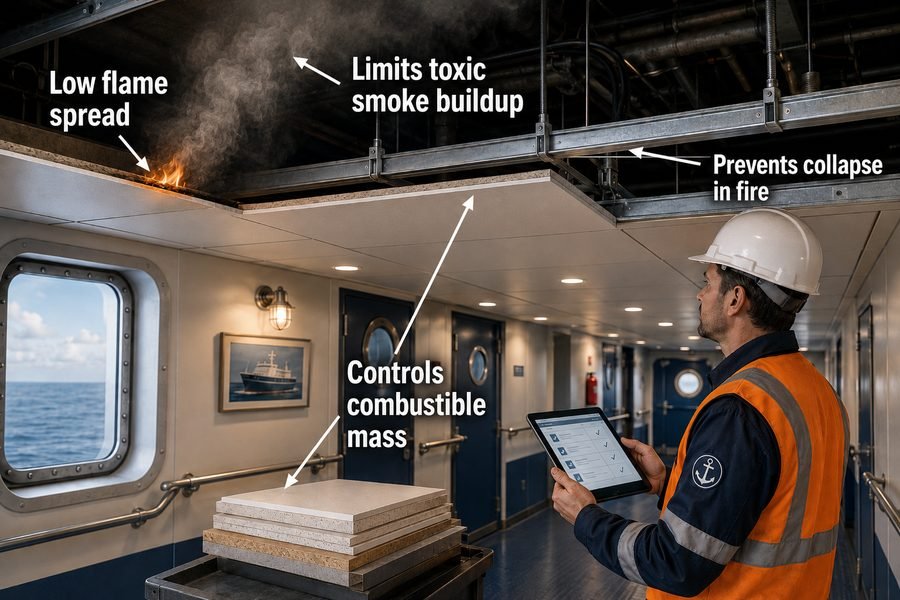
Ceilings are very important in ship fires. Heat and smoke rise to the ceiling. If the ceiling fails, the fire spreads very fast. Interior designers want the ceiling to look nice. But they must follow SOLAS Chapter II-2 first.
Ensuring Low Flame Spread and Low Toxic Smoke Accumulation
Designers must choose low flame spread finishes. The paint or film on the ceiling cannot help the fire move. According to the rules, the maximum thickness of a combustible ceiling paint is 1.5 millimeters11. Also, the ceiling must not release toxic smoke. Smoke stays near the ceiling. People must walk under it. The finish must pass the FTP Code Part 2 for carbon monoxide and hydrogen chloride limits12.
Managing the Total Mass of Combustible Materials
Designers must manage the total mass. The rules calculate the total weight of combustible materials in a room. The ceiling adds to this weight. If the designers use heavy plastic decorative panels, the room might fail the inspection. They must use lightweight, fire-retardant finishes. Good fire-retardant ceiling finishes cost about $15 to $25 per square meter.
Preventing Ceiling Profile Collapse During a Fire
Designers must prevent the ceiling from collapsing. The metal profiles hold the ceiling up. During a fire, the metal gets hot. It bends. If the ceiling falls, it blocks the doors. People cannot escape. The suspension system must carry the weight safely. It must survive high heat. Designers must calculate the load capacity of the ceiling grid.
| Ceiling Design Factor | SOLAS / IMO Rule | Authoritative Limit |
|---|---|---|
| Paint Thickness | Regulation 5 | Maximum 1.5 mm |
| Flame Spread | FTP Code Part 5 | Low flame spread certified |
| Smoke Emission | FTP Code Part 2 | Pass toxicity limits (e.g., CO < 1450 ppm) |
| Structural Support | Regulation 9 | Maintain draft stops and fire divisions |
Good designers know these numbers. They work with the procurement team. Together, they find beautiful panels that pass all the tests.
Conclusion
Mastering SOLAS Chapter II-2 ensures your marine panels are safe, certified, and cost-effective. By verifying regulations and certificates, you can build secure ships and avoid costly procurement mistakes.
-
"Summary of SOLAS chapter II-2 - International Maritime Organization", https://www.imo.org/en/ourwork/safety/pages/summaryofsolaschapterii-2-default.aspx. SOLAS Chapter II-2 and the associated Fire Test Procedures Code establish non-combustibility and fire-resistance requirements for ship construction materials and divisions, supporting the statement that cabin panel cores must meet non-combustibility criteria in regulated applications. Evidence role: expert_consensus; source type: institution. Supports: SOLAS requires non-combustible cores for panels.. Scope note: The exact requirement depends on vessel type, location of the division, and applicable flag-state implementation. ↩
-
"RESOLUTION MSC.307(88) (adopted on 3 December ...", https://wwwcdn.imo.org/localresources/en/KnowledgeCentre/IndexofIMOResolutions/MSCResolutions/MSC.307(88).pdf. The IMO Fire Test Procedures Code specifies the standard time–temperature curve used in fire-resistance testing, under which furnace temperature reaches approximately 927°C at 60 minutes, supporting the stated A-Class test condition. Evidence role: definition; source type: institution. Supports: According to the IMO FTP Code, an A-Class test reaches 927°C after one hour.. Scope note: This supports the test-temperature condition, not by itself the performance of any specific wall-panel product. ↩
-
"[PDF] RESOLUTION MSC.97(73) (adopted on 5 December 2000 ...", https://wwwcdn.imo.org/localresources/en/KnowledgeCentre/IndexofIMOResolutions/MSCResolutions/MSC.97(73).pdf. SOLAS Chapter II-2, Regulation 5 sets limits on combustible materials used on exposed interior surfaces, including restrictions on veneer thickness and calorific value, supporting the stated 1.5 mm and 45 MJ/m² thresholds in the relevant shipboard contexts. Evidence role: general_support; source type: institution. Supports: Combustible veneers in relevant shipboard areas are limited to about 1.5 mm thickness and a calorific value below 45 MJ/m² under IMO/SOLAS fire-growth rules.. Scope note: The limits apply according to the spaces and material categories covered by SOLAS; they should not be read as a universal rule for every marine panel surface. ↩
-
"[PDF] RESOLUTION MSC.307(88) (adopted on 3 December 2010 ...", https://wwwcdn.imo.org/localresources/en/KnowledgeCentre/IndexofIMOResolutions/MSCResolutions/MSC.307(88).pdf. The IMO 2010 FTP Code, Part 2 specifies smoke and toxicity testing for materials and includes a maximum carbon monoxide concentration of 1,450 ppm, supporting the cited CO threshold for materials tested under that procedure. Evidence role: general_support; source type: institution. Supports: IMO FTP Code Part 2 uses a 1,450 ppm carbon monoxide limit in smoke and toxicity testing for relevant marine materials.. Scope note: The threshold supports the testing requirement, but it does not demonstrate that any individual supplier’s panel meets the limit without a valid test report. ↩
-
"How Does the IMO FTP Code Connect with Other Marine Fire Safety ...", https://magellanmarinetech.com/how-imo-ftp-code-connect-with-other-marine-fire-safety-frameworks/. The IMO 2010 FTP Code, Annex 1, Part 1 sets out the non-combustibility test method and acceptance criteria, including furnace-temperature exposure and limits on temperature rise, sustained flaming, and mass loss. Evidence role: definition; source type: institution. Supports: The stated furnace temperature, temperature-rise, flaming-time, and weight-loss criteria come from IMO 2010 FTP Code Part 1.. ↩
-
"What Is the Purpose and Scope of the IMO FTP Code?", https://magellanmarinetech.com/what-purpose-scope-of-imo-ftp-code/. SOLAS fire-safety rules and the IMO FTP Code require certain shipboard materials to demonstrate compliance through prescribed fire-test procedures; approval documents are commonly used to show this compliance during vessel construction and inspection, though individual shipyard acceptance practices may differ. Evidence role: general_support; source type: institution. Supports: Shipboard panels may be rejected if the supplier cannot provide evidence that the materials comply with IMO FTP Code fire-test requirements.. Scope note: This supports the need for documented compliance but may not directly prove that every shipyard will reject panels lacking the certificate. ↩
-
"Summary of SOLAS chapter II-2 - International Maritime Organization", https://www.imo.org/en/ourwork/safety/pages/summaryofsolaschapterii-2-default.aspx. SOLAS chapter II-2, regulation 9 sets requirements for containment of fire, including the required fire integrity of bulkheads and decks and the use of A-, B-, and C-class divisions by space category; this supports using the approved fire plan to identify required panel ratings. Evidence role: general_support; source type: institution. Supports: The ship fire plan, based on SOLAS Regulation 9, indicates where A-class and B-class panels must be installed.. Scope note: The regulation supports the rating framework but does not verify any specific shipyard drawing or supplier product. ↩
-
"Summary of SOLAS chapter II-2 - International Maritime Organization", https://www.imo.org/en/ourwork/safety/pages/summaryofsolaschapterii-2-default.aspx. SOLAS chapter II-2, regulation 5 restricts combustible veneers and similar surface materials in accommodation and service spaces, including maximum veneer thickness limits such as 2.0 mm in specified areas; this supports checking decorative film thickness against the vessel’s applicable space category. Evidence role: general_support; source type: institution. Supports: Regulation 5 limits combustible veneer or film thickness, with a 2.0 mm limit applying in many relevant shipboard areas.. Scope note: The exact limit depends on ship type, space category, and the currently applicable SOLAS text or flag/class interpretation. ↩
-
"[PDF] RESOLUTION MSC.307(88) (adopted on 3 December 2010 ...", https://wwwcdn.imo.org/localresources/en/KnowledgeCentre/IndexofIMOResolutions/MSCResolutions/MSC.307(88).pdf. SOLAS Chapter II-2 and the IMO Fire Test Procedures Code provide the regulatory context for limits on combustible interior materials and for smoke/toxicity testing of exposed surfaces in ship accommodation and service spaces, including escape-route areas. Evidence role: general_support; source type: institution. Supports: Passenger ships have stricter regulatory controls on combustible interior materials and smoke/toxicity performance in corridors, stairway enclosures, and other escape-route-related spaces.. Scope note: The rules are classification- and space-specific; the source supports the regulatory basis for combustible-material and smoke/toxicity controls but may not prove the article’s exact wording or numeric threshold without citing the specific SOLAS regulation text. ↩
-
"[PDF] solas - International Maritime Organization", https://wwwcdn.imo.org/localresources/en/publications/Documents/Supplements/English/QH110E_supplement_January2026.pdf. SOLAS Chapter II-2 requires approved automatic sprinkler, fire detection, and fire alarm systems in specified accommodation and service spaces on passenger ships, with broader requirements for passenger ships carrying more than 36 passengers. Evidence role: general_support; source type: institution. Supports: Passenger ships are generally subject to automatic sprinkler-system requirements in accommodation and related spaces, affecting ceiling design and installation.. Scope note: The requirement depends on ship size, passenger capacity, and SOLAS applicability; the source supports the general regulatory requirement but not an unconditional rule for every passenger ship in every space. ↩
-
"[PDF] RESOLUTION MSC.307(88) (adopted on 3 December 2010 ...", https://wwwcdn.imo.org/localresources/en/KnowledgeCentre/IndexofIMOResolutions/MSCResolutions/MSC.307(88).pdf. SOLAS chapter II-2, regulation 5 sets limits on combustible materials and exposed surface finishes to reduce fire-growth potential; the 1.5 mm value should be verified against the exact material type and shipboard space because SOLAS thickness limits vary by application. Evidence role: general_support; source type: institution. Supports: According to the rules, the maximum thickness of a combustible ceiling paint is 1.5 millimeters.. Scope note: Contextual support only unless the source specifically identifies combustible ceiling paint or finish thickness as 1.5 mm for the relevant space. ↩
-
"[PDF] Future Ship powering optionS - International Maritime Organization", https://wwwcdn.imo.org/localresources/en/OurWork/Environment/Documents/Air%20pollution/Future_ship_powering_options_report.pdf. The IMO FTP Code Part 2 specifies smoke and toxicity testing for materials used on ships, including concentration limits for gases such as carbon monoxide and hydrogen chloride; this supports the need to verify ceiling finishes against smoke-toxicity criteria rather than flame spread alone. Evidence role: definition; source type: institution. Supports: The finish must pass the FTP Code Part 2 for carbon monoxide and hydrogen chloride limits.. Scope note: The source supports the existence and role of the FTP Code Part 2 toxicity test, but individual pass/fail values may depend on the edition of the Code and test conditions cited. ↩