Buying cheap marine panels without checking SOLAS certificates wastes your money. Your shipyard client will fail inspections, and you face huge rework costs. Here is the exact reason why.
SOLAS compliance is mandatory because it ensures marine wall and ceiling panels meet strict fire safety, toxicity, and structural standards. Without International Maritime Organization (IMO) certified Type Approval, panels cannot be legally installed, leading to failed inspections, rejected deliveries, project delays, severe fines, and loss of marine insurance coverage.
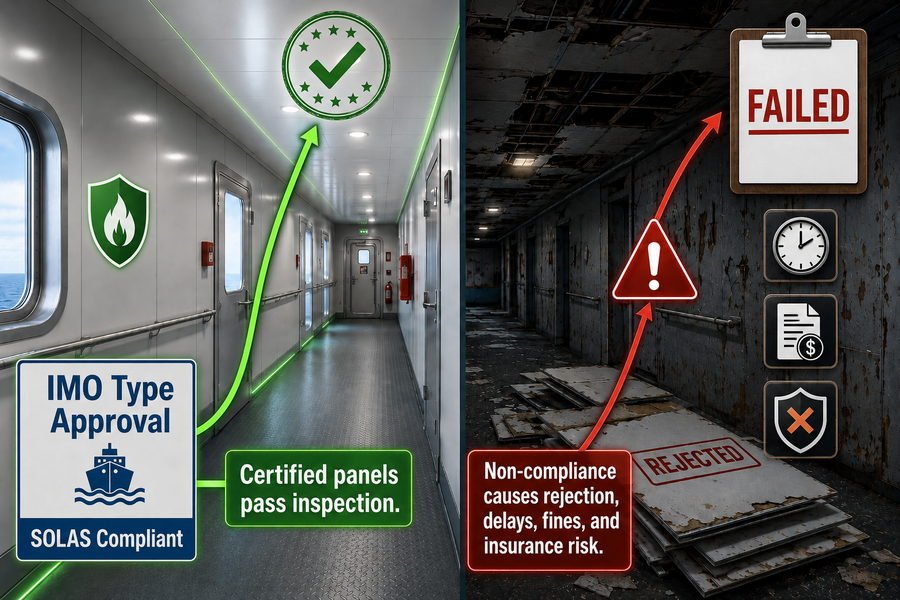
If you ignore these rules, your interior outfitting project will fail. I have seen procurement officers lose their jobs over this. Let us look at the real costs and problems you will face if you do not check these certificates.
What happens if non-SOLAS-compliant marine wall panels are installed on a newbuild?
You install cheap panels to save money, but the surveyor spots the missing MED wheelmark. Now, you must rip everything out, destroying your profit and client trust.
Installing non-SOLAS panels on a newbuild results in four immediate disasters: failed classification society inspections, mandatory tear-down and replacement of all uncertified materials, project delays averaging 45 to 60 days, and financial losses exceeding $50,000 per cabin in material, labor, and shipyard penalty costs.
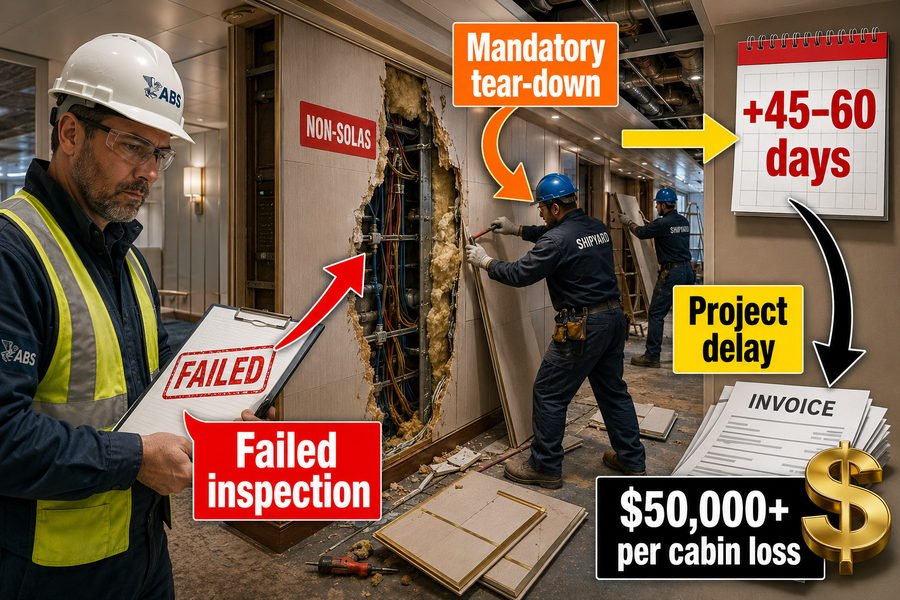
I have worked in marine outfitting for many years. I have seen buyers make this exact mistake. They buy cheap wall panels from a factory that only makes land-based materials. They think a normal fire door is the same as a marine fire door. This is a very bad idea. Let us look at the four things that happen when you do this.
Failed Classification Society Inspections on Newbuilds
Every new ship must pass an inspection. A surveyor from a group like DNV, Lloyd's Register (LR), or ABS will walk through the cabins. The surveyor will look at the marine wall panels. They will ask to see the Type Approval certificate1. This certificate proves the panel meets IMO standards. If you do not have this document, the surveyor will fail the inspection right away. The ship cannot get its safety certificates2. Without these certificates, the ship cannot leave the shipyard.
Mandatory Tear-Down of Uncertified Marine Wall Panels
When you fail the inspection, you cannot just pay a small fine and walk away. The rules are strict. You must take out every single non-compliant panel.3 I once helped a client who had to rip out 50 entire cabins. The workers had to undo all the framing and wiring. This destroys the panels. You cannot reuse them. You have to throw them in the trash. This means you lose all the money you spent on the first set of materials.
Project Delays Averaging 45 to 60 Days
Tearing down panels takes time. But getting new panels takes even more time. You have to find a real marine supplier. Then they have to make the panels. Then you have to ship them. If you buy from Asia and ship to Europe, sea freight takes about 35 days alone. When you add production time, you will face a delay of 45 to 60 days. Shipyards work on very tight schedules. A delay this big ruins the whole building plan.
Financial Losses Exceeding $50,000 Per Cabin
The cost of this mistake is huge. First, you lose the cost of the bad panels. Second, you pay workers to tear them down. Third, you buy new, correct panels. Fourth, you pay workers to install them again. Finally, the shipyard will charge you a delay penalty. Based on standard European shipbuilding contracts, delay fines can be $10,000 per day4. When you add all this up, the total loss easily passes $50,000 for just one cabin.
| Cost Category | Estimated Cost for One Cabin | Source of Estimate |
|---|---|---|
| Bad Material Cost | $1,500 | Average market price for non-marine panels |
| Tear-down Labor | $2,000 | European shipyard labor rates ($80/hour) |
| New Compliant Panels | $3,500 | Average market price for IMO-certified panels |
| Re-installation Labor | $3,000 | European shipyard labor rates ($80/hour) |
| Shipyard Delay Fines | $40,000+ | Based on 4 days delay per cabin at $10k/day |
| Total Loss | $50,000+ | Combined total loss per cabin |
Why do shipowners reject marine ceiling panels without SOLAS Chapter II-2 documents?
You ship beautiful ceiling panels to Europe. The shipowner asks for the fire test report. You do not have it. The shipowner sends the containers back immediately.
Shipowners reject ceiling panels without SOLAS Chapter II-2 documents because they must prove the materials have low flame spread characteristics, restrict smoke generation, and pass the IMO FTP Code Part 5 test. Without these three proofs, the shipowner faces legal liability and cannot operate the vessel commercially.
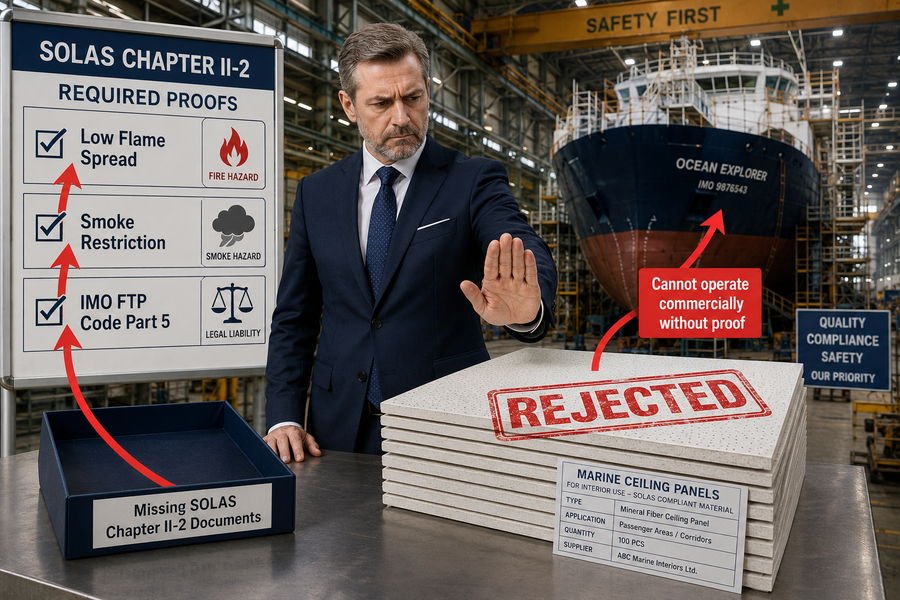
When you talk to a shipowner, they only care about safety and the law. They know that a fire on a ship is the worst thing that can happen. People cannot run away from a ship in the middle of the ocean. This is why shipowners will never accept ceiling panels without the right papers. Let us look at the three specific proofs they need.
Requirement for Low Flame Spread in Marine Ceiling Panels
SOLAS Chapter II-2 says that all exposed surfaces in cabins must have low flame spread characteristics5. This means if a fire starts, the ceiling panel must not help the fire grow. The fire must travel very slowly across the panel surface. If the panel is normal plastic or cheap wood, the fire will run across the ceiling in seconds. Shipowners reject panels without certificates because they cannot risk a fast fire. The certificate proves the fire will stay small.
Strict Limits on Smoke Generation and Toxicity
Fire is bad, but smoke kills more people. When materials burn, they make smoke and toxic gas. SOLAS Chapter II-2 has very strict limits on this. The materials inside the ceiling panel must not make thick, black smoke. They also must not release deadly gases. If a ceiling panel makes too much smoke, people in the cabin cannot see the door to escape. They will breathe the gas and die. Shipowners need documents to prove your panels are safe to breathe around during a fire.
Passing the IMO FTP Code Part 5 Fire Test
To prove low flame spread and low smoke, the panel must pass a real fire test. This test is called the IMO Fire Test Procedures (FTP) Code Part 56. In this test, a lab puts the panel in a hot machine. According to the IMO FTP rules, the test checks the heat the panel gives off. It must not give off too much heat. The lab test costs about $3,000 to $5,000. If your panel does not have the paper showing it passed this exact Part 5 test, the shipowner will always say no.
| Requirement for Ceiling Panels | What it Means | Standard Used |
|---|---|---|
| Low Flame Spread | Fire moves slowly across the surface | SOLAS Chapter II-2 |
| Restrict Smoke Generation | Smoke is light and not toxic | IMO FTP Code Part 2 |
| Surface Flammability Test | Lab tests the heat release rate | IMO FTP Code Part 5 |
How does SOLAS non-compliance delay shipyard outfitting projects?
Your workers are ready. The ship is waiting. But customs holds your panels because they lack SOLAS tags. Your shipyard client fines you $5,000 every single day.
SOLAS non-compliance delays outfitting projects through three main bottlenecks: customs clearance holds lasting 14 to 30 days, re-ordering compliant panels which takes 60 to 90 days for manufacturing and shipping, and rescheduling specialized marine installation teams who are often booked six months in advance.
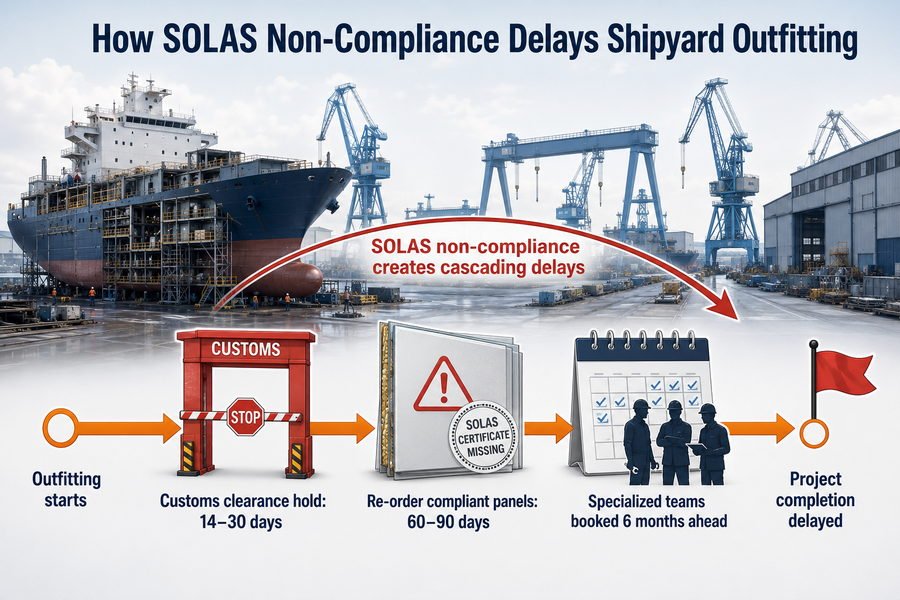
In the marine business, time is money. A delay of one week can ruin your relationship with a shipyard. When you buy interior materials that do not meet SOLAS rules, the project stops. I have helped clients fix these problems, and the time lost is always worse than they think. Here are the three ways non-compliant panels stop your project.
Customs Clearance Holds for Uncertified Marine Panels
When your shipping containers arrive at a major port in Europe or the USA, customs officers check the paperwork. Many countries have rules that marine safety equipment and fire-rated panels must have proper marks. In Europe, this is the MED wheelmark7. If the customs officer sees you are importing marine panels but there is no SOLAS certificate, they will hold the container. They do this to stop unsafe materials from entering the country. These customs holds usually last 14 to 30 days. You cannot get your panels during this time.
Manufacturing and Shipping Lead Times for Compliant Replacements
If you finally accept that your panels are wrong, you have to buy new ones. You cannot just go to a local store to buy marine wall panels. You must order them from a real marine factory. If you order from China or Vietnam, it takes about 25 to 35 days for the factory to make the panels. Then, sea freight to Europe or America takes another 35 to 45 days. Add time for trucks and port handling, and you are waiting 60 to 90 days just to get the right materials.
Rescheduling Marine Interior Installation Teams
You cannot use regular house carpenters to build a ship interior. You need specialized marine installation teams. These workers know how to fit panels to a steel deck. Because these teams are highly skilled, they are very busy. They are often booked six months in advance. If your materials are 90 days late, the installation team will leave your ship and go to another job. You will then have to wait months to get them back. The ship will sit empty and unfinished.
| Delay Cause | Expected Time Lost | Reason for Delay |
|---|---|---|
| Customs Hold | 14 to 30 days | Missing MED wheelmark or safety papers |
| Re-ordering Panels | 60 to 90 days | Factory production (30 days) + Sea freight (40+ days) |
| Rescheduling Workers | Up to 6 months | Specialized marine teams are booked far in advance |
Why must procurement confirm SOLAS scope before issuing a marine panel PO?
You find a great supplier in China. The price is 30% lower. You send the purchase order. Later, you realize their certificate only covers land-based fire doors, not ships.
Procurement must confirm SOLAS scope before issuing a PO to verify three critical details: the certificate validity dates, the specific panel thickness approved, and the correct fire class rating (such as B-15 or A-60). Missing any of these renders the purchase invalid and forces complete repurchasing.
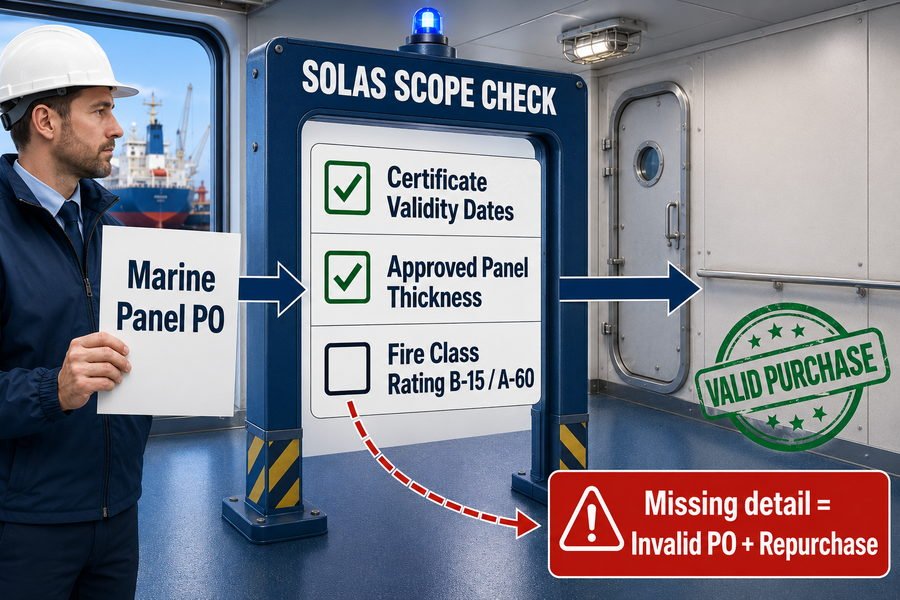
When I worked as an employee at an outfitting factory, I saw buyers make big mistakes on their purchase orders (POs). They saw a certificate, smiled, and paid the money. They did not read the details on the paper. A certificate is only good if it matches exactly what you are buying. You must check three things before you sign that PO.
Checking Certificate Validity Dates for Marine Panels
Every SOLAS Type Approval certificate has an expiration date. Usually, a certificate from a class society like USCG or DNV is valid for 5 years8. If the factory gives you a certificate that expired last month, it is useless. The surveyor will not accept it. Sometimes, a factory will send an old certificate hoping you do not check the date. You must look at the "Valid Until" box on the paper. If it is expired, do not issue the PO.
Verifying Approved Panel Thickness in SOLAS Documents
A fire certificate is not for every panel the factory makes. It is for a very specific design. The most important detail is the thickness of the panel. For example, the certificate might say the factory passed the test with a 50mm thick rockwool panel. If your PO asks for a 25mm thick panel, the 50mm certificate does not cover it. The 25mm panel is not legal. You must make sure the thickness you want is written clearly on the valid certificate.
Matching the Fire Class Rating to the Vessel Plan
Marine panels have different fire ratings. Common ratings are B-0, B-15, A-30, and A-60. The letter "B" means it stops flames. The number "15" means it stops heat from passing through for 15 minutes.9 The ship's general arrangement plan tells you exactly what rating each wall needs. If the plan asks for an A-60 panel, but the factory's certificate is only for a B-15 panel, the panels will fail the inspection. Always match the PO rating to the certificate rating.
| Detail to Check | Why it Matters | Consequence of Mistake |
|---|---|---|
| Expiration Date | Certificates are only valid for 5 years | Surveyor rejects the materials |
| Panel Thickness | The fire test is based on a specific size | Thinner panels will burn too fast |
| Fire Class Rating | Must match the ship's safety plan | Installing B-15 when A-60 is required is illegal |
What flag state penalties hit vessels with non-SOLAS-compliant interior panels?
Port state control boards the ship. They check the cabin panels. They find no SOLAS marks. The ship is detained, and the financial bleeding begins for your client.
Flag states penalize vessels with non-SOLAS panels by issuing formal deficiency reports, detaining the vessel in port at a cost of $20,000 to $50,000 per day, issuing direct fines up to $100,000, and revoking the Passenger Ship Safety Certificate until all panels are completely replaced.
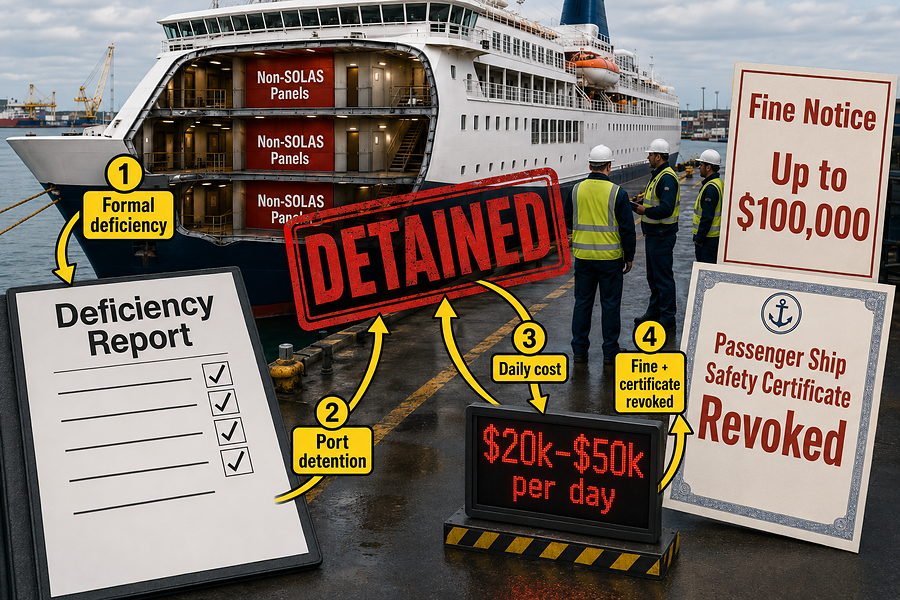
Flag states and Port State Control (PSC) are the police of the ocean. They enforce the law. If you put bad panels on a ship and somehow hide it from the shipyard surveyor, you will not hide it from the port police. When PSC finds out, the punishment is very harsh. This destroys the shipowner's business. Let us break down the four penalties they will apply.
Formal Deficiency Reports and Port State Control Inspections
When PSC inspectors come on board, they look at fire safety first. If they see interior panels that look cheap or lack proper certification marks, they will ask the captain for the material paperwork. If the papers do not prove SOLAS compliance, the inspector will write a formal deficiency report. This report goes into a global computer system.10 Now, every port in the world knows this ship is unsafe. The ship will be targeted for extra inspections everywhere it goes.11
Financial Costs of Vessel Detention Due to Non-Compliant Panels
Writing a report is just the start. If the fire risk is high, the inspector will detain the ship.12 This means the ship is legally locked to the dock. It cannot move. It cannot carry cargo or passengers. A ship makes money by moving. When it is detained, the owner loses massive amounts of money. Port fees and lost business usually cost the owner between $20,000 and $50,000 every single day the ship is stuck.13
Direct Fines and Revocation of Passenger Ship Safety Certificates
Along with daily losses, the flag state will issue direct fines. For severe safety violations like using completely uncertified fire boundaries, these fines can reach $100,000. Worse than the fine, the flag state will revoke the ship's safety certificates. For a cruise ship or ferry, they will take away the Passenger Ship Safety Certificate. Without this piece of paper, the ship is dead. It cannot legally have passengers on board. The owner must rip out all your bad panels and install new ones before they get the certificate back.
| Penalty Type | Estimated Cost or Impact | Source / Authority |
|---|---|---|
| Deficiency Report | Bad reputation, extra inspections | Port State Control (Paris MoU / Tokyo MoU) |
| Vessel Detention | $20,000 to $50,000 per day | Standard shipping industry daily charter rates |
| Direct Fines | Up to $100,000 | Maritime law violation penalties |
| Certificate Revocation | Total loss of business | Flag State Administration |
How does SOLAS Chapter II-2 compliance impact marine insurance acceptance?
A small fire breaks out in a cabin. It is put out quickly. But the insurance company checks the panel certificates. They are fake. The claim is fully denied.
SOLAS Chapter II-2 compliance impacts marine insurance because underwriters require absolute proof of fire safety. Without compliance, insurance companies will refuse to issue the initial hull and machinery policy, charge 300% higher premiums for sub-standard risks, and immediately deny payout claims if a fire incident actually occurs.
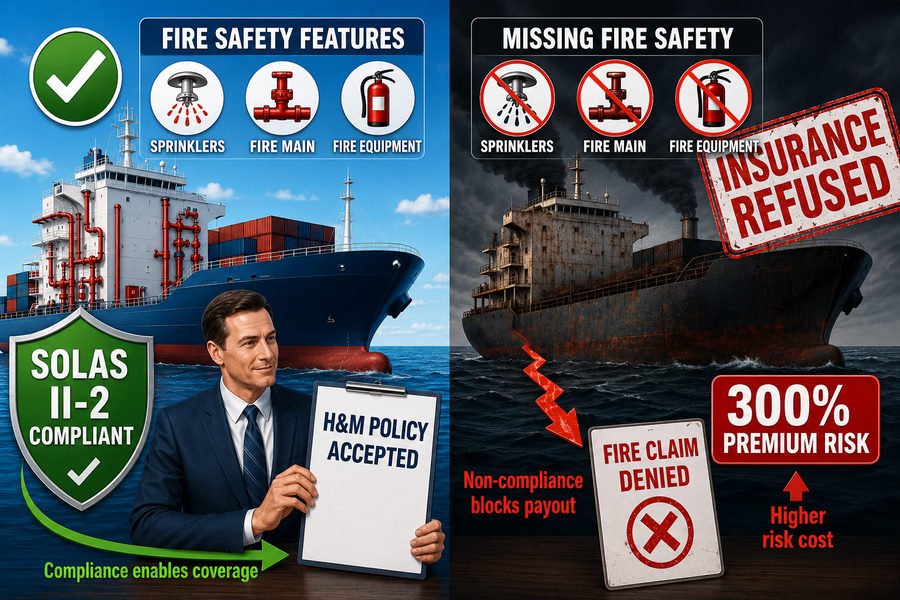
Insurance companies do not like risk. A ship in the middle of the ocean is already a high risk. Insurance underwriters base their entire business on the rules in SOLAS. If your interior decoration company uses panels that do not meet SOLAS Chapter II-2, you make the ship too dangerous to insure. Let us see how insurance companies react to non-compliant materials in three specific ways.
Refusal of Initial Hull and Machinery Policy for Uncertified Ships
When a new ship is built, the owner must buy Hull and Machinery (H&M) insurance. Before the insurance company signs the paper, they ask for the ship's classification documents. If the ship has non-compliant marine panels, the classification society will not issue the final papers14. Because of this, the insurance underwriter will refuse to write the policy. A shipowner will never pay your invoice if your materials stop them from getting basic ship insurance.
Premium Increases for Sub-Standard Marine Outfitting Risks
Sometimes, a ship might have minor non-compliance issues that the flag state allows for a short time under a special exemption. But the insurance company sees this as a high risk. Because the fire walls are weak, the chance of a total loss is higher. To protect themselves, the insurance company will increase the price of the insurance premium. Industry data shows that premiums can jump by 300% for ships with sub-standard fire protection15. The shipowner will be very angry at you for this extra cost.
Denial of Payout Claims Following a Fire Incident
This is the worst part. Let us say the ship gets insurance. Later, a fire happens in a passenger cabin. The insurance company sends a fire investigator. The investigator finds out the marine ceiling panels melted too fast because they were not SOLAS approved. The insurance company will point to the contract rule that says the ship must maintain class standards. Because the panels broke the law, the insurance company will completely deny the claim16. The shipowner gets zero money to fix the burned ship.
| Insurance Impact | What Happens | Financial Result |
|---|---|---|
| Policy Refusal | Cannot get H&M insurance | Ship cannot sail legally |
| Premium Increase | Base insurance cost goes up | 300% higher yearly costs for the owner |
| Claim Denial | Insurance refuses to pay for fire damage | Millions of dollars lost by the shipowner |
Conclusion
Buying marine panels is not just about price. Always verify SOLAS compliance first. This simple check protects your projects, your shipyard clients, and your business profits.
-
"How Does the IMO FTP Code Connect with Other Marine Fire Safety ...", https://magellanmarinetech.com/how-imo-ftp-code-connect-with-other-marine-fire-safety-frameworks/. A classification-society type approval or equivalent approval documentation can be used to show that shipboard materials have been assessed against applicable maritime fire-safety requirements, including IMO fire-test procedures for bulkheads, linings, and surface materials. Evidence role: definition; source type: institution. Supports: A Type Approval certificate is used to demonstrate that marine wall panels meet applicable IMO standards.. Scope note: The source would support the role of type approval in demonstrating compliance, but it may not prove that every classification surveyor will request the document in the same way on every newbuild. ↩
-
"International Convention for the Safety of Life at Sea (SOLAS), 1974", https://www.imo.org/en/about/conventions/pages/international-convention-for-the-safety-of-life-at-sea-(solas),-1974.aspx. SOLAS and flag-state survey frameworks require ships to hold statutory safety certificates issued after satisfactory surveys, providing contextual support for the statement that unresolved non-compliance can prevent certification. Evidence role: expert_consensus; source type: institution. Supports: A new ship with unresolved compliance issues may be unable to obtain the required safety certificates.. Scope note: This supports the general certification requirement; the exact consequence for a missing wall-panel approval would depend on the vessel type, flag administration, and surveyor findings. ↩
-
"What Is the Purpose and Scope of the IMO FTP Code? - Magellan ...", https://magellanmarinetech.com/what-purpose-scope-of-imo-ftp-code/. Classification and statutory survey procedures require identified non-conformities affecting fire safety or approved construction arrangements to be corrected before approval or certification, which supports replacement or remediation of non-compliant installed materials. Evidence role: mechanism; source type: institution. Supports: Non-compliant installed marine wall panels generally must be corrected, replaced, or otherwise brought into compliance before approval.. Scope note: This would support the need to correct non-compliance, but it may not establish that removal of every panel is always mandatory; alternative remediation may be accepted in some cases. ↩
-
"Subpart 11.5 - Liquidated Damages - Acquisition.GOV", https://www.acquisition.gov/far/subpart-11.5. Shipbuilding-contract commentary and maritime-law scholarship describe liquidated damages for delayed vessel delivery as a standard contractual remedy, providing contextual support for daily delay penalties in newbuilding projects. Evidence role: general_support; source type: paper. Supports: Shipbuilding contracts can impose daily delay penalties, potentially reaching large daily amounts.. Scope note: The source would support the existence of daily delay damages, but a specific USD 10,000-per-day figure depends on the vessel price, negotiated contract terms, jurisdiction, and currency. ↩
-
"Summary of SOLAS chapter II-2 - International Maritime Organization", https://www.imo.org/en/ourwork/safety/pages/summaryofsolaschapterii-2-default.aspx. SOLAS Chapter II-2 requires specified exposed interior surfaces, including accommodation-space linings such as bulkheads and ceilings, to meet low flame-spread requirements under the fire-safety provisions for ship construction and materials. Evidence role: general_support; source type: institution. Supports: SOLAS Chapter II-2 requires exposed cabin or accommodation-space surfaces used for ceiling panels to have low flame-spread characteristics.. Scope note: The exact scope depends on ship type, space category, and the detailed SOLAS regulation, so the source supports the regulatory basis rather than every possible cabin surface without exception. ↩
-
"[PDF] RESOLUTION MSC.307(88) (adopted on 3 December 2010 ...", https://wwwcdn.imo.org/localresources/en/KnowledgeCentre/IndexofIMOResolutions/MSCResolutions/MSC.307(88).pdf. The IMO Fire Test Procedures Code Part 5 specifies the surface flammability test used for materials such as bulkhead, ceiling, and deck finishes, including performance criteria related to flame spread and heat release. Evidence role: definition; source type: institution. Supports: IMO FTP Code Part 5 is the relevant fire test for demonstrating low flame spread/surface flammability characteristics of marine ceiling panel surfaces.. Scope note: This supports the role and measured criteria of the Part 5 test, but it does not verify the article’s separate estimate of laboratory testing cost. ↩
-
"Directive 96/98/EC - Wikipedia", https://en.wikipedia.org/wiki/Directive_96/98/EC. EU Directive 2014/90/EU on marine equipment establishes conformity-assessment and marking requirements for equipment placed on board EU ships, including use of the wheel mark to indicate compliance with applicable international instruments. Evidence role: definition; source type: government. Supports: In Europe, marine safety equipment and fire-rated panels must carry the MED wheelmark or equivalent compliance documentation.. Scope note: This supports the EU marking requirement generally; whether a specific panel shipment is covered depends on the product category and intended vessel use. ↩
-
"Survival Craft Equipment-Update to Type Approval Requirements", https://www.federalregister.gov/documents/2022/11/14/2022-23666/survival-craft-equipment-update-to-type-approval-requirements. A maritime type-approval authority or classification-society rule should document that many marine equipment type-approval certificates are issued for a fixed term, commonly five years, supporting the article’s statement about certificate validity periods. Evidence role: statistic; source type: government. Supports: Usually, a certificate from a class society like USCG or DNV is valid for 5 years.. Scope note: Validity periods can vary by issuing authority, product category, and renewal status, so the source should be used to support the usual practice rather than an absolute rule. ↩
-
"[PDF] recommendation for fire test procedures for “a” and “b” class ...", https://wwwcdn.imo.org/localresources/en/KnowledgeCentre/IndexofIMOResolutions/AssemblyDocuments/A.163(ES.IV).pdf. The IMO fire-test framework defines A- and B-class divisions by flame-passage and temperature-rise criteria over specified test durations; ratings such as B-15 and A-60 indicate the duration for which the insulation criterion is met, supporting the article’s explanation of fire-class labels. Evidence role: definition; source type: institution. Supports: The letter "B" means it stops flames. The number "15" means it stops heat from passing through for 15 minutes.. Scope note: This supports the meaning of the rating labels, but it does not by itself verify which rating is required for any specific vessel area or plan. ↩
-
"[PDF] PROCEDURES FOR PORT STATE CONTROL, 2023", https://wwwcdn.imo.org/localresources/en/OurWork/IIIS/Documents/A%2033-Res.1185%20-%20PROCEDURES%20FOR%20PORT%20STATE%20CONTROL,%202023%20(Secretariat)%20(1).pdf. Port State Control regimes record deficiencies and detentions in shared inspection databases, such as THETIS for the Paris MoU and APCIS for the Tokyo MoU, and those records are used in future inspection targeting; this supports the data-sharing mechanism but not the literal claim that every port worldwide sees the same record. Evidence role: mechanism; source type: institution. Supports: A formal PSC deficiency report is entered into a shared inspection database and can affect future targeting.. Scope note: PSC databases are organized by regional memoranda of understanding and may exchange or publish data, but they are not a single universal database covering every port in the world. ↩
-
"Port State Control - International Maritime Organization", https://www.imo.org/en/ourwork/iiis/pages/port%20state%20control.aspx. PSC risk-based inspection systems use prior deficiencies and detentions as factors in ship risk profiles and inspection priority, supporting the claim that a recorded deficiency can increase future inspection attention; the support is contextual because targeting rules differ among PSC regions. Evidence role: mechanism; source type: institution. Supports: Recorded PSC deficiencies can increase the likelihood of future inspections.. Scope note: The evidence should not be read as proving extra inspections in every port, only that prior deficiencies can influence risk-based targeting. ↩
-
"[PDF] PROCEDURES FOR PORT STATE CONTROL, 2023", https://wwwcdn.imo.org/localresources/en/OurWork/IIIS/Documents/A%2033-Res.1185%20-%20PROCEDURES%20FOR%20PORT%20STATE%20CONTROL,%202023%20(Secretariat)%20(1).pdf. IMO and regional PSC procedures provide that a ship may be detained when deficiencies pose a clear hazard to safety, health, or the environment, which supports detention as a possible consequence of serious fire-safety deficiencies; the source does not establish that every high-risk panel deficiency results in detention. Evidence role: expert_consensus; source type: institution. Supports: Serious fire-safety deficiencies can justify PSC detention.. Scope note: Detention depends on the inspector’s assessment, applicable convention requirements, and the severity of the deficiency. ↩
-
"[PDF] PROCEDURES FOR PORT STATE CONTROL, 2023", https://wwwcdn.imo.org/localresources/en/OurWork/IIIS/Documents/A%2033-Res.1185%20-%20PROCEDURES%20FOR%20PORT%20STATE%20CONTROL,%202023%20(Secretariat)%20(1).pdf. Maritime economics research on vessel detention, port delay costs, or daily charter-equivalent earnings can support the order of magnitude of daily losses from detention; the estimate is contextual because actual losses vary by vessel type, charter market, cargo commitments, port fees, and season. Evidence role: statistic; source type: paper. Supports: Vessel detention can impose daily costs in the tens of thousands of US dollars.. Scope note: A single study or dataset may not prove the range for all ship types, especially both cargo ships and passenger vessels. ↩
-
"How to choose the right marine wall panels for marine interior ...", https://magellanmarinetech.com/how-choose-right-marine-wall-panels-for-marine-interior-projects/. IMO SOLAS Chapter II-2 and the FTP Code establish fire-safety performance requirements for materials used in ship accommodation and structural fire protection, supporting the claim that non-compliant outfitting materials can prevent completion of statutory or class fire-safety certification. Evidence role: mechanism; source type: institution. Supports: Non-compliant marine panels can prevent a vessel from receiving final classification or statutory certification.. Scope note: The source would support the regulatory mechanism generally; whether a particular classification society refuses final papers depends on the vessel type, applicable notation, survey findings, and flag-state administration. ↩
-
"Insurance Premiums Tax and Surcharge", https://revenue.ky.gov/Business/Insurance-Premiums-Tax-Surcharge/Pages/default.aspx. A marine-insurance underwriting or actuarial source documenting premium loadings for vessels with deficient fire protection would support the assertion that fire-safety non-compliance can materially increase insurance premiums. Evidence role: statistic; source type: institution. Supports: Ships with sub-standard fire protection can face sharply higher insurance premiums, potentially up to 300%.. Scope note: A source may show risk-based premium increases without confirming the specific 300% figure for all vessel types or markets. ↩
-
"[PDF] applying the knowing neglect standard in time hull insurance", https://digitalcommons.mainelaw.maine.edu/cgi/viewcontent.cgi?article=1889&context=mlr. Marine insurance law sources on warranties and class-maintenance clauses explain that breach of classification, seaworthiness, or statutory compliance obligations may affect cover for casualty claims, supporting the legal basis for claim denial after material non-compliance is discovered. Evidence role: general_support; source type: government. Supports: An insurer may deny a fire-damage claim if the vessel used non-compliant materials that breached class, statutory, or policy conditions.. Scope note: This supports the possibility of denial, not an automatic outcome in every jurisdiction or policy wording; causation, materiality, waiver, and local insurance law can affect the result. ↩