Finding a cheap supplier is easy. Finding one who understands marine fire safety is hard. Bad panels fail inspections. How do you check their SOLAS Chapter II-2 knowledge?
Overseas buyers verify a supplier's SOLAS Chapter II-2 awareness by auditing three core areas: their technical response to fire class ratings, the validity of their Type Approval certificates, and their factory quality control records for non-combustible materials.
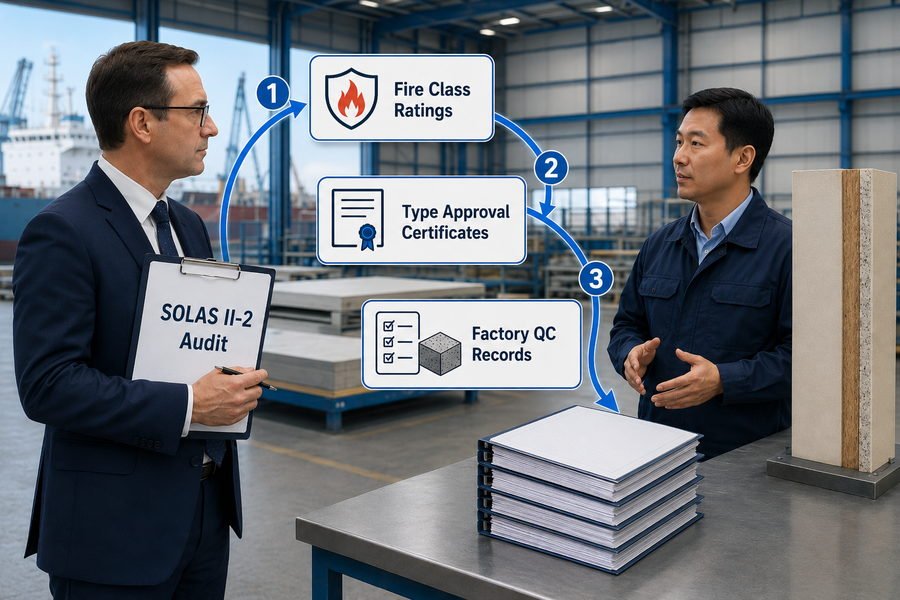
I work as a marine outfitting specialist at Magellan Marine. Every day, I help buyers screen factories. You need practical ways to find the truth. Read on to see the exact steps I use to screen out bad suppliers and keep your ship projects safe and on schedule.
What SOLAS questions should procurement ask a Chinese marine panel manufacturer?
Language barriers make buying from China risky. You ask about fire safety, and the sales team just says yes. What exact questions force them to prove their technical skills?
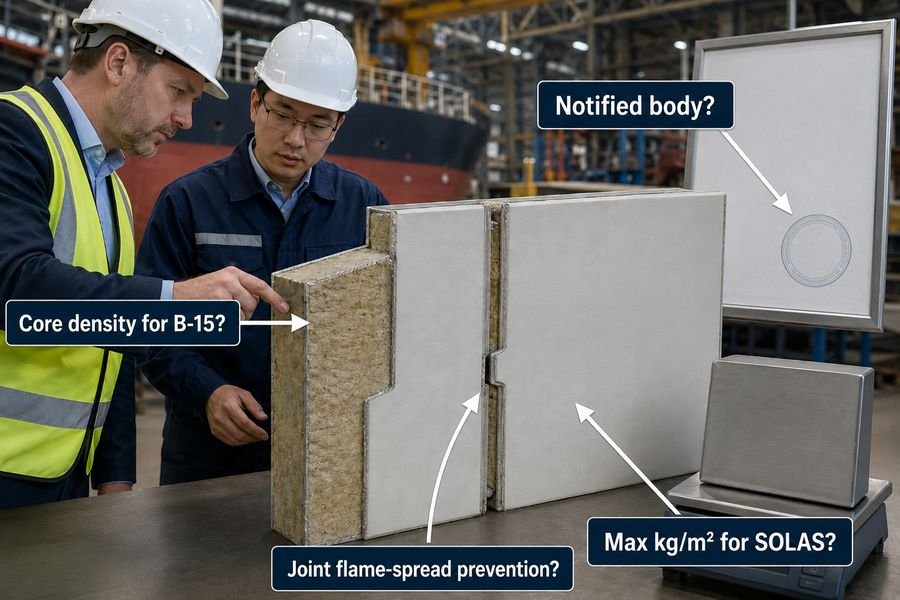
Procurement must ask four specific SOLAS questions: What is the core material density for B-15 panels? How do your joints prevent flame spread? Which notified body issued your Module B certificate? What is your maximum panel weight per square meter to meet SOLAS rules?
Questioning B-15 Panel Core Material Density
I speak with sales teams in Asia often. They want to sell fast. You must slow them down. Ask about B-15 panel core density. SOLAS requires rock wool density to be at least 120 kg/m³ for B-15 walls.1 If the sales person says 80 kg/m³, they do not know the rules. A density of 80 kg/m³ will fail a marine fire test.2 It is that simple. You cannot compromise on this number.
Assessing Flame Spread Prevention in Panel Joints
Next, ask about the joints. Flame spread happens at the gaps between panels. Good suppliers use Z-joints or internal splines.3 These joint types pass the 15-minute fire test easily. Poor suppliers use simple butt joints without proper high-temperature sealant. Ask them to send a technical drawing of their standard panel joint. If they cannot provide a clear drawing, they do not understand fire containment.
Verifying Module B Certificates from Notified Bodies
Third, ask about the notified body. A valid Module B certificate must come from a recognized body. Examples are DNV, ABS, or Bureau Veritas. Sometimes, a factory will show a fake or expired certificate. You must check the name of the notified body. Then, you can verify the certificate number on the notified body's official website. This takes five minutes but saves you from a massive disaster.
Checking Maximum Panel Weight for Non-Combustibility
Finally, check the weight. A standard 50mm B-15 panel should weigh about 15 kg to 18 kg per square meter. If it is too light, it lacks enough rock wool. If it lacks rock wool, it will not stop a fire. Ask the supplier for the exact weight per square meter. This forces them to look at their own engineering data.
| SOLAS Verification Question | Acceptable Answer | Unacceptable Answer |
|---|---|---|
| What is your B-15 core density? | 120 kg/m³ or higher | 80 kg/m³ or 100 kg/m³ |
| How do joints stop flame spread? | Z-joints or splines with CAD proof | Simple butt joints |
| Who issued the Module B certificate? | DNV, ABS, LR, or BV | "Our local testing lab" |
| What is the weight of a 50mm panel? | 15 kg to 18 kg per square meter | Under 14 kg per square meter |
How can a shipyard engineer test a panel supplier's SOLAS Chapter II-2 knowledge?
Engineers cannot visit every factory in developing countries. You need to check their technical limits from far away. How do you test their real engineering limits without a factory visit?
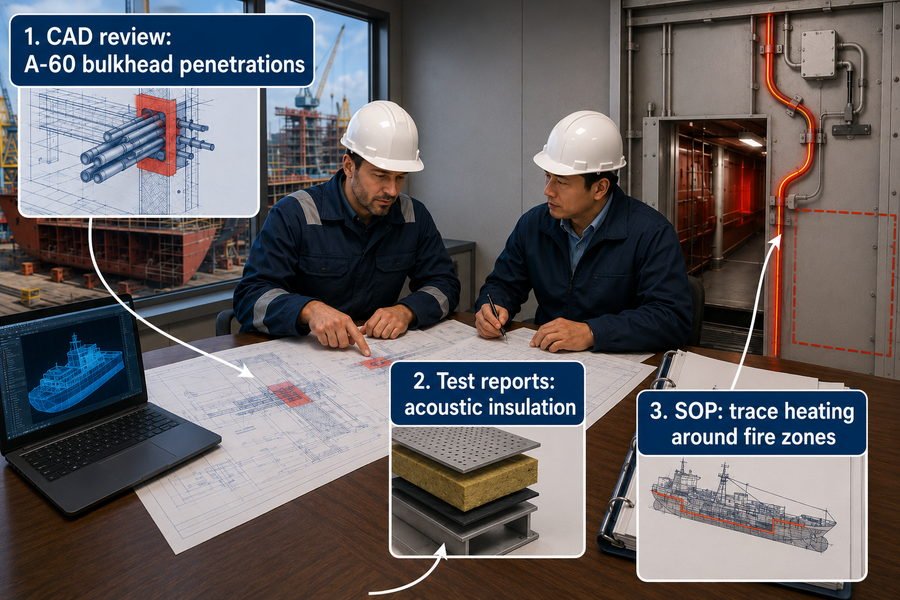
Shipyard engineers test a supplier's SOLAS Chapter II-2 knowledge by requesting three technical actions: reviewing custom CAD drawings for A-60 bulkhead penetrations, demanding test reports for acoustic insulation, and asking for their standard operating procedure on trace heating around fire zones.
Reviewing CAD Drawings for A-60 Bulkhead Penetrations
Shipyard engineers need hard proof. First, give the supplier a custom CAD drawing. Ask them how they handle an A-60 bulkhead penetration for pipes or cables. According to SOLAS, an A-60 rating means the unexposed side cannot rise above 180°C for 60 minutes4. They must show steel sleeves and certified sealants like Roxtec in their return drawing. If they just say they will cut a hole and fill it with foam, they fail the test entirely.
Evaluating Test Reports for Marine Acoustic Insulation
Second, demand acoustic test reports. SOLAS focuses on fire, but noise control is also a strict marine rule5. A good A-60 panel reduces noise by at least 45 decibels (dB). Ask for the official laboratory report for sound reduction. Real marine panel suppliers test their panels for both fire and sound. If they only have fire certificates and no sound reports, they likely sell cheap land-based panels.
Analyzing Standard Operating Procedures for Fire Zones
Third, ask for their Standard Operating Procedure (SOP) on fire zones. They must know how to build the panels so heat does not transfer through the metal frame. The gap between the inner steel skin and the outer structural frame must have proper insulation. Usually, this means at least 25mm of high-density ceramic fiber packing. Ask the engineer at the factory to explain this thermal bridge problem. Their answer will tell you their true skill level.
| Engineering Test Area | Passing Criteria | Failing Criteria |
|---|---|---|
| A-60 Bulkhead Penetrations | Uses certified sleeves and marine sealants | Suggests standard expanding foam |
| Acoustic Insulation Reports | Provides official lab report showing 45+ dB | Claims soundproof without any lab proof |
| Fire Zone SOP | Understands thermal bridge and ceramic packing | Does not know what a thermal bridge is |
What red flags expose a marine panel supplier's weak SOLAS knowledge?
Fake certificates look very real today. You might buy a panel that gets rejected by the port state control. What are the obvious warning signs of a bad supplier?
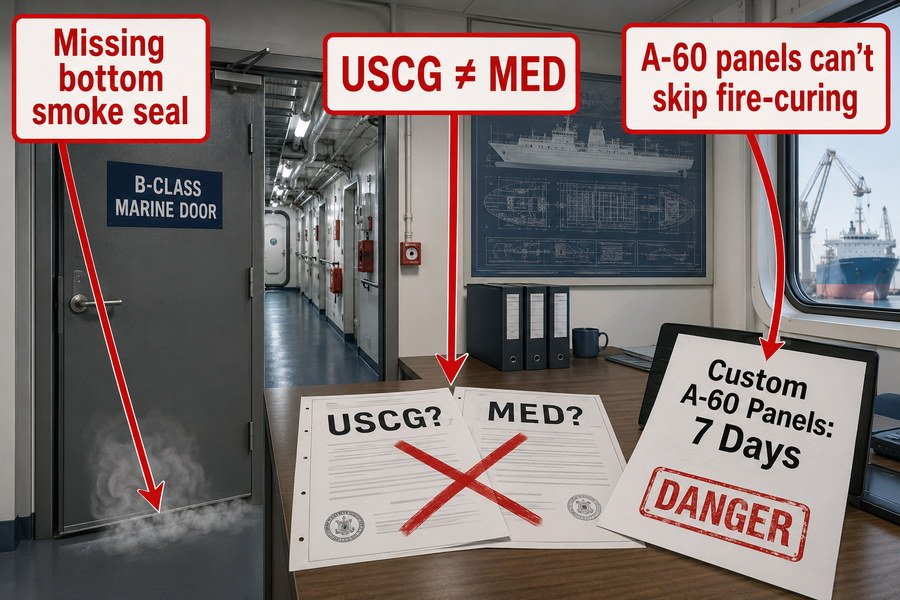
Three major red flags expose weak SOLAS knowledge: offering B-Class doors without bottom gap smoke seals, mixing up USCG and MED certification requirements, and quoting lead times under 10 days for custom A-60 panels, which skips mandatory fire-curing processes.
Missing Smoke Seals on B-Class Marine Fire Doors
I see bad suppliers all the time in this industry. The first red flag is offering B-Class doors without smoke seals. SOLAS Chapter II-2 states B-15 doors must stop flames for 15 minutes6. They also need a strict bottom gap limit. Sometimes, ships need a 25mm bottom gap for cabin ventilation. If the supplier does not ask about this gap or provide a proper smoke seal, walk away. They do not understand how smoke kills before fire does.
Confusion Between USCG and MED Certification Rules
The second red flag is mixing up USCG and MED rules. MED is the European Wheelmark. USCG is the United States Coast Guard. They are different systems. A supplier must know the mutual recognition agreements between them. If the sales person says MED covers everything for a US-flagged ship7, they are wrong. A supplier who does not know basic global shipping rules will cause your project to fail inspection.
Unrealistic Short Lead Times for Custom A-60 Panels
The third red flag is lead times. Some suppliers promise custom A-60 panels in 7 to 10 days. This is a lie. The marine glue needs 48 hours just to cure under heavy pressure in the press machine. A real, honest lead time for 500 square meters of custom A-60 panels is 25 to 35 days. If they say 10 days, they are either skipping the glue curing process or sending you old stock that does not match your exact CAD drawings.
| Supplier Red Flag | Why It Violates SOLAS | The Real-World Risk |
|---|---|---|
| No Smoke Seals on Doors | Fails Chapter II-2 smoke containment | Crew inhales toxic smoke during a fire |
| Confusing USCG and MED | Misunderstands flag state regulations | Ship gets detained at the destination port |
| Lead Time Under 10 Days | Skips mandatory 48-hour glue curing | Panels delaminate and fail in the first year |
Why should project managers audit supplier SOLAS familiarity before contract signing?
Delays cost thousands of dollars a day in a shipyard. If your panels fail the surveyor's test, your whole project stops. Why must you audit them early?
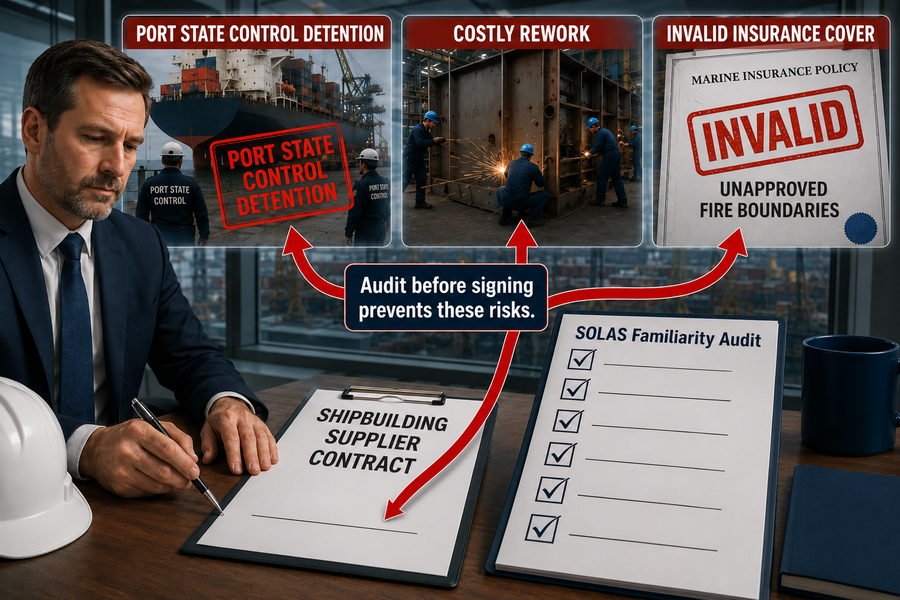
Project managers must audit supplier SOLAS familiarity before signing to prevent three critical risks: port state control detention of the vessel, costly rework from installing non-compliant B-15 bulkheads, and invalidation of the ship's marine insurance due to unapproved fire boundaries.
Preventing Port State Control Detention Through Proper Audits
Project managers care about time and money. First, if you do not audit the supplier, the Port State Control (PSC) will catch the mistake later. If the PSC boards the ship and finds bad wall panels, they will detain the ship immediately8. A detained ship costs the owner $10,000 to $50,000 per day9 in lost revenue. As the project manager, you will take the blame. You must audit early to stop this.
Avoiding Costly Rework of Non-Compliant B-15 Bulkheads
Second, you must avoid rework. Imagine your team installs 2,000 square meters of B-15 panels. Then, the class surveyor visits. The surveyor rejects the panels because the factory used toxic, non-marine glue. You must tear all the panels out. Removing the bad panels and buying new ones will take 60 days. It will also cost double your original budget. An early audit prevents this massive waste of money.
Protecting Marine Insurance Coverage with Approved Fire Boundaries
Third, you must protect the ship's marine insurance. Marine insurance companies demand 100% SOLAS compliance. If a fire starts in a cabin and the panels fail in 10 minutes instead of the required 60 minutes, the insurance company will investigate. When they find out the panels lacked proper certification, they will not pay the claim. You audit the supplier before signing the contract to protect the 5 million USD interior outfitting investment.
| Audit Failure Risk | Financial Impact | Time Delay Impact |
|---|---|---|
| Port State Control Detention | $10,000 to $50,000 per day | Indefinite until fixed |
| Non-Compliant Panel Rework | Double the original material cost | 60 days to replace and reinstall |
| Invalidated Marine Insurance | Total loss of vessel value | Permanent loss |
How do shipowners screen marine panel vendors by SOLAS literacy?
Shipowners invest millions into a vessel for a 20-year lifespan. Cheap panels rot or fail fire tests in five years. How do owners screen for long-term safety?
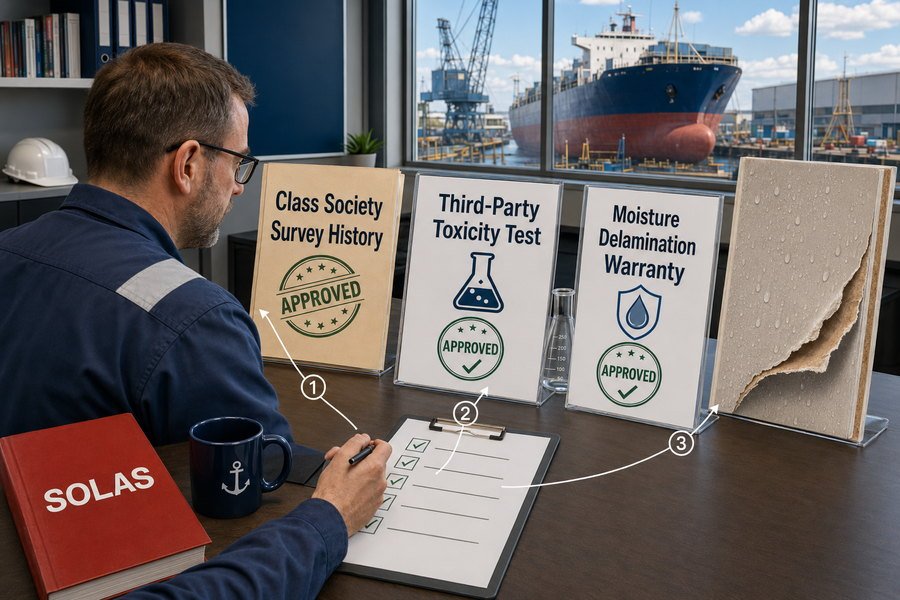
Shipowners screen marine panel vendors by SOLAS literacy using three strict methods: requiring a history of successful Class Society surveys, demanding third-party lab toxicity test results, and evaluating their warranty policy for moisture-induced panel delamination.
Reviewing Past Success with Class Society Surveys
Shipowners think about the long term. First, they look at Class Society records. A good marine panel vendor has passed surveys with the American Bureau of Shipping (ABS) or Lloyd's Register (LR). Owners ask the vendor for the names of the last three ships they supplied. Then, the owner checks if those ships passed their ABS or LR surveys. If the vendor cannot name three successful ships, the owner will not buy from them.
Demanding Third-Party Toxicity Test Results for Fire Smoke
Second, shipowners check toxicity. SOLAS Chapter II-2 strictly limits the toxic smoke a panel can make when burning.10 Shipowners ask for the IMO FTP Code Annex 1 Part 2 test report. This official lab report proves the carbon monoxide and hydrogen cyanide levels remain low during a fire. If a vendor uses cheap commercial glue, it will produce deadly gas. Only vendors who provide this third-party lab report pass the screening.
Evaluating Warranty Policies for Moisture-Induced Panel Delamination
Third, they look at moisture resistance. Ships are very wet environments. Poor panels absorb water and the thin steel skins peel off the rock wool core.11 We call this delamination. Shipowners screen vendors by asking for a clear 5-year warranty against delamination in 85% humidity environments. Only a vendor who uses high-quality, high-temperature marine glue can offer this kind of guarantee. Cheap suppliers will only offer a 1-year warranty.
| Shipowner Screening Method | Evidence Required from Vendor | Why It Matters for 20-Year Lifespan |
|---|---|---|
| Class Society History | 3 recent ship project names | Proves the product works in real life |
| Toxicity Test Results | IMO FTP Code Annex 1 Part 2 report | Ensures crew safety from toxic gas |
| Delamination Warranty | 5-year warranty document | Prevents panels from rotting in high humidity |
What documents prove a marine panel manufacturer follows SOLAS Chapter II-2?
Words are cheap, but official paper is heavy. You cannot trust a sales brochure for ship safety. What exact documents prove they follow the law?
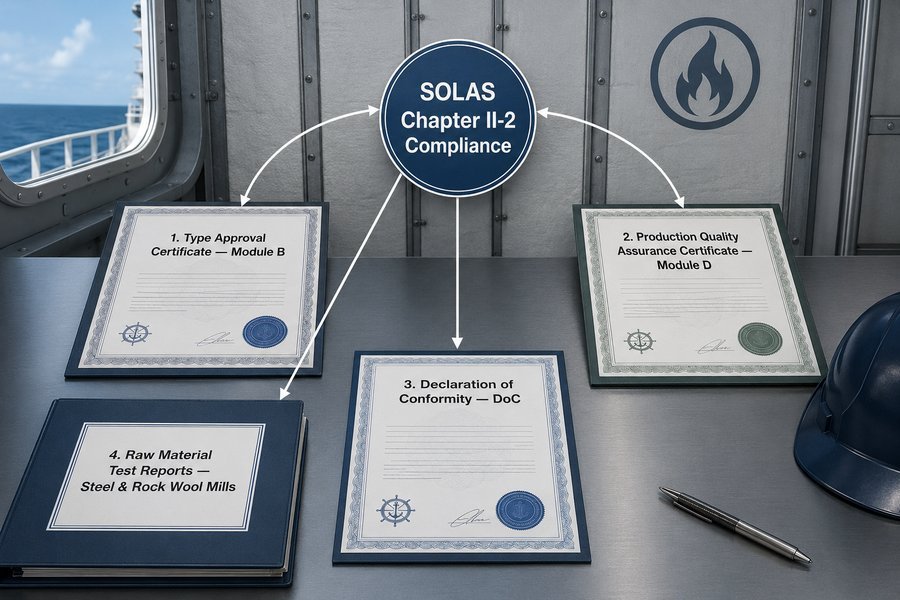
To prove SOLAS Chapter II-2 compliance, a manufacturer must provide four key documents: the Type Approval Certificate (Module B), the Production Quality Assurance Certificate (Module D), the Declaration of Conformity (DoC), and the raw material test reports from the steel and rock wool mills.
Verifying Type Approval Certificates (Module B)
At Magellan Marine, I handle these papers every day. First, you need the Module B certificate. This paper proves the specific panel design passed the physical fire test in a lab. It usually costs the factory around $15,000 to get this test done. If a factory has a Module B certificate, it shows they invest serious money into their product safety. Always check the expiration date on this document.
Checking Production Quality Assurance Certificates (Module D)
Second, you need the Module D certificate. Module B just means they made one good panel for the laboratory. Module D means a third-party auditor checks their factory every year. The auditor makes sure the factory builds every single panel exactly like the tested one. You must have both Module B and Module D. One without the other is useless for your marine project.
Reviewing the Declaration of Conformity (DoC)
Third, get the Declaration of Conformity (DoC). This is a very important legal document. The factory owner or manager signs this paper to take direct legal responsibility for the batch of panels they send to you. If the panels fail later, the DoC proves the factory claimed they were safe. You must keep this document in your ship's official records for the lifespan of the vessel.
Tracing Raw Material Test Reports for Steel and Rock Wool
Finally, you must ask for raw material reports. The factory buys rock wool and steel from other companies. The rock wool must have its own mill certificate proving it is non-combustible. The galvanized steel sheet must have a mill test report showing it is at least 0.6mm thick. If the factory cannot track their raw materials, they do not have real quality control.
| Required Document | What It Proves | Who Issues It |
|---|---|---|
| Module B Certificate | The design passed the fire test | Notified Body (e.g., DNV, ABS) |
| Module D Certificate | The factory maintains quality control | Notified Body Auditor |
| Declaration of Conformity | The factory takes legal responsibility | The Manufacturer |
| Mill Test Reports | The steel and rock wool are genuine | The Raw Material Suppliers |
Conclusion
Verifying SOLAS Chapter II-2 awareness is critical for marine safety. By asking exact technical questions, checking strict documents, and spotting early red flags, you protect your crew, budget, and ship.
-
"[PDF] RESOLUTION MSC.307(88) (adopted on 3 December 2010 ...", https://wwwcdn.imo.org/localresources/en/KnowledgeCentre/IndexofIMOResolutions/MSCResolutions/MSC.307(88).pdf. A primary regulatory source should establish the SOLAS/IMO FTP Code criteria for B-15 divisions and clarify whether the standard prescribes a mineral-wool density or instead requires performance in a specified fire test. Evidence role: expert_consensus; source type: government. Supports: SOLAS requires rock wool density to be at least 120 kg/m³ for B-15 walls.. Scope note: SOLAS and the FTP Code may define B-15 by fire-resistance performance rather than by a universal 120 kg/m³ core-density requirement. ↩
-
"How to choose the right marine wall panels for marine interior ...", https://magellanmarinetech.com/how-choose-right-marine-wall-panels-for-marine-interior-projects/. A fire-test report or technical study should support the relationship between mineral-wool density and B-15 fire-test performance, while noting that pass/fail results depend on the complete tested assembly, including facings, joints, fixings, and insulation layout. Evidence role: mechanism; source type: paper. Supports: A density of 80 kg/m³ will fail a marine fire test.. Scope note: Density alone may not determine fire-test failure for every panel design; certification is normally based on the tested assembly as a whole. ↩
-
"[PDF] RESOLUTION MSC.307(88) (adopted on 3 December 2010 ...", https://wwwcdn.imo.org/localresources/en/KnowledgeCentre/IndexofIMOResolutions/MSCResolutions/MSC.307(88).pdf. A fire-test standard or marine accommodation-panel technical reference should show that panel joints and connections are part of the tested fire-resisting assembly and that joint geometry and sealing influence flame and hot-gas passage. Evidence role: mechanism; source type: institution. Supports: Good suppliers use Z-joints or internal splines to reduce flame spread at panel joints.. Scope note: Such evidence would support the importance of engineered joints generally, but it would not prove that every Z-joint or spline design satisfies B-15 requirements without assembly-specific testing. ↩
-
"How Does the IMO FTP Code Connect with Other Marine Fire Safety ...", https://magellanmarinetech.com/how-imo-ftp-code-connect-with-other-marine-fire-safety-frameworks/. The SOLAS/IMO fire-test framework for A-class divisions specifies that an A-60 division must prevent flame passage for 60 minutes and limit the unexposed-face temperature rise, including a maximum rise of 180°C at any point. Evidence role: definition; source type: institution. Supports: An A-60 fire rating limits the temperature rise on the unexposed side during a 60-minute fire test.. Scope note: The full criterion also includes an average temperature-rise limit, so a source should be used to support the complete A-60 definition rather than only the 180°C point limit. ↩
-
"[PDF] MSC.337(91) - International Maritime Organization", https://wwwcdn.imo.org/localresources/en/KnowledgeCentre/IndexofIMOResolutions/Documents/MSC%20-%20Maritime%20Safety/337(91).pdf. The IMO Code on Noise Levels on Board Ships establishes maximum noise-level limits for shipboard spaces and is linked to SOLAS requirements for applicable vessels, supporting the point that marine noise control is regulated rather than merely optional. Evidence role: expert_consensus; source type: institution. Supports: Noise control is subject to formal marine regulatory requirements.. Scope note: This supports the regulatory importance of shipboard noise control, but it does not by itself prove that any particular A-60 panel must achieve a 45 dB sound-reduction value. ↩
-
"[PDF] RESOLUTION MSC.307(88) (adopted on 3 December 2010 ...", https://wwwcdn.imo.org/localresources/en/KnowledgeCentre/IndexofIMOResolutions/MSCResolutions/MSC.307(88).pdf. SOLAS fire-test classifications define B-class divisions by their ability to prevent flame passage for the first half hour, with the B-15 subclass additionally meeting insulation-temperature criteria for 15 minutes under the prescribed test conditions. Evidence role: definition; source type: institution. Supports: SOLAS Chapter II-2 states B-15 doors must stop flames for 15 minutes.. Scope note: This supports the regulatory meaning of the B-15 rating, but the exact door assembly must still be covered by an approved type-test certificate. ↩
-
"[PDF] Marine Safety: Port State Control", https://media.defense.gov/2022/Feb/09/2002935707/-1/-1/0/CI_16000_73.PDF. U.S. Coast Guard guidance treats Marine Equipment Directive approvals under specific acceptance and mutual-recognition arrangements rather than as a blanket substitute for all approvals required on U.S.-flagged vessels. Evidence role: general_support; source type: government. Supports: A supplier is wrong to say that MED certification automatically covers everything for a US-flagged ship.. Scope note: The source should be checked for the particular equipment category, because acceptance may vary by product type, approval module, and applicable USCG policy letter or regulation. ↩
-
"[PDF] PROCEDURES FOR PORT STATE CONTROL, 2023", https://wwwcdn.imo.org/localresources/en/OurWork/IIIS/Documents/A%2033-Res.1185%20-%20PROCEDURES%20FOR%20PORT%20STATE%20CONTROL,%202023%20(Secretariat)%20(1).pdf. Official Port State Control guidance supports that vessels may be detained when deficiencies present a clear hazard to safety, health, or the marine environment, including serious fire-safety deficiencies; this supports the detention risk but not that detention is automatic in every inspection. Evidence role: general_support; source type: institution. Supports: If PSC inspectors find serious non-compliant fire boundary materials, the vessel may be detained.. Scope note: PSC detention is discretionary and depends on the severity of deficiencies and the inspecting authority’s assessment. ↩
-
"[PDF] PROCEDURES FOR PORT STATE CONTROL, 2023", https://wwwcdn.imo.org/localresources/en/OurWork/IIIS/Documents/A%2033-Res.1185%20-%20PROCEDURES%20FOR%20PORT%20STATE%20CONTROL,%202023%20(Secretariat)%20(1).pdf. A maritime economics study or institutional shipping report documenting off-hire, delay, or detention-related daily losses would support the claimed order of magnitude for detention costs; such evidence would contextualize the estimate rather than prove a universal daily cost. Evidence role: statistic; source type: paper. Supports: A detained ship can cost the owner tens of thousands of dollars per day in lost revenue or delay-related losses.. Scope note: Actual losses vary by vessel type, charter rate, cargo, port, and duration of detention. ↩
-
"What Is the Purpose and Scope of the IMO FTP Code? - Magellan ...", https://magellanmarinetech.com/what-purpose-scope-of-imo-ftp-code/. The IMO Fire Test Procedures Code, applied through SOLAS fire-safety requirements, includes smoke and toxicity testing procedures for certain shipboard materials, supporting the need to assess fire-smoke toxicity in marine interiors. Evidence role: general_support; source type: institution. Supports: SOLAS Chapter II-2 and related IMO fire-testing rules regulate smoke-toxicity performance for relevant shipboard materials.. Scope note: This supports the regulatory context for smoke-toxicity testing, but it does not verify any specific vendor’s panel or test results. ↩
-
"Moisture Effects on Acoustic Emission Characteristics ... - PMC", https://pmc.ncbi.nlm.nih.gov/articles/PMC10934220/. Research on bonded sandwich panels reports that moisture ingress can degrade adhesive interfaces and contribute to skin-core debonding or delamination, supporting the described moisture-related failure mechanism. Evidence role: mechanism; source type: paper. Supports: Moisture absorption can contribute to adhesive degradation and delamination between sandwich-panel skins and cores.. Scope note: The support is contextual for sandwich-panel construction generally and may not directly test steel-skin, rock-wool marine panels under the exact humidity conditions described. ↩