Confused by SOLAS rules? Using the wrong panels causes failed inspections and delays. Let me show you the exact areas with the strictest rules to keep your project safe.
Under SOLAS Chapter II-2, the strictest marine panel requirements apply to Category A machinery spaces, control stations, galleys, and main escape routes. These four critical zones demand A-60 class fire-rated boundaries to contain extreme heat, protect critical ship operations, and ensure safe passenger evacuation during maritime emergencies.
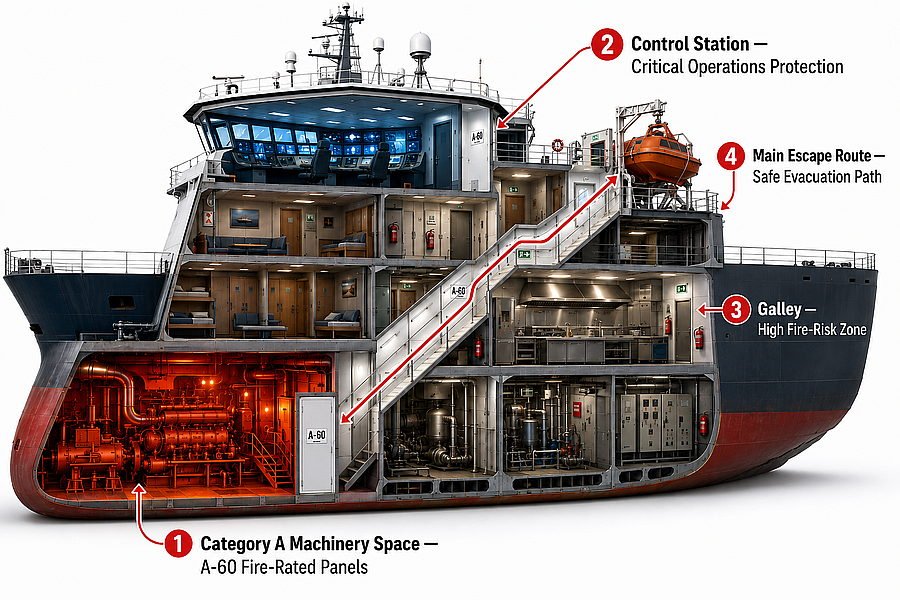
Let us break down exactly what this means for your next outfitting project so you can buy the right materials without wasting money.
Why do SOLAS accommodation spaces require certified marine wall and ceiling panels?
Buying cheap panels? They might catch fire fast. Accommodation spaces need certified panels to stop smoke and save lives. Here is why certification matters for your interiors.
SOLAS accommodation spaces require certified panels for three vital reasons: to prevent fire spread, restrict toxic smoke generation, and maintain structural integrity. According to the IMO FTP Code, certified B-15 panels must block flames for 30 minutes and limit unexposed side temperature rise to 140°C.
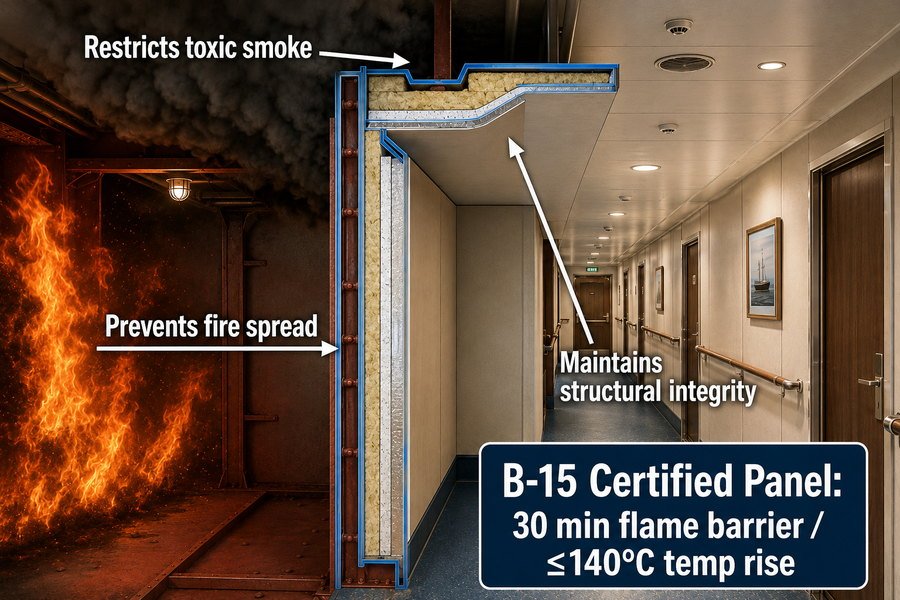
When I worked on the floor of a marine outfitting factory, I saw many buyers try to save money by purchasing standard commercial building panels. This is a huge mistake. We must look deeply at the three reasons outlined above to understand why shipyards reject uncertified materials.
Preventing Fire Spread in Accommodation Spaces
The first reason SOLAS demands certified panels is to prevent fire spread. Accommodation spaces are where the crew and passengers sleep. If a fire starts in a cabin bed, a certified B-15 marine wall panel keeps the flames trapped inside that single room1. The IMO FTP Code Part 3 dictates that a B-15 panel must hold back flames completely for 30 minutes. I always tell my clients at Magellan Marine that this 30-minute window gives the crew enough time to grab fire hoses and extinguish the threat. If the fire spreads to the next cabin, the ship is in major trouble.
Restricting Toxic Smoke and Maintaining Structural Integrity
The second reason is restricting toxic smoke generation. During a ship fire, toxic gas kills people much faster than actual heat2. Certified panels use specific surface finishes, like low-flame spread PVC films or painted galvanized steel. According to IMO FTP Code Part 53, these surfaces will not release black, toxic smoke when they get hot.
The third reason is maintaining structural integrity. The wall must stay standing. A standard B-15 panel uses high-density rockwool core material. The density is usually between 100 kg/m³ and 120 kg/m³. This dense rockwool ensures the panel stays strong. During a laboratory furnace test, the unexposed side of the panel cannot rise more than 140°C on average above the starting temperature4. If you buy uncertified panels, the internal glue melts quickly, the outer steel warps, and the whole wall falls down in five minutes.
| Feature | Standard Land Panel | Certified B-15 Marine Panel | SOLAS Requirement |
|---|---|---|---|
| Core Material | Paper honeycomb or cheap foam | High-density rockwool (120 kg/m³) | Non-combustible core |
| Flame Block Time | 5 to 10 minutes | Minimum 30 minutes | IMO FTP Code Part 3 |
| Average Price | $8 to $12 per square meter | $18 to $25 per square meter | Must have MED/USCG Certificate |
| Smoke Generation | High toxic smoke | Very low smoke | IMO FTP Code Part 5 |
How does SOLAS Chapter II-2 classify fire zones for marine panel selection?
Picking the wrong panel rating hurts your budget. SOLAS groups ship areas into specific fire zones. I will explain this system simply to save you time.
SOLAS Chapter II-2 classifies fire zones into 14 distinct space categories, ranging from low-risk sanitary spaces to high-risk galleys. It uses a matrix to determine boundary ratings between adjacent spaces, dictating A-Class, B-Class, or C-Class panels based on the combined fire risk of the two neighboring zones.
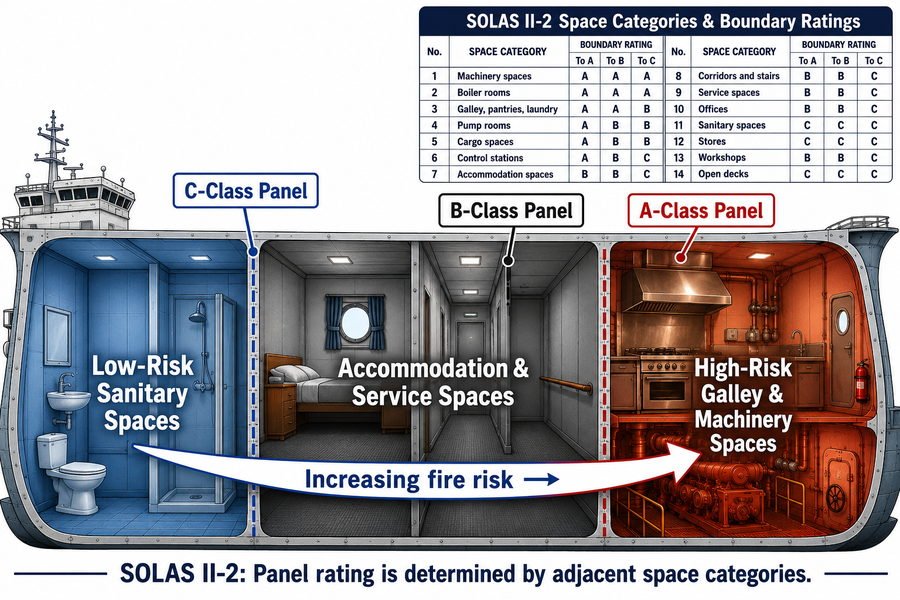
Understanding the classification system is the most important skill for a marine outfitting buyer. If you do not understand the zones, you will buy panels that are too thick or too thin. Let us look at the 14 categories and the matrix system in detail.
Understanding the 14 SOLAS Space Categories
SOLAS Chapter II-2 Regulation 9 divides every part of a passenger ship into 14 space categories.5 They rank these spaces by fire risk. For example, Category 1 includes control stations, which hold radio rooms and fire control panels. These are critical. Category 14 covers open decks, which have almost zero fire risk. Category 7 covers galleys and main pantries, which have huge fire risks because of cooking oil and stoves.6 Category 6 covers standard accommodation spaces, like passenger cabins. When you look at a ship drawing, you must identify the category of every single room. I have helped many buyers map these out, and missing just one category can force you to order replacement panels by air freight, which costs a fortune.
Using the Boundary Matrix for A-Class, B-Class, and C-Class Panels
Once you know the categories, you use the SOLAS boundary matrix7 to pick the panel class. The matrix cross-references the two rooms sharing a wall. This determines if you need A-Class, B-Class, or C-Class panels.
For example, if a Category 6 room (cabin) sits next to another Category 6 room (cabin), the matrix says you only need a B-0 class wall. A B-0 panel stops flames for 30 minutes but has no strict temperature limit.8 However, if a Category 6 room sits next to a Category 7 room (galley), the matrix says you need an A-60 class wall. An A-60 panel stops flames and heat for 60 minutes. Finally, C-Class panels are just non-combustible dividers with no fire rating time limit. They are used between low-risk areas. If you use an A-60 panel where a B-0 panel is allowed, you waste money and add useless weight to the ship.
| Neighboring Spaces | Required Panel Rating | Typical Core Thickness | Estimated Cost per sqm |
|---|---|---|---|
| Cabin (Cat 6) to Cabin (Cat 6) | B-0 Class | 25mm to 50mm | $15 to $20 |
| Corridor (Cat 2) to Cabin (Cat 6) | B-15 Class | 50mm | $18 to $25 |
| Galley (Cat 7) to Cabin (Cat 6) | A-60 Class | 50mm to 100mm | $35 to $50 |
| Open Deck (Cat 14) to Sanitary Space (Cat 13) | C-Class | 25mm | $12 to $15 |
Which SOLAS spaces require non-combustible ceiling panels?
Not sure where ceilings must be strictly non-combustible? A wrong guess means tearing them down later. Here are the exact spaces that require them.
SOLAS mandates non-combustible ceiling panels in four main areas: all accommodation spaces, service spaces, control stations, and machinery spaces. These panels must pass the IMO FTP Code Part 1 test, ensuring they do not burn or give off flammable vapors when exposed to a 750°C furnace.
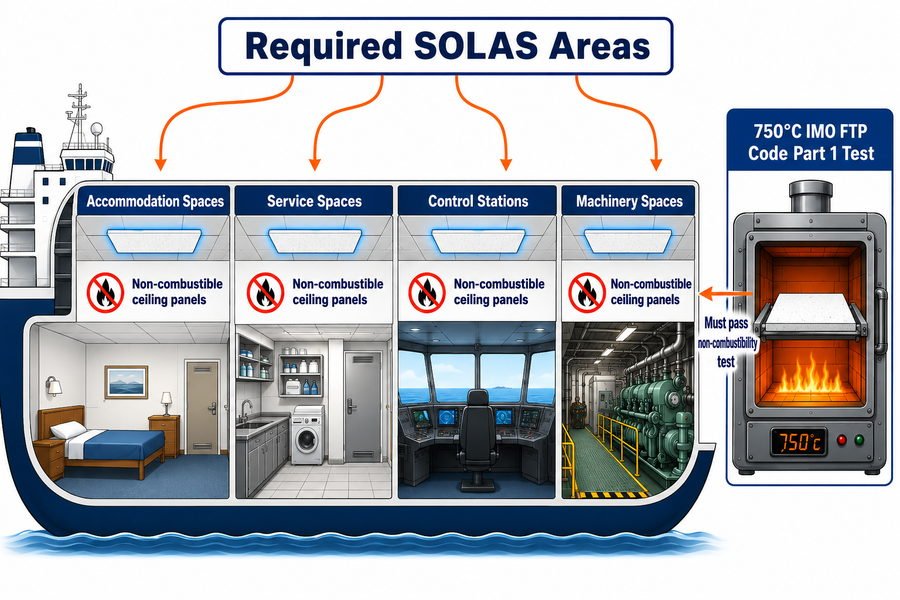
Ceilings are often ignored until the end of a project, but they cover huge areas of the ship. If a ceiling burns, the fire spreads across the top of the room instantly. We must explore the four areas mentioned to ensure full compliance.
Non-Combustible Panel Rules for Accommodations and Service Spaces
SOLAS clearly states that all accommodation spaces and service spaces must use non-combustible ceiling panels9. Accommodation spaces include cabins, dining rooms, hospitals, and lounges. Service spaces include laundries, small pantries, and storerooms.10 In these areas, the ceiling acts as a shield. To prove a panel is non-combustible, the factory sends it to a lab for the IMO FTP Code Part 1 test11. The lab puts the ceiling material into a furnace heated to 750°C for 30 minutes. If the material burns, smokes, or loses too much weight, it fails. I remember a project where a client bought cheap aluminum ceilings with a thick PVC coating. The coating burned in the 750°C furnace, and the whole batch was rejected. A proper non-combustible ceiling usually uses painted galvanized steel with a thin film (less than 0.1mm) and a rockwool or glass wool backer.
Non-Combustible Panel Rules for Control Stations and Machinery Spaces
The next two areas are control stations and machinery spaces. Control stations include the bridge and emergency generator rooms. Machinery spaces hold the engines and fuel pumps.12 In these rooms, the ceiling must also be strictly non-combustible. The stakes here are even higher. If a fire starts in the engine room, the ceiling above it must not add fuel to the fire. Sometimes, buyers ask me if they can use wood or plastic decorative ceilings in the wheelhouse to make it look nice. The answer is always no. Even decorative ceilings in control stations must have a non-combustible core. A good B-0 rated non-combustible continuous ceiling system will cost you about $18 to $22 per square meter in China. It is a small price to pay to keep the ship safe.
| Space Category | Examples | Ceiling Requirement | Accepted Materials |
|---|---|---|---|
| Accommodation Spaces | Cabins, Lounges | Non-combustible | Steel/Aluminum + Rockwool |
| Service Spaces | Laundries, Pantries | Non-combustible | Painted Steel + Mineral Wool |
| Control Stations | Bridge, Radio Room | Non-combustible | Steel panel with <0.1mm film |
| Machinery Spaces | Engine Room | Non-combustible | Raw Galvanized Steel + Rockwool |
Why do SOLAS Chapter II-2 escape routes demand specific marine panel ratings?
A blocked exit is a disaster. Escape routes must stay safe during a fire. We must use specific panels to keep these paths open.
SOLAS Chapter II-2 escape routes demand specific marine panel ratings for three reasons: to shield passengers from extreme heat, to prevent flame penetration into stairways, and to ensure corridors remain clear of toxic gas. Stairway enclosures typically require A-60 or A-0 boundaries, while corridors need at least B-15 panels.
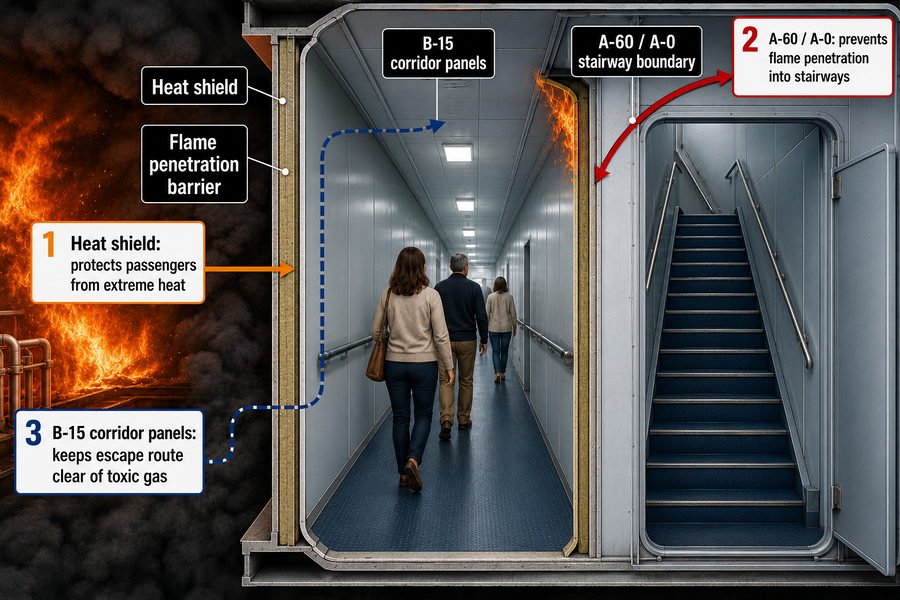
Escape routes are the lifelines of any vessel. When an alarm rings, people panic. If the escape route is hot or full of smoke, people cannot reach the lifeboats. Let us examine the three reasons why these routes need strict panels, and look at the differences between stairways and corridors.
Shielding Passengers and Blocking Flames in Stairways
The main vertical zones and stairway enclosures act like chimneys during a fire. Flames naturally want to travel up the stairs. Therefore, SOLAS requires panels to prevent flame penetration into stairways and to shield passengers from extreme heat. This is why stairway enclosures usually require A-Class boundaries. If the stairway is next to a high-risk area, it needs an A-60 panel. An A-60 panel keeps the heat on the cold side below 140°C even when the fire side is at 945°C.13 This means a passenger can touch the stairway wall and not burn their hand while running down the stairs. If the stairway is next to a low-risk area, an A-0 panel is enough. An A-0 panel blocks the actual fire for 60 minutes, but it does not have to stop the heat.
Ensuring Corridors Stay Clear of Toxic Gas with B-15 Panels
The third reason is to ensure corridors remain clear of toxic gas and smoke. Corridors are horizontal escape routes leading to the stairs. SOLAS requires corridor walls to be at least B-15 class.14 A B-15 panel stops flames and smoke for 30 minutes, keeping the corridor clear so people can breathe while they escape. The doors in these corridors must also match the B-15 rating. A major issue I see is bad installation. If the shipyard leaves gaps between the B-15 corridor panel and the ceiling, toxic gas will leak into the escape route. The panels must connect perfectly. A standard B-15 panel for corridors weighs about 18 kg per square meter, making it easy for workers to handle and install tightly.
| Escape Route Component | Adjoining Space Risk | Minimum Panel Rating | Time to Block Flames |
|---|---|---|---|
| Stairway Enclosure | High Risk (Galley) | A-60 Class | 60 minutes |
| Stairway Enclosure | Low Risk (Cabin) | A-0 Class | 60 minutes |
| Main Corridor | Medium Risk (Cabin) | B-15 Class | 30 minutes |
| Escape Trunk | Machinery Space | A-60 Class | 60 minutes |
How does SOLAS treat galley and machinery boundaries for interior panels?
Galleys and engine rooms are the biggest fire hazards. You cannot use normal panels here. Let us look at the heavy-duty rules for these zones.
SOLAS treats galleys and Category A machinery spaces as high-fire-risk zones, strictly requiring A-60 class boundaries when adjacent to accommodation areas. These panels must feature thick rockwool insulation, typically 50mm to 100mm, to block 945°C fires for a full 60 minutes, ensuring maximum thermal containment.
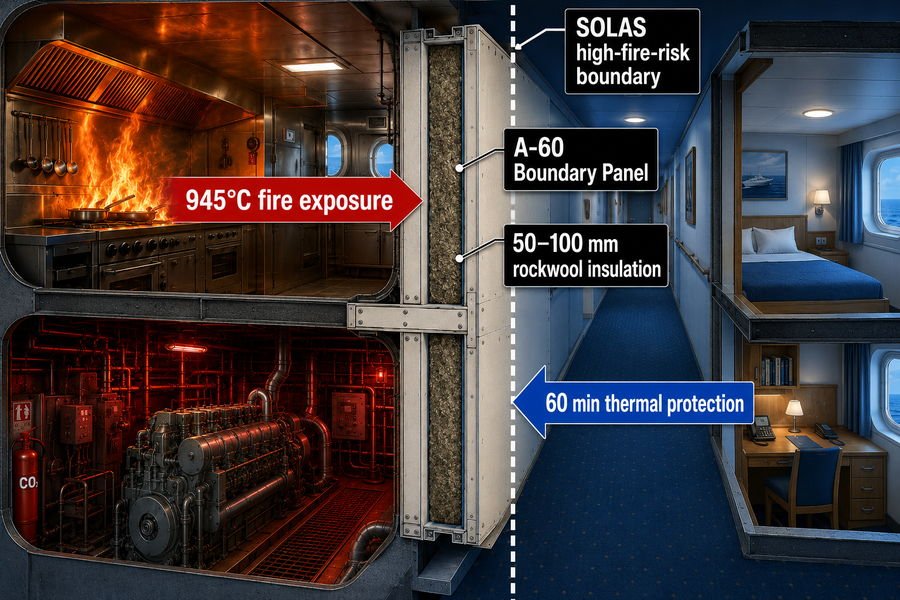
The engine room has huge amounts of diesel fuel, and the galley has hot cooking oil. These two areas start the most fires on ships. Because of this, the rules are very strict. We will look at galleys and machinery spaces separately to understand the exact panel requirements.
A-60 Requirements for Galley Boundaries
A galley is classified as a Category 7 space under SOLAS.15 Because cooks use open flames and deep fat fryers, fires happen fast. SOLAS dictates that any wall separating a galley from a cabin, dining room, or corridor must be an A-60 class boundary.16 The goal is maximum thermal containment. This means the panel must block the flames and the heat for 60 full minutes. To do this, an A-60 panel uses very thick rockwool insulation. While a standard cabin panel is 25mm or 50mm thick, an A-60 galley wall panel is often 50mm thick with double steel skins, or it requires an extra layer of 50mm marine rockwool applied directly to the ship's steel bulkhead. This brings the total insulation thickness up to 100mm. The steel surface inside the galley is usually stainless steel instead of PVC-coated steel. Stainless steel is easy to clean, does not burn, and costs about $45 to $60 per square meter.
Insulation and Testing Standards for Category A Machinery Spaces
Category A machinery spaces hold the main propulsion engines.17 This is a Category 12 space. If an oil pipe bursts and hits a hot exhaust manifold, you get a massive fire immediately. SOLAS requires the walls between the engine room and the accommodation block to be A-60 class. During the official IMO laboratory test, the A-60 panel is subjected to the standard time-temperature curve. The furnace heats up to 945°C within 60 minutes.18 The panel must not let flames through, and the cold side must stay cool enough to protect the crew living next door. The rockwool used here is extremely heavy, often 130 kg/m³ to 150 kg/m³ density. This makes the panels heavy and hard to move, so you must arrange good lifting tools for the installation workers.
| Boundary Type | Adjacent Area | Required Rating | Insulation Thickness | Surface Material |
|---|---|---|---|---|
| Galley (Cat 7) | Dining Room (Cat 6) | A-60 | 50mm - 100mm total | Stainless Steel / Painted Steel |
| Galley (Cat 7) | Open Deck (Cat 14) | A-0 | 25mm - 50mm | Stainless Steel |
| Machinery (Cat 12) | Crew Cabin (Cat 6) | A-60 | 100mm total | Galvanized / Painted Steel |
| Machinery (Cat 12) | Store Room (Cat 13) | A-0 | 50mm | Galvanized Steel |
Why must designers map SOLAS Chapter II-2 fire zones before specifying ceilings?
Ordering ceilings blindly? You will face huge installation headaches. Mapping fire zones first stops costly errors. Here is why you must plan ahead.
Designers must map SOLAS Chapter II-2 fire zones before specifying ceilings to achieve three critical goals: avoiding costly over-specification of A-Class materials, ensuring continuous B-Class draft stops, and preventing supply chain delays. Proper mapping aligns procurement exactly with the vessel’s fire control plan, saving up to 20% in material costs.
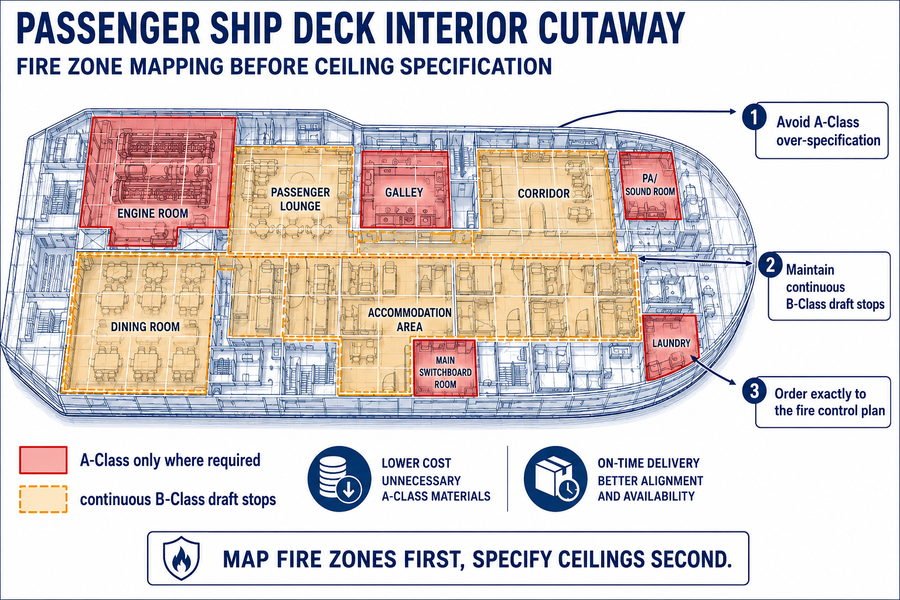
Planning is everything in ship interior decoration. If you just send your supplier a list of room names without mapping the fire zones, you will lose money and time. Let us explore the three critical goals of mapping fire zones before you buy a single piece of material.
Avoiding Over-Specification and Managing Continuous B-Class Draft Stops
The first goal is avoiding costly over-specification. Many procurement officers buy high-rated A-Class or B-15 ceilings for every room just to be safe. This is a waste. By mapping the SOLAS zones19, you might find that 60% of your rooms only need B-0 ceilings. A B-15 ceiling costs around $25 per square meter, while a B-0 ceiling costs $18. On a large ship with 5,000 square meters of ceiling, mapping the zones saves you $35,000 instantly.
The second goal is ensuring continuous B-Class draft stops. SOLAS requires long corridors and large ceiling voids to be divided by draft stops every 14 meters.20 A draft stop stops fire from running hidden above the ceiling.21 If you map the zones, you know exactly where these draft stops go. You can then order the correct steel profiles and heavy rockwool to build them. If you do not map them, the surveyor will find missing draft stops during the final inspection, and you will have to cut open your beautiful new ceilings to install them.
Preventing Supply Chain Delays Through Accurate Zone Mapping
The third goal is preventing supply chain delays. Custom marine panels from China or Vietnam take time to manufacture. The lead time is usually 30 to 45 days, plus 30 days for ocean shipping. If you do not map the fire zones early, you will inevitably order the wrong quantities of A-Class and B-Class panels. When the shipyard realizes the mistake, you will have to place a rush order. Shipping heavy steel panels by air to Europe or the United States is incredibly expensive and ruins your profit margin. By mapping the fire control plan with your supplier on day one, you align procurement perfectly.
| Procurement Strategy | Ceilings Ordered | Draft Stops Planned | Impact on Budget | Lead Time Issues |
|---|---|---|---|---|
| Without Mapping | 100% B-15 (Over-spec) | Missed completely | High waste ($$$) | Emergency orders needed |
| With SOLAS Mapping | 40% B-15, 60% B-0 | Designed into layout | Saved 20% budget | Everything arrives on time |
Conclusion
Understanding SOLAS fire zones and matching them with the correct A-Class, B-Class, and non-combustible panels guarantees safety, passes inspections, and strictly controls your interior marine outfitting budget.
-
"What Is the Purpose and Scope of the IMO FTP Code? - Magellan ...", https://magellanmarinetech.com/what-purpose-scope-of-imo-ftp-code/. The IMO FTP Code’s fire-resistance criteria for B-class divisions support the claim that certified B-15 bulkhead panels are intended to prevent flame passage for a defined test period, with insulation performance rated for 15 minutes. Evidence role: definition; source type: institution. Supports: Certified B-15 marine wall panels are designed to help prevent flames from spreading out of an accommodation room.. Scope note: This supports the tested fire-resistance function of B-15 divisions, not a guarantee that every real cabin fire will remain confined to one room. ↩
-
"Conditions Permitting the Transport of High Concentrations of ...", https://www.nist.gov/publications/conditions-permitting-transport-high-concentrations-carbon-monoxide-building-fires. Fire-safety research and public-health sources generally identify smoke inhalation and toxic combustion products, including carbon monoxide, as major causes of injury and death in fires, supporting the importance of smoke and toxicity control in shipboard interiors. Evidence role: expert_consensus; source type: government. Supports: Toxic smoke and gases are a major life-safety hazard in fires and can be more immediately dangerous than heat exposure.. Scope note: Most evidence is based on fires generally rather than accommodation-space ship fires specifically, so it provides contextual support rather than vessel-specific mortality data. ↩
-
"[PDF] RESOLUTION MSC.307(88) (adopted on 3 December 2010 ...", https://wwwcdn.imo.org/localresources/en/KnowledgeCentre/IndexofIMOResolutions/MSCResolutions/MSC.307(88).pdf. The IMO FTP Code includes test procedures for surface flammability and, in separate provisions, smoke and toxicity characteristics of materials used on ships; these standards provide the regulatory context for limiting hazardous smoke from interior surface materials. Evidence role: definition; source type: institution. Supports: IMO fire-test procedures regulate the flame-spread and smoke/toxicity characteristics of surface materials used in certified marine panels.. Scope note: The source may show that smoke and toxicity are addressed separately from Part 5, so it contextualizes the regulatory requirement rather than proving that Part 5 alone covers black toxic smoke release. ↩
-
"[PDF] RESOLUTION A.754(18) adopted on 4 November 1993 ...", https://wwwcdn.imo.org/localresources/en/KnowledgeCentre/IndexofIMOResolutions/AssemblyDocuments/A.754(18).pdf. The IMO FTP Code fire-resistance criteria for B-class divisions specify insulation limits based on temperature rise on the unexposed face, including an average temperature-rise threshold of 140°C during the applicable rating period. Evidence role: definition; source type: institution. Supports: A B-15 panel must meet a laboratory furnace-test insulation criterion limiting average temperature rise on the unexposed side.. Scope note: This supports the laboratory acceptance criterion for certified divisions; it does not by itself establish field performance under all fire scenarios or installation conditions. ↩
-
"[PDF] solas - International Maritime Organization", https://wwwcdn.imo.org/localresources/en/publications/Documents/Supplements/English/QH110E_supplement_January2026.pdf. SOLAS Chapter II-2, Regulation 9 sets out fire integrity requirements for bulkheads and decks and uses numbered space categories for passenger-ship spaces when applying the boundary tables. Evidence role: definition; source type: institution. Supports: SOLAS Chapter II-2 Regulation 9 divides passenger ship spaces into numbered categories used for fire boundary requirements.. Scope note: The source establishes the regulatory classification framework, but it does not by itself verify any project-specific room categorization. ↩
-
"Summary of SOLAS chapter II-2 - International Maritime Organization", https://www.imo.org/en/ourwork/safety/pages/summaryofsolaschapterii-2-default.aspx. SOLAS fire boundary tables identify galleys and main pantries as a distinct higher-risk space category, while maritime fire-safety literature commonly treats cooking equipment and cooking oils as significant ignition and fuel sources in galley fires. Evidence role: general_support; source type: institution. Supports: Category 7 includes galleys and main pantries, and those spaces have elevated fire risk due to cooking equipment and oils.. Scope note: This supports the regulatory categorization and the general fire-hazard rationale, but it does not quantify the risk for every galley design. ↩
-
"Summary of SOLAS chapter II-2 - International Maritime Organization", https://www.imo.org/en/ourwork/safety/pages/summaryofsolaschapterii-2-default.aspx. SOLAS Chapter II-2 Regulation 9 uses tabulated fire-integrity requirements that cross-reference adjacent space categories to determine the required division standard between spaces. Evidence role: mechanism; source type: institution. Supports: The SOLAS boundary matrix cross-references adjacent room categories to determine whether an A-, B-, or C-class division is required.. Scope note: The source explains the regulatory method; the exact rating still depends on the applicable ship type, table, and any flag-state or class interpretations. ↩
-
"[PDF] recommendation for fire test procedures for “a” and “b” class ...", https://wwwcdn.imo.org/localresources/en/KnowledgeCentre/IndexofIMOResolutions/AssemblyDocuments/A.163(ES.IV).pdf. SOLAS definitions for B-class divisions require them to prevent flame passage for the first half hour of the standard fire test, while the numeral after the dash indicates the insulation period; B-0 therefore denotes no required insulation period beyond integrity. Evidence role: definition; source type: institution. Supports: A B-0 panel provides 30 minutes of flame integrity but has no required insulation time rating.. Scope note: This supports the regulatory meaning of B-0, but actual product approval depends on certified test results for the specific panel assembly. ↩
-
"[PDF] MSC.99(73) - International Maritime Organization", https://wwwcdn.imo.org/localresources/en/KnowledgeCentre/IndexofIMOResolutions/MSCResolutions/MSC.99(73).pdf. SOLAS Chapter II-2 and the associated Fire Safety Systems framework require many interior linings, ceilings, and related construction materials in accommodation and service spaces to meet non-combustibility or fire-restriction criteria. Evidence role: general_support; source type: institution. Supports: SOLAS states that accommodation spaces and service spaces must use non-combustible ceiling panels.. Scope note: The source should be checked against the vessel type, build date, and exact SOLAS regulation, because requirements can vary by ship category and arrangement. ↩
-
"[PDF] resolution msc.27(61) - International Maritime Organization", https://wwwcdn.imo.org/localresources/en/KnowledgeCentre/IndexofIMOResolutions/MSCResolutions/MSC.27(61).pdf. SOLAS Chapter II-2, Regulation 3 defines accommodation spaces and service spaces and lists examples such as cabins, public spaces, hospitals, pantries, lockers, and store-rooms. Evidence role: definition; source type: institution. Supports: Accommodation spaces include cabins, dining rooms, hospitals, and lounges, while service spaces include laundries, small pantries, and storerooms.. Scope note: The cited definitions establish the regulatory categories, not the suitability of any specific ceiling product. ↩
-
"How Does the IMO FTP Code Connect with Other Marine Fire Safety ...", https://magellanmarinetech.com/how-imo-ftp-code-connect-with-other-marine-fire-safety-frameworks/. The IMO Fire Test Procedures Code, Part 1 sets out the non-combustibility test used for materials in ship construction, including furnace exposure and criteria related to flaming, temperature rise, and mass loss. Evidence role: mechanism; source type: institution. Supports: A panel’s non-combustibility is demonstrated through the IMO FTP Code Part 1 test.. Scope note: This supports the testing method generally; the pass/fail outcome for a particular panel would require that panel’s laboratory test report. ↩
-
"[PDF] MSC.99(73) - International Maritime Organization", https://wwwcdn.imo.org/localresources/en/KnowledgeCentre/IndexofIMOResolutions/MSCResolutions/MSC.99(73).pdf. SOLAS Chapter II-2, Regulation 3 defines control stations to include spaces containing emergency sources of power and navigation or radio equipment, and defines machinery spaces by reference to propulsion machinery, boilers, oil fuel units, and similar equipment. Evidence role: definition; source type: institution. Supports: Control stations include the bridge and emergency generator rooms, while machinery spaces include areas with engines and fuel pumps.. Scope note: The examples in the article are simplified; the regulatory definitions contain additional categories and qualifications. ↩
-
"[PDF] RESOLUTION MSC.307(88) (adopted on 3 December 2010 ...", https://wwwcdn.imo.org/localresources/en/KnowledgeCentre/IndexofIMOResolutions/MSCResolutions/MSC.307(88).pdf. The IMO Fire Test Procedures Code defines A-class divisions by their ability to prevent flame passage for 60 minutes and limits the average temperature rise on the unexposed face to 140°C for A-60 insulation during the standard fire test. Evidence role: definition; source type: institution. Supports: An A-60 panel keeps the cold-side temperature rise within the A-60 limit during a standardized fire-resistance test.. Scope note: The 945°C figure reflects the standardized furnace time-temperature curve rather than proof of conditions in every shipboard fire, and the standard does not directly establish that the surface is safe to touch. ↩
-
"Summary of SOLAS chapter II-2 - International Maritime Organization", https://www.imo.org/en/ourwork/safety/pages/summaryofsolaschapterii-2-default.aspx. SOLAS Chapter II-2 Regulation 9 sets fire integrity requirements for bulkheads and decks, including corridor bulkheads, and its tables specify B-class or higher divisions depending on ship type and adjoining-space category. Evidence role: general_support; source type: institution. Supports: SOLAS prescribes minimum fire-integrity ratings for corridor walls, and B-15 is a common required rating in relevant accommodation escape-route contexts.. Scope note: The minimum rating is not universal for all corridors; it varies by vessel category, accommodation layout, and the risk category of adjacent spaces. ↩
-
"[PDF] MSC.99(73) - International Maritime Organization", https://wwwcdn.imo.org/localresources/en/KnowledgeCentre/IndexofIMOResolutions/MSCResolutions/MSC.99(73).pdf. SOLAS chapter II-2 fire-integrity tables classify ship spaces by fire risk and use numbered space categories, including galleys/service spaces in the relevant accommodation-area boundary tables. Evidence role: definition; source type: institution. Supports: A galley is classified as a Category 7 space under SOLAS.. Scope note: Category numbering can differ by ship type and SOLAS table, so the cited source should match the vessel category addressed by the article. ↩
-
"[PDF] Supplement - International Maritime Organization", https://wwwcdn.imo.org/localresources/en/publications/Documents/Supplements/English/QF110E_122015.pdf. SOLAS chapter II-2 Regulation 9 specifies minimum fire integrity ratings for bulkheads between accommodation and service-space categories; the A-60 requirement depends on the adjacent-space categories and the applicable table. Evidence role: expert_consensus; source type: institution. Supports: SOLAS requires A-60 class boundaries between galleys and specified adjacent accommodation or circulation spaces.. Scope note: This supports the regulatory basis for A-class boundaries but should be checked against the exact ship type, tonnage, and SOLAS table before treating every galley-to-corridor or galley-to-cabin boundary as A-60. ↩
-
"[PDF] solas/conf/d/5 - International Maritime Organization", https://wwwcdn.imo.org/localresources/en/KnowledgeCentre/ConferencesMeetings/SOLASConferenceDocuments/SOLAS%20CONF%20D%205.pdf. SOLAS defines machinery spaces of category A to include spaces containing internal-combustion machinery used for main propulsion, supporting the identification of main engine rooms as Category A machinery spaces. Evidence role: definition; source type: institution. Supports: Category A machinery spaces include spaces containing the main propulsion engines.. Scope note: The SOLAS definition also includes other machinery arrangements, such as certain oil-fired equipment and high-power internal-combustion machinery, so main propulsion engines are not the only qualifying criterion. ↩
-
"[PDF] RESOLUTION MSC.307(88) (adopted on 3 December 2010 ...", https://wwwcdn.imo.org/localresources/en/KnowledgeCentre/IndexofIMOResolutions/MSCResolutions/MSC.307(88).pdf. The IMO Fire Test Procedures Code uses the standard time-temperature curve for fire-resistance testing, under which furnace temperature reaches approximately 945 °C at 60 minutes. Evidence role: mechanism; source type: institution. Supports: In the A-60 fire-resistance test, the furnace temperature reaches about 945 °C after 60 minutes.. ↩
-
"Summary of SOLAS chapter II-2 - International Maritime Organization", https://www.imo.org/en/ourwork/safety/pages/summaryofsolaschapterii-2-default.aspx. SOLAS chapter II-2 establishes fire-safety objectives and requires structural fire protection to be arranged according to the fire risk and use of spaces, providing contextual support for differentiating ceiling specifications by mapped zones. Evidence role: general_support; source type: institution. Supports: Mapping SOLAS zones can show that different rooms require different ceiling fire ratings rather than a uniform high-rated specification.. Scope note: This supports the principle of zone-based fire protection, but it does not verify the article’s illustrative 60% B-0 allocation for a specific vessel. ↩
-
"[PDF] MSC.99(73) - International Maritime Organization", https://wwwcdn.imo.org/localresources/en/KnowledgeCentre/IndexofIMOResolutions/MSCResolutions/MSC.99(73).pdf. SOLAS fire-protection provisions for accommodation and service spaces specify subdivision of concealed air spaces behind ceilings and linings by close-fitting draught stops at intervals not exceeding 14 metres. Evidence role: definition; source type: institution. Supports: SOLAS requires concealed ceiling or lining spaces to be divided by draught stops at a maximum spacing of 14 metres.. ↩
-
"[PDF] Fireblocking, Draftstopping, & Firestopping", https://www.phila.gov/media/20251215104531/Fireblocking-Draftstopping-Webinar-12.12.25.pdf. Fire-safety guidance describes draftstopping as a method for subdividing concealed spaces so that flame, hot gases, and smoke are less able to spread through uninterrupted voids. Evidence role: mechanism; source type: government. Supports: Draft stops reduce hidden fire spread through concealed ceiling voids.. Scope note: General building-fire guidance explains the mechanism; maritime applications should still be checked against SOLAS and vessel-specific approval requirements. ↩