Buying marine wall panels is stressful enough. Discovering your documents use outdated SOLAS rules causes delays and lost money. I will show you how to avoid this nightmare.
Outdated SOLAS documents for marine wall panels create severe procurement risks including immediate classification society rejection, port state control detentions, project delays of 4 to 8 weeks, and financial penalties averaging $15,000 to $50,000 for emergency panel replacements and re-certification processes.
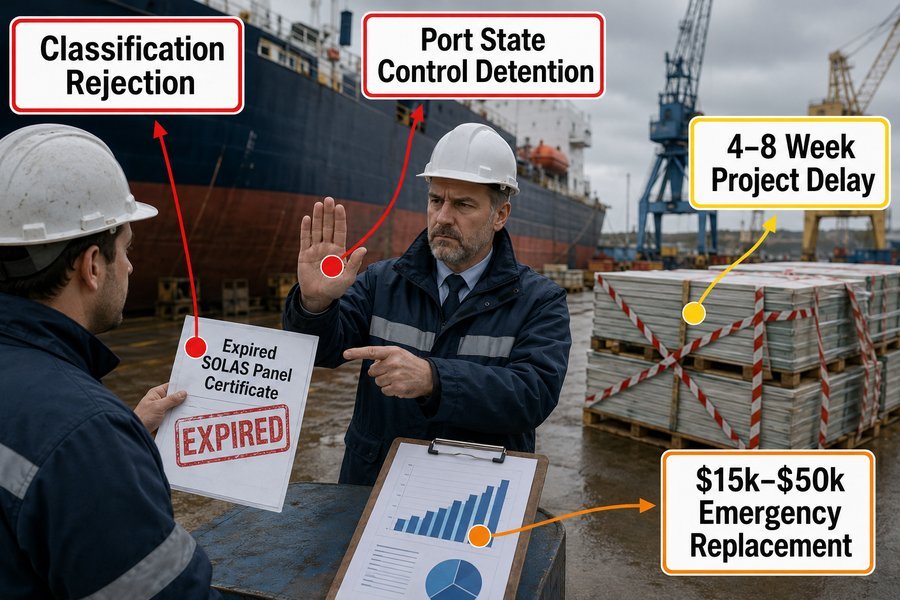
You might think a small typo in a certificate date is harmless. But in the shipbuilding world, this tiny mistake can stop your entire interior decoration project in its tracks. Let us look deeper into these specific risks.
Classification Society Rejection and Port State Control Detentions
When you submit outdated SOLAS documents, the first risk you face is immediate rejection by the classification society. I have seen this happen many times. Surveyors from organizations like DNV or ABS are very strict. According to the International Association of Classification Societies (IACS) 2023 guidelines, surveyors must reject any marine wall panel that does not reference the latest active SOLAS amendments1. If the certificate says "SOLAS 1974" but misses the 2014 updates, they will not approve the installation.
The second major risk is Port State Control (PSC) detentions. If an inspector misses the error during construction, the PSC officers will catch it when the ship starts trading. Based on the 2023 Annual Report by the Paris MoU on Port State Control, ships can be detained for days if their structural fire protection certificates are invalid2. A detained ship costs the shipowner about $20,000 to $30,000 per day in lost charter fees3. Because you supplied the panels, the shipowner will blame your company for this loss.
Project Delays and Financial Penalties for Panel Replacement
The third risk involves severe project delays. If your marine wall panels are rejected due to outdated documents, you cannot simply print a new piece of paper. You must order new, fully certified panels. Sourcing high-quality marine wall panels from China or Vietnam, producing them, and shipping them to a shipyard in Europe or the United States takes time. According to standard industry lead times from major Asian suppliers, this process causes project delays of 4 to 8 weeks4. Your interior decoration team will have to stop working and wait.
The fourth risk is the direct financial penalty. You have to pay for the emergency replacement of the panels and the re-certification process. Based on my experience at Magellan Marine, the cost of ripping out non-compliant panels, buying new ones, and paying for expedited air freight usually averages $15,000 to $50,000 per project. You also have to pay the classification surveyor an hourly rate of about $150 to $250 for the extra re-inspection time.
| Procurement Risk Type | Average Impact / Cost | Primary Source of Risk |
|---|---|---|
| Classification Rejection | 100% stop of installation work | IACS Surveyor Document Audit |
| Port State Control Detention | $20,000 - $30,000 per day | Paris MoU / Tokyo MoU Inspections |
| Project Schedule Delay | 4 to 8 weeks waiting time | Asian Manufacturing and Shipping |
| Emergency Replacement Cost | $15,000 to $50,000 total | Material, Labor, Air Freight |
What Risks Arise When Marine Wall Panel Certificates Cite Superseded SOLAS Versions?
You submitted the certificates, but the inspector points out an old SOLAS year. Your heart sinks. Old versions mean your panels might not meet today's strict fire safety standards.
Citing superseded SOLAS versions on marine wall panel certificates triggers three main risks: legal liability for installing non-compliant materials, immediate suspension of shipyard panel installation work, and failure of the International Code for Application of Fire Test Procedures (FTP Code) 2010 smoke and toxicity tests.
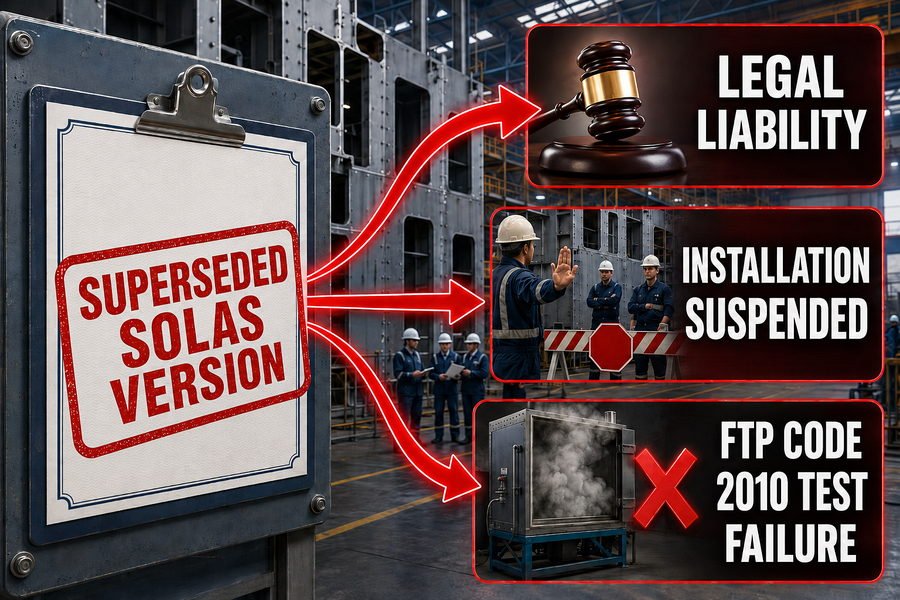
When a certificate shows an old SOLAS date without the latest amendments, alarm bells ring for every surveyor. Here is exactly what happens when those older versions slip through the cracks.
Legal Liability and Work Suspension for Non-Compliant Panel Installation
The first major risk you face is legal liability for installing non-compliant materials. When you sign a contract with a large shipyard in Europe or the United States, you legally promise to supply materials that meet current laws5. If your certificate cites a superseded SOLAS version, you break this contract. According to standard maritime law, if a fire happens on the ship later, the marine court will look at the certificates. If the panels were installed using superseded rules, your interior decoration company could face lawsuits worth millions of dollars.
The second risk is the immediate suspension of shipyard panel installation work. Shipyard quality control managers do not take chances. If they see an old SOLAS reference, they will issue a formal "Stop Work Order." I remember a case in 2025 where a client bought cheap panels from a new supplier. The certificates cited the old 1998 rules. The shipyard manager halted the work of 20 decorators instantly. The daily labor cost for a team of 20 skilled marine carpenters in the US is roughly $8,000 to $10,000 per day6. You have to pay this idle labor cost while you try to fix the paperwork.
Failure to Meet Current FTP Code 2010 Standards
The third risk is the failure of the panels to meet the International Code for Application of Fire Test Procedures (FTP Code) 2010. Superseded SOLAS versions often point to the old FTP Code 19987. The old rules were much weaker.
The FTP Code 2010 requires much stricter smoke and toxicity tests.8 For example, under the old rules, a panel might pass the fire test, but the glue inside could release toxic gas. The new rules strictly limit the release of carbon monoxide and hydrogen cyanide during a fire. If your certificate cites the old SOLAS version, it means the panels probably never passed the new toxicity limits. The surveyor will know this instantly and reject the marine wall panels.
| Consequence of Superseded SOLAS | Immediate Impact | Long-Term Impact |
|---|---|---|
| Legal Liability Breach | Contract violation with shipyard | Potential lawsuits if a fire occurs |
| Shipyard Work Suspension | 20 workers sit idle | $8,000 to $10,000 wasted labor per day |
| FTP Code 2010 Failure | Panels fail smoke limits | Entire panel batch must be destroyed |
| Old Toxicity Standards | High toxic gas release | Danger to passengers and crew |
How Do Compliance Reviewers Spot Expired SOLAS Clauses on Marine Ceiling Panel Docs?
You hope the old ceiling panel paperwork slips through. It never does. Reviewers are trained to find expired clauses, leaving you with rejected panels and a tight deadline.
Compliance reviewers spot expired SOLAS clauses on marine ceiling panel documents by cross-referencing three elements: checking the specific IMO resolution numbers, verifying the Marine Equipment Directive (MED) module B expiration dates, and comparing the stated fire test standards against the mandatory FTP Code 2010 requirements.
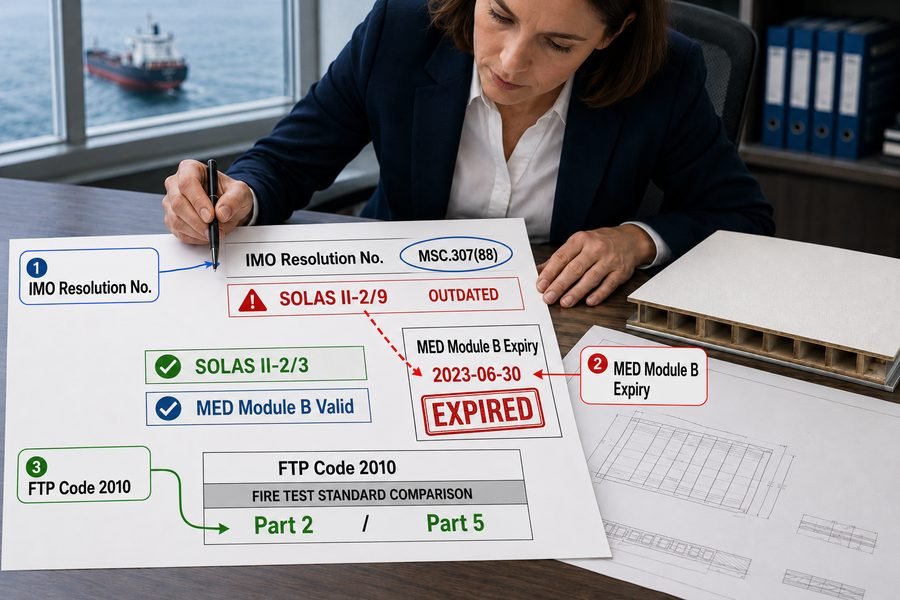
Reviewers do not just glance at the paper; they use a systematic approach to catch outdated information. Knowing their method helps you check your own documents first.
Cross-Referencing IMO Resolution Numbers and MED Module B Expiration Dates
The first thing a compliance reviewer does is check the specific International Maritime Organization (IMO) resolution numbers printed on the certificate. Reviewers memorize the active numbers. For marine ceiling panels, the current standard for fire test procedures is IMO Resolution MSC.307(88)9. If the reviewer looks at your document and sees IMO Resolution A.653(16) or MSC.61(67)10, they know immediately that the SOLAS clause is expired. Those old numbers belong to the 1998 rules. I always tell my clients to look for "MSC.307(88)" before they pay their supplier.
The second method reviewers use is verifying the Marine Equipment Directive (MED) module B expiration dates. If your project is for a European shipyard, your panels must have the "Wheelmark" certification. The MED Module B certificate proves the panel type passed the fire test. According to the European Union MED rules (Directive 2014/90/EU), these certificates are only valid for a maximum of 5 years. Reviewers will check the "Valid Until" date on the certificate. If the date is passed, or if the certificate does not show the newest MED implementing regulation number, the reviewer will reject the marine ceiling panels.
Comparing Stated Standards Against FTP Code 2010 Requirements
The third element reviewers check is the stated fire test standard against the mandatory FTP Code 2010 requirements. They read the test report attached to the certificate. An expired SOLAS clause usually means the factory used an old testing method.
Reviewers look closely at the non-combustibility test standard. The FTP Code 2010 clearly states that the test must follow the ISO 1182:2010 standard11. If your certificate says the panel was tested under ISO 1182:1990, the reviewer will spot it instantly. They also check the surface flammability test. The current requirement demands tests for burning drops. If the test report does not mention a check for "burning drops," the reviewer knows the panel was tested under expired SOLAS clauses and will stop your project.
| Reviewer Checking Method | What They Look For | Warning Sign of Expired Clause |
|---|---|---|
| IMO Resolution Check | MSC.307(88) for FTP 2010 | Seeing old MSC.61(67) or A.653(16) |
| MED Module B Check | Certificate validity date | Date older than 5 years |
| Non-Combustibility Check | ISO 1182:2010 standard | Seeing old ISO 1182:1990 standard |
| Flammability Detail | Mentions "no burning drops" | Missing the burning drops test data |
Why Are Marine Panel Submittals Rejected for Missing SOLAS Amendment References?
Your panel submittal comes back stamped "Rejected." The reason? Missing SOLAS amendments. This oversight means the surveyor cannot prove your panels meet the newest safety laws.
Marine panel submittals are rejected for missing SOLAS amendment references because they fail to prove compliance with four critical updates: updated calorific value limits, revised smoke density criteria, new toxicity limits for panel adhesives, and current non-combustibility test requirements mandated by the latest IMO circulars.
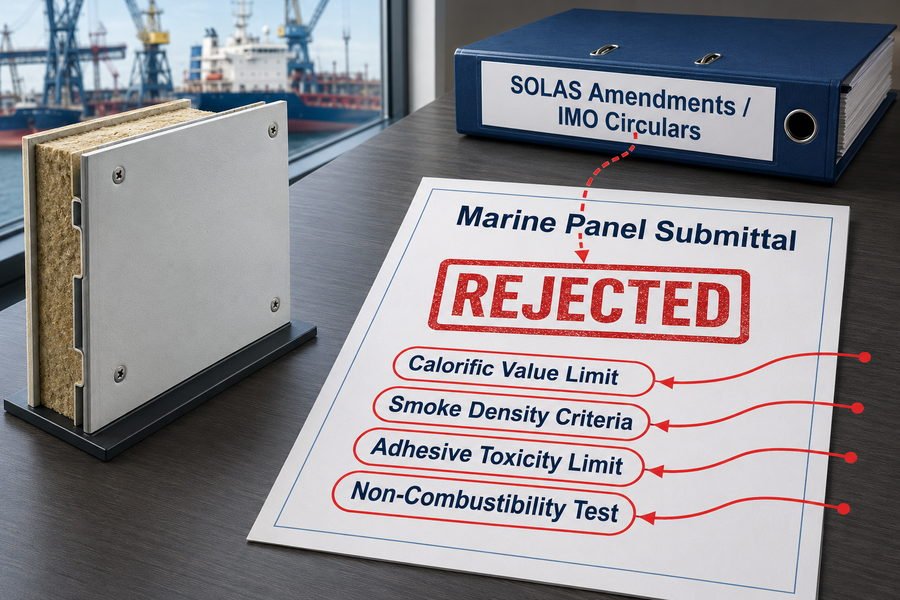
A missing amendment reference is not just a missing line of text. It represents a missing proof of safety. Let me explain the exact updates surveyors look for.
Proving Updated Calorific Value Limits and Non-Combustibility for Panels
The first reason your submittal is rejected is that it fails to prove compliance with updated calorific value limits. Calorific value measures how much heat a panel releases when it burns. According to the latest SOLAS amendments and the FTP Code 2010 Annex 1 Part 5, the maximum gross calorific value for standard B-15 class marine panels must not exceed 45 MJ/m²12. If the SOLAS amendment reference is missing, the surveyor cannot trust that the panel meets this specific 45 MJ/m² limit. They must assume the panel might release too much heat and cause a fire to spread faster.
The fourth reason (grouping by topic) is the failure to prove current non-combustibility test requirements. The newest IMO circulars demand very specific furnace temperatures during the test. The core material of the marine wall panel, usually rockwool, must be tested in a furnace at exactly 750 degrees Celsius for 30 minutes13. If the submittal lacks the latest SOLAS reference, the surveyor has no proof that the factory maintained this exact 750-degree temperature. Without this proof, the submittal is rejected.
Meeting New Toxicity and Smoke Density Limits for Panel Adhesives
The second reason for rejection is failing to prove compliance with revised smoke density criteria. In a ship fire, thick smoke kills people before the flames do. The newest SOLAS amendments drastically lowered the allowed smoke generation limits. During a 20-minute test, the specific optical density of the smoke must stay very low14. If your document misses the latest amendment, it means the panel's surface PVC film might create too much black smoke.
The third reason is the lack of proof for new toxicity limits for panel adhesives. Marine panels are made by gluing steel skins to a rockwool core. When heated, cheap glue releases deadly gases. The latest SOLAS amendments set strict limits: maximum 1450 ppm for Carbon Monoxide, 140 ppm for Hydrogen Chloride, and 140 ppm for Hydrogen Cyanide15. If your supplier used cheap glue to lower the price, they might hide this by omitting the newest SOLAS references. The surveyor knows this trick and will reject the submittal to protect the crew.
| Missing Proof Requirement | Latest SOLAS / FTP 2010 Limit | Danger if Not Compliant |
|---|---|---|
| Calorific Value | Maximum 45 MJ/m² for B-Class | Fire spreads too rapidly |
| Non-Combustibility | Tested at 750°C for 30 min | Panel core might burn |
| Smoke Density | Strict low optical density | Thick black smoke blinds crew |
| Adhesive Toxicity | Max 140 ppm Hydrogen Cyanide | Poisonous gas kills passengers |
How Can Project Coordinators Avoid Rework From Outdated SOLAS Marine Panel Specs?
Reworking panel specs wastes time and eats your profit. If your Asian supplier gives you old specs, you pay the price. You must take control of the review process.
Project coordinators can avoid rework from outdated SOLAS marine panel specs by taking four steps: implementing a pre-order document audit, mandating valid DNV or ABS Type Approval certificates, requiring suppliers to sign a latest-amendment compliance guarantee, and using a standardized spec-checking checklist before shipyard submission.
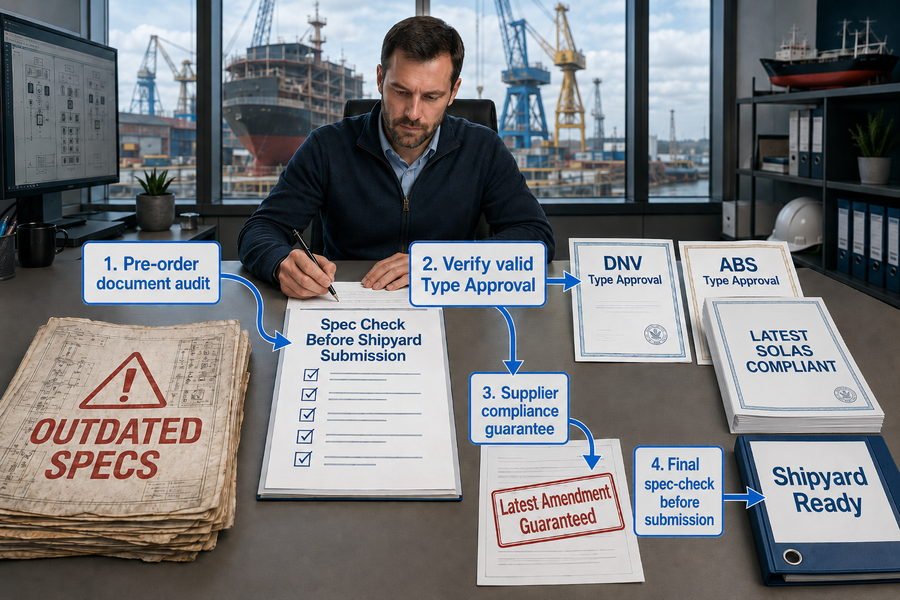
You do not have to wait for the shipyard to reject your documents. By taking proactive steps, you can secure compliance before the panels even leave the factory.
Implementing a Pre-Order Document Audit and Mandating Valid Type Approvals
The first step you must take is implementing a pre-order document audit for your marine panels. Do not wait until the goods arrive at the shipyard. Before you send the 30% advance payment to the factory in China or Vietnam, you must ask them to send all certificates for the exact panel model you are buying. You must read every page. Look at the date the test was done. If the test date is before 2012, the document is likely based on the old FTP Code 1998.16 Stop the order immediately. I always review these documents for my clients before they spend a single dollar.
The second step is mandating valid DNV, ABS, or Lloyd's Register Type Approval certificates. Do not accept a simple letter from the factory saying the panels are good. You must demand the official Type Approval certificate issued by a major IACS member. According to DNV Approval of Manufacturer (AoM) guidelines, a valid Type Approval proves that the classification society has already checked the factory's production line against the very latest SOLAS rules. If the factory cannot provide a valid DNV or ABS certificate, you must find a new supplier.
Requiring Supplier Guarantees and Using Spec-Checking Checklists
The third step is requiring suppliers to sign a latest-amendment compliance guarantee. When you write the purchase order, you must add a special legal clause. The clause should state: "The supplier guarantees that all marine wall panels and ceiling panels fully comply with SOLAS 1974, as amended, and the FTP Code 2010. If the panels fail classification review due to outdated standards, the supplier will replace the goods at their own cost." If a factory refuses to sign this, they know their products are outdated.
The fourth step is using a standardized spec-checking checklist before shipyard submission. You must create a simple, one-page Excel checklist for your interior decoration team. The checklist must include items like: "Does the certificate state MSC.307(88)?17", "Is the MED expiration date in the future?", and "Is the test report less than 5 years old?" Your team must check "Yes" to all boxes before sending the documents to the European or US shipyard. This simple tool stops human errors and prevents expensive rework.18
| Action Step for Coordinators | When to Do This | Expected Result |
|---|---|---|
| Pre-order Document Audit | Before paying the 30% deposit | Catch old tests before losing money |
| Mandate Type Approvals | During supplier selection | Ensures IACS has verified the factory |
| Sign Compliance Guarantee | On the final Purchase Order | Shifts financial risk to the supplier |
| Spec-Checking Checklist | Before shipyard submittal | Prevents shipyard rejection and rework |
Which Documentation Gaps Signal a Marine Wall Panel Supplier Ignores SOLAS Amendments?
You want low prices from overseas suppliers, but you fear bad quality. If a supplier ignores SOLAS updates, their documents will show clear warning signs. Learn to spot them.
Three documentation gaps clearly signal a marine wall panel supplier ignores SOLAS amendments: citing FTP Code 1998 instead of FTP Code 2010, providing test reports older than 5 years without renewal, and omitting the specific IMO MSC circular numbers related to modern low-flame spread characteristics.
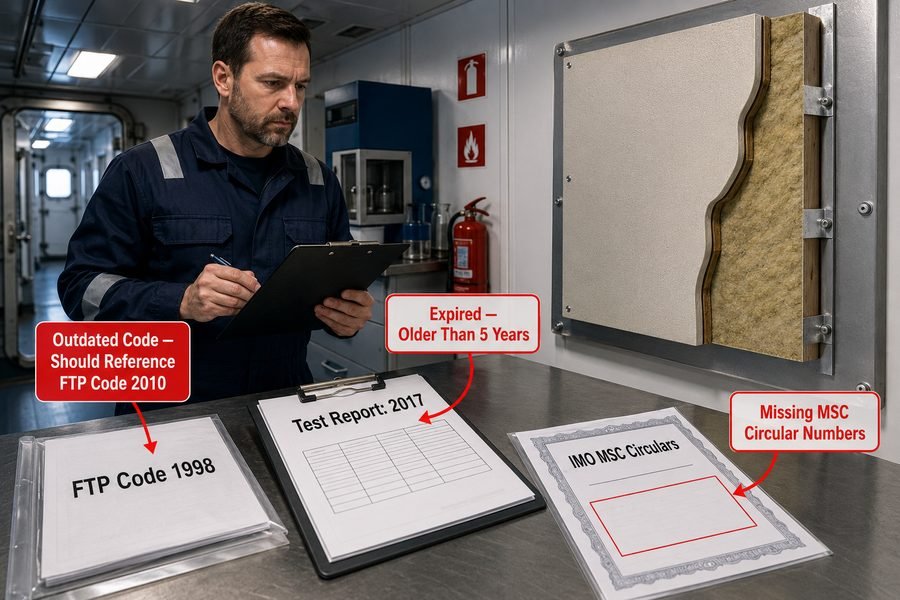
When you buy from developing countries to save money, you must be the gatekeeper for quality and compliance. These specific document gaps are your biggest red flags.
Citing FTP Code 1998 and Providing Panel Test Reports Older Than 5 Years
The first major documentation gap is citing FTP Code 1998 instead of FTP Code 201019. Some small suppliers try to save money by not updating their product tests. Testing a marine wall panel to the new FTP Code 2010 standard costs a factory about $5,000 to $8,000 at an authorized laboratory. To avoid this cost, the supplier will keep using their old certificates. If you look at their product datasheet and see "Resolution MSC.61(67)" or "FTP Code 1998", it is a massive warning sign. It proves the supplier does not care about current marine safety laws.
The second gap is providing panel test reports older than 5 years without renewal. According to marine classification rules, a fire test report is not valid forever. The materials and glues a factory uses can change over time. Therefore, Type Approval certificates and test reports must be renewed every 5 years20. If a supplier hands you a test report dated from 2018 for a project in 2026, it is a critical gap. It shows the supplier has not maintained their quality control systems and is ignoring the mandatory 5-year renewal cycle required by SOLAS.
Omitting Specific IMO MSC Circular Numbers for Low-Flame Spread
The third documentation gap is omitting the specific IMO MSC circular numbers related to modern low-flame spread characteristics21. The surface of a marine wall panel usually has a decorative PVC film. SOLAS Chapter II-2 regulation 3 requires this surface to have low-flame spread characteristics. This means the fire must not travel quickly across the wall.
The latest rules for this are very specific. The supplier's Declaration of Conformity must clearly list the testing procedures for surface flammability. If their document just says "Fireproof Panel" but does not explicitly list the specific IMO MSC circulars proving low-flame spread and low heat release, they are hiding something. A professional supplier who follows SOLAS amendments will always proudly display the exact testing codes on every single document they produce.
| Documentation Gap | What You See on the Paper | What It Means for the Supplier |
|---|---|---|
| Old FTP Code Citation | Reads "FTP Code 1998" | Factory refuses to pay for new fire tests |
| Expired Test Reports | Report date is over 5 years old | Factory lacks continuous quality control |
| Missing MSC Circulars | Only says "Fireproof Panel" | PVC surface film likely burns too fast |
| Missing Toxicity Data | No gas ppm levels shown22 | Cheap, toxic glue used inside the panel |
How Does an Outdated SOLAS Reference on Marine Ceiling Panel Datasheets Affect Shipowner Sign-Off?
The project is finished, but the shipowner refuses to sign. An old SOLAS reference on your ceiling panel datasheet destroyed their trust. Now you face a payment freeze.
An outdated SOLAS reference on marine ceiling panel datasheets affects shipowner sign-off by triggering three consequences: withholding of final project payments, demanding independent third-party fire testing at the contractor's expense, and causing the ship's insurance provider to delay issuing the vessel's final safety cover notes.
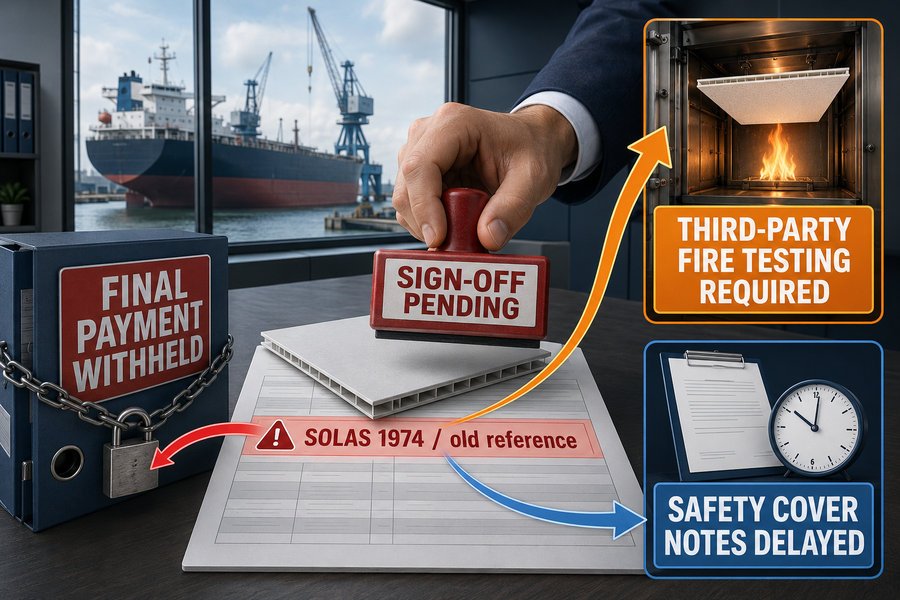
The shipowner's signature is the final hurdle to getting paid. When old SOLAS references appear, the shipowner's technical team will halt the entire handover process to protect their investment.
Withholding of Final Project Payments and Demanding Independent Fire Testing
The first consequence is the immediate withholding of final project payments. In most marine interior decoration contracts, the final 10% to 20% of the payment is tied to the successful handover to the shipowner23. If the shipowner's representative finds an outdated SOLAS reference24 on your marine ceiling panel datasheet, they will refuse to sign the completion certificate. For a large cruise ship or offshore platform accommodation project, this final payment can be hundreds of thousands of dollars. You will not get this money until the paperwork problem is solved. Your company will suffer a severe cash flow problem.
The second consequence is the shipowner demanding independent third-party fire testing at your expense. Because the old SOLAS reference destroyed their trust in your Asian supplier, the shipowner will not just accept a new piece of paper. They will demand proof. I have seen shipowners force the contractor to cut out a section of the already installed marine ceiling panel. You then have to send this sample to an independent laboratory, like SGS or Intertek, for a full FTP Code 2010 fire test. You have to pay the testing fee, which is around $6,000, plus the cost of shipping and replacing the cut panel.
Insurance Delays for the Vessel's Final Safety Cover
The third consequence is causing the ship's insurance provider to delay issuing the vessel's final safety cover notes. A commercial ship cannot leave the shipyard without Protection and Indemnity (P&I) insurance and Hull and Machinery (H&M) insurance25.
Marine insurance underwriting standards from companies like Lloyd's Register are very strict. The underwriters will check the final surveyor reports. If the surveyor notes that the marine ceiling panels have questionable or outdated SOLAS certificates, the underwriter will refuse to issue the insurance cover note. The shipowner cannot legally operate the ship. Because your panels caused this massive delay, the shipowner will be extremely angry and will likely never do business with your interior decoration company again.
| Consequence of Outdated Datasheet | Direct Impact on You | Cost to Your Company |
|---|---|---|
| Payment Withholding | Final 10%-20% invoice unpaid | Severe cash flow shortage |
| Third-Party Testing Demand | Must cut installed panels for testing | $6,000+ test fee plus labor |
| Insurance Cover Delay | Shipowner cannot operate the vessel | Complete loss of future business |
| Handover Schedule Failure | Missed contract deadline | Contractual delay penalties applied |
Conclusion
Outdated SOLAS documents create massive risks for your marine outfitting projects. By checking certificates strictly and working with updated suppliers, you ensure smooth approvals, fast installations, and protected profits.
-
"Summary of SOLAS chapter II-2 - International Maritime Organization", https://www.imo.org/en/ourwork/safety/pages/summaryofsolaschapterii-2-default.aspx. IMO SOLAS and class/statutory survey guidance establish that fire-protection materials used on ships must demonstrate compliance with the applicable SOLAS requirements and recognized test/approval procedures in force at the time of approval or survey. Evidence role: expert_consensus; source type: institution. Supports: Surveyors must reject marine wall panels whose documentation does not reference the currently applicable SOLAS amendments.. Scope note: This would support the compliance principle, but may not directly state that every panel certificate missing a specific amendment must automatically be rejected. ↩
-
"[PDF] PROCEDURES FOR PORT STATE CONTROL, 2023", https://wwwcdn.imo.org/localresources/en/OurWork/IIIS/Documents/A%2033-Res.1185%20-%20PROCEDURES%20FOR%20PORT%20STATE%20CONTROL,%202023%20(Secretariat)%20(1).pdf. Paris MoU Port State Control annual reporting and inspection procedures identify invalid or missing statutory certificates and fire-safety deficiencies as grounds that can lead to ship detention until deficiencies are rectified. Evidence role: case_reference; source type: institution. Supports: Ships may be detained by Port State Control when structural fire protection certificates are invalid.. Scope note: The source may document certificate and fire-safety detentions generally rather than isolating structural fire-protection certificates as a separate detention category. ↩
-
"[PDF] PROCEDURES FOR PORT STATE CONTROL, 2023", https://wwwcdn.imo.org/localresources/en/OurWork/IIIS/Documents/A%2033-Res.1185%20-%20PROCEDURES%20FOR%20PORT%20STATE%20CONTROL,%202023%20(Secretariat)%20(1).pdf. Maritime economics sources and freight-market reports show that daily vessel charter hire can reach tens of thousands of U.S. dollars, making detention-related off-hire losses in the range of $20,000–$30,000 per day plausible for some vessel types and market periods. Evidence role: statistic; source type: research. Supports: A detained ship may cost a shipowner about $20,000 to $30,000 per day in lost charter fees.. Scope note: Daily charter rates vary substantially by vessel type, size, route, and market cycle, so the figure should be framed as an approximate range rather than a universal detention cost. ↩
-
"The Impact of the COVID-19 Pandemic on Freight Transportation ...", https://www.usitc.gov/research_and_analysis/tradeshifts/2020/special_topic.html. Maritime logistics references on Asia–Europe and trans-Pacific ocean freight transit times, combined with manufacturing lead-time studies for engineered building or marine materials, support that replacement procurement can extend schedules by several weeks. Evidence role: general_support; source type: research. Supports: Replacing rejected marine wall panels sourced from Asia can cause project delays of 4 to 8 weeks.. Scope note: This evidence would support the plausibility of a 4–8 week delay, but exact lead time depends on supplier capacity, certification status, shipping mode, customs clearance, and shipyard location. ↩
-
"History of SOLAS fire protection requirements", https://www.imo.org/en/OurWork/Safety/Pages/History-of-fire-protection-requirements.aspx. IMO materials on SOLAS and fire-safety requirements support that ship construction and onboard materials are subject to internationally adopted safety rules, including fire-test procedures made mandatory through SOLAS; this provides regulatory context for why shipyard supply contracts commonly require current compliance. Evidence role: general_support; source type: institution. Supports: Shipyard suppliers are expected to provide materials that comply with current applicable maritime safety laws.. Scope note: This would not prove breach of any specific contract, because breach depends on the contract wording and governing law. ↩
-
"Carpenters - Bureau of Labor Statistics", https://www.bls.gov/oes/2023/may/oes472031.htm. U.S. Bureau of Labor Statistics occupational wage data for carpenters or shipbuilding-related trades can provide a neutral benchmark for estimating the daily labor cost of a 20-person crew when multiplied by hours worked and adjusted for burdened labor costs. Evidence role: statistic; source type: government. Supports: A 20-person team of skilled marine carpenters in the United States can plausibly represent several thousand dollars per day in labor cost.. Scope note: BLS wage data would contextualize the estimate but would not directly verify a specific shipyard’s idle-labor charge, overtime, benefits, or contractor overhead. ↩
-
"What Is the IMO FTP Code for Marine Interior Materials?", https://magellanmarinetech.com/what-imo-ftp-code-for-marine-interior-materials/. IMO records on the original FTP Code show that the International Code for Application of Fire Test Procedures was adopted by MSC.61(67) and became mandatory under SOLAS in 1998, establishing the historical basis for references to pre-2010 fire-test certification. Evidence role: historical_context; source type: institution. Supports: Older SOLAS-related certificates may refer to the pre-2010 FTP Code regime that entered into force in 1998.. Scope note: The official instrument is commonly identified by its IMO resolution and entry-into-force date; the source may not use the informal label “FTP Code 1998.” ↩
-
"[PDF] RESOLUTION MSC.307(88) (adopted on 3 December 2010 ...", https://wwwcdn.imo.org/localresources/en/KnowledgeCentre/IndexofIMOResolutions/MSCResolutions/MSC.307(88).pdf. The 2010 FTP Code, adopted by IMO Resolution MSC.307(88), includes smoke and toxicity test procedures for relevant shipboard materials and specifies toxic-gas measurements such as carbon monoxide and hydrogen cyanide, supporting the claim that current certification must address smoke and toxicity performance. Evidence role: mechanism; source type: institution. Supports: The FTP Code 2010 contains smoke and toxicity testing requirements for applicable marine interior materials.. Scope note: A single source on the 2010 Code may establish the current test requirements, but a direct “stricter than old rules” comparison may require consulting both the 1998 and 2010 FTP Code texts. ↩
-
"[PDF] RESOLUTION MSC.307(88) (adopted on 3 December 2010 ...", https://wwwcdn.imo.org/localresources/en/KnowledgeCentre/IndexofIMOResolutions/MSCResolutions/MSC.307(88).pdf. IMO Resolution MSC.307(88) adopted the International Code for Application of Fire Test Procedures, 2010, supporting its use as the governing IMO resolution for FTP Code 2010 references. Evidence role: historical_context; source type: institution. Supports: For marine ceiling panels, the current standard for fire test procedures is IMO Resolution MSC.307(88).. Scope note: This supports the resolution’s role in adopting FTP Code 2010; applicability to a specific ceiling panel still depends on the relevant SOLAS/MED product category. ↩
-
"[PDF] RESOLUTION MSC.61(67) (adopted on 5 December 1996 ...", https://wwwcdn.imo.org/localresources/en/KnowledgeCentre/IndexofIMOResolutions/MSCResolutions/MSC.61(67).pdf. IMO materials identify MSC.61(67) as the resolution adopting the 1998 FTP Code and A.653(16) as an earlier recommendation on improved fire test procedures, supporting the statement that these resolution numbers refer to older fire-test regimes rather than FTP Code 2010. Evidence role: historical_context; source type: institution. Supports: IMO Resolution A.653(16) and MSC.61(67) are old resolution numbers associated with pre-2010 fire-test rules.. Scope note: The source can establish the historical status of the resolutions, but not that every certificate bearing those references is automatically unacceptable without considering transitional or flag-state rules. ↩
-
"[PDF] RESOLUTION MSC.307(88) (adopted on 3 December 2010 ...", https://wwwcdn.imo.org/localresources/en/KnowledgeCentre/IndexofIMOResolutions/MSCResolutions/MSC.307(88).pdf. The 2010 FTP Code’s non-combustibility test provisions reference ISO 1182:2010 as the test method, supporting the claim that certificates relying on ISO 1182:1990 may indicate use of an outdated test reference. Evidence role: mechanism; source type: institution. Supports: The FTP Code 2010 requires the non-combustibility test to follow ISO 1182:2010.. Scope note: This supports the standard referenced by FTP Code 2010; whether an older test report is acceptable may depend on certificate issue date, renewal status, and administering authority practice. ↩
-
"What Is the Purpose and Scope of the IMO FTP Code? - Magellan ...", https://magellanmarinetech.com/what-purpose-scope-of-imo-ftp-code/. The IMO 2010 FTP Code, Annex 1, Part 5, provides the surface-flammability test criteria used to assess heat-release and calorific-value limits for marine bulkhead, wall, and ceiling materials, including the cited 45 MJ/m² threshold where applicable. Evidence role: definition; source type: institution. Supports: The gross calorific value limit for standard B-15 class marine panels is 45 MJ/m² under the relevant SOLAS/FTP Code requirements.. Scope note: The source should be checked against the exact panel construction and certificate scope, because FTP Code limits may apply differently to finishes, veneers, adhesives, or complete assemblies. ↩
-
"[PDF] RESOLUTION MSC.307(88) (adopted on 3 December 2010 ...", https://wwwcdn.imo.org/localresources/en/KnowledgeCentre/IndexofIMOResolutions/MSCResolutions/MSC.307(88).pdf. The IMO 2010 FTP Code non-combustibility test procedure specifies furnace-temperature and exposure-duration conditions for determining whether marine materials meet non-combustibility requirements. Evidence role: mechanism; source type: institution. Supports: The core material of a marine wall panel must be tested under a 750°C furnace condition for about 30 minutes to demonstrate non-combustibility.. Scope note: The article’s wording says “exactly” 750°C; the formal test method may specify tolerances or stabilization requirements rather than an absolute temperature with no deviation. ↩
-
"[PDF] RESOLUTION MSC.307(88) (adopted on 3 December 2010 ...", https://wwwcdn.imo.org/localresources/en/KnowledgeCentre/IndexofIMOResolutions/MSCResolutions/MSC.307(88).pdf. The IMO 2010 FTP Code smoke and toxicity test provisions describe measurement of smoke optical density over a defined test period for materials used on ships. Evidence role: mechanism; source type: institution. Supports: Marine panel materials subject to the FTP Code are evaluated for smoke generation using a test that measures specific optical density over a defined period.. Scope note: This support establishes the test framework and measurement concept; the phrase “very low” is qualitative and should be replaced or supplemented with the exact numerical criterion if the source provides one. ↩
-
"What Is the Purpose and Scope of the IMO FTP Code? - Magellan ...", https://magellanmarinetech.com/what-purpose-scope-of-imo-ftp-code/. The IMO 2010 FTP Code smoke and toxicity provisions list maximum allowable concentrations for combustion gases such as carbon monoxide, hydrogen chloride, and hydrogen cyanide in fire-test effluents. Evidence role: definition; source type: institution. Supports: The relevant SOLAS/FTP Code toxicity criteria set ppm limits for carbon monoxide, hydrogen chloride, and hydrogen cyanide released during testing of marine panel materials or components.. Scope note: The exact ppm values should be verified against the applicable FTP Code edition and material category, because individual gas limits may vary by table, amendment, or test condition. ↩
-
"[PDF] RESOLUTION MSC.307(88) (adopted on 3 December 2010 ...", https://wwwcdn.imo.org/localresources/en/KnowledgeCentre/IndexofIMOResolutions/MSCResolutions/MSC.307(88).pdf. IMO Resolution MSC.307(88) adopted the 2010 FTP Code, and related SOLAS amendments brought it into force from 1 July 2012, supporting the use of pre-2012 fire-test documentation as a compliance red flag. Evidence role: historical_context; source type: institution. Supports: A test date before 2012 may indicate that marine panel documentation relies on the earlier FTP Code 1998 rather than the 2010 FTP Code.. Scope note: A pre-2012 test date does not by itself prove non-compliance; certificates may have been renewed, reissued, or supplemented under later rules. ↩
-
"Fire testing laboratories - International Maritime Organization", https://www.imo.org/en/ourwork/safety/pages/firetestinglaboratories-default.aspx. IMO documentation identifies MSC.307(88) as the resolution adopting the International Code for Application of Fire Test Procedures, 2010, supporting its use as a document-check reference for FTP Code compliance. Evidence role: definition; source type: institution. Supports: Certificates for marine panels should be checked for reference to MSC.307(88) because it identifies the 2010 FTP Code.. Scope note: The presence of MSC.307(88) on a certificate is a documentary indicator, not independent proof that a particular product sample or production batch complies. ↩
-
"The effectiveness of checklists and error reporting systems in ... - PMC", https://pmc.ncbi.nlm.nih.gov/articles/PMC11329062/. Research on checklist use in complex technical and organizational settings finds that checklists can reduce omissions and process errors, providing contextual support for their use in document-control workflows. Evidence role: general_support; source type: paper. Supports: A standardized spec-checking checklist can reduce human error and help avoid rework in document submission processes.. Scope note: Evidence on checklist effectiveness is general and may not directly measure marine-panel submittals or shipyard rework costs. ↩
-
"MSC 2010-13 - International Maritime Organization", https://www.imo.org/en/knowledgecentre/indexofimoresolutions/pages/msc-2010-13.aspx. The International Maritime Organization adopted the 2010 FTP Code by Resolution MSC.307(88), replacing the earlier 1998 FTP Code framework for prescribed fire-test procedures under SOLAS. Evidence role: historical_context; source type: institution. Supports: Citing FTP Code 1998 rather than FTP Code 2010 is a documentation red flag for current marine fire-safety compliance.. Scope note: This supports the regulatory transition between FTP Code editions, but it does not by itself prove that any individual supplier is non-compliant or acting negligently. ↩
-
"Ship classification society", https://en.wikipedia.org/wiki/Ship_classification_society. Classification-society type-approval schemes commonly state that marine equipment type-approval certificates are issued for a fixed validity period, often five years, after which renewal or reassessment is required. Evidence role: expert_consensus; source type: institution. Supports: Marine panel type-approval documentation is generally not indefinite and commonly requires periodic renewal, often on a five-year cycle.. Scope note: This supports a common class/type-approval practice; the exact renewal obligation may depend on the flag administration, classification society, product category, and certificate scheme rather than a single universal SOLAS clause. ↩
-
"What Is the Purpose and Scope of the IMO FTP Code? - Magellan ...", https://magellanmarinetech.com/what-purpose-scope-of-imo-ftp-code/. SOLAS Chapter II-2 and the IMO FTP Code define and regulate low flame-spread characteristics for shipboard materials, with surface flammability testing addressed in the FTP Code test procedures. Evidence role: definition; source type: institution. Supports: Marine wall-panel surfaces may need documented low flame-spread characteristics under SOLAS/IMO fire-safety rules.. Scope note: This supports the regulatory meaning and testing context of low flame-spread characteristics; the precise applicability to a specific wall panel depends on its installation location and vessel type. ↩
-
"What Is the Purpose and Scope of the IMO FTP Code? - Magellan ...", https://magellanmarinetech.com/what-purpose-scope-of-imo-ftp-code/. The IMO FTP Code includes smoke and toxicity testing provisions that report concentrations of specified combustion gases, providing context for why gas-concentration data may appear in fire-test documentation. Evidence role: mechanism; source type: institution. Supports: Smoke and toxicity documentation for relevant marine materials may include gas concentration measurements, so missing gas ppm data can be a documentation gap.. Scope note: This supports the relevance of gas ppm data in smoke/toxicity testing, but absence of ppm values on a summary document does not alone prove that toxic glue was used or that the product failed testing. ↩
-
"Shipbuilding Contract - SEC.gov", https://www.sec.gov/Archives/edgar/data/1332639/000119312507055526/dex424.htm. Standard shipbuilding and construction-contract practice commonly links final instalments or retention release to delivery, acceptance, or completion certification, which contextualizes why unresolved handover documentation can delay final payment. Evidence role: general_support; source type: institution. Supports: In many marine interior decoration contracts, a final payment portion is linked to successful handover or completion certification.. Scope note: The cited source may support the contractual mechanism generally; the specific 10%–20% range depends on the individual contract and project market. ↩
-
"[PDF] RESOLUTION MSC.307(88) (adopted on 3 December 2010 ...", https://wwwcdn.imo.org/localresources/en/KnowledgeCentre/IndexofIMOResolutions/MSCResolutions/MSC.307(88).pdf. The International Maritime Organization’s 2010 FTP Code sets fire-test procedures used under SOLAS Chapter II-2 for evaluating fire performance of shipboard materials, supporting why references to superseded SOLAS/FTP requirements may raise compliance concerns during handover. Evidence role: historical_context; source type: institution. Supports: Outdated SOLAS references on a marine ceiling panel datasheet can create compliance concerns for the shipowner’s technical team.. Scope note: This supports the regulatory relevance of current SOLAS/FTP references, but it does not prove that every shipowner will halt a handover for this issue. ↩
-
"Protection and indemnity insurance - Wikipedia", https://en.wikipedia.org/wiki/Protection_and_indemnity_insurance. Marine-insurance references distinguish P&I cover for third-party liabilities from hull and machinery cover for physical loss or damage to the vessel, supporting the article’s description of these as core insurance categories for commercial ship operation. Evidence role: definition; source type: institution. Supports: Commercial vessels commonly rely on P&I insurance and Hull and Machinery insurance as core covers before operation.. Scope note: This supports the importance and function of the insurance types, but legal requirements to sail vary by flag state, port state, charter contract, and financing arrangements. ↩