Buying marine panels without certification risks your entire project budget. A rejected installation means tearing everything down. Let us look at why Class Type Approval is your safety net.
Class Type Approval for marine wall and ceiling panels guarantees compliance with SOLAS fire safety and IMO acoustic standards. It prevents shipyard rework, eliminates port state control detentions, ensures surveyor acceptance, and protects the $5,000 to $15,000 investment per cabin from total loss due to regulatory failure.
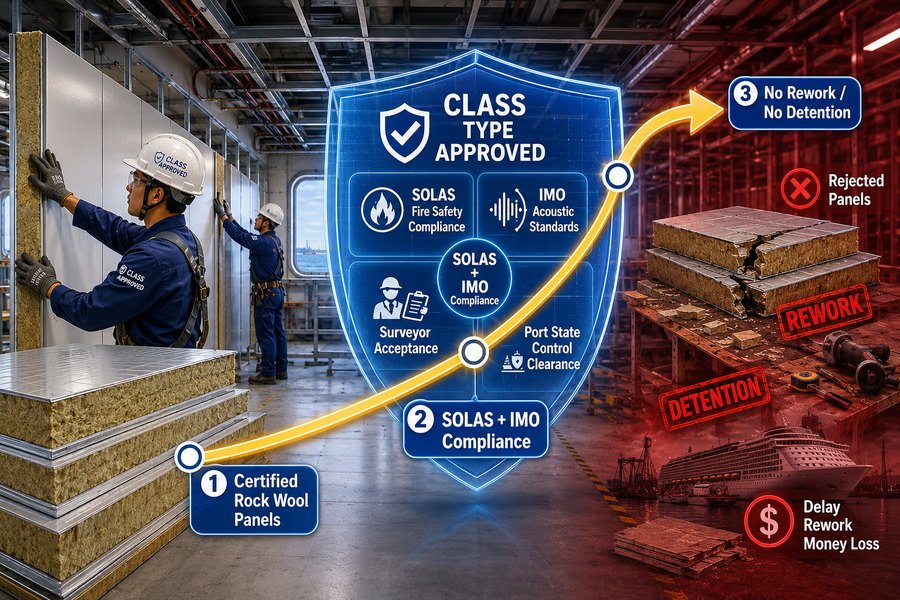
You might think a standard panel looks identical to a certified one, saving you money upfront. But the hidden costs of ignoring certification will quickly drain your profits, so keep reading to see how to avoid these massive financial traps.
What Risks Come With Buying Marine Wall Panels Without Class Type Approval?
Unapproved panels look cheap until the surveyor arrives. A failed fire test can halt your shipbuilding schedule. We must understand the exact financial and safety risks involved.
Buying unapproved marine wall panels brings three major risks: immediate rejection by class surveyors forcing 100% replacement, failure during SOLAS fire tests causing structural collapse within 15 minutes, and voiding the ship's $10 million to $50 million insurance policy due to non-compliant interior materials.
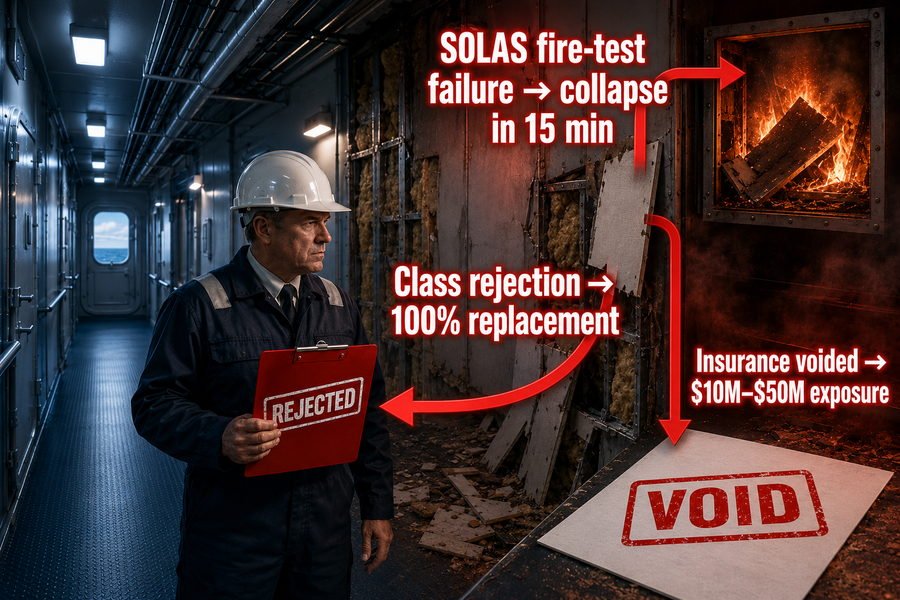
I once helped a client who bought cheap, unapproved panels from a small factory. They thought they saved $10,000. Instead, they lost much more. Let us break down the three major risks I saw them face.
Immediate Rejection by Class Surveyors Forcing 100% Replacement
The first risk is immediate rejection by class surveyors, which forces a 100% replacement of the materials. When a ship surveyor from DNV or ABS walks onto your vessel, they look for the MED (Marine Equipment Directive) wheelmark or the class certificate. If your panels do not have these, the surveyor will stop the work at once. You will have to tear down every single panel you just installed. For a small crew boat with 20 cabins, replacing these panels easily costs $50,000 in lost materials alone. Add the labor cost to remove them, and you will lose at least $70,000 before you even buy the new, correct panels.
Failure During SOLAS Fire Tests Causing Structural Collapse
The second risk is failure during SOLAS fire tests, which causes structural collapse within 15 minutes. Marine wall panels must hold back fire. A standard B-15 panel must block flames and keep the unexposed side cool for at least 15 minutes1 in a furnace heated to 800°C. Unapproved panels usually use cheap glue or low-density rockwool (under 100 kg/m3)2. During a fire test, these cheap panels warp, melt, and collapse in just 3 to 5 minutes. This fast collapse means crew members cannot escape. It turns a small cabin fire into a deadly disaster.
Voiding the Ship's Insurance Policy Due to Non-Compliant Materials
The third risk is voiding the ship's insurance policy. A typical commercial ship has a hull insurance policy worth $10 million to $50 million. Insurance companies write strict rules in their contracts. They state that the ship must use approved, compliant materials3. If a fire happens and investigators find unapproved wall panels, the insurance company will refuse to pay the claim. The shipowner must pay the entire loss out of pocket.
| Risk Type | Direct Consequence | Estimated Financial Loss |
|---|---|---|
| Surveyor Rejection | 100% material replacement | $50,000 - $70,000 per 20 cabins |
| Fire Test Failure | Structural collapse under 15 mins | Total loss of vessel safety rating |
| Insurance Voiding | Claim denial after an incident | $10,000,000+ (Total Hull Value) |
How Does Type Approval Cut Surveyor Rejection of Marine Ceiling Panels at Acceptance?
Surveyor inspections often cause long delays. When panels lack clear paperwork, surveyors demand extra lab tests. Type approval skips this nightmare and speeds up your project handover.
Type approval cuts surveyor rejection by providing pre-verified documentation for two critical factors: guaranteed material non-combustibility per IMO FTP Code Annex 1 Part 1, and proven B-0 or B-15 fire resistance ratings. This turns a 5-day cabin inspection into a simple 2-hour visual and paperwork check.
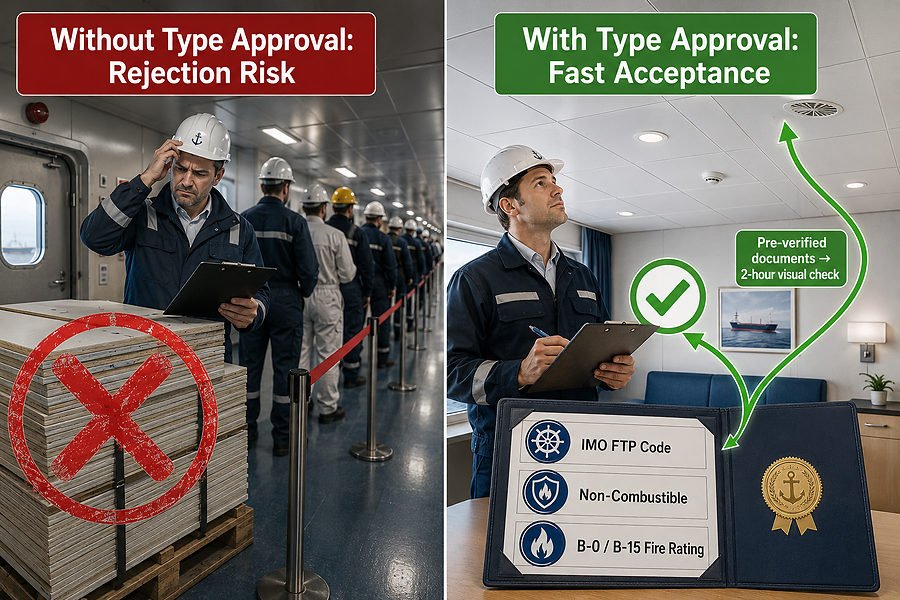
When you build ship interiors, time is money. I always tell my clients to use approved panels because it makes the surveyor's job easy. Here is exactly how type approval handles the two critical factors and speeds up the inspection.
Providing Pre-Verified Non-Combustibility per IMO FTP Code Part 1
The first critical factor is guaranteed material non-combustibility. According to the IMO FTP Code Annex 1 Part 14, the materials inside a marine ceiling panel cannot burn or add fuel to a fire. If you use unapproved panels, the surveyor will not trust the materials. They will cut a piece of your ceiling and send it to a test lab. You will wait 14 to 21 days5 for the lab results, and you will pay $3,000 to $5,000 for the test itself. But if you have Type Approval6, the certificate acts as pre-verified documentation. The surveyor simply reads the certificate number, matches it to the panel sticker, and signs the paper. There are no lab tests and no delays.
Proving B-0 or B-157 Fire Resistance Ratings for Fast Checks
The second critical factor is the proven fire resistance rating, specifically B-0 or B-15. A B-0 rating means the ceiling stops flames for 30 minutes. A B-15 rating means it stops flames for 30 minutes and keeps the heat low for 15 minutes. Surveyors are very strict about these ratings. With a Type Approval certificate, you prove the panel already passed the massive furnace test at the factory. Because these two critical factors are pre-verified, the surveyor does not need to guess. What used to be a stressful 5-day cabin inspection, full of arguments and measuring, turns into a fast 2-hour visual check. You get your acceptance signature and can move on to the next ship.
| Inspection Step | Unapproved Ceiling Panels | Type Approved Ceiling Panels |
|---|---|---|
| Non-combustibility Check | Lab test required (14-21 days) | Paperwork check only (10 minutes) |
| Fire Rating Verification | Rejected or demands redesign | Paperwork check only (10 minutes) |
| Total Inspection Time | 5 to 25 days | 2 hours |
| Lab Testing Costs | $3,000 - $5,000 per sample | $0 |
Why Do Marine Outfitters Require Type-Approved Wall Panels in Subcontracts?
Outfitters face tight profit margins. Using bad panels leads to massive penalty fees from the shipyard. They mandate type approvals to protect their own contracts and reputations.
Marine outfitters require type-approved wall panels in subcontracts to secure four guarantees: passing the shipyard's incoming quality control, avoiding $5,000-per-day delay penalties, ensuring exact panel weight (15 to 18 kg/m2) for ship stability calculations, and maintaining their own ISO 9001 quality management system compliance.
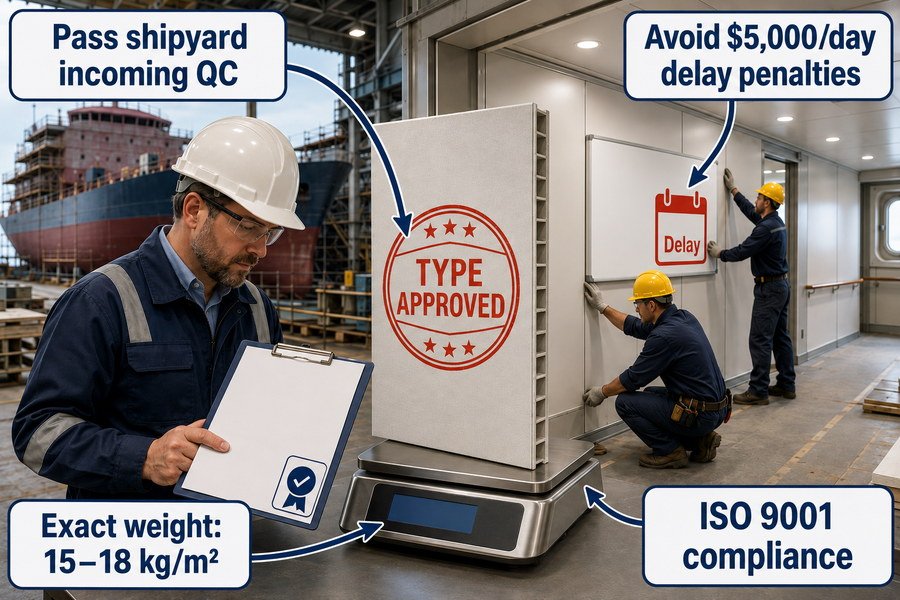
I started my career working in a marine outfitting factory, so I know how outfitters think. They do not buy panels just because they look nice. They buy panels because they need to fulfill strict subcontract rules. Let us look at the four guarantees they must secure.
Passing Shipyard Incoming Quality Control and Avoiding Delay Penalties
The first two guarantees are passing the shipyard's incoming quality control (IQC) and avoiding delay penalties. When a truck full of wall panels arrives at a large shipyard, the IQC inspectors check the delivery before they open the gate. If the panels do not have a Type Approval certificate from DNV, ABS, or Lloyd's Register, the shipyard will reject the whole truck. The outfitter cannot even bring the goods inside.
This rejection leads right to the second guarantee: avoiding delay penalties. Shipyard contracts are brutal. If the outfitter is late finishing the cabin interiors, the shipyard charges liquidated damages. A standard penalty is $5,000 to $10,000 per day8. If unapproved panels sit at the gate for 10 days while the outfitter begs for permission, the outfitter loses $50,000. Type-approved panels slide right through IQC, keeping the schedule safe.
Ensuring Exact Panel Weight for Stability and Maintaining ISO 9001
The third guarantee is ensuring exact panel weight for ship stability calculations. A ship must balance perfectly in the water. The shipyard naval architects calculate the center of gravity using the weight of every wall9. A standard 50mm thick type-approved rockwool wall panel weighs exactly 15 to 18 kg/m2. Unapproved panels have terrible quality control; one panel might weigh 14 kg/m2 and another 20 kg/m2. This ruins the ship's stability math.
The fourth guarantee is maintaining the outfitter's ISO 9001 quality management system compliance. ISO 9001 requires strict traceability. The outfitter must prove where every piece of material came from. Type Approval certificates provide a direct tracking number back to the factory batch. If an outfitter uses unapproved panels, they will fail their annual ISO audit and lose their business license.
| Guarantee Needed by Outfitter | Impact of Using Type Approved Panels | Impact of Using Unapproved Panels |
|---|---|---|
| Pass Shipyard IQC | Instant gate clearance | Truck rejected at the shipyard gate |
| Avoid Delay Penalties | Zero daily fines | $5,000 to $10,000 lost per day |
| Exact Weight for Stability | Consistent 15-18 kg/m2 weight | Random weights ruin stability math |
| ISO 9001 Compliance | Full material traceability | Fails annual quality audit |
How Does Missing Type Approval Trigger Rework or Delays on Marine Interior Projects?
Finding out a panel is unapproved during installation is a disaster. You have to rip down finished walls. Let us see exactly how this causes massive project delays.
Missing type approval triggers rework and delays through three specific phases: mandatory tear-down of already installed uncertified panels, a 30 to 45-day lead time to order new approved replacements from Asia, and a 20% increase in total labor costs due to paying workers for double installation.
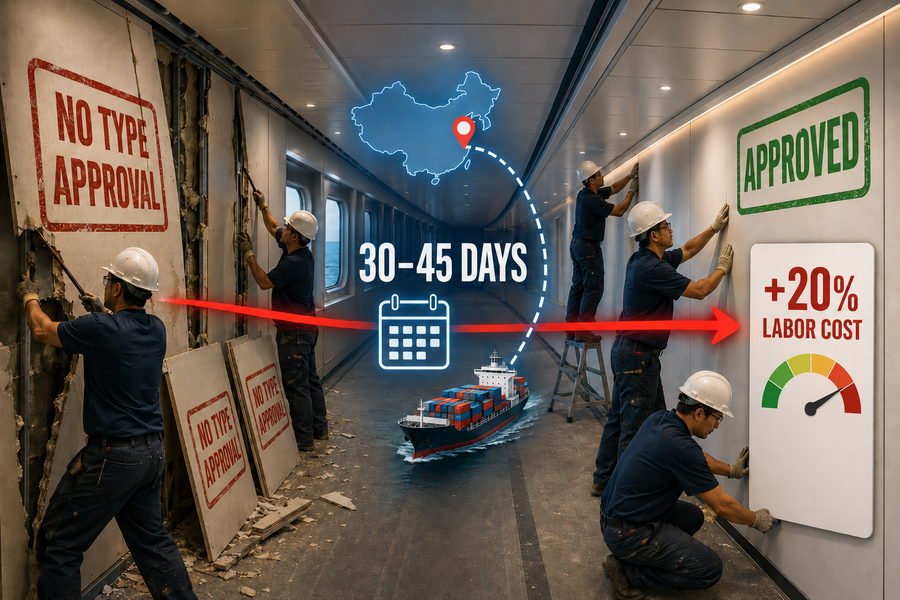
I once watched a project manager cry because he had to tell his boss they used the wrong panels. Missing type approval does not just cause a small bump in the road; it destroys the schedule in three painful phases.
The Cost of Mandatory Tear-Down for Uncertified Installed Panels
The first phase of delay is the mandatory tear-down of the already installed uncertified panels. Imagine you have built out 1,000 square meters of cabins. The walls are up, the doors are in, and the cables run behind the panels. Then, the surveyor notes the missing approval10. You cannot just swap a sticker. You must pull down every single panel. Removing 1,000 square meters takes a crew of five men about 7 to 10 full days.11 You also destroy many panels during removal, meaning they go straight into the trash. Your project moves backward by two weeks instantly.
The second phase is the long wait. You need new, approved panels. The standard lead time to order approved marine wall panels from a high-quality factory in Asia is 30 to 45 days. The factory needs 15 to 20 days to manufacture the panels, apply the correct 0.6mm galvanized steel skins, and pack them. Then, shipping the panels by sea to Europe or the United States takes another 20 to 25 days. During this month and a half, your interior team has nothing to do. The whole deck construction stops.
Absorbing the 20% Increase in Total Labor Costs
The third phase is the brutal 20% increase in total labor costs due to double installation12. You already paid your workers to build the rooms the first time. You paid them to tear the rooms down. Now, you must pay them to build the rooms a second time. If your interior labor budget was $100,000, paying for this extra rework will push your labor cost to $120,000 or higher. You pay for the same job twice, completely wiping out any profit you hoped to make.
| Rework Phase | Action Required | Time Lost | Financial Impact |
|---|---|---|---|
| Phase 1 | Mandatory Tear-down | 7 to 10 days | Cost of wasted materials and dump fees |
| Phase 2 | Waiting on Lead Time | 30 to 45 days | Zero progress; overhead costs continue |
| Phase 3 | Double Installation | 14 to 20 days | 20% increase in total labor budget |
Why Do Shipowners Specify Class-Approved Wall and Ceiling Panels in Newbuild Contracts?
Shipowners invest millions into a new vessel. They cannot risk their asset on cheap interiors. They demand class approvals to ensure long-term safety and high resale value.
Shipowners specify class-approved panels in newbuild contracts to achieve three main goals: securing a mandatory Passenger Ship Safety Certificate (PSSC), qualifying for premium charter rates from top-tier operators, and guaranteeing a 20 to 25-year operational lifespan for the interior materials in high-humidity marine environments.
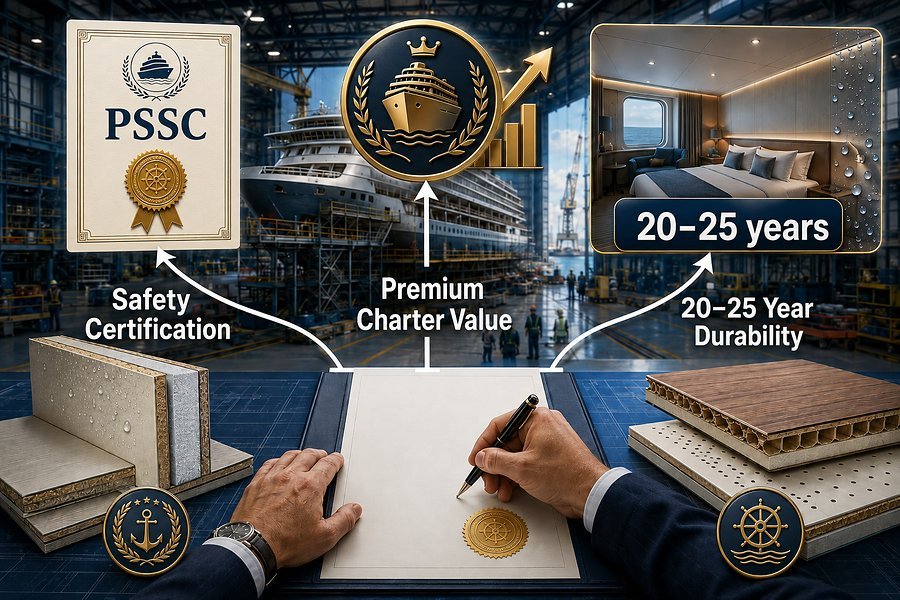
A shipowner does not care about saving $5 on a piece of wall. They care about making their $50 million ship work for decades. They force shipyards to use approved materials to meet three very specific business goals.
A shipowner does not care about saving $5 on a piece of wall. They care about making their $50 million ship work for decades. They force shipyards to use approved materials to meet three very specific business goals.
Securing the PSSC and Qualifying for Premium Charter Rates
The first goal is securing the mandatory Passenger Ship Safety Certificate (PSSC). If a shipowner builds a ferry or a cruise ship, SOLAS regulations demand a PSSC before a single passenger can board13. The maritime authority will only issue this certificate if every fire zone is built with class-approved panels14. Without the PSSC, the ship is just a floating piece of metal that cannot legally make money.
The second goal is qualifying for premium charter rates from top-tier operators. Big oil companies and luxury cruise operators lease ships from shipowners. These operators pay premium rates, sometimes over $20,000 per day. But they audit the ship first. They demand to see the Type Approval certificates for the interior build. If the ship has unapproved, cheap walls, the top-tier operators will walk away. The shipowner will have to rent the ship to low-tier companies for much less money.
Guaranteeing a 20 to 25-Year Operational Lifespan in Marine Environments
The third goal is guaranteeing a 20 to 25-year operational lifespan for the interior materials. The sea is a harsh place. High humidity and salt air destroy normal materials15. Class-approved panels use high-quality materials, like a 0.6mm thick galvanized steel sheet coated in durable PVC film. They use high-density adhesives that do not peel in extreme moisture. The shipowner knows that if they buy unapproved panels, the walls will rust and peel in 3 years. By demanding class-approved panels, the owner ensures the cabins will still look good and stay structurally sound for 20 to 25 years.
| Shipowner Goal | Why It Matters | Benefit of Class-Approved Panels |
|---|---|---|
| Secure PSSC | Legal requirement to carry passengers | Guarantees compliance and immediate sailing |
| Premium Charter Rates | Maximizes daily rental income | Attracts top-tier clients paying $20,000+/day |
| 25-Year Lifespan | Lowers long-term maintenance costs | Resists rust and peeling in salty, wet air |
Conclusion
Class Type Approval is not just paper; it is your ultimate protection against rework, delays, and financial ruin when sourcing marine wall and ceiling panels for any shipbuilding project.
-
"What Is the Purpose and Scope of the IMO FTP Code? - Magellan ...", https://magellanmarinetech.com/what-purpose-scope-of-imo-ftp-code/. The IMO FTP Code or SOLAS fire-safety provisions define B-class divisions, including the 15-minute fire-resistance period and temperature-rise criteria for B-15 ratings. Evidence role: definition; source type: institution. Supports: A B-15 marine wall panel is expected to maintain specified fire-resistance and insulation performance for at least 15 minutes under standardized testing.. Scope note: The source establishes the regulatory test criterion, not the performance of any particular commercial panel. ↩
-
"Evaluation of heterogeneous core sandwich panels for energy ...", https://ui.adsabs.harvard.edu/abs/2024AppTE.24923455K/abstract. Fire-safety research on mineral-wool sandwich panels and adhesives can support the mechanism by which core density, binder behavior, and adhesive degradation affect panel integrity under fire exposure. Evidence role: mechanism; source type: paper. Supports: Lower-quality adhesives or low-density mineral-wool cores can reduce the fire integrity and mechanical stability of marine-type sandwich panels.. Scope note: Such studies provide material-science context and may not directly test the exact unapproved panels described in the article. ↩
-
"[PDF] applying the knowing neglect standard in time hull insurance", https://digitalcommons.mainelaw.maine.edu/cgi/viewcontent.cgi?article=1889&context=mlr. Marine-insurance guidance or policy-law sources can show that hull and machinery policies commonly impose warranties, classification requirements, or seaworthiness obligations related to regulatory compliance and approved equipment. Evidence role: general_support; source type: institution. Supports: Commercial vessel insurance policies may condition coverage on the vessel maintaining class, seaworthiness, and compliance with applicable safety requirements, including use of approved materials.. Scope note: Insurance coverage depends on the exact policy wording, jurisdiction, causation, and investigation findings; a general source cannot prove automatic claim denial in every case. ↩
-
"What Is the Purpose and Scope of the IMO FTP Code? - Magellan ...", https://magellanmarinetech.com/what-purpose-scope-of-imo-ftp-code/. The IMO FTP Code, Annex 1, Part 1 establishes the non-combustibility test procedure and acceptance criteria used for materials subject to SOLAS fire-safety requirements. Evidence role: definition; source type: institution. Supports: According to the IMO FTP Code Annex 1 Part 1, the materials inside a marine ceiling panel cannot burn or add fuel to a fire.. Scope note: This supports the regulatory test basis; whether a particular ceiling panel must be non-combustible depends on the vessel type, location, and applicable flag/class requirements. ↩
-
"[PDF] RESOLUTION MSC.307(88) (adopted on 3 December 2010 ...", https://wwwcdn.imo.org/localresources/en/KnowledgeCentre/IndexofIMOResolutions/MSCResolutions/MSC.307(88).pdf. Published schedules or fee tables from accredited fire-testing laboratories can provide contextual evidence for typical turnaround times and costs for non-combustibility or marine fire-test services. Evidence role: statistic; source type: other. Supports: Unapproved panels may require laboratory testing that can take 14 to 21 days and cost thousands of dollars per sample.. Scope note: Laboratory duration and price vary by country, accreditation scope, sample preparation, queue length, and whether the test is an IMO FTP Code test, so such sources would contextualize rather than conclusively prove the article’s exact figures. ↩
-
"SURVEYS, VERIFICATIONS AND CERTIFICATION", https://www.imo.org/en/OurWork/IIIS/Pages/Survey-Verification-Certification.aspx. Classification-society type approval documentation generally records that a product design or material has been assessed and tested against specified standards, allowing surveyors to verify compliance through certificates and product identification rather than repeating the full approval test at each installation. Evidence role: mechanism; source type: institution. Supports: If you have Type Approval, the certificate acts as pre-verified documentation that can simplify the surveyor’s verification of approved ceiling panels.. Scope note: Actual acceptance remains subject to the attending surveyor, certificate validity, installation conditions, and the vessel’s flag/class rules. ↩
-
"[PDF] recommendation for fire test procedures for “a” and “b” class ...", https://wwwcdn.imo.org/localresources/en/KnowledgeCentre/IndexofIMOResolutions/AssemblyDocuments/A.163(ES.IV).pdf. SOLAS and related fire-test procedure guidance define B-class divisions as preventing flame passage for the first half hour, with the numerical suffix indicating the insulation period for limiting temperature rise, such as 15 minutes for B-15 and no required insulation period for B-0. Evidence role: definition; source type: institution. Supports: A B-0 rating means the ceiling stops flames for 30 minutes, while a B-15 rating means it stops flames for 30 minutes and meets heat-insulation criteria for 15 minutes.. Scope note: The article’s phrase “keeps the heat low” is a simplified description of prescribed temperature-rise limits in the formal test criteria. ↩
-
"Subpart 11.5 - Liquidated Damages - Acquisition.GOV", https://www.acquisition.gov/far/subpart-11.5. Shipbuilding and construction contract references describe liquidated damages as pre-agreed daily sums payable for late completion, providing context for the use of daily delay penalties in shipyard subcontracting. Evidence role: general_support; source type: paper. Supports: Shipyard or construction subcontracts can impose daily liquidated damages when a contractor delays completion.. Scope note: A source may substantiate the existence and function of daily liquidated damages but may not verify that USD 5,000–10,000 is a standard amount for all cabin-interior subcontractors. ↩
-
"[PDF] RESOLUTION MSC.267(85) (adopted on 4 December 2008 ...", https://wwwcdn.imo.org/localresources/en/KnowledgeCentre/IndexofIMOResolutions/MSCResolutions/MSC.267(85).pdf. Naval architecture and ship-stability guidance explains that a vessel’s stability calculations depend on the distribution of weights and the resulting center of gravity, supporting the relevance of known interior outfit weights to stability assessment. Evidence role: mechanism; source type: education. Supports: Ship stability calculations depend on accurate weight distribution and center-of-gravity estimates, including outfit weights.. Scope note: General stability sources establish the calculation principle; they may not specifically list wall panels as a separate input in every shipyard’s weight-control system. ↩
-
"What Is the Purpose and Scope of the IMO FTP Code? - Magellan ...", https://magellanmarinetech.com/what-purpose-scope-of-imo-ftp-code/. IMO/SOLAS fire-safety requirements and the FTP Code require specified shipboard materials and surface finishes to be tested and accepted under prescribed fire-test procedures, supporting the premise that panels lacking required approval can be rejected during survey. Evidence role: mechanism; source type: institution. Supports: A surveyor may reject installed marine interior panels when required type approval is missing.. Scope note: The source would establish the regulatory basis for rejection, but it may not state that every non-approved installation must be physically removed in all circumstances. ↩
-
"Construction Labor Productivity : U.S. Bureau of Labor Statistics", https://www.bls.gov/productivity/highlights/construction-labor-productivity.htm. Construction estimating or productivity references that give labor-hour rates for interior panel or wall demolition would provide a basis for comparing the stated 1,000 m² removal duration with standard crew productivity assumptions. Evidence role: statistic; source type: other. Supports: A five-person crew may need roughly 7–10 days to remove 1,000 m² of installed interior panels.. Scope note: Such references would provide benchmark productivity rates rather than direct evidence for this exact ship-interior scenario, where access, cabling, and fire-rating details may change the duration. ↩
-
"Rework in construction projects Research Papers - Academia.edu", https://www.academia.edu/Documents/in/Rework_in_construction_projects. Peer-reviewed construction-management studies on rework costs document that design or installation errors can materially increase project labor and total costs, supporting the claim that double installation can produce a significant labor-cost overrun. Evidence role: general_support; source type: paper. Supports: Rework and double installation can increase total labor costs by around 20% or more in a project scenario.. Scope note: The literature may support the scale and mechanism of rework-related cost growth generally, but the exact 20% figure would depend on project scope, labor rates, and how much of the work must be repeated. ↩
-
"Safety and environmental standards on passenger ships", https://www.imo.org/en/MediaCentre/HotTopics/Pages/passengership-default.aspx. The International Convention for the Safety of Life at Sea requires passenger ships engaged on international voyages to carry a valid Passenger Ship Safety Certificate after survey, supporting the statement that passenger service is contingent on statutory safety certification. Evidence role: definition; source type: institution. Supports: SOLAS regulations require passenger ships to hold a Passenger Ship Safety Certificate before carrying passengers.. Scope note: This support applies specifically to ships and voyages within SOLAS scope; domestic passenger vessels may be governed by national rules. ↩
-
"What Is the Purpose and Scope of the IMO FTP Code? - Magellan ...", https://magellanmarinetech.com/what-purpose-scope-of-imo-ftp-code/. SOLAS Chapter II-2 and the Fire Test Procedures Code require fire divisions and certain accommodation materials on passenger ships to meet prescribed fire-resistance and fire-test standards, commonly verified through flag-state or classification-society approval. Evidence role: expert_consensus; source type: institution. Supports: Passenger-ship fire zones must use approved materials or assemblies that meet applicable fire-safety standards.. Scope note: The source may support required fire performance and approval procedures generally, but may not state that every panel in every fire zone must be 'class-approved' in those exact terms. ↩
-
"Marine Atmospheric Corrosion of Carbon Steel: A Review - PMC", https://pmc.ncbi.nlm.nih.gov/articles/PMC5506973/. Corrosion research and marine-environment standards describe chloride-laden salt spray and high humidity as accelerants of atmospheric corrosion and coating degradation, supporting the claim that ordinary materials deteriorate faster at sea. Evidence role: mechanism; source type: paper. Supports: Marine humidity and salt-laden air accelerate corrosion and material degradation.. Scope note: The evidence supports the general degradation mechanism; it does not by itself establish the exact service life of any specific wall-panel product. ↩